Framekit templates
Start from a designer-made template
 Use template
 Use template
 Use template
 Use template
 Use template
 Use template
 Use template
 Use template
A 20-page 8x8 hardcover photo book at Shutterfly has a list price of about $36.49. The same book is regularly available for about $7.80. That is not a sale, it is a pricing strategy, and it means the number on the product page tells you almost nothing about what you will pay.
Then try to compare that against a professional lab. Most of them will not show you a price at all until you have configured an entire book.
A photo book printing service is a company that turns a set of images into a bound, printed book, either through a consumer web builder that lays the pages out for you or through a professional lab that expects a finished print-ready file.
The two halves of this market barely acknowledge each other, they price in incompatible ways, and the gap between the cheapest and the most expensive way to print the same forty pages is larger than most people expect.
Before any of this matters, someone has to choose the pictures.
Framekit is the step in front of the lab for a lot of photographers, since client galleries ship on every plan including the free one, and the frames a client marks as favourites become the shortlist you lay the book out from.
The best photo book printing service in 2026 depends on which half of the market you are in.
Blurb is the best choice for anyone who wants to know what a book costs before building it, because it publishes a base price plus a flat per-page rate, at $67 for a 12x12 imagewrap hardcover with $0.70 for each page beyond the 20-page minimum.
Artifact Uprising is the best for gift-quality books with published prices from $19 to $239, Shutterfly is the cheapest if you buy on promotion and never at list, and professional labs such as Printique, Bay Photo and Zno produce the best physical books while making you configure an order or download a PDF to learn what they charge.
Updated in September 2026: we re-verified Framekit's plans and corrected our own section, which previously implied Framekit could sell albums; its store is digital downloads only, and its role here is the client gallery albums are chosen from.
How We Compared 12 Photo Book Printing Services
We priced the same specification everywhere it was possible: a 40-page hardcover photo book at or near 12x12 inches, on each vendor's standard paper, single copy, before shipping and before promotions.
Where a vendor does not sell that specification we priced the nearest equivalent and said so. All pricing was read on 9 August 2026.
Findings are labelled by grade. Anything about how a builder behaved, how its templates constrained a layout, and what a vendor does or does not disclose before checkout is something we did with the sites open.
Prices were read from each vendor's own page where the page rendered figures.
Print quality assessments are drawn from professional community consensus and are marked as reported rather than measured, because we did not commission twelve books for this comparison and will not pretend otherwise.
The transparency problem in this category is severe enough to be a finding rather than a footnote. Blurb publishes a complete calculator. Artifact Uprising publishes product prices.
Almost everyone else requires you to configure a book, download a price list as a PDF, or contact them. Saal Digital returned "your location is not allowed" rather than a page. Chatbooks rate-limited us.
Where a figure is not readable at source we say so and do not invent one.
In one linetwelve services, one 40-page hardcover specification, every price read at the vendor's own page where the vendor showed one and explicitly labelled where it did not.
What Pricing the Same Book Twelve Times Showed
The category is split into two businesses that share a name. Consumer builders sell a cheap book at a discount that is permanently available, and professional labs sell an expensive book to people who will not shop on price.
Neither publishes numbers in a way that lets you compare them, and only one vendor in this comparison makes it genuinely easy.
- Blurb is the only service here that publishes a base price and a flat per-page rate you can add up before you start.
- A consumer 8x8 hardcover has a reported list price around $36.49 and a reported promotional price around $7.80, a gap of about 79%.
- The same 40 pages cost roughly $2.03 a page at Blurb's 12x12 hardcover and a small fraction of that on a discounted consumer book at a much smaller size.
- 5 of the 12 will not show a price without configuring an order, downloading a PDF price list, or contacting sales.
- Professional layflat albums start around $159 and reach $239 before any customisation, at the vendors that publish figures.
- 1 vendor refused to serve its pricing page to us at all on geographic grounds.
For the pick matched to what you are making rather than the whole field, jump to the decision guide.
What 40 Printed Pages Actually Cost
Here is the comparison the category resists. Every vendor prices differently: some publish a base plus a per-page increment, some publish an all-in product price at a fixed page count, and some publish nothing.
Converting to the cost of one 40-page book, and then to a per-page figure, is the only way to see it.
| Service | What it publishes | Price for the nearest 40-page hardcover | Per page |
|---|---|---|---|
| Blurb, 12x12 imagewrap | Base plus per-page | $67 base plus 20 extra pages at $0.70 = $81 | $2.03 |
| Blurb, 13x11 imagewrap | Base plus per-page | $70 base plus 20 extra pages at $0.70 = $84 | $2.10 |
| Artifact Uprising Hardcover | Product price | From $59 | Not published |
| Artifact Uprising Layflat Album | Product price | From $159 | Not published |
| Artifact Uprising Signature Layflat | Product price | From $239 | Not published |
| Shutterfly 8x8 hardcover | Base plus per-page | Reported $36.49 list, about $7.80 on promotion | Reported from $0.50 |
| Milk Books Large Portrait book | Starting price, euros | From 138 euro | Not published |
| Milk Books Large Portrait album | Starting price, euros | From 394 euro | Not published |
| Mixbook softcover | Starting price, euros | From 14.99 euro | Not published |
| Printique, Bay Photo, Zno, nPhoto | Configure or download | Not readable | Not published |
| Saal Digital | Refused by location | Not readable | Not published |
Two things fall out of this. The first is that Blurb's $0.70 a page is the only number in the whole category you can plan a project around, and it is why a self-publishing photographer can quote a client before building anything.
The second is more uncomfortable.
A per-page figure of $2.03 at Blurb against a promotional consumer book at a fraction of that looks damning until you notice they are not the same object: a 12x12 professionally bound book on decent paper against an 8x8 consumer book on thin stock.
The category's real problem is that it makes that distinction almost impossible to see before you have paid.
In one lineonly one vendor here publishes a per-page rate, a 40-page 12x12 hardcover works out at $2.03 a page there, and five of the twelve will not quote you at all without an account.
The 12 Best Photo Book Printing Services in 2026: Full Comparison
Scores are out of 10 across four weighted criteria: print and binding quality as reported by professional users (30%), price transparency meaning whether you can learn the cost before building a book (25%), the range of sizes, papers and bindings offered (25%), and value at the 40-page specification (20%).
Transparency carries a full quarter because in this specific category the inability to compare is the dominant practical problem, and a vendor that hides its prices is imposing a real cost on you.
| Service | Type | Published price | Transparency | Best for | Score |
|---|---|---|---|---|---|
| Blurb | Self-publishing | $67 plus $0.70 a page at 12x12 | Full calculator | Knowing the cost up front | 8.9 |
| Printique | Professional lab | Behind a price list | Poor | Best all-round pro quality | 8.5 |
| Artifact Uprising | Premium consumer | $19 to $239 published | Good | Gift-quality books | 8.3 |
| Bay Photo | Professional lab | Behind the order platform | Poor | Wedding and portrait albums | 8.1 |
| Milk Books | Premium | From 138 euro published | Moderate | Heirloom-quality albums | 7.9 |
| Zno | Professional lab | USD price list as a PDF | Poor | Photographers reselling albums | 7.7 |
| nPhoto | Professional lab | Behind an account | Poor | European pro albums | 7.4 |
| Mixbook | Consumer builder | From 14.99 euro | Moderate | Easy builder, frequent sales | 7.0 |
| Saal Digital | Consumer and pro | Refused by location | Very poor | Not assessable from here | 6.5 |
| Shutterfly | Consumer builder | $36.49 list, promotional in practice | Misleading | Cheap books bought on offer | 6.2 |
| Chatbooks | Subscription books | Rate-limited to us | Poor | Recurring phone-photo books | 5.9 |
| WHCC | Professional lab | Behind an account | Poor | Established pro accounts | 5.6 |
Printique and Bay Photo both score well on the physical product and lose ground on the same thing: you cannot find out what a book costs without committing time to an order.
That is a defensible choice for a lab selling to professionals with accounts, and it is a real obstacle for the photographer comparing three labs on a Tuesday evening.
1. Blurb: The Only One That Tells You the Price
Blurb is a self-publishing platform rather than a photo-gift company, and the difference shows in exactly one place that matters more than any other: it publishes a working price calculator.
What it feels like to usemore like preparing a book for print than filling a template. You can lay out in its own tool, in Adobe InDesign through a plugin, or in Lightroom, and the InDesign route is why a lot of designers use it for portfolios and zines.
The templates are plainer than Artifact Uprising's and the control is considerably greater.
The real numbera 12x12 imagewrap hardcover is $67.00 with additional pages at $0.70 each, and a 13x11 landscape imagewrap is $70.00 on the same per-page rate. Dust jacket versions are $64.00 and $68.00.
All Blurb books have a 20-page minimum, so a 40-page 12x12 book is $67 plus $14, or $81, which is $2.03 a page. Premium papers move the base to between $74 and $101, and volume discounts start at 20% for 10 to 19 copies.
The detail nobody writes aboutthe volume discount changes what this service is for.
At 20% off for ten copies, a photographer producing a client album plus nine family copies, or an artist printing a small edition, is in a completely different economic position than someone printing one book.
No consumer builder in this comparison offers anything comparable, and none of the professional labs publishes theirs.
The gotchapaper choice moves the price more than most people expect. The gap between standard 80# semi matte and the premium stocks is roughly $7 to $34 on the base, and on a photography book the paper is the thing you will notice for the next twenty years.
Skip it ifyou want an heirloom layflat wedding album, which is a different product built by a different kind of company.
Verdict: the best choice for anyone who needs to know the cost before committing, which includes every photographer quoting a client. Not the most beautiful book in this comparison and by some distance the easiest to plan around.
Selling those books rather than just printing them? We covered the channels and their cuts in how to sell art online from your own website.
2. Printique: Best All-Round Professional Quality
Printique, the professional arm of the lab formerly known as AdoramaPix, is the service photographers name most often when the question is quality rather than price.
What it feels like to usebuilt for someone who already has a finished layout. The layflat binding is the reason to be here, with pages that open completely flat so a spread reads as one image rather than two pages with a gutter through the middle.
The range covers hardcover, softcover, fabric, leather and acrylic covers across both books and premium albums.
The real numberwe could not read one. Printique's product pages describe the range in detail and carry no prices, with the figures held behind a separate price list page and the order flow.
That is a deliberate choice for a lab whose customers mostly have accounts, and it makes casual comparison impossible.
The gotchalayflat is not one thing. There is a real difference between a true layflat with a hinged fold and a lighter book that merely opens wide, and the terminology across this category does not distinguish them consistently. Order a sample before you commit a wedding client to one.
Skip it ifyou are printing one book for yourself and want to know the price tonight, where Blurb answers in thirty seconds.
Verdict: the strongest general-purpose professional lab in this comparison and the one we would order a sample from first. Budget an evening to get a real quote out of it.
3. Artifact Uprising: Best Gift-Quality Book With Published Prices
Artifact Uprising sits between the consumer builders and the professional labs, with a design sensibility closer to a stationery brand than a photo lab, and it publishes its prices.
What it feels like to usedeliberately constrained. The templates give you fewer choices than Blurb and the results look more considered as a consequence, which for someone who is not a designer is the right trade.
Paper and cover materials are the point, and they are noticeably better than the mass-market builders.
A sitewide promotion was live when we checked, at 20% off orders over $150 and 15% off everything.
The gotchapage counts are not published alongside those prices, so the per-page comparison that works for Blurb cannot be run here without configuring a book. A $59 hardcover and an $81 Blurb 12x12 are not necessarily comparable objects and the site does not help you find out.
Skip it ifyou need a large volume at a predictable unit cost, where Blurb's published discounts do the job.
Verdict: the best-looking book here that you can price without an account, and the right answer for a gift, a personal project or a small client album where the object matters more than the arithmetic.
4. Bay Photo: Best for Wedding and Portrait Albums
Bay Photo is a long-established professional lab based on the US west coast whose four album lines are widely used by wedding and portrait photographers reselling finished albums to clients, which shapes both the product range and the way it publishes information about it.
What it feels like to usea lab rather than a website.
Four distinct album lines cover the range from budget to premium: Pacific Albums with genuine leather, linen and leatherette covers across twelve sizes from 4x6 to 12x12, Sunrise Albums in eight sizes, Softbound Albums in eleven, and press-printed BayBooks as coffee-table books in six sizes from 8x8 to 12x12.
The real numbernot published on the product pages. The comparison table sets out covers, sizes and customisation options across the four lines and omits pricing entirely, leaving the order platform or a phone call as the route to a quote.
The detail nobody writes aboutthe four-line structure is genuinely useful once you understand it, because it maps onto client price points. A photographer can offer the same design at three tiers by changing the album line rather than the layout, which is how album sales actually work in a portrait studio.
The gotchafor a photographer reselling, the absence of published pricing is a bigger problem than it looks, because your own price list depends on their cost and you cannot build one from the website.
Skip it ifyou are a consumer printing one book, where this whole apparatus is aimed elsewhere.
Verdict: an excellent lab for photographers who sell albums as a product, and effectively closed to anyone who wants to compare before opening an account.
5. Milk Books: Heirloom Quality at Heirloom Prices
Milk Books occupies the top of the consumer-accessible end of this market, with archival paper stocks, genuinely thick board pages on its album lines, and prices that reflect both of those decisions rather than competing with the mass-market builders.
What it feels like to userestrained and slow in the way premium products often are. The editor pushes toward fewer, larger images per spread, which is the correct instinct for a book somebody will still own in thirty years.
The real numberthe site served us euro pricing from a European address, with Photo Books from 38 euro, Photo Albums from 212 euro and Moleskine Photo Books from 85 euro.
A Large Portrait Premium Photo Book starts at 138 euro and takes 24 to 300 archival paper pages, a Large Portrait Premium Photo Album starts at 394 euro with 24 to 80 thick board pages, and the Extra Large Portrait Premium Album starts at 587 euro.
US dollar pricing requires switching region.
The gotchathe distinction between a photo book and a photo album here is a factor of nearly three in price, and it is a real material difference rather than marketing.
Book pages are archival paper; album pages are thick board that lies flat and does not bend. Know which one you are buying.
Skip it ifthe budget is the primary constraint, because nothing here is competing on price.
Verdict: the best object in this comparison for a wedding album or a family heirloom, at prices that make sense only when the book is meant to outlive the occasion.
6. Zno: Best for Photographers Reselling Albums
Zno is a professional lab aimed squarely at photographers who resell albums, with flush mount albums, fine art albums, layflat photo books and presentation box sets.
What it feels like to usean ordering system with design software attached, aimed at a photographer producing dozens of albums a year rather than one.
The real numberZno publishes a US dollar price list as a downloadable PDF rather than as a web page, which is more transparent than a login wall and less usable than a calculator. Its own site does not display prices in the product pages themselves.
The detail nobody writes abouta downloadable price list is actually the professional norm and it exists for a reason, because labs revise cost structures and want resellers working from one authoritative document.
It is genuinely better than a phone call and genuinely worse than a public calculator, and if you are building a price list of your own it is the format you want.
The gotchadesign software bundled with a printing service creates a soft lock-in, because a layout built in a lab's own tool does not move to another lab. Keep your source files.
Skip it ifyou print occasionally and do not want an account relationship.
Verdict: a strong choice for a working photographer with regular album volume, and unnecessary machinery for anyone printing one book.
7. nPhoto: The European Professional Option
nPhoto is a European professional lab with a strong reputation among wedding photographers for its album construction, and a product range that overlaps closely with Bay Photo's while serving a largely different geography and a different set of shipping economics.
What it feels like to useprofessional-facing, with product ranges organised by what a photographer sells rather than by what a consumer wants. It also integrates with third-party album design software, which matters for anyone already designing outside a lab's own tool.
The real numbernot readable without an account. Its product information is thorough and its pricing is not public.
The gotchashipping and customs are a real factor for a European lab serving other regions, and they are frequently larger than the difference between two labs' unit prices. Price the delivered book rather than the book.
Skip it ifyou are outside its shipping economics, where a domestic lab wins on total cost even at a higher unit price.
Verdict: a credible professional alternative for European photographers and a logistics question for everyone else.
8. Mixbook: The Easiest Consumer Builder
Mixbook is a consumer photo book builder with an unusually good editor, and it consistently draws better reviews than its larger competitors on layout flexibility.
What it feels like to usethe most flexible of the consumer tools. You can move away from the template rather than filling it, which for anyone with a design eye is the difference between a book you like and one you tolerate. Softcover and hardcover formats support up to 400 pages.
The real numberthe site served us euro pricing, with softcover books starting at 14.99 euro across sizes including 8x6, 8.5x8.5 and 8.5x11 inches. Base page counts and per-page increments are held on a separate pricing guide rather than the product page.
The gotchaas with every consumer builder here, the list price is not the operating price. Promotions in this segment are close to permanent, and buying at list is a mistake the category quietly relies on.
Skip it ifyou need professional binding or archival materials.
Verdict: the best consumer builder for someone who wants control over the layout, and a service to buy on promotion rather than on impulse.
9. Saal Digital: We Could Not Assess It
Saal Digital is a well-regarded European lab with a strong reputation among photographers for professional-grade books at competitive prices, and it is in this comparison as an honest gap.
What it feels like to usewe do not know. The site returned "your location is not allowed" rather than a page, so we could not read its range or its prices at all.
The real numbernot obtainable from here. We are including the entry rather than quietly dropping it, because a service that is well-reviewed and geographically restricted is a useful thing for a reader to know exists.
The gotchageographic restrictions in this category are more common than they look, and they interact with shipping costs to make a lab that is excellent in one country irrelevant in another.
Skip it ifyou are outside the regions it serves, which we could not determine.
Verdict: widely praised by European photographers and unassessable from our position, which we would rather say than guess.
10. Shutterfly: Cheap on Promotion, Never at List
Shutterfly is the largest consumer photo book service by volume and the clearest single example of the pricing pattern this entire article is about, which is why it appears here despite producing the least interesting object in the comparison.
What it feels like to usetemplate-driven and aimed at volume, with an editor that prioritises getting a book finished over getting it right. Print quality is consumer-grade and entirely adequate for a family album.
The real numberan 8x8 hardcover with the standard 20 pages is reported at $36.49 at list and around $7.80 on the promotions that are routinely available. Additional pages are reported from about $0.50 to $1.89 depending on format. Shipping starts at about $4.99.
The detail nobody writes about, and it is the reason this entry exists: a gap of about 79% between list and street price means the list price is not a price.
Anyone paying $36.49 for that book has simply arrived on the wrong day, and any comparison article quoting the list figure is misleading you in the other direction.
The gotchathe extra-page rate can exceed the discounted base price of the entire book. Twenty additional pages at $1.89 is $37.80 on a book whose promotional base was $7.80, which inverts the whole economics and is exactly the sort of thing you discover at checkout.
Skip it ifyou are printing anything you want to keep for decades.
Verdict: genuinely the cheapest way to get a physical book into someone's hands, provided you never buy at list and you watch the per-page rate.
11. Chatbooks: Books as a Subscription
Chatbooks turns photo books into a recurring subscription product, automatically compiling and printing books from a phone camera roll or a connected social feed on a schedule you set once, which is a genuinely different proposition from everything else here.
What it feels like to usealmost entirely automatic, which is the pitch. For a family documenting children rather than producing a designed object, removing the decision is the feature.
The real numberChatbooks rate-limited our requests and we could not read its current pricing, so we are not quoting a figure.
The gotchaa subscription that produces physical objects has a failure mode subscriptions usually do not, which is a stack of books you did not consciously choose to buy. Check the cadence and the cancellation terms rather than the per-book price.
Skip it ifyou care about layout, paper or binding.
Verdict: a clever product for a specific habit and not a photography tool. Worth knowing about for the family-album use case it genuinely serves.
12. WHCC: Professional, and Closed Until You Have an Account
White House Custom Colour is a professional lab with a long-standing reputation among portrait and wedding photographers in the United States, known particularly for consistent colour handling across a large product range aimed at studios rather than consumers.
What it feels like to usean established professional relationship rather than a shop. The product range and the colour handling are aimed at photographers with an existing workflow.
The real numbernot public. Pricing sits behind an account, which is standard for this tier and is the least useful arrangement for anyone comparing options.
The gotchaprofessional labs price for resale, which means their published-once-you-are-in figures assume you are marking them up. Comparing a lab wholesale price against a consumer retail price is a category error, and it is the most common mistake in threads about which lab is cheapest.
Skip it ifyou are not selling to clients, where consumer and self-publishing services are both cheaper and easier.
Verdict: a serious lab for a working studio and effectively invisible to everyone else, which is a business decision rather than an oversight.
You Also Need Something to Design In
In one linethe printing service and the design software are separate purchases at the professional end, and the design tool is frequently the larger annual cost, which nobody mentions when comparing labs.
Consumer builders include a layout tool, which is why Shutterfly and Mixbook feel cheap. Professional labs mostly expect a finished, print-ready file, and getting one means either a design application or an outsourced designer.
Dedicated album design software is the usual route for wedding and portrait photographers.
Fundy Designer publishes its pricing: the Pro Suite is available at about $290 a year or $29 a month on a lease, or as a perpetual purchase at about $397 for the Pro Suite and about $322 for the Album Suite, with a Pro Enhancements subscription at roughly $189 a year after the first three months.
Pixellu SmartAlbums and AlbumStomp are the other names photographers use most; neither publishes a readable price without entering its checkout, so we are not quoting figures for them.
A general design application works and is slower. InDesign, Affinity Publisher or even Blurb's own InDesign plugin will produce a print-ready file, and the album tools exist because doing forty spreads by hand is tedious rather than difficult.
Outsourced design is the third option and the one photographers underuse.
Album design services take your selects and return a laid-out album, typically with a couple of revision rounds included and a fee for further changes.
Community reporting puts a further revision round at around $25 and around four images per spread as typical, though per-album prices are quoted rather than published.
The arithmetic worth running: if album design software costs roughly $290 a year and you design six albums a year, that is about $48 an album in software before you have printed anything.
Outsourcing at a comparable per-album figure removes both the cost and the hours, which is why studios doing volume frequently outsource and studios doing three albums a year should not buy the software.
Layflat, Flush Mount, and the Words That Cost Money
In one linefour binding terms in this category describe genuinely different objects at genuinely different prices, they are used loosely across vendor sites, and confusing them is the most expensive mistake available.
Standard or perfect binding is a normal book. Pages meet at a gutter, a spread crossing the centre loses information into the fold, and it is the cheapest construction. Fine for a portfolio of single images, wrong for panoramic spreads.
Layflat means the book opens flat so a spread reads as one continuous image.
The construction varies: a true layflat hinges the fold so the two halves meet cleanly, while lighter versions simply open wider than a standard book. The word appears on both and the difference is visible in the finished object.
Flush mount is the wedding album construction: thick, rigid pages, usually mounted prints or press-printed board, with no flexibility at all.
This is what Bay Photo's Pacific line and Zno's flush mount albums are, and it is the most expensive per page by a distance.
Board or thick-page books sit between layflat and flush mount, and Milk Books' distinction between its 24-to-300-page archival paper books and its 24-to-80-page thick board albums is the clearest published example of the gap.
That is roughly a threefold price difference between two products that both look like albums on a website.
The practical rule: decide whether images will cross the centre of the spread before you choose a service, because that single decision eliminates half the market and moves the price by a factor of two or more.
Preparing Files So the Print Matches the Screen
In one linemost disappointing photo books are disappointing for four preventable reasons that happen before the file is uploaded, and none of them is the lab's fault.
Colour space. Screens are backlit and additive, print is reflective and subtractive, and the gamut is smaller.
Images that look rich on a calibrated monitor print duller, and saturated blues and bright greens are where the loss is most visible.
Soft-proof against the lab's profile if it publishes one, and expect to lift saturation slightly for print rather than assuming the file is finished.
Shadow detail. This is the single most common complaint and the most avoidable. Print holds less shadow separation than a screen, so an image with rich blacks on a monitor becomes a black shape on paper.
Lifting the shadows a little before submitting looks flat on screen and correct in the book.
Resolution at final size. A full-bleed image across a 12x12 spread is 24 inches wide, which at 300dpi means 7,200 pixels. A file that was fine for a website will not hold up, and the lab will print it anyway.
Check the pixel dimensions against the physical size before you lay out, not after.
Bleed and the safe area. Anything important placed near the trim edge risks being cut, and anything crossing the gutter on a non-layflat binding will disappear into the fold. Every lab publishes a template with these marked and almost nobody downloads it.
The habit that prevents all four: print one test spread as a single photographic print at the lab you intend to use, before laying out the whole book. It costs very little and it tells you exactly how much your images shift on that lab's paper.
Paper Is the Spec That Still Matters in Twenty Years
In one linepaper choice moves the price by less than the binding does and determines almost everything about how the book ages, which makes it the highest-return upgrade in this category.
Three properties matter and only one of them is usually advertised.
Weight and thickness. Thin pages show the image from the page behind them, which on a photography book is distracting and permanent.
Blurb's standard is 80# semi matte with premium stocks costing $7 to $34 more on the base, and that is the cheapest meaningful quality upgrade available anywhere in this comparison.
Finish. Matte and semi-matte hide fingerprints and reduce glare and slightly reduce apparent contrast. Gloss and lustre look punchier under a lamp and show every handling mark. For a book people will actually pick up, matte ages better.
Archival rating. This is the one that separates a keepsake from a decade. Archival or acid-free stock resists yellowing and embrittlement; standard consumer stock does not, and the difference does not appear for years.
Milk Books' emphasis on archival paper is the reason its prices sit where they do.
If you upgrade one thing on a book you intend to keep, upgrade the paper rather than the cover. Nobody has ever taken a photo album off a shelf and admired the leatherette.
What a Photographer Should Charge for an Album
In one linethe lab price is a cost of goods rather than a price, and the most common mistake photographers make with albums is marking up the printing instead of pricing the product.
This is where the opacity in the professional half of the market actually bites, because you cannot build a price list from figures you cannot see.
The structure that works is straightforward once separated into parts. There is the lab cost, which is the book. There is the design time, whether that is your hours or an outsourced fee.
There is the revision allowance, because clients change their minds and unbounded revisions are how album projects become unprofitable. And there is the margin, which is the actual business.
Two habits are worth more than any specific multiplier.
Price the album before the wedding, not after. An album offered during the booking conversation, as part of a collection, sells at a rate that the same album offered eight months later does not.
By then the client has spent their budget and the emotional moment has passed.
Cap the revisions in writing. Two rounds included, a stated fee beyond that. Community practice puts a further round at around $25 when outsourcing design, and your own time is worth considerably more than that.
Without a cap, a single indecisive client can consume the margin on three albums.
The reason this section sits in a printing comparison is that the choice of lab determines your floor. A photographer selling a $900 album out of a lab with published pricing can model the business precisely.
One selling out of a lab that quotes on request is guessing, and the guess is usually low.
Order a Sample Before You Order Forty
Every professional lab in this comparison will sell you a sample book, and the photographers who are happiest with their albums all did this before committing a client's wedding to one.
Order the smallest book each lab offers, with the same paper and binding you intend to sell, containing your own images rather than their sample content. Their images are chosen to flatter their process; yours are the ones that have to survive it.
Then look at three things under a lamp rather than on a screen. How dark are the shadows, because print loses shadow detail that a monitor shows and labs differ in how much.
How is the skin tone, because that is where colour management failures become obvious and unfixable. And how does the spread behave at the gutter, because that is where the binding claim gets tested.
That costs a small amount and an evening, and it is the only way to answer a question no comparison table including this one can settle for you.
Where the Album Gets Chosen
Every service above prints a book, and none of them is where a client chooses the forty images that go into it, which for a photographer is the step that decides whether albums are a product or a chase.
That is what our client galleries are for, so read this as disclosure rather than a thirteenth entry.
Framekit is an AI website builder for photographers, filmmakers and creators, with client galleries on every plan including the free one.
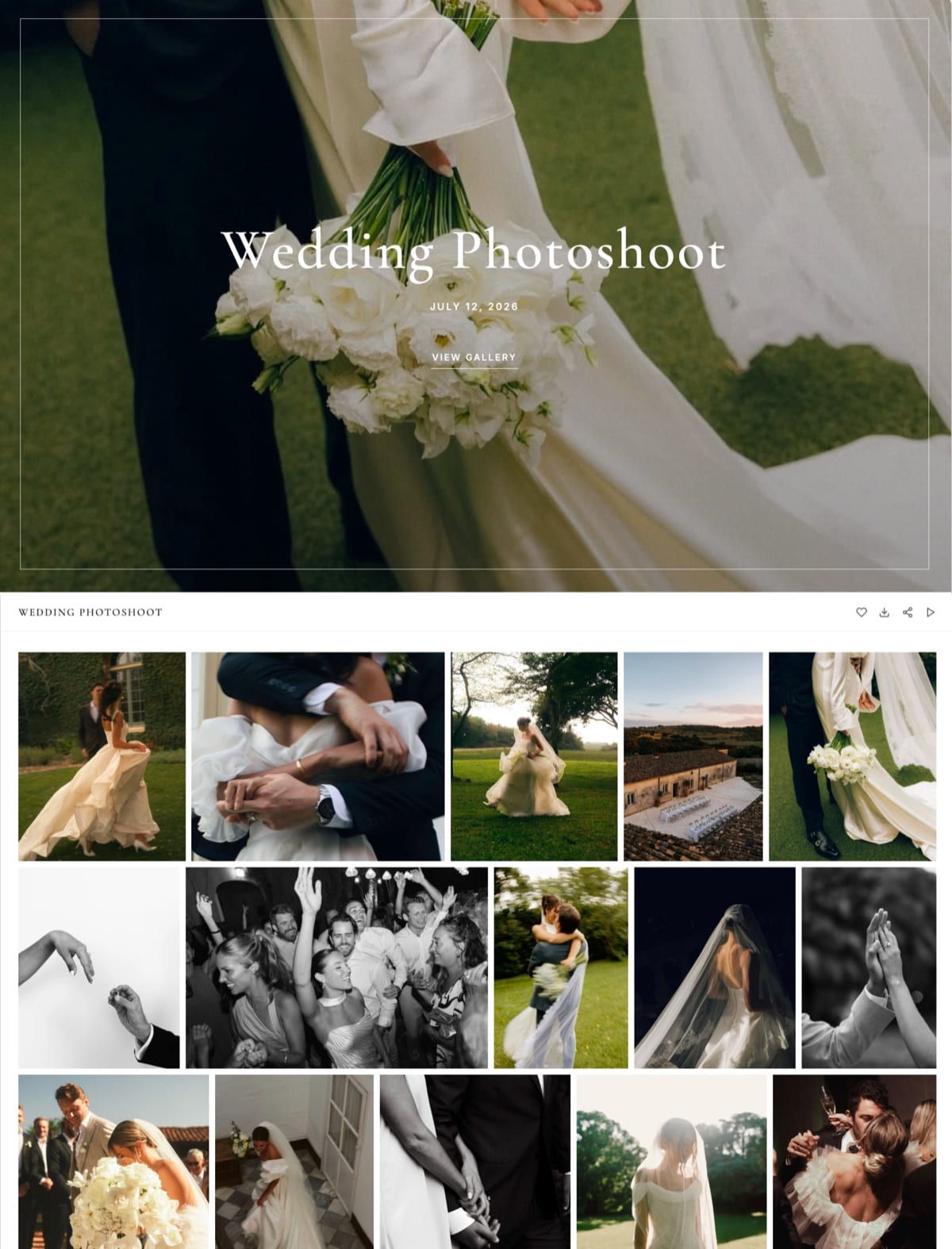
The client opens one share link, taps a heart on the images they want, and filters to favourites, so the album selection arrives as a list rather than an email of file numbers.
Downloads can be the full set or favourites only behind a PIN, photos can be watermarked, and a gallery can hold the wedding film next to the stills.
Two honest limits, and they are significant here. Framekit is not a print lab, has no print ordering and does not sell physical products, so the album itself is priced, sold and fulfilled through the lab relationships in this comparison.
And selection works through favourites rather than a formal threaded approval round, so a staged sign-off workflow needs a dedicated proofing tool.
The Decision Guide
Work down these in order and stop at the first yes, because who the book is for matters far more here than which lab has the best reputation.
Do you need to know the price before you build the book, or quote a client from it? If yes, Blurb, the only service here with a public calculator, at $67 for a 12x12 hardcover plus $0.70 a page.
Is this a wedding album you are selling to a client? If yes, a professional lab: Printique or Bay Photo in the United States, nPhoto in Europe, Zno if you are doing volume. Order samples from two before choosing.
Is it a gift or a personal project where the object matters and the budget is moderate? If yes, Artifact Uprising, whose prices are published and run from $19 to $239.
Is it a family heirloom meant to last decades? If yes, Milk Books, and choose the archival paper book or the thick board album deliberately rather than by price.
Are you printing ten or more copies? If yes, Blurb again, because it is the only one publishing volume discounts, starting at 20% for 10 to 19 copies.
Is the budget the main constraint and the book a family album? If yes, Shutterfly or Mixbook, bought on promotion, never at list, with the per-page rate checked before you add pages.
Do you want books to arrive automatically without deciding each time? If yes, Chatbooks, and read the cancellation terms first.
Frequently Asked Questions
What is the best photo book printing service in 2026?
The best photo book printing service in 2026 depends on the job. Blurb is the best for anyone who needs to know the price before building, at $67 for a 12x12 imagewrap hardcover plus $0.70 for each page beyond the 20-page minimum.
Printique and Bay Photo produce the best professional albums and publish no prices. Artifact Uprising is the best gift-quality option with published prices from $19 to $239, and Shutterfly is the cheapest provided you buy on promotion.
How much does a photo book cost?
A 40-page hardcover photo book costs about $81 at Blurb's 12x12 size, working out at $2.03 a page, while a smaller consumer 8x8 hardcover is reported at about $36.49 at list and around $7.80 on the promotions that are routinely available.
Professional layflat albums start at $159 and reach $239 at vendors that publish figures, and flush mount wedding albums from professional labs typically cost more again.
Why do photo book companies hide their prices?
Professional labs price for resale rather than retail, so their figures assume you are a photographer marking the book up for a client, and publishing wholesale pricing publicly complicates that.
Consumer builders hide prices for a different reason: their list prices are rarely what anyone pays, so a headline figure would misrepresent the product in the opposite direction.
Five of the twelve services in this comparison require an account, a configured order or a downloaded PDF before they will quote.
What is the difference between layflat and flush mount albums?
Layflat means the book opens flat so an image can cross the spread without disappearing into a gutter, and the construction ranges from a true hinged fold to a book that merely opens wide.
Flush mount means thick, rigid pages, usually mounted prints or press-printed board, with no flex at all, which is the traditional wedding album construction and the most expensive per page.
Both terms are used loosely across vendor sites, so check the construction rather than the word.
Is Blurb good quality?
Blurb produces good quality for its price band, particularly on its premium paper options, and it is a self-publishing platform rather than a fine-art lab.
Its standard 80# semi matte stock is adequate and its premium papers, which add roughly $7 to $34 to the base price, are a noticeable improvement. For a portfolio, a zine or a personal photography book it is more than sufficient.
For a wedding album sold to a client, a professional lab produces a better object.
What is the cheapest way to print a photo book?
The cheapest way to print a photo book is a consumer builder bought on promotion, with an 8x8 Shutterfly hardcover reported at around $7.80 against a $36.49 list price.
Watch the per-page rate, which is reported between $0.50 and $1.89 depending on format, because twenty additional pages can cost several times the discounted base price of the book itself. Never buy a consumer photo book at list.
How many pages should a photo book have?
Most services set a 20-page minimum and that is genuinely enough for a single event told tightly.
A wedding album typically runs 20 to 40 spreads, which is 40 to 80 pages, and community practice puts about four images per spread as a working average.
The most common mistake is including too much: a 60-page book of your best work is looked at more often than a 200-page book of everything.
Do I need special software to design a photo book?
Consumer builders include a layout tool, so no. Professional labs mostly expect a print-ready file, which means dedicated album software, a general design application such as InDesign or Affinity Publisher, or an outsourced designer.
Fundy Designer publishes pricing at about $290 a year or $29 a month on a lease, or about $397 as a perpetual Pro Suite purchase, with Pro Enhancements at roughly $189 a year after three months.
Is it worth paying for archival paper?
For a book intended to last decades, yes, and it is the single highest-return upgrade in this category.
Archival or acid-free stock resists the yellowing and embrittlement that standard consumer paper develops over years, and the difference does not appear early enough to be caught by a review.
Paper also moves the price less than binding does, so upgrading the pages rather than the cover is usually the better use of the same money.
Which photo book service is best for wedding photographers?
For wedding photographers selling albums to clients, Printique and Bay Photo are the strongest choices in the United States, nPhoto in Europe, and Zno for photographers producing enough volume to justify an account relationship.
All four price for resale and none publishes public figures, so budget time to get a real quote and order samples from two before committing a client's album to either.
Can I print a photo book that lays completely flat?
Yes, and the term to look for is layflat, offered by Printique, Bay Photo, Zno, nPhoto, Artifact Uprising and Milk Books among others. Artifact Uprising publishes layflat album prices from $159.
The construction differs between a true hinged layflat and a lighter binding that opens wide, so if a panoramic image crossing the spread is the reason you want it, confirm the construction rather than the marketing term.
How long do photo books take to arrive?
Turnaround varies from a few days for consumer builders to two or three weeks for professional albums with custom covers, before shipping.
For a client album this matters more than the price, because a wedding delivery promise is usually made before the album is designed.
Ask the lab for its current production time rather than its published one, particularly between October and December when the whole category slows down.
Are photo books from consumer services good enough for clients?
For a paying client expecting a professional product, generally no.
Consumer books use thinner stock, standard binding and consumer colour management, and the difference between one and a professional lab album is obvious when the two are side by side.
They are entirely adequate for a family album, a personal project or a gift, which is what they are built for.
How do clients choose images for an album?
The simplest route is a client gallery with favourites: the client hearts the images they want and you export that list to your album design software.
Framekit's galleries do this free with watermarks and PIN-protected downloads; Pic-Time and ShootProof add print ordering, which Framekit does not offer.
Final Verdict: The Best Photo Book Printing Service in 2026
Blurb is the answer for anyone who needs to plan, quote or budget, because it is the only service in this comparison that publishes a base price and a per-page rate you can add up before opening the editor.
At $67 plus $0.70 a page for a 12x12 hardcover, with volume discounts starting at 20% for ten copies, it is also the only one that makes a small edition economically sensible.
For a client album, the honest answer is a professional lab and a sample order. Printique and Bay Photo produce better physical objects than anything on the consumer side, and both will cost you an evening to price.
Where this category loses, plainly: five of the twelve services here will not tell you what a book costs without an account, a configured order or a PDF download, one refused to serve us its page at all, and the largest consumer service lists a price roughly five times what anybody actually pays.
That is not a minor inconvenience, it is a structural obstacle to making a good decision, and no comparison article can fully solve it for you.
Where Framekit loses, and it is worth stating directly: we are not a print lab, we do not fulfil physical products, and nothing on this page competes with us.
We are where the client sees the images and picks the album selection; the sale, the printing and the fulfilment remain a separate relationship you will need to build yourself.
The short version. Know the price up front: Blurb. Best professional album: Printique or Bay Photo, after samples. Best published-price gift book: Artifact Uprising. Heirloom: Milk Books. Reselling at volume: Zno. Cheapest family album: Shutterfly or Mixbook, on promotion only.
Related readingthe best print fulfilment for photographers, the best client gallery platforms, how to price photography, the best print-on-demand sites for artists, and the best client galleries for wedding photographers.