Framekit templates
Start from a designer-made template
 Use template
 Use template
 Use template
 Use template
 Use template
 Use template
 Use template
 Use template
You finished the preset pack. Twelve files, an install guide, a cover graphic, and a $24 price. The next decision is where to sell it, and the two names everyone offers are Etsy and Gumroad.
Most Gumroad vs Etsy for digital products comparisons quote two headline rates, declare the smaller number the winner, and stop.
The headline rates are the least interesting part. On a direct sale of that $24 pack, the two platforms are about $1.17 apart, in Etsy's favour once the card processing Gumroad charges on top is counted.
The real gap opens elsewhere: in the fee each platform charges when it decides a sale was its doing rather than yours - a fee that on Etsy becomes impossible to refuse once your shop succeeds.
A digital product platform is a service that takes payment for a downloadable file, delivers it to the buyer automatically, and takes a cut of each sale for doing so.
Etsy and Gumroad are both that, and structurally they are opposites: Etsy is a marketplace that brings buyers to you, Gumroad is a hosted checkout for buyers you bring.
Framekit, which we make, is the third structure: the store is a page of your own site, the buyer list is yours, and the cut starts at 5% and falls to nothing on a flat plan.
Etsy is the better choice for a digital seller with no audience, because Etsy search can put a $24 preset pack in front of strangers, and the price of that is a stack of four fees that reaches 26.4% when Etsy's Offsite Ads claims the order.
Gumroad is the better choice when you already have any audience, because its 10% plus 50 cents plus processing stack is simpler, the customer list is exportable, and there is no ad fee you cannot decline - though its Discover marketplace takes 30% when it sources the buyer.
On a direct sale Etsy is cheaper: Etsy keeps $2.73 of the $24 pack, Gumroad $3.90 once the card processing it charges on top of its 10% plus 50 cents is counted, per both platforms' published fee policies.
Once you have steady traffic of your own, a store on your own site beats both, and Framekit is the runner-up to name there if you want that store attached to a portfolio you already run, with the honest caveat that we send you no buyers and leave the VAT paperwork with you.
Full disclosure: Framekit is our product, it sells digital downloads from your own website, and it competes with both platforms here, so weigh our conclusions accordingly. Our pitch is confined to one clearly labelled section, and the fee arithmetic stands on its own. Both platforms do things we do not: Etsy has the largest handmade-and-digital marketplace on the internet, and Gumroad is a merchant of record that handles international VAT.
How We Compared Gumroad and Etsy
We priced one product on both platforms rather than comparing rate cards in the abstract: a $24 Lightroom preset pack sold by a US-based photographer, the same pack and the same price carried through every table and every section of this comparison.
Verified from primary sources in July 2026. Every Etsy figure comes from Etsy's published Fees and Payments Policy and its Etsy Payments Policy, and every Gumroad figure from Gumroad's pricing page and fee help page, each checked this month and linked at the claim it supports.
This comparison is built from published pricing, help documentation, and policy text, plus community reports where flagged - not from a fresh test purchase made tonight.
Framekit's own section was re-verified on 19 September 2026, which corrected where its checkout lives, and re-verified again on 20 September 2026 against its published plans.
Reported as community sentiment. Recurring seller reports about support and payout reviews on both platforms, labelled as sentiment wherever they appear.
The carried example. The $24 preset pack, roughly 21 sales and $504 a month, 500 sales and $12,000 a year. Every number below is that same business, so you can check the arithmetic on any line.
Gumroad vs Etsy at a Glance
These two platforms answer the same question, where do I sell my files, with opposite architectures, and almost every practical difference between them follows from that one structural split rather than from any single fee.
| Etsy | Gumroad | |
|---|---|---|
| What it is | A marketplace with its own search traffic | A hosted checkout for your own traffic |
| Who brings the buyer | Mostly Etsy | Mostly you |
| Fee stack on a direct sale (US) | $0.20 listing + 6.5% transaction + 3% + $0.25 processing | 10% + $0.50, plus 2.9% + $0.30 card processing |
| Fee when the platform sources the sale | Offsite Ads: 15%, or 12% once past $10,000 a year | Discover: 30% |
| Can you refuse that fee? | Only while under $10,000 in trailing sales; mandatory after | Yes, Discover is optional |
| Fees on the carried $24 pack, direct | $2.73 | $3.90 |
| Merchant of record for VAT | Collects and remits VAT on auto-download digital items and US sales tax | Yes, full merchant of record |
| Your customer email list | Off-limits for marketing without buyer consent | Exportable |
| Monthly cost to exist | $0 (Etsy Plus optional at $10) | $0 |
Fees verified against Etsy's Fees and Payments Policy, Etsy's Payments Policy, and Gumroad's pricing and fee help pages in July 2026. Etsy's processing rate varies by country; 3% plus 25 cents is the US rate.
In one lineon a sale you generate Etsy costs about $1.17 less than Gumroad, and the bigger differences live in who owns the buyer and what the platform charges when it takes credit for the order.
Two Fee Stacks, Line by Line
Etsy charges several small fees that arrive separately and Gumroad charges one large fee plus card processing, and comparing the headline numbers without stacking them is how most sellers get the answer wrong.
Here is Etsy's full stack for a US digital seller.
| Etsy line item | Amount | When it applies |
|---|---|---|
| Listing fee | $0.20 per listing | When you publish, and again every four months on auto-renew |
| Renewal on each sale | $0.20 | A multi-quantity listing auto-renews at $0.20 after every unit sells |
| Transaction fee | 6.5% | On the listing price plus any shipping and gift wrap, every sale |
| Payment processing | 3% + $0.25 in the US | Every Etsy Payments sale; the rate varies by the country of your bank |
| Offsite Ads | 15%, or 12% past $10,000/yr | Orders attributed to an Etsy-run ad; capped at $100 per order |
| Currency conversion | 2.5% | When your listing currency differs from your payout currency |
| Etsy Plus | $10 a month | Optional subscription; not required to sell |
The renewal line deserves a pause, because almost nobody prices it in.
Digital listings are multi-quantity, and Etsy's fee policy states such listings automatically renew at $0.20 after each item sells - so the listing fee is really a 20-cent charge on every sale, a smaller sibling of Gumroad's 50-cent flat fee.
Gumroad's stack is one fee with one branch: 10% plus 50 cents per direct sale, with card processing (2.9% plus 30 cents) or PayPal's fee charged on top, as Gumroad's fee help page states, and 30% on sales sourced by its Discover marketplace, processing included.
There is no subscription and no paid plan that lowers either rate; the direct rate only drops, to 5% plus 50 cents, on sales made after you pass $20,000 in a calendar month.
We have taken apart that structure at length in our Gumroad fees guide; this comparison uses its conclusions.
In one lineEtsy splits its cut into four small pieces and Gumroad charges one fee plus processing, and stacked honestly Etsy's direct-sale total comes in about $1.17 under Gumroad's.

What the Same $24 Preset Pack Nets You on Each
This table is the whole comparison compressed into one product, and the pattern to read is not the gap between the direct rows, which is about a dollar, but the spread between each platform's best case and its worst.
| Route | Fees on the $24 pack | You keep | Effective rate |
|---|---|---|---|
| Etsy, direct sale (US seller) | $2.73 | $21.27 | 11.4% |
| Etsy, Offsite Ads order at 15% | $6.33 | $17.67 | 26.4% |
| Etsy, Offsite Ads order at 12% | $5.61 | $18.39 | 23.4% |
| Gumroad, direct sale | $3.90 | $20.10 | 16.3% |
| Gumroad, Discover sale | $7.20 | $16.80 | 30.0% |
| Framekit Free, on your own site | $2.20 | $21.80 | 9.2% |
| Framekit Business, $39/mo flat | $1.00 | $23.00 | 4.2% plus the flat plan |
The Etsy direct figure is $1.56 in transaction fee, $0.97 in processing, and the $0.20 renewal.
Framekit rows include card processing at roughly 2.9% plus 30 cents, charged separately by your processor per Stripe's published pricing; Gumroad's direct figure is its $2.90 fee plus about $1.00 of card processing charged on top, its Discover figure includes processing, and Etsy's processing is itemised above.
Fine print for US Etsy sellers: the 6.5% transaction fee excludes sales tax, but processing is assessed on the total including tax, so real processing runs slightly higher on taxed orders.
In one linethe honest ranking on a direct sale is Framekit at 9.2%, Etsy at 11.4%, Gumroad at 16.3% - and the marketplace-attributed versions of the identical sale run 23% to 30%, which is where the real money moves.
Etsy Offsite Ads: The Fee You Cannot Fully Refuse
Offsite Ads is the mechanism that most separates what Etsy advertises from what successful Etsy sellers pay, and it is worth understanding precisely because it is the one fee on either platform that becomes mandatory.
The mechanism. Etsy buys ads for its sellers' listings on Google, Instagram, Facebook, Pinterest, and similar networks, without asking you first.
If a buyer clicks one of those ads and then places any order from your shop within 30 days of the click, that order is an Attributed Order and carries an Offsite Ads fee on top of everything in the stack above.
Read that carefully: any order inside the window, not just the advertised item.
The rates, from Etsy's fee policy. The standard fee is 15% of the order total. While your shop has sold less than $10,000 in the trailing 365 days, you may opt out.
The moment your shop crosses $10,000, calculated on the first of each month, participation becomes required for as long as the shop exists, the rate drops to 12%, and a prior opt-out stops applying - even if your sales later fall back under the threshold.
The only mercy is a cap: the Offsite Ads fee on a single order cannot exceed $100.
On the carried pack. A $24 preset pack sold through an Offsite Ads click costs $3.60 in ad fee at 15%, on top of the standard stack, for $6.33 all-in - 26.4% of the sale.
At the mandatory 12% tier it is $2.88 on top, $5.61 total, 23.4%. Etsy is, on those orders, meaningfully more expensive than Gumroad's direct rate and approaching Gumroad's marketplace rate.
Why it stings on digital. For a $200 physical order with healthy margin, pay-per-performance advertising at 12% can be a fine trade.
On a $24 download, surrendering a quarter of the price for an order you cannot prove needed the ad is a different deal, and you do not get to decline it order by order.
In one lineOffsite Ads converts Etsy from an 11.4% platform into a 23% to 26% platform on the orders it claims, and past $10,000 a year you no longer get a vote.
Gumroad Discover: The Same Trap at Twice the Sticker
Gumroad has its own marketplace surcharge, and fairness requires putting it beside Offsite Ads rather than pretending only Etsy plays this game.
When a buyer finds your product through Gumroad Discover, its recommendation-and-browse marketplace, the fee on that sale is a flat 30%, processing included, rather than 10% plus 50 cents plus processing - $7.20 of the $24 pack instead of $3.90.
The two mechanisms differ in one way that matters more than the rates.
Discover is opt-in as a channel and applies to sales it demonstrably sourced through the marketplace; Offsite Ads becomes compulsory at scale and attaches to every order in a 30-day window after one ad click.
A Gumroad seller can run a store that never pays 30% by relying on their own traffic. An Etsy seller past $10,000 cannot, because Etsy decides which orders were Etsy's doing.
The blended cost is what to watch on both.
A Gumroad seller getting a third of sales from Discover pays roughly 21% blended on our pack, processing included; an Etsy seller with a fifth of revenue Offsite-attributed at 12% pays about 13.8% blended.
Neither number appears on either pricing page, and both are the real rate the seller experiences.
Run it on your own store. Etsy sellers: download last month's statement CSV, add every transaction-fee, processing, listing, and Offsite Ads line, and divide by gross sales.
Gumroad sellers: split your analytics into Discover and direct, take 30% of the first and 10% plus 50 cents an order, plus about 2.9% and 30 cents of processing, on the second.
The percentage you get is your real rate - compare that, not any headline, against 5% plus processing or a flat $39 month.
In one lineDiscover at 30% is more expensive than Offsite Ads per order but honest about being optional, and blended rates, not headline rates, are what the two platforms actually charge.
Marketplace vs Hosted Checkout: Whose Customer Is It
The fee tables above price a single sale; this section prices the customer relationship, which over a few years becomes the larger number even though it never appears on any statement.
On Etsy, the customer is Etsy's. The buyer searched Etsy, paid Etsy, and downloads your files from Etsy's own delivery system on Etsy's domain.
Etsy's Seller Policy states that without the buyer's consent you may not add any Etsy member to your email or marketing list, and its fee policy separately prohibits moving transactions off the platform, down to the detail of banning QR codes that direct buyers to another venue.
Your product page also lives inside Etsy search, which means your buyer scrolls past your competitors on the way to your listing, and those competitors can bid Etsy Ads placements against your own keywords.
On Gumroad, the traffic is yours but the address is not. You bring the audience from your newsletter, your socials, your portfolio, and Gumroad hosts the checkout and delivers the file.
You can export your customer list and email those buyers, which is a genuine structural advantage over Etsy.
What you do not own is the venue: your store is a page on gumroad.com, the platform's brand frames your product, and every link you have ever shared points at a domain you rent space on.
The compounding difference. At 500 sales a year, the Etsy seller ends the year with 500 orders fulfilled and a list they are not permitted to market to.
The Gumroad seller ends it with 500 addresses they can launch the next product to for free. That gap never appears in the $24 arithmetic, and it decides who has a business in year three.
In one lineEtsy rents you its buyers for a fee and keeps them, Gumroad rents you a checkout for your buyers and lets you keep them, and which trade is right depends entirely on whether you have buyers of your own.
VAT, Sales Tax, and Who Handles the Paperwork
Tax handling is the place where these two platforms are closer than most comparisons claim, and the difference that remains is legal position rather than day-to-day workload for a small digital seller.
Gumroad is a full merchant of record.
It is legally the seller on your transactions, so EU and UK VAT on your downloads, US sales tax where applicable, and the disputes and chargebacks that follow are its problem, filed under its registrations.
This is the strongest single thing the 10% buys.
Etsy is not your merchant of record in the same blanket sense, but for a digital seller the practical coverage overlaps heavily: Etsy's fee policy states that it collects and remits VAT on digital items delivered via automatic download in countries that require it, and it calculates, collects, and remits US sales tax as a marketplace facilitator.
A US preset seller on Etsy is not filing Irish VAT returns either.
Where the gap reappears is everything that is not a standard auto-download sale: made-to-order digital work on Etsy can fall outside the automatic machinery, leaving edge-case compliance yours in places where on Gumroad it simply is not.
If never thinking about tax is the requirement, Gumroad's position is cleaner.
And if you later move to your own store, the work moves with you: a platform like Framekit is not a merchant of record, so your processor's tooling or your accountant inherits the VAT question.
In one lineboth platforms make VAT on a standard digital download effectively invisible to a small seller, Gumroad does it more completely, and leaving both is what puts the paperwork back on your desk.
The Third Option: A Store on a Site You Own
We build one of these, so this section is the pitch, clearly labelled, and everything above it works fine without it. The honest version of the argument is arithmetic plus ownership, not a claim that platforms are useless.
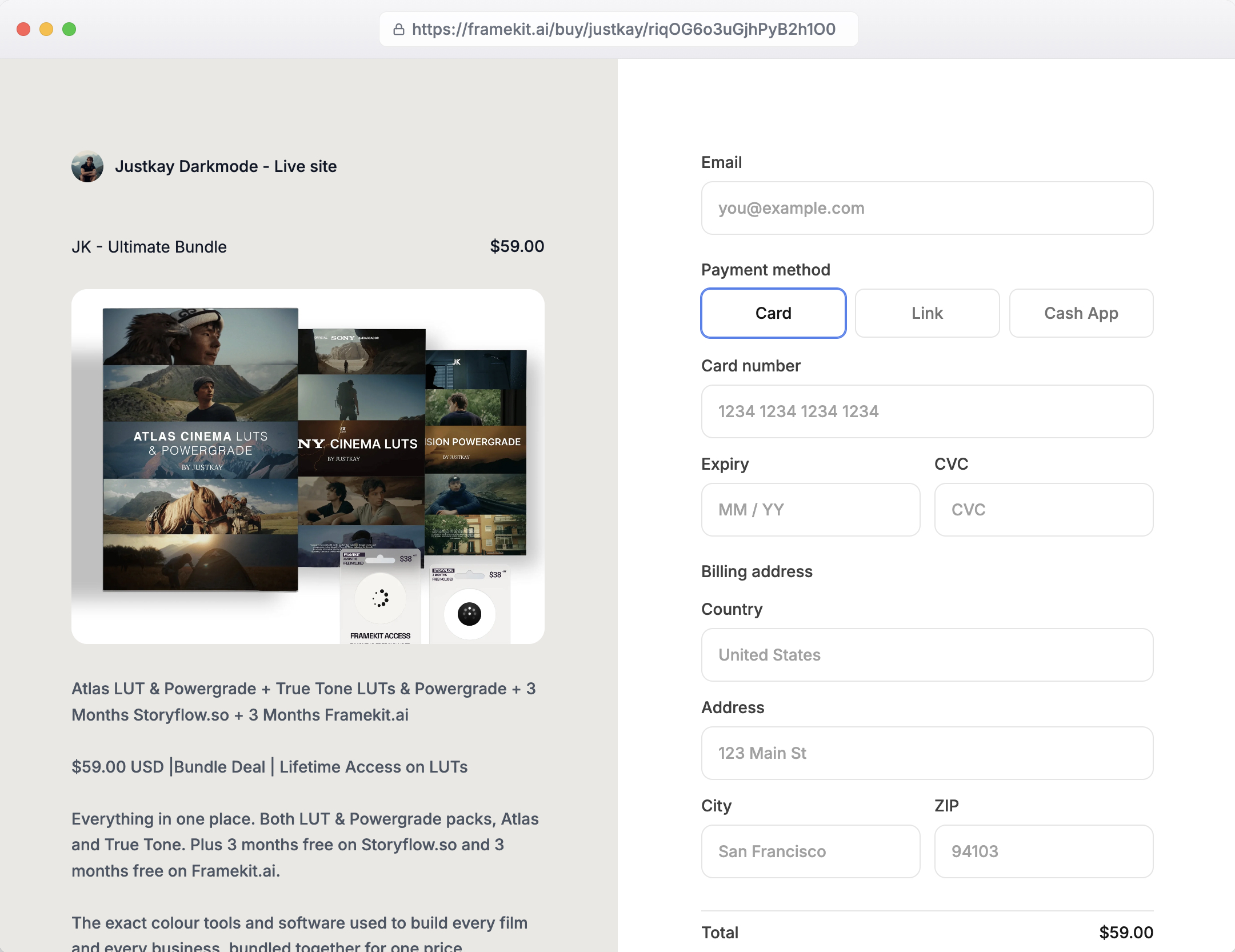
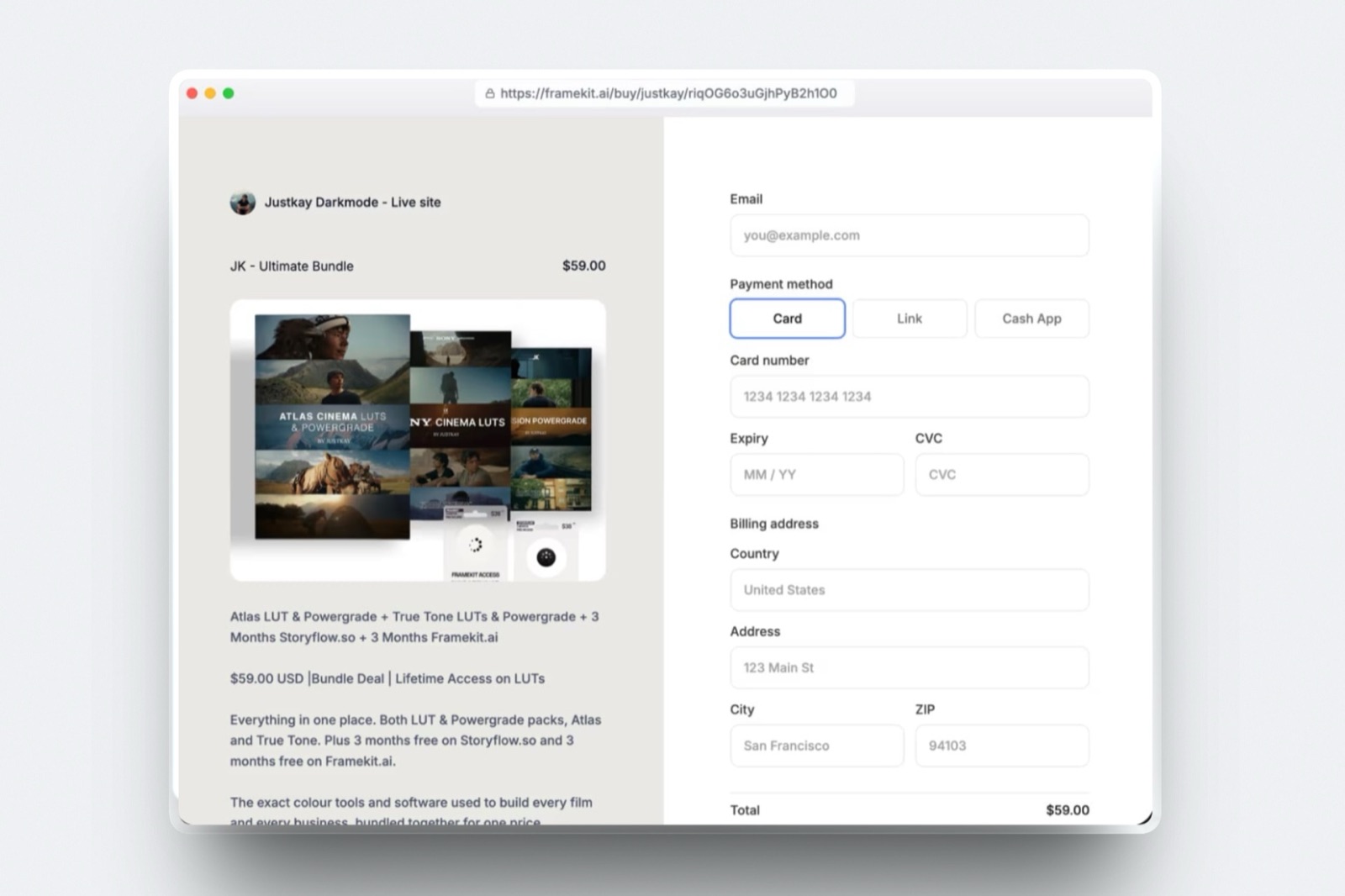
Framekit is an AI website builder for photographers, filmmakers, designers, and other creators, with a digital-only store built in: presets, LUTs, templates, ebooks - downloadable files, sold from a store that is a page of your own site on your own domain, with payment taken on a hosted Framekit checkout page that carries your name and logo.
The transaction fee starts at 5% on the Free and Starter plans, is 3% on Pro at $19 a month, and drops to 0% on Business at $39 a month, with card processing paid separately to your processor in every case.
The crossover where the flat $39 plan beats a 5% cut is about $780 a month in sales.
On the carried pack, the Free plan's combined cut of $2.20 undercuts both platforms' direct rates by 53 cents to $1.70 a sale, and Business brings it to $1.00.
Across the 500-sale year, all-in including processing, that is roughly $1,098 on Framekit Free and $966 on Business against $1,365 on Etsy and $1,950 on Gumroad direct-only - and the platform figures climb toward $1,653 and $2,500 once realistic Offsite Ads and Discover shares enter the mix.
The structural point matters more than any single year: a marketplace percentage keeps scaling with your sales (Gumroad's only drops, to 5% plus 50 cents, past $20,000 of sales in a calendar month), and a flat plan means your cost stops scaling with your success.
What we plainly do not do: we have no marketplace, so we will find you zero customers, and we are not a merchant of record, so VAT compliance is yours.
If you sell presets from an audience you already own, our guide to selling Lightroom presets from your own website walks the whole setup.
Which Should You Pick? A Decision Tree
Work down these questions in order and stop at the first branch that is true of your situation today, not the situation you hope to be in, because each question outranks the ones below it.
Do you have zero audience - no list, no following, no site traffic?
- Yes. Etsy. It is the only option here whose search puts your pack in front of strangers this week, and 11.4% direct is a fair acquisition price. Opt out of Offsite Ads while you still can; the opt-out expires at $10,000 a year.
- No. Continue.
Do you want tax to stay someone else's job even as you branch into custom or non-download digital work?
- Yes. Gumroad. Full merchant-of-record status is the cleanest tax position a solo seller can have, and it covers edge cases Etsy's automatic collection does not.
- No. Continue.
Are you selling under roughly $200 a month?
- Yes. Gumroad over Etsy if the traffic is your own - one fee plus processing, an exportable list, no ad-fee ambush. Gumroad costs under about $10 a month more at this volume; pick for structure, not savings.
- No. Continue.
Do you already have a website, or sell more than about $500 a month?
- Yes. Move the store to your own site, with Framekit or any builder that sells downloads, and keep the platforms, if at all, as secondary channels. Above $780 a month the flat-plan math beats every percentage in this comparison, and the customer list compounds on top.
Frequently Asked Questions
Is Gumroad or Etsy better for selling digital products in 2026?
Etsy is better for digital sellers with no existing audience, because Etsy search brings buyers to you, at a cost of about 11.4% on a direct $24 sale and up to 26.4% when its Offsite Ads program claims the order.
Gumroad is better once you have any audience of your own: its 10% plus 50 cents is a simpler stack, its 30% Discover fee is avoidable, and your customer emails are exportable.
Sellers past roughly $500 a month usually keep the most by selling from their own website.
Which is cheaper at $500 a month, Gumroad or Etsy?
Etsy is cheaper than Gumroad at $500 a month if every sale is direct: on 21 sales of a $24 pack ($504), Etsy's fees total about $57 (transaction, US processing, and renewals) against Gumroad's $82 including card processing.
Offsite Ads narrows the gap without closing it: with a fifth of orders attributed at 15%, Etsy's month runs about $72.
A 5% store with separate processing runs about $46 on the same month, and a 0% flat plan at $39 about $60, so at this volume the free-plan own-store route is cheapest.
Does Etsy or Gumroad handle VAT on digital products for me?
Both largely do, differently. Gumroad is a full merchant of record: it is legally the seller, so EU and UK VAT, applicable US sales tax, and chargebacks are its responsibility.
Etsy is not a blanket merchant of record, but its fee policy states it collects and remits VAT on digital items delivered via automatic download where required, and it remits US sales tax as a marketplace facilitator.
For a standard downloadable product, neither platform leaves VAT on your desk; Gumroad's coverage is the more complete of the two.
Can I sell the same digital product on both Etsy and Gumroad?
Yes. Neither Etsy nor Gumroad requires exclusivity, and listing the same preset pack on both is a sensible strategy: Etsy as the discovery channel for strangers, Gumroad or your own store as the destination for your audience.
Keep the price identical everywhere, and never link Etsy buyers out to a cheaper checkout - Etsy prohibits directing its buyers to another venue, and enforcement can cost you the shop.
Do I own my customer emails on Etsy or Gumroad?
On Gumroad, effectively yes: you can export your customer list and email those buyers about future products.
On Etsy, no: Etsy's Seller Policy states that without the buyer's consent you may not add any Etsy member to your email or physical mailing list or use their identity for marketing.
You receive buyer information to fulfil the order, not to build an audience with. This is the single largest structural difference between the two platforms for anyone planning a second product.
Why did Etsy charge me an extra 15% on an order?
That order was attributed to Etsy Offsite Ads.
Etsy runs ads for sellers' listings on outside networks, and when a buyer clicks one and then places any order from your shop within 30 days, that order carries a 15% fee, or 12% if your shop has passed $10,000 in trailing-365-day sales.
The fee applies to the whole attributed order, not just the advertised item, and is capped at $100 per order. You can opt out only while under the $10,000 threshold; past it, participation stays mandatory for the remaining life of the shop.
What does Etsy actually cost per sale on a digital download?
For a US seller, Etsy costs about 11.4% on a direct digital sale once every line is stacked: 6.5% transaction fee, 3% plus 25 cents payment processing, and the 20-cent listing renewal that fires after each unit of a multi-quantity listing sells.
On a $24 preset pack that is $2.73, leaving $21.27. An Offsite Ads attribution adds 12% or 15% of the order on top, taking the total to $5.61 or $6.33.
Non-US sellers should check their country's processing rate, which ranges up to 6.5% plus 30 cents.
Does the 20-cent Etsy listing fee really apply to every sale?
Effectively yes, for digital products. Etsy's fee policy states that when you list multiple quantities of the same item, the listing automatically renews at $0.20 after each item sells.
Since digital listings are almost always multi-quantity, each sale triggers a fresh 20-cent renewal, making the listing fee a per-sale cost in practice, plus the $0.20 every four months to keep an unsold listing live.
It is Etsy's version of Gumroad's 50-cent flat fee, at less than half the size.
Can I opt out of Etsy Offsite Ads?
Only while your shop has sold less than $10,000 in the trailing 365 days. Under that threshold, Offsite Ads runs at 15% on attributed orders and you may switch it off.
Once your shop crosses $10,000, Etsy makes participation permanently mandatory at 12%, and a previous opt-out stops applying even if sales later fall back under the line.
Gumroad has no equivalent forced tier; its 30% Discover fee only ever applies to marketplace-sourced sales.
Does Gumroad charge payment processing on top of its 10%?
Yes, on direct sales. Gumroad's fee help page states that the 10% plus 50 cents does not include credit card processing at 2.9% plus 30 cents, or PayPal fees, so a direct $24 sale costs $2.90 to Gumroad plus about $1.00 of processing, $3.90 in all.
The 30% Discover rate is the exception and includes processing.
Honest comparison therefore adds processing to every direct-sale number, Gumroad's included, as Etsy charges at 3% plus 25 cents in the US and your own store does through Stripe or a similar processor at roughly 2.9% plus 30 cents.
What happens if I use my Etsy shop to send buyers to my own website?
Etsy prohibits it, and the enforcement risk is your shop.
Etsy's fee policy bars moving a transaction initiated on Etsy off the platform, and its messaging rules ban sharing external URLs, contact details, or QR codes that direct buyers to another venue.
The compliant strategy is one-directional: use your own site, socials, and list to send buyers wherever you like, and treat Etsy buyers as Etsy's.
What is the cheapest way to sell a $24 preset pack in 2026?
A store on your own site is cheapest at almost any volume: about $2.20 per sale in combined fee and processing on Framekit's free plan, and about $1.00 on its $39 flat plan, against effective direct-sale rates of 11.4% on Etsy and 16.3% on Gumroad.
The exception is the seller with no traffic at all, for whom the platforms' higher rates are buying customer acquisition, which is the one thing an owned store cannot do.
Our ranking of the best platforms to sell presets covers the full field.
Final Verdict: Gumroad or Etsy in 2026
Pick Etsy to be found. Pick Gumroad to be paid simply. And plan to outgrow both, because the tables above already tell you the month that switch starts paying for itself.
Etsy wins the zero-audience case outright, and it is not close: it is the only checkout in this comparison attached to a search engine full of buyers, and 11.4% on a direct sale is a reasonable price for that.
What you accept in exchange is the deepest fee stack here, a buyer who belongs to Etsy rather than to you, and an ad program that becomes compulsory at 12% the year you become good at this.
For what reviewers say elsewhere, log it with its bias: Etsy scores 1.4 on Trustpilot across some 20,700 reviews and Gumroad 1.4 across about 400, both dominated by buyer-side complaints - sentiment about support, not a verdict on seller economics.
Gumroad wins for the creator with even a small audience: one fee plus processing, an exportable list, a merchant of record handling VAT, and marketplace pricing that only applies to marketplace sales.
Its weakness is the mirror image - it will not find you customers at 10%, only at 30%, and your store lives on its domain. Already on one and eyeing the other?
The switching math runs through our Etsy alternatives for digital sellers and Gumroad alternatives guides.
Where Framekit loses to both, stated plainly: we have no marketplace and no buyer traffic to lend you, and we are not a merchant of record, so if discovery or hands-off VAT is the reason you are choosing a platform, we are not your answer and either Etsy or Gumroad is.
The case for us begins the day your own audience, not a platform's, is generating the sales - at which point a fee that starts at 5% and falls to 0% on a flat $39 plan, on a domain you own, keeps more of every $24 than either platform in this comparison.
Related reading: the full Gumroad fees breakdown, our Gumroad vs Payhip head-to-head, the best platforms to sell presets, and how much it costs to sell digital products online.
Every fee in this comparison was verified in July 2026 against Etsy's Fees and Payments Policy, Etsy's Payments Policy, Etsy's Seller Policy, and Gumroad's published pricing and fee help pages.