Framekit templates
Start from a designer-made template
 Use template
 Use template
 Use template
 Use template
 Use template
 Use template
 Use template
 Use template
Big Cartel is where thousands of artists opened their first shop, for a good reason: a free plan that publishes a real store, zero transaction fees on every tier, and an admin nobody needs a tutorial for. Then the shop grows.
The free plan stops at 5 products, Platinum stops at 50, abandoned-cart recovery is locked behind the $30 Diamond plan, and the free tier ships with exactly one template.
This guide ranks the best Big Cartel alternatives for 2026 on prices verified this month, priced on one real shop.
A Big Cartel alternative is an ecommerce platform that gives an artist or maker their own storefront and checkout for selling prints, apparel, zines, and downloads, without capping the catalog at 5 free products or 50 paid ones.
The question is rarely whether Big Cartel is bad; it is whether the thing your shop needs next costs less somewhere else.
The best Big Cartel alternative for most artists in 2026 is Shopify, because Basic at $29 a month on annual billing costs a dollar less than Big Cartel's own Diamond plan while removing the product cap and adding abandoned-cart recovery plus the deepest print-on-demand ecosystem in commerce; the trade is that you assemble everything yourself.
Etsy is the pick when nobody knows your work yet, Payhip is the free start with no product cap at a 5% fee, and INPRNT is the hands-off print marketplace at a 50% cut.
Two honest notes: an artist with under 50 physical products is often cheapest staying on Big Cartel Platinum at $15, and Framekit, our own product ranked last here, sells digital files only, so it cannot replace Big Cartel for anyone shipping physical prints.
Framekit's own store terms were re-verified on 19 September 2026; every competitor figure is as verified in July 2026.
Full disclosure: Framekit is our product and it appears in this ranking, so read the list knowing that. We ranked it seventh, below every platform that can sell a physical print, because it cannot sell one, and no weighting we could honestly defend changes that for this audience. Every competitor is linked so you can audit our numbers, and each beats Framekit at something real.
How We Ranked the Big Cartel Alternatives
We priced one real shop across every platform instead of reprinting rate cards: a printmaker with a 30-product catalog selling $800 a month, which is 20 orders at a $40 average, 80% physical prints and 20% digital downloads.
That shop is over Big Cartel's free cap, inside Platinum's 50, and small enough that a monthly fee still stings, which is exactly where most artists comparing alternatives sit.
Verified from primary sources in July 2026. Every Big Cartel figure comes from Big Cartel's published pricing and its digital-products documentation, checked this month; Shopify, Squarespace, Wix, Payhip, Etsy, and Printful figures come from each vendor's pricing page or help center, linked inline at the claim each supports.
This comparison is built from published pricing, docs, and policy text, plus community reports where flagged as such, not fresh hands-on builds of all seven stores; our hands-on depth is real only on Framekit, which we run.
The rubric. Monthly cost at a 30-product catalog 25%, fees kept per sale 20%, physical-goods and print-on-demand depth 20%, design control 15%, built-in discovery 10%, customer ownership 10%.
Physical depth is weighted heavily on purpose: this audience sells objects, and it is also the criterion where our own product scores a zero, which is why Framekit sits at the bottom of this table rather than the top.
What the Price Audit Found
Before the reviews, the countable facts, each checked against vendor pages during July 2026, because three of them contradict what most artists assume about this market.
- Big Cartel charges a 0% transaction fee on all plans, and so do Shopify, Squarespace Core and up, and Wix commerce plans. Zero commission is table stakes for an own-site store in 2026, not a differentiator.
- Digital downloads are not on Big Cartel's free plan: its own FAQ states digital sales are paid-plan only, and every product needs a non-zero price, so free downloads are out too.
- Shopify's $5 Starter plan is closed to new stores in 2026, per Shopify's help center, so the realistic Shopify entry price is Basic at $29 a month on annual billing.
- Print-on-demand through Printful requires a paid Big Cartel plan; the free Gold tier cannot connect it.
- Only two alternatives run a 30-product catalog at $0 a month: Payhip at a 5% fee and INPRNT at a 50% print commission. Everything else is $19 to $36 a month before processing.
In one linethe platforms nearly tie on per-sale fees, so this decision is really about product caps, monthly rent, and who does the printing.
The 7 Best Big Cartel Alternatives Compared
The table below scores each platform on the rubric above, priced for the carried 30-product, $800-a-month print shop.
Framekit's 6.4 reflects a zero on physical-goods depth, the heaviest-weighted criterion after cost; it is here for the digital slice of an art practice, not as a full replacement.
| Platform | Best for | Monthly cost to exist | Fee per sale (beyond processing) | Our rating |
|---|---|---|---|---|
| Shopify | Physical-first artists outgrowing Big Cartel | $29 (annual billing) | 0% | 8.8/10 |
| Etsy | Artists with no audience yet | $0 | 6.5% + $0.20, more when ads attribute | 8.1/10 |
| Squarespace | Portfolio and store in one designed site | $29 Core (annual) | 0% physical, 5% digital | 7.9/10 |
| Payhip | A free store with no product cap | $0 | 5% | 7.6/10 |
| Wix | Layout freedom and app depth | $29 Core (annual) | 0% | 7.4/10 |
| INPRNT | Prints with zero production work | $0 | 50% of print price | 7.0/10 |
| Framekit | The digital-download side only | $0 | 5%, falling to 0% on Business | 6.4/10 |
Processing is separate nearly everywhere: card rates around 2.9% plus 30 cents apply on Shopify, Squarespace, Wix, Payhip, Framekit, and Big Cartel itself; Etsy itemizes a 3% plus 25 cent US processing line; INPRNT simply pays you a share.
1. Shopify: Best Overall Big Cartel Alternative

Our rating: 8.8/10
Shopify is the platform Big Cartel sellers graduate to, and in 2026 the math behind that migration is blunter than the marketing: Basic costs $29 a month on annual billing ($39 month-to-month) per Shopify's pricing page, one dollar less than Big Cartel's Diamond plan, for an uncapped catalog instead of 500 products, abandoned-checkout recovery included instead of Diamond-gated, and an app store measured in thousands instead of a short integrations list.
The real numberon the carried shop, Shopify runs $58.20 a month all-in, the $29 subscription plus card processing at 2.9% and 30 cents per order, an effective 7.3% of the $800, against Big Cartel Platinum's $44.20.
The $14 monthly gap, $168 a year, is the true price of switching at this volume, and it buys capacity: deeper variants, inventory across channels, and both Printful and Printify as first-class print-on-demand citizens.
The standout detailabandoned-checkout recovery, the feature Big Cartel reserves for its $30 tier, is included on every Shopify plan. If cart recovery is the specific feature pushing you to upgrade Big Cartel, Shopify Basic is cheaper than the upgrade.
The honest gotchathe $5 Starter plan you may remember as the budget answer is gone for newcomers; Shopify's help center states it is not available to new stores.
And on Basic, an outside payment provider adds 2% to every sale, so the 0% headline assumes Shopify Payments.
Skip it ifyour catalog fits inside 50 products and your feature needs fit inside Platinum; paying $29 for headroom you will not use for two years is how artists end up resenting a good platform.
What reviewers say elsewhereShopify holds a 4.4 on G2 across roughly 4,976 reviews, the strongest verified score among the full stores in this guide.
Verdict: Shopify is the correct destination for a physical-first artist whose Big Cartel shop is genuinely full: same 0% transaction fee, one dollar under Diamond, no ceiling after that. It is a store you assemble, though, not one you inherit. Selling downloads too? Our Shopify vs Gumroad breakdown prices the digital side. Visit Shopify
2. Etsy: Best When Nobody Knows Your Work Yet
Our rating: 8.1/10
Etsy is the only name on this page that brings buyers with it, and for an artist without an audience that fact outweighs every fee line below.
Big Cartel sends you zero customers; Etsy's search sends print and zine buyers to shops every day, and the price of standing in front of them is a stack of fees rather than a subscription.
The real numberon a direct $40 print sale, Etsy's stack per its published fee policy is $2.60 in transaction fee at 6.5%, $1.45 in US processing at 3% plus 25 cents, and the 20-cent listing renewal that fires after every unit sells: $4.25 total, 10.6%, leaving $35.75.
On the carried shop's month that is $85, and the roughly $41 gap over Big Cartel Platinum is what customer acquisition costs when it works.
The honest gotchaOffsite Ads. When an Etsy-run ad touches an order, that order carries an extra 15% fee, or 12% once your shop passes $10,000 in trailing sales, at which point participation becomes mandatory with no way back to opting out.
The same $40 print on an attributed order costs $10.25 in fees, 25.6%; with a fifth of revenue attributed, the carried shop's month climbs from $85 to $109, 13.6%.
The standout detailthe 20-cent listing fee is really a per-sale fee. Multi-quantity listings auto-renew at $0.20 after each unit sells, so a 30-product catalog is not $6 to list once, it is 20 cents on every order forever.
Skip it ifyou already have the audience. Every Etsy sale to a follower you brought is a 6.5%-plus toll on traffic that was yours, paid to stand in a row of your competitors.
What reviewers say elsewhereEtsy sits at 1.4 on Trustpilot across some 20,700 reviews, dominated by buyer-side complaints; weigh it as sentiment about support, not seller economics.
Verdict: run Etsy as a discovery channel, not a home: list there to be found, and route the audience you earn toward a store where the percentage stops. The head-to-head math lives in our Gumroad vs Etsy comparison, the exit routes in Etsy alternatives for digital sellers. Visit Etsy
3. Squarespace: Best Portfolio and Store in One Designed Site

Our rating: 7.9/10
Squarespace answers a question Big Cartel never tries to: what if the shop and the portfolio were one designed site?
A Big Cartel store is a store; a Squarespace site is a portfolio, an about page, a mailing-list signup, and a shop sharing one template family that looks gallery-adjacent out of the box, which matters to buyers who judge the frame as well as the print.
The real numberper Squarespace's pricing page, Basic at $19 a month on annual billing charges 2% on physical sales and 7% on digital content, and Core at $29 drops physical to 0% with digital at 5%.
Core is the plan the carried shop would pick: $29 plus $8 in digital-content fees on the $160 download slice plus processing is $66.20 a month, 8.3%, eight dollars behind Shopify.
The standout detailphysical and digital run on different fee schedules. Physical hits 0% one tier up; digital content starts at 7% and only reaches 0% on the top Advanced plan. A print seller reads that table very differently than a preset seller.
The honest gotchathere is no free plan, only a trial, so a slow season still bills, and print-on-demand runs through integrations rather than anything native.
Skip it ifyou want the shop live this afternoon; as a pure checkout, Squarespace is paying for design you are not using.
What reviewers say elsewhereSquarespace averages a 4.4 on G2 across more than 1,100 reviews, on par with Shopify and well clear of the marketplaces here.
Verdict: Squarespace is the pick when the site around the shop is half the point, priced about eight dollars a month above Shopify on the carried shop. Choose by center of gravity: Shopify is a store with pages, Squarespace is a portfolio with a checkout. Visit Squarespace
4. Payhip: Best Free Alternative with No Product Cap
Our rating: 7.6/10
Payhip is the closest thing on this list to Big Cartel's original promise, a free store with no card required, except it never asks you to count products.
Per Payhip's pricing, the Free plan is $0 forever with unlimited listings at a 5% transaction fee, Plus is $29 at 2%, and Pro is $99 at 0%, with Stripe and PayPal processing at their standard rates on every plan.
It began as a digital-downloads tool and now sells physical products too, which quietly makes it a real Big Cartel alternative rather than just a Gumroad one.
The real numberthe carried shop on Payhip Free costs $40 in platform fees plus processing, $69.20 a month, 8.7%, with nothing billed in a quiet month.
The crossover against Big Cartel Platinum is $300 a month in sales: below it Payhip's 5% is cheaper than $15 flat, above it Big Cartel wins on price. Payhip's own $29 Plus plan only pays for itself past roughly $967 a month.
The standout detailthe fee schedule is the growth plan. You start free at 5%, and the paid tiers exist to buy the percentage down, the reverse of Big Cartel, where paid tiers buy product slots.
The honest gotchaphysical selling is functional, not deep. Shipping is flat rates by region, there is no print-on-demand pipeline, and the storefront is a clean page rather than a designed site, so most sellers run it beside another website.
Skip it ifprints are your volume and a POD service does your fulfilment; Payhip has no lane for that workflow.
Verdict: Payhip is the best $0 answer for an artist over Big Cartel's 5-product cap who is not ready to pay rent: unlimited products now, 5% while you are small, a fee that falls when you choose. Past $300 a month in steady sales, the flat-fee platforms above take over on price. Our Gumroad vs Payhip comparison covers its digital-side rival. Visit Payhip
5. Wix: Best Layout Freedom and App Depth
Our rating: 7.4/10
Wix sells the opposite discipline of Big Cartel: where Big Cartel gives you a handful of decisions, Wix gives you all of them, a drag-anywhere editor and an app market covering booking, events, memberships, and every long-tail need an artist's site eventually grows.
Commerce starts on the Core plan at about $29 a month on annual billing ($36 month-to-month) per Wix's plans page; the cheaper Light tier and the free plan cannot sell at all, so read Wix's famous free plan as a portfolio tier, not a store.
The real numberthe carried shop on Core is $58.20 a month, $29 plus $29.20 processing through Wix Payments at 2.9% and 30 cents, identical to Shopify's total, with no Wix commission on top.
The difference is what surrounds the number: Shopify's commerce stack is deeper, Wix's site-building is freer, and abandoned-cart emails are included on Core just as they are on Shopify Basic.
The honest gotchaa published Wix site cannot switch templates without a rebuild, a permanence that bites artists precisely because their visual direction moves.
Verdict: Wix earns its slot for the artist whose website does five jobs of which the shop is one. As a pure Big Cartel replacement it is Shopify money without Shopify's commerce depth, so pick it only when the editor and app market are the actual draw; if you would rather design decisions were made for you, a constrained template will serve better. Visit Wix
6. INPRNT: Best Prints with Zero Production Work
Our rating: 7.0/10
INPRNT is a different species from everything above: a curated art-print marketplace where you upload the artwork and INPRNT prints, ships, and handles customer service, paying the artist 50% of the price on paper prints per its published artist documentation, with smaller shares on products like canvas.
There is no subscription, no inventory, no post office, and admission is by application or invitation, which keeps the gallery's floor high.
The real numberthe carried shop's $640 of monthly print sales pays the artist $320 on INPRNT.
That looks brutal next to the roughly $617 an own store keeps of the same $640 before its plan fee, until you subtract what the own-store artist pays in giclee printing, mailers, tubes, and hours at the post office, real costs the 50% already absorbed.
For many illustrators the honest gap is a third of the headline one, paid for doing none of the work.
The honest gotchait is a marketplace, so the customer is INPRNT's: buyers browse a gallery of your peers, checkout happens on INPRNT's domain, and there is no exportable list to launch your next drop to. Digital files and zines have no lane here at all.
Skip it ifprint quality control is part of your brand, or the mailing list is the asset you are building.
Verdict: INPRNT is the right answer for the artist who wants prints to be income rather than a second job, and the wrong answer for anyone building a customer base they own. The strongest version of this setup is INPRNT for hands-off prints beside an own-domain store for everything else. Visit INPRNT
7. Framekit: Best for the Digital Slice Only

Our rating: 6.4/10
Framekit is an AI website builder for artists, illustrators, photographers, and other solo creatives, ranked last here for one disqualifying reason we will not dress up: its built-in store sells digital files only.
No physical products, no variants, no shipping. An artist selling paper prints, apparel, or zines, which is most of this post's audience, cannot replace Big Cartel with Framekit, full stop.
What it does instead is the other half of an art practice.
Cadence and Score, Framekit's own models built for creative sites, generate a portfolio designed around your actual work, and the store hangs downloads off that site on your own domain: digital prints, brush packs, tutorial and zine PDFs.
The transaction fee starts at 5% on the Free and Starter plans, drops to 3% on Pro at $19 a month, and hits 0% on Business at $39, always plus card processing, with the flat plan overtaking the 5% cut at about $780 a month in sales.
The real numberthe carried shop's $160 digital slice on Framekit Free costs $8 in fees plus $5.84 processing, $13.84 a month with no subscription, while the physical 80% lives on whichever platform above you chose.
That pairing is the honest pitch: portfolio plus digital store on a domain you own, physical fulfilment where physical belongs.
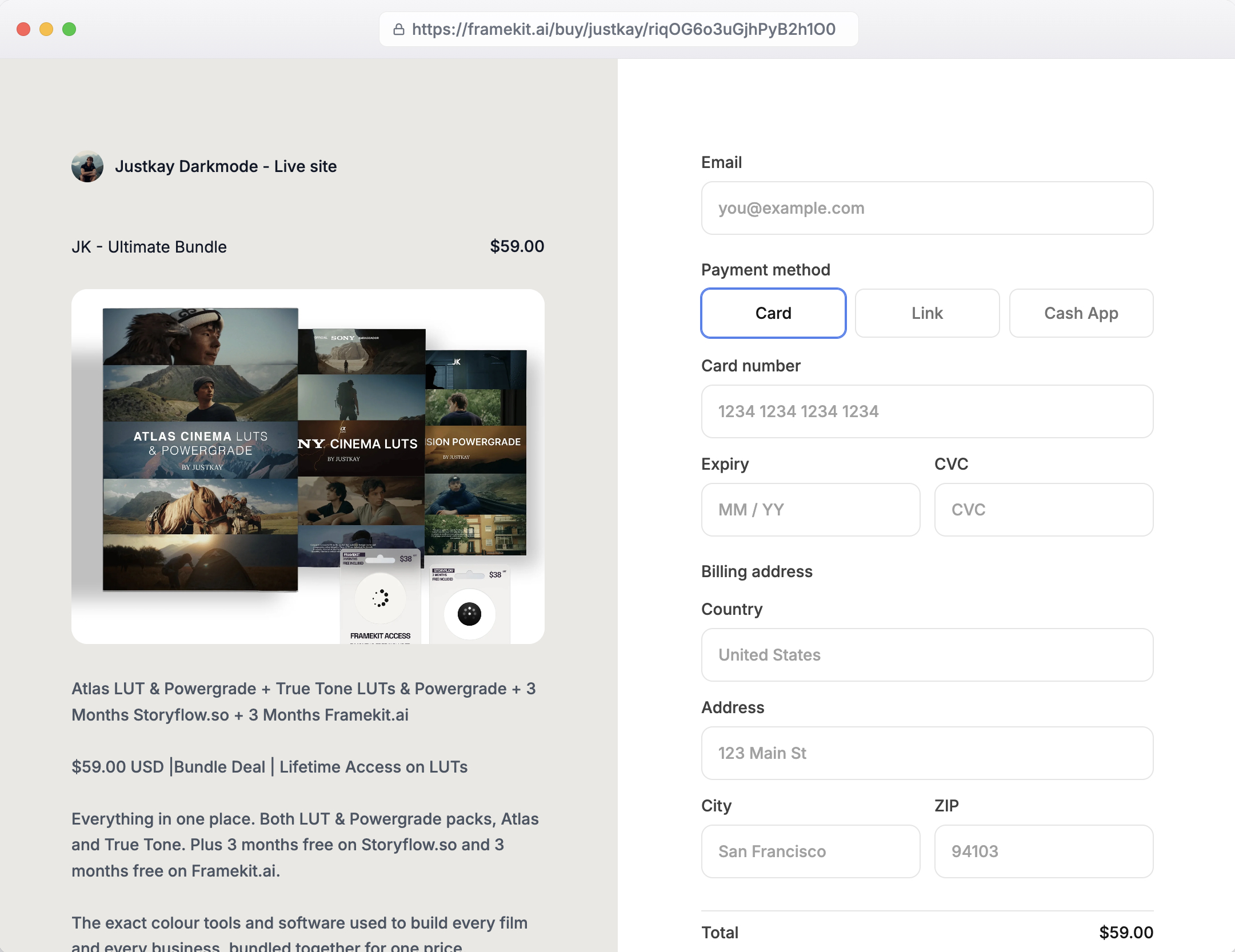
The standout detailevery product also gets a direct buy link to a hosted checkout page, so a zine PDF or brush pack can be sold from an Instagram bio or a newsletter without anyone visiting the site, and free products work as lead magnets that collect a buyer's email.
The gotchapayments run through Stripe Connect into your own Stripe account, which makes you the merchant of record: Framekit does not collect or remit VAT or sales tax on digital sales, and its fee is kept if you refund. Discount codes start on Pro.
Skip it ifmost of what you sell is paper, fabric or anything that ships, or you want the platform to handle VAT on downloads for you, which Framekit does not do. For physical goods, any store above is the better fit.
Verdict: Framekit is not a Big Cartel replacement for a physical-first artist and does not pretend to be sixth-best at trying. It is the strongest option here for exactly one reader: the artist whose next products are files, who wants the portfolio and the download store on one owned domain. Start free at framekit.ai/store, and see how to sell art from your own website for the workflow.
The Same $800 Print Shop on Every Platform
In one linethe spread on the carried shop runs from about $44 to $109 a month, and the cheapest row on the table is the platform this article is about alternatives to.
Here is the printmaker's month everywhere: 30 products, $800 across 20 orders averaging $40, 80% physical, card processing at 2.9% plus 30 cents where billed separately.
| Platform and plan | Subscription | Platform fees | Processing | Monthly total | Effective rate |
|---|---|---|---|---|---|
| Big Cartel Platinum | $15 | $0 | $29.20 | $44.20 | 5.5% |
| Shopify Basic (annual) | $29 | $0 | $29.20 | $58.20 | 7.3% |
| Wix Core (annual) | $29 | $0 | $29.20 | $58.20 | 7.3% |
| Squarespace Core (annual) | $29 | $8 digital fee | $29.20 | $66.20 | 8.3% |
| Payhip Free | $0 | $40 | $29.20 | $69.20 | 8.7% |
| Etsy, all sales direct | $0 | $56 | $29 | $85.00 | 10.6% |
| Etsy, fifth of revenue ad-attributed | $0 | $80 | $29 | $109.00 | 13.6% |
| INPRNT (print slice only) | $0 | 50% of print price | none billed | keeps $320 of $640 | 50% of prints |
| Framekit Free (digital slice only) | $0 | $8 | $5.84 | $13.84 | 8.7% of $160 |
The first row is the point most alternatives articles skip: at 30 products and $800 a month, Big Cartel Platinum is the cheapest complete store on this page.
The alternatives win on what the money buys, not the amount: Shopify's $14 premium buys no product ceiling, included cart recovery, and the POD ecosystem; Squarespace's buys the designed site; Etsy's buys strangers finding you; INPRNT's 50% buys out the entire production job, which no other row includes.
Run it on your own shop. Pull last month's Big Cartel orders, multiply gross sales by 0.029, add 30 cents per order, add your plan fee: that is your current true monthly cost.
Now price the one feature you are missing and rerun the top rows with your numbers. If the alternative is not cheaper or meaningfully more capable at your real volume, you have your answer already.
Print-on-Demand: Who Connects to What
In one lineevery full store here can reach Printful, but Big Cartel makes POD a paid-plan feature, Shopify makes it an ecosystem, and the marketplaces make it irrelevant.
Print-on-demand is the fork in an art shop's road: keep doing your own giclee-and-mailing-tube production, or let a service print each order as it comes.
The platforms split cleanly, per Printful's integration docs, which list Big Cartel alongside Shopify, Etsy, Wix, and Squarespace as supported stores.
On Big Cartel, the Printful connection exists but requires a paid plan; the free Gold tier cannot connect it at all, which makes $15 Platinum the true floor for a POD-based Big Cartel shop.
On Shopify, POD is the deepest habit in the ecosystem: Printful, Printify, and dozens of rivals install in minutes and push orders automatically, a large part of why apparel-heavy artists default there.
On Etsy and INPRNT, the question changes shape: Etsy allows POD fulfilment partners on listings, and INPRNT is print-on-demand aimed the other way, the marketplace doing the printing and paying you a share instead of billing you a base cost.
On Framekit, there is no POD integration and no physical checkout for one to feed; print fulfilment concedes entirely to the platforms above.
If prints matter and photography is your lane, our print fulfilment guide compares the dedicated labs.
Who Owns the Customer When You Leave
In one linethe own-store platforms hand you the buyer's email and the right to use it, the marketplaces do not, and that difference compounds into the next product launch.
The mechanism never appears on a fee table. On Shopify, Squarespace, Wix, Payhip, Big Cartel, and Framekit, every checkout gives you a customer record you may market to.
On Etsy, the buyer is Etsy's: its seller policy bars adding buyers to your marketing list without consent, its rules prohibit steering transactions off-platform, and your listing sits in search beside your direct competitors.
On INPRNT, the relationship belongs to the gallery the same way.
Play it forward one cycle: the artist with 240 own-store orders this year opens next spring's zine preorder to 240 inboxes for free; the artist with 240 marketplace orders opens it to zero, and pays the marketplace's percentage again to reach the same people.
That second toll is the real price of discovery, and it is why the winning pattern is marketplace for finding buyers, own store for keeping them.
When Staying on Big Cartel Is the Right Call
In one linethe honest edge case for this whole article is a catalog under 50 products at steady volume, where Big Cartel Platinum is the cheapest complete store in this comparison and switching buys little.
An alternatives guide owes you the case for not switching.
At $15 a month with a 0% transaction fee, 50 products, custom domain, shipping labels, and paid-plan access to Printful, Platinum undercuts every full alternative here at the carried shop's volume, with the least demanding admin in this comparison.
The genuine reasons to leave are specific: a catalog pushing past 50 products, wanting cart recovery without paying $30 for Diamond when Shopify includes it at $29, digital sales on a $0 budget, which Big Cartel's paid-only digital rule blocks, or needing an app its short list lacks.
If none of those is biting yet, staying put is not inertia, it is arithmetic.
Which Alternative Fits: Work Down the Tree
Answer these in order and stop at the first yes, because each question outranks the ones after it, and the branches assume the verified prices above rather than ideal circumstances.
Does anyone outside your existing audience need to find your work?
- Yes, discovery is the bottleneck: Etsy, with Offsite Ads opted out while sales are under $10,000 a year, and a plan to route repeat buyers to an own store later.
- No, you bring your own buyers: continue.
Is your budget for the store $0 a month?
- Yes, selling mostly files: Framekit Free for the store-plus-portfolio, or Payhip Free for checkout only.
- Yes, selling physical work: Payhip Free at 5%, or INPRNT if you would rather surrender 50% than produce prints at all.
- No: continue.
Would you pay to never print, pack, or ship again?
- Yes: INPRNT for curated paper prints, or Shopify plus Printful for POD under your own brand and margins.
- No, production stays in-house: continue.
Is your catalog over 50 products, or is cart recovery the feature you are missing?
- Yes to either: Shopify Basic, which costs less than Big Cartel Diamond and removes both constraints at once.
- No to both: stay on Big Cartel Platinum, or pick Squarespace Core if the portfolio around the shop is what your current site lacks.
Frequently Asked Questions
Is Big Cartel still free in 2026?
Yes, Big Cartel's Gold plan is still free in 2026, with real limits: 5 products, one template (Cosmos), no digital downloads, no custom domain, and no integrations, print-on-demand included.
Paid tiers are Platinum at $15 a month for 50 products and Diamond at $30 for 500, with a 20% discount on annual billing. Every plan, free included, charges a 0% transaction fee, so you pay only card processing on each sale.
Does Big Cartel take a cut of sales?
No, Big Cartel takes 0% of sales on every plan, free included; its documentation states you keep 100% of profits minus standard payment processing from Stripe or PayPal, roughly 2.9% plus 30 cents per US card transaction.
The same is true of Shopify, Wix commerce plans, and Squarespace Core and up for physical goods, so 0% commission is the own-store baseline in 2026, not a reason by itself to pick any platform.
Can I sell digital downloads on Big Cartel?
Yes, but only on paid plans: Big Cartel's digital-products FAQ states digital sales are available on all paid tiers, so the free Gold plan cannot sell downloads at all.
Files upload at up to 1GB each, buyers get an instant link by email, and every product needs a non-zero price, which rules out free downloads as list-builders.
An artist selling downloads on a $0 budget needs Payhip's or Framekit's free plan instead.
Big Cartel vs Shopify for artists: which is better?
Big Cartel is better for artists with under 50 products and simple needs, because Platinum at $15 a month with a 0% fee is the cheapest complete store in this comparison and the easiest to run.
Shopify is better once the catalog or feature list outgrows that: Basic at $29 on annual billing is a dollar less than Big Cartel's Diamond plan and adds an uncapped catalog, built-in abandoned-checkout recovery, and the deepest print-on-demand ecosystem available.
What is the cheapest way to sell 10 products online?
For 10 products, the cheapest structure depends on volume: below about $300 a month in sales, Payhip Free at a 5% fee costs less than any subscription; above that, Big Cartel Platinum's flat $15 with 0% fees wins, since 5% of $300 is the same $15.
Big Cartel's free plan does not fit, because 10 products is double its cap. If all 10 are digital files, Framekit's free plan prices the same as Payhip and includes a portfolio site around the store.
Do I need Shopify if I only sell prints?
No, a print seller with a small catalog does not need Shopify: at 30 products and $800 a month, Big Cartel Platinum runs $44.20 a month all-in against Shopify Basic's $58.20, and both charge 0% commission.
Shopify earns its $14 premium when the catalog passes 50 products, when apparel and POD enter the mix, or when cart recovery matters, since Big Cartel gates that behind its $30 Diamond plan.
Does Printful work with Big Cartel?
Yes, Printful lists Big Cartel as a supported integration, syncing products and routing orders automatically, but it requires a paid Big Cartel plan; the free Gold tier cannot connect print-on-demand at all.
Printful's docs also note Big Cartel shipping prices must be set manually. Artists planning a POD-first shop should compare Platinum at $15 against Shopify Basic at $29, where the POD tooling runs deeper.
What does Big Cartel's free plan not include?
Big Cartel's free Gold plan excludes digital downloads, integrations including print-on-demand, custom domains, multiple product images per listing, and every template beyond its single Cosmos theme, and it caps the catalog at 5 products.
It does include a real checkout with cards and PayPal, sales tax automation, inventory tracking, and real-time stats at a 0% transaction fee: one of the best free physical-goods storefronts, as long as the shop stays tiny.
Can I sell physical prints on Framekit?
No. Framekit's store sells digital files only; there are no physical products, no variants, and no shipping, so paper prints, apparel, and zines cannot be sold through it.
Framekit fits an art practice as the portfolio plus the digital-download store on one owned domain, at a fee starting at 5% and falling to 0% on the $39 Business plan, while physical work sells through Big Cartel, Shopify, or a marketplace beside it.
Will I lose my customers if I move off Etsy to my own store?
You will not lose past orders, but you largely cannot take the relationship with you: Etsy's seller policy prohibits adding buyers to a marketing list without their consent and bars steering its buyers to another venue, so an Etsy customer base is not portable the way an own-store list is.
The standard migration is gradual: open the own store, put its address on packaging and social profiles, and let new work funnel there while Etsy keeps serving discovery.
Final Verdict: Which Big Cartel Alternative Wins
For most artists who have genuinely outgrown Big Cartel, the answer is Shopify: at $29 a month on annual billing it costs less than Big Cartel's own top plan while removing the product cap, including the cart recovery Big Cartel charges $30 for, and connecting to more print-on-demand than everything else here combined.
Etsy answers a different problem, being unknown, and is worth its stack only until the audience is yours.
Squarespace wins when the site matters as much as the shop, Payhip when the budget is zero, INPRNT when the production work should be someone else's entirely.
And the quiet conclusion of the price table: an artist with under 50 products and no missing must-have feature is often best served by staying on Big Cartel Platinum, the cheapest complete store in our cost table. Switch for capacity or capability, not for the fee schedule.
Where Framekit loses, plainly: it does not sell physical goods, so it is not a Big Cartel replacement for anyone shipping prints, apparel, or zines, and it will not find you buyers the way Etsy or INPRNT will.
Its case starts where your products become files: the strongest way on this page to put the portfolio and the digital store on one domain you own, free to start, with a fee that falls to 0% on a flat $39 plan instead of scaling with your success forever.
Related reading: Gumroad vs Etsy for digital products, Shopify vs Gumroad for digital products, the best platforms for selling digital art, and how to sell art online from your own website.
Every price and fee above was checked during July 2026 against Big Cartel's pricing and digital-products pages, Shopify's pricing page and help center, Squarespace's pricing page, Wix's plans page, Payhip's pricing page, Etsy's fee policy, and Printful's integration documentation; INPRNT's artist share comes from its published artist documentation.
Prices move, so confirm the current figure before you commit.