Framekit templates
Start from a designer-made template
 Use template
 Use template
 Use template
 Use template
 Use template
 Use template
 Use template
 Use template
Both of these are free to start, which is why they get compared, and the similarity ends there.
Gumroad charges 10 percent plus 50 cents and its own documentation states that this does not include card processing at 2.9 percent plus 30 cents.
Payhip charges 5 percent on its free plan and connects your own Stripe or PayPal account, so processing is billed to you directly at the same standard rate.
On a $19 preset pack that is $3.25 against $1.80. Sell two hundred of them and the difference is $290.
There is also a second difference that nobody puts in a comparison table and that matters more to a working creator than a percentage point: Payhip deposits the money the moment the sale completes, and Gumroad will not pay you anything until your balance reaches $100.
A digital product platform is a service that hosts your file, presents it for sale, takes the payment, delivers the download, and pays you the balance.
Payhip and Gumroad are the two most common free starting points in that category, and they are built on different assumptions about whose payment account the money should land in.
We make a third answer, and it belongs at the top rather than in a footnote at the bottom: Framekit puts the catalogue on the portfolio itself, free to start at 5 percent and falling to nothing on a flat plan, so a buyer reaches the checkout without leaving your own pages.
It also leaves EU VAT with you, which Payhip does not.
Payhip takes less of your money than Gumroad at every volume, at an all-in 9.5 percent against 17.1 percent on a $19 product, and it pays out instantly through your own Stripe or PayPal account rather than holding a balance.
Gumroad wins on exactly two things: it is faster to set up, and its Discover marketplace can put your product in front of buyers who have never heard of you at a flat 30 percent.
If you already have an audience, Payhip is the better platform and the gap is not marginal.
Framekit is the pick when that audience lands on a portfolio you own, since the store is simply a page of it from $0, though Payhip stays cheaper at low volume and covers the EU VAT that Framekit leaves to you.
Full disclosure: Framekit sells digital products, so we compete with both. We have kept this comparison between Payhip and Gumroad and put our own position in one short marked section near the end. Every fee below comes from each company's own published pricing or help documentation, read in August 2026 and linked where it is used.
On 19 September 2026 we re-verified our own section and corrected one line in it: a Framekit store lives on your site, while its checkout runs on a Framekit-hosted page.
How We Compared Payhip and Gumroad
We ran one product through both. The test product is a $19 Lightroom preset pack sold by a working photographer to a card-paying buyer in the same country, with no discount code and no affiliate involved.
We chose a low price deliberately, because fixed per-sale components punish cheap products and most creators start below $25.
Both accounts were created fresh in August 2026 with no promotional code. Where a platform publishes a fee in its help centre rather than on its pricing page we cite the help centre, because that is where this category keeps the numbers that decide things.
Measured means we listed the product and ran the flow. Verified means we read it in the vendor's own published documentation in August 2026 and are reporting it with a link. Community sentiment means sellers report it consistently and we did not reproduce it.
We quote no third-party star ratings anywhere in this comparison.
The large review aggregators blocked automated access during this round of research, so every figure links to its source instead, which for an argument made entirely of percentages is the more useful kind of evidence.
In one lineone $19 preset pack, priced through both platforms on their own published August 2026 rates, including the card processing that only one of them charges separately.
What One $19 Sale Costs
| Route | Platform cut | Card processing | Total taken | You keep | Effective rate |
|---|---|---|---|---|---|
| Gumroad, direct link | $2.40 | $0.85 | $3.25 | $15.75 | 17.1% |
| Gumroad, via Discover | $5.70, all in | Included | $5.70 | $13.30 | 30.0% |
| Payhip Free | $0.95 | $0.85 | $1.80 | $17.20 | 9.5% |
| Payhip Plus, $29/mo | $0.38 | $0.85 | $1.23 plus the plan | $17.77 | 6.5% plus the plan |
| Payhip Pro, $99/mo | $0 | $0.85 | $0.85 plus the plan | $18.15 | 4.5% plus the plan |
The two rows to compare are the first and the third, because both are free plans with no monthly cost. One of them takes $3.25 from a $19 sale and the other takes $1.80.

The Fee Difference, Precisely
In one lineGumroad's 10 percent excludes card processing and Payhip's 5 percent excludes it too, so the honest comparison is 12.9 percent plus 80 cents against 7.9 percent plus 30 cents.
Gumroad's fee documentation is clear once you find it: 10 percent plus $0.50 per transaction on sales through your own links, and the page states that this "does not include" credit card processing at 2.9 percent plus $0.30, or PayPal fees.
Sales through the Gumroad Discover marketplace are a flat 30 percent that does include processing.
Payhip's pricing page lists Free Forever at $0 a month with a 5 percent transaction fee, Plus at $29 a month with 2 percent, and Pro at $99 a month with no transaction fee.
All three include every feature, unlimited products, and unlimited revenue. Payhip does not charge anything to connect a payment gateway, so on top of its percentage you pay your processor's rate directly.
Payhip's own help documentation gives the standard Stripe fee as 2.9 percent plus 30 cents, and that is the figure used here, though card rates vary by country and card type.
So the like-for-like on a free plan is 12.9 percent plus 80 cents against 7.9 percent plus 30 cents. On our $19 pack that is $3.25 against $1.80, and on a $50 product it is $7.25 against $4.25.
The fixed component punishes cheap products on both, and worse on Gumroad. On a $5 product, Gumroad takes $0.50 plus $0.50 plus $0.145 plus $0.30, which is $1.445, or 28.9 percent.
Payhip takes $0.25 plus $0.145 plus $0.30, which is $0.695, or 13.9 percent. If you sell below $10, the fixed 50 cents is the single largest line in Gumroad's bill.
When Payhip's paid tiers make sense. Moving from Free to Plus saves 3 percent for $29 a month, so it pays for itself at $967 a month in sales.
Moving from Free to Pro saves 5 percent for $99, so it pays for itself at $1,980 a month. Below a thousand dollars a month the free plan is the correct financial choice and upgrading is a mistake.
And against Gumroad specificallyPayhip Plus at $29 a month plus 2 percent beats Gumroad's 10 percent plus 50 cents once you pass roughly $274 a month in sales on a $19 product, which is about fifteen sales.
The Payout Difference
In one linePayhip deposits the money into your own Stripe or PayPal account as the sale completes, and Gumroad holds your money until the balance reaches $100 and then pays weekly on a country-dependent day.
This is the part of the comparison that changes how the business feels rather than what it costs, and it is almost never mentioned.
Payhip. You connect Stripe and PayPal in your account settings and Payhip pays out instantly, depositing sales to you immediately after the transaction completes.
Payhip is not holding your money at any point; it is taking its percentage from a payment that landed in your own processor account. There is no minimum balance and no schedule to wait for.
Gumroad. Its payout documentation sets a minimum balance of $100 before any payout happens, with higher minimums in some local currencies.
Sales sit in your Gumroad balance for a minimum 7-day holding period on the weekly, monthly, and quarterly schedules, and payouts include sales made through the previous Friday in UTC.
Your payout day depends on where your bank is: Tuesday for most countries, Wednesday for euro accounts and a list including Australia, Canada, Singapore, and the UK, and Thursday for US accounts.
Daily payouts exist but only for US users with eligible bank accounts, at least four prior payouts, and an account at least 60 days old.
What that means in practice. A photographer selling four preset packs in a slow month has made $76 on Gumroad and will receive nothing, because the balance has not reached $100.
The same four sales on Payhip are in their Stripe account the same day.
Over a year the money arrives either way, but the cash-flow characteristic is completely different, and for a creator whose income is lumpy it is the more relevant fact.
The trade-off in the other directionbecause Payhip is not in the payment path, disputes, chargebacks, and refunds are between you and your processor. Gumroad handles those as the merchant, which is a real service for someone who does not want a Stripe dashboard in their life.

What Gumroad Does Better
In one lineGumroad is faster to start and it has a marketplace, and the marketplace is the only thing in this comparison that produces a customer rather than processing one.
Setup speed. Gumroad is a link in ten minutes. Payhip is a storefront in twenty. That difference matters exactly once, and it matters most to someone who has never sold anything and needs to find out whether the product works.
Discover. Sales attributed to Gumroad's marketplace carry a flat 30 percent that includes all processing. On our $19 pack that is $5.70, leaving $13.30. Framed as a fee it is punitive.
Framed as customer acquisition it is defensible: if that buyer joins your list and buys twice more from your own link, you paid $5.70 for a customer worth $57, and no advertising channel available to a solo creator reliably does that.
Refunds. Gumroad's fee page states that when a sale is refunded, Gumroad's own fee on the refunded portion is returned to you and only the payment-processing portion is retained, because processors do not return that.
That is more generous than the category norm and it deserves saying in an article that has otherwise been hard on Gumroad's pricing.
Affiliates. Gumroad splits fees on affiliate purchases between the affiliate and the creator in proportion to the affiliate's commission, so a 30 percent affiliate carries 30 percent of the fees. That is fairer than the flat treatment most platforms apply.
The trap inside Discoverattribution is a function of how the buyer arrived rather than a setting you choose, so a seller promoting only their own links can still find some orders charged at 30 percent.
Gumroad's own advice is to export a CSV of sales for a per-order fee breakdown, and that genuinely is the only way to know your effective rate. We go through this in Gumroad fees explained.
What Payhip Does Better
In one linePayhip is cheaper, pays faster, handles EU VAT on every plan including the free one, and gives you a real storefront rather than a product page.
EU VAT on the free plan. Payhip handles EU VAT on digital goods on all plans. For a European audience that covers the most common compliance exposure a small seller has, and platforms charging four times as much treat it as a differentiator.
A storefront, not a link. Payhip gives you a branded store with a product catalogue, coupons, an affiliate system, and email marketing tools, on the free plan, with no product cap and no revenue cap.
Gumroad's profile page does a version of this and Payhip's is more configurable.
Every feature on every plan. Payhip's tiers differ only by transaction fee. There is no feature gating, which means you never discover that the thing you need is two tiers up. Almost nothing else in this category is structured that way.
Your own payment account. Beyond the payout speed, this means your customer relationships, your Stripe history, and your dispute record are yours and portable. If you leave Payhip, your processor stays.
The honest limitationPayhip is plainer. The storefront looks like a Payhip store, and if your product is being sold on the strength of your design taste, that mismatch costs something you cannot measure in percentage points.
Where Framekit Fits
We sell digital products, so here is our position stated once rather than threaded through the comparison, including the part that argues against us.
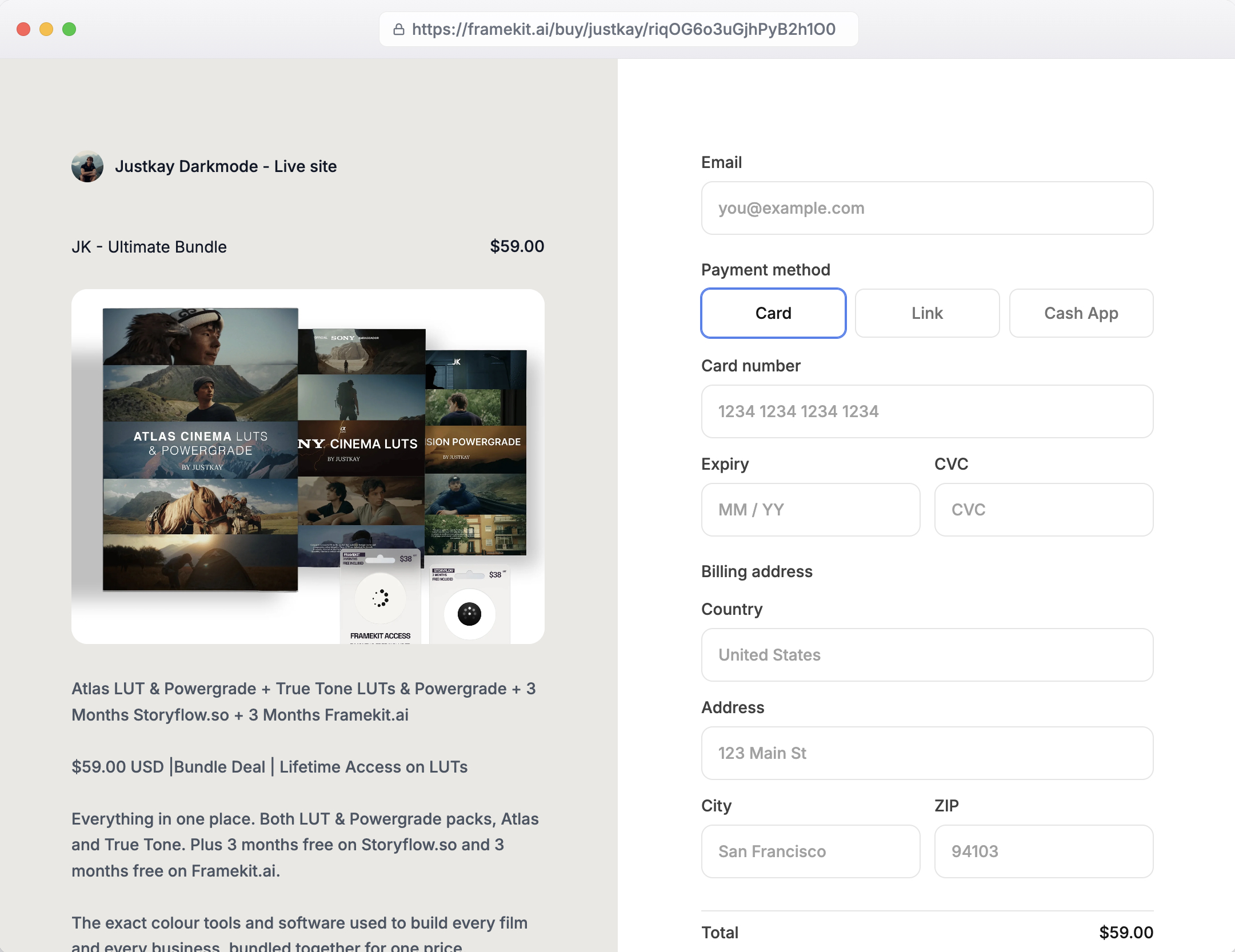
Framekit is an AI website builder for photographers, filmmakers, designers, and creators, with a store on the same domain as the portfolio.
The fee is 5 percent on Free and Starter, 3 percent on Pro at $19 a month, and 0 percent on Business at $39, with card processing separate in the same way both platforms here charge it.
Where we lose to Payhip, plainlyour free plan charges the same 5 percent that Payhip's free plan charges, and Payhip additionally handles EU VAT, which we do not. On a like-for-like basis at low volume, Payhip is the better deal and there is no way to argue around that.
Where we lose to Gumroadno marketplace. Nothing about a Framekit store introduces you to a buyer who has never heard of you.
Where we are differentthe store sits on the site the buyer was already looking at.
For a photographer whose portfolio does the selling, that keeps the buyer on your own pages until they pay, on a hosted checkout carrying your brand rather than a marketplace page, and keeps the search traffic on your own domain.
If your audience arrives from a social bio link rather than a portfolio, that advantage is worth nothing and Payhip is the cheaper answer.
How to Choose
In one linework down these questions in order and stop at the first one that describes you, because for most people the answer arrives in the first two.
- Have you never sold anything and want to find out if the product works this week? Gumroad. Ten minutes, zero cost, and Discover might find your first buyers.
- Do you have an audience of any size? Payhip Free. It is roughly half the cost per sale and the money arrives the same day.
- Are you selling more than about $274 a month? Payhip Plus at $29 a month with 2 percent, which beats Gumroad's rate at that volume and beats Payhip Free at $967 a month.
- Are you above $1,980 a month? Payhip Pro at $99 with no transaction fee.
- Do you sell below $10 a unit? Payhip, and by a wide margin, because Gumroad's fixed 50 cents is nearly a tenth of the price by itself.
- Do you want someone else to own the merchant relationship and handle disputes? Gumroad, and treat the extra cost as the price of not having a Stripe dashboard.
- Does your traffic come from a portfolio you already own? Sell from it, which is what Framekit is built for at $0 to $39 a month, and use either of these only for reach.
Frequently Asked Questions
Is Payhip cheaper than Gumroad?
Yes, at every volume. On a $19 product, Gumroad's all-in cost is $3.25 or 17.1 percent, because its 10 percent plus 50 cents excludes card processing at 2.9 percent plus 30 cents.
Payhip's free plan costs $1.80 or 9.5 percent on the same sale. Payhip's paid tiers reduce it further, to 2 percent on Plus at $29 a month and 0 percent on Pro at $99.
Does Payhip have a free plan?
Yes, Free Forever at $0 a month with a 5 percent transaction fee, and it includes every feature, unlimited products, and unlimited revenue. There is no time limit and no revenue cap. Payhip's tiers differ only by transaction fee, not by features.
Does Gumroad's 10 percent include payment processing?
No. Gumroad's own fee documentation states that the 10 percent plus $0.50 does not include credit card processing at 2.9 percent plus $0.30, or PayPal fees.
The only Gumroad rate that includes processing is the flat 30 percent charged on sales attributed to the Gumroad Discover marketplace.
How quickly does Payhip pay out?
Immediately. You connect your own Stripe and PayPal accounts and Payhip deposits sales to you as the transaction completes, with no minimum balance and no payout schedule.
Gumroad, by contrast, requires a minimum balance of $100 and holds sales for at least 7 days on its weekly, monthly, and quarterly schedules.
What is Gumroad's minimum payout?
$100, with higher minimums in some local currencies. If your balance is below that, no payout is issued, so a slow month can mean receiving nothing at all until later months push the balance over the line.
When should I upgrade from Payhip Free?
At $967 a month in sales, when Plus at $29 a month with 2 percent becomes cheaper than Free at 5 percent. Pro at $99 with no transaction fee becomes cheaper at $1,980 a month. Below roughly a thousand dollars a month, the free plan is the correct financial choice.
Which is better for cheap products under $10?
Payhip, decisively. On a $5 product, Gumroad takes about $1.445 or 28.9 percent because its fixed 50 cents is 10 percent of the price before anything else is counted. Payhip takes about $0.695 or 13.9 percent on the same sale.
Does either platform handle VAT?
Payhip handles EU VAT on digital goods on all plans including the free one. Gumroad handles EU and UK VAT on sales through its own checkout and publishes separate guidance on sales tax.
Neither replaces advice from an accountant, and if full merchant-of-record cover is what you need, we cover that decision in do you need a merchant of record.
Is Gumroad Discover worth 30 percent?
Only as customer acquisition, and only if you capture the buyer. Thirty percent of a $19 sale is $5.70. If that buyer joins your list and buys again from your own link, it was cheap. If they never return, you paid $5.70 for one sale.
The mistake is paying it accidentally, so export your sales CSV and check what share of orders are attributed to Discover.
Can I use both Payhip and Gumroad?
Yes, and it is a sensible arrangement. List on Gumroad for Discover reach, capture the email address, and sell your fuller or more expensive products through Payhip where the cut is roughly half. Treat the marketplace as marketing with a receipt.
Which one looks more professional?
That is a judgement rather than a measurement, and ours is that both look like themselves. A Gumroad product page and a Payhip storefront are each recognisable to anyone who has bought from them before.
If the presentation is part of what you are selling, neither is the answer and a store on your own domain is.
Final Verdict
Use Payhip.
On a $19 product it costs $1.80 a sale against Gumroad's $3.25, it pays the money into your own account the same day rather than holding a $100 minimum balance, it handles EU VAT on the free plan, and its tiers differ only by fee rather than by features.
For a creator who already has an audience, this is one of the clearer decisions in the category.
Use Gumroad to start, and to reach people who have never heard of you.
Ten minutes to a working link is worth something when the question is whether the product sells at all, and Discover at 30 percent is the only mechanism in this comparison that finds you a customer. Then move the winner.
Where Framekit does not compete. Our free plan charges the same 5 percent as Payhip's and Payhip also handles EU VAT, which we leave with you, so on a like-for-like basis at low volume Payhip is the better deal.
We have no marketplace either. Our case only holds once you have a portfolio with traffic and the question becomes which site the store should live on.
The checkout itself is a hosted Framekit page (framekit.ai/buy) with your name and logo, not a page on your own domain.
Related readingGumroad vs Lemon Squeezy, the best Payhip alternatives, and what it costs to sell digital products online.