
Framekit templates
Start from a designer-made template
 Use template
 Use template
 Use template
 Use template
 Use template
 Use template
 Use template
 Use template
You are about to pay $99 a month for affiliate software so you can pay affiliates $3,000 a month. Then you will spend an afternoon comparing the $99 against a $49 alternative.
Affiliate software for digital products is a tool that gives each partner a tracked link, records which sales came from it, calculates the commission owed, and pays it out. It is genuinely useful software.
It is also, at any realistic volume, about three percent of what your affiliate programme costs you, and almost every guide to this category ranks it on that three percent.
We ranked it on the whole bill.
Rewardful is the best affiliate software for most digital-product sellers in 2026, because it starts at $49 a month with zero transaction fee on affiliate revenue, unlimited affiliates on every plan, and PayPal and Wise payouts included at entry.
FirstPromoter matches it on price and beats it on fraud controls at the top tier but caps you at 1,000 affiliates on the entry plan.
Refersion is the cheapest way to start at $39 a month and the most expensive way to scale, because it adds 3% of every affiliate-driven sale on top.
And if you already sell through Gumroad, Lemon Squeezy or Podia, the affiliate tooling is included and you should use it before buying anything.
Framekit does not appear in this ranking. We make an AI website builder, not affiliate software, and there is no affiliate feature in the product to rank.
There is a short section near the end about the part of this problem a website does touch, clearly labelled, and you can skip it.
How We Priced This
Every tool here was priced against one scenario: $10,000 a month in affiliate-driven sales, paying partners a 30% commission, which is a standard rate for digital products.
That means $3,000 a month leaving your account as commission before any software is involved.
We chose 30% because it is what preset packs, template shops and course sellers actually pay. If your rate is 20% or 50%, the conclusion below gets stronger, not weaker.
Three kinds of statement appear in this guide:
- Read from the vendor's pricing page in the first week of August 2026. Every plan price, revenue cap, affiliate limit and overage rate is this, and the page is linked in that tool's entry.
- Built and clicked through. We set up a programme, generated links and walked the affiliate signup on Rewardful, Tapfiliate and the built-in tools inside Gumroad and Lemon Squeezy.
- Not verified. PartnerStack does not publish a rate card. We say so rather than repeating a number from a comparison site that also did not verify it.
We did not run a live affiliate programme at $10,000 a month through ten platforms. Nobody has. The cost modelling is arithmetic on published rates, and the workflow observations are from building programmes rather than running them at scale.
By the numbers:
- $3,000 is the commission on our test scenario. $99 is the most expensive standalone software plan that covers it.
- 3.2% of the total programme cost is the software, at that volume, on the most expensive qualifying plan.
- 6 of 10 cap something on the entry plan: affiliates, campaigns, tracked revenue or conversions.
- 2 of 10 charge a percentage of affiliate revenue on top of the subscription.
- 4 of 10 are included free inside a platform you may already pay for.
- $16,000 a month is the exact point where Refersion's cheap plan stops being cheap.
- $0 is what the software costs if your store already has it, which is the finding most of these comparisons bury.
The Rubric
We scored on five criteria and published the weights here, because in a category where the headline price is a small share of the real cost, the weighting is doing more work than usual.
| Criterion | Weight | What it covers |
|---|---|---|
| Total programme cost | 30% | Subscription plus any percentage of affiliate revenue |
| Ceilings | 25% | Affiliate, campaign, revenue and conversion limits by plan |
| Payout mechanics | 20% | Rails supported, bulk payouts, manual work per cycle |
| Fraud and attribution controls | 15% | Self-referral blocking, cookie window, coupon tracking |
| Setup effort | 10% | Integration with the store you already run |
Ceilings are weighted heavily because they are how this category actually charges you. A tool with a low headline price and a $5,000 monthly revenue cap is a tool that reprices itself the month your programme starts working.
What $10,000 a Month of Affiliate Sales Actually Costs
Every row uses the same scenario: $10,000 of affiliate-driven revenue in one month, a 30% commission paid to partners, and whichever plan tier that volume actually requires rather than the cheapest one advertised. The last column is the point of the exercise.
| Tool | Plan needed | Software cost | Commission paid | Total | Software as a share of total |
|---|---|---|---|---|---|
| Refersion | Launch, $39 + 3% | $339 | $3,000 | $3,339 | 10.2% |
| Rewardful | Growth, $99 | $99 | $3,000 | $3,099 | 3.2% |
| FirstPromoter | Business, $99 | $99 | $3,000 | $3,099 | 3.2% |
| Tapfiliate | Launch, $89 | $89 | $3,000 | $3,089 | 2.9% |
| LeadDyno | Lite, $49 | $49 | $3,000 | $3,049 | 1.6% |
| Easy Digital Downloads | Professional, EUR 209.65/yr | about $19 | $3,000 | about $3,019 | 0.6% |
| Gumroad | Included | $0 | $3,000 | $3,000 | 0% |
| Lemon Squeezy | Included | $0 | $3,000 | $3,000 | 0% |
| Podia | Included on plan | $0 | $3,000 | $3,000 | 0% |
| PartnerStack | Not published | Not published | $3,000 | Not published | Not published |
The spread between the most and least expensive software here is $339 against $0. The commission is $3,000 in every single row.
That is the finding. Read down the last column and the entire category collapses into a rounding error, with one exception: Refersion's percentage.
A 3% surcharge on affiliate revenue is the only line in this table that grows with your programme, and at $10,000 a month it is already three times the cost of the most expensive flat plan.
In one linechoose affiliate software on its ceilings and its payout rails, not on its monthly price, because the monthly price is not where your money goes.
1. Rewardful: Best Overall
Rewardful is built around Stripe and Paddle, which is exactly where digital-product revenue already lives, and the setup reflects that.
Connecting a Stripe account and having commissions calculate correctly took us under half an hour, and the thing that stood out was what was not gated: unlimited affiliates and unlimited visitors on the $49 entry plan, at a moment when three competitors here cap affiliates at 50.
The real numberStarter is $49 a month for up to $7,500 of monthly affiliate revenue, Growth is $99 for up to $15,000, and Enterprise starts at $149 above that, with two months free on annual billing.
Our $10,000 scenario needs Growth, so $99, which is 3.2% of the $3,099 the programme costs you that month.
The standout detailthe entry plan already includes coupon tracking and double-sided incentives.
Coupon tracking matters more than it sounds for creators, because a large share of affiliate promotion in this space happens as a discount code mentioned in a video rather than as a clicked link, and a tool that only tracks links will quietly under-credit those partners until they leave.
The honest gotchathe branded affiliate portal and custom domain are on Growth, not Starter. If you want the affiliate dashboard to look like your business rather than like Rewardful, the real entry price is $99 rather than $49.
That is a common pattern in this category and Rewardful is not the worst offender, but it is worth pricing the tier you will actually use.
Skip it ifyour payments do not run through Stripe or Paddle. Rewardful's tight coupling to those two is its main strength and its main constraint.
What reviewers say elsewhereRewardful's G2 profile is dominated by SaaS founders rather than creators, with setup speed the recurring praise and reporting depth the recurring request.
Verdict: the default choice for a digital-product seller on Stripe. It does not cap the thing that grows, and the thing it does cap is priced honestly.
2. FirstPromoter: Best Fraud and Attribution Controls
FirstPromoter sits at the same price points as Rewardful and differentiates on control. Multi-tiered commissions, one-click Stripe payouts and the deeper fraud tooling are what you are paying for.
The real number$49 a month for up to $5,000 of monthly affiliate revenue, $99 for up to $15,000, and $149 or more above that. Our scenario needs the $99 Business plan, the same as Rewardful.
The honest gotchathe entry plan caps three things at once - three campaigns, 1,000 affiliates and two websites - and its revenue ceiling is $5,000 a month rather than Rewardful's $7,500.
So the $49 tiers look identical and are not: FirstPromoter's forces an upgrade a third sooner. One-click Stripe payouts are also a Business feature, so on Starter you are doing PayPal and Wise bulk payouts by hand each cycle.
The standout detailthe advanced fraud protection is Enterprise-only, which is an unusual place to put it.
Self-referral fraud - an affiliate buying through their own link for the discount plus the commission - is the single most common problem in creator affiliate programmes, and it is more of a problem at small scale than at large.
Putting the strongest defences behind the $149 tier is backwards for this audience.
Skip it ifyou want the strongest fraud controls on a small budget. That specific combination does not exist here.
What reviewers say elsewhereG2 reviewers consistently rate the attribution accuracy highly and the interface less so.
Verdict: the better tool if you have been burned by attribution disputes, and the worse deal at the entry tier. Buy Business or buy Rewardful.
3. Tapfiliate: Best Overage Transparency
Tapfiliate prices on activity rather than on your revenue, charging by clicks and conversions instead of taking a view on how much money your programme makes.
That is a genuinely different model, and for a seller with a small number of high-performing partners it is the cheaper one.
The real numberLaunch is $89 a month, or $74 billed annually, and Scale is $179 a month, or $149 annually. Launch includes one programme, 50 affiliates, 5,000 monthly clicks and 500 monthly conversions.
Overages are published rather than hidden: $1.50 per thousand extra clicks and $15 per thousand extra conversions on Launch, dropping to $1.00 and $10 on Scale.
The standout detailpublishing overage rates at all puts Tapfiliate ahead of most of this category on honesty. You can model a bad month rather than discover it.
The honest gotcha50 affiliates on the entry plan is the real constraint, and it arrives faster than the click limits.
A creator programme with a public signup form can pass 50 partners in a few weeks, most of whom will never drive a sale, and you are then choosing between pruning your partner list and doubling your bill to $179.
Skip it ifyou plan an open, public affiliate programme. This pricing model suits a curated list of a few dozen partners, not a long tail.
What reviewers say elsewhereTapfiliate's reviews skew toward ecommerce rather than digital goods, so weight the integration praise accordingly.
Verdict: the right shape for a small, curated partner programme, and the wrong shape for an open one.
4. Refersion: Cheapest to Start, Most Expensive to Grow
Refersion is the only tool in this ranking that takes a cut of the sales it tracks, and that single decision changes everything about when it makes sense.
The real numberLaunch is $39 a month plus 3% of affiliate-driven sales, and Growth is $199 a month plus 2%, with 20% off on annual billing.
On our $10,000 month, Launch costs $339 and Growth costs $399, so Launch wins. The crossover is $16,000 a month in affiliate revenue, above which Growth is cheaper - and above which you are paying $199 plus $320 anyway.
The standout detailthere is a genuinely free tier, but it is a marketplace listing rather than software. You get discovered by affiliates browsing Refersion's marketplace and can accept applications.
For a new programme with no partner list, that discovery is worth something no flat-fee tool offers.
The honest gotchathe percentage. At $10,000 a month Refersion costs $339 against Rewardful's $99, and unlike every flat plan here that gap widens as you succeed. At $50,000 a month of affiliate revenue, Growth costs $1,199 a month while Rewardful's Enterprise starts at $149.
Skip it ifyour programme is already working. This is a tool to start on and leave.
What reviewers say elsewhereRefersion's Capterra listing draws heavily on Shopify merchants, and the affiliate marketplace is the most-cited reason for choosing it.
Verdict: a good on-ramp and a bad destination. Start here if you need affiliates to find you, and diary the move.
5. LeadDyno: Cheapest Entry With Real Features
LeadDyno is the lowest flat cost in this guide that still covers our test scenario, and it gets there by pricing on the number of active affiliates rather than on the revenue they generate.
If your programme is a handful of committed partners rather than a public signup form, that is the pricing axis you want.
The real numberLite is $49 a month for 50 active affiliates and Essential is $129 for 150, with two higher tiers covering 500 affiliates and unlimited affiliates, and 15% off annual billing.
Because there is no revenue cap, our $10,000 month fits on the $49 Lite plan as long as you have 50 or fewer active partners - the cheapest qualifying option in this guide.
The honest gotchathe tiers climb steeply and the middle one is thin. Going from 50 to 150 affiliates costs $80 more a month, and the 500-affiliate tier sits $300 above Lite.
For a creator programme where most partners are dormant, "active affiliates" is the definition to check carefully before you commit.
The standout detailLite includes fraud prevention and an 18-month historic data export, which is more than the entry tier of several more expensive tools here.
Skip it ifyou expect a few hundred partners. The pricing curve is unkind in exactly that band.
Verdict: the best value at small scale, and worth re-pricing the moment your partner list grows.
6. Gumroad Affiliates: Best If You Already Sell There
Gumroad includes affiliate tooling in the platform. You set a commission rate, invite a partner, and Gumroad tracks and pays them out of the sale automatically. There is no separate subscription and no integration to configure.
The real number$0 in software. What you actually pay is Gumroad's 10% plus 50 cents per sale on everything, affiliate-driven or not.
On our $10,000 affiliate month that platform fee is roughly $1,170 on top of the $3,000 commission, assuming a $29 product and 345 sales.
The honest gotchathat $1,170 is not an affiliate cost, it is your platform cost, and it applies to your direct sales too. Comparing "$0 affiliate software" against Rewardful's $99 is comparing the wrong two numbers.
The right comparison is your total platform bill, and Gumroad's is the highest in this guide.
The standout detailaffiliates are paid automatically at the point of sale rather than in a monthly payout cycle you run. For a solo seller, removing the payout admin entirely is worth more than most feature comparisons suggest.
Skip it ifyou have already outgrown Gumroad's percentage. Do not stay for the free affiliate feature.
Already on Gumroad and watching the cut? Gumroad's fees explained does the arithmetic, and the best Gumroad alternatives covers where sellers move.
Verdict: the correct answer if you sell on Gumroad, and not a reason to start.
7. Lemon Squeezy Affiliates: Best Bundled With Tax Handling
Lemon Squeezy also includes affiliate tooling at no extra cost, inside a platform that acts as your merchant of record.
That combination is rarer than it sounds: the commission calculation and the tax settlement happen in the same system, on the same sale, which removes a reconciliation step that otherwise lands on you.
The real number$0 for the affiliate features, on top of 5% plus 50 cents per transaction. On our scenario that is about $672 in platform fees at a $29 price point, roughly half Gumroad's.
The standout detailbecause Lemon Squeezy is the legal seller, commission and tax are settled in the same place. That removes a genuinely annoying reconciliation problem where your affiliate tool reports gross revenue and your tax obligation is calculated on something slightly different.
The honest gotchathe affiliate tooling is basic next to a dedicated tool. There is no multi-tier commission structure, no sophisticated fraud console, and limited campaign segmentation. For most creator programmes that is fine.
For a programme with a hundred partners on three different rates, it is not.
Skip it ifyour affiliate programme is a real channel rather than a side feature. At that point dedicated software pays for itself in control.
Verdict: the best-integrated option here, and deliberately shallow. Good enough is often the right depth for this.
8. Podia Affiliates: Best If Downloads Sit Beside Courses
Podia bundles affiliate management into a broader creator platform that also runs courses, digital downloads and an email list, so the partner programme sits beside everything else rather than in a separate tool with its own login.
For sellers whose downloads are the small sibling of a course, that consolidation is the whole argument.
The real numberincluded in the plan. Mover is $42 a month with 5% transaction fees, Shaker is $84 with none and Earthquaker is $150 with none.
At our $10,000 affiliate month, Shaker at $84 removes the 5% and costs less overall than Mover at $42 plus $500 in fees.
The honest gotchathe email subscriber caps are the real ceiling on Podia, at 100 on Mover, 500 on Shaker and 1,000 on Earthquaker. Affiliate programmes generate list growth, so the feature you came for pushes you into the tier you did not budget for.
Skip it ifdownloads are your entire business. You are paying course-platform prices for an affiliate feature.
Verdict: sensible if you are already on Podia. Not a reason to move there.
9. Easy Digital Downloads: Cheapest at Scale, If You Run WordPress
Easy Digital Downloads handles affiliate commissions and payouts through its own extensions, and because the whole thing runs on your own WordPress install there is no revenue cap of any kind, no affiliate limit, and nobody repricing you after a good month.
That is a materially different relationship from every hosted tool above.
The real numberthe Commissions and Payouts functionality sits on Professional at EUR 209.65 a year and All Access at EUR 349.65, which works out at roughly $19 a month at the introductory rate - the cheapest qualifying option in this guide by a wide margin.
The honest gotchathose are introductory prices and the page says renewals are at full price, which is EUR 599 for Professional and EUR 999 for All Access. Year two is roughly three times year one.
There is also no revenue cap because there is no vendor watching your revenue, which means there is also nobody to call when attribution breaks.
Skip it ifyou do not already run WordPress. The affiliate saving does not justify adopting a CMS.
Verdict: unbeatable running cost with a real maintenance bill attached, and a renewal price you should put in a calendar now.
10. PartnerStack: Enterprise Partner Ecosystems
PartnerStack manages partner ecosystems at a scale well past what this guide is about, covering resellers, agencies and multi-programme partnerships with dedicated relationship management on both sides.
It is included here mainly so you know where the ceiling of this category is, and why you probably are not near it.
The real numberthere is not one. PartnerStack does not publish a rate card, and any specific figure you find in a comparison article did not come from PartnerStack's pricing page. We are not going to invent one.
Skip it ifyou sell digital products as a solo creator or small studio. This is enterprise software and the sales process will tell you so.
Verdict: the right tool at a scale where someone else is choosing it. Revisit when you have a partnerships hire.
The Commission Rate Is the Only Number That Moves
The software costs between nothing and $339 a month at our test volume. The commission costs $3,000. Every hour spent choosing between a $49 and a $99 tool is an hour not spent on the decision that is sixty times larger.
In one linea five-point change in your commission rate is worth more than the entire software category.
Here is our $10,000 month at four commission rates, with Rewardful's $99 Growth plan held constant.
| Commission rate | Paid to affiliates | Software | Total cost of the channel | Effective rate |
|---|---|---|---|---|
| 20% | $2,000 | $99 | $2,099 | 21.0% |
| 30% | $3,000 | $99 | $3,099 | 31.0% |
| 40% | $4,000 | $99 | $4,099 | 41.0% |
| 50% | $5,000 | $99 | $5,099 | 51.0% |
Moving from 40% to 30% saves $1,000 a month. Moving from the most expensive software here to the cheapest saves $339, once, and only if you were on Refersion.
The counter-argument matters and most vendor content will not make it: a higher commission recruits better partners. A 50% rate on a $29 product is $14.50 to the affiliate, which is enough for someone with a real audience to bother.
A 20% rate is $5.80, which is not. The right rate is the one that attracts partners who would otherwise ignore you, and finding it is worth far more attention than the software comparison you came here for.
The test you can run before you buy anything
Take last month's revenue and answer three questions:
- What share came from other people's audiences? If it is zero, you do not have an affiliate problem, you have a partner-recruitment problem, and no software solves that.
- How many partners would you actually have? If the answer is under ten, use whatever your store already includes and spend the $99 on the partners.
- What is one sale worth to you? Multiply your product price by your commission rate. If that number is under about $10, expect recruitment to be hard regardless of tooling.
Payouts Are Where the Manual Work Hides
In one linethe feature that decides how much of your month this eats is the payout rail, and it is gated on the entry tier of most tools here.
Paying affiliates is the part nobody demos. Four things decide whether it takes ten minutes or a full afternoon each cycle:
Bulk versus one-click. Rewardful includes PayPal and Wise payouts on Starter and puts one-click PayPal on Enterprise. FirstPromoter puts one-click Stripe payouts on Business.
On the tiers below those, you are exporting a spreadsheet and doing a bulk transfer by hand every month.
International partners. A programme with partners in six countries is a currency problem before it is a software problem. Wise support is the practical answer and not every tool has it.
Minimum payout thresholds. Most programmes hold small balances until they reach a floor. Set it too low and you make dozens of tiny transfers; too high and partners with $18 owed feel cheated and stop promoting.
Recurring commissions. If your product renews, the commission usually does too, and that turns a one-off payout into an ongoing liability you need to model. The best subscription billing platforms for creators covers what recurring revenue costs before any affiliate is paid from it.
Tax paperwork. Above certain thresholds you may owe your affiliates tax documentation, which varies by jurisdiction and is genuinely your problem rather than the software's.
This is the single most common thing creators are surprised by in year two of a programme, and it is worth an hour with an accountant before your programme grows rather than after.
Fraud, Attribution and the Things That Cause Arguments
Affiliate programmes rarely fail because the software broke. They fail because a partner believed they were owed money that the system did not credit them, or because someone gamed a rule you never set.
All four of the mechanics below are configuration decisions you can make in an afternoon, and all four become arguments if you do not.
In one linealmost every affiliate dispute is one of four mechanics, and all four are configurable before they become an argument.
Self-referral. An affiliate buys through their own link to collect both the discount and the commission. Every tool here can block it and not every tool blocks it by default. Check this on day one.
Cookie window. How long after a click does a sale still count? Thirty days is the common default. A short window under-credits partners whose audience takes time to decide, which for considered creative purchases is most of them.
Coupon versus link attribution. A large share of creator affiliate traffic arrives through a discount code mentioned out loud, not a clicked link.
If your tool only tracks links, those partners see zero and conclude your programme is broken. Rewardful includes coupon tracking on its entry plan; check yours.
Last-click versus first-click. If a buyer arrives through an affiliate, leaves, and returns through your newsletter, who gets paid? Decide this before someone asks, publish it in your programme terms, and stop relitigating it per dispute.
The Adjacent Job: The Page Affiliates Send Traffic To
This section is about a different part of the problem, and it is here because it is the part we work on. Skip it if you only came for the software comparison.
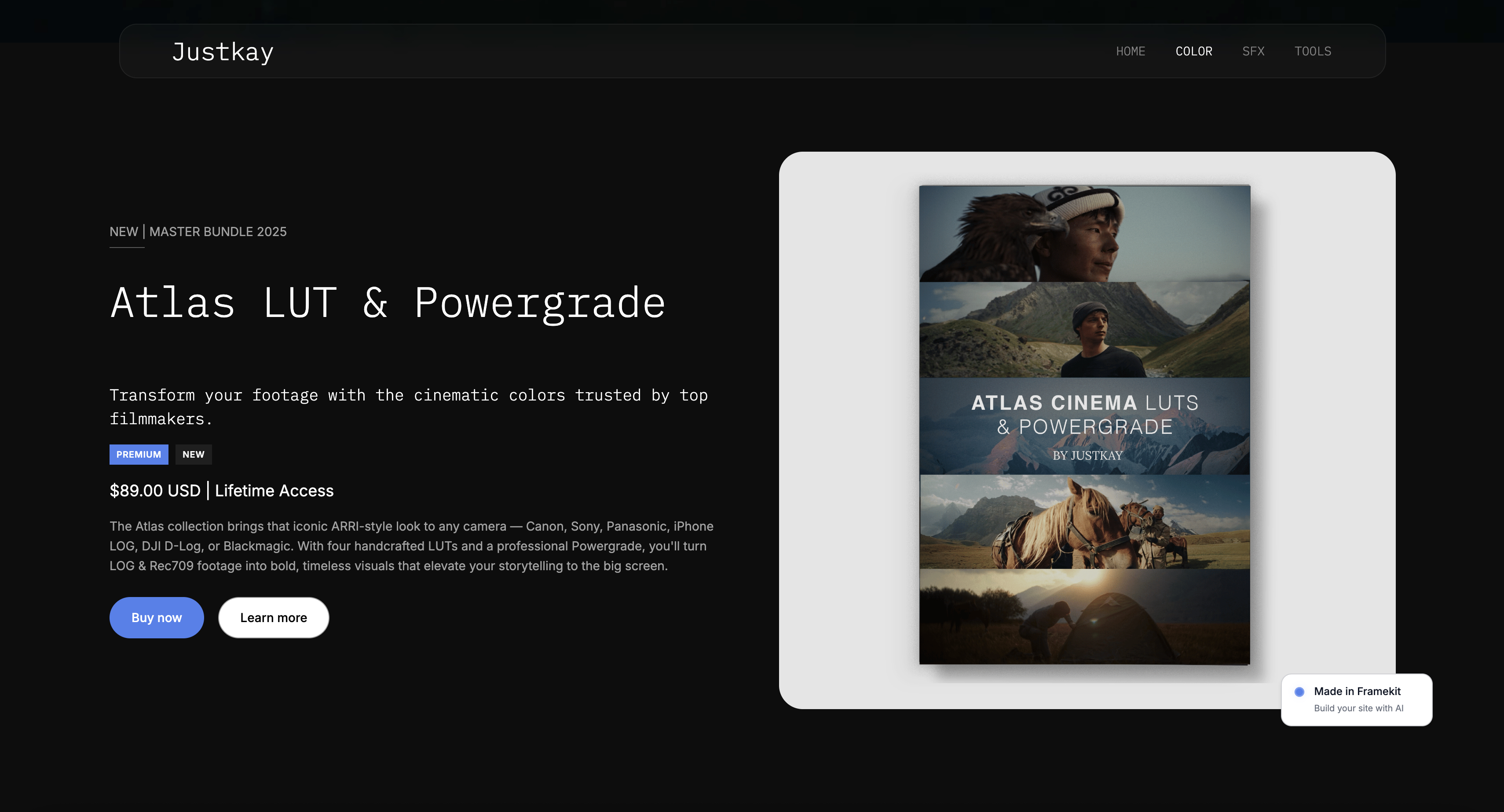
Framekit is an AI website builder for photographers, filmmakers, designers and other creators, and it has no affiliate feature.
There is no affiliate dashboard, no partner portal, no commission engine, and nothing in this ranking would change if there were, because the tools above do that job properly and we do not do it at all.
What a website does own is the destination.
An affiliate's job ends the moment someone clicks, and everything after that click is yours: whether the page loads into something that looks like a business, whether the product is explained, whether the checkout asks for a shipping address it does not need.
A partner who sends a thousand people to a page that converts at 1% will quietly stop sending traffic, and they will not tell you why.
The practical consequence is that your affiliate link should point at a page you control, on your own domain, rather than at a third-party product page with someone else's branding around it.
Framekit's transaction fee on product sales is 5% on Free and Starter, 3% on Pro at $19 a month and 0% on Business at $39 a month, with card processing on top - which matters here only because affiliate revenue is revenue you already paid a commission on, and a platform percentage stacked on top of a 30% commission is the expensive combination in this whole guide.
Pair it with Rewardful or FirstPromoter, both of which track sales through Stripe regardless of what built the page.
Decision Guide
This is ordered by constraint rather than by preference, because in this category the constraint decides: what your store already includes, how many partners you actually have, and where your payments run. Work down the list and stop at the first yes.
1. Do you already sell through Gumroad, Lemon Squeezy or Podia?
Yes: use the affiliate tooling you are already paying for, and revisit only when you have a partner asking for something it cannot do.
2. Is your programme under ten partners?
Yes: do not buy software. A spreadsheet and unique discount codes will carry you further than you expect, and the $99 is better spent on the partners themselves.
3. Do your payments run through Stripe or Paddle, with a real partner list?
Yes: Rewardful, on Growth at $99 if you want the branded portal, which you will.
4. Have you had attribution disputes, or do you need multi-tier commissions?
Yes: FirstPromoter on Business at $99.
5. Do you need affiliates to discover you rather than the other way round?
Yes: Refersion's Launch plan at $39 plus 3%, with a diary note at $16,000 a month of affiliate revenue.
6. Do you run a curated programme of under 50 partners and want published overage rates?
Yes: Tapfiliate Launch at $89.
7. Do you already maintain a WordPress store?
Yes: Easy Digital Downloads Professional, and budget the renewal at EUR 599 rather than the introductory EUR 209.65.
Frequently Asked Questions
The questions below are the ones that come up once a programme is live, when the interesting problems turn out to be attribution, payouts and partner behaviour rather than features.
What is the best affiliate software for digital products in 2026?
Rewardful is the best affiliate software for digital products for most sellers in 2026, at $49 a month for up to $7,500 of monthly affiliate revenue and $99 up to $15,000, with unlimited affiliates on every tier and coupon tracking included at entry.
FirstPromoter is the better pick if attribution disputes or multi-tier commissions matter, and if you already sell through Gumroad, Lemon Squeezy or Podia, the included affiliate tooling is usually sufficient and costs nothing extra.
How much does affiliate software actually cost compared to the commission?
Far less than sellers expect. On $10,000 a month of affiliate-driven sales at a 30% commission, you pay $3,000 in commission and between $0 and $339 in software.
On the most expensive flat plan that qualifies, the software is 3.2% of what the channel costs.
The exception is Refersion, which charges 3% of affiliate revenue on top of its subscription, making it the only tool here whose cost grows with your success.
Rewardful vs FirstPromoter: which should I choose?
Choose Rewardful for the better entry tier and FirstPromoter for the better controls.
Both are $49 and $99 at their first two tiers, but Rewardful's $49 plan covers $7,500 of monthly affiliate revenue against FirstPromoter's $5,000, and Rewardful does not cap affiliates while FirstPromoter caps at 1,000 on Starter.
FirstPromoter answers back with multi-tier commissions and one-click Stripe payouts on its $99 Business plan.
What commission rate should I pay affiliates on digital products?
Between 20% and 50%, and the right number is the one that makes promoting you worth a partner's time. On a $29 product, 20% is $5.80 per sale and 50% is $14.50.
Because digital products have no unit cost, the higher rates are affordable in a way they are not in physical goods, and the practical constraint is what you are willing to give up rather than what you can afford.
Do I need affiliate software if I only have a few partners?
No. Under about ten partners, unique discount codes and a spreadsheet work, and every platform in this guide that includes affiliate tooling covers that case for free.
Buy dedicated software when you have partners asking questions your current setup cannot answer: tiered rates, self-referral blocking, automated payouts, or a branded portal.
How do I stop affiliates buying through their own links?
Every tool here can block self-referrals, and not all of them do it by default, so check the setting before you launch.
Self-referral is the most common form of affiliate fraud in creator programmes because it is easy and feels harmless: the affiliate collects the discount and the commission on a purchase they were going to make anyway.
FirstPromoter has the deepest controls, though its most advanced fraud features sit on the Enterprise tier.
Does affiliate tracking work if a partner shares a discount code instead of a link?
Only if your tool supports coupon tracking, and this is the single most commonly missed requirement for creator programmes.
A large share of affiliate promotion in this space happens verbally in videos and newsletters, where a memorable code beats a URL. Rewardful includes coupon tracking on its entry plan.
Without it, those partners see zero sales attributed and reasonably conclude your programme is broken.
Who pays the tax on affiliate commissions?
Your affiliates owe tax on their own commission income, and depending on where you and they are based you may owe them documentation for it.
This obligation varies by jurisdiction and by amount, and it is genuinely yours rather than the software's, though several tools will collect tax forms for you.
It is worth an hour with an accountant before your programme grows rather than after.
Can I move an existing affiliate programme to different software?
Yes, and the affiliates move more easily than the data. Partner lists export and import cleanly.
What generally does not survive is historical attribution and pending commission balances, so the clean approach is to settle all outstanding payouts, freeze the old programme on a stated date, and issue new links.
Give partners at least a month of notice, because a dead affiliate link is invisible to them until someone complains.
What is a good cookie window for digital products?
Thirty days is the common default and sixty is more generous than most sellers realise they can afford.
Creative purchases are often considered rather than impulsive: someone sees a LUT pack recommended, thinks about it, and buys after their next shoot.
A short window quietly under-credits exactly the partners whose recommendations carry the most weight.
Is Refersion's 3% worth it?
Refersion's 3% is worth it only while you need its marketplace to find affiliates.
At $10,000 a month of affiliate revenue, Launch costs $339 against Rewardful's $99, and the gap widens as the channel grows, reaching roughly $1,199 a month at $50,000 of affiliate revenue on Growth.
Treat the percentage as a recruitment fee and move once you have a partner list of your own.
Which affiliate tool has no revenue cap?
LeadDyno and Easy Digital Downloads both price on something other than your revenue - active affiliates and a software licence respectively - so neither reprices when you have a good month.
Rewardful, FirstPromoter and Refersion all tie their tiers to monthly affiliate revenue, which means a successful campaign can move you up a plan without you touching anything.
Does Framekit have an affiliate program feature?
No. Framekit is a website builder and store, and it does not include affiliate tracking, a partner portal or commission payouts.
If you need an affiliate programme, use one of the tools ranked above, most of which track through Stripe and therefore work regardless of what built your site.
The Verdict
Rewardful wins because it does not charge you for succeeding. Unlimited affiliates on every plan, coupon tracking at entry, and a revenue ceiling that is 50% higher than its nearest price-matched rival at the $49 tier.
FirstPromoter is the better tool if you have specific control requirements and the worse deal if you do not. Refersion is the right way to start and the wrong way to continue.
But the honest summary of this whole category is the table near the top of this guide: the software is 3.2% of what an affiliate programme costs, and the commission is the other 96.8%.
If you take one thing from a comparison of ten affiliate tools, take the fact that the comparison barely matters.
Where Framekit loses, and it is not closeFramekit does not have an affiliate feature at all. No tracking, no partner portal, no commission engine.
Every tool ranked above is a better fit for this job than we are, which is why we are not in the ranking, and if affiliate management is what you came for you should close this page with one of their names rather than ours.
Verdict: if your store already includes affiliate tooling, use it. If it does not and you have real partners, Rewardful at $99. Then stop optimising the software and go argue with yourself about the commission rate, which is where the money is.
Plans, caps and overage rates here came from each vendor's published pricing page in the first week of August 2026. Two of these tools changed their tier structure in the past year, so confirm the ceiling that applies to you before committing.
Related readingthe best payment processors for digital products, the best digital product delivery tools, what it costs to sell digital products online, how to price digital products, and website builders to sell digital products.