Framekit templates
Start from a designer-made template
 Use template
 Use template
 Use template
 Use template
 Use template
 Use template
 Use template
 Use template
Your LUT pack is 2 GB. It sold a thousand copies in November. Somewhere around copy four hundred, the download links stopped working, and the first you heard about it was a refund request from a colorist in Melbourne who assumed you had taken the money and vanished.
A digital product delivery tool is the software that takes a completed payment, produces a secure download link, sends it to the buyer, and keeps working when a lot of people click it at once.
It sounds like the least interesting part of selling a file. It is the part that generates the support tickets.
Almost every comparison of these tools ranks them on features. We ranked them on the number that actually breaks: bandwidth.
DPD is the best digital product delivery tool in 2026 for anyone selling large files, because it is the only option here that publishes genuinely unlimited bandwidth and it starts at $10 a month, which means a thousand copies of a 2 GB pack costs the same as one copy.
SendOwl has the deepest feature set of any dedicated delivery tool and puts every feature on every plan, but its published bandwidth allowance tops out at 50 GB a month.
Framekit is second and the best pick for most sellers of ordinary-sized files, because the product pages sit on your own site, checkout and delivery run on a hosted page under your name, buyers can re-download from a page they bookmark, and the fee drops to 0% on a flat $39 plan with no sales cap - but it publishes no bandwidth allowance or file-size ceiling, so on a 2 GB pack at volume DPD is the safer bet.
Sellfy is the pick if a single file is enormous, since it allows product files up to 20 GB, and Lemon Squeezy is the pick if you want the tax paperwork to disappear at the same time.
Disclosure: Framekit is our product and it ranks second, behind a $10 tool that publishes the one number we do not. We priced it against the same thousand-copy month as the others, we link to every vendor, and each review says where that tool beats us.
How We Tested, and the One Workload Everything Is Measured Against
We built the same product on all nine platforms: a 2 GB zip containing a LUT pack, priced at $29, with a PDF install guide bundled alongside it.
Then we sized every platform against one scenario - a thousand copies delivered in a single calendar month - because that is the volume at which the differences between these tools stop being cosmetic.
A thousand copies of a 2 GB file is roughly 2 TB of egress. Hold that number, because it is the one that decides this guide.
What we did and did not do:
- Read at source. Every plan price, storage figure, bandwidth allowance and file-size ceiling below came off the vendor's own pricing page in the first week of August 2026, and the page is linked inside that tool's entry. Framekit's entry was re-verified in September 2026 against its current pricing page and the shipped delivery code, after its old per-file and bandwidth figures were withdrawn from the published plan comparison.
- Built and previewed. We created a product and walked the buyer flow on SendOwl, Gumroad, Payhip, Lemon Squeezy, Sellfy and Framekit. Notes about how the upload behaves and what the buyer receives come from that.
- Not stress-tested. We did not push 2 TB through any of these platforms. The bandwidth analysis is arithmetic applied to published allowances, not a load test, and we say so wherever it appears.
- Reported by sellers. A few observations about support response and link-expiry complaints come from public seller reports rather than our own experience, and are labelled where they occur.
By the numbers:
- 1 of 9 publishes unlimited bandwidth with no asterisk.
- 3 of 9 cap your annual sales volume by plan rather than your usage, which is a different kind of ceiling entirely.
- 20 GB is the largest single product file any platform here accepts.
- 10 GB per month is the smallest published bandwidth allowance, which is five copies of our 2 GB pack.
- 2 TB is what a thousand copies of that pack actually needs.
- $10 a month is the cheapest plan here that can serve all of it.
- 8 of 9 deliver the file by emailed link rather than by an account the buyer logs into, which matters more than it sounds when the email lands in spam.
The Rubric
We scored on five criteria and published the weighting below rather than burying it, because a ranking whose rubric is hidden is an opinion wearing a table.
The weighting is also the reason this guide's order differs from most others you will read: capacity outranks features here, and it does so deliberately.
| Criterion | Weight | What it covers |
|---|---|---|
| Delivery capacity | 35% | Bandwidth allowance, max file size, behaviour at volume |
| Total cost at our workload | 25% | Plan price plus any transaction fee on 1,000 sales |
| Buyer experience | 20% | Link expiry, download caps, re-download, mobile behaviour |
| Seller controls | 15% | Licence keys, PDF stamping, updates to past buyers |
| Ownership | 5% | Whose domain, whose branding, whose customer list |
Delivery capacity carries the most weight because it is the only criterion on this list that produces refunds when it fails.
Ownership is weighted lowest here on purpose, even though we care about it a great deal elsewhere, because this guide is about the plumbing rather than the shopfront - and weighting it higher would have flattered the tool we make.
The Only Table That Matters: 1,000 Copies of a 2 GB Pack
| Tool | Entry price | Published bandwidth | Max product file | Can it serve 2 TB in a month? |
|---|---|---|---|---|
| DPD | $10/mo | Unlimited | Not published | Yes, on the published allowance |
| Easy Digital Downloads | Free core, $79.60/yr Personal | Your own hosting | Your own hosting | Yes, if your host allows it |
| SendOwl | $39/mo Launch | 10 GB/mo | Not published | No, 5 copies at Launch |
| Sellfy | $39/mo Starter | Not published | 10 GB to 20 GB by plan | Not published |
| Lemon Squeezy | No monthly fee | Not published | Not published | Not published |
| Gumroad | No monthly fee | Not published | Not published | Not published |
| Payhip | Free plan | Not published | Not published | Not published |
| Podia | $42/mo Mover | Not published | Not published | Not published |
| Framekit | Free plan, 0% fee on $39 Business | Not published | Not published | Not published |
That table has more "not published" in it than any of us would like, and that is itself the finding, and our own row is one of them.
Five of these companies will happily sell you a plan without telling you how much data it will move, which means the first time you learn your ceiling is when a buyer emails you about a dead link.
Where the numbers do exist, they are stark. SendOwl's entry plan publishes 10 GB a month. Our pack is 2 GB. That is five downloads before the allowance is gone, and even the $159 Scale plan at 50 GB is twenty-five.
DPD publishes unlimited bandwidth on a $10 plan. For this specific workload the gap between them is not incremental, it is categorical.
In one linefor heavy files, the delivery decision is made entirely on bandwidth, and most vendors do not publish theirs.
1. DPD: Best Overall for Heavy Files
DPD is the least fashionable product in this guide and the only one that answers our test scenario without a caveat. It has been doing one job since before most of its competitors existed: take a payment, hand over a file, do not fall over.
The real numberthree plans at $10, $16 and $30 a month, and every one of them lists unlimited bandwidth. Against our thousand copies of a 2 GB pack, that is roughly 2 TB of egress on a $10 plan.
Every other tool here either caps you well below that or declines to say.
The standout detailDPD prices subscriptions per subscriber rather than as a plan tier.
The first five subscribers are free and after that it is a flat 69 cents per subscriber per month, and the pricing page states plainly that this covers billing, support and the bandwidth for continued access.
That is an unusually honest way to price something that is genuinely a cost.
The honest gotchathe interface looks its age, and there is no storefront worth the name. DPD is delivery infrastructure that you point your own store or your own payment buttons at. If you were hoping for a shopfront, this is not it, and you will need something else in front of it.
Skip it ifyour products are small. A 40 MB preset pack does not need unlimited bandwidth, and you would be paying $120 a year for headroom you never touch when Payhip's free plan would carry it.
What reviewers say elsewhereDPD's public reviews are thin compared with the newer platforms, which is what a decade-old product with low churn looks like. The recurring theme in what does exist is reliability rather than delight. Treat that as community sentiment; we did not run it at volume ourselves.
Verdict: if your files are large, stop here. The rest of this guide is for people whose files are not.
2. Framekit: Best All-in-One Store and Delivery

Framekit is an AI website builder for creative sellers whose account also covers galleries, video review, decks and a download store.
As a delivery tool it does the whole chain in one account: product pages on your site, a hosted checkout page under your name and logo, the file, and the page the buyer downloads from, with a direct buy link you can paste anywhere if you have no site at all.
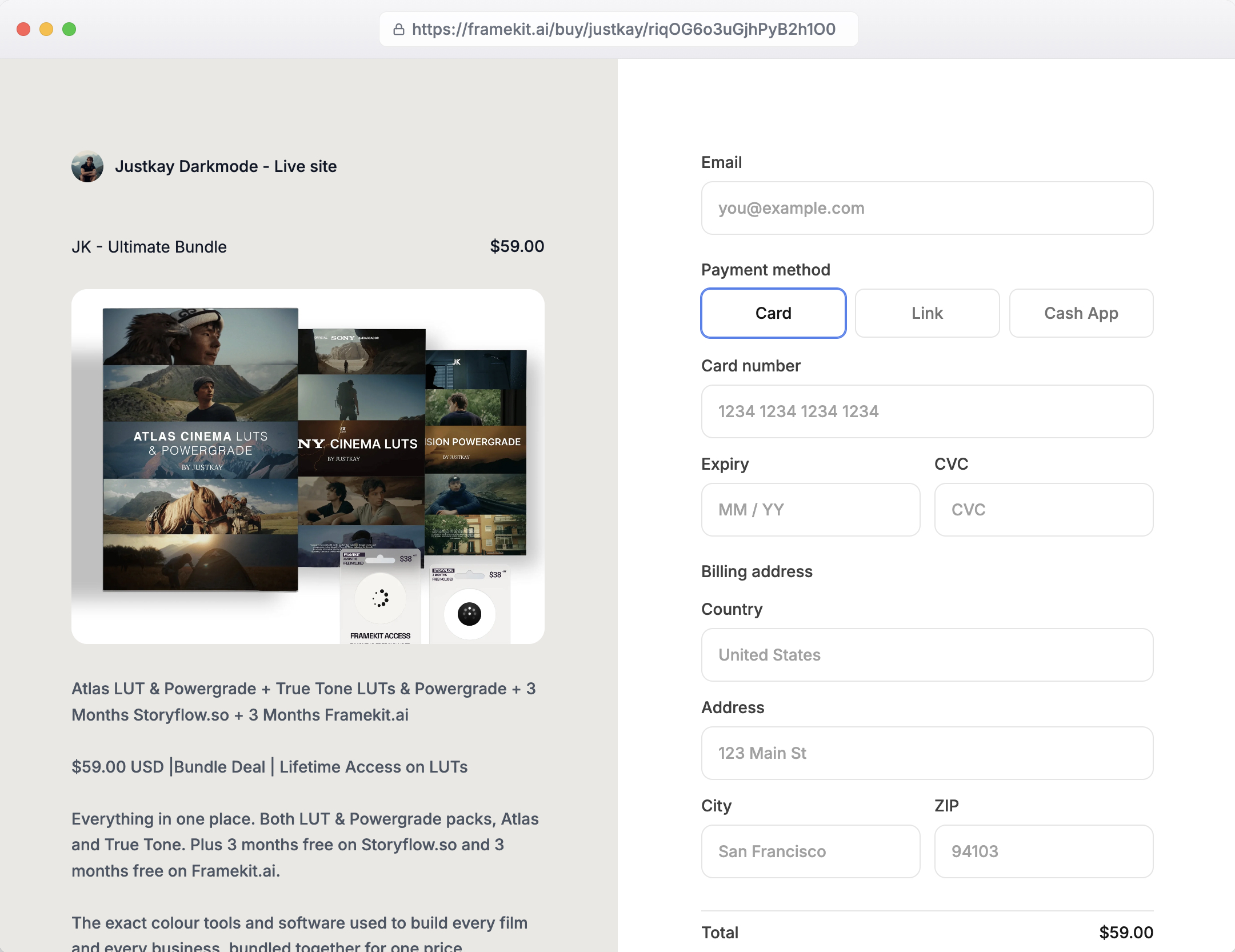
A product can hold several files, and you can upload a whole folder: the folder structure carries through to what the buyer receives, so a file like Cinematic/Warm.cube arrives inside its folder rather than loose.
Payment goes through the seller's own Stripe account, and after paying the buyer lands on a download page that tells them to bookmark it and come back any time.
The real numberon the thousand-copy month at $29, the Business plan's 0% fee means Framekit's own cost is the $39 subscription, with Stripe's processing on top as it is everywhere.
The same month on the Free plan's 5% would be $1,450, so Business pays for itself after 27 sales. Unlike Sellfy and SendOwl, there is no annual sales cap pushing you up a tier.
The standout detaildelivery happens twice. The download page is bookmarkable, and the order email carries signed links that stay valid for seven days. When a buyer loses both, you press resend in the orders dashboard and a fresh set of links goes out.
The honest gotchaFramekit publishes no bandwidth allowance and no per-file ceiling for store downloads, which is exactly the "not published" this guide criticises in others, and we did not push 2 TB through it.
It also has no licence keys, no PDF stamping, no subscriptions and no merchant-of-record tax handling, and it keeps its fee on a refunded sale.
Skip it ifyou ship multi-gigabyte packs at launch-day volume and need a published guarantee (DPD), or you need PDF stamping and licence keys (SendOwl).
Verdict: the best all-in-one delivery for creators whose files are tens or hundreds of megabytes and whose site is the shopfront. Test your largest file on the free plan before you move a catalogue. See how the Framekit store delivers files.
3. SendOwl: Best Feature Set, Worst Ceiling
SendOwl has the most complete delivery toolkit here, and it makes an unusual promise on its pricing page: every feature is on every plan, with no upsell tiers.
PDF stamping, licence keys, drip scheduling, affiliates, subscriptions, upsells, cart abandonment, API access and fraud filters are all included at the entry price.
The real numberLaunch is $39 a month, Grow is $87 and Scale is $159, with annual billing at $32.50, $72.50 and $132.50 respectively. Storage is unlimited on all three.
The honest gotchabandwidth is not. Launch publishes 10 GB a month, Grow 20 GB and Scale 50 GB. Our 2 GB pack therefore gets five deliveries a month on the $39 plan and twenty-five on the $159 plan.
There is a second ceiling stacked on top of that one: each plan also caps annual sales volume, at $10,000 on Launch, $36,000 on Grow and $100,000 on Scale.
So you can outgrow a SendOwl plan two entirely different ways, and a good year does it faster than a good file.
The standout detailthe PDF stamping is the best implementation of that idea in this comparison, writing the buyer's details into the document itself. For anyone selling ebooks or guides where casual sharing is the leak, that single feature is worth more than the bandwidth is worth losing.
Skip it ifyou sell anything over a few hundred megabytes. The maths simply does not work, and no feature list fixes it.
What reviewers say elsewhereSendOwl's G2 listing skews toward sellers of ebooks and courses rather than large media files, which is consistent with where the bandwidth allowances point. Praise clusters on the licence-key and stamping features.
Verdict: the right tool for small files with complicated requirements, and the wrong tool for big files with simple ones. Buy it for the stamping and the licence keys, not for the pipes.
4. Sellfy: Best for One Enormous File
Sellfy is a store rather than a pure delivery tool, and it earns its place in a delivery guide on one published number that nobody else in this comparison comes close to matching: the maximum size of a single product file.
The real numbermaximum product file size of 10 GB on Starter, 15 GB on Business and 20 GB on Premium, with plans at $39, $79 and $159 a month billed monthly, or $29, $59 and $119 billed yearly. Transaction fees are 0% on all three.
The honest gotchathe plans cap annual sales volume at $10,000, $50,000 and $200,000.
A 0% transaction fee is a genuinely good deal right up until the sales cap makes it a tiered percentage in disguise, and at $50,000 a year you are moving to the $79 plan whether the features suit you or not.
Sellfy also does not publish a bandwidth allowance, so the ceiling that matters most for our test workload is unknown.
The standout detailemail marketing credits are bundled by plan - 2,000, 10,000 and 50,000 - which quietly removes a separate subscription for a lot of small sellers.
Skip it ifyour catalogue is many small products rather than a few huge ones. You are paying for a ceiling you will never approach.
Already comparing stores rather than delivery tools? The best Sellfy alternatives covers the wider set.
What reviewers say elsewhereSellfy's public reviews are mostly from print-on-demand and merchandise sellers rather than large-file sellers, so weight them accordingly if your use case is a 15 GB sample library.
Verdict: the specialist answer to a specific problem. If one of your products is 12 GB, this is a short list of one.
5. Easy Digital Downloads: Best If You Already Run WordPress
EDD is the self-hosted answer, and self-hosted changes the shape of every number in this guide. Bandwidth is whatever your host gives you, file size is whatever your server accepts, and there is no platform sitting between you and your buyer taking a percentage.
The real numberthe core plugin is free on WordPress.org, and the paid tiers are Personal at EUR 79.60 a year, Extended at EUR 159.60, Professional at EUR 209.65 and All Access at EUR 349.65, each covering one to three sites.
The honest gotchathose are introductory prices and the page says so - renewals are at full price, which is EUR 199, EUR 399, EUR 599 and EUR 999 respectively.
A first-year cost of EUR 209.65 becoming a second-year cost of EUR 599 is the kind of thing that should be in your budget rather than in your inbox.
Software licensing and the commissions system are only on Professional and All Access, and Stripe Pro is All Access only, so the tier you need is usually higher than the tier you first price.
The standout detailEU VAT compliance is included on every paid tier, which is unusual for a self-hosted tool and removes one of the standard arguments for a hosted platform.
Skip it ifyou do not already run WordPress and do not want to. Adding a CMS, a host, a backup strategy and a security posture to sell a preset pack is a large amount of infrastructure for a small amount of commerce.
What reviewers say elsewhereEasy Digital Downloads has the strongest developer community of anything here, which shows up as a large extension ecosystem and as a recurring complaint that the useful extensions are on the higher tiers.
Verdict: the cheapest option at volume and the most expensive option in attention. If you already maintain a WordPress site, it is close to free. If you do not, it is a second job.
Running your own WordPress install instead? The best WordPress plugins to sell digital downloads prices the whole stack - licence, renewal, hosting and processing - and finds the totals land within about $60 of a flat hosted plan.
6. Lemon Squeezy: Best When the Tax Should Disappear Too
Lemon Squeezy delivers files competently, and that is not why you would choose it.
You would choose it because it is merchant of record at 5% plus 50 cents per transaction with no monthly fee, which means the VAT registration and filing that comes with selling downloads internationally stops being your problem.
The real numberon a $29 pack, 5% plus 50 cents is $1.95, so our thousand-copy month costs $1,950 in platform fees. DPD moves the same 2 TB for $10 that month. The $1,940 difference buys you the entire tax function, which DPD does not touch at all.
The honest gotchaneither the bandwidth allowance nor the maximum file size is published on the pricing page, so for our 2 TB scenario the honest answer is that we do not know, and neither will you until you try it. For a fee at this level, that is a fair thing to ask support before committing.
Skip it ifyour delivery costs are the problem you are solving. You are buying compliance here, and paying delivery-tool money for it.
Verdict: the best answer to a bigger question than the one this guide asks. If tax is on your mind as well as files, it is the efficient purchase.
7. Gumroad: Fastest to a First Delivery
Gumroad remains the shortest path from a finished file to a working download link. Upload, price, publish, share the URL. There is no plan to choose and no server to think about.
The real number10% plus 50 cents per sale, which on our $29 pack is $3.40. Our thousand-copy month is $3,400 in fees, against $10 for the same month on DPD plus a checkout you set up yourself. That is the price of never configuring anything.
The honest gotchasales that arrive through Gumroad Discover are charged 30% rather than 10%, so the same pack nets $20.30 instead of $25.60 when Gumroad brings the buyer. Neither bandwidth nor file-size limits are published.
Skip it ifyou are past a few hundred dollars a month. The convenience premium stops being a rounding error quickly.
Already on Gumroad and watching the 10%? Gumroad's fees explained does the arithmetic, and the best Gumroad alternatives covers where sellers go next.
Verdict: the right first delivery tool and the wrong tenth one.
8. Payhip: Cheapest Way to Get a Store and Delivery Together
Payhip bundles a storefront, checkout and file delivery, and connects to your own Stripe or PayPal account so the money lands in a processor you control rather than in a platform balance.
The real numberthe Free Forever plan adds 5% per sale, Plus is $29 a month with 2%, and Pro is $99 a month with no transaction fee.
On our thousand-copy month at $29, the free plan costs $1,450 in platform fees, Plus costs $609 including that month's subscription, and Pro costs $99 with nothing per sale.
Pro is cheaper than the free plan by $1,351 in a single month at this volume.
The honest gotchathose crossovers matter and Payhip does not do the sum for you. The free plan wins below roughly $1,700 a month in sales, Plus wins in the band above that, and Pro takes over past about $3,300 a month. Staying on free out of habit is the expensive mistake here.
Skip it ifyour files are large. Like most of this list, Payhip publishes no bandwidth allowance.
Verdict: the best value in the middle of this list, and the structure we would pick if we wanted a store without giving up our own payment processor.
9. Podia: Best If Downloads Sit Next to Courses
Podia is a creator platform where downloads are one product type among several, and it is the right pick when your preset pack is the small sibling of a course.
The real numberMover is $42 a month with 5% transaction fees, Shaker is $84 with none, and Earthquaker is $150 with none.
Product counts are capped: 50 downloads on Mover, 150 on Shaker, unlimited on Earthquaker.
Podia also states plainly that your payment processor charges 2.9% plus 30 cents on top, which is a more honest disclosure than most of this list manages.
The honest gotchathe email subscriber caps are low relative to the price - 100 on Mover, 500 on Shaker, 1,000 on Earthquaker. If your list is the reason you sell anything, you will hit that ceiling before you hit the product one.
Skip it ifdownloads are your whole business. You are paying course-platform prices for file delivery.
Verdict: good at the thing it is actually for. As a pure delivery tool it is expensive, and it does not pretend otherwise.
What a Year of Delivery Actually Costs
In one linedelivery is priced two incompatible ways - a flat subscription or a percentage of every sale - and which one is cheaper flips hard at a volume most sellers cross without noticing.
Take our $29 pack at three volumes, over twelve months.
| Yearly volume | Percentage model (Gumroad, 10% + 50c) | Percentage model (Lemon Squeezy, 5% + 50c) | Flat model (DPD $10/mo) |
|---|---|---|---|
| 240 sales, $6,960 | $816 | $468 | $120 |
| 1,200 sales, $34,800 | $4,080 | $2,340 | $120 |
| 12,000 sales, $348,000 | $40,800 | $23,400 | $120 |
The flat column does not move. That is the entire argument for a dedicated delivery tool, and it is why the least fashionable product in this guide ranks first.
The argument against it is equally real and this table does not show it: DPD delivers a file and nothing else. No storefront, no tax handling, no email list, no discovery.
The percentage columns are buying services the flat column never provided. Comparing them straight across is a category error, and any guide that does it without saying so is selling you something.
The test you can run in five minutes
Open your last twelve months of sales and write down two numbers: total revenue, and total gigabytes shipped. Then:
- Multiply revenue by your platform's percentage. That is what delivery cost you last year.
- Divide your total gigabytes by twelve. That is your real monthly bandwidth, and it is the number to check against any plan's published allowance before you switch.
- Compare the first number against $120.
If the gap is uncomfortable, the question is not whether to move but what else the percentage was buying, and whether you can replace those pieces for less than the difference.
Worried about the files being reshared? The best piracy protection tools for digital products covers what each protection layer actually does, and why most sellers already have everything they need bundled into the platform they use.
The Buyer Side, Which Is Where the Refunds Come From
The seller sees a dashboard full of successful transactions. The buyer sees a link that did or did not work, and has no way to tell an expired token from a scam.
That asymmetry is why delivery problems convert into refund requests and chargebacks far more often than they convert into support emails, and why the settings below are worth ten minutes before a launch rather than an afternoon after one.
In one lineevery delivery failure looks identical to the buyer, and it looks like fraud.
Four mechanics decide whether your buyer ever contacts you:
Link expiry. Most tools expire the download link after a fixed window.
That is sensible security and terrible customer service on a 2 GB file, because the buyer who clicks it on hotel wifi, gets to 80% and loses the connection now has a dead link and a receipt.
Check the expiry setting before launch, and lengthen it.
Download caps. A limit of three downloads per purchase seems generous until you remember the buyer has a laptop, a desktop and a phone, and that the first attempt failed. Caps are anti-piracy theatre that mostly punish honest buyers on slow connections.
Re-download after the fact. Six months later your buyer has a new machine and no email. Whether they can get the file again without your intervention is the single biggest predictor of how much support a product generates.
Account-based delivery wins this decisively over emailed links, and only one tool in nine here defaults to it.
Updates to past buyers. If you ship version 2 of a preset pack, can the 400 people who bought version 1 get it? On SendOwl and EDD yes, natively. Elsewhere it is usually a manual email with a new link, which means you will not do it.
The Fine Print
The things that end up costing sellers money on these platforms are almost never the headline price.
They are the second ceiling nobody mentions, the renewal that arrives at three times the introductory rate, and the difference between two words that sound interchangeable and are not.
Here are the five that came up repeatedly while pricing this guide.
In one linetwo ceilings will stop you before bandwidth does, and neither is on the front of the pricing page.
The annual sales cap. SendOwl caps sales at $10,000, $36,000 and $100,000 a year by plan. Sellfy caps at $10,000, $50,000 and $200,000.
These are not usage limits, they are revenue limits, and they mean a good quarter can force a plan upgrade that has nothing to do with how much data you moved.
A tool advertising 0% transaction fees while capping annual sales volume is charging a percentage with extra steps.
Renewal pricing. Easy Digital Downloads publishes introductory annual prices and renews at full price - EUR 79.60 becoming EUR 199, EUR 209.65 becoming EUR 599. Budget year two, not year one.
Refunds. Refunding a digital sale gets the buyer their money and does not get you your transaction fee back on any percentage-model platform we could find a published policy for.
On the flat-model tools there is nothing per-sale to lose, which is a quiet advantage nobody markets.
Who is merchant of record. Lemon Squeezy, Gumroad and Paddle-style platforms are the legal seller and handle VAT. DPD, SendOwl, EDD and Framekit are not, so international VAT is yours.
That is a bigger annual cost than most of the fee differences in this guide, and it is covered properly in our merchant of record explainer.
Storage versus bandwidth. These are different, and vendors love to advertise the cheap one. Unlimited storage means you can upload a lot. Bandwidth is what it costs to hand it out.
SendOwl offers unlimited storage on a plan with 10 GB of monthly bandwidth, which is an accurate statement and a misleading impression.
What Sellers Get Wrong About File Size
In one linethe file you upload and the file you should be selling are usually not the same file, and shrinking it is cheaper than any plan upgrade.
Most oversized digital products are oversized by accident. A LUT pack ships with uncompressed preview stills nobody opens. A preset bundle carries three format variants when 95% of buyers use one.
A template includes the raw project file, the exported version, and a video walkthrough that would be better hosted than downloaded.
The arithmetic is worth doing before you shop for bandwidth. Our 2 GB pack at a thousand copies a month needs 2 TB.
The same pack trimmed to 400 MB - by moving the walkthrough video to a streaming host and offering the extra formats as a separate download for the people who ask - needs 400 GB.
That is the difference between a tool that publishes unlimited bandwidth being mandatory and an ordinary store being a comfortable bet, and it took an afternoon rather than a migration.
Three specific trims that usually work:
Split the tutorial out. Video is almost always the largest thing in a creative product and the least likely to be downloaded twice. Host it, link it, stop shipping it.
Offer format variants on request. If you sell LUTs in five formats, ship the one everyone uses and let buyers ask for the rest. Your support inbox will get perhaps two emails a month and your bandwidth bill drops by half.
Compress the previews. A 40 MB folder of PNG examples inside a product that costs $29 is an expensive way to show someone what they already bought.
The counter-argument is real: every trim is friction for the buyer, and a product that arrives incomplete generates worse feedback than a product that arrives slowly.
The test is whether the removed piece is something a buyer wants on day one or something they might want in month three.
Moving Delivery Tools Without Losing Buyers
In one linemigrating delivery is easy for one-off products and genuinely hard for subscriptions, and the difference is worth knowing before you commit to either.
For one-off downloads there is no state to move. Export your customer list, upload the files to the new tool, repoint the buy buttons, and keep the old links alive for a grace period so anyone mid-purchase is not stranded.
The whole job is an evening. The one thing people forget is the grace period: kill the old links the same day and every buyer from the previous six months who tries to re-download becomes a support ticket.
Subscriptions are a different problem. Recurring payment details generally cannot be moved between processors without a formal migration, so subscribers may have to re-enter their card, and a meaningful share of them will simply not bother.
If you sell anything recurring, treat the delivery tool as a long-term decision rather than a reversible one, and read the migration terms before the first subscriber signs up.
Three things to take with you when you move:
The customer list, with purchase history. Not just emails - who bought what, and when. Without it you cannot honour a re-download request or ship an update to version-one buyers.
Your product URLs. If a product page has been linked to or ranked, changing its address quietly deletes that. Redirect, do not delete.
The receipts. Buyers ask for them years later, particularly business buyers expensing a purchase. Export before you cancel, because access usually ends with the subscription.
Decision Guide
The quick answer at the top is a five-second scan. This is the reasoned path, and it is deliberately ordered by constraint rather than by preference, because in this category the constraint almost always decides. Work down the questions and stop at the first yes.
1. Is any single product larger than about 500 MB?
Yes: DPD if you want unlimited bandwidth cheaply, Sellfy if one file is over 10 GB and you also want a storefront. Do not choose on features - choose on the ceiling.
2. Do you already run a WordPress site you maintain?
Yes: Easy Digital Downloads, on Professional or All Access if you need licence keys. Price the renewal, not the first year.
3. Do you sell internationally and dread the VAT return more than the fee?
Yes: Lemon Squeezy. You are buying compliance and delivery in one purchase.
4. Do you need PDF stamping or licence keys on small files?
Yes: SendOwl, whose entry plan includes every feature. Confirm your monthly gigabytes fit inside 10 GB first.
5. Are your products under a few hundred megabytes, and should the store sit next to your portfolio?
Yes: Framekit, free to start at 5% and 0% on the $39 Business plan. Upload your largest file on the free plan before you commit, because no ceiling is published.
6. Do you want a store today with no monthly cost and your own Stripe account?
Yes: Payhip's free plan, moving to Plus above roughly $1,700 a month in sales.
7. Do you want to be selling in ten minutes and will deal with the cost later?
Yes: Gumroad. Set the revenue number now at which you will revisit it.
Frequently Asked Questions
These are the questions that arrive after the first launch rather than before it, which is why most of them are about ceilings, failures and refunds rather than features.
What is the best digital product delivery tool in 2026?
DPD is the best digital product delivery tool in 2026 for large files, because it publishes unlimited bandwidth on plans starting at $10 a month, which is the only published allowance here capable of serving a thousand copies of a 2 GB pack.
Framekit is second for sellers of ordinary-sized files who want the store, checkout and re-download page in the same account as their site, with a fee that falls to 0% on a $39 plan.
For small files with complex requirements, SendOwl has the deeper feature set and puts every feature on every plan, though its published bandwidth allowance is 10 GB to 50 GB a month.
How much bandwidth do I need to sell a large digital product?
Multiply your file size by your expected monthly sales.
A 2 GB pack selling a thousand copies a month needs roughly 2 TB of egress, which exceeds every published allowance in this guide except DPD's unlimited plans and whatever your own host allows on a self-hosted setup.
Most sellers dramatically underestimate this because storage figures are advertised loudly and bandwidth figures are not.
What is the largest file I can sell?
Sellfy publishes the highest ceiling of any hosted platform here at 10 GB on Starter, 15 GB on Business and 20 GB on Premium.
Most other vendors do not publish a maximum product file size at all, and Framekit is one of them: its uploads are resumable and it no longer lists a per-file limit, but we have not published a tested ceiling, so try your largest file on the free plan first.
Framekit vs DPD: which should I use for delivery?
Choose DPD if your files are gigabytes and your volume is high, and Framekit if your files are ordinary sizes and you want the store too. DPD publishes unlimited bandwidth from $10 a month but has no real storefront.
Framekit gives you the product page, checkout, re-downloadable delivery page and a website in one account, at 0% on the $39 Business plan, but publishes no bandwidth allowance.
Do these tools stop my files being shared?
No, and no tool can. What they do is raise the friction: expiring links, download caps, PDF stamping that writes the buyer's name into the document, and licence keys that gate software.
SendOwl and Easy Digital Downloads have the strongest implementations here. Treat all of it as protection against casual resharing rather than against determined piracy.
Can I send an updated version of a product to people who already bought it?
On SendOwl and Easy Digital Downloads, yes, natively. On most of the rest it is a manual export of buyer emails and a new link sent yourself, which in practice means it does not happen.
If you plan to iterate on a product, make this a selection criterion rather than an afterthought.
DPD vs SendOwl: which should I choose?
Choose DPD if file size or download volume is your constraint, and SendOwl if features are. DPD publishes unlimited bandwidth from $10 a month but is delivery only, with no real storefront.
SendOwl is $39 a month at entry and includes PDF stamping, licence keys, affiliates, subscriptions and upsells on every plan, but publishes 10 GB of monthly bandwidth at that price and caps annual sales at $10,000.
Is a 0% transaction fee actually 0%?
Not always. Sellfy advertises 0% transaction fees on every plan and caps annual sales volume at $10,000, $50,000 and $200,000 by tier. SendOwl caps at $10,000, $36,000 and $100,000.
A revenue cap that forces a plan upgrade is a percentage charged in larger steps, and you should model it that way.
What happens when a buyer's download link expires?
They email you, usually annoyed, and you re-issue it manually. Every tool here lets you set or extend the expiry window, and on large files the default is often too short for a real-world connection.
Lengthen it before launch, and prefer account-based delivery over emailed links if your buyers are likely to come back months later.
Do I still owe VAT if my delivery tool handles the files?
Yes, unless that tool is the merchant of record. DPD, SendOwl, Easy Digital Downloads and Framekit deliver files without becoming the legal seller, so VAT on international digital sales remains your obligation.
Lemon Squeezy and Gumroad act as merchant of record and take that on. This is usually a bigger annual number than the fee difference between any two tools here.
Can I use a delivery tool with my own website?
Yes, and it is the most common setup among sellers who have outgrown a hosted storefront. DPD, SendOwl and Easy Digital Downloads are all built to sit behind your own site, handling payment and file delivery while your pages do the selling.
The result is that the buyer stays on your domain and the customer record is yours.
Is Dropbox or Google Drive good enough for delivering products?
No, for three specific reasons: the link is shareable by anyone who receives it, there is no purchase record tied to the file, and neither service will stop distributing when you want the product retired.
They also break the buyer's expectation of a receipt and a download page. Use them for client file transfer, not for products you sell repeatedly.
Do I need a separate delivery tool if my store already delivers files?
Usually not, and adding one is a common early over-purchase. Gumroad, Payhip, Sellfy, Podia, Lemon Squeezy and Framekit all deliver files as part of the product you are already paying for.
A dedicated tool like DPD or SendOwl earns its place when you hit a specific ceiling - bandwidth, file size, licence keys, PDF stamping - or when you want to keep your storefront on your own site and let something else handle the pipes.
What is the difference between storage and bandwidth?
Storage is how much you can upload and keep; bandwidth is how much gets sent to buyers each month. They are priced separately and advertised very unevenly.
SendOwl offers unlimited storage on a plan that publishes 10 GB of monthly bandwidth, which is entirely accurate and easy to misread.
For anyone selling files repeatedly, bandwidth is the number that constrains you and storage almost never is.
Which delivery tool is cheapest for a beginner?
Payhip's free plan is the cheapest way to get a store and delivery together with no monthly cost, charging 5% per sale on top of your own Stripe or PayPal fees. Gumroad is faster to set up at 10% plus 50 cents.
Both are sensible starting points, and both get expensive at a volume you should decide in advance.
How many downloads should I allow per purchase?
Enough that a failed attempt is not a support ticket, which in practice means at least five on a large file.
Download caps exist to limit sharing, but a 2 GB file frequently fails partway through on ordinary connections, and each failure consumes an attempt. The refund you avoid is worth more than the copy you prevent.
The Verdict
DPD wins this guide because the criterion that matters most here is the one it is built around.
A thousand copies of a 2 GB pack is 2 TB of data, and DPD is the only tool in this comparison whose published allowance absorbs that without a conversation, at $10 a month.
Everything else here either caps you well below it or does not publish a number at all, and "not published" is not a feature.
SendOwl is the better product and the worse fit for heavy files. Sellfy is the answer if one file is genuinely enormous. Easy Digital Downloads is the cheapest at scale if you already run WordPress and the most expensive if you do not.
Lemon Squeezy is the right purchase when tax is on your mind as much as delivery.
Framekit is second: the best all-in-one choice for ordinary-sized files, with product pages on your site, hosted checkout, delivery and a bookmarkable download page, and a fee that starts at 5% and falls to 0% on a flat $39 a month with no sales cap.
Where Framekit losesFramekit does not publish a bandwidth allowance or a per-file ceiling, so it is not the tool to bet a 2 GB launch on; DPD is the better fit there, and Sellfy for a single 15 GB file.
It is not for anyone who needs licence keys, PDF stamping, subscriptions or merchant-of-record tax handling either, and SendOwl or Lemon Squeezy will serve those sellers better than we can.
Verdict: pick on your largest file and your busiest month, not on the feature grid. The tool that fails you will fail on capacity, and it will fail in public.
Plans, bandwidth allowances and file-size ceilings here were read from each vendor's published pricing page in the first week of August 2026. Two of these vendors changed plan structures within the last year, so re-check the one number your decision rests on before you commit.
Related readingthe best payment processors for digital products, what it costs to sell digital products online, the best free product-selling software, how to sell LUTs online, and website builders to sell digital products.