Framekit templates
Start from a designer-made template
 Use template
 Use template
 Use template
 Use template
 Use template
 Use template
 Use template
 Use template
Your checkout asks for a shipping address. The product is a 40 MB preset pack.
That is the whole problem with selling digital products on Shopify, and it does not show up in any pricing comparison, because it is not a pricing problem. Shopify's card rate is genuinely competitive.
What you are actually paying for is a system built to move boxes, wearing a costume.
A digital-product store is software that takes a payment and hands over a file: no address, no shipping calculation, no fulfilment status, no delivery estimate. Every platform below does that natively. Shopify does it with an app.
Framekit is the best Shopify alternative for digital products in 2026, because it delivers files natively with no app and no shipping-address logic, pays straight into your own Stripe account, puts the store on the same site as your portfolio, and its $39 Business plan takes a 0% fee - $288 a month at our volume against $348 on Payhip Pro.
The trade-off is that it sells digital downloads only, so Payhip is the better pick if you also ship prints or want EU VAT handled.
Sellfy and Podia are strong flat-fee alternatives, and Lemon Squeezy is the one to choose if you would rather someone else handled all the tax.
But read the fee section first, because Shopify's own processing rate is lower than most of this list and leaving it purely to save money usually does not.
How We Compared These Platforms
Leaving Shopify for digital-only selling changes which costs matter, so it is worth stating what these judgements are built on.
- Verified from primary sources: platform fees, monthly pricing and app requirements were read from each vendor's published pages during September 2026.
- Assessed hands-on: whether file delivery works without an add-on, what the checkout looks like on a phone, and how much setup stands between signing up and a first sale.
- Not assessed: physical fulfilment and shipping, which is the half Shopify wins and none of these alternatives attempt.
No checkout speed claims or performance scores are published here, for any of these platforms.
Disclosure: Framekit is our product and it ranks first in this guide, for digital-only sellers. We priced the other nine the same way, we link to every one of them, and the reviews name what Shopify, Payhip and Big Cartel do that we do not do at all: physical products, above all.
In September 2026 we re-verified Framekit's fees and features against its current pricing page and moved it to first; in August it sat second, partly on a per-file limit Framekit no longer publishes. Every other vendor's figure was read in August 2026 and is dated in place.
How We Priced This
One scenario runs through every platform in this guide: 250 sales a month of a $24 preset pack, or $6,000 in monthly revenue. That is a working store rather than a hypothetical one, and it is large enough that percentage pricing and flat pricing separate clearly.
Card processing is where this comparison needs an honest caveat rather than a footnote. Shopify's pricing page serves rates by country, and the page served to us quoted 1.9% plus EUR 0.25 on its Basic plan for standard cards.
For every other platform we have used 2.9% plus 30 cents, the widely published standard rate.
That difference flatters Shopify by roughly $70 a month at our volume, and we have kept the platform costs and the processing costs in separate columns so you can substitute your own rate.
Three grades of claim. Read at the vendor's own pricing page in the first week of August 2026: Shopify, Payhip, Sellfy, Podia, Lemon Squeezy, Big Cartel, Squarespace, Easy Digital Downloads, Gumroad and Stripe, plus Framekit's own plan file. Built a store and bought from it covers Payhip, Gumroad, Lemon Squeezy and Framekit. Partly published applies to Squarespace, whose transaction-fee table renders but whose plan prices did not, and Big Cartel, which publishes plan prices but not transaction fees.
By the numbers:
- 2% is Shopify's extra charge on its Basic plan for using any payment provider other than its own.
- 7% is Squarespace's transaction fee on digital content on its Basic plan, against 2% on physical products.
- 1 app is what Shopify needs to deliver a file, on top of the plan.
- $120 a month is what Shopify's third-party gateway penalty costs at our test volume.
- $974 is the most expensive way to sell the same $6,000, against $264 for the cheapest.
- 6 of 10 alternatives take no percentage of your sales at all.
- $0 in extra apps is what any of them needs to deliver a download.
The Rubric
We scored on five criteria, weighted for a seller whose products are files and who is currently paying for a platform built around parcels. That weighting is why this ranking differs from a general ecommerce comparison, where theme quality and app ecosystems would carry far more.
| Criterion | Weight | What it covers |
|---|---|---|
| Cost at 250 sales a month | 30% | Plan, percentage and any required add-ons |
| Native digital delivery | 25% | Files without an app, and what the buyer receives |
| Checkout fit | 20% | Fields required, address logic, mobile behaviour |
| Ownership | 15% | Domain, customer list, whose payment account |
| Physical goods | 10% | Whether you can still sell prints and merchandise |
Native delivery carries a quarter of the weight because it is the specific thing Shopify does not do, and physical goods is in the rubric at all because a meaningful share of people leaving Shopify still sell prints alongside their files.
What 250 Sales of a $24 Product Costs
| Platform | Plan and cut | Platform cost | Processing | Total |
|---|---|---|---|---|
| Big Cartel | Platinum, $15 | $15 | $249 | $264 |
| Shopify | Basic, about $31, with its own payments | $31 | $181.50 | $212.50 |
| Framekit | Business, $39, 0% | $39 | $249 | $288 |
| Sellfy | Business, $79, 0% | $79 | $249 | $328 |
| Podia | Shaker, $84, 0% | $84 | $249 | $333 |
| Payhip | Pro, $99, 0% | $99 | $249 | $348 |
| Stripe Payment Links | Free | $0 | $249 | $249 |
| Easy Digital Downloads | Professional, about $19 plus hosting | About $19 | $249 | About $268 |
| Lemon Squeezy | 5% + 50c, processing included | $425 | Included | $425 |
| Squarespace | Core, 5% on digital content | $300 plus plan | $249 | Over $549 |
| Gumroad | 10% + 50c, plus processing | $725 | $249 | $974 |
Shopify comes out second cheapest in that table, and the reason is its processing rate rather than anything about the platform itself.
This is the part most Shopify-alternatives articles get backwards.
On the pricing served to us, Shopify Payments at 1.9% plus EUR 0.25 is materially cheaper than the 2.9% plus 30 cents most of this list assumes, which is worth roughly $70 a month at our volume.
If your reason for leaving is the monthly bill, check that you are comparing your actual card rate rather than a headline plan price.
The number that does argue for leaving is the one below it: use any payment provider other than Shopify Payments and Basic adds 2%, which on $6,000 a month is $120.
That is a charge for not using their processor, it falls to 1% on Grow and 0.6% on Advanced, and it is the most aggressive version of that pattern anywhere in this sprint's fee research.
In one lineShopify is not expensive to process payments through, and it is expensive to leave the moment you want a different gateway or a checkout that does not ask where to post a download.
1. Framekit: Best Overall for Digital-Only Sellers

Framekit is an AI website builder for photographers, filmmakers, designers and other creators, and the store is one of five tools in the same account, beside client galleries, video review and Slides.
For someone leaving Shopify it replaces the plan, the downloads app and the theme in one move: products live on the same site as the portfolio, and each has a direct buy link as well.
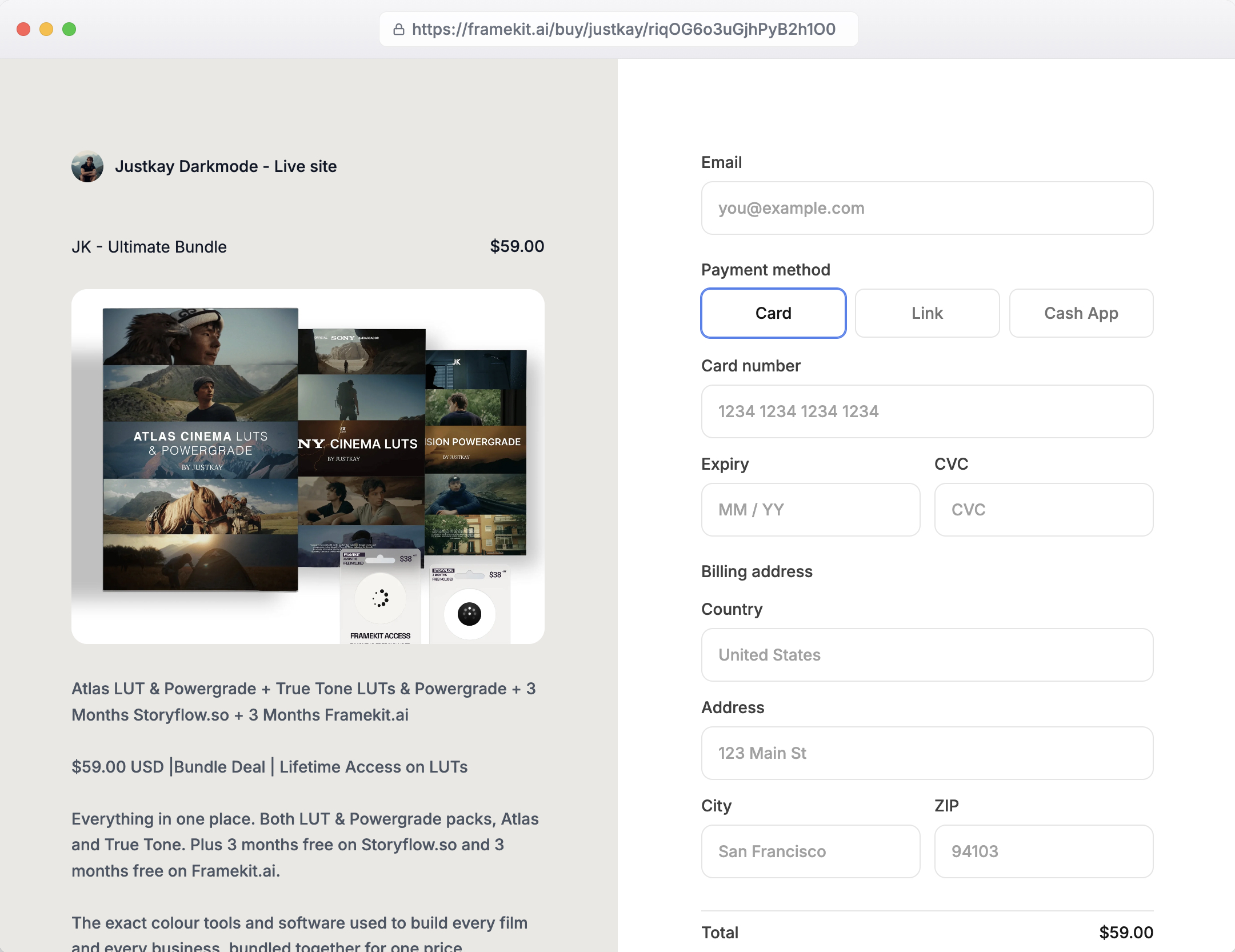
The checkout asks for an email and a payment, not a parcel address, and it runs on a hosted page under your name and logo with the Stripe payment form built in.
Each sale is a direct charge on your own connected Stripe account, so the balance and payout schedule are yours, and there is no penalty for the processor you use because Stripe is the processor.
The buyer gets the file the moment payment clears and can come back for it later.
The real numberproduct sales carry a 5% fee on Free and Starter, 3% on the $19 Pro plan and 0% on the $39 Business plan, and card processing is charged separately.
At our volume Business plus processing is $288: $24 more than Big Cartel's $15 plan, which does not publish its transaction fees, and $60 a month less than Payhip Pro.
The crossover where the flat plan beats the percentage is $780 a month in sales, which is 33 sales of a $24 pack.
The standout detailthe thing that sells a preset pack is usually the photographer's work sitting next to it. On Shopify that work lives on a different site, or in a theme fighting to look like a portfolio.
Here the portfolio is the store, and the AI builder will lay out the product pages from a description.
The honest gotchaFramekit does not sell physical products at all, so if you also ship prints or merchandise it is not a Shopify replacement and Payhip or Big Cartel is the better call.
It also has no subscriptions, no affiliate programme and no merchant-of-record tax handling, discount codes start on Pro, and it keeps its own fee on refunded sales on the 5% and 3% plans.
Skip it ifyou sell physical goods, you need a marketplace to find buyers, or you want VAT off your desk.
Verdict: the strongest replacement for a Shopify store that was always really a portfolio with a checkout attached, and the wrong tool for a shop that ships things. See how the Framekit store works.
2. Payhip: Best If You Also Sell Physical Goods
Payhip is the closest thing to Shopify's breadth without Shopify's assumptions. It sells digital products, physical products, memberships and courses, delivers files natively, and connects to your own Stripe or PayPal account instead of holding your money in a platform balance.
The real numberthe free plan takes 5%, Plus is $29 a month at 2% and Pro is $99 a month with no transaction fee. At 250 sales of $24 the free plan costs $300 in platform fees and Pro costs $99, so the paid plan is $201 a month cheaper than the free one.
The standout detailmoney settles into your own processor account. After Shopify, where the balance and the payout schedule belong to the platform and using a different gateway costs 2%, that structural difference is the thing sellers notice in the first week.
The honest gotchathe storefront is plain. Shopify's theme ecosystem is enormous and Payhip's is not, so a store that was doing real brand work on Shopify will look more generic here. You are trading presentation for control and about $120 a month.
Skip it ifyour business is fundamentally physical with digital as a sideline, and your Shopify theme and apps are load-bearing. Payhip can sell physical goods; it will not replace a mature Shopify setup.
What reviewers say elsewherePayhip's Capterra listing is strongest on simplicity and value, with design flexibility the recurring request - which matches exactly what you give up.
Verdict: the best all-round replacement for a Shopify store that mixes files with physical goods, and the one to pick if EU VAT handling matters. Buy Pro rather than drifting on the free plan.
3. Sellfy: Best Flat Fee With Big Files
Sellfy is a storefront that takes no percentage at all, sells digital and physical products, and publishes the highest single-file ceiling of any hosted platform in this comparison.
The real numberStarter is $39 a month billed monthly or $29 yearly, Business is $79 or $59, and Premium is $159 or $119, all at 0% transaction fees, with maximum product file sizes of 10 GB, 15 GB and 20 GB respectively.
The honest gotchathe annual sales caps of $10,000, $50,000 and $200,000. Our $6,000 a month is $72,000 a year, which is past Starter and into the $79 Business plan, so the advertised entry price is not the price you would pay.
A 0% transaction fee behind a revenue cap is a percentage charged in larger steps.
The standout detailprint-on-demand is built in, which means a seller leaving Shopify with a merchandise line does not necessarily lose it.
Skip it ifyour revenue is growing quickly and unpredictably. You will change tiers on revenue rather than on need.
Verdict: the best option here for a seller with very large files or a mixed digital and print-on-demand catalogue.
4. Podia: Best If You Also Teach
Podia bundles digital downloads with courses, memberships and email marketing in a single subscription, which fits a Shopify seller whose catalogue has been drifting away from products and toward teaching.
It is the broadest product here that still takes no percentage on its main plans.
The real numberMover is $42 a month with 5% transaction fees, Shaker is $84 with none and Earthquaker is $150 with none. At our volume Shaker costs $84 against Mover's $342, so again the more expensive plan is dramatically cheaper.
The standout detailthe email tool is included rather than integrated, with caps of 100, 500 and 1,000 subscribers by plan. For a Shopify seller currently paying separately for email, that removes a subscription.
The honest gotchano physical products worth the name, and those email caps arrive fast. 250 sales a month generates more than 500 email addresses inside a year.
Skip it iffiles are all you sell. You are paying for a course platform.
Verdict: a good landing place if your Shopify store was the first step toward selling knowledge rather than things.
5. Lemon Squeezy: Best With VAT Handled
Lemon Squeezy is a store and a merchant of record in one, so the sales-tax obligation on international sales moves from you to the platform.
The real number5% plus 50 cents per transaction with processing included, so $425 on our test month - more than every flat-fee option here.
The standout detailon Shopify, tax on digital goods across the EU and US states is entirely your problem, and most sellers discover this late. Moving to a merchant of record makes it disappear rather than making it easier.
The honest gotchaat a $24 price point, the 50-cent fixed fee is 2.1 points on its own, so the effective rate is 7.1%. On cheaper products it is worse.
Skip it ifyour buyers are domestic and you are already registered.
Verdict: the right choice if compliance is what actually pushed you off Shopify, and expensive if it is not.
6. Big Cartel: Cheapest Real Storefront
Big Cartel has been serving independent artists and makers since long before most of this list existed, and it remains the cheapest genuine storefront in the comparison. It is also one of only three here that sells physical and digital products side by side.
The real numberthere is a free Gold plan, Platinum is $15 a month and Diamond is $30, with digital products supported from Platinum upward. At our volume Platinum plus processing is $264, the second-lowest total here.
The standout detailit sells physical and digital side by side at $15 a month, which for an artist selling prints and downloadable brushes is a materially better fit than any digital-only platform.
The honest gotchatransaction fees are not stated on the pricing page, so the $15 is a plan price rather than a total. That is a real gap in a comparison like this one, and it is worth confirming before you commit.
Skip it ifyou need courses, memberships or sophisticated marketing tooling. This is deliberately a shop.
Verdict: the best value for an artist with a mixed catalogue, with one number you will have to ask about.
7. Stripe Payment Links: Cheapest Possible
If you have a handful of products and no attachment to having a storefront, a Stripe Payment Link is a checkout with no platform behind it and no monthly cost.
The real numberthe software is free; you pay card processing only. At our volume that is $249 with nothing on top, which is the lowest platform cost available anywhere.
The honest gotchait does not deliver files. You get a payment and an email address, and the actual fulfilment is yours to arrange, which for 250 sales a month is not something you want to do by hand.
Skip it ifyou sell more than a couple of products or need delivery handled.
Verdict: the right answer for one product and the wrong one for a catalogue. Pair it with a delivery tool if you go this way.
8. Easy Digital Downloads: Cheapest at Scale, on WordPress
Easy Digital Downloads is the self-hosted option, and self-hosting changes the arithmetic entirely: there is no platform percentage, no revenue cap, no vendor sitting between you and your buyer, and correspondingly nobody to call when something breaks at midnight.
The real numberthe core plugin is free, and the paid tiers are Personal at EUR 79.60 a year, Extended at EUR 159.60, Professional at EUR 209.65 and All Access at EUR 349.65, which at the Professional introductory rate is roughly $19 a month.
The honest gotchathose are introductory prices and the page says renewals are at full price - EUR 599 for Professional. Year two costs roughly three times year one, and you are also running WordPress, which is a host, a backup strategy and a security posture.
Skip it ifyou do not already maintain a WordPress site. Adopting a CMS to escape a $31 Shopify plan is a poor trade.
Verdict: the cheapest running cost in this guide with the highest attention cost. Right for people already on WordPress and wrong for almost everyone else.
9. Squarespace: Beautiful, With a Digital-Content Fee

Squarespace is the design-led option and the one most likely to make a Shopify store look worse by comparison, and it has a pricing quirk that matters enormously for this specific use case.
The real number, and it is the finding of this entrySquarespace's published fee table charges different transaction fees for physical products and for digital content.
Basic is 2% on products and 7% on digital content and memberships. Core is 0% on products and 5% on digital content. Plus is 0% and 1%, and Advanced is 0% and 0%.
The honest gotchaa seller reading "0% transaction fees" on the Core plan and assuming it applies to their preset pack is wrong by five percentage points. At our volume that is $300 a month on a plan advertised as taking no cut.
The plan prices themselves did not render for us, so the totals in the table above are partial by necessity.
The standout detailthe templates are genuinely the best-looking in this comparison, and for some sellers that is worth paying for. It should be a decision rather than a surprise.
Skip it ifdigital products are your main business and you are not on Plus or Advanced.
Verdict: excellent design, and a fee structure that specifically penalises the thing this guide is about.
10. Gumroad: Fastest, Most Expensive
Gumroad will have your catalogue selling again the same afternoon you leave Shopify, and at 250 sales a month it costs more than every other option here.
The real number10% plus 50 cents per sale, or $725 on our test month, with $249 of card processing charged on top for $974 in total. That is $686 a month more than Framekit's Business plan and $710 more than Big Cartel's Platinum plan.
The honest gotchathe 30% Discover rate applies to buyers Gumroad brings you, which is a marketing fee rather than a platform fee and belongs in a separate calculation.
Skip it ifyou have volume. At $6,000 a month the convenience premium is $5,244 a year.
Working through it? Gumroad's fees explained has the arithmetic.
Verdict: a good bridge and a bad destination.
Staying on Shopify and just need the files delivered? The best Shopify apps for digital downloads prices eight of them against a 500 MB product sold 300 times, where one app's $9 plan costs $279 and its $55 plan costs $55.
What Shopify Actually Costs a Digital Seller
The comparison above puts Shopify near the top on cost, which is accurate and incomplete. Three charges sit outside the plan price and outside the card rate, and for a seller whose products are files, all three apply.
In one linethe plan is cheap, the processing is cheap, and the surcharges are where a digital catalogue gets expensive.
Three costs stack on top of the headline plan, and none of them appear when you compare monthly prices.
The third-party gateway penalty. Use any processor other than Shopify Payments and Basic adds 2% of your sales, falling to 1% on Grow, 0.6% on Advanced and 0.2% on Plus.
At $6,000 a month that is $120, $60 and $36 respectively. It is not a fee for a service; it is a fee for a choice.
The delivery app. Shopify does not deliver files natively in the way every alternative here does.
Shopify's own Digital Downloads app is free, and the better third-party options are subscriptions, so the real stack is a plan plus an app and sometimes an upsell app on top.
The checkout you cannot fully undo. The flow is built around shipping. You can switch off address collection for digital-only orders, and the underlying assumptions - fulfilment status, delivery estimates, shipping profiles - stay in the admin you use every day.
None of that makes Shopify a bad product. It makes it a product built for a different job, which is why the honest reason to leave is fit rather than price.
The test to run on your own Shopify bill
- Open your last invoice and find your effective card rate. Compare it against 2.9% plus 30 cents rather than against a competitor's plan price.
- Add 2% of your monthly sales if you are not using Shopify Payments. That line has nothing to do with the value you receive.
- Add every app subscription that exists only to make digital products work.
- Compare the total against $39 to $99 a month flat.
For most digital sellers doing real volume, steps 2 and 3 are the entire case for moving, and step 1 is the reason not to move for the wrong reason.
Decision Guide
This is ordered by the question that actually decides it, which for a Shopify seller is almost never budget - it is whether anything in your catalogue ships in a box. Work down and stop at the first yes.
1. Do you sell physical products as well as files?
Yes: Payhip at $99 on Pro, Big Cartel at $15 on Platinum for a cheaper and simpler shop, or Sellfy if you also want print-on-demand. Do not move a mixed catalogue to a digital-only platform.
2. Is your store really a portfolio with a checkout attached?
Yes: Framekit, free to start at 5% and $39 on Business at 0% once you pass $780 a month in sales.
3. Are any of your files larger than about 500 MB?
Yes: Sellfy, whose plans allow product files up to 10 GB, 15 GB and 20 GB.
4. Did tax push you off Shopify?
Yes: Lemon Squeezy at 5% plus 50 cents, which becomes the merchant of record and removes the obligation rather than helping with it.
5. Do you already run WordPress?
Yes: Easy Digital Downloads, budgeting the renewal at EUR 599 rather than the introductory EUR 209.65.
6. Do you sell one or two products and want no monthly fee?
Yes: a Stripe Payment Link plus something to deliver the file.
7. Are you staying on Shopify?
Then use Shopify Payments. The 2% third-party gateway penalty is the single largest avoidable line on a digital seller's Shopify bill.
Frequently Asked Questions
These are the questions that come up once someone has decided Shopify is the wrong shape for their catalogue and has started pricing what to replace it with, which is when migration risk and the surcharges matter more than the feature grid.
What is the best Shopify alternative for digital products in 2026?
Framekit is the best Shopify alternative for digital products in 2026, at $39 a month on its Business plan with a 0% fee, because it delivers files natively, pays into your own Stripe account and puts the store on the same site as your portfolio, for $288 a month at 250 sales of $24.
Payhip at $99 is the better pick if you also sell physical goods or want EU VAT handled, and Sellfy is the choice if any single file is very large.
Framekit vs Payhip: which is the better Shopify replacement?
Framekit is better for digital-only creative sellers and Payhip for mixed catalogues. Both deliver files natively and settle into your own payment account.
Framekit Business is $39 a month at 0% and includes a full website builder, so at our volume it costs $60 a month less; Payhip Pro is $99 at 0% but also sells physical goods, memberships and courses and handles EU VAT on digital sales.
Can Shopify sell digital products?
Yes, with an app. Shopify does not deliver files natively the way the platforms in this guide do, so you install its free Digital Downloads app or a paid third-party alternative. It works.
What it does not change is a checkout designed around shipping, with address collection, fulfilment states and delivery logic that a file does not need.
Why does Shopify charge 2% extra on some sales?
Because you are not using Shopify Payments. Shopify's published pricing adds a transaction fee for orders processed through any other payment provider - 2% on Basic, 1% on Grow, 0.6% on Advanced and 0.2% on Plus.
At $6,000 a month in sales that is $120 on Basic. It is the largest avoidable line on most digital sellers' Shopify bills and it disappears entirely if you use Shopify Payments.
Is Shopify expensive for digital products?
Less than its reputation suggests on processing, and more than it looks once the surcharges stack. The card rate served to us on Basic was 1.9% plus EUR 0.25, which is cheaper than the 2.9% plus 30 cents most alternatives assume.
What adds up is the 2% third-party gateway penalty, any paid delivery or upsell apps, and the plan itself. Price all three, not just the plan.
Does Squarespace charge extra for digital products?
Yes, and it is easy to miss.
Squarespace's published fee table charges different rates for physical products and digital content: Basic is 2% on products and 7% on digital content and memberships, Core is 0% and 5%, Plus is 0% and 1%, and Advanced is 0% on both.
A seller reading "0% transaction fees" on the Core plan and selling downloads is actually paying 5%, which at $6,000 a month is $300.
Which Shopify alternative is cheapest?
Big Cartel's Platinum plan at $15 a month is the cheapest storefront here, totalling about $264 at our test volume including card processing, though it does not publish transaction fees.
Framekit's Business plan at $39 with a 0% fee totals $288. A bare Stripe Payment Link is cheaper still at $249 but does not deliver files or give you a store.
Can I move my Shopify products to another platform?
Digital products move easily and the rest of the store does not. Product data, descriptions and files export and re-import in an afternoon. What does not transfer is your theme, your app configurations, your URL structure and your reviews.
Redirect your old product URLs rather than deleting them, and keep the Shopify store live for a fortnight while the new one takes over.
Do I need a separate app to deliver files on these alternatives?
No. Payhip, Sellfy, Podia, Lemon Squeezy, Gumroad, Big Cartel, Easy Digital Downloads and Framekit all deliver digital products natively as part of what you already pay.
That is the core structural difference from Shopify, where file delivery is an addition to a system built for physical fulfilment.
What about selling prints alongside my digital products?
Payhip, Big Cartel and Sellfy all handle physical goods, and Sellfy includes print-on-demand. Framekit, Podia and Lemon Squeezy are digital-only, so a catalogue with prints in it needs one of the first three or a second platform.
This is the most common reason a Shopify seller cannot move to a purely digital tool.
Does Framekit replace Shopify?
Only for digital-only sellers. Framekit does not sell physical products, so if you ship prints, merchandise or anything in a box it is not a Shopify replacement and Payhip or Big Cartel is the better fit.
Where it does replace Shopify well is a creative business whose store was always a portfolio with a checkout attached, at $39 a month with no cut of sales.
Is it worth leaving Shopify just to save money?
Usually not on processing alone, and often yes once the surcharges are included. Shopify's card rate is competitive; the 2% third-party gateway fee and the app subscriptions are what make a digital seller's bill grow.
If you use Shopify Payments and no paid apps, the saving from moving is small and the disruption is real. If you pay the 2% and two app subscriptions, the case is strong.
What happens to my SEO if I move off Shopify?
It survives if you redirect and suffers if you do not. Product and collection URLs that rank need 301 redirects to their new addresses, and the new platform needs to support custom URLs to receive them.
This is the most commonly skipped migration step and the most expensive one, because the traffic loss appears weeks later when nobody is looking for a cause.
The Verdict
Framekit wins for the reader this guide is written for: someone whose Shopify store sells files.
It removes the two things that make Shopify awkward for them, the downloads app and the parcel-shaped checkout, pays into your own Stripe account, and at $39 with a 0% fee it undercuts every flat-fee store here except Big Cartel, which does not publish its transaction fees.
Payhip is second and would be first for a broader reader: it matches Shopify's breadth - digital and physical, memberships and courses - and at $99 a month with no cut it is still $120 a month cheaper than a Basic plan running a third-party gateway.
A meaningful share of people leaving Shopify still ship something, and for them Payhip is the answer.
The finding worth carrying away is the one that argues against this article's own premise. Shopify's processing rate is cheaper than most alternatives assume, and a seller who moves purely to save on card fees will often be disappointed.
The real costs are the 2% third-party gateway penalty, the apps that exist to make files work, and a checkout that asks your buyer for a postal address before handing them a download.
Where Framekit losesFramekit does not sell physical products, does not bring you buyers through a marketplace, and does not handle VAT as a merchant of record.
If you ship prints, Payhip or Big Cartel is the better fit; if you need discovery, a marketplace is; if you want the tax gone, Lemon Squeezy; and if a single file is many gigabytes, Sellfy publishes the ceiling we do not.
Verdict: mixed catalogue, Payhip or Big Cartel. Digital-only creative business, Framekit. Very large files, Sellfy. Tax the reason you are leaving, Lemon Squeezy. Staying on Shopify, switch to Shopify Payments today and stop paying 2% for the privilege of choosing your own processor.
Plan prices and fee tables were read from each vendor's published pricing page during the first week of August 2026. Squarespace's plan prices and Big Cartel's transaction fees did not render and are flagged in place.
Shopify serves pricing by country, so confirm your own card rate before comparing.
Related readingthe best website builders to sell digital products, the best checkout tools for selling digital products, the best digital product delivery tools, what it costs to sell digital products online, and the best zero-commission selling platforms.
If the choice is between staying on Shopify and moving to a marketplace-style platform, Shopify vs Gumroad finds the crossover at about three sales a month.