
Framekit templates
Start from a designer-made template
 Use template
 Use template
 Use template
 Use template
 Use template
 Use template
 Use template
 Use template
You sold forty copies of a $29 LUT pack last month. That is $1,160 on the dashboard.
The money that actually reached your bank was $1,003, and you cannot easily say where the other $157 went, because it left in five separate pieces: a percentage, a fixed fee per sale, a cross-border surcharge on the eleven buyers outside your country, a currency conversion spread on the four who paid in euros, and one $15 dispute fee from a buyer who forgot they bought it.
A payment processor is the service that takes a buyer's card details, moves the money to your account, and decides how much of it survives the trip.
For digital products the choice matters more than it does for physical goods, because there is no cost of goods to hide the fee inside. On a $29 download, every point of processing is a point of margin.
That is the whole game, and almost every comparison of these tools stops at the headline rate.
Stripe is the best payment processor for digital products in 2026 because it takes the smallest cut and leaves the customer relationship, the checkout design and the data with you - but it hands you the entire sales-tax job, which is the real trade-off.
Lemon Squeezy and Paddle both cost roughly twice as much per sale and are worth it the moment you sell across borders, because they become the merchant of record and the VAT paperwork stops being yours.
Framekit ranks third as the quickest way to sell at Stripe's rate without building a store: the product pages sit on your own site, checkout and delivery run on a hosted page under your name, and the money lands in your own Stripe account, but it adds a 5% to 0% fee by plan and does not do your tax.
Gumroad is the fastest way to take a payment today at the highest ongoing price, and Mollie is the pick if most of your buyers are European and expect iDEAL or Bancontact.
Disclosure: Framekit is our product and it is not a processor: it is a store that runs on Stripe, which is why Stripe ranks above it. We priced it the same way as the other eleven, we link to every vendor, and where a merchant of record beats us on tax we say so plainly.
How We Tested and What "Verified" Means Here
We took one product - a $29 LUT pack, delivered as a 240 MB zip - and priced a single sale of it through all twelve options, then repriced the same sale for a buyer in Germany paying in euros.
Every fee below was pulled from the vendor's own published pricing page during the first week of August 2026, and we have said in each entry where a number came from.
In September 2026 we re-verified Framekit's own fees and added it to the ranking, because its store now takes payment through the seller's own Stripe account.
Three different kinds of claim appear in this guide, and they are not equally strong:
- Priced from source. We opened the vendor's public pricing page and read the rate off it. Every fee in the comparison table is this kind of claim, and the vendor page is linked inline in that tool's review.
- Run through a live account. We have moved real money through Stripe, PayPal, Gumroad and Lemon Squeezy on our own products, so the notes about payout timing, dashboard behaviour and dispute handling on those four come from use rather than documentation.
- Reported, not tested. A handful of observations - support responsiveness, how quickly an account review resolves - are what sellers report publicly. Those are labelled where they appear, and you should weight them accordingly.
Two honest limits on the testing. First, we did not complete a live charge on FastSpring, Mollie, Square or Polar; those entries are priced from source and previewed, not transacted.
Second, and this one matters more than it sounds: Stripe serves a different pricing page depending on where you are. From our test location, stripe.com/pricing returns the EEA table, not the US one.
Every Stripe figure in this guide is the EEA-served rate, labelled as such.
If you are in the United States you will see different card rates on the same URL, and you should read yours off the page rather than trusting any guide, including this one.
By the numbers, from this round of pricing:
- 11 of 12 publish a rate shaped as a percentage plus a fixed fee. FastSpring is the exception and quotes per account.
- 5 of 12 act as merchant of record and take the sales-tax liability off you: Lemon Squeezy, Paddle, Polar, Gumroad and FastSpring.
- $15 to EUR 20 is the dispute fee range we found published, and it is charged whether you win or lose.
- 2% is what Stripe adds when a sale needs a currency conversion, on top of a card rate that is already higher for a foreign card.
- +1.5% is what Polar publishes for any card issued outside the US, which is the shape most non-merchant-of-record processors use.
- $2.70 separates the cheapest and most expensive option here on a single $29 sale. That is 9.3% of the sale price.
- 0 of the processors we could find a published policy for return the fee when you refund a customer.
The Rubric, and Why It Is Weighted This Way
We scored every processor on five criteria, and the weighting is published here rather than buried, because a comparison that hides its rubric is just an opinion with a table attached.
Cost carries the most weight and control the least, and the reasoning for both is below the table.
| Criterion | Weight | What we looked at |
|---|---|---|
| Total cost on a real sale | 30% | Percentage, fixed fee, cross-border, conversion, all applied to the same $29 |
| Tax and compliance burden | 25% | Merchant of record or not; what paperwork lands on you |
| Payout reliability | 20% | Schedule, minimums, holds, freeze risk |
| Checkout quality | 15% | Payment methods, mobile behaviour, localisation |
| Control and portability | 10% | Whose brand, whose data, how hard to leave |
Cost is weighted highest because on a $29 digital product there is no material cost to dilute it.
Tax burden is second because it is the fee nobody prices: an EU VAT registration and quarterly OSS return is real work, and a merchant of record buying that back is worth several points of margin to a solo seller.
We weighted checkout quality lower than most guides do, deliberately, because we did not run a conversion test and will not pretend otherwise.
What One $29 Sale Actually Pays
This is the table the rest of the guide is built on. Same product, same price, one sale, a standard domestic card. Euro-denominated fees are converted at 1.08 for comparability and marked as such.
The last column is the published cross-border treatment, quoted rather than modelled, because four of these vendors do not publish enough detail to model it honestly.
| Processor | Headline rate, as published | Kept on a $29 domestic sale | Published cross-border treatment | Merchant of record |
|---|---|---|---|---|
| Stripe (EEA table) | 1.5% + EUR 0.25 | $28.30 | Foreign card billed at 3.15% + EUR 0.25, plus 2% if converted | No |
| Mollie | 1.80% + EUR 0.25 | $28.21 | 3.25% + EUR 0.25 for non-EEA cards | No |
| PayPal (Expanded Checkout) | 2.89% + $0.29 | $27.87 | Varies by country, not stated on the main pricing page | No |
| Square (online) | 2.9% + $0.30 | $27.86 | Not stated on the fees page | No |
| Lemon Squeezy | 5% + $0.50 | $27.05 | Flat, with a note that some payments carry extra fees | Yes |
| Paddle | 5% + $0.50 | $27.05 | Included in the headline rate | Yes |
| Polar (Starter) | 5% + $0.50 | $27.05 | +1.5% for any non-US card | Yes |
| Payhip (Free plan) | 5% plus your own processor | $26.85 | Inherits whatever your processor charges | Partly |
| Ko-fi (Gold) | 0% platform fee, your own processor | $28.30 | Inherits whatever your processor charges | No |
| Framekit (on Stripe) | 5% Free, 3% Pro, 0% Business, plus Stripe | $26.85 Free, $28.30 Business | Inherits Stripe's foreign-card and conversion rates | No |
| Gumroad | 10% + $0.50 | $25.60 | Absorbed, Gumroad is the seller of record | Yes |
| FastSpring | Quoted per account | Not published | Not published | Yes |
Two things jump out of that table, and neither is the ranking. The first is the size of the domestic spread: Stripe keeps $2.70 more of a $29 sale than Gumroad does, which at forty sales a month is $108 a month, or $1,296 a year, for the same forty customers buying the same file.
The second is that the cheapest domestic option is not automatically the cheapest for you.
Stripe's own table prices a foreign card at 3.15% plus EUR 0.25 and adds 2% again if the sale converts currency - so a euro sale on a dollar-priced product runs at roughly 5.15% plus the fixed fee, which lands within a few cents of what the flat 5% merchant-of-record platforms charge on every sale, and those platforms also do your VAT return.
If more than about half your buyers are abroad, the gap you were optimising has already closed.
In one lineprice the processor against where your buyers actually are, not against the headline rate on its home page.
1. Stripe: Best Overall
Stripe is the default for a reason that has nothing to do with marketing: it is the cheapest way to move money for a digital product, and it gets out of the way.
Setting up a first payment link took us under ten minutes from a cold signup, and the thing that still surprises people coming from a marketplace is how little Stripe cares what you sell it.
There is no listing, no category, no approval queue. You create a price and you get a URL.
The real numberon our carried $29 pack, Stripe's published EEA card rate of 1.5% plus EUR 0.25 leaves $28.30.
That is the highest take-home in this guide, and it is the number every other option in the table is implicitly asking you to pay a premium against.
The standout detailStripe's dispute pricing has a shape most guides miss. The EEA table charges EUR 20 when a dispute arrives, and EUR 20 again if you respond to it manually.
There is also a Smart Disputes option priced at 30% of the disputed amount, but only on disputes you win.
For a $29 product that is academic; the point is that a single chargeback costs you roughly the margin on twenty-eight sales, so the cheapest dispute strategy on cheap digital goods is usually to refund fast and never let one open.
The honest gotchaStripe hands you the entire tax job. It will calculate tax if you buy Stripe Tax, priced on the same page at EUR 0.45 per transaction on the no-code tier, but calculating is not the hard part.
The hard part is being registered in the places you owe, and filing.
Sell one EUR 29 download to a buyer in Germany and you are, in principle, inside the EU's VAT-on-digital-services regime from the first sale, which means an OSS registration and a quarterly return.
Stripe will not do that for you and does not pretend it will. That is the entire argument for the merchant-of-record platforms further down this list.
The second gotcha is quieter. Stripe's pricing page geo-serves.
From our test location the URL returns the EEA table, not the US one, so a seller in Ohio and a seller in Cyprus reading the same guide are looking at genuinely different rates. Read yours off the page before you build a spreadsheet on it.
Skip it ifyou sell mostly to buyers outside your own country and the idea of registering for VAT in another jurisdiction makes you want to close the laptop. The money you save on rate you will spend on an accountant, and probably on evenings.
What reviewers say elsewhereStripe's G2 profile carries one of the largest review bases in payments.
The recurring praise is documentation and developer experience; the recurring complaint is support reachability and abrupt account reviews on new accounts.
Verdict: the right choice for most creators selling digital products, and the wrong choice for exactly one reason. If your buyers are domestic, take the money you save and stop reading. If they are not, keep reading, because the next two entries sell you out of a job you do not want.
2. Lemon Squeezy: Best for Selling Globally Without Touching Tax
Lemon Squeezy charges 5% plus 50 cents per transaction with no monthly fee for its ecommerce features, and in exchange it becomes your merchant of record.
That phrase is doing an enormous amount of work. It means Lemon Squeezy is legally the seller.
It collects the VAT, it files the returns, it takes the liability, and your relationship is with Lemon Squeezy rather than with sixty tax authorities.
The real number$27.05 of a $29 sale, the same whether the buyer is in Texas or Tallinn. Against Stripe's domestic $28.30 you are paying $1.25 a sale for the tax job. At forty sales a month that is $50, which is less than an hour of an accountant's time.
The standout detailthe email tool is free up to 500 subscribers and sits inside the same product, so the buyer list and the mailing list are the same list. Most sellers end up paying a separate provider for that, and the ones who do not usually end up with a buyer list they never email.
The honest gotchathe pricing page carries a small asterisk reading that some payments may be subject to additional fees, and it does not enumerate them on that page.
Flat-rate pricing that is flat in the headline and footnoted in the small print is worth an email to support before you model a year on it.
There is also a live strategic question: Stripe acquired Lemon Squeezy, and the pricing page now advertises a 2026 update covering Lemon Squeezy and Stripe Managed Payments. Products inside a larger parent get repositioned.
That is not a prediction, it is a reason to keep your product files and your customer list somewhere you control.
Skip it ifevery buyer you have is in your own country. You are then paying a 3.5-point premium over Stripe for a compliance service you do not need.
What reviewers say elsewheresellers publicly report the tax handling as the thing they would not give up, and payout timing as the thing they notice most when moving from Stripe. Treat that as community sentiment rather than a measured result; we did not time payouts across a full cycle.
Already on Stripe and dreading your first EU VAT return?
The trade is priced in our merchant of record guide, and if you want the head-to-head, Lemon Squeezy versus Framekit covers where each one stops.
Verdict: the best default for a creator whose buyers are scattered across countries. You are not buying a cheaper rate, you are buying an entire category of paperwork off your desk, and for most solo sellers that is the better purchase.
3. Framekit: Best for Selling on Stripe Without Building a Store

Framekit is an AI website builder that also runs a digital-download store, client galleries, video review and Slides from one login, and it belongs in a processor guide for one reason: it is the shortest route to Stripe's rate for someone who does not want to build a checkout.
You connect your own Stripe account, upload the file, set a price, and the product gets a hosted checkout page and a direct buy link you can paste anywhere, plus a spot on your Framekit site if you have one.
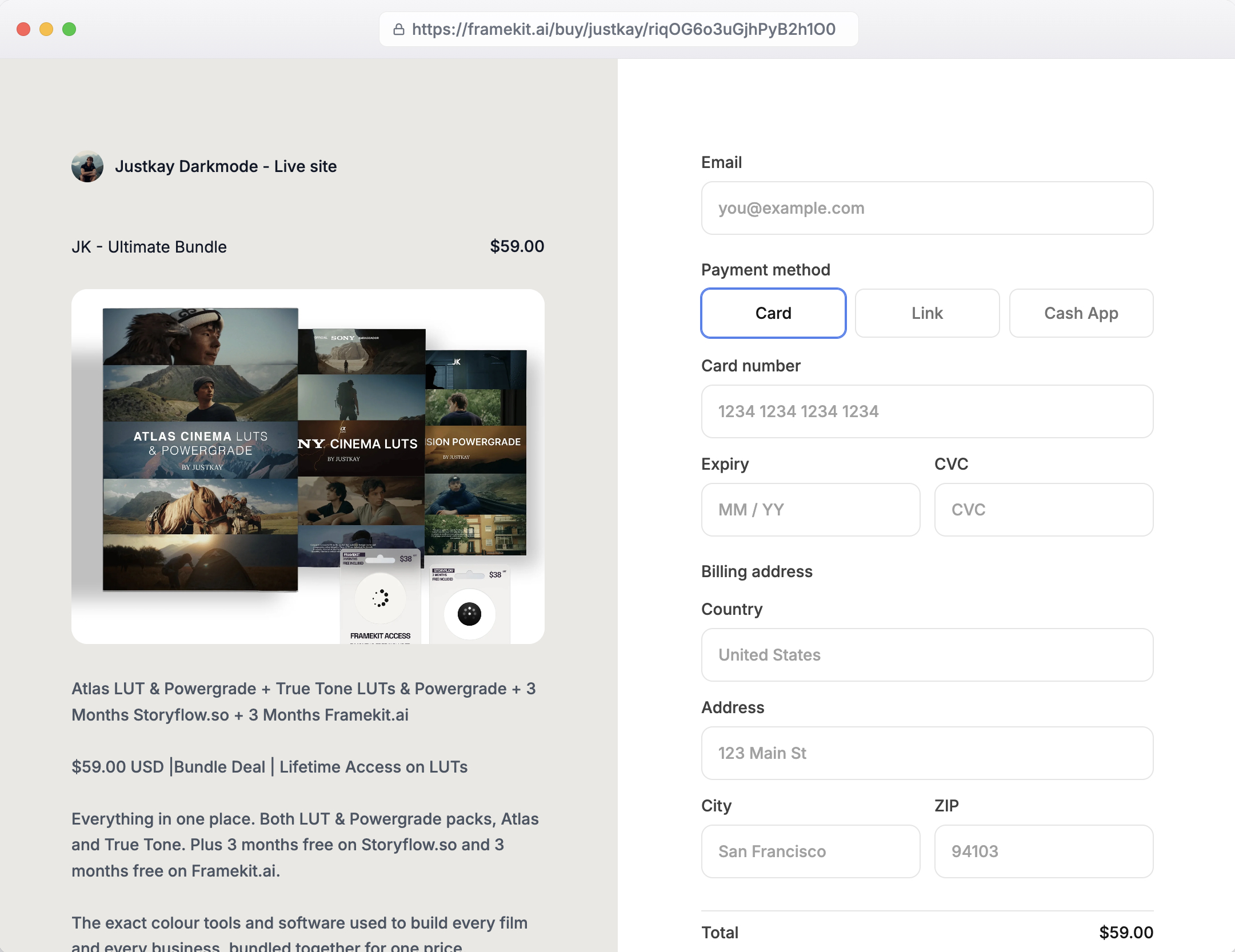
The real numberon the carried $29 pack, the Free plan's 5% is $1.45 and Stripe's EEA card rate is $0.70, leaving $26.85. On Business at $39 a month the Framekit fee is 0%, so a sale keeps Stripe's $28.30 and the plan is the only extra.
The crossover is $780 a month in sales, which is 27 copies of the pack. At 200 sales a month, Stripe fees plus the $39 plan come to $180, against $390 on the flat 5% merchant-of-record platforms.
The standout detailthe charge is a direct charge on your own Stripe account. The money never sits in a Framekit balance waiting for a payout cycle, so Stripe's payout schedule, instant payouts and dashboard are yours as if you had built the checkout yourself.
After payment the buyer gets the file instantly and can come back for it later.
The honest gotchaFramekit is not a merchant of record. You are the seller, so VAT and sales tax are your job exactly as they are on raw Stripe.
Framekit also keeps its own fee when you refund a sale, just as Stripe keeps its processing fee, and discount codes start on Pro.
It sells one-off digital downloads only: no subscriptions, no licence keys, no pay-what-you-want and no affiliate programme.
Skip it ifmost of your buyers are abroad and you never want to file a VAT return (Lemon Squeezy), or your product renews (Paddle).
Verdict: the best choice here for a domestic seller who wants Stripe's economics and a store that looks like their own business, and a poor one for anyone who needs the tax job taken away. See how the Framekit store works.
4. Paddle: Best for Subscription and Licence Products
Paddle prices at 5% plus 50 cents per checkout transaction and is built around software and subscriptions rather than one-off downloads.
It is also a full merchant of record: tax registration, filing and remittance are included in the rate, along with fraud and chargeback handling.
The real numberidentical take-home to Lemon Squeezy at $27.05 on our $29 pack. The difference between them is not price, it is shape.
The standout detailPaddle's pricing page states plainly that products under $10 need custom pricing and a conversation with sales.
That is a genuinely useful disclosure and almost nobody else makes it, because it tells you exactly where a percentage-plus-fixed-fee model breaks. On a $7 product, 50 cents is over 7% before the percentage even applies.
The honest gotchaPaddle is aimed at software companies, and it shows in the onboarding. There is an approval step, and sellers of media assets rather than software sometimes find themselves explaining their product.
If you sell a LUT pack and a preset bundle rather than a licensed application, expect the setup to feel slightly like wearing someone else's coat.
Skip it ifyou sell single cheap downloads and nothing recurring. The fee shape punishes low prices, and Paddle tells you so itself.
What reviewers say elsewherethe G2 listing skews toward SaaS teams, which is worth knowing when you read the reviews - the reviewer base is not selling $19 preset packs.
Verdict: the strongest option in this guide if your product renews. If it does not renew, Lemon Squeezy does the same job at the same price with less friction for a creator.

5. PayPal: Best Second Button, Rarely the First
PayPal is not the cheapest and not the most capable, and it still belongs on your checkout, because a meaningful share of buyers will not enter a card number on a site they have never heard of but will click a button they recognise. That is the entire case, and it is a good one.
The real numberPayPal publishes 2.89% plus $0.29 for Expanded Checkout and 2.99% plus $0.49 for standard PayPal Checkout.
On $29 that is $27.87 and $27.64 respectively - between Stripe and the merchant-of-record platforms, and closer to the middle of the table than PayPal's reputation for expense suggests.
The standout detailthe two rates differ by a dime in percentage terms but by 20 cents in fixed fee, and on cheap products the fixed fee is what hurts. On a $9 product the standard rate is an effective 8.4%, while on a $99 product it is 3.5%.
Same processor, same day, more than double the effective rate depending only on what you charge.
The honest gotchacross-border and currency-conversion pricing is not on the main pricing page. Those fees exist, they vary by country, and you will find them in the fee schedule rather than in the headline.
Any guide that hands you a clean international PayPal number without saying which country it applies to has guessed. We are not going to.
Skip it ifyou want one checkout to reconcile. Running PayPal alongside a card processor means two dashboards, two payout schedules and two sets of disputes, and for a solo seller that is real overhead for a conversion gain nobody in this category has measured publicly.
What reviewers say elsewherePayPal's Trustpilot page is dominated by account-hold complaints from sellers.
Weight it carefully - unhappy sellers review payment holds and happy ones review nothing - but the pattern is consistent enough to plan around. Do not let a PayPal balance be the only place your revenue lives.
Verdict: add it as a second option, never build on it alone. It converts buyers a card form loses, and it is the account most likely to freeze at the worst moment.
6. Gumroad: Fastest to a First Sale, Most Expensive to Stay
Gumroad is not really a payment processor, it is a processor bolted to a store, and that bundle is why it is still the fastest route from a finished file to a working checkout. You can be selling in fifteen minutes with no site at all.
The real number10% plus 50 cents, which takes $3.40 out of our $29 sale and leaves $25.60. That is the lowest take-home in this guide.
The second number is the one to actually watch: sales that come through Gumroad Discover are charged 30%, so the same $29 pack nets $20.30 if a buyer found you through Gumroad rather than through you.
The honest gotchathe 30% Discover rate is not a punishment, it is a marketplace fee for marketing you did not do, and it is defensible on its own terms.
What is not obvious is that once a customer arrives through Discover, Gumroad has introduced your buyer to a page full of other people's products. You paid 30% to be shown next to your competitors.
Skip it ifyou are past roughly $800 a month in sales and your traffic is your own. At $2,000 a month, 10% is $200 a month, or $2,400 a year, for a checkout you could rent for a flat fee elsewhere.
What reviewers say elsewherethe recurring public complaint is the fee level rather than the product, which is a good sign about the product and a bad sign about the maths.
Already on Gumroad and feeling the 10%? Gumroad's fees, broken down shows where the money goes, and the best Gumroad alternatives covers where sellers move next.
Verdict: the best place to start and a costly place to stay. Use it to prove the product sells, then price the move.
7. Polar: Best Documented Fine Print
Polar is a newer merchant of record, and it publishes the most honest fee page in this entire comparison. Where most vendors give you a headline and a footnote, Polar gives you the whole ledger.
The real numberthe Starter plan is 5% plus 50 cents, the same as Lemon Squeezy and Paddle, moving to 3.8% + 40 cents on Pro, 3.6% + 35 cents on Growth and 3.4% + 30 cents on Scale.
Organisations created before 27 May 2026 keep a grandfathered 4% + 40 cents rate with a 0.5% surcharge on subscription payments.
The standout detailPolar publishes what almost nobody else does - the payout side. Two dollars per month in which you take a payout, 0.25% plus 25 cents per payout, and a cross-border payout charge of 0.25% inside the EU rising to 1% elsewhere.
It also states plainly that it does not refund the transaction fee when you refund a customer, because the card networks charge it regardless of what happens later. That sentence is worth more to a seller than any feature list.
The honest gotchathe rate went up. Starter moved from 4% + 40 cents to 5% + 50 cents in May 2026. A young platform repricing once will reprice again, and you should size your dependency accordingly.
Skip it ifyou need a large support organisation behind your checkout. This is a small, fast-moving product.
Verdict: worth a serious look, and worth reading even if you pick something else, because its fee page is the template every other vendor should be held to.
8. Mollie: Best for European Buyers
If most of your buyers are in the Netherlands, Belgium, Germany or France, the conversion problem is not your card rate, it is that your checkout does not offer the payment method they reach for.
Mollie's answer is local methods as first-class citizens rather than an afterthought.
The real number1.80% plus EUR 0.25 on European cards leaves $28.21 of our $29 sale, second only to Stripe, and non-EEA cards are quoted at 3.25% plus EUR 0.25.
The honest gotchaMollie is a gateway, not a merchant of record. The VAT job is still yours, exactly as it is with Stripe, so choose Mollie for the checkout rather than for the compliance.
Skip it ifyour audience is mostly American. You would be optimising for iDEAL in a market that has never heard of it.
Verdict: the right pick for a European seller with European buyers, and an odd one for anybody else.

9. Payhip: Cheapest Way to Bundle a Store and a Processor
Payhip sits between a processor and a storefront: you connect your own Stripe or PayPal account and Payhip layers the store, the delivery and the EU VAT handling on top.
The real numberthe Free Forever plan adds 5% on top of your own processor's fee, Plus is $29 a month with 2%, and Pro is $99 a month with no transaction fee at all. With Stripe's EEA rate underneath, the free plan leaves $26.85 of a $29 sale.
The standout detailbecause the processor is yours, the money lands in your Stripe account rather than in a platform balance. That is a materially different risk profile from any platform that holds your funds and pays you out on a schedule.
The honest gotchathe $99 Pro plan only pays for itself above roughly $2,000 a month in sales against the 5% free tier. Below that you are pre-paying for a discount you are not using.
Verdict: the most sensible structure in the middle of this list. You keep your processor and rent only the parts you actually need.
10. Square: Best If You Also Sell in Person
Square is here for one specific creator: the one who sells prints at a market on Saturday and a preset pack online on Sunday and wants one ledger for both.
The real number2.9% plus 30 cents online leaves $27.86, with in-person at 2.6% plus 15 cents and manually keyed transactions at 3.3% plus 30 cents.
The honest gotchathe fees page does not state a cross-border card rate, and Square's digital-goods tooling is thinner than anything else on this list. It is a point-of-sale company that also does online.
Skip it ifyou never take a payment face to face. There is no reason to be here.
Verdict: a good answer to a question most digital sellers are not asking, and the right answer for the ones who are.
11. Ko-fi: Best Zero-Platform-Fee Option
Ko-fi's proposition is unusual: payments go directly to your own PayPal or Stripe account, and on the paid Gold tier Ko-fi takes no platform cut at all. You pay only what your processor charges.
The real numberwith Stripe's EEA rate underneath and no platform fee, a $29 sale leaves $28.30, matching the top of the table.
The honest gotchaKo-fi blocks automated access to its pricing page, so we could not verify the current Gold price at the source the way we did for every other entry here. Treat the plan price as unconfirmed and check it yourself before you plan around it.
The product limits are also real: this is a tip-jar-plus-shop, not a commerce platform, and the store is on Ko-fi's domain with Ko-fi's branding around it.
Skip it ifyou want the store to look like your business rather than like a Ko-fi page.
Verdict: genuinely the cheapest way to take money for a small catalogue, as long as you accept that the shopfront belongs to someone else.
12. FastSpring: Enterprise Merchant of Record
FastSpring is a long-established merchant of record aimed at software companies with real volume, and it does the full job: global tax, localised checkout, subscription management, reseller channels.
The real numberthere is not one. FastSpring quotes per account and publishes no rate card, and its site blocks automated access, so we could not verify pricing at source. Any specific FastSpring percentage you read in a comparison guide came from somewhere other than FastSpring's pricing page.
Skip it ifyou are a solo creator. A quote-based processor is a poor fit for someone selling a $29 pack, and you will spend a sales call to find out.
Verdict: the right tool at a scale most readers of this guide have not reached. Revisit it at seven figures, not at four.
What the Fee Costs You Over a Year
In one lineprocessing is not a line item, it is a percentage of everything you will ever sell, and it compounds with your growth rather than against it.
Take three realistic volumes for a creator selling digital products and run the same $29 pack through them. These use the domestic take-home from the comparison table, so they are the optimistic case for every option.
| Monthly sales | Stripe (EEA) | Lemon Squeezy / Paddle / Polar | Gumroad |
|---|---|---|---|
| 20 sales, $580/mo | $14.10/mo in fees | $39.00/mo | $68.00/mo |
| 70 sales, $2,030/mo | $49.35/mo | $136.50/mo | $238.00/mo |
| 200 sales, $5,800/mo | $141.00/mo | $390.00/mo | $680.00/mo |
At 200 sales a month, the difference between the cheapest and most expensive column is $539 every month, or $6,468 a year. That is not a fee, that is a salary line.
The trap in reading that table is assuming the cheap column is free money. It is not. The Stripe column comes with a tax obligation you either handle or pay someone to handle, and the merchant-of-record column has already bought that.
The honest way to read it: at 20 sales a month, the $24.90 monthly difference between Stripe and a merchant of record is less than an hour of bookkeeping, so buy the simplicity.
At 200 sales a month, the $249 monthly difference will buy you a great deal of bookkeeping, so do the maths properly.
The test you can run on your own numbers
Open last month's sales report and write down three figures: total revenue, number of transactions, and the share of buyers outside your country. Then:
- Multiply your transaction count by the fixed fee. That is the part of your bill that has nothing to do with how much you charge, and it is the part that punishes cheap products.
- Multiply your revenue by the percentage. That is the part that grows exactly as fast as you do.
- Add them, multiply by twelve.
That annual figure is what your processor keeps whether you have a good year or a bad one. If it is larger than what a flat monthly plan would cost you, you are paying a percentage for something you could be renting.
A processor is only half the decision.
The layer on top of it - the cart that adds an order bump or recovers an abandoned sale - is priced separately and gates its best features unevenly, which the best checkout tools for selling digital products works through against 500 orders of a $49 product.
Which Checkout Converts, and Why We Will Not Give You a Number
In one linewe did not run a conversion test, so what follows is reasoning from mechanics, not a measured result - and you should distrust any guide that hands you a conversion percentage for a checkout it did not A/B test at volume.
What is knowable from the mechanics is still useful:
- Payment method coverage is the biggest lever, and it is regional. A Dutch buyer looking for iDEAL and finding only a card form is a lost sale that has nothing to do with your product. This is Mollie's whole argument.
- A wallet button beats a card form on mobile, because Apple Pay and Google Pay skip the part where somebody types sixteen digits with one thumb on a train.
- Fewer fields wins. A digital product needs an email address and a payment method. A checkout that asks for a shipping address is a checkout built for physical goods, which is exactly the friction you inherit when you bolt a digital-download app onto a store designed for boxes.
- Domain trust is real and asymmetric. A checkout on your own domain, in your own type, with your own name in the address bar, does not have to explain itself. A checkout that redirects to a third party at the moment of payment does.
The Fine Print Nobody Reads Until It Costs Them
In one linethe headline rate is the smallest of the ways a processor takes money from you.
Refunds. Refund a $29 sale and the customer gets $29 back. You do not get the fee back. Polar states this in plain language and explains why: the card networks charge the fee regardless of what happens afterwards.
Framekit behaves the same way with its own store fee. Assume every processor here behaves the same way unless it says otherwise in writing.
A 5% refund rate on a $29 product is not a 5% cost, it is 5% of revenue plus the fees on the refunded sales.
Disputes. A chargeback costs EUR 20 on Stripe's EEA table and $15 on Polar, charged whether you win or lose. On a $29 product, winning a dispute still loses money.
Two practical consequences: put a recognisable name on the card descriptor so buyers know what the charge is, and refund immediately when someone asks rather than defending a $29 sale into a $44 loss.
If your products are large enough that delivery itself is the constraint, the best digital product delivery tools sizes nine of them against a thousand copies of a 2 GB pack and finds that most vendors do not publish a bandwidth allowance at all.
Payout timing and minimums. This is where the platforms differ most and publish least. Stripe pays on a rolling, weekly or monthly schedule of your choosing, with instant payouts priced at 1% and a EUR 0.50 minimum.
Polar charges $2 for each month in which you take a payout plus 0.25% and 25 cents per payout, which is a small fee that is invisible until you are taking weekly payouts on small balances.
Currency and FX. Stripe adds 2% when a sale needs converting, on top of a foreign-card rate already roughly double the domestic one.
If you price in dollars and half your buyers pay in euros, you are running a materially different effective rate than your dashboard's headline suggests.
Merchant-of-record platforms bury this inside a flat rate, which is worth something in predictability even when it costs more.
Getting the money out. Everything above concerns what a sale costs.
What it costs to move the resulting balance into a bank account in another currency is a separate and often larger charge, traced end to end in the best ways to get paid selling digital products.
Tax and merchant of record. This is the single biggest fork in the road. If a platform is the merchant of record, it is legally the seller: it collects VAT and GST, it registers, it files, and the liability is its own.
If it is a gateway, all of that is yours from the first international sale.
Our merchant of record explainer walks the decision, and the tax tools freelance creatives actually use covers what sits underneath the filing.
Affiliate programmes. None of the gateways here run one for you, and the platforms that do include it charge for the privilege in their sale percentage.
If partners are part of your plan, the best affiliate software for digital products prices ten options against $10,000 a month of partner-driven sales and finds the software is about 3% of what the channel costs.
Account risk. Every processor here can freeze an account, and the ones that hold your money on the way to you can hold it longer.
The mitigation is unglamorous: keep a second payment route configured, keep your customer list exported somewhere you control, and never let a platform balance be your only working capital.
Decision Guide
The quick picks at the top of this guide are a five-second scan.
This is the reasoned path, and it is a branching sequence rather than a list, because the right processor depends almost entirely on where your buyers live and how much tax work you are willing to own.
Work down these in order and stop at the first yes.
1. Are more than half your buyers outside your own country, and do you want nothing to do with VAT?
Yes: Lemon Squeezy for one-off digital products, Paddle if the product renews. Stop here. You are buying compliance, not a rate.
2. Are your buyers mostly in your own country?
Yes: Stripe. It is the cheapest option in this guide and the tax job is manageable inside one jurisdiction. Add PayPal as a second button if your audience skews older or less comfortable with card forms.
3. Are most of your buyers in continental Europe specifically?
Yes: Mollie, for iDEAL, Bancontact and SEPA as first-class methods rather than bolt-ons. The VAT job is still yours.
4. Do you have no site, no list, and a file you want to sell this afternoon?
Yes: Gumroad. Accept 10% as the price of speed, and set a revenue threshold now at which you will move.
5. Do you want to keep your own Stripe account but not build a store?
Yes: Framekit if you want product pages next to your work and a hosted checkout under your name, Payhip on the free plan if you want its EU VAT handling, or Ko-fi if you are comfortable selling from their domain.
6. Do you also sell face to face?
Yes: Square, so one system covers the market stall and the download.
7. Do you want the checkout on the same domain as your portfolio?
That is the storefront question rather than the processor question, and it is covered in depth in the best website builders to sell digital products.
Frequently Asked Questions
These are the questions sellers actually ask once the money starts moving, including the uncomfortable ones about refunds, frozen accounts and who is liable for tax. Every answer below is self-contained, so you can read one without reading the rest.
What is the best payment processor for digital products in 2026?
Stripe is the best payment processor for digital products for most sellers in 2026, because it takes the smallest cut of each sale and leaves the checkout, the customer data and the branding with you.
Its published EEA card rate of 1.5% plus EUR 0.25 leaves $28.30 of a $29 sale. The trade is that Stripe is not a merchant of record, so sales-tax registration and filing remain your responsibility.
Lemon Squeezy is second for cross-border sellers who want the tax handled, and Framekit is third for sellers who want Stripe's rate with a ready-made store on their own site.
What is a merchant of record, and do I need one?
A merchant of record is a company that becomes the legal seller of your product, which means it collects and remits VAT and sales tax, takes the compliance liability, and pays you the balance.
Lemon Squeezy, Paddle, Polar, Gumroad and FastSpring all act as merchant of record.
You need one when you sell to buyers in other countries and do not want to register for VAT or GST yourself, which for a solo creator is usually from the first international sale onward.
Stripe vs Lemon Squeezy: which keeps more of a $29 sale?
Stripe keeps more per sale, Lemon Squeezy keeps more of your time. On a $29 domestic sale Stripe's EEA rate leaves $28.30 against Lemon Squeezy's $27.05, a difference of $1.25.
But Stripe's foreign-card rate of 3.15% plus 2% for currency conversion means a cross-border sale costs roughly 5.15% plus the fixed fee, which lands close to Lemon Squeezy's flat 5% - and Lemon Squeezy also files your VAT return.
If most of your buyers are abroad, the money gap largely disappears and the paperwork gap does not.
Do payment processors refund their fee when I refund a customer?
No. Every processor here whose policy we could find keeps the transaction fee on a refunded sale. Polar states the reason explicitly: the card networks charge the fee at the moment of the transaction regardless of what happens afterwards.
Budget refunds as the sale price plus the fee, not just the sale price.
How much does a chargeback cost on a digital product?
A dispute costs EUR 20 on Stripe's published EEA table and $15 on Polar, and both are charged whether you win the dispute or lose it.
On a $29 product that means defending a chargeback costs more than the sale was worth, so the economically rational response to a disputed cheap download is almost always an immediate refund rather than a defence.
Which payment processor is cheapest for products under $10?
None of them are good, and that is a pricing problem rather than a processor problem.
A fixed fee of 50 cents on a $7 product is 7.1% before any percentage applies, so the effective rate on cheap digital goods runs into double digits everywhere.
Paddle is the only vendor here that says so out loud, requiring custom pricing below $10. The practical fix is to bundle: one $29 pack costs far less to process than four $7 items.
Do I need to charge VAT on digital downloads sold to the EU?
Yes, in principle, from the first sale.
EU rules place VAT on digital services at the buyer's location, with no small-seller threshold for cross-border digital sales in the way there is for goods, which is why the one-stop-shop registration exists.
Either register and file, or use a merchant of record that does it for you.
Our guide to what it costs to sell digital products online covers where that lands in your margin.
Is PayPal or Stripe better for selling digital products?
Stripe is better as your primary processor and PayPal is better as a secondary button. Stripe is cheaper on published rates, has stronger tooling and does not hold funds as readily.
PayPal converts a segment of buyers who will not enter card details on an unfamiliar site, at 2.89% plus $0.29 on Expanded Checkout.
Most sellers who take both use Stripe for the checkout and PayPal as an alternative payment method inside it.
Can I switch payment processors without losing my customers?
Yes for one-off digital products, and with real friction for subscriptions. One-off sales carry no state, so switching is a matter of repointing your store and exporting your customer list.
Active subscriptions are different: card details usually cannot be moved between processors without a migration agreement, so subscribers may need to re-enter payment details, and a share of them will not.
Decide your processor before you launch anything recurring.
What happens to my money if my payment account gets frozen?
Your funds are held, typically for a review period, and your checkout stops taking money in the meantime. This is the risk that is not on any pricing page and it applies to every processor in this guide.
The three mitigations that actually help: keep a second processor configured and tested, keep your customer email list exported outside the platform, and do not let a platform balance be your only working capital.
How fast do I get paid?
It varies more than the rates do. Stripe lets you choose a rolling, weekly or monthly payout schedule and prices instant payouts at 1% with a EUR 0.50 minimum.
Polar charges $2 for any month in which you take a payout, plus 0.25% and 25 cents per payout, and 0.25% to 1% more for cross-border payouts.
Merchant-of-record platforms generally pay on a fixed cycle rather than on demand, because they are settling tax alongside your money.
Is Gumroad's 10% worth it?
Gumroad's 10% plus 50 cents is worth it while you have no audience of your own and no store, and stops being worth it the moment you do.
At $2,000 a month in sales it costs $200 a month, or $2,400 a year, which buys a great deal of alternative infrastructure.
The 30% Discover rate is a separate calculation: it is a marketing fee for buyers Gumroad found for you, which is defensible, but it also introduces your customer to a page of competing products.
Does Framekit handle sales tax for me?
No. Framekit is a store and website builder that charges through your own Stripe account, not a merchant of record, so VAT and sales-tax registration and filing remain yours exactly as they would with Stripe.
If removing the tax job entirely is your goal, Lemon Squeezy or Paddle is the better fit and this guide ranks Lemon Squeezy ahead of us deliberately.
Framekit vs Stripe Payment Links: which keeps more of a $29 sale?
Stripe Payment Links keep more on Framekit's Free plan, and the same amount on Framekit Business.
A $29 sale through a bare Stripe link keeps $28.30 on the EEA rate; through Framekit Free it keeps $26.85 after the 5% store fee, and on Framekit Business at $39 a month it keeps $28.30 again.
What Framekit adds is the store around the link: a product page, instant file delivery, re-downloads and a site, which a payment link does not give you.
What is the cheapest way to sell a digital product with no monthly fee?
Ko-fi on a free or Gold plan with your own Stripe account, or Payhip's free plan, are the two cheapest no-monthly-fee routes, because the platform cut is zero or 5% and the money lands in a processor account you control.
The cost is that the shopfront is on someone else's domain. Zero-commission selling platforms compares the whole set.
The Verdict
Stripe wins this guide on the criterion that matters most on a digital product, which is how much of the sale survives.
It is cheaper than everything else here on a domestic sale, it leaves the checkout and the customer with you, and its documentation is the best in the category. If your buyers are mostly in your own country, this is not a close decision.
It becomes close the moment your buyers are not.
Stripe's own numbers show a foreign card at 3.15% plus a further 2% for conversion, which is roughly the flat rate Lemon Squeezy and Paddle charge on every sale while also filing your VAT returns.
At that point you are not comparing rates, you are comparing a rate against a job, and the job is the bigger number for most solo creators.
Where Framekit losesFramekit is not a merchant of record and does not file tax on your behalf, so if your goal is to never think about VAT again, Lemon Squeezy or Paddle is the better fit and we would rather you picked one of them than picked us and were surprised in April.
Framekit also does not replace a processor - it sits on top of Stripe - so nothing in this guide's cost table goes away by using it, and it is not for anyone selling subscriptions or licence keys.
What it changes is where the store lives: product pages on your site, a checkout under your name and logo, your customer list, with a fee that starts at 5% and falls to 0% on a flat $39 a month rather than a percentage that never falls.
Verdict: use Stripe if you sell at home, a merchant of record if you sell abroad, Framekit if you want Stripe's rate without building the store, Gumroad only until you have proved the product sells, and keep the customer list somewhere you control whichever one you choose.
Fees, plans and payout terms in this guide were read off each vendor's published pricing page during the first week of August 2026. Payment pricing moves, so check the two or three numbers your decision actually turns on before you commit.
Related readinghow much it costs to sell digital products online, how to start selling digital products, building a portfolio website with a shop, the best free product-selling software, and how to price digital products.