
Framekit templates
Start from a designer-made template
 Use template
 Use template
 Use template
 Use template
 Use template
 Use template
 Use template
 Use template
Your store says you made $2,000 this month. Your bank says something else, and the gap is bigger than the platform fee you spent a weekend researching.
There are three separate charges between a sale and your bank account, and most comparisons of ways to get paid selling digital products only ever discuss the first one. The platform takes its cut.
The money then sits in a balance, usually in US dollars. Then it converts to your currency and moves to your bank, and that last step is where the least transparent pricing in this entire category lives.
A payout route is the path your money takes after a sale completes: the balance it lands in, the currency that balance is held in, and the transfer that finally moves it to your bank. We followed the same $2,000 all the way along that path.
Wise is the best way to receive money from selling digital products if you are paid in a currency other than your own, because its conversion starts at 0.57% and it publishes the rate openly, while the conversion built into most payout defaults is neither cheap nor published.
Payoneer is a close second at 0.50% conversion and is often the only option a marketplace supports, but it charges a $29.95 annual fee if you receive under $6,000 in twelve months.
If your buyers and your bank are in the same currency, none of this applies and Stripe's direct payouts are free.
Framekit ranks fourth as the cheapest store route into that Stripe payout: sales land directly in your own Stripe account, and on the $39 Business plan it takes 0% - but it is a store, not a payout rail, and it does nothing about conversion.
Disclosure: Framekit is our product. It ranks fourth because this guide is about moving money to your bank, which Stripe, Wise and Payoneer do and we do not. We priced it on the same $2,000 month as everything else and link to every provider.
Framekit was added to this guide in September 2026, when we re-verified its fees against its current pricing page; the other providers' fees were read in August 2026 and are dated in place.
How We Traced the Money
One scenario, followed end to end: $2,000 a month in sales of a $29 digital product, roughly 69 orders, buyers mostly in the United States, and a seller whose bank account is in euros. That is the most common shape of an international creator business and the one where the hidden costs are largest.
We separated the journey into the three charges that actually occur, because lumping them together is how the real cost gets lost:
- The platform cut, taken at the point of sale.
- The payout fee, charged to move the balance out.
- The conversion, charged to turn dollars into the currency your bank actually holds.
Claims below come in three grades. Read at the vendor's own page during the first week of August 2026 covers every fee we quote for Wise, Payoneer, Stripe, PayPal, Gumroad, Lemon Squeezy, Paddle, Payhip and Sellfy. Used directly covers Wise, PayPal, Stripe and Gumroad, where we have moved our own money and watched what arrived. Could not verify is used explicitly, and it applies to one number that matters more than any other in this guide, which we will come to.
By the numbers:
- 0.57% is Wise's published starting conversion rate.
- 0.50% is Payoneer's published rate for moving between currency balances.
- $29.95 is Payoneer's annual fee if you receive less than $6,000 in any twelve consecutive months.
- $1.50 is what Payoneer charges to move money to a local bank in your own country and currency.
- $6.11 is Wise's fee to receive a US dollar wire, against free for a domestic transfer.
- 3 separate charges stand between a sale and your bank, and most fee comparisons discuss one.
- 1 of them is not published anywhere we could find at the source.
The Rubric
We scored on five criteria, weighted for the specific problem this guide is about: getting money out of a selling platform and into a bank account that holds a different currency. That is a narrower question than which platform is best, and it produces a different ranking.
| Criterion | Weight | What it covers |
|---|---|---|
| Total cost from sale to bank | 35% | Platform cut, payout fee and conversion together |
| Transparency of the conversion | 25% | Whether the FX cost is published at all |
| Speed and reliability of payout | 20% | Schedule, holds, minimums, reversals |
| Country and currency coverage | 15% | Where you can actually receive, and in what |
| Account risk | 5% | Freezes, reserves, inactivity charges |
Transparency is weighted unusually high, at a quarter of the score, and the reason is the central finding of this guide: the charge you cannot see is routinely larger than the charges you compared.
Where $2,000 Actually Goes
Every line below is the same month, the same product and the same buyer mix, followed from the sale to a euro bank account.
Platform cuts are shown for four different selling platforms so you can find yours, and the payout and conversion lines apply on top of whichever one you use.
| Step | What happens | Typical cost on $2,000 |
|---|---|---|
| Platform cut, Gumroad | 10% plus 50 cents on 69 orders | $234.50 |
| Platform cut, Lemon Squeezy | 5% plus 50 cents, processing included | $134.50 |
| Platform cut, Payhip Pro | $99 a month, no per-sale fee | $99 plus processing |
| Platform cut, Stripe direct | 1.5% plus EUR 0.25 on EEA cards | About $50 |
| Platform cut, Framekit Business | $39 a month, 0% fee, Stripe processing on top | $39 plus about $50 |
| Payout to bank, Stripe | Included in the processing rate | $0 |
| Payout to bank, Payoneer | Local bank, local currency | $1.50 |
| Receive a US dollar wire, Wise | Swift transfer in | $6.11 |
| Convert USD to EUR, Wise | From 0.57% | About $11 |
| Convert USD to EUR, Payoneer | 0.50% between balances | About $10 |
| Convert USD to EUR, platform default | Not published at source | Unknown |
Read the last row again, because it is the whole point of this guide.
Every other line in that table came off a published pricing page.
The conversion applied when you take a default payout in a currency your platform holds but your bank does not is the one number we could not verify at any vendor's own page, and it is applied to the entire balance rather than to a transaction.
On $2,000 a month, each percentage point of spread is $20, or $240 a year, taken from money you have already paid a platform fee on.
The practical consequence: two creators with identical sales on identical platforms can end the year several hundred dollars apart based purely on which button they pressed to get paid.
In one linecompare payout routes with the same seriousness you compare platform fees, because the conversion is charged on your whole balance and is the least visible number in the chain.
1. Wise: Best for Converting Currencies
Wise gives you local account details in several currencies, which means a US buyer's payment can arrive as a domestic US transfer rather than as an international wire, and you convert on your own schedule at a rate you can see before you press the button.
The real numberconversion starts at 0.57%, registration is free, domestic incoming payments cost nothing, and receiving a US dollar Swift wire costs $6.11. On our $2,000 month, converting the whole balance to euros is roughly $11.
The standout detailthe rate is shown before you commit and the fee is stated separately from the exchange rate. That sounds like a small thing and it is the entire product.
Most conversion elsewhere is priced inside the rate, which means you cannot tell what you paid without looking up the mid-market rate yourself and doing arithmetic afterwards.
The honest gotchathe local account details are not universal. Which currencies you can receive as a local transfer depends on where you are registered, and for some countries the answer is fewer than you hope. Check your own combination before assuming a US dollar balance is free to receive.
Skip it ifyour buyers pay in your own currency already. You would be adding an account to solve a problem you do not have.
What reviewers say elsewhereWise's Trustpilot profile carries a very large review base, with transparency the recurring praise and account verification delays the recurring complaint.
Verdict: the default answer for any creator whose sales and bank account are in different currencies. The published rate is worth more than the marginal difference in percentage.
2. Payoneer: Best Marketplace Coverage
Payoneer's advantage is not price, it is acceptance. A great many marketplaces and platforms will pay into Payoneer in countries where they will not pay into anything else, which makes this the practical answer rather than the theoretical one for a lot of sellers.
The real numberconversion between balances is 0.50%, withdrawal to a local bank in your own country and currency is $1.50, and receiving into a local-currency receiving account is free, with 1% and a $1 minimum for non-local currencies.
The honest gotcha, and it catches small sellers specificallythere is a $29.95 annual fee that applies if your account receives less than $6,000 in any twelve consecutive months. A creator making $300 a month is under that threshold and pays it.
The fee is published, it is not hidden, and it is exactly the kind of thing nobody reads before signing up.
The standout detailthe 0.50% conversion is marginally cheaper than Wise's starting rate, which is worth noting given Wise's reputation. Where Wise wins is that its rate is shown before you convert rather than after.
Skip it ifyour platforms all support Wise or direct bank payout and you earn under $6,000 a year. The annual fee undoes the conversion saving.
What reviewers say elsewherereviewer sentiment splits sharply by country, with the same features praised where coverage is good and criticised where verification is slow. Weight reviews from your own market rather than the aggregate.
Verdict: the pragmatic choice when a platform will not pay you any other way, and a slightly expensive one for very small sellers because of the inactivity charge.
3. Stripe: Cheapest When Currencies Match
If your buyers pay in the currency your bank holds, Stripe is the cheapest route in this guide by a wide margin, because the payout itself is free and there is nothing to convert.
The real numberpayouts to your bank are included in the processing rate, which on the European table served to us is 1.5% plus EUR 0.25 for standard EEA cards.
There is no separate payout fee and no conversion when the currencies match. On our $2,000 month that is roughly $50 in total, against Gumroad's $234.50 before anything has even been converted.
The honest gotchathe moment currencies do not match, Stripe's own conversion is 2% on the pricing we were served, which is roughly three and a half times Wise's published starting rate.
For a European seller taking mostly dollar payments, that 2% on $2,000 is $40 a month, or $480 a year, and it is entirely avoidable by holding the dollars and converting elsewhere.
The standout detailyou can hold balances in multiple currencies rather than converting on every payout, which turns an automatic 2% into a decision you make deliberately.
Skip it ifyou need a marketplace to find your buyers. Stripe moves money and does no selling whatsoever.
Verdict: the cheapest possible answer when currencies align, and a quietly expensive one when they do not unless you change the default.
4. Framekit: Best Store That Pays Into Your Own Stripe

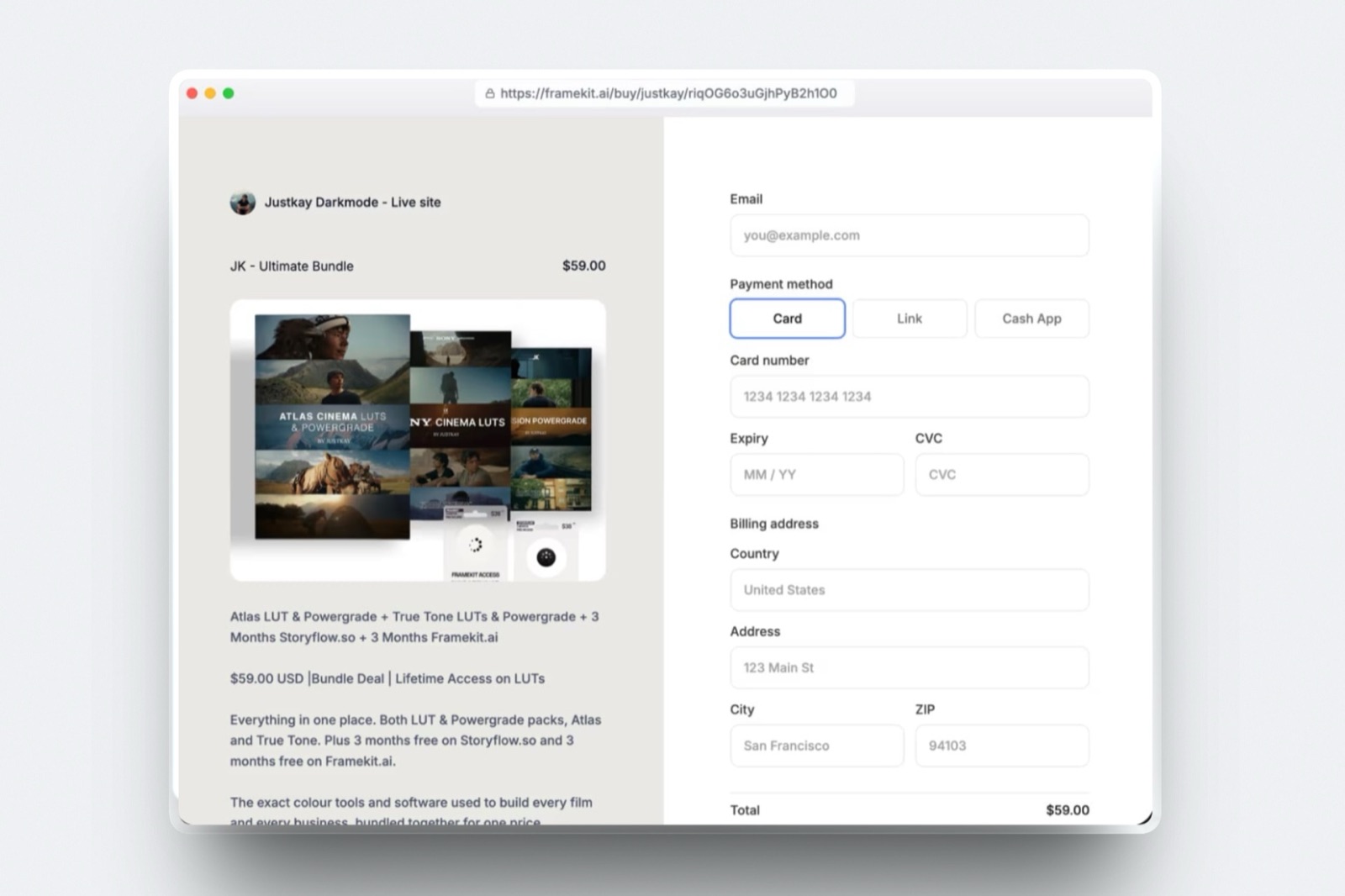
Framekit is an AI website builder whose account also includes a digital-download store, client galleries, video review and Slides, and it belongs in a payout guide for one structural reason: it never holds your money.
Each sale is a direct charge on your own connected Stripe account, so the balance, the payout schedule and the currency settings are Stripe's and yours, not ours.
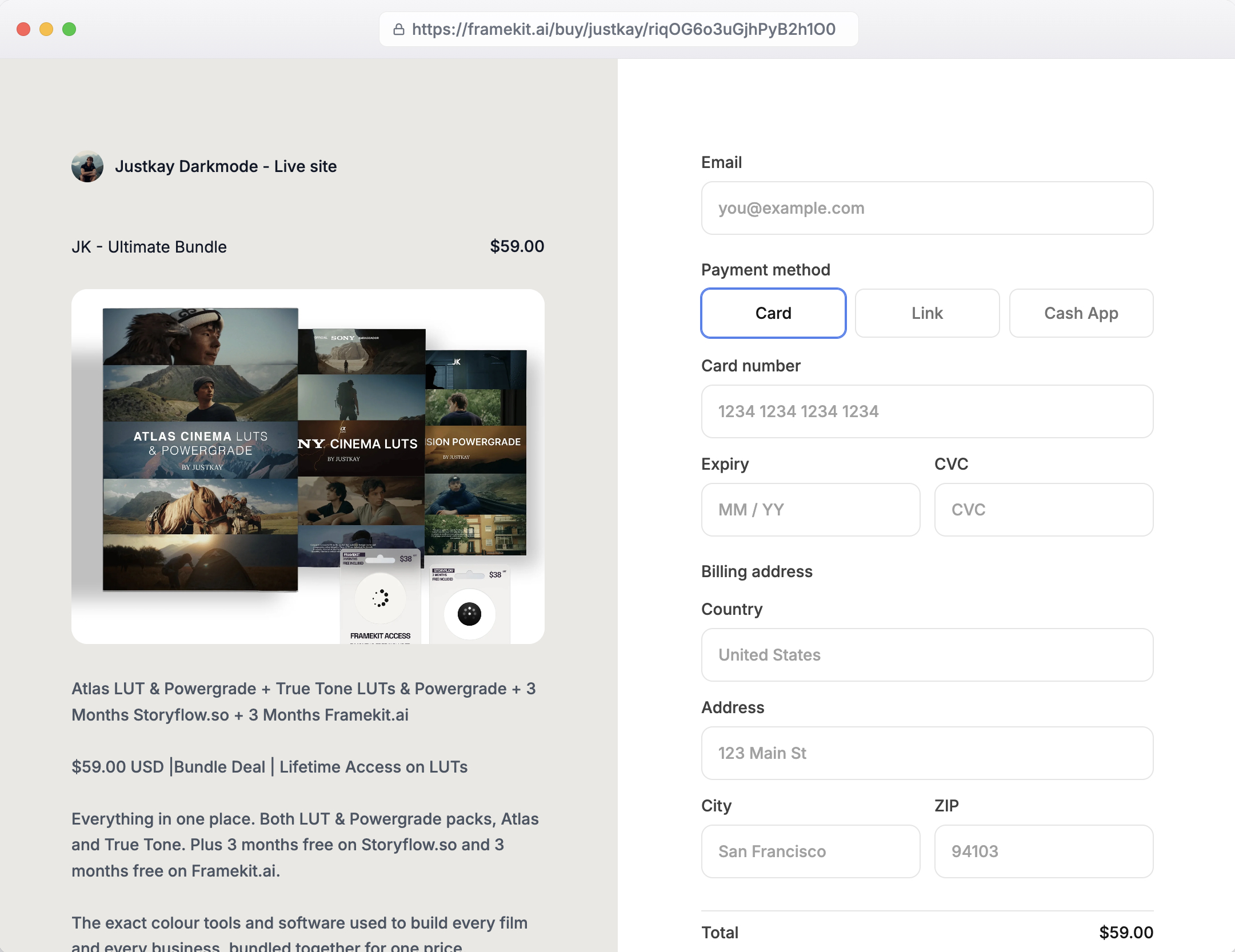
The real numberon our $2,000 month, the Business plan at $39 takes 0%, so the store costs $39 plus Stripe's roughly $50 of processing, about $89 before conversion.
The Free plan's 5% would be $100 plus the same processing, and Pro's 3% is $60 plus the $19 plan. The crossover to Business is $780 a month in sales, so at this volume it is the obvious plan.
Against Lemon Squeezy's $134.50 that is about $45 a month less, and against Gumroad's $234.50 about $145 less.
The standout detailbecause the money is in your own Stripe account, every move in this guide is available to you. You can hold dollars in Stripe instead of auto-converting at 2%, and send them to a Wise account on your own schedule.
A platform that pays you from its own balance decides that for you.
The honest gotchaFramekit does not convert currency, does not pay you out and is not a merchant of record, so the tax you collect is still yours to file and the conversion problem this guide is about is untouched.
It also keeps its own fee on refunded sales on the 5% and 3% plans, and it sells one-off digital downloads only, with no subscriptions.
Skip it ifyou want tax settled before the money reaches you (Lemon Squeezy), or you need a marketplace to find buyers.
Verdict: the cheapest way in this guide to put a store in front of Stripe's free payouts, and no help at all with the conversion. See how the Framekit store gets you paid.
5. PayPal: Most Accepted, Least Transparent
PayPal is the payout method almost every platform supports and almost every buyer recognises, and it is the clearest example in this guide of paying for convenience without being told the price.
The real number, and the honest limit of itPayPal publishes 2.89% plus $0.29 for Expanded Checkout and 2.99% plus $0.49 for standard Checkout on the pricing page.
What is not on that page is the currency conversion spread applied when a dollar balance is paid into a euro account, which lives in a separate fee schedule that varies by country.
We could not verify it at the source, so we are not going to publish a figure for it - and the fact that this is the single hardest number to find in the entire category is the reason it is worth being careful about.
The honest gotchabecause the conversion is priced inside the exchange rate rather than as a separate line, the cost does not appear on your statement as a fee at all. You see a rate. Comparing it requires looking up the mid-market rate for that day yourself.
Skip it ifyou have any alternative your platform supports and your currencies differ. Take the payout in dollars and convert somewhere that publishes its rate.
What reviewers say elsewherePayPal's Trustpilot page is dominated by account-hold complaints from sellers, which is a biased sample by nature but a consistent enough pattern to plan around.
Verdict: keep it as a payment option for buyers, avoid it as a conversion route for yourself.
6. Lemon Squeezy: Paid Net of Tax and Everything Else
Because Lemon Squeezy is the merchant of record, what arrives in your balance is already net of the platform fee, the card processing and the sales tax it collected and remitted on your behalf. That is a genuinely different arrangement from being paid gross and owing tax later.
The real number5% plus 50 cents per transaction with processing inside the rate. On our 69-order, $2,000 month that is $134.50, leaving $1,865.50 before payout and conversion.
The standout detailyou are not holding money that you owe to a tax authority. For a solo creator, the cash-flow clarity of that is worth more than it sounds - the alternative is a balance that looks like profit and partly is not.
The honest gotchapayouts run on a fixed cycle rather than on demand, because tax is being settled alongside your money. If you need funds the day a launch lands, this is not the platform that gives them to you.
Skip it ifall your buyers are domestic and you are already registered for tax where you live. You are paying 5% for a compliance service you do not need.
Verdict: the cleanest money in this guide, arriving slightly later and slightly smaller than the alternatives.
7. Paddle: Same Arrangement, Different Audience
Paddle is the other full merchant of record here, priced identically at 5% plus 50 cents per checkout transaction with tax registration, filing and remittance included.
The real number$134.50 on our test month, the same as Lemon Squeezy, and for the same reasons.
The honest gotchathe payout minimums and schedule are set for software businesses rather than for creators, and there is an approval step at signup that expects you to look like a software company. Sellers of media assets sometimes spend a week explaining what they sell.
Skip it ifyour products are one-off creative files rather than software or subscriptions. Lemon Squeezy does the identical job with less friction for this audience.
Verdict: correct if your product renews, unnecessarily formal if it does not.
8. Payhip: Paid Into Your Own Processor
Payhip's structural advantage for getting paid is that it never holds your money. Sales go into your own Stripe or PayPal account and Payhip bills you separately for its share.
The real numberthe free plan takes 5%, Plus is $29 a month at 2%, and Pro is $99 a month with no transaction fee.
At $2,000 a month, the free plan costs $100 and Pro costs $99 - almost identical, which means anyone doing this volume on free is paying a percentage for no reason.
The standout detailbecause the funds land in your processor rather than in a platform balance, the payout schedule, the currency handling and the risk profile are all yours. If a platform freezes, your money is not inside it.
The honest gotchayou inherit your processor's conversion cost, which if that processor is Stripe on a default setting is 2%. The structure is better; the default is not automatically cheaper.
Skip it ifyou want someone else to handle tax. Payhip handles EU VAT on digital goods but is not your merchant of record in the full sense.
Verdict: the best risk structure in this guide, and the one that most rewards changing the default conversion route.
9. Gumroad: Simplest Payout, Largest Cut
Gumroad pays creators by direct deposit or PayPal depending on country, on a regular schedule, with no configuration at all. It is the least work in this guide and by a distance the most expensive.
The real number10% plus 50 cents per sale, which on our 69-order month is $234.50 - $100 more than Lemon Squeezy and roughly $185 more than taking payments directly through Stripe.
The honest gotchathe payout method available to you depends on your country, and where the answer is PayPal you inherit PayPal's unpublished conversion spread on top of the 10%.
That is two opaque costs stacked, and it lands hardest on sellers outside the US and EU - the same sellers with the fewest alternatives.
Skip it ifyou have any volume at all. The convenience premium is $2,814 a year at this level of sales.
Already on Gumroad and doing real numbers? Gumroad's fees explained works through it, and the best Gumroad alternatives covers the move.
Verdict: the least thinking and the most expensive thinking-free option available.
10. Sellfy: Flat Fee, With a Revenue Ceiling
Sellfy charges a flat monthly fee and takes no percentage, connecting to your own payment accounts so the money arrives the way your processor sends it.
The real numberStarter is $39 a month billed monthly or $29 billed yearly, Business is $79 or $59, and Premium is $159 or $119, all at 0% transaction fees. At our $2,000 month, Starter plus processing is the cheapest flat-fee route here.
The honest gotchathe plans cap annual sales volume at $10,000, $50,000 and $200,000. Our $2,000 a month is $24,000 a year, which is already past Starter's ceiling and into the $79 Business plan.
A 0% transaction fee with a revenue cap is a percentage expressed in steps, and it is worth modelling as one.
Skip it ifyour sales are growing quickly. You will move tiers on revenue rather than on need.
Verdict: genuinely 0% within the band you paid for, which is a narrower promise than it first appears.
One case this guide does not cover: getting paid by a company rather than a person.
That runs on invoices and payment terms instead of payouts, and selling digital products to businesses prices the nine routes that can produce the document a finance department will actually pay.
The Conversion Is the Fee Nobody Compares
The whole reason this guide exists is a mismatch: creators research platform fees exhaustively and accept whatever conversion the payout screen offers, when the second one is charged on a larger number.
In one linea platform fee applies to each sale and the conversion applies to your entire balance, which is why a point of spread can outweigh a point of commission.
Here is the same $2,000 balance converted from dollars to euros four ways.
| Route | Published rate | Cost on $2,000 | Cost over a year |
|---|---|---|---|
| Payoneer, between balances | 0.50% | $10 | $120 |
| Wise, from | 0.57% | $11.40 | $137 |
| Stripe, automatic conversion on payout | 2% | $40 | $480 |
| Platform default paid into a foreign-currency bank | Not published | Unknown | Unknown |
The gap between the top and third rows is $343 a year for pressing a different button, on money you have already paid a platform fee to earn. And the fourth row, which is what most creators are actually on, is the one where nobody can tell you the number.
There is a real counter-argument worth stating: consolidating everything into one account is simpler, and simplicity has value when you are running a business alone. The point is not that everyone should hold four accounts.
It is that the conversion should be a decision you made once, deliberately, rather than a default you inherited.
The test to run on your own account this week
- Find your last payout. Note the amount that left the platform in its original currency and the amount that arrived in your bank.
- Look up the mid-market rate for that date. Any reputable currency site will give it.
- Multiply the amount sent by that rate. The difference between your result and what actually arrived is what the conversion cost you, including anything priced inside the exchange rate.
- Multiply by twelve.
Most creators doing this for the first time find a number between one and four percent of their annual revenue that they had never counted as a fee, because it never appeared as one.
Getting the money is one half of the problem and owing tax on it is the other: the best sales tax tools for digital sellers prices nine of them against $60,000 of sales across three regions, and finds the cheapest one files nothing at all.

Payout Speed, Holds and the Things That Go Wrong
Cost is the part of this you can plan.
Everything in this section is the part you cannot, and it is where the difference between providers actually shows up: a reserve you did not expect, a first payout that takes two weeks, a country that is not supported for the currency you are paid in.
In one linethe difference between platforms is rarely the schedule and almost always what happens when something is unusual.
Rolling reserves. Some processors hold a percentage of your revenue for a period when your account is new or your dispute rate rises.
This is normal, it is disclosed in the terms rather than on the pricing page, and it is a genuine cash-flow event for a small business.
First-payout delay. Almost every platform holds the first payout longer than subsequent ones, typically while verification completes. Plan a launch around this and you will be unpleasantly surprised.
Minimums. Small balances often sit until they reach a floor. This is harmless unless you are relying on the money, and irritating when a $40 balance is stranded because the minimum is $50.
Country coverage. This is the constraint that overrides every cost calculation in this guide.
If your country is not supported by the cheapest route, the cheapest route is not available to you, and the practical answer becomes whichever of Payoneer or PayPal your platform will pay into.
Account freezes. Every option here can freeze an account, and the ones holding your balance can hold it longest.
The mitigations are unglamorous and they work: keep a second payout route verified before you need it, do not let a platform balance be your only working capital, and withdraw on a schedule rather than accumulating.
Decision Guide
This is ordered by the constraint that decides the answer, which here is currency rather than preference: if your buyers pay what your bank holds, most of this guide does not apply to you. Work down the questions and stop at the first yes.
1. Do your buyers pay in the same currency your bank holds?
Yes: take payments through Stripe directly and payouts are free with nothing to convert. Stop here, you have no problem to solve.
2. Is your country supported by Wise for the currency you are paid in?
Yes: hold the balance and convert with Wise at its published rate rather than accepting an automatic conversion on payout.
3. Does your platform or marketplace only pay into Payoneer?
Yes: use Payoneer, and check your annual volume against the $6,000 threshold so the $29.95 inactivity fee does not surprise you.
4. Are you being paid into PayPal by default?
Change it if anything else is available. The conversion is priced inside the exchange rate and is the hardest cost in this guide to see.
5. Do you want the platform to settle tax before it pays you?
Yes: Lemon Squeezy, or Paddle if the product renews. You trade a slower payout cycle for a balance that is genuinely yours.
6. Do you want the money to land in an account you control from the start?
Yes: Framekit, Payhip or Sellfy, all of which connect to your own processor rather than holding funds. Framekit is the cheapest of the three at this volume on its $39 Business plan with no sales cap; Payhip adds EU VAT handling.
7. Do you want to think about none of this?
Gumroad, and accept that at $2,000 a month it costs about $2,814 a year more than doing it yourself.
Frequently Asked Questions
These are the questions that come up when the amount in your bank does not match the amount on your dashboard, which is when most creators discover this part of the stack exists.
What is the best way to get paid selling digital products?
The best way to get paid selling digital products depends on whether your buyers pay in your own currency.
If they do, taking payments through Stripe directly is cheapest, because payouts to your bank are included in the processing rate and there is nothing to convert.
If they do not, hold the balance and convert through Wise at its published 0.57% starting rate or Payoneer at 0.50%, rather than accepting whatever conversion your platform applies automatically.
How much does currency conversion cost when selling internationally?
Between roughly 0.5% and 4% depending entirely on the route, and the expensive end is usually the default. Payoneer publishes 0.50% between balances and Wise publishes from 0.57%.
Stripe's automatic conversion on the pricing served to us is 2%. Conversions priced inside an exchange rate rather than as a separate fee are the hardest to compare, and are typically the most expensive.
Wise vs Payoneer: which is better for creators?
Payoneer is marginally cheaper on conversion at 0.50% against Wise's 0.57% starting rate, and Wise is more transparent because it shows the rate and the fee separately before you convert.
The deciding factor for most creators is coverage: Payoneer is accepted by marketplaces and in countries where Wise is not, which frequently makes it the only real option rather than the preferred one.
Payoneer also charges $29.95 a year if you receive under $6,000 in twelve months.
Does Payoneer charge a fee if I do not use it?
Yes. Payoneer charges $29.95 annually if your account receives less than $6,000 equivalent in any twelve consecutive months.
For a creator making a few hundred dollars a month, that fee can exceed what the account saves on conversion, which makes Payoneer a poor fit for very small volumes unless a platform gives you no alternative.
Why is the money in my bank less than my platform dashboard says?
Because three separate charges sit between the two, and dashboards usually show only the first.
The platform takes its cut at the sale, a payout fee may apply to move the balance, and a currency conversion applies if your bank holds a different currency from the balance.
The third is charged on your whole balance rather than per sale and is frequently the largest of the three.
How do I work out what conversion is actually costing me?
Take your last payout, note the amount sent in the original currency and the amount received, then look up the mid-market exchange rate for that date and multiply.
The gap between your calculation and what arrived is the true conversion cost, including anything priced inside the rate rather than shown as a fee.
Multiply by twelve for the annual figure, which for most creators is between one and four percent of revenue.
Which platforms pay out in my own currency?
It varies by platform and by country, and the honest answer is that you must check your own combination rather than trust a general claim. Stripe supports payouts in many local currencies where it operates.
Gumroad's available payout method depends on your country and is sometimes PayPal only. Framekit, Payhip and Sellfy sidestep the question by paying into your own processor account.
Does Framekit hold my money before paying me?
No. Framekit charges each sale directly on your own connected Stripe account, so the funds sit in your Stripe balance and pay out on your Stripe schedule, in whatever currencies your Stripe account supports.
Framekit's fee is 5% on Free and Starter, 3% on Pro and 0% on the $39 Business plan, and it does not convert currency or file sales tax for you.
Is it better to be paid gross or net of tax?
Net is simpler and gross gives you the cash sooner. Merchant-of-record platforms like Lemon Squeezy and Paddle collect and remit sales tax before paying you, so what arrives is genuinely yours.
Platforms that pay you gross leave you holding money that partly belongs to a tax authority, which looks like better cash flow until the return is due.
How long do payouts take?
Most platforms here run on a fixed cycle of a few days to a couple of weeks, and the schedule is rarely the problem.
The first payout is almost always slower while verification completes, small balances often wait for a minimum, and new accounts sometimes carry a rolling reserve where a percentage is held back.
Plan a launch around the first payout rather than assuming the steady-state schedule.
Can a platform freeze my money?
Yes, and every option in this guide can. Platforms that hold your balance can hold it longest, which is the practical argument for structures where funds land in your own processor account instead.
The mitigations that work are having a second payout route verified in advance, withdrawing on a schedule rather than accumulating a large balance, and never treating a platform balance as your only working capital.
Do I pay tax on money before or after these fees?
Generally you owe tax on your gross revenue and deduct the fees as business expenses, rather than owing tax only on what arrived, though the specifics depend on your jurisdiction and how your business is structured.
This matters because a creator who treats the net payout as their income will understate revenue. Keep the platform statements, not just the bank statements.
What is the cheapest overall way to sell and get paid?
Selling through your own store on your own processor, holding the balance in the currency your buyers pay in, and converting deliberately through a published-rate provider.
On $2,000 a month that is roughly $50 in processing plus about $11 in conversion, plus $39 if Framekit Business is the store, against $234.50 in platform fees alone on the most expensive option here, before conversion is even considered.
The Verdict
Wise wins this guide on the criterion that turned out to matter most, which is not the lowest number but the visible one.
Payoneer is fractionally cheaper on conversion at 0.50%, and Wise publishes its rate in a form you can check before you commit, which over a year of payouts is worth more than seven hundredths of a percentage point.
The larger conclusion is not really about either of them.
It is that most creators have researched their platform fee to two decimal places and have never looked at what their payout conversion costs, despite the second applying to a bigger number.
On $2,000 a month, moving from an automatic 2% conversion to a published 0.57% one saves $343 a year, which is more than several of the platform-fee differences that people agonise over.
Framekit sits fourth: the cheapest store route into your own Stripe payouts, at about $89 a month on Business for this volume, with the money never passing through our hands.
Where Framekit losesFramekit does not convert currency, does not pay you out and is not a merchant of record - Stripe does the payout, and the conversion and tax jobs in this guide stay with you.
If you were hoping a website builder would solve the payout question, it will not, and Wise, Payoneer and Stripe, ranked above us, are where that problem actually gets solved.
Verdict: match your currencies if you can and take Stripe's free payouts. If you cannot, hold the balance and convert through Wise or Payoneer on purpose. And check what your last payout actually cost you, because it is the one fee in this business that nobody sends you an invoice for.
Fees here were read from each provider's published pricing page during the first week of August 2026, except where a figure is explicitly flagged as unpublished. Conversion pricing changes and varies by corridor, so check the specific currency pair you are paid in.
Related readingthe best payment processors for digital products, the best checkout tools for selling digital products, what it costs to sell digital products online, do you need a merchant of record, and how to price digital products.
Before changing platforms, check whether you have simply outgrown a tier, which when to upgrade your creator platform helps you calculate.