Framekit templates
Start from a designer-made template
 Use template
 Use template
 Use template
 Use template
 Use template
 Use template
 Use template
 Use template
When you sell digital products to businesses, almost everything written about selling digital products stops applying.
Every other comparison in this series is an argument about percentages - five against three, ten against nothing, which platform keeps the least of your money. That argument is correct for consumer sales and close to irrelevant here.
A business-to-business digital sale is the sale of a downloadable or licensed digital product to a company rather than an individual, where the buyer needs a formal invoice, a named legal entity, usually a tax identifier on the document, and often payment terms rather than a card charge at the moment of purchase.
That is a different machine from the consumer stores in this series, ours included: Framekit takes a card and issues a receipt, so it belongs to the portfolio-and-direct-sales half of a B2B story rather than to the invoicing ranking below, and there is a labelled section near the end that says exactly where that line falls.
Here is the arithmetic that replaces it. You sell a ten-seat licence to a design agency for $2,000. On Stripe Invoicing the platform takes about $8. On Paddle it takes $100. The gap is $92, and $92 is not the number that decides this deal.
The number that decides it is $2,000, because that is what you lose when the agency's finance manager asks for an invoice with a purchase order number on it and your store can only send a card receipt from a checkout page.
That is the whole thesis. When you sell to businesses, the fee is a rounding error and the paperwork is the product. A tool that takes 5% and gets you paid beats a tool that takes 0.4% and cannot.
FastSpring is the strongest option if selling to companies is a real part of your business, because quotes and invoices are first-class objects there rather than bolted on - but its pricing is quote-only, so you cannot budget for it from the website.
If you already have Stripe, Stripe Invoicing is by far the cheapest way to start at 0.4% per paid invoice, with the catch that you remain responsible for working out the tax yourself.
Paddle and Lemon Squeezy solve the tax problem by becoming the seller of record, and Paddle's own pricing page says invoicing requires talking to sales.
The Number That Actually Matters Here
Before any tool comparison, it is worth being precise about what changes when the buyer is a company rather than a person, because almost everything you have read about selling digital products assumes the second one.
An individual buying a $49 preset pack makes the decision and the payment in the same second, with the same instrument, on the same page. A company buying the same pack for its ten retouchers separates those three things.
Somebody wants the product. Somebody else approves the spend. A third person actually pays, usually weeks later, from an accounts payable system that consumes invoices and produces bank transfers.
Every failure in B2B digital selling happens in the gaps between those three people. The retoucher cannot expense $2,000 on a personal card. The approver will not sign off on a PDF receipt that lists no company name.
Accounts payable cannot match a Stripe charge to a purchase order that was raised against your quote.
Here is the same $2,000 deal priced across the options in this guide, so the size of the fee argument is visible next to the size of the deal.
| Route | Platform cost on a $2,000 deal | Formal invoice | Payment terms | You handle tax |
|---|---|---|---|---|
| Stripe Invoicing Starter | About $8 plus payment processing | Yes | Yes | Yes |
| Stripe Invoicing Plus | About $10 plus payment processing, adds quotes | Yes | Yes | Yes |
| FastSpring | Quote-only, not published | Yes | Yes | No |
| Paddle | $100 at the published rate | Sales conversation | Sales conversation | No |
| Lemon Squeezy | Roughly $100 at the published rate | Yes | No | No |
| Quaderno on top of your store | $29 to $149 a month, flat | Yes | Depends on store | Partly |
| Shopify plus a quote app | $19 to $79 a month plus Shopify | Via app | Via app | Yes |
| Easy Digital Downloads | 79.60 to 349.65 euros a year | Via extension | Via extension | Yes |
| Gumroad | About $200.50 at the published rate plus payment processing | Receipt only | No | No |
The spread on the fee column is about $192 between the cheapest and the most expensive workable option. The spread between closing this deal and not closing it is $2,000. Any decision you make by reading the fee column first is a decision made on the smaller number.
In one lineIn B2B, pick the route that can produce the document your buyer's finance team needs, then optimise the fee afterwards.
How We Priced This, and What We Could Not
The research here ran into a wall that is specific to this category, and naming it up front tells you how much weight to put on each entry below.
Consumer platforms publish prices.
B2B platforms publish contact forms. We read Stripe Invoicing, Quaderno, Shopify Plus, Easy Digital Downloads and the two Shopify apps directly from their own pricing pages, so those figures are exact and dated.
FastSpring publishes no rate at all - its pricing page says the team works with you to determine flat-rate pricing based on transaction type and volume.
Paddle publishes 5% plus 50 cents for checkout transactions and then states that products under $10 or invoicing require contacting sales, which means the published number is not the number a B2B seller pays.
We have not signed a FastSpring contract or negotiated a Paddle invoicing rate, so this guide contains no invented percentages for either. Where a number is missing, the entry says so rather than estimating.
Prices in this guide were read on 10 August 2026. Two of them are in euros because the vendor's pricing page served euros to us, and we have not converted them, because the conversion would be a number we made up rather than a number they published.
The comparison ignores payment processing costs, which apply on top of every route here and are broadly similar across them. It also ignores your accountant's fee, which is real and which the tax-handling column silently determines.
In one lineThree of the nine entries carry no published price, and that absence is itself a finding about how this category sells.
1. FastSpring: Quotes and Invoices as First-Class Objects
FastSpring is the only platform in this comparison where the B2B path is not an afterthought bolted onto a consumer checkout, and you can tell from the way the product is organised rather than from any marketing claim.
What it doesIts digital invoicing product describes creating and managing customised quotes for prospective customers inside the FastSpring app, with expiration terms, custom notes, tags and several discount types.
Localised invoices allow you to add a VAT ID for VAT-exempt customers. It operates as a merchant of record, so it becomes the seller for tax purposes across the regions it covers.
The detail that mattersFastSpring lets prospects generate their own quotes from a storefront, and its own page gives the reason plainly - customers often need internal approval before purchasing.
That single sentence is the entire B2B problem stated by a vendor rather than by us. A buyer who can self-serve a quote can walk it into an approval meeting without ever emailing you, which shortens the part of the cycle you cannot control.
PricingNot published. The pricing page states there is no minimum transaction volume, no additional feature fees, and that rates are set per business based on transaction type and volume, withheld automatically as purchases process.
The honest gotchaYou cannot budget for FastSpring from the website. For a seller doing four B2B deals a year, the sales conversation itself may cost more time than the deals are worth, and there is no free tier to test the workflow before you commit.
Quote-only pricing also means you have no way to know whether you are being offered the same rate as a comparable seller.
Skip it ifB2B is an occasional accident rather than a plan. The setup effort only pays back if invoiced deals are a repeating part of your revenue.
Verdict: The right answer when selling to companies is a strategy rather than a surprise, and the wrong answer when you just want to see a price before you talk to anyone.
2. Paddle: Handles the Tax, Gates the Invoice
Paddle is a merchant of record, which means it becomes the legal seller and takes on the global sales tax and VAT problem entirely, and for a software or template seller with international business customers that is genuinely the hardest part of this job.
What it doesThe published rate is 5% plus 50 cents per checkout transaction, and that single fee covers global tax compliance, subscription billing, fraud protection, chargeback defence and buyer support. There are no monthly minimums or long-term contracts on the pay-as-you-go tier.
The detail that mattersPaddle's own pricing page carves invoicing out of the published rate. It states that products under $10 or invoicing require contacting sales for custom pricing.
So the 5% figure everybody quotes for Paddle is the consumer checkout number, and the B2B number is whatever you negotiate.
That is not a criticism of the rate, which may well be lower at volume, but it does mean Paddle cannot be compared on price against Stripe Invoicing in this guide, because one of the two prices does not exist publicly.
Pricing5% plus 50 cents per checkout transaction. Invoicing priced separately by arrangement.
The honest gotchaOn the published rate, our $2,000 example costs $100. If your B2B deals are large, a percentage fee is a structurally expensive way to buy an invoice, because the work of issuing an invoice does not scale with the amount on it.
Sellers doing a handful of five-figure deals a year should price the flat-fee routes before assuming a revenue share is convenient.
Skip it ifYou are already tax-compliant in your markets and only need a document. You would be buying the expensive half of Paddle to get the cheap half.
Verdict: Excellent if the tax burden is your actual problem, and worth a conversation rather than an assumption if invoicing is.
3. Stripe Invoicing: 0.4% and You Own the Tax Problem
Stripe Invoicing is the cheapest credible route in this entire guide by a wide margin, and the reason it is cheap is that it does one job well and leaves the harder job with you.
What it doesThe Starter tier is 0.4% per paid invoice and the Plus tier is 0.5% per paid invoice, with Plus adding quotes.
Both include a hosted invoice page, automatic collection with smart retries, a customer self-service portal, and invoice auto-reconciliation for ACH and wire transfers. Stripe Payments pricing applies on top for the money actually moving.
The detail that mattersThe auto-reconciliation for ACH and wire is the B2B feature hiding in plain sight.
Large company payments frequently arrive as bank transfers rather than card charges, days or weeks after the invoice, with a reference number that has to be matched back to the original document by hand.
Automating that match is unglamorous and it is exactly the work that makes invoiced selling tolerable at more than a handful of deals a month.
Pricing0.4% per paid invoice on Starter, 0.5% on Plus, plus standard Stripe payment processing. No setup fees.
The honest gotchaStripe is not a merchant of record. You remain the seller for tax purposes everywhere you sell, which for digital goods sold internationally is a genuine obligation rather than a formality.
On our $2,000 deal you save roughly $92 against Paddle and you buy yourself a compliance job that may cost considerably more than $92 a year to discharge properly.
Skip it ifYou sell to businesses across many countries and have no tax adviser. The saving is real and the exposure is real, and only you can price the second one.
Verdict: The best value in this guide and the one with the most homework attached, which is the same sentence viewed from two sides.
4. Lemon Squeezy: Merchant of Record With a VAT ID Field
Lemon Squeezy occupies the middle of this comparison deliberately: it is a merchant of record like Paddle and FastSpring, but it is set up and priced like a consumer store, which makes it the least ceremonious way to accept a business buyer.
What it doesIt sells as merchant of record, collects and remits VAT and sales tax on your behalf, accepts a business tax identifier at checkout so EU business buyers are handled under the reverse charge, and issues invoices to buyers without you doing anything.
Setup is measured in an afternoon rather than a procurement cycle.
The detail that mattersFor a seller whose B2B is real but small - a few agencies a year buying team licences of a font or template pack - the deciding factor is not features but whether the business buyer hits a wall. On Lemon Squeezy they do not.
The buyer enters a company name and tax ID, gets a compliant document, and expenses it. Nobody had to build anything.
PricingWe could not load Lemon Squeezy's pricing or fee documentation during this research, so this entry carries no fee figure. Treat any percentage you have seen quoted elsewhere as unverified until you read it on their own page.
The honest gotchaThere are no payment terms. A business buyer still pays by card at the moment of purchase, which is fine for a $2,000 deal on a company card and impossible for a buyer whose policy is net 30 on everything. Merchant of record solves tax, not procurement.
Skip it ifYour buyers insist on paying by bank transfer after the fact. No amount of tax handling fixes a payment method mismatch.
Verdict: The lowest-effort way to be payable by a company, provided that company is willing to use a card.
5. Quaderno: The Layer That Fixes Whatever You Already Use
Quaderno is the only entry here that does not sell anything for you, and that is precisely its argument: it sits on top of the store you already run and produces the compliant documents that store cannot.
What it doesFour published tiers - Hobby at $29 a month for 25 transactions, Startup at $49 for 250, Business at $99 for 1,000 and Growth at $149 for 2,500, with custom pricing beyond that.
A transaction counts any sale, refund or purchase recorded in the app. Exceeding a limit upgrades the plan automatically rather than triggering overage charges.
All tiers include international tax calculation, nexus alerts, automatic invoicing and tax reports. Only Hobby is limited to a single jurisdiction, single user and single integration.
The detail that mattersThe pricing is flat, which inverts the arithmetic of every percentage-based option above. On our $2,000 deal Quaderno's marginal cost is zero, because you have already paid the monthly fee.
A seller closing twelve $2,000 deals a year pays $588 on the Startup tier for all of them, against $1,200 in Paddle fees at the published rate on the same revenue. The larger your average deal, the more decisively flat pricing wins.
Pricing$29, $49, $99 or $149 a month by transaction volume, with a seven-day trial and no card required to start.
The honest gotchaQuaderno is a document and compliance layer, not a payment route. It will not give a buyer net 30 terms, it will not chase an unpaid invoice, and it does not remove your status as seller of record.
You are still the merchant; you have bought better paperwork and better tax reporting, which is valuable and is not the same as somebody else taking the liability.
Skip it ifYour platform already issues compliant invoices and remits your tax. Adding Quaderno to a merchant of record is paying twice for one job.
Verdict: The best value in the guide for a seller with large or frequent B2B deals on a store that is otherwise fine.
6. BSS B2B Order and Request a Quote: Shopify's Quote Desk

If your store is already on Shopify, the missing B2B piece is usually not payment but negotiation, and this app adds the request-a-quote workflow that a company buyer expects before any money is discussed.
What it doesBuyers request quotes, negotiate pricing and place bulk orders, with customisable quote forms, a call-for-price button that hides prices from guests, CSV bulk uploads, quick reordering from history and quote management inside Shopify.
The Business tier adds email approval and automatic conversion of an accepted quote into an order.
The detail that mattersHiding prices from guests sounds like a gimmick and is the single most requested B2B behaviour in the category.
A company buying twenty seats does not want your retail price on the page, because the whole point of the conversation is that they are not paying it.
An app that can suppress the number until a quote exists changes what kind of deal is possible.
PricingGrowth is $19 a month or $194.40 a year, Business is $39 a month or $398.40 a year, and Enterprise is $79 a month or $806.40 a year, with a 14-day trial and a free tier for development stores. Growth caps quotes at 100 a month; Business and above are unlimited.
The rating4.9 stars from 172 reviews on the Shopify App Store, with 94% of them at five stars.
The honest gotchaThis is an app on a platform, which means two subscriptions and two places for something to break.
It also assumes Shopify, which for pure digital sellers is already an odd fit - you are paying for an inventory and shipping engine you will never use in order to reach an app ecosystem.
Skip it ifYou are not on Shopify. Nothing here justifies moving there for digital products alone.
Verdict: The best-reviewed quoting workflow in the guide, available only to sellers who already made the Shopify decision for other reasons.
7. Net Terms Tracker: Net 30 at Checkout, and No Track Record
This app does the one thing every other entry in the guide refuses to do, which is let a business buyer complete a checkout without paying at that moment, and it is listed here with an unusually large warning attached.
What it doesApprove a customer for Net 15, Net 30 or Net 60 terms and enforce it at checkout, with per-customer credit limits, branded PDF invoices, a customer finance portal where buyers view and pay their own invoices, automated payment reminders and CSV exports.
The detail that mattersThe customer finance portal is the part that scales. Chasing an unpaid invoice is a task that grows linearly with the number of invoices, and it is the reason most small sellers refuse terms entirely.
Handing the buyer a page where they can see what they owe and settle it converts your collections work into their administrative work, which is where it belongs.
PricingA free Starter plan covering five net-terms customers with manual order approval, and a Pro plan at $29 a month for unlimited customers with credit limits, the finance portal, branded invoices and reminders, with a 30-day trial.
The honest gotchaThe app launched on 6 May 2026 and currently has no reviews and no star rating at all. We have not run a payment cycle through it.
Extending credit to strangers on the strength of software with no track record is a genuinely bad idea, and the free tier's five-customer cap is the right way to test it - on buyers you already trust.
Skip it ifYou cannot afford to be paid late. Offering terms means accepting that some invoices arrive at day 45 and a few never arrive at all.
Verdict: The only route in this guide to terms at checkout, and one to trial narrowly rather than adopt.
8. Easy Digital Downloads: WordPress, Once You Add the Parts
Easy Digital Downloads is the self-hosted answer, and it earns its place here on a single structural advantage: on your own WordPress install, nothing about the transaction is anybody else's decision.
What it doesA free Lite version on the WordPress plugin directory, then four paid tiers - Personal at 79.60 euros a year, Extended at 159.60, Professional at 209.65 and All Access at 349.65, priced annually.
Software licensing, advanced reporting and the wider extension library sit on the upper tiers. Invoicing is not a headline feature of any tier and is added through an extension.
The detail that mattersThere is no platform fee. On our $2,000 deal EDD takes nothing at all, and on twelve such deals a year it still takes nothing, which means the entire annual cost of the software is recovered on the first invoice you send.
That is a different economic shape to everything above it, and for a seller with high-value B2B deals it is the cheapest structure available anywhere in this series.
PricingFree Lite tier, then 79.60 to 349.65 euros a year depending on extension access.
The honest gotchaEverything is assembly. You are responsible for hosting, updates, plugin conflicts, the payment gateway, and your own tax compliance in every market you sell into, with no merchant of record standing between you and a foreign tax authority.
The plugin cost is the small part of the true cost.
Skip it ifYou do not already run WordPress and do not want to. The savings do not survive the first weekend spent debugging a checkout.
Verdict: The cheapest way to invoice a company for a large digital sale, sold to you as parts rather than as a product. Our WordPress plugins guide for digital downloads goes deeper on the assembly.
9. Gumroad: Fastest to Sell, Worst to Invoice
Gumroad is in this guide because a large share of the people reading it are already using it, and the honest advice is that it is the weakest B2B tool here despite being one of the best consumer ones.
What it doesA hosted checkout, a card payment, an emailed receipt and file delivery, all working within minutes of signing up. It acts as merchant of record for sales tax and VAT, so the tax side is genuinely handled.
The detail that mattersWhat arrives in the buyer's inbox is a receipt, not an invoice raised against a purchase order. For an individual those words are interchangeable.
For an accounts payable department they are not: a receipt records that somebody paid, while an invoice is a request for payment that can be matched to an approved PO before any money moves.
Gumroad produces the first and the entire B2B process is built around the second.
Pricing10% plus 50 cents on each sale, with card processing charged on top, the highest platform rate in this series. On our $2,000 deal that is $200.50 before processing.
The honest gotchaYou are paying the highest fee in the guide for the least B2B capability in the guide. That combination is defensible when Gumroad's audience and discovery are doing work for you, and indefensible on a deal you sourced yourself from an agency that found you directly.
Skip it ifMore than a small fraction of your revenue comes from companies. Our breakdown of Gumroad's fees shows what the rate costs at various volumes.
Verdict: Keep it for consumer sales if it is working, and invoice your business buyers from somewhere else. There is no rule that says one product needs one checkout.
What Procurement Actually Asks For
The requirements below are not preferences, and knowing them in advance is the difference between a deal that closes in a week and one that dies quietly in an approval queue nobody tells you about.
A document titled Invoice. Not a receipt, not an order confirmation. It needs an invoice number that is unique and sequential, an issue date, and payment terms stated on the face of it.
Your legal entity and theirs. Your registered business name and address, and theirs exactly as they gave it to you. A mismatch of one word against their supplier record can bounce the document back to you.
A tax identifier, usually both. Yours because their bookkeeping requires it, theirs because whether you charge tax at all may depend on it.
A purchase order number, when one exists. This is the single most common reason a digital seller gets stuck.
The company raised a PO before you were paid, and their system will not release funds against an invoice that does not quote it. If your checkout has no field to carry that number, you cannot be paid through their normal process.
A payment method their treasury uses. Card is fine for smaller amounts at many companies and forbidden at others. Bank transfer is universal and slow.
In one lineRead that list against your current checkout, and the entries that fail are your actual shortlist criteria.
The Reverse Charge, Explained Without Jargon
If you sell to businesses in other countries, one tax rule shapes more of this decision than any feature, and it is much simpler than its name suggests.
Selling a digital service to a business in another EU country generally means you do not charge VAT at all.
The European Commission's own guidance for businesses states that if you sell services to businesses based in another EU country you do not usually need to charge your customers VAT, and that your customers pay VAT on the services received at the applicable rate in their country using the reverse charge procedure.
The official EU guidance on cross-border VAT is the primary source, and it is worth reading in full before you accept anyone else's summary of it, including this one.
The practical consequence is that a B2B sale into the EU and a consumer sale into the EU are different transactions with different tax outcomes, and your store has to be able to tell them apart.
That is what the business tax ID field on a checkout is for. Without it, every sale is treated as consumer, which means either you charge VAT you did not need to charge, or your paperwork does not support the treatment you applied.
This is also the strongest argument for a merchant of record. FastSpring, Paddle and Lemon Squeezy each take this determination on themselves.
That is the thing you are buying with the percentage, and if you sell internationally it is worth more than the percentage looks like it costs.
Our guide to selling digital products in Europe covers the consumer side of the same rules.
In one lineA business buyer in another country is a different tax event, and a checkout with no tax ID field cannot see the difference.
Purchase Orders and Payment Terms: What You Are Agreeing To
Offering net 30 sounds like a small accommodation and it is a financing decision, so it deserves to be priced rather than agreed to reflexively when a large buyer asks.
When you invoice on net 30, you have delivered the product and lent the buyer its value for a month. On a $2,000 deal that is a $2,000 loan at zero interest.
Twelve such deals staggered through the year means you are permanently carrying roughly $2,000 of unpaid work, which for most solo sellers is a meaningful share of working capital.
Then there is the part the terms do not say. Net 30 is measured from the invoice date at some companies and from the date their system received it at others, and the second one starts whenever an inbox is processed.
Payment runs are frequently weekly or fortnightly, so an invoice that matures on day 30 pays on day 35. A missing PO number sends it back to the start.
The defensible version of terms for a small seller looks like this. Offer them only above a deal size that makes them worth it. Require the PO number before you deliver, not after.
Cap how much any single buyer can owe you at once, which is exactly what a credit limit feature does. And treat late payment as the base case, because it is.
In one lineTerms are credit you are extending, so set a limit per buyer and get the PO number before the files leave your hands.
Multi-Seat Licensing: The Part Nobody Prices
Almost every guide to selling digital products assumes one buyer and one copy, and the moment a company is involved that assumption breaks in a way that costs real money.
An agency buying your template pack for ten designers is not buying ten copies.
They are buying one file and permission for ten people to use it, which means the thing you are actually selling is a licence document, and your price for it is a number you invented.
Charge the individual price and you have sold $49 of work to a team that will produce ten designers' output from it.
Charge ten times the individual price and you will lose most of these deals, because the buyer knows the marginal cost of a second download is nothing.
The pricing most sellers land on after a few of these is a tiered licence: single user, small team up to five, and a company-wide tier priced at roughly three to six times the single-user rate rather than by headcount.
That is a convention rather than a law, and it exists because it is defensible to a buyer without requiring you to audit anybody.
The technical enforcement is a separate question with its own guide - our look at protection tools covers what licence keys can and cannot actually stop.
For B2B specifically, enforcement matters less than clarity: a company that has bought a five-seat licence generally intends to comply with it, and mostly needs the document to say plainly what it bought.
In one lineWrite the licence tiers down before your first company enquiry, because inventing them under time pressure costs you either the deal or the margin.
The Adjacent Job: What Framekit Does and Does Not Do Here
This section is labelled so you can skip it. Framekit is not ranked in the nine above, and when we re-verified its store in September 2026 the reason was unchanged: a straightforward capability gap rather than modesty.
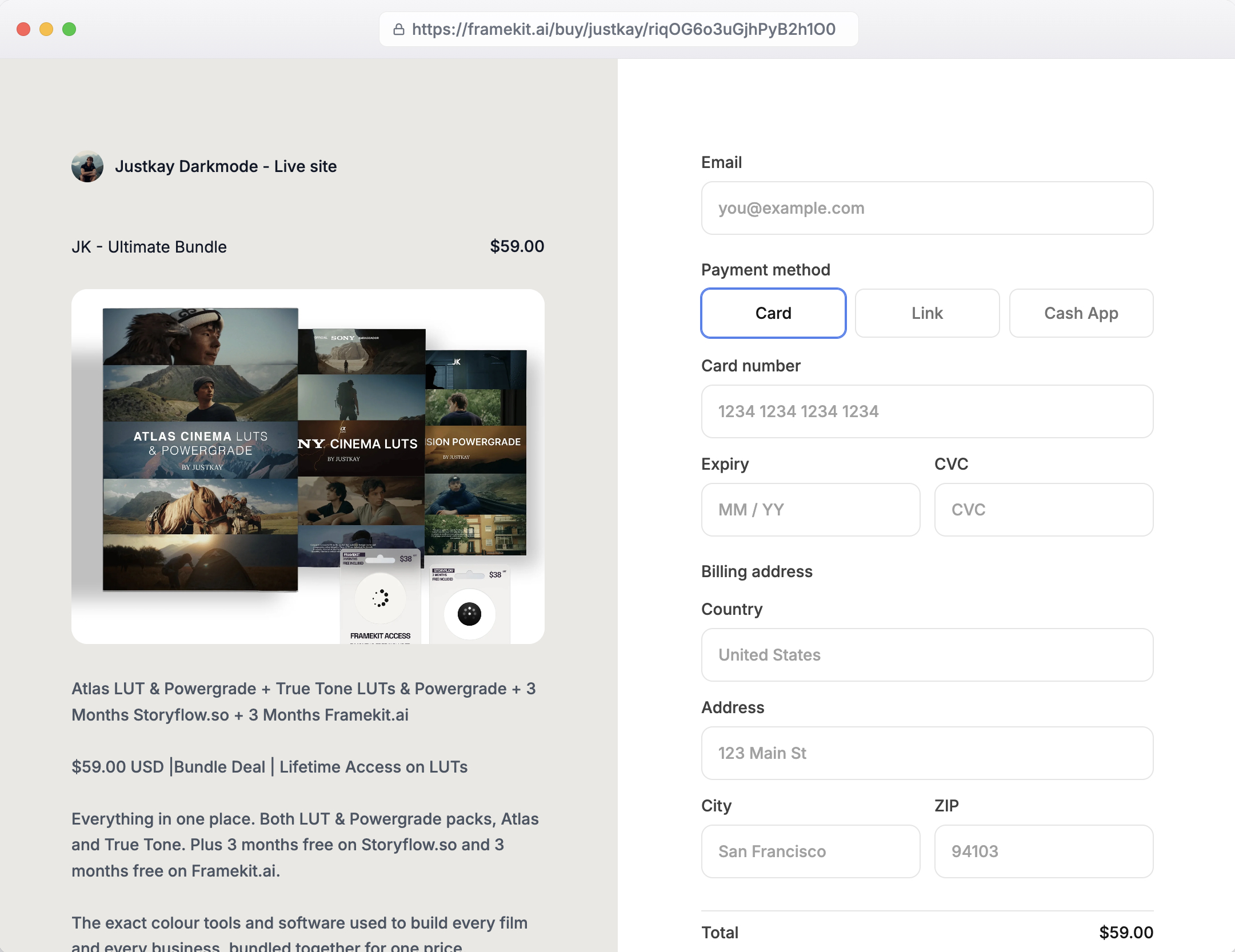
Framekit is an AI website builder that generates a portfolio site and a connected digital store from a description of your work, then lets you sell files from it with a card checkout. That is a consumer selling flow.
There are no company accounts, no purchase order field, no net payment terms, and no quote-to-order workflow. Framekit is not a merchant of record either, so you remain the seller for tax purposes on the sales it processes.
For a business buyer, that means a wall Gumroad has too.
They can pay by card, through a Stripe checkout paid into an account in your name, and receive files immediately, and if their finance process needs a PO-matched invoice with their VAT number on it, our checkout will not produce one.
Where Framekit is genuinely useful in a B2B story is the part before and around the transaction.
Companies find individual creators through portfolios, and the site that convinces a creative director to license your work is a different artefact from the invoice that pays you for it.
The same account holds Slides, for the pitch or proposal deck a company asks for before it commits, and video review, where a client comments at the exact frame and approves the cut on commissioned work.
Plenty of sellers in this guide will run a Framekit portfolio and store for direct consumer sales and invoice their occasional agency deals through Stripe Invoicing, which costs about $8 on our example and requires no migration of anything.
Framekit's own product-sale fee is 5% on the Free and Starter plans, 3% on Pro at $19 a month and 0% on Business at $39 a month, with plans billed monthly or annually at a 20% discount. Those apply to consumer sales through the store, which is the job it does.
In one lineUse Framekit for the portfolio and the direct sales, and invoice companies from a tool built to invoice companies.
Decision Guide
This is ordered by the question that actually gates the decision, which is not how much you sell but how the buyer is permitted to pay you. Work down and stop at the first yes.
Does your business buyer pay by company card, at the moment of purchase? Then you do not have a B2B problem, you have a tax problem. Use Lemon Squeezy or any merchant of record with a business tax ID field at checkout and stop reading.
Do they need a formal invoice but can pay it promptly? Use Stripe Invoicing at 0.4% per paid invoice if you have a tax adviser or sell domestically, and FastSpring if you sell internationally and want the tax liability to be somebody else's.
Do they require net 15, 30 or 60 terms? Only two routes here reach that: Net Terms Tracker on Shopify at $29 a month, or invoicing manually through Stripe with terms stated on the document and collections done by you.
Do they negotiate price before buying? You need quotes as an object, not an email thread. That is FastSpring, Stripe Invoicing Plus at 0.5%, or the BSS quote app at $19 a month if you are on Shopify.
Are your deals large and infrequent? Stop paying percentages. Quaderno at $49 a month or Easy Digital Downloads at 79.60 euros a year both cost the same on a $200 sale and a $20,000 one.
Is this your first company enquiry and you have nothing set up? Send a Stripe invoice. It takes fifteen minutes, costs 0.4%, and you can design a proper process after you find out whether this happens twice.
Frequently Asked Questions
Can I just send a business buyer a PDF invoice I made myself?
Yes, and for a first deal it is often the right call.
An invoice is a document with required information on it, not a regulated artefact, so a well-formed PDF with your entity details, their entity details, a unique invoice number, both tax identifiers, the PO number if they gave you one, and your bank details is perfectly payable.
What you lose is automatic reconciliation, reminders, and any record that connects the payment to the order. That is fine at two invoices a year and unmanageable at twenty.
What is a merchant of record, and do I need one to sell to businesses?
A merchant of record is a company that becomes the legal seller of your product, taking on responsibility for collecting and remitting sales tax and VAT in the buyer's jurisdiction.
FastSpring, Paddle, Lemon Squeezy and Gumroad all operate this way.
You do not need one to sell to businesses, but if you sell across borders it removes the single most error-prone obligation you have, and the percentage they charge is largely the price of that removal.
Why does my buyer keep asking for a purchase order number?
Because their company raised a PO to approve the spend before you were engaged, and their accounts payable system will only release payment against an invoice quoting that number. It is a control designed to stop unapproved spending.
The practical implication for you is that the PO number has to appear on the document you send, so your invoicing tool needs a custom field or a notes area that can carry it.
Should I charge VAT to a business customer in another EU country?
Usually not.
The European Commission's guidance for businesses states that services sold to businesses in another EU country generally do not carry VAT from you, and the customer accounts for it at their local rate under the reverse charge procedure.
The complication is proving the buyer is a business, which is what a validated tax identifier does.
If you are unsure, read the official guidance linked earlier in this guide and confirm with an accountant, because the liability for getting it wrong sits with you.
Is net 30 worth offering to close a deal?
Sometimes, and it is a financing decision rather than a courtesy. On a $2,000 sale you are lending the buyer $2,000 for a month at no interest, and in practice usually longer than a month because payment runs and PO matching add days.
Offer terms above a deal size that justifies the carrying cost, cap what any single buyer can owe you at one time, and get the purchase order number before you deliver the files rather than afterwards.
How should I price a multi-seat licence for a company?
The common convention is three tiers - single user, a small team tier covering up to about five people, and a company-wide tier priced at roughly three to six times the single-user rate.
Pricing strictly per head tends to lose deals, because the buyer knows an extra download costs you nothing, and pricing at the individual rate leaves obvious money on the table. Whatever you choose, write it down before the enquiry arrives.
Which option is cheapest for a $2,000 deal?
Easy Digital Downloads is cheapest in platform fees, taking nothing on the sale itself against an annual software cost from 79.60 euros.
Stripe Invoicing is cheapest among hosted options at about $8 on the Starter tier plus payment processing. Paddle costs $100 at its published rate and Gumroad $200.50 at 10% plus 50 cents.
None of these figures include payment processing, and none of them price the tax work that the cheaper routes leave with you.
Do I need a different store for business customers?
Not usually, and running two is often simpler than making one do both jobs.
A consumer store optimised for immediate card purchases and an invoicing tool for the occasional company deal is a common and perfectly respectable setup, because the two transactions have almost nothing in common beyond the file being delivered.
Adding an invoicing route costs you very little and does not require moving your existing catalogue anywhere.
What if the company simply refuses to pay by card?
Then you need bank transfer, and the tools that reconcile it automatically are worth their fee. Stripe Invoicing includes auto-reconciliation for ACH and wire transfers, which matches an incoming transfer to the invoice it settles.
Doing that manually is tolerable at low volume and becomes the worst recurring task in your week somewhere around ten open invoices.
The Verdict
If selling to companies is a deliberate part of your business, FastSpring is the strongest option in this guide, because quotes, invoices and VAT-exempt handling are built into the product rather than added to it, and because buyers can generate their own quote and walk it into an approval meeting without you.
The trade-off is real and worth stating twice: its pricing is quote-only, so you cannot evaluate the cost before you talk to a salesperson, and for a seller with a handful of B2B deals a year that conversation is not a good use of a week.
For most people reading this, the honest recommendation is smaller. Send a Stripe invoice.
At 0.4% per paid invoice it costs about $8 on a $2,000 deal, it takes fifteen minutes to set up, it handles the bank transfer reconciliation that makes invoicing tolerable, and it commits you to nothing.
The catch is that you remain the seller for tax purposes, which is a genuine obligation rather than a technicality, and if you are selling internationally without an adviser then paying Paddle or FastSpring a percentage to take that liability is money well spent.
Framekit is not for this job and does not pretend to be. It has no purchase orders, no payment terms, no company accounts and no quote workflow, and it is not a merchant of record.
If your buyers are businesses with a procurement process, our checkout will not produce the document they need, and the better answer is to keep the portfolio and consumer store where they are and invoice companies from a tool built for it.
The thing worth carrying away is the arithmetic at the top. Across every route here the fee difference on a $2,000 deal is about $192. The difference between having an invoice and not having one is $2,000. Optimise the second number first.
Verdict: Choose the route by what your buyer's finance department can pay, not by the percentage on the pricing page, and expect the cheapest route to be the one that leaves the most work with you.
Sources for this guide were read on 10 August 2026 from each vendor's own pricing or product documentation, with the cross-border VAT position taken from the European Commission's business guidance.
Three vendors publish no rate, and their entries say so instead of estimating one.