Framekit templates
Start from a designer-made template
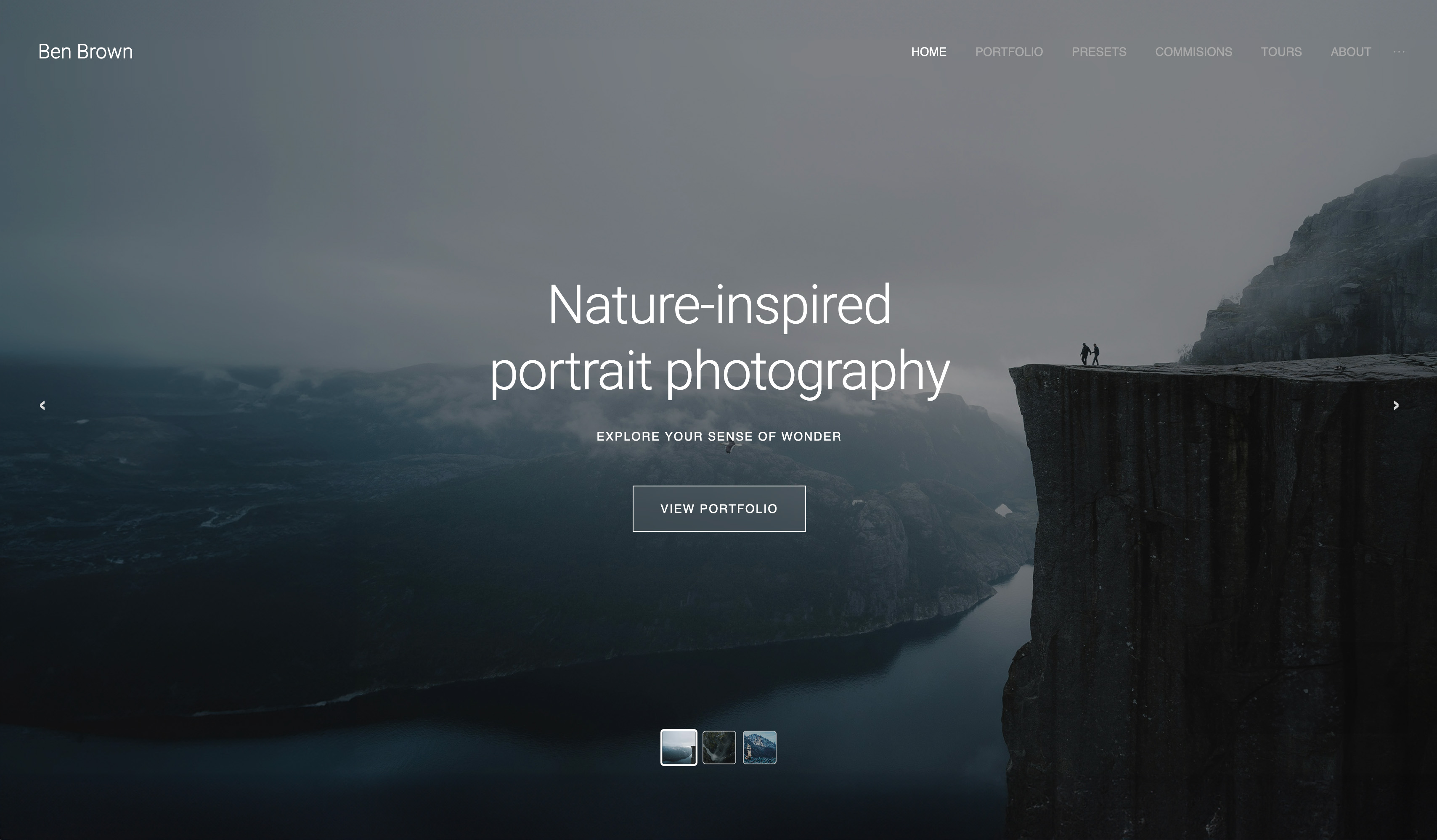 Use template
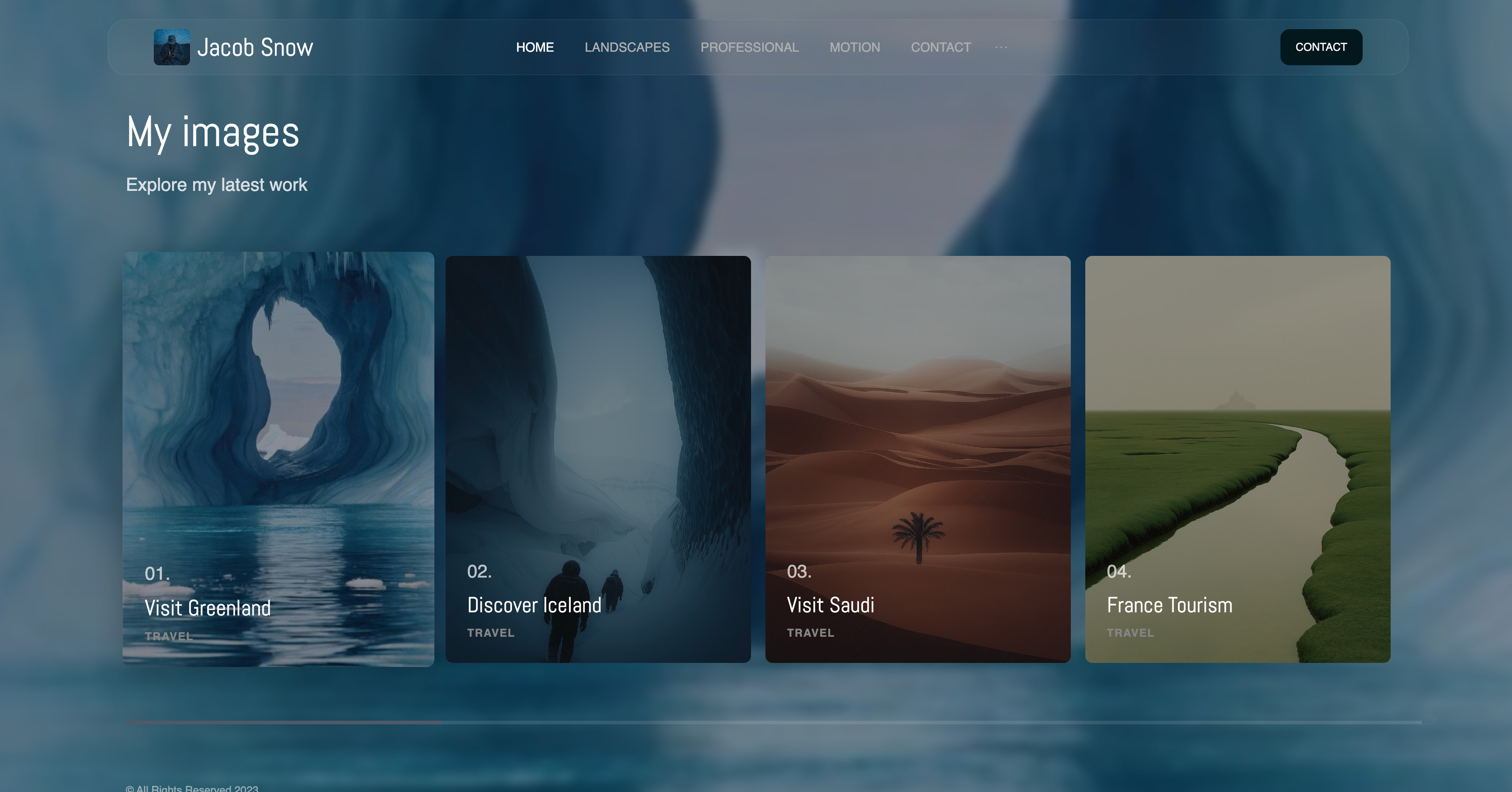 Use template
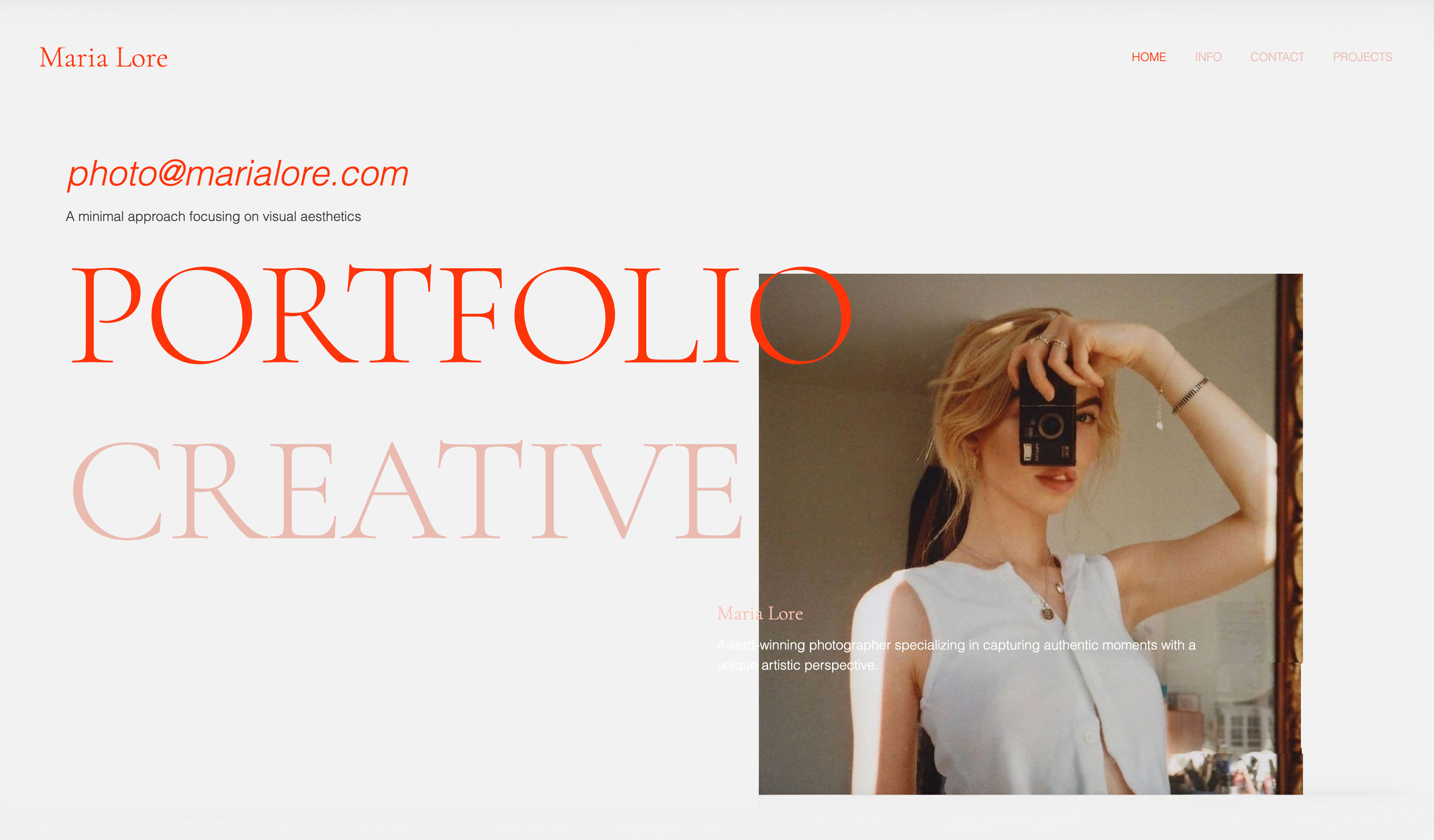 Use template
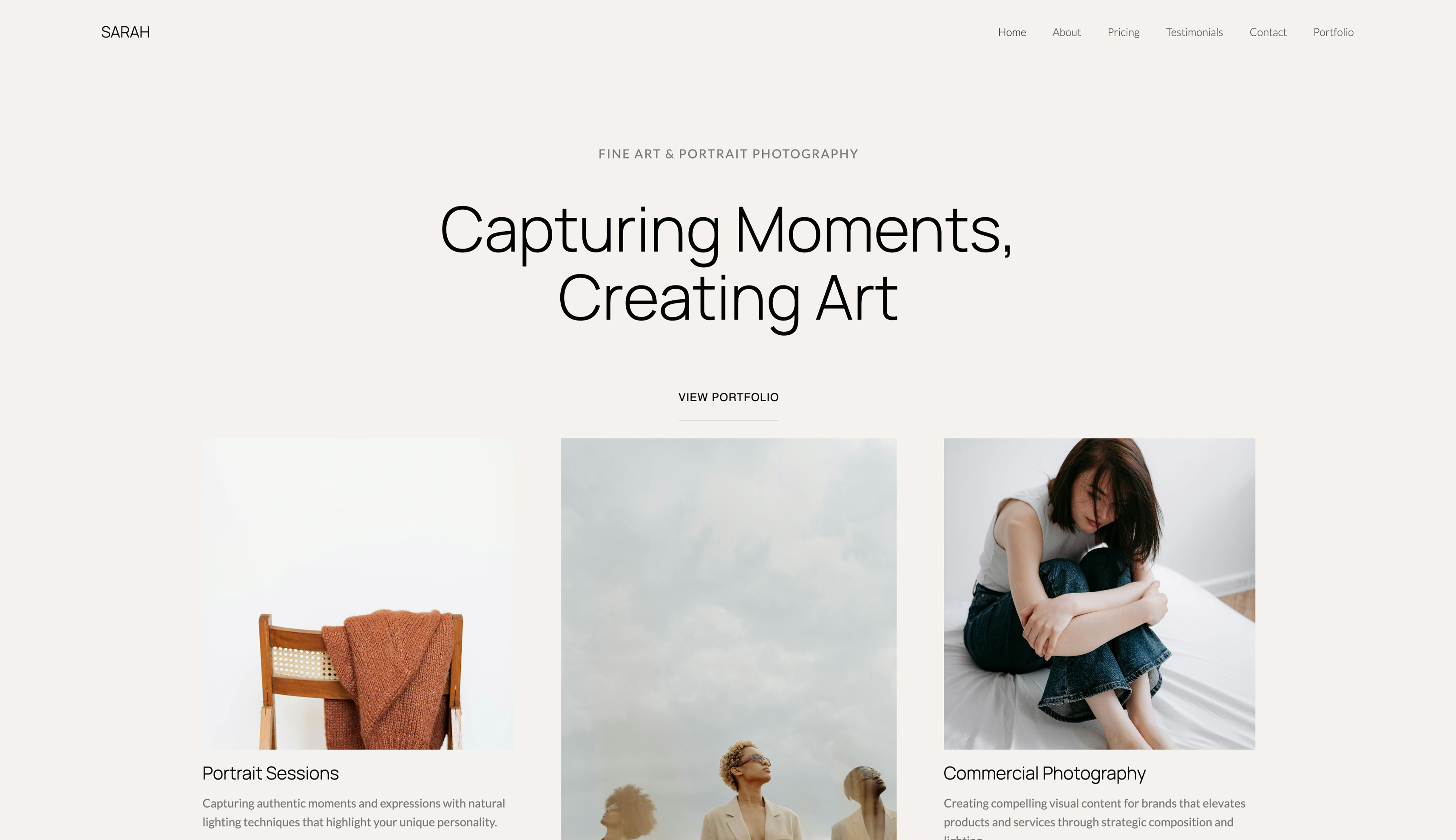 Use template
 Use template
 Use template
 Use template
 Use template
Client galleries for product photographers have a requirement no wedding tool was ever asked to meet: the filename is part of the deliverable.
A brand's e-commerce team does not want beautiful photographs, they want SKU-4471-front.jpg to arrive named exactly that, at exactly 2000 pixels on the long edge, in a folder structure their product information system can ingest without a human touching it.
So the delivery stage of a product shoot is really two deliveries. First a proofing round where a brand manager and an agency producer approve 90 hero angles out of 360 frames.
Then a machine-readable handoff where the approved set arrives correctly named, correctly sized, and correctly grouped, twice, because they always want a web set and a print set.
Most gallery platforms silently rename your files on download. Some strip the metadata. Almost all of them zip everything into one flat folder. That is where product photographers lose an afternoon per job.
A client gallery for product photography is software that presents a shoot for approval, keeps filenames and file integrity intact through the download, and delivers the approved set in the sizes and structure a commerce team can actually use.
The best client gallery for product photographers in 2026 is Framekit, because delivery runs from your own domain beside the portfolio brands check before hiring, galleries are uncapped on every plan including free, and there is no commission on delivery at any tier.
The honest trade-off: Framekit has no metadata search or asset management layer, so if a client wants a permanent searchable library, PhotoShelter is the better tool.
Picflow is the strongest pick for structured approval rounds, PicDrop is the fastest proofing loop, and Dropbox remains the most practical pipe for the final machine-readable handoff.
Framekit puts your product galleries on the same domain as the portfolio that wins e-commerce contracts, free to start.
Full disclosure: we make Framekit and we have ranked it first, so the concessions below matter as much as the praise. The same 90-SKU shoot went through all twelve platforms, every price was checked against the vendors' published pages in August 2026, and we state where we lose: PhotoShelter beats us on searchable archives, Picflow beats us on threaded approval, Dropbox beats us on raw bulk transfer, and several rivals carry contracts and invoicing that we do not.
How We Tested These Product Photography Galleries
The test was a real e-commerce brief rather than a feature checklist, because filename behaviour and download structure are things you can only discover by doing.
The job90 SKUs at four angles each, 360 frames, published for approval by a brand manager and an agency producer, then delivered as 90 approved heroes in two sizes with original filenames intact.
Filename and metadata integrity. Whether files download named as uploaded, and whether IPTC survives. Weighted 25%, because a renamed file is a broken deliverable.
Approval structure. Whether two reviewers can approve independently and whether you can see who approved what. Weighted 20%.
Delivery flexibility. Folder structure, multiple size sets, and ZIP behaviour on a 40GB handoff. Weighted 20%.
Ownership of the link. Whether the page a brand's marketing team forwards internally carries your studio. Weighted 20%.
Real annual cost for a studio shooting 40 commercial product jobs a year. Weighted 15%.
Everything below is labelled by how we know it. Hands-on: uploading, approving, downloading and inspecting the resulting files.
Verified from primary sources: prices, storage and fees, read from published pricing pages in August 2026 and linked where the claim carries weight. Community sentiment: repeated complaints in public reviews, always identified as sentiment.
What a 90-SKU Shoot Revealed
The differences that mattered were not the ones on any pricing page.
- 4 of the 12 platforms altered filenames or appended identifiers on at least one download path we tested, which is fatal for a product information system ingest.
- 7 of the 12 deliver a ZIP as a single flat folder, so folder structure has to be rebuilt by hand or scripted afterwards.
- Only 3 of the 12 let two named reviewers approve independently rather than merging both into one anonymous favourites list.
- 1 of the 12 serves the gallery from a domain you own, which is the difference between a brand's internal forward being your marketing and being someone else's.
- Per-file ceilings ranged from 100MB on Framekit to whole-transfer caps of 3GB on WeTransfer's free tier, and a 16-bit retouched TIFF will test both.
The test worth running yourself before you commit to a platform: upload one file named exactly as your client's system expects, download it through the client-facing path rather than your own admin view, and compare the two filenames character for character.
That check takes four minutes and has saved product photographers entire afternoons.
The 12 Best Client Galleries for Product Photographers, Compared
Weights are stated above and they favour file integrity and ownership over commerce, because product photographers are paid a day rate and a licence fee rather than a print margin.
Framekit reaches 9.2 with a 6 on asset management, where PhotoShelter is far ahead, and a 7 on threaded approval, where Picflow is ahead.
| Platform | Best for | Filenames preserved | Store commission | Our rating |
|---|---|---|---|---|
| Framekit | Owning the delivery and the portfolio | Yes | None on delivery | 9.2/10 |
| PhotoShelter | Searchable archives and licensing | Yes | Licensing built in | 8.9/10 |
| Picflow | Two-reviewer approval rounds | Yes | Varies | 8.7/10 |
| PicDrop | Fast proofing on large sets | Yes | No store | 8.5/10 |
| Pixieset | A familiar, polished client view | Yes | 15% free, 0% paid | 8.2/10 |
| Dropbox | Bulk machine-readable handoff | Yes | None | 8.0/10 |
| CloudSpot | Contracts and invoices in one place | Yes | 15% free, 2.5% paid | 7.7/10 |
| ShootProof | Licence and invoice alongside images | Yes | 0% on every plan | 7.5/10 |
| SmugMug | Long-term archive of every shoot | Yes | ~15% on markup | 7.2/10 |
| Pic-Time | Presentation-led client delivery | Yes | 15% free, 0% self-collected | 6.9/10 |
| WeTransfer | One-time bulk sends | Yes | None | 6.3/10 |
| Google Drive | Cheapest storage, weakest delivery | Recompresses previews | None | 5.7/10 |
Pricing was read from published vendor pages in August 2026. Card processing of roughly 2.9% plus $0.30 applies wherever a client pays for something.
Ask the filename question first. Before comparing gallery designs, upload one correctly named file and download it as a client would. Platforms that fail this test cannot be fixed with a subscription upgrade.
1. Framekit: Best Overall for Product Photographers

Our rating: 9.2/10
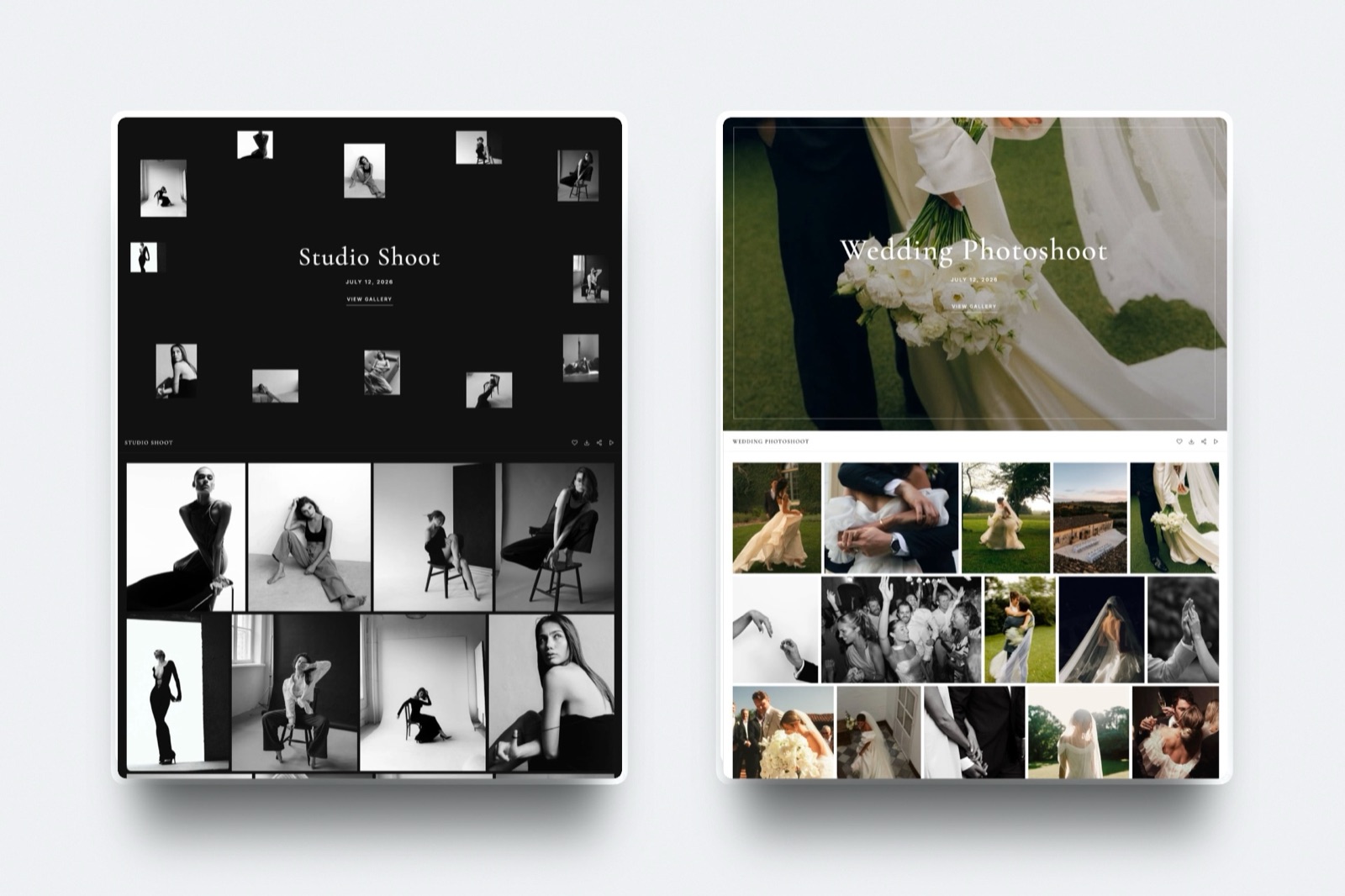
Framekit is an AI website builder with client galleries and a digital store built in, which for product photographers means the approval gallery and the portfolio that won the job are the same website on the same domain.
That matters here more than in most genres, because e-commerce work is bought by marketing teams who forward links internally, and every forward either introduces your studio to a new decision-maker or introduces a software company.
The mechanics hold up on a large shoot. Galleries are uncapped on every plan, so a 90-SKU job can be split into per-category galleries without paying more. Originals go up to 100MB per photo, which covers retouched layered exports.
Downloads come as full-resolution originals or a ZIP with no account required, so an agency producer with no time and no patience can get the set in two clicks.
Best forProduct and e-commerce photographers who want the approval gallery to double as the marketing site that wins the next brand.
Key features:
- Unlimited galleries on every plan including free, so per-SKU or per-category splits cost nothing
- Delivery from your own domain, next to the portfolio, about page and contact form
- Password and PIN protection per gallery for embargoed product launches
- Watermarking, favourites and slideshow for the approval round
- Full-resolution and ZIP downloads without a client account
- Originals up to 100MB per photo and branded sharing emails
- A digital store for selling licence extensions and additional crop sets directly
The real number40 product jobs a year on Framekit costs $0 in per-gallery or per-delivery fees on any plan.
The only ceiling is storage, one pool shared with your public site's media: 10GB free, 50GB on Starter at $9 a month, 300GB on Pro at $19, and 2TB on Business at $39.
At roughly 12GB per delivered product job, Pro carries about eight jobs live at once and Business carries a full year.
Pricing (pooled account storage in parentheses)Free $0 (10GB), Starter $9/mo (50GB, custom domain, no Framekit branding), Pro $19/mo (300GB), Business $39/mo (2TB, 0% fee on digital sales). Annual billing takes 20% off.
Pros:
- The delivery URL is yours, so internal forwards at a brand build your studio
- Uncapped galleries let you structure a big shoot by category instead of dumping 360 frames in one page
- Portfolio, galleries and a licence store on one subscription instead of three
Cons:
- No digital asset management: no keyword search, no metadata filtering, no permanent library for a client
- No two-reviewer approval attribution, so both approvers land in one favourites list
- No automated multi-size export, so the web set and the print set are two uploads
- No contracts or invoicing module
Skip it ifyour client wants a permanent, searchable brand asset library rather than a shoot delivery. That is PhotoShelter's job, not ours.
Verdict: Framekit is the best product photography gallery in 2026 for studios whose next contract depends on being remembered, because it is the only option here where the delivery link is a page of your own website. It is not an asset manager. See the wider field in our client gallery platforms guide, or start at framekit.ai.
2. PhotoShelter: Best for Searchable Archives and Licensing
Our rating: 8.9/10
PhotoShelter is the only platform in this comparison that treats images as assets with metadata rather than as pictures in a folder, and product photographers who shoot repeat catalogue work for the same brands feel the difference in year two.
Keyword and IPTC search across the whole library turns "find every shot of the 2024 packaging" from an archive dig into a query.
It also handles licensing natively, with rights-managed and royalty-free pricing wired into the download, which suits product work where usage terms differ between the web set and the campaign set.
Best forProduct photographers with repeat catalogue clients and a licensing revenue line.
The real numberthe entry Basic plan is $12.99 a month but carries only 4GB, which is a third of one product job at our test volume. Client proofing starts on Standard at $29.99 a month with 100GB, and unlimited storage arrives on Pro at $49.99.
Treat $360 a year as the honest starting price for professional use.
Prosthe strongest metadata and search layer here, licensing as a first-class feature, a custom domain included on every plan.
Consthe cheap tier's storage is unusable for product volumes, the interface is a professional archive rather than a designed client experience, and approval tooling is thinner than the proofing specialists.
Skip it ifyou deliver and move on. An archive engine is expensive if nobody searches it.
Verdict: PhotoShelter is the right answer when your images keep earning after delivery. If they do not, the same budget buys better proofing and better presentation elsewhere. Also see our website builders for photographers roundup if the site is the part you actually need.
3. Picflow: Best for Two-Reviewer Approval Rounds
Our rating: 8.7/10
Product approval is rarely one person's decision. A brand manager wants the front angle, the agency producer wants a different crop, and somebody has to reconcile them.
Picflow is the only platform here built around that: comment threads attach to individual frames, images can be annotated directly, and tagging lets you rebuild an approved set without exporting anything.
Paid plans start at $21 a month and include a storefront, digital downloads, print fulfilment, invoicing and contracts with signature collection, so it reaches into the business layer as well.
Skip it ifyour approvals arrive as an email listing frame numbers. The structure would go unused.
Verdict: Picflow is the specialist we would recommend over our own product to a studio whose real problem is reconciling two approvers. Compare it with the field in our photo proofing tools guide. Visit Picflow
4. PicDrop: Fastest Proofing on Large Sets
Our rating: 8.5/10
Publishing 360 frames and getting a client through them quickly is PicDrop's entire design goal, and on a product shoot that speed is worth real money.
There is no store, no album designer and no CRM, which keeps the client-facing view free of anything a brand manager could misclick.
Pro is EUR 14.99 a month for 500GB with unlimited galleries, your own branding on client pages, and 60 minutes of video conversion, with an extra 250GB at EUR 7.99.
Free gives 1GB across 3 galleries and Advanced is EUR 39.99 for 1TB with up to four team seats. The current structure took effect for new customers in May 2026, so older reviews describing a Lite plan are stale.
Figures are on PicDrop's pricing page.
Skip it ifyou want licence sales or a website from the same subscription.
Verdict: PicDrop offers the best storage per euro of any pure proofing tool here and does exactly one job properly. Pair it with a website you own.
5. Pixieset: Best Familiar Client View
Our rating: 8.2/10
Pixieset's polish and familiarity work in product photography for the same reason they work everywhere else: nobody needs instructions.
For a brand contact who receives galleries from five suppliers, an interface they already know reduces the questions that land in your inbox mid-shoot.
Free gives 3GB with a 15% store commission; Basic at about $10 a month gives 10GB with 0% commission and Plus at about $20 gives 100GB. Video minutes are included on paid tiers, useful when a product shoot includes short motion assets.
It holds 4.7 out of 5 across 207 Capterra reviews, the deepest sample here.
Skip it ifthe delivery page needs your name on it rather than Pixieset's.
Verdict: Pixieset is the comfortable default and a genuinely good client experience, held back for commercial work by living on somebody else's subdomain. Our Pixieset alternatives guide covers the move.
6. Dropbox: Best Machine-Readable Handoff
Our rating: 8.0/10
For the final handoff, Dropbox is genuinely the right tool and it would be dishonest to rank it lower. Folder structures survive intact, filenames are untouched, a client's system can sync directly, and 2TB costs $11.99 a month on Plus with 3TB at $19.99 on Professional.
What it cannot do is the approval round. There is no select mechanism, no watermark, no branding, no way to know who approved what, and a client staring at a grid of filenames is not being sold anything.
Skip it ifyou expect it to replace the proofing stage. It cannot.
Verdict: Dropbox is the last mile of a product delivery, not the whole road. Proof somewhere designed, then hand the approved set over as a folder.
7. CloudSpot: Best Bundled Admin
Our rating: 7.7/10
CloudSpot pairs the gallery with contracts, invoicing and scheduling, which fits commercial product work where every job has a purchase order behind it.
Free gives 5GB across up to 3 galleries at 15% commission, Entry is $7 a month for 15GB and up to 15 galleries, Lite is $17 for 100GB with unlimited galleries and the full studio suite, Pro is $34 for 500GB, and Unlimited is $50, per CloudSpot's pricing page.
Paid tiers swap commission for a 2.5% transaction fee.
The gallery cap on cheap tiers is the problem for a studio splitting big shoots by category.
Skip it ifyou already run a CRM and a contract tool you like.
Verdict: CloudSpot at the Lite tier is strong value and the clearest pricing in the category, but the cheap plans are not sized for commercial volumes.
8. ShootProof: Best for Licence and Invoice Together
Our rating: 7.5/10
ShootProof charges 0% commission on every plan including the cheapest and keeps contracts and invoicing in the same account as the gallery, which is useful when the usage licence and the delivery need to be one conversation.
Plans price on photo count rather than storage: free covers 100 photos, 1,500 runs about $10 a month, 5,000 about $20, 25,000 about $30 and unlimited about $60, per ShootProof's plans page.
A 360-frame product job makes those tiers go further than they do in wedding work.
Skip it ifdesign polish is part of your pitch.
Verdict: ShootProof is functional, cheap for the volume, and keeps the paperwork close to the pictures. Our ShootProof alternatives guide covers what else fits.
9. SmugMug: Best Long-Term Archive
Our rating: 7.2/10
Unlimited storage on every tier makes SmugMug the cheapest way to keep a decade of catalogue shoots reachable, which matters when a client asks for the 2023 packaging shot.
Annual pricing is $20 a month for Direct, $23.50 for Portfolio and $37 for Pro, with monthly rates at $29, $35.50 and $52.
The client-facing side is dated next to the proofing specialists, and its Capterra rating sits at 3.5 across a small sample of 11 reviews.
Skip it ifthe approval experience is part of what you are selling.
Verdict: SmugMug is storage with a shopfront attached. Excellent as an archive layer, weak as a proofing tool. See our SmugMug alternatives comparison.
10. Pic-Time: Presentation-Led Delivery
Our rating: 6.9/10
Pic-Time makes the most designed galleries in this comparison, and for a small brand founder receiving their first proper product shoot that presentation genuinely lands.
Free takes 15% commission, Beginner is $8 a month with 10GB, Professional $25 with 100GB and Advanced $50 with unlimited storage, with 0% commission on paid plans when you collect payment yourself.
Its automation is aimed at consumer print campaigns, which a product studio will never switch on.
Skip it ifyour clients are e-commerce teams rather than founders.
Verdict: Pic-Time is beautiful and aimed elsewhere. Consider it only if your product clients are small brands who buy on feel.
11. WeTransfer: One-Time Bulk Sends
Our rating: 6.3/10
WeTransfer is the fastest way to move an approved set once, and it stays useful for sending a retoucher 40GB at short notice.
As a gallery it fails immediately: the free tier caps at 3GB per transfer, allows 3GB a month across a maximum of 10 transfers, and expires links after three days. Starter is $8 a month, Ultimate is $23 with transfers up to 1TB.
Skip it ifthe client will need the files again next quarter, which in product work they always will.
Verdict: WeTransfer is a courier. Our WeTransfer alternatives guide covers what to use when the link has to persist.
12. Google Drive: Cheapest Storage, Weakest Delivery
Our rating: 5.7/10
Nobody beats Google on price: 15GB free, 100GB at $1.99 a month, 200GB at $2.99 and 2TB at $9.99, pooled across Drive, Gmail and Photos. As backup that is unbeatable.
As product delivery it is the weakest option here. Previews recompress, sharing permissions confuse clients, downloads arrive as numbered folders, and the page carries Google's branding. It appears in this ranking because so many photographers still use it.
Skip it ifyou are being paid. Keep it for backup.
Verdict: Google Drive is a backup drive with a share button. Treat it as one and deliver somewhere else.
What Product Delivery Costs a Studio Over a Year
Costed for 40 product jobs a year at roughly 12GB delivered per job, keeping a rolling six-month archive live.
| Setup | Annual subscription | Per-delivery fees | What it does not do |
|---|---|---|---|
| Framekit Pro | $228 | $0 | Asset management, contracts |
| PhotoShelter Standard | $360 | $0 on delivery | Designed client presentation |
| Picflow entry | $252 | Varies on sales | Ownership of the delivery domain |
| PicDrop Pro | ~$195 | None, no store | Website, commerce |
| Dropbox Professional | $240 | $0 | Approval, branding, selection |
The spread across serious options is about $165 a year, which is less than a single day rate, so cost should not be the deciding factor.
Decide instead on the two things that actually differ: whether filenames survive the client-facing download, and whose brand is on the page a marketing team forwards.
In one linein product work, buy file integrity and brand ownership, and treat the subscription as a rounding error.
How to Choose a Product Photography Gallery
Work through these in order and stop at the first clear yes, since product delivery requirements are unusually easy to rank once you write them down.
1. Does a client need a permanent searchable library of your work for them? If yes, PhotoShelter, and nothing else here substitutes.
2. Do two or more named people have to approve independently? If yes, Picflow.
3. Does your next contract depend on the brand remembering your studio? If yes, Framekit, because the gallery is a page of your own site.
4. Is the bottleneck simply getting 360 frames in front of someone quickly? If yes, PicDrop.
5. Is the final handoff going into an automated commerce pipeline? If yes, use Dropbox for that last step regardless of what you proofed on.
Frequently Asked Questions
What is the best client gallery for product photographers in 2026?
The best client gallery for product photographers in 2026 is Framekit, because galleries are uncapped on every plan, filenames survive the client-facing download, and the delivery page lives on your own domain beside the portfolio that wins e-commerce contracts.
PhotoShelter is the better choice if clients need a searchable permanent archive, and Picflow is better when two people have to approve independently.
Do client galleries rename my files when a client downloads them?
Some do, and it is the single most damaging failure in product photography because a renamed file breaks a product information system ingest.
Always test by uploading one correctly named file, downloading it through the client-facing path rather than your own admin view, and comparing the names character for character.
Do this before you commit to a platform, not after your first e-commerce client complains.
How should product photographers deliver web and print sizes?
Deliver them as two clearly labelled sets rather than one folder, because commerce teams and print teams have different systems and different people.
Most galleries here have no automated multi-size export, so you export both sets from your editor and upload each separately.
Agreeing the long-edge pixel dimensions in writing before the shoot removes most of the revision requests that follow.
Framekit vs PhotoShelter for product photography: which is right?
Framekit is right when your revenue comes from shooting new work and being remembered by brand teams, because the delivery link is a page of your own website.
PhotoShelter is right when clients treat your images as a permanent asset library they will search for years, because its metadata and keyword layer has no equivalent here.
The dividing line is whether anyone ever searches the archive after delivery.
Can I sell licence extensions through a client gallery?
Yes, on platforms with a digital store. Framekit sells digital products with a transaction fee of 5% on Free and Starter, 3% on Pro and 0% on Business, and ShootProof allows digital sales with 0% commission on every plan.
Selling an extended usage term as a product rather than a renegotiation is one of the cleanest ways to add revenue to a product shoot.
What file size limits matter for product photography?
Per-file ceilings matter more than total storage when you deliver retouched 16-bit files.
Framekit accepts originals up to 100MB per photo, WeTransfer's free tier caps an entire transfer at 3GB, and ShootProof prices by photo count rather than size, which quietly favours large files.
Test your largest realistic deliverable on the free tier before subscribing.
How long should a product gallery stay live?
Keep commercial product galleries live indefinitely unless a client asks otherwise, because e-commerce teams return for assets months after launch and a dead link becomes your support problem.
Use an archive date rather than an expiry where the platform allows it. Free file-transfer tools are the exception and the reason to avoid them here; WeTransfer's free tier drops links after three days.
Do product photographers need proofing, or is a folder enough?
A folder is enough only when one person decides and nothing needs approving. As soon as a brand manager and an agency producer are both involved, a folder pushes the approval into email, where it becomes untraceable.
A proofing gallery replaces that with a record of what was chosen, which also protects you when someone later insists they approved a different angle.
Which gallery platform is cheapest for a product studio?
PicDrop Pro at roughly EUR 14.99 a month is the cheapest serious option per gigabyte, and Framekit Pro at $19 a month is the cheapest that also includes a website and a store.
The spread across all credible options is under $200 a year, which is less than one day rate, so choosing on price alone usually means paying more later in workflow time.
Should I use Dropbox for the final product delivery?
Often, yes. Dropbox preserves folder structure and filenames, syncs directly into a client's systems, and offers 2TB for $11.99 a month, which no gallery platform matches.
Use it for the machine-readable handoff after approval, and keep the proofing round on a designed gallery, because a shared folder gives the client no way to choose and gives you no record of what they chose.
Final Verdict
Product photography exposes gallery software faster than any other genre, because the deliverable has technical requirements rather than emotional ones.
The platforms that pass are the ones that leave your files alone and let a brand team approve without confusion, and the one that wins is the one that also makes the delivery page part of your own website, since e-commerce work is repeat business and repeat business depends on being remembered.
Where Framekit loses. We are not an asset manager.
There is no keyword search, no metadata filtering and no permanent client-facing library, and PhotoShelter beats us outright for any client who will search the archive later.
Picflow handles two-reviewer approval better than we do, PicDrop is faster on a 360-frame proofing round, and Dropbox is a better final pipe than anything we offer.
If any of those three is your actual bottleneck, we are the wrong pick and we would rather say so.
Run the four-minute check this week: upload one file named the way your best client's system expects, download it as they would, and compare the two names. Whatever that test says about your current platform is more useful than any ranking, including this one.
Related readingclient gallery platforms compared, the best website builder for product photographers, photo delivery tools, and client galleries with a built-in store.
Prices, storage caps and per-file ceilings were read from each vendor's published pages in August 2026, and every platform ran the identical 90-SKU brief including a client-side download check, because filename behaviour is the one thing in this category that no vendor documents and every product photographer depends on.