Framekit templates
Start from a designer-made template
 Use template
 Use template
 Use template
 Use template
 Use template
 Use template
 Use template
 Use template
Most photographers looking for CloudSpot alternatives are not unhappy with the product. They are unhappy with a number.
Either they hit the gallery cap, which is 3 on the free plan and 15 on the $7 Entry plan, or they looked closely at the paid tiers and noticed that "commission-free" comes with a 2.5% transaction fee on payments, which is a good deal against typical processing but is not zero.
CloudSpot is a genuinely good tool and it deserves to be described accurately before anything replaces it. The studio manager covering invoicing, contracts and scheduling is real and useful. The pricing page is the clearest in the category.
Deposits land in two days on the higher tiers instead of four. None of that is marketing.
The problem is shape. CloudSpot's cheap plans are built for a photographer delivering a handful of galleries a month, and the moment your business stops looking like that, the next tier up is $17 rather than $7.
A client gallery platform is software that hosts, protects and delivers finished photographs to paying clients, usually adding proofing, favourites, downloads and sometimes a store, and the alternatives below differ mostly in what they cap and what they charge when you sell.
The best CloudSpot alternative in 2026 is Framekit, because galleries are uncapped on every plan including free and delivery carries no commission at any tier, so the two limits people leave CloudSpot over both disappear, and the gallery lives on a website you own.
The honest trade-off: Framekit has no studio manager, so the invoicing, contracts and scheduling CloudSpot bundles would need another tool.
Pixieset is the closest like-for-like swap, ShootProof is the pick for print sellers at 0% commission, and PicDrop is the cheapest for large storage.
Framekit gives you unlimited galleries on a domain you own, with no card needed to start.
Full disclosure: Framekit is our own product and it is ranked first, so read the concessions closely. We built the same 400-image client gallery on every platform, verified pricing against published vendor pages in August 2026, and we say clearly where CloudSpot and others beat us: CloudSpot's studio manager, ShootProof's print fulfilment, Pixieset's in-gallery structure, and PicDrop's storage per euro are all things we do not match.
Framekit's plan storage was re-verified on 19 September 2026: Starter now carries 50GB and Pro 300GB, which changes the Lite-versus-Pro comparison below in Framekit's favour on capacity.
Why Photographers Leave CloudSpot
Three reasons come up repeatedly in conversations with photographers who have moved, and only one of them is about money in the obvious sense of a bill being too high.
Gallery caps on the affordable tiers. Free allows 3 galleries and Entry at $7 a month allows 15.
A portrait photographer delivering weekly clears 15 in a quarter, and a headshot photographer delivering per-subject clears it in a single corporate day. Unlimited galleries start at Lite, which is $17 a month.
The jump from $7 to $17. There is no tier between them, so the practical price of a working CloudSpot account is $204 a year rather than $84.
The 2.5% transaction fee. CloudSpot's paid plans are described as commission-free and charge 2.5% on payments, which the company positions against typical processing of 2.9% to 3.5%. That framing is fair.
It is still a percentage, and photographers comparing against ShootProof's flat 0% commission notice.
None of that makes CloudSpot a bad platform. It makes it a platform with a specific shape, and the alternatives below are sorted by which part of that shape you are trying to change. Current CloudSpot figures are on their pricing page.
How We Compared These CloudSpot Alternatives
One job on twelve platforms: a 400-image client gallery, password protected, with favourites collection, a full-resolution download, and one digital product listed and bought so we could see what each platform kept.
Gallery and storage limits on the tier a working photographer would actually buy, weighted 25%, since that is the reason most people are reading this.
Cost of selling, meaning commission, transaction fees and processing combined rather than the headline percentage, weighted 20%.
Ownership of the delivery link, weighted 20%, because it is the cost that compounds silently.
Client experience, covering mobile behaviour, downloads and whether an account is required, weighted 20%.
Business tooling, meaning contracts, invoicing and scheduling, weighted 15%, because that is what you would be giving up by leaving CloudSpot.
Claims are separated by source throughout. Hands-on: building, protecting, delivering and buying. Verified from primary sources: prices, caps and fees read from published pricing pages in August 2026. Community sentiment: recurring public complaints, labelled as sentiment.
What Comparing 12 Alternatives Showed
These are the numbers that matter specifically to someone leaving CloudSpot rather than someone choosing a gallery platform for the first time, since the two decisions are not the same problem.
- 6 of the 12 alternatives place no cap at all on gallery count, which is the single most common reason for the switch.
- Only 2 of the 12 charge nothing at all on delivery and nothing on digital sales at their top tier.
- The real entry price for an uncapped account ranges from $9 a month (Framekit Starter) to about $21 (Picflow), against CloudSpot's $17 Lite.
- 1 of the 12 puts the gallery on a domain you own rather than a vendor subdomain.
- Storage on a roughly $17 to $20 plan ranges from 10GB (Pixieset Basic) to 500GB (PicDrop Pro), a fiftyfold spread at the same price point.
Run this before you move: count the galleries you had live at once during your busiest month last year, and the gigabytes they held. Those two numbers eliminate most of this list immediately and they are the only two most photographers actually need.
The 12 Best CloudSpot Alternatives in 2026, Compared
Weighting is set out above and it favours caps and selling costs over polish, because that is what drives this specific switch. Framekit reaches 9.2 with a 5 on business tooling, where CloudSpot itself and ShootProof are both ahead of it.
| Platform | Gallery limit on entry paid tier | Storage there | Cost of selling | Our rating |
|---|---|---|---|---|
| Framekit | Unlimited, from $9/mo | 50GB | 0% on delivery, 5% on digital sales | 9.2/10 |
| Pixieset | Unlimited, about $10/mo | 10GB | 0% on paid plans | 9.0/10 |
| ShootProof | Photo-count based, about $10/mo | 1,500 photos | 0% on every plan | 8.8/10 |
| Pic-Time | Beginner $8/mo | 10GB | 0% when you self-collect | 8.5/10 |
| PicDrop | Unlimited on Pro | 500GB | No store | 8.3/10 |
| Picflow | From $21/mo | Plan based | Varies by storefront | 8.1/10 |
| PhotoShelter | Unlimited galleries, $12.99/mo | 4GB | Licensing built in | 7.9/10 |
| SmugMug | Unlimited, $20/mo annual | Unlimited | ~15% on markup | 7.7/10 |
| Zenfolio | Plan based, from $9/mo | Plan based | 7% flat per order | 7.2/10 |
| GotPhoto | Volume oriented, from $9.90/mo | 50GB | 9% service fee | 7.0/10 |
| Dropbox | Folder based, $11.99/mo | 2TB | None, no store | 6.6/10 |
| WeTransfer | Transfer based, $8/mo | Transfer based | None, no store | 6.0/10 |
Every figure was read from the vendors' published pricing pages in August 2026, and card processing of about 2.9% plus $0.30 applies on top wherever a client pays, on every platform in this table.
The two-number test. Your busiest month's simultaneous gallery count and total gigabytes eliminate most platforms instantly. Work those out before reading another feature list.
1. Framekit: Best Overall CloudSpot Alternative

Our rating: 9.2/10
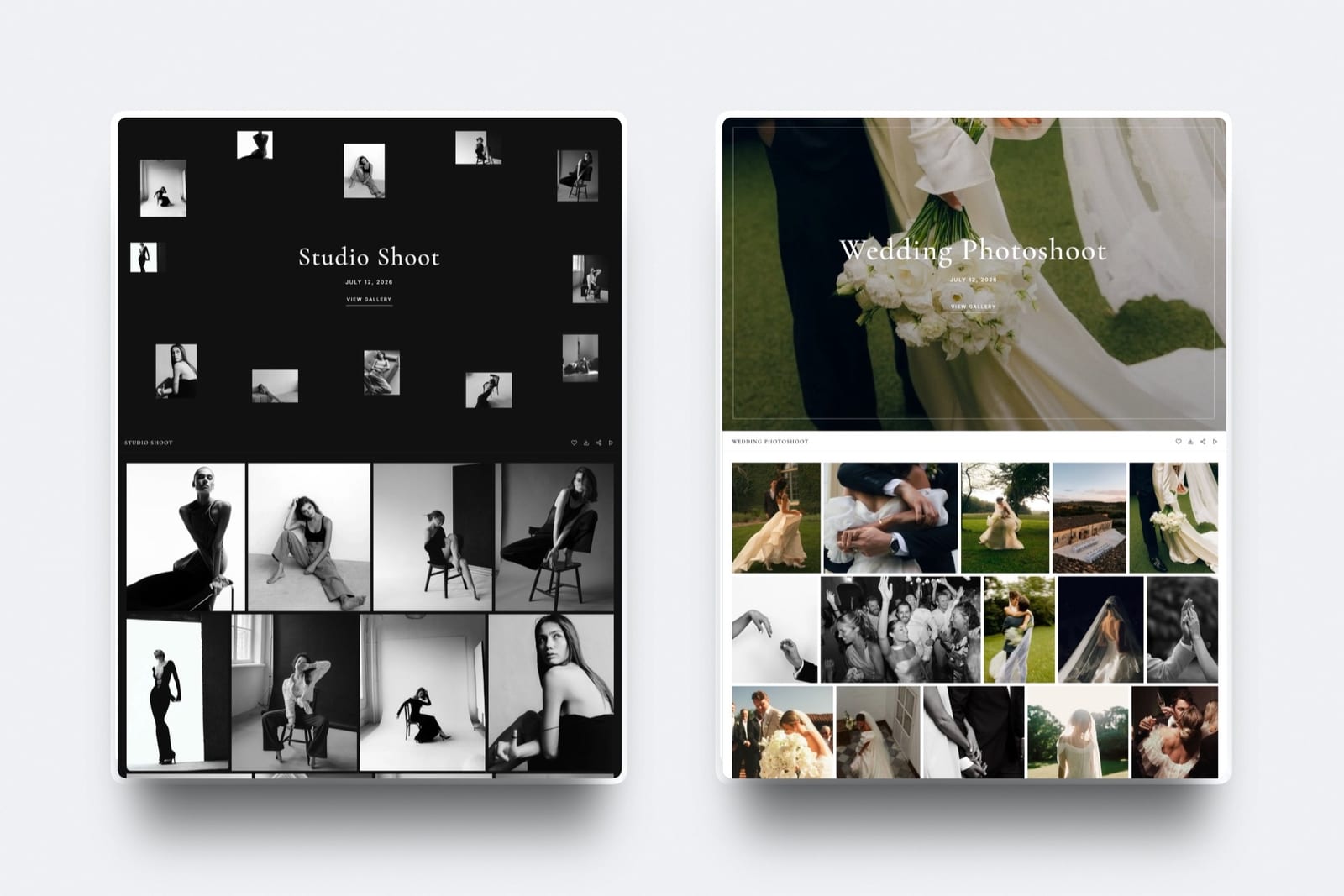
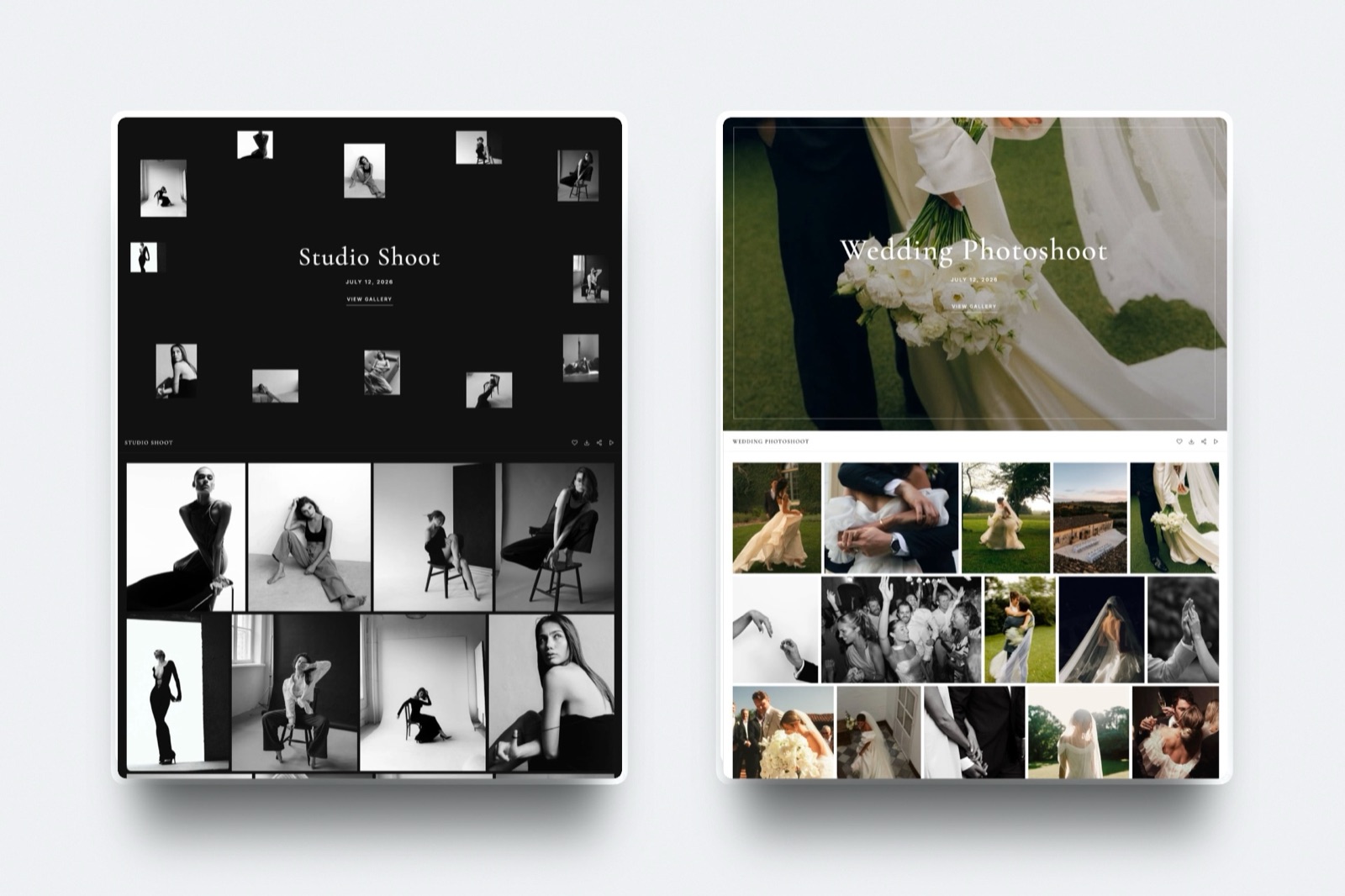
Framekit is an AI website builder with client galleries and a digital store built in, and it is the most direct answer to the two things that push photographers off CloudSpot.
Galleries are uncapped on every plan, including the free one, so the 3-gallery and 15-gallery ceilings simply do not exist. And delivery carries no commission and no transaction fee at any tier, because there is no print store taking a cut.
The larger difference is where the gallery lives. On CloudSpot your client opens a page on CloudSpot's domain.
On Framekit they open a page on yours, next to your portfolio, your about page and your shop, which means every delivery is a visit to the site that books your next job rather than to a software company.
Best forPhotographers who left CloudSpot over gallery caps and want delivery to build their own brand.
Key features:
- Unlimited galleries on every plan including free, with storage as the only ceiling
- Delivery from your own domain alongside a real portfolio and store
- Password and PIN protection, watermarking, favourites, slideshow, full-resolution and ZIP downloads on every tier
- No client account required to download, which removes the most common support question
- Originals up to 100MB per photo and branded sharing emails
- A digital store for presets, licences and downloads, with fees of 5% on Free and Starter, 3% on Pro and 0% on Business
The real numberthe tier comparison that matters is CloudSpot Lite at $17 a month for 100GB and unlimited galleries against Framekit Pro at $19 a month for 300GB and unlimited galleries.
The gallery cap matches and Framekit gives three times the storage for $2 more; beyond that, Framekit adds a full website on your own domain and CloudSpot adds invoicing, contracts and scheduling.
Choose on which of those two you would otherwise pay for separately.
Pricing (pooled account storage in parentheses)Free $0 (10GB, unlimited galleries), Starter $9/mo (50GB, custom domain, no Framekit branding), Pro $19/mo (300GB), Business $39/mo (2TB, 0% fee on digital sales). Annual billing takes 20% off.
Pros:
- No gallery cap on any plan, which removes the reason most people leave CloudSpot
- No commission or transaction fee on delivery at any tier
- The delivery page is part of a website you own, not a vendor subdomain
Cons:
- No studio manager: no invoicing, contracts or scheduling, all of which CloudSpot includes from the Lite tier
- No print lab or print fulfilment
- No 2-day payout mechanism, since you connect your own processor for digital sales
- Newer than CloudSpot, with less gallery-specific workflow history
Skip it ifthe studio manager is why you were on CloudSpot in the first place. Replacing it means adding a CRM, and that changes the price comparison entirely.
Verdict: Framekit is the best CloudSpot alternative for photographers whose complaint is caps, fees or branding, and the wrong move for photographers who love the business tooling. See the wider field in our client gallery platforms guide, or start at framekit.ai.
2. Pixieset: The Closest Like-for-Like Swap
Our rating: 9.0/10
If you want the CloudSpot experience without the gallery cap, Pixieset is the shortest move.
Galleries are uncapped, the client experience is the most familiar in the category, mobile behaviour is strong, and the platform reaches into websites and a studio manager of its own, so the bundle logic that attracted you to CloudSpot still applies.
Free gives 3GB with a 15% store commission, Basic at about $10 a month gives 10GB with 0% commission, and Plus at about $20 gives 100GB with an hour of video upload.
It carries 4.7 out of 5 across 207 Capterra reviews, the deepest review base of any platform here.
Skip it ifyou wanted to stop delivering from a vendor subdomain. Pixieset has the same architecture as CloudSpot in that respect.
Verdict: Pixieset is the safe, boring, correct switch for most people leaving CloudSpot over caps alone. Our Pixieset alternatives guide covers the next hop if you outgrow it too.
3. ShootProof: Best for Print Sellers
Our rating: 8.8/10
If the 2.5% transaction fee is what sent you looking, ShootProof answers it directly: 0% commission on sales on every plan including the cheapest, with pro-lab fulfilment, contracts and invoicing included.
That last part matters here, because it is the closest replacement for CloudSpot's studio manager.
Plans price by photo count rather than gallery count, so the cap moves rather than disappearing: free covers 100 photos, 1,500 runs about $10 a month, 5,000 about $20, 25,000 about $30 and unlimited about $60, per ShootProof's plans page.
It holds 4.9 out of 5 across 92 G2 reviews.
Skip it ifyou deliver huge galleries. A photo-count cap can bite harder than a gallery cap.
Verdict: ShootProof is the alternative that keeps the most of your sales and the most of CloudSpot's business tooling. It is the least beautiful option here and does not pretend otherwise. Our ShootProof alternatives guide has more.
4. Pic-Time: Best Designed Alternative
Our rating: 8.5/10
Pic-Time is the upgrade for photographers who found CloudSpot functional but plain.
Its galleries are the most designed in this comparison, and its automated store campaigns, reminders and gifting flows sell prints without manual effort, which is a genuine revenue difference rather than a cosmetic one.
Free takes 15% commission, Beginner is $8 a month with 10GB, Professional $25 with 100GB and Advanced $50 with unlimited storage.
Paid tiers charge 0% commission when you collect payment yourself through Stripe, PayPal or Square, and commission applies only to your markup rather than production cost.
Skip it ifyou need contracts and invoicing in the same tool. Pic-Time is a gallery and store, not a studio manager.
Verdict: Pic-Time is the presentation and sales upgrade, and the Advanced tier's unlimited storage is the cleanest answer here for a photographer with a heavy archive.
5. PicDrop: Cheapest Big Storage
Our rating: 8.3/10
For photographers whose real constraint was storage rather than gallery count, PicDrop offers by far the most gigabytes per euro.
Pro is EUR 14.99 a month for 500GB with unlimited galleries, your own branding on client pages, collaboration mode for proofing and presentation mode for delivery, with a further 250GB at EUR 7.99.
Free is 1GB across 3 galleries, which matches CloudSpot's free cap, and Advanced is EUR 39.99 for 1TB with up to four team members.
New customers moved to this structure in May 2026, so older articles quoting a Lite plan are stale; see PicDrop's pricing page.
Skip it ifyou sell anything from your galleries. There is no store at all.
Verdict: PicDrop is the capacity answer and a genuinely fast proofing tool, at the cost of every commercial feature CloudSpot gave you.
6. Picflow: Best for Structured Feedback
Our rating: 8.1/10
Picflow is the alternative for photographers whose clients comment rather than simply choose.
Per-image comment threads, direct annotation, filters and tagging make approval rounds traceable, and paid plans from $21 a month include a storefront, digital downloads, print fulfilment, invoicing and contracts.
That last list is the closest thing here to CloudSpot's studio manager, which makes Picflow a more complete swap than its price suggests.
Skip it ifyour clients approve by email and always have.
Verdict: Picflow costs more than CloudSpot Lite and does more with the feedback loop. Worth it for commercial and agency work, overkill for portraits.
7. PhotoShelter: Best for Archives
Our rating: 7.9/10
PhotoShelter is a different category of product and belongs here for one reason: if your galleries are really an archive, no gallery platform will fix that, and PhotoShelter's keyword and metadata search will.
It also includes a custom domain on every plan, so the ownership problem is partly solved.
Basic is $12.99 a month with only 4GB, Standard is $29.99 with 100GB and client proofing, and Pro is $49.99 with unlimited storage. Treat Standard as the real entry point.
Skip it ifnobody searches your back catalogue.
Verdict: PhotoShelter is the right move only if the archive is the problem. As a straight CloudSpot replacement it is expensive and less client-friendly.
8. SmugMug: Unlimited Storage Everywhere
Our rating: 7.7/10
Every SmugMug plan carries unlimited storage, which no other platform in this comparison offers at the entry tier. For a photographer who kept hitting CloudSpot's gigabyte ceilings rather than its gallery caps, that alone can settle it.
On annual billing SmugMug charges $20 a month for Direct, $23.50 for Portfolio and $37 for Pro, and monthly billing raises those to $29, $35.50 and $52 respectively.
Print sales carry a commission on markup commonly planned around 15%, which is worse than CloudSpot's 2.5% transaction fee if you sell regularly.
Skip it ifyou sell prints in volume. The commission model is a step backwards from where you were.
Verdict: SmugMug solves storage and worsens selling. Choose it only if the archive matters more than the store. See our SmugMug alternatives roundup for context.

9. Zenfolio: One Bill for Everything
Our rating: 7.2/10
Zenfolio bundles a website, galleries and print sales at around $9 a month for Basic, $23 for Professional and $40 for Advanced, with a flat 7% per order. For a photographer who liked CloudSpot's bundling instinct but wants a website included, it is the closest structural match.
Design is the limitation and its Capterra rating of 3.9 across 14 reviews is too small a sample to lean on.
Skip it ifpresentation is part of your pitch.
Verdict: Zenfolio is a lateral move: different bundle, similar compromises. Our Zenfolio alternatives guide covers where people go next.
10. GotPhoto: For Volume Work Only
Our rating: 7.0/10
GotPhoto belongs here only for photographers whose CloudSpot problem is that they have started shooting schools, sports or dance at volume.
Free carries a 12% service fee with 5GB and one user, Growth is $9.90 a month at 9% with 50GB, and Pro is $49.90 at 7% with 1TB and five staff seats.
For portrait and wedding work it is the wrong tool and the percentages are worse than what you left.
Skip it ifyou are not shooting volume events.
Verdict: GotPhoto is a specialist detour, not a general alternative. Right answer for a narrow group and a costly mistake for everyone else.
11. Dropbox: Storage Without a Gallery
Our rating: 6.6/10
Dropbox is the honest low-cost floor: $11.99 a month for 2TB on Plus and $19.99 for 3TB on Professional, more storage than any gallery platform here at the price, with sync and file requests that work well with collaborators.
Everything CloudSpot did for your client experience disappears. No favourites, no watermarking, no branding, no store, and a permissions model that generates support questions from non-technical clients.
Skip it ifthe client's experience is part of what they are paying for.
Verdict: Dropbox is a downgrade dressed as a saving. Use it behind a gallery, not instead of one.
12. WeTransfer: Not a Gallery at All
Our rating: 6.0/10
WeTransfer is included because photographers genuinely consider it when a subscription annoys them, and it is worth being clear about what that costs.
The free tier caps at 3GB per transfer with a monthly ceiling of 3GB across a maximum of 10 transfers and links that expire after three days; Starter is $8 a month and Ultimate is $23 with transfers up to 1TB.
Every expired link becomes an email, and those emails arrive while you are shooting.
Skip it ifthe client will ever need the files twice.
Verdict: WeTransfer is a courier, not an alternative. Our WeTransfer alternatives guide covers what to use when the link has to last.
What Leaving CloudSpot Actually Costs or Saves
Priced below for a photographer delivering 30 client galleries a year at roughly 3GB each, with about $3,000 of annual sales running through the gallery store, which is a typical portrait workload.
| Setup | Annual subscription | Cost of $3,000 in sales | Also included |
|---|---|---|---|
| CloudSpot Lite (staying) | $204 | $75 at 2.5% | Contracts, invoicing, scheduling |
| Framekit Pro | $228 | $90 at 3% on Pro, $0 on Business | Website on your own domain, store |
| Pixieset Plus | $240 | $0 on paid plan | Store, basic site builder |
| ShootProof 5,000 photos | $240 | $0 on every plan | Contracts, invoicing, print lab |
| PicDrop Pro | ~$195 | No store | Proofing only |
The honest reading is that nobody saves meaningful money by switching.
Every serious option lands between roughly $195 and $240 a year, so a move should be made for capability rather than cost: uncapped galleries, a website you own, a print lab, or storage headroom.
If you are hoping to cut the bill, staying and upgrading is usually cheaper than moving.
In one lineleave CloudSpot for a capability you need, not for a saving that is not there.
How to Choose Your CloudSpot Replacement
1. Did you leave because of gallery caps? If yes, Framekit or Pixieset, both uncapped, and choose between them on whether owning the domain matters to you. This is the most common reason for the switch and the easiest one to satisfy.
2. Did you leave because of the 2.5% fee on sales? If yes, ShootProof at 0% commission on every plan, or Pic-Time's paid tiers if you self-collect payment.
3. Did you leave because of storage? If yes, PicDrop Pro at 500GB or SmugMug for unlimited.
4. Do you need to replace the studio manager as well? If yes, ShootProof or Picflow, since both carry contracts and invoicing.
5. Do you want your delivery link to stop advertising a software company? If yes, Framekit, since it is the only option here that serves galleries from your own domain.
Frequently Asked Questions
What is the best CloudSpot alternative in 2026?
The best CloudSpot alternative in 2026 is Framekit, because galleries are uncapped on every plan including free and delivery carries no commission or transaction fee, which removes both of the limits photographers usually leave CloudSpot over.
Pixieset is the closest like-for-like swap, ShootProof is best for print sellers at 0% commission, and PicDrop is cheapest for large storage.
Why do photographers leave CloudSpot?
Most leave for one of three reasons: the 3-gallery free cap and 15-gallery Entry cap, the jump from the $7 Entry plan to the $17 Lite plan with nothing in between, or the 2.5% transaction fee on paid plans.
CloudSpot positions that fee favourably against typical processing of 2.9% to 3.5%, which is fair, but photographers comparing it with ShootProof's flat 0% commission notice the difference.
Is CloudSpot really commission-free?
CloudSpot's Lite, Pro and Unlimited plans are described as commission-free and charge a 2.5% transaction fee on payments, which the company compares against average processing rates of 2.9% to 3.5%.
The free and Entry plans carry a 15% commission on orders. So "commission-free" is accurate as CloudSpot defines it, and a 2.5% cost still exists on the paid tiers.
Framekit vs CloudSpot: which is better for client galleries?
Framekit is better if you want uncapped galleries on every plan, no fee on delivery, and a gallery that lives on your own domain beside a real portfolio.
CloudSpot is better if you want invoicing, contracts and scheduling in the same subscription, which Framekit does not offer at all.
At $19 against $17 a month Framekit gives 300GB to CloudSpot's 100GB, both with unlimited galleries, so beyond storage the choice is website versus studio manager.
What is the cheapest CloudSpot alternative?
PicDrop Pro at about EUR 14.99 a month is the cheapest serious alternative and comes with 500GB and unlimited galleries, though it has no store and no website.
Framekit Starter at $9 a month is cheaper still with unlimited galleries and a custom domain, but gives 50GB rather than 500GB. Below that, free tiers exist everywhere and none of them supports a working business.
Which CloudSpot alternative includes contracts and invoicing?
ShootProof and Picflow both include contracts and invoicing alongside galleries, and Pixieset offers a studio manager as a separate product in its suite.
Framekit, PicDrop and Pic-Time do not, so leaving CloudSpot for one of those means adding a separate CRM or invoicing tool, which changes the true cost of the switch.
Can I move my existing galleries from CloudSpot to another platform?
There is no automated migration between these platforms, so moving means downloading your originals and re-uploading them to the new tool.
Plan it around a quiet period, keep the old account live until every active client has what they need, and export any contracts or invoices before you cancel.
Photographers who switch mid-season almost always regret the timing rather than the choice.
Do any CloudSpot alternatives let me use my own domain?
Framekit is the only platform in this comparison that serves client galleries from your own domain as part of a full website, with a custom domain available from the $9 Starter plan.
PhotoShelter includes a custom domain for its website product on every plan, and SmugMug and Zenfolio offer domain mapping for their own site templates. Every dedicated gallery tool otherwise uses a vendor subdomain.
How much storage do I actually need to replace CloudSpot Lite?
CloudSpot Lite gives 100GB, and the direct equivalents are Pixieset Plus at about $20 a month with the same 100GB and Framekit Pro at $19 a month with 300GB, both with unlimited galleries.
If you were routinely near the ceiling, PicDrop Pro at 500GB for about EUR 14.99 or SmugMug's unlimited storage from $20 a month annually are the two ways to buy real headroom rather than a like-for-like swap.
Is switching client gallery platforms worth the disruption?
Only if you are gaining a capability rather than chasing a saving, since every credible option here lands between roughly $195 and $240 a year.
Uncapped galleries, a website on your own domain, a print lab, or a large storage increase are all worth a migration. A few dollars a month is not, especially once you count the hours of re-uploading.
Final Verdict
CloudSpot is a well-built platform with an unusually honest pricing page, and most people leaving it are not escaping a bad product but outgrowing a specific shape: a small gallery allowance on the cheap tiers and a percentage on sales.
Framekit is the best replacement because it removes both, and adds the thing no dedicated gallery tool offers, which is a delivery page that belongs to you rather than to a vendor.
Where Framekit loses. We have no studio manager, so if CloudSpot's invoicing, contracts and scheduling are part of your daily workflow, moving to us means adding another subscription and the maths stops being favourable.
ShootProof will beat us on print revenue with 0% commission and real lab fulfilment. PicDrop gives you far more storage per pound. Pixieset does more inside a single gallery than we do.
Those are four good reasons to choose something else, and we would rather you chose well than chose us.
Before you move anything, do the two-number test: your peak simultaneous gallery count and your peak storage. If CloudSpot Lite clears both and you use the studio manager, staying is the right answer and this guide has saved you a migration.
Related readingclient gallery platforms compared, the best Pixieset alternatives, photo proofing tools, and client galleries with a built-in store.
Every price, gallery cap, storage figure and fee in this comparison was read from the vendors' published pricing pages in August 2026, and the same 400-image gallery with a test purchase was built on all twelve platforms, because the cost of selling is only visible once money has actually moved.