Framekit templates
Start from a designer-made template
 Use template
 Use template
 Use template
 Use template
 Use template
 Use template
 Use template
 Use template
The submission platform is free. That is the first thing to understand about this category, because almost every article about it is written as though you are choosing between products that charge you money.
FilmFreeway costs filmmakers nothing. Its competitors mostly cost filmmakers nothing.
The money in a festival campaign is the festival fees, which run about $35 to $70 a submission in 2026, and the single largest variable in that bill is not which platform you use. It is what date you press send.
A film festival submission platform is a service that lists festivals, holds your film and its materials, and handles the entry and payment process on your behalf, replacing the era when each festival took a DVD and a cheque.
Filmmakers use them to run a campaign of dozens of submissions from one dashboard.
A campaign also needs somewhere permanent to point.
Framekit is where a lot of filmmakers put that: a film page on a domain you own carrying the trailer, the laurels, the press kit and a contact route, plus video review for showing a cut to trusted viewers before you spend a fee on it.
The best film festival submission platform in 2026 is FilmFreeway, because it lists the overwhelming majority of festivals worth entering, costs filmmakers nothing, and charges festivals a 12% commission rather than charging you.
Festhome and Shortfilmdepot are worth a second account for European festivals that FilmFreeway does not carry, and a handful of major festivals still take entries through their own portals.
The real decision is not the platform: submitting at early deadlines rather than final ones changes the cost of a thirty-festival campaign by roughly $690.
Updated in September 2026: we re-verified Framekit's plans and corrected our section on where a festival run points, since Framekit now includes video review and client galleries; submission fees are as checked in August 2026.
How We Compared 8 Festival Submission Routes
We approached this from the filmmaker's side rather than the vendor's.
For each route we established what it charges filmmakers, how it makes money, how many festivals it lists in practice, whether it covers the regions independent filmmakers actually target, and what happens to a submission after it is paid for.
We also priced a realistic thirty-festival campaign at both early and final deadlines using published 2026 fees from named festivals.
The evidence here comes in three grades. Structural facts about how each platform works and charges are drawn from vendor help documentation and industry reporting, and are attributed where they matter.
Festival entry fees are read from the festivals' own 2026 submission pages and named individually. Judgments about coverage and usability reflect what filmmakers report publicly, and are marked as reported rather than measured.
One vendor could not be read directly: FilmFreeway returns a 403 to automated requests, so its commercial terms below come from its own published help centre content as reported by third parties, and are labelled accordingly.
Festhome's site does not state a filmmaker-facing price at all.
In one lineeight routes assessed from the filmmaker's side, with a thirty-festival campaign priced at both early and final deadlines from named 2026 festival pages.
What Pricing a Festival Campaign Showed
The finding that should change what you do is that the platform comparison is nearly irrelevant to your budget, and the deadline calendar is enormous. Everything else in this article follows from that.
- The same thirty-festival campaign costs about $1,350 at early deadlines and about $2,040 at final ones, a difference of roughly $690 for identical films entering identical festivals.
- FilmFreeway is free to filmmakers and charges participating festivals a 12% commission on entry fees.
- Published 2026 short film fees at named festivals run from $35 to $70, with several charging 40% to 77% more at the final deadline than the early one.
- The dominant platform of the previous era shut down in 2019, and a wave of adjacent screenwriting platforms closed during 2025.
- 0 of the platforms in this comparison charge filmmakers a per-submission platform fee on top of the festival's own.
- The most expensive mistake available in this category is not choosing the wrong platform, it is submitting to the wrong festivals.
For the route matched to your film and your region, jump to the decision guide.
What a 30-Festival Campaign Actually Costs
Thirty submissions is a realistic first campaign for a short film with genuine ambitions. Pricing it against published 2026 fees, rather than against platform features, is the number that decides whether a festival run is affordable.
| Festival | Early deadline fee | Final deadline fee | Increase |
|---|---|---|---|
| Tribeca, shorts discounted rate | About $35 | Not published at this rate | Not applicable |
| New York Shorts International | About $39 | About $69 | About 77% |
| Palm Springs ShortFest | About $45 early bird | Higher at later deadlines | Not published |
| LA Shorts | About $49 | About $70 | About 43% |
| Sundance, shorts | About $55 | Not published at this rate | Not applicable |
| Santa Barbara International | About $60 regular | About $70 | About 17% |
| Thirty-festival campaign, blended | About $1,350 | About $2,040 | About $690 |
The blended figures assume an average of about $45 a submission at early deadlines and about $68 at final ones, which is consistent with the named festivals above.
Your own campaign will differ, and the shape will not: the same festivals cost roughly half as much again if you wait.
There is a second, larger number hiding behind this table. A thirty-festival campaign at $1,350 is a real production budget line, and for many short films it exceeds what was spent on the shoot.
That is worth confronting before the first submission rather than after the twentieth rejection.
In one linethirty submissions costs about $1,350 at early deadlines and about $2,040 at final ones, and the platform you use contributes nothing to either figure.
The 8 Best Festival Submission Routes in 2026: Full Comparison
Scores are out of 10 across four weighted criteria: how many festivals worth entering the route actually lists (35%), cost to the filmmaker including any platform charges (20%), how well it handles the mechanics of a campaign, meaning materials, deadlines, tracking and screeners (25%), and regional coverage beyond North America (20%).
Coverage carries the largest share because a platform that does not list the festival you want is not a cheaper option, it is not an option.
| Route | Filmmaker cost | Coverage | Strongest for | Score |
|---|---|---|---|---|
| FilmFreeway | Free | Very large, global | Almost every campaign | 9.2 |
| Festhome | Free to register | Strong in Europe and Latin America | European festivals FilmFreeway misses | 7.8 |
| Shortfilmdepot | Free to register | European shorts, some major festivals | Short films targeting Europe | 7.5 |
| Direct to the festival | Free | Whatever that festival runs | The handful that require it | 7.2 |
| Click for Festivals | Free to register | Spanish-speaking territories | Spain and Latin America | 6.6 |
| Movibeta | Free to register | Spain and Latin America | Iberian and Latin American circuits | 6.3 |
| Reelport | Free to register | European, some large festivals | Specific European festivals | 6.0 |
| Festival-run portals | Free | One festival each | Sundance, Cannes and similar | 5.8 |
FilmFreeway scores far above the field and the gap is about coverage rather than quality. Its competitors are in several cases better designed and none of them lists enough of the festivals an independent filmmaker actually wants, which in this category settles the argument.
1. FilmFreeway: The Default, and It Costs You Nothing
FilmFreeway became the standard route into festivals after the previous incumbent closed, and its position is now so dominant that for most filmmakers the platform question is settled before it is asked.
What it feels like to usebuilt for running a campaign rather than making a submission.
Your film, poster, stills, credits and links live in one project profile, and each submission draws from it, so entering the thirtieth festival takes about a minute rather than repeating the whole upload.
The festival directory carries deadlines, fees, entry requirements and filmmaker reviews in one place, which is the actual product.
The real numberfree for filmmakers.
According to FilmFreeway's own published help material, it is free for festivals that do not charge entry fees, and festivals with entry fees pay a commission of 12%, alongside a one-time activation fee reported at $100 and $50 for subsequent calls for entries, plus payment processing of 3% and $0.30 per transaction.
FilmFreeway blocks automated requests, so these figures are reported rather than read at source.
The detail nobody writes aboutthat 12% is charged to the festival, not added to your fee, and it is worth understanding what it means for the ecosystem.
A small festival charging $30 nets about $25 after commission and processing, which is part of why entry fees have drifted upward and why some festivals now offer meaningfully cheaper direct submission.
Asking a festival whether it takes direct entries occasionally saves real money.
The gotchathe filmmaker reviews and star ratings are useful and they are not an independent audit.
Festivals with high volumes of paid submissions accumulate reviews from people who were selected, and a five-star average tells you less about whether the festival will do anything for your film than the laurels of previous winners will.
Skip it ifevery festival on your list runs its own portal, which for a small number of the largest festivals is the case.
Verdict: the correct default for essentially every campaign, and the reason is coverage rather than features. Use it, and spend the energy you saved on choosing better festivals.
Building the site your festival page links to? We compared the options in the best website builders for filmmakers.
2. Festhome: The Second Account Worth Having
Festhome is a Spanish-founded platform with genuine strength across European and Latin American festivals, and it is the most common second account among filmmakers running international campaigns.
What it feels like to useclean and rather more European in its festival mix, which is precisely the reason to have it. Several festivals in Spain, Portugal, Italy and across Latin America list here and not on FilmFreeway, and the gap is not small if those territories are your target.
The real numberregistration is free and the site does not publish a filmmaker-facing platform charge, so what you pay is the festivals' own entry fees. We could not read a stated price because none is stated.
The gotcharunning two platforms means running two sets of deadlines, two sets of materials and two inboxes. That is genuinely more administration, and the way filmmakers get caught is missing an early deadline on the second platform because the calendar lived on the first.
Skip it ifyour campaign is North American, where the overlap with FilmFreeway is close to total and the second account adds work for nothing.
Verdict: the right second account for a European or Latin American campaign, and unnecessary overhead for a domestic one. Open it only when a festival you want is not on FilmFreeway.
3. Shortfilmdepot: Built for Short Films in Europe
Shortfilmdepot is a long-established European platform focused specifically on short films, and it carries a number of significant European festivals.
What it feels like to usenarrower and older than FilmFreeway, with an interface that reflects its age and a festival list that reflects its focus. For a short film aiming at European festivals it covers ground the larger platform does not.
The real numberfree to register, with festival entry fees payable to the festivals. No filmmaker-facing platform fee is published.
The detail nobody writes aboutplatforms with a narrow specialism tend to be used by festival programmers who prefer them, which is not visible from the filmmaker side.
A festival that lists on a shorts-only platform and not on the general one is frequently signalling something about the kind of submissions it wants.
The gotchaits coverage outside Europe is thin, so it is an addition to a campaign rather than a foundation for one.
Skip it ifyou are not making short films or not targeting Europe.
Verdict: worth an account for a European shorts campaign and irrelevant otherwise. A specialist tool used correctly.
4. Direct Submission: Still Worth Asking About
Submitting directly to a festival, outside any platform, is the oldest route and it persists for specific and useful reasons.
What it feels like to useentirely dependent on the festival. Some run a form and an email address, some run a proper portal, and a few still want a link and a note. The experience is inconsistent by definition.
The real numberfree of platform charges by definition, and occasionally cheaper on the entry fee itself. Because platforms take a commission from the festival, some festivals price direct entries lower or waive fees for direct submissions in specific circumstances.
The detail nobody writes aboutfee waivers are far more common than filmmakers assume and are almost never advertised.
Festivals routinely waive fees for films from certain regions, for students, for previous alumni, for films with particular subject matter, and simply for asking politely with a strong project.
A short, specific email to a programmer costs nothing and has a meaningfully non-zero success rate.
The gotchathere is no tracking, no dashboard and no record beyond your own. Running a campaign this way at scale is how films get submitted twice or missed entirely.
Skip it ifyou are running thirty submissions, where the administrative load makes this impractical as a primary route.
Verdict: not a platform and worth knowing about anyway. Use it for the specific festivals where it saves money, and always ask about waivers before paying full price.

5. Click for Festivals: Spanish-Speaking Territories
Click for Festivals is a Spanish platform serving festivals across Spain and Latin America, and it covers a circuit that is genuinely underrepresented on the dominant platform.
What it feels like to useregionally focused in a way that is either exactly what you need or completely irrelevant. The festival mix is heavily Spanish-language, and for a filmmaker targeting that circuit the coverage is the point.
The real numberfree to register, with festival entry fees payable to the festivals.
The gotchaa good deal of the interface and festival information is in Spanish, which is entirely reasonable for its audience and a genuine barrier if you do not read it.
Machine translation handles the listings adequately and handles submission requirements less well, and misreading a requirement is how a fee gets wasted.
Skip it ifSpanish-language festivals are not part of your plan.
Verdict: a specialist account for a specific circuit, and a sensible third platform for a genuinely international campaign.
6. Movibeta: The Iberian and Latin American Circuit
Movibeta serves a similar territory to Click for Festivals with a somewhat different festival roster, and the two are frequently used together by filmmakers working that circuit seriously.
What it feels like to usefunctional and regionally specific, with a festival list that overlaps its Spanish counterpart without duplicating it. That partial overlap is the reason filmmakers targeting the region end up with both.
The real numberfree to register, with the festivals charging their own entry fees.
The gotchathree or four platform accounts across one campaign is where deadline management genuinely breaks down. If you reach this point, the answer is a spreadsheet rather than another account, with every festival, platform, deadline tier and fee in one place.
Skip it ifyou already have Click for Festivals and your target list is covered.
Verdict: worth adding only when a specific festival requires it, which is the correct way to treat every platform after the first two.
7. Reelport: The European Institutional Route
Reelport is a European platform with long-standing relationships with a number of significant festivals and institutional programmes, and it handles submissions for events that do not use the consumer platforms.
What it feels like to usemore institutional than the others, reflecting a festival client base that skews toward established European events and funded programmes.
The real numberfree to register, with the festivals setting their own fees.
The gotchaits relevance is entirely determined by whether the specific festivals you want use it. Unlike FilmFreeway, there is no case for opening an account speculatively.
Skip it ifnone of your target festivals list here, which for most campaigns is the case.
Verdict: a route to specific European festivals rather than a platform to adopt. Check your target list first, and open an account only if it appears.
8. Festival-Run Portals: Where the Biggest Names Live
Several of the largest festivals run their own submission systems rather than relying on a platform, and for those festivals there is no alternative route.
What it feels like to usevaried and generally more demanding than a platform. Requirements are stricter, materials are specified more precisely, and the process assumes you are treating this submission as significant rather than as one of thirty.
The real numberthe festival's own entry fee, with no platform layer. Sundance's published 2026 short film fee is about $55 and Tribeca's discounted shorts rate is about $35, both of which sit inside the normal range rather than above it.
The detail nobody writes aboutthe largest festivals are frequently not the most expensive ones.
Sundance at about $55 and Tribeca at about $35 are cheaper than several regional festivals charging $70 at a final deadline, which inverts the assumption that prestige costs more. What the big festivals cost you is odds, not money.
The gotchaevery festival portal is a separate account, a separate set of materials and a separate deadline. Build the list before you build the accounts.
Skip it ifyou cannot, for the festivals that require it.
Verdict: not optional for the festivals that use them, and a useful reminder that the headline names are not where a campaign budget goes.
The Platforms That Disappeared, and Why It Matters
In one linethe previous dominant platform closed in 2019 and a wave of adjacent screenwriting platforms shut down during 2025, which is worth knowing both because older advice is stale and because it says something about how fragile this infrastructure is.
Withoutabox was the standard route into festivals for over a decade, owned by IMDb, and it wound down with commitments fulfilled through 30 October 2019.
Any guidance mentioning it is at minimum six years out of date, which is a reasonable prompt to check what else in that guidance has moved.
The 2025 screenwriting collapse is more recent and less widely absorbed. Coverfly shut down on 1 August 2025.
ScreenCraft, The Script Lab and WeScreenplay all closed in early March 2025, and The Tracking Board discontinued its services from 1 September 2025, in a broader collapse of the Industry Arts portfolio under its parent company.
For screenwriters those platforms held contest histories, scores and industry visibility, and their closure removed a whole layer of the ecosystem within months.
Two practical lessons follow, and they apply to filmmakers as much as to screenwriters.
Do not let a platform be the only home for your work or your record. Laurels, selections, contact details and press coverage should live somewhere you control, because platforms close and take their profile pages with them.
Treat a platform's ranking or score as marketing rather than as an asset. The screenwriters who had built standing inside a scoring system discovered in 2025 that the standing did not transfer anywhere.
Choosing Festivals Is the Decision That Actually Costs Money
In one linea thirty-festival campaign is a $1,350 to $2,040 decision, and almost all of that money is decided by which festivals you pick rather than by any tool in this comparison.
The uncomfortable arithmetic is that most submissions do not pay off, and the ones that do tend to be predictable in advance. Four filters remove most of the waste.
Does the festival programme films like yours? Look at the last three years of selections rather than the mission statement. A festival that has never programmed a documentary short is not going to start with yours, whatever the category list says.
Does selection produce anything? A screening in a real cinema with an audience and programmers in the room is worth entering.
A laurel emailed to you with a link to an online playlist is worth almost nothing, and there is now a substantial industry selling exactly that.
Is it qualifying or connected? Some festivals carry Academy Award qualification or reliable distributor attendance, and those are worth premium fees. Most are not, and the fee is frequently the same.
What does the fee buy at this deadline? The identical festival at an early deadline versus a final one can differ by 43% to 77% on the named examples above. Planning a submission calendar three months out is worth more than any negotiation.
The habit that saves the most money is unglamorous: build the target list first, note every festival's early deadline, and submit in waves timed to those dates rather than reacting to whatever is closing this week.
Reactive submitting is how a $1,350 campaign becomes a $2,040 one.
The Screener Is the Submission
In one lineprogrammers watch a link, not a film, and the technical state of that link decides more submissions than most filmmakers are willing to believe.
A festival programmer working through several thousand entries opens your screener alongside hundreds of others. Four things go wrong regularly and all four are free to fix.
The link expires or the password changes mid-campaign. Submission windows run for months and judging happens weeks after the deadline.
A screener that worked when you submitted and does not work when it is watched is a wasted fee, and there is rarely a mechanism to fix it after the fact. Use a link and password you will not touch until the campaign ends.
Download is disabled when the festival needs it, or enabled when it should not be. Some festivals require a downloadable file for offline judging. Read the requirements rather than assuming streaming is enough.
The film is not what the entry says it is. Runtime, aspect ratio, language and subtitle state all have to match the submission form. Mismatches create work for programmers, and work for programmers is not what you want to be memorable for.
Burned-in subtitles are missing. If any dialogue is not in the festival's language, subtitles need to be in the file for judging rather than supplied as a separate track that may not load. This is the most common technical rejection reason filmmakers report.
There is also a strategic point about the first two minutes. Programmers do not owe your film a full viewing and, at volume, most entries are decided early.
That is not a reason to put a hook in the first ten seconds of every film, and it is a reason to be honest with yourself about whether a slow opening is doing work or simply arriving late.
Laurels, and What They Are Actually Worth
In one linea laurel is a marketing asset with a wide range of underlying value, and an entire sub-industry now sells them at the same price as festivals with cinemas.
Being clear about this saves money and embarrassment.
A selection at a festival that screens to an audience is a genuine credit. Somebody programmed your film over others, it played in a room, and people who were not related to you watched it. That is worth entering for and worth putting on a poster.
An award from a monthly online competition is a different object with a similar-looking graphic.
A number of operations run monthly or even weekly cycles, accept a very high proportion of entries, charge normal festival fees and deliver a laurel image by email. Nothing illegal is happening and nothing useful is either.
How to tell them apart before paying. Look for a physical venue and dates, a published programme from previous years with named films, evidence of an audience, and whether previous selections mention the festival in their own materials.
A festival with no venue, no published past programme and a very large number of award categories is selling graphics.
Where laurels genuinely matter. Distributors and sales agents recognise perhaps a few dozen festivals.
Everyone else recognises none of them, which means the audience for most laurels is other filmmakers and your own website.
That is not worthless, and it is worth pricing accurately: a $70 final-deadline fee for a graphic is an expensive graphic.
The rule that follows: if you cannot name what a selection at a given festival would concretely give you, do not submit to it. Wanting a laurel is a reason and it should be a priced one.
What Happens If You Actually Get In
In one lineselection triggers a second round of costs and deadlines that almost nobody budgets for, and the ones that catch people are deliverables and travel.
Getting into a festival is the outcome you paid for, and it is a beginning rather than an end.
Deliverables. Festivals request a screening file to a specification, which is frequently not what you have.
A DCP, the cinema delivery format, is a real expense if you do not already own one, and the request usually arrives with a short deadline.
Some festivals accept a high-quality ProRes file, and knowing which before you submit lets you budget accordingly.
Materials. Press stills at print resolution, a poster in specified dimensions, a director photograph, a synopsis in a set word count and sometimes a trailer. Preparing these once at the start of a campaign means the requests take an hour rather than a week.
Travel. Attending is optional and it is where most of the value of a festival run actually lives, because the point of a screening is the room.
Programmers, distributors and other filmmakers are there, and a film that plays without its director is a film nobody meets.
Budget for at least the one or two festivals you most want to attend rather than spreading submissions thinly and attending none.
Premiere status. This is the one that bites hardest and earliest.
Many significant festivals require a premiere of some kind, world, international, national or regional, and accepting a small early selection can disqualify you from a larger later one.
Sequence your submissions so the festivals with premiere requirements are decided before the ones without.
That last point interacts directly with the deadline arithmetic elsewhere in this article. Submitting early saves money, and submitting to the wrong festival early can cost you a premiere.
The resolution is to submit early to the festivals with premiere requirements and let the others sit.
Building the Campaign Calendar
In one linea festival campaign is a scheduling problem before it is a creative one, and the filmmakers who spend less are the ones who built a calendar rather than reacting to whatever closes this week.
Four columns are enough, and a spreadsheet beats every tool.
The festival, the platform and the deadline ladder. Every festival with each of its deadline tiers and the fee at each. This is where the roughly $690 difference between an early and a late campaign becomes visible rather than theoretical.
Premiere requirement. Yes or no, and which kind. This column determines the order of everything else.
Notification date. When you will hear. Two festivals whose notification dates fall after another's deadline create the decision you cannot unmake, and seeing that on a page is the only way to plan around it.
Fit evidence. One line on why this festival, ideally naming a film they programmed that resembles yours. If you cannot fill this column, the entry is a guess and should be cut.
Build it once, before submitting anything, and the campaign runs itself.
Every filmmaker who reports spending twice what they intended describes the same failure: submitting reactively, at final deadlines, to festivals chosen because they appeared in a search rather than because they were right.
Run This Test Before You Spend Anything
Take your five most-wanted festivals and look up two things for each: their last three years of selections, and their full deadline and fee ladder for 2026.
If your film does not resemble anything they have programmed in three years, remove them from the list. That single filter typically removes a third of a first-time campaign and saves several hundred dollars.
Then, for the ones that survive, note the earliest deadline and what it costs against the final one. Add the two totals. The difference between those numbers is what planning is worth to you, in cash, on this specific film.
This takes about an hour and it is the highest-return hour in the entire festival process, because unlike everything else in this article it changes the number rather than the tooling.
The Honest Case Against a Festival Run
In one linefor a meaningful share of short films, spending $1,350 on submissions is a worse decision than spending nothing and releasing the film, and nobody in this industry has any incentive to tell you that.
Everyone involved in the festival economy is paid by submissions.
Platforms take a commission from festivals, festivals take fees from filmmakers, consultants sell strategy, and none of that machinery benefits from a filmmaker concluding that a campaign is not worth running.
So it is worth stating the counter-argument plainly.
A festival run makes sense when the film needs gatekeepers. If your goal is a feature deal, an agent, a commission, or entry into a professional network, festivals are where those people are, and selection is a credential they recognise.
That is a real mechanism and it justifies real money.
It makes much less sense when the goal is an audience. A short film released well online, with a proper page, a trailer, a press approach and an audience you already have, can reach more people in a week than a thirty-festival run reaches in two years.
The festivals in that run will mostly screen to fifty people in a room, several of whom made the other films.
The premiere trap makes this an actual decision rather than a both-and. Because many significant festivals require a premiere, releasing online usually forecloses the festival route.
You have to choose, and choosing by default is how films end up in a two-year campaign nobody planned.
A middle path exists and is underused. Target a short list of festivals that genuinely matter for your goals, give it a fixed budget and a fixed deadline, and release online the moment that window closes rather than extending it.
A ten-festival campaign at early deadlines is about $450, which is a different kind of decision from $1,350.
The test we would apply: name the specific outcome you want from the festival run, and name the festival most likely to produce it. If you cannot do both in a sentence, the money is better spent on the release.
How Programmers Actually Decide
In one lineunderstanding the volume a programming team is working through explains most of what looks arbitrary about festival rejection, and it changes what you put in a submission.
A mid-sized festival may receive several thousand entries for a few dozen slots. That ratio is the single most useful fact for calibrating expectations, and it has consequences worth knowing.
First-pass viewing is short and it is not personal. Screeners are watched at volume, frequently by a team of readers before a programmer sees anything. A film that does not establish what it is early is not being judged harshly, it is being triaged.
Programming is a jigsaw, not a ranking. A festival assembles blocks that work together in a room: length, tone, subject and pacing all have to balance across a ninety-minute programme.
Excellent films are cut because there were already two other films about the same thing, and that outcome contains no information about quality.
Context beats craft in the paperwork. The synopsis, the director statement and the stills are what a programmer sees before pressing play, and they set the expectation the film is then judged against.
A precise, honest synopsis helps you; an overwritten one invites disappointment.
Rejection carries no feedback and no signal. Nearly every festival declines without comment, and reading a pattern into a run of rejections is usually reading noise.
The one exception worth taking seriously is a film rejected everywhere including festivals that clearly programme its genre, which is worth a second opinion from someone who will be honest.
The practical consequence for a submission: make the first minute clear, make the synopsis accurate, and choose festivals whose past programmes suggest your film would fit the jigsaw rather than merely meet the criteria.
Where a Festival Run Should Point
Every platform above sends your film somewhere, and none of them is where a programmer, a distributor or a future collaborator goes to find out who you are; a profile page on a submission platform is not that place either, as the 2025 shutdowns demonstrated.
Framekit is an AI website builder for filmmakers, photographers and creators, so a film can have a real page: the trailer, the laurels, the press kit, the credits and a contact route, on a domain you own.
The link you put in every submission and every email to a programmer keeps working after the campaign ends and after any given platform does not.
The same account also covers the stage before submission.
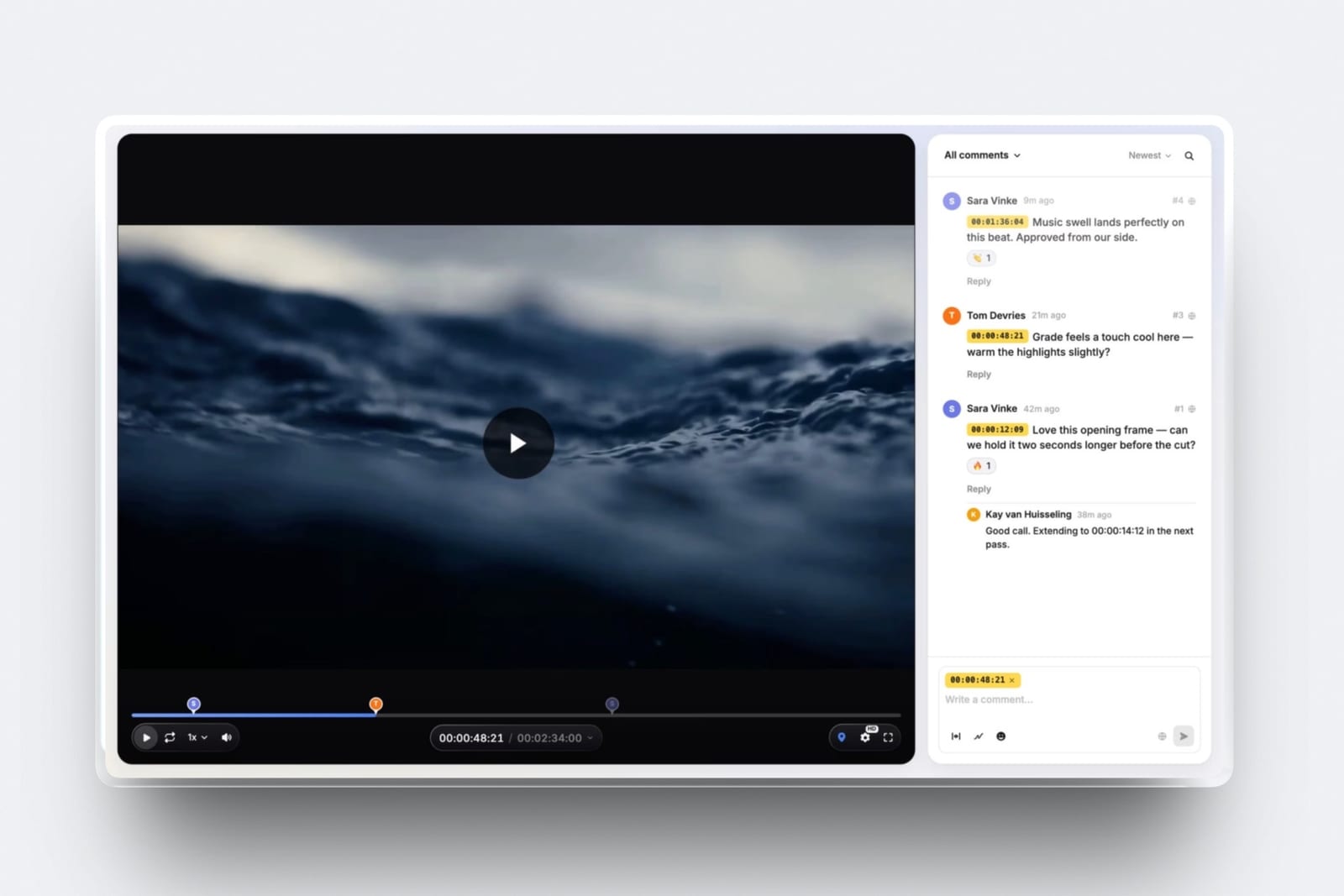
Its video review lets trusted viewers leave notes at the exact frame on the festival cut, with versions stacked as you recut, and a password-protected client gallery can hold a screener for a sales agent or distributor who asks for one directly.
Two honest limits. Framekit does not submit films to festivals and is not an alternative to anything ranked above, and it is not a public streaming host with forensic watermarking, so festivals that require a platform or Vimeo screener still get one.
The Decision Guide
Work down these in order and stop at the first yes. The platform question is genuinely simple; the questions after it are where your money goes.
Are you running any kind of normal campaign? If yes, FilmFreeway. It is free, it lists nearly everything, and the alternatives are additions rather than replacements.
Is a festival you want missing from FilmFreeway? If yes, look for it on Festhome first, then Shortfilmdepot for European shorts, then the Spanish-language platforms, and open an account only for the festival that requires it.
Are you targeting Spanish-language festivals seriously? If yes, Click for Festivals and Movibeta together, and build a spreadsheet rather than trying to hold four platforms in your head.
Is one of your targets a major festival with its own portal? If yes, use it, and note that Sundance at about $55 and Tribeca's discounted shorts rate at about $35 are cheaper than many regional festivals.
Have you checked whether any of your targets waive fees? If not, do that before paying. Waivers for students, regions, alumni and specific subject matter are common and almost never advertised.
Is your submission list built from festivals that have programmed films like yours? If not, stop and rebuild it. This is the only decision in this article that changes the total by hundreds of dollars.
Frequently Asked Questions
What is the best film festival submission platform in 2026?
The best film festival submission platform in 2026 is FilmFreeway, which is free for filmmakers, lists the overwhelming majority of festivals worth entering, and makes its money by charging participating festivals a 12% commission on entry fees rather than charging you.
Festhome and Shortfilmdepot are worth secondary accounts for European festivals FilmFreeway does not carry, and several major festivals including Sundance run their own portals.
Does FilmFreeway charge filmmakers?
No. FilmFreeway is free for filmmakers, and what you pay is the festivals' own entry fees.
According to its published help material, festivals without entry fees use it free, festivals with entry fees pay a 12% commission, and there is a reported one-time activation fee of $100 with $50 for subsequent calls, plus payment processing of 3% and $0.30 per transaction.
All of those charges fall on the festival rather than on you.
How much does it cost to submit a film to festivals?
Published 2026 short film entry fees at named festivals run from about $35 to $70, with Tribeca's discounted shorts rate at about $35, Sundance at about $55, LA Shorts from $49 to $70 and New York Shorts from $39 to $69.
A thirty-festival campaign costs roughly $1,350 at early deadlines and about $2,040 at final ones, which is a difference of about $690 for identical submissions.
Are early bird festival deadlines worth it?
Yes, and the saving is larger than most filmmakers expect. On the named festivals in this comparison the final deadline costs between 17% and 77% more than the early one, and across a thirty-festival campaign that difference is about $690.
Since the film is the same and the festivals are the same, planning a submission calendar three months ahead is the single most effective cost reduction available in this whole process.
Is Withoutabox still available?
No. Withoutabox, the IMDb-owned platform that dominated festival submissions for over a decade, wound down with commitments fulfilled through 30 October 2019.
Any article or advice still referencing it as a current option has not been updated in at least six years, which is worth bearing in mind when evaluating the rest of that advice.
What happened to Coverfly and the screenwriting platforms?
Coverfly shut down on 1 August 2025, as part of a broader collapse of the Industry Arts portfolio under its parent company.
ScreenCraft, The Script Lab and WeScreenplay all closed in early March 2025, and The Tracking Board discontinued its services from 1 September 2025.
Writers who had built contest histories and rankings inside those systems found that the standing did not transfer anywhere, which is a strong argument for keeping your record on a site you control.
Do I need more than one submission platform?
Most filmmakers do not. FilmFreeway's coverage means a single account handles a normal campaign, and additional platforms are worth opening only when a specific festival you want is not listed there.
Running several platforms means several sets of deadlines and materials, and the most common failure is missing an early deadline on a secondary platform because the calendar lived on the primary one.
Can I get film festival submission fees waived?
Frequently, and it is far more common than filmmakers assume.
Festivals waive fees for students, for films from particular regions, for previous alumni, for specific subject matter, and sometimes simply on request for a project a programmer is interested in.
Waivers are almost never advertised, and a short, specific email to a programmer costs nothing. Always ask before paying a final-deadline fee.
Is it cheaper to submit directly to a festival?
Sometimes. Because platforms take a commission from the festival rather than from you, some festivals price direct submissions lower or handle waivers only through direct contact.
The trade is that you lose the tracking, materials management and deadline handling that make a thirty-festival campaign manageable, so direct submission works best as a targeted exception rather than as your main route.
Which festivals are worth submitting to?
The ones that have programmed films like yours in the last three years, that screen to a real audience with programmers present, and where selection produces something beyond a laurel image.
A substantial industry now sells laurels for online-only playlists at the same fee as festivals with cinemas and distributors in the room.
Checking three years of past selections before submitting removes about a third of a typical first campaign.
How much should I budget for a festival run?
Budget about $1,350 for thirty submissions if you plan ahead and hit early deadlines, or about $2,040 if you submit reactively at final deadlines.
That figure exceeds the production budget of many short films, which is worth confronting before the first submission.
A smaller, better-researched list of ten to fifteen well-matched festivals frequently produces more than thirty scattered ones at twice the cost.
Do festival submission platforms take a percentage of my fee?
Not from you. FilmFreeway's 12% commission is charged to the festival, and the other platforms in this comparison publish no filmmaker-facing platform fee either. What you pay is the festival's entry fee.
The commission does affect you indirectly, because it is part of why entry fees have drifted upward and why some festivals offer cheaper direct routes.
What should I have ready before I start submitting?
A finished film with correct technical specifications, a screener link with a password that will not expire mid-campaign, a poster, three or four stills at print resolution, a short synopsis and a longer one, full credits, a director biography and a headshot.
Assembling these once into a platform profile is what makes the second and thirtieth submission take a minute each rather than repeating the whole process.
How do I get feedback on my festival cut before submitting?
Send the cut to three or four trusted viewers through a review tool that pins notes to the frame, rather than asking for emailed impressions.
Framekit's video review does this free with version stacks and no viewer accounts, and Frame.io works if your editor wants notes inside Premiere.
Final Verdict: The Best Festival Submission Platform in 2026
FilmFreeway is the answer, and the decision is easier than the category makes it look. It is free to filmmakers, it lists nearly every festival worth entering, and it charges festivals a 12% commission instead of charging you.
Open one account, build one project profile, and add a second platform only when a specific festival forces you to.
The decision that actually costs money is the one after that. A thirty-festival campaign runs about $1,350 at early deadlines and about $2,040 at final ones, and both figures are dwarfed in importance by whether the festivals on your list have ever programmed a film like yours.
Where this category loses, plainly: no platform filters out festivals that exist to sell laurels, the review scores on the dominant platform are not an independent audit, and the infrastructure itself is less permanent than it looks, as the 2019 and 2025 shutdowns demonstrated.
Your record needs to live somewhere you own.
Where Framekit loses, and it is worth stating directly: we do not submit films to festivals, we do not list festivals, and we are not an alternative to anything ranked above.
We are also not a public streaming host, so a festival screener still goes through the submission platform or Vimeo. If a submission route is what you came for, the eight above are your list and we are not on it.
The short version. Any normal campaign: FilmFreeway, free. European festivals it misses: Festhome, then Shortfilmdepot for shorts. Spanish-language circuits: Click for Festivals and Movibeta.
The largest festivals: their own portals, and note that Sundance at about $55 is cheaper than many regional festivals at a final deadline. Before any of it: rebuild your target list from three years of past selections.
Related readingthe best website builders for filmmakers, what a filmmaker portfolio should include, the best video hosting platforms, how to build a filmmaker website that books clients, and the best screenwriting software.