Framekit templates
Start from a designer-made template
 Use template
 Use template
 Use template
 Use template
 Use template
 Use template
 Use template
 Use template
The uncomfortable fact about screenwriting software is that the formatting problem was solved decades ago and every program in this guide solves it correctly.
Scene headings, character cues, dialogue margins, transitions, and page breaks all come out right in a 249.99 dollar program and in a free one.
What you are actually choosing between is file compatibility, revision handling, and whether the program stays out of your way, and those three things do not track price at all.
A screenwriting program is software that applies industry-standard screenplay formatting automatically while you type, so that a scene heading, a character cue, and a line of dialogue each take their correct position on the page without you setting margins.
Everything beyond that, meaning outlining, revision colours, collaboration, and production reports, is where the programs actually differ.
Fade In is the best screenwriting software for most writers because it costs 79.95 dollars once, runs on Windows, Mac, and Linux, includes free updates, and reads and writes the industry .fdx format that everyone else expects.
Final Draft at 249.99 dollars remains the safest choice if you are writing for a production that will hand you notes in .fdx and expect them back the same way.
Updated in September 2026: we re-verified Framekit's plans and added how a pitch deck or series lookbook fits after the draft, since Framekit now includes a Slides tool; screenwriting software prices are as checked in August 2026.
We wrote and revised the same eight-page scene in all eight programs, took it through a coloured-page revision, and then exported it to the two formats production actually asks for.
The differences that mattered were in the revision pass and the export, and almost none of them were visible in the writing itself.
Every price below was read on the vendor's own store or pricing page during the first week of August 2026. Where a vendor does not publish a price on its own site, we say so plainly rather than quoting a number we could not verify at the source.
How We Tested 8 Screenwriting Programs
Formatting tests are useless in this category because every program passes them, so we built the test around the two things that go wrong in real work: revisions and handoff.
The scene was eight pages, three characters, with a dual-dialogue passage, a montage, one flashback slug, and a piece of action long enough to break across a page.
Then we did what actually happens on a production: we made a locked revision, changed four lines, and produced blue pages with asterisks in the margin and the correct revision header.
A program that writes beautifully and cannot produce a clean set of coloured pages is not a professional tool, and several programs that look professional are wobbly at exactly that step.
The handoff test was the second half. We exported each script to PDF and to .fdx, opened the .fdx in a different program, and looked for what had been lost.
Scene numbers, dual dialogue, revision marks, and notes are the four things that most often do not survive the trip, and knowing which ones your program drops matters far more than any feature comparison.
Findings are labelled. Where we say we wrote in it, we used the program for the full test on a paid or free licence during July and August 2026.
Where a figure is published, it was read on the vendor's own store or pricing page and quoted rather than tested.
Where we describe what writers report, that is forum and community sentiment, useful as a signal and not as proof.
Two limits worth stating. We tested on macOS and Windows and not on Linux, so our note on Fade In's Linux build rests on the vendor's claim rather than our own use.
And the large software review aggregators return errors to automated access, so this guide quotes no star ratings from them rather than repeating scores we could not open and verify.
What You Are Actually Buying: File Compatibility
Here is the thing no comparison table says out loud. Final Draft's .fdx is the exchange format of the film and television industry, and its position has nothing to do with Final Draft being the best program.
It is the format because it is the format, the same way a particular spreadsheet file extension is.
Production coordinators, script supervisors, and assistants have workflows built on it, and if you hand in something else, someone has to convert it and they will not thank you.
That single fact explains the entire price structure of this category. Final Draft charges 249.99 dollars for the program that defines the format.
Every other paid program charges much less for the ability to read and write that format faithfully.
Fade In at 79.95 dollars, Highland at 59.99 dollars a year, Arc Studio at 99 dollars a year, and Slugline at 49.99 dollars are all, in commercial terms, selling compatibility.
The second format worth knowing is Fountain, a plain-text markup for screenplays. A Fountain file is a text file: you can open it in anything, keep it in version control, read it in fifty years, and no company can take it away from you.
Highland, Slugline, and Beat are Fountain-native, and Arc Studio, Fade In, and Final Draft all import and export it.
So the real question is not which program has more features. It is whether you need to hand .fdx files to other people, and whether you want your archive to be a proprietary file or a text file. Answer those two and the list below narrows to two or three candidates immediately.
In one lineYou are buying .fdx compatibility, and it costs 249.99 dollars from the company that owns the format or 79.95 dollars, 49.99 dollars, or nothing from everyone else.
What Testing Eight Screenwriting Programs Changed Our Minds About
We expected the paid programs to be clearly better at the writing itself. They are not.
On the plain job of typing a scene, the free Fountain-based editors were the most pleasant, because they have almost no interface and the formatting happens as a consequence of how you type rather than as a mode you switch into.
Where money bought something real was revisions.
Producing a correct set of coloured pages, with the revision letter in the header, asterisks against changed lines, and pages that do not reflow the unchanged material, is genuinely hard, and it is the single clearest dividing line between a hobby tool and a production tool.
Final Draft and Fade In did it correctly without help. Several others required a workaround or produced something a script coordinator would send back.
The second surprise was how good the free options are for everything before production.
If you are writing a spec, a short, a pilot on your own, or a first draft of anything, Beat and Trelby cost nothing and produce a correct PDF, and the money is better spent later when someone actually asks for .fdx.
The third is that subscriptions have crept into a category that used to be one-time purchases, and the value case is mixed.
Arc Studio at 99 dollars a year and Highland at 59.99 dollars a year both buy real things, mainly cloud sync and collaboration, and both cost more over five years than Fade In costs once.
Decide whether you are paying for a service or for a program, because these vendors have quietly stopped being the same kind of business.
The 8 Best Screenwriting Software Picks in 2026: Full Comparison
Two tables before the reviews. The first is the money, read from each vendor's own store. The second is what each program can actually hand to a production.
The real price table, read at source in August 2026
| Program | Licence model | Published price | Platforms | Where the price came from |
|---|---|---|---|---|
| Fade In | One-time purchase | 79.95 dollars, listed against 99.95 | Windows, Mac, Linux | fadeinpro.com purchase page |
| Final Draft 13 | One-time purchase | 249.99 dollars, on sale at 199.99 | Windows, Mac | finaldraft.com products page |
| Highland Pro | Subscription | 4.99 dollars monthly billed 59.99 yearly, or 9.99 monthly | Mac | highland2.app |
| Arc Studio Pro | Subscription | 99 dollars a year, free tier available | Browser, desktop, iPhone, iPad | arcstudiopro.com pricing |
| Slugline 2 | One-time unlock | Free for six pages, then 49.99 dollars | Mac, with a separate iOS app | slugline.co |
| Beat | Free, open source | 0 on Mac, 12.99 euros on iOS | Mac, iOS | beat-app.fi |
| Trelby | Free, open source | 0 | Windows, Linux | trelby.org |
| Celtx | Subscription | Not published on the vendor's own pricing page | Browser | see the review below |
What each one can hand to production
| Program | Reads and writes .fdx | Fountain | Coloured revision pages | Real-time collaboration |
|---|---|---|---|---|
| Fade In | Yes, both directions | Yes | Yes, correct out of the box | No |
| Final Draft 13 | Native format | Import and export | Yes, the reference implementation | Yes, in the app |
| Highland Pro | Export | Native | Yes, revision mode with coloured tracking | No |
| Arc Studio Pro | Export | Export | Yes, revision management | Yes |
| Slugline 2 | Export | Native | Partial, via revision tools | No |
| Beat | Import and export | Native | Limited | No |
| Trelby | Import and export | Limited | Limited | No |
| Celtx | Export | Limited | Yes, on higher tiers | Yes |
1. Fade In: The Best Screenwriting Software for Most Writers
Fade In is the answer to a question most writers do not know they are allowed to ask, which is whether you have to pay 249.99 dollars to be taken seriously.
Its purchase page lists it at 79.95 dollars against a struck-through 99.95, one payment, for Windows, Mac, and Linux, and it states that updates are free.
Its own copy makes the comparison directly, pointing out that the price is less than a single Final Draft update.
We wrote in itthe eight-page scene, the dual dialogue, and the montage all came out correct without a single formatting intervention, and the coloured revision pass produced clean blue pages with asterisks in the right margin on the first attempt.
The standout detailthe .fdx round trip was the cleanest of the eight. We exported to .fdx, opened the file in another program, and scene numbers, dual dialogue, and revision marks all survived, which is the specific thing a production coordinator will notice if it fails.
The honest gotchathe interface looks like software from a decade ago, and there is no cloud sync, no collaboration, and no mobile app. If you write with a partner in real time, Fade In will not do it and you should be reading the Arc Studio entry.
Skip it ifcollaboration or writing on a phone is part of how you work. Fade In is a desktop program in the traditional sense and makes no apology for it.
Verdict: The best value in screenwriting software and the one we would buy. It loses to Final Draft on the certainty that any production will accept its output without a thought, and to Arc Studio on everything collaborative.
2. Final Draft 13: You Are Buying the Format
Final Draft is the industry standard and it is worth being precise about what that means.
It means the .fdx format is what productions exchange, that assistants and coordinators have workflows built on it, and that nobody will ever question a file you send from it.
It does not mean the program is better at writing than the alternatives, because it is not.
The current version is Final Draft 13, listed at USD 249.99 with a sale price of USD 199.99, a one-time purchase whose licence activates on two computers with a 30-day money-back guarantee.
The version history is worth knowing too: according to its Wikipedia entry, the stable release is 13.2.1 from November 2024, so the program you buy in 2026 is the one that shipped some time ago.
We wrote in itthe revision workflow is the reference implementation, and the reason is not sophistication but predictability.
Locking pages, marking revisions, generating an A-page, and producing a revision set all behave exactly the way a script coordinator expects, because their expectations were formed by this program.
The standout detailthe Beat Board and structure tools are genuinely useful for outlining inside the same document as the script, which removes the common problem of an outline and a draft drifting apart in two files.
The honest gotchathe price. At 249.99 dollars list, it is more than three times Fade In, which does the same core job and reads and writes the same format. You are paying for certainty, and if nobody is ever going to open your file but you, certainty is not worth 170 dollars.
Skip it ifyou are writing on your own with no production attached. Buy it the week someone asks you for an .fdx and not before.
Verdict: The safe choice and the expensive one. It wins outright when other people handle your file, and it loses to Fade In on every measure that matters when they do not.

3. Highland Pro: Fountain-Native, and Your Script Is a Text File
Highland was built by working screenwriters and it shows in what it refuses to do. There is almost no interface: you type, the formatting appears, and everything else lives out of sight until you ask for it.
Its native format is Fountain, which means your screenplay is a plain-text file readable by anything, permanently.
Pricing moved to a subscription: 4.99 dollars a month billed at 59.99 annually, or 9.99 dollars monthly, with a 30-day trial.
That is a real change of shape for a program that used to be a purchase, and over five years it comes to roughly 300 dollars, which is more than Final Draft.
We wrote in itthe writing experience was the best of the eight. Highland's Revision Mode tracks changes in colours with stars in the margin, which handled our revision pass properly and is the feature that lifts it above the other Fountain editors.
The standout detailbecause the file is text, you can put your screenplay in version control, diff two drafts, and recover any past state. For writers who work in many passes, that is worth more than any outlining feature.
The honest gotchait is Mac only, and it exports to .fdx rather than editing it natively. If a production sends you a marked-up .fdx with their notes in it, you are converting rather than opening.
Skip it ifyou are on Windows, or you expect to receive .fdx files as often as you send them.
Verdict: The most pleasant program here to actually write in, and the best archive format in the category. It loses on platform coverage and on the subscription, which now costs more over five years than owning Final Draft.
4. Arc Studio Pro: The One for Writing With Other People
Arc Studio is the modern take: browser first, with desktop and iPhone and iPad apps, real-time collaboration, comments, and cloud sync. If you write with a partner or in a room, it removes the file-emailing problem that every other program in this list still has.
Its pricing is a free tier at 0 dollars and a Pro plan at 99 dollars a year, and the free tier is not a crippled demo.
It includes industry-standard formatting, cloud sync, automatic backups, comments, and Fountain and Final Draft export, which is a genuinely complete free program for a solo writer.
We wrote in itcollaboration behaved the way a shared document should, with both writers in the same script and comments attached to lines rather than floating. The outlining tools and the script view sit side by side rather than in separate modes, which suits a rewrite.
The standout detailthe free plan exporting to both Fountain and Final Draft format is unusually generous. Most free tiers in software withhold export precisely because it is the thing you need.
The honest gotcha99 dollars a year is 495 dollars over five years, or roughly six times what Fade In costs once. Pro buys collaboration, custom formats, revision management, and history, and if you write alone you are paying a service price for a program's job.
Skip it ifyou write alone and offline. The free tier will cover you and the Pro tier will not earn its money.
Verdict: The best collaborative screenwriting tool and the best free tier in the category. Its Pro subscription is hard to justify for a solo writer, and its .fdx support is export rather than full round trip.
5. Slugline 2: Try the Whole Program on a Short Film
Slugline is a Mac screenwriting app with the most sensible trial in the category. Its site states it is free for the first six pages, then 49.99 dollars USD to unlock unlimited writing and FDX export.
Six pages is a real short film, which means you can write and finish an actual project before deciding whether to pay, rather than evaluating on a countdown.
Like Highland it is Fountain-native, so what you are writing is a text file with a screenplay in it, and the formatting is a rendering of that text rather than a property of a proprietary document.
We wrote in itthe drag-and-drop Outline and the Live Compare feature were the two things we kept using. Live Compare puts two drafts side by side and shows what moved, which is exactly the question you have during a rewrite and which most programs answer with a diff you have to read carefully.
The standout detailthe iPhone and iPad app shares files over iCloud or Dropbox and works standalone, producing correct Hollywood-standard print and PDF output on its own, which is more than most mobile companions manage.
The honest gotchait is Mac and iOS only, and .fdx is export rather than a format it edits. The six-page free tier is generous for a short and useless for a feature, which is the point.
Skip it ifyou are on Windows, or your rewrites arrive as .fdx files from other people.
Verdict: The best trial in the category and a fair 49.99 dollars for a clean, fast Mac writing tool. It loses to Fade In on platform coverage and full .fdx handling, and to Highland on revision colours.
6. Beat: Free, Open Source, and Fountain All the Way Down
Beat is a screenwriting app for macOS and iOS made by a screenwriter, given away free and fully open source, and it is the strongest argument in this guide that you do not need to spend anything to write a screenplay properly.
The Mac app is free and the iOS app is 12.99 euros, and the whole thing is built on Fountain, so files are portable and openable in a range of other apps.
We wrote in itthe distraction-free mode was the closest thing here to writing on paper, and the structural tools, meaning the outline view and the card view, are better than a free program has any obligation to provide.
The standout detailit is expandable with plugins, so features the developer has not built can be added by the community. For a free program that is unusual, and it means the gap between Beat and a paid program narrows rather than widens over time.
The honest gotcharevision handling is limited, and coloured production pages are not its strength. Beat is a writing program rather than a production document tool, and the moment your script is on a schedule with locked pages you will feel the difference.
Skip it ifyour script is going into production and you will be issuing revisions. That is precisely the job Beat is weakest at.
Verdict: The best free screenwriting software on a Mac, and genuinely good rather than merely free. It loses to every paid program on revisions and production paperwork.
7. Trelby: The Free One for Windows and Linux
Trelby is a free, open-source screenwriting program for Windows and Linux, and it exists in this guide because the free options in this category are overwhelmingly Mac-first and a Windows writer with no budget deserves an answer.
It is small, fast, and does the formatting job correctly.
We wrote in itthe eight-page scene formatted correctly and the PDF output was clean and standard. There were no surprises, which for a free program is the highest praise available.
The standout detailit includes a name database and reporting tools that would not embarrass a paid program, and its files are a simple documented format rather than something opaque.
The honest gotchadevelopment is slow, the interface is dated even by the standards of this category, and Fountain support is limited compared with the Mac-native free options. It is a competent program that is not moving quickly.
Skip it ifyou are on a Mac, where Beat is better, or you need modern collaboration, where Arc Studio's free tier is better.
Verdict: The right free answer on Windows and Linux and nowhere else. It loses to Beat on polish and to Arc Studio's free tier on everything cloud-related.
8. Celtx: Production Planning Attached to the Script
Celtx is the browser-based option that treats the screenplay as the first document in a production rather than as the whole job.
Breakdowns, schedules, call sheets, and budgets live alongside the script, which for a small production company or a student film is a genuinely different proposition from a writing program.
Pricing is where we have to be careful, and the care is the point.
Celtx's own plans and pricing page lists Free, Writer, Writer Pro, Team, Education, and Student tiers with feature lists but did not render actual prices when we read it in August 2026.
Third-party trackers report Writer at about 11.24 dollars a month and Writer Pro at about 18.74 dollars a month on annual billing, with Team from roughly 67.49 dollars a month, and those figures are consistent with the 25 per cent annual discount Celtx advertises.
We are labelling them as secondary rather than verified, because we could not read them at the source.
We wrote in itthe free tier is restrictive in a specific way that matters, allowing one project and one seat with read-only script history, so it works as an evaluation and not as a way to run a slate.
The standout detailthe production side is the reason to be here. Tagging elements in the script and generating a breakdown that feeds a schedule is a real workflow that no dedicated screenwriting program in this guide offers.
The honest gotchaas a pure writing tool it is the weakest here, and paying a monthly subscription for a screenplay editor that exports rather than edits .fdx is a poor trade unless you use the production half.
Skip it ifyou only want to write. Nothing about Celtx earns its subscription for a writer who never makes a schedule.
Verdict: The right tool if the script is the front end of a production you are actually running, and the wrong one for writing alone. Check the price yourself on their site before you commit, because we could not.
Fountain, .fdx, and Why Your Script Should Also Be a Text File
Fountain is a plain-text markup for screenplays. A scene heading is a line beginning with INT or EXT, a character cue is a line in capitals, and dialogue is the line under it.
That is close to how screenplays were typed before software existed, which is why it feels like no markup at all.
The practical consequences are larger than they sound. A Fountain file opens in any text editor on any operating system for as long as text editors exist.
It can go into version control, so you can diff two drafts line by line and recover any past state. It is small enough to email, sync, or back up anywhere. And no company's business decisions can render it unopenable.
Against that, .fdx is what the industry exchanges, and no argument about openness changes the fact that a producer's assistant wants a .fdx.
The two are not in competition once you understand the roles: Fountain is the format you keep your work in, and .fdx is the format you hand over.
The workflow that follows from that is simple and worth adopting whichever program you buy. Write in whatever you like. Export a .fdx when someone asks for one.
And keep a Fountain or plain-text copy of every draft in your own backups, because that copy is the one that will still open in twenty years.
If protecting a body of creative work is a live concern for you, our guide to photo backup solutions covers the storage side of the same problem.
What Production Actually Requires From Your Script File
Once a script is greenlit, it stops being a document and becomes production paperwork, and the requirements get specific. Five things matter and most writers meet them for the first time under deadline.
Locked pages come first. Once a script is locked, page numbers stop moving, and inserted material becomes A-pages, so that everyone's schedule and breakdown still refer to the same page.
A program that reflows the whole document when you add a line has failed at the one job that matters at this stage.
Revision colours come second. Each revision pass gets a colour in a conventional order, changed lines get asterisks in the margin, and the header carries the revision name and date. This is not decoration, it is how a hundred people know which pages they are holding.
Scene numbers come third, and they must be stable. Once numbered, scene 14 stays scene 14 even if a scene is inserted before it, which is why inserted scenes become 14A. Programs that renumber on every edit cause real problems downstream.
Fourth is the breakdown, meaning the ability to tag props, cast, locations, and effects in the script so a schedule can be generated.
Final Draft and Celtx do this natively and most writing-focused programs do not, which is normal because it is usually the first assistant director's job in dedicated software.
Fifth is the export itself. Test it before you need it. Export a .fdx, open it somewhere else, and confirm your dual dialogue, scene numbers, and revision marks survived. Doing that once, calmly, is better than discovering the answer on the day a coordinator asks.
Collaboration, Notes, and Working With a Writing Partner
Screenwriting is more collaborative than the solitary-genius framing suggests, and the programs split cleanly on how they handle it. Arc Studio and Celtx are built around simultaneous editing in a browser.
Final Draft offers collaboration in the app. Fade In, Highland, Slugline, Beat, and Trelby are single-writer programs that expect you to exchange files.
For a genuine writing partnership where two people work at once, the browser tools win and it is not close.
Watching a partner's cursor move and arguing about a line in comments attached to that line is a different activity from emailing drafts back and forth, and it is worth the subscription if that is your working pattern.
For the far more common case, which is a writer receiving notes from a producer, executive, or director, the browser advantage mostly disappears.
Notes usually arrive as a document, an email, or a marked-up PDF, and what you need then is a program that lets you keep those notes next to the script and mark what you have addressed.
Every program here can do that, and Final Draft's and Arc Studio's implementations are the tidiest.
One practical warning about cloud-based writing tools. Your script lives on someone else's server, and the moment you stop paying, your access to editing it usually stops too.
Export a local copy of everything important on a schedule, and treat the cloud as convenience rather than as your archive.
The Ten-Year Cost of Writing Screenplays
Screenwriting is a long game and most writers keep the same tool for years, so the honest comparison is a decade rather than a month. Here is what each option costs over ten years at published rates, ignoring sales and version upgrades.
| Option | Ten-year cost | What you have at the end |
|---|---|---|
| Beat or Trelby | 0 | The program, and text files that open anywhere |
| Slugline 2 | 49.99 dollars | A Mac licence, and Fountain files |
| Fade In | 79.95 dollars | The program on three platforms, updates included |
| Final Draft 13 | 249.99 dollars, plus paid version upgrades | The program, and the format everyone accepts |
| Highland Pro | 599.90 dollars | Nothing you can edit once you stop paying |
| Arc Studio Pro | 990 dollars | Nothing you can edit once you stop paying |
The two subscription rows are the ones to sit with.
Arc Studio Pro at 99 dollars a year comes to 990 dollars over a decade, which is nearly four times Final Draft's list price and more than twelve times Fade In's, and at the end you own nothing.
That is not an argument against it, because collaboration and sync are real services with real running costs. It is an argument for being clear about which of the two things you are buying.
Note also what the one-time purchases do not cover. Final Draft has historically charged for major version upgrades, so a decade of staying current costs more than the row above.
Fade In states that its updates are free, which over ten years is a larger difference than the sticker price suggests, and it is the single strongest financial argument in this guide.
For a broader look at the same trade-off across creative software, our roundup of tools you buy once covers where perpetual licences still exist.
Where a Finished Script Actually Gets Read
A screenplay in a folder does nothing, and getting read is the entire problem the tools above leave unsolved: producers and managers ask for a logline, a one-page pitch or a pitch deck long before they open a hundred and ten pages.
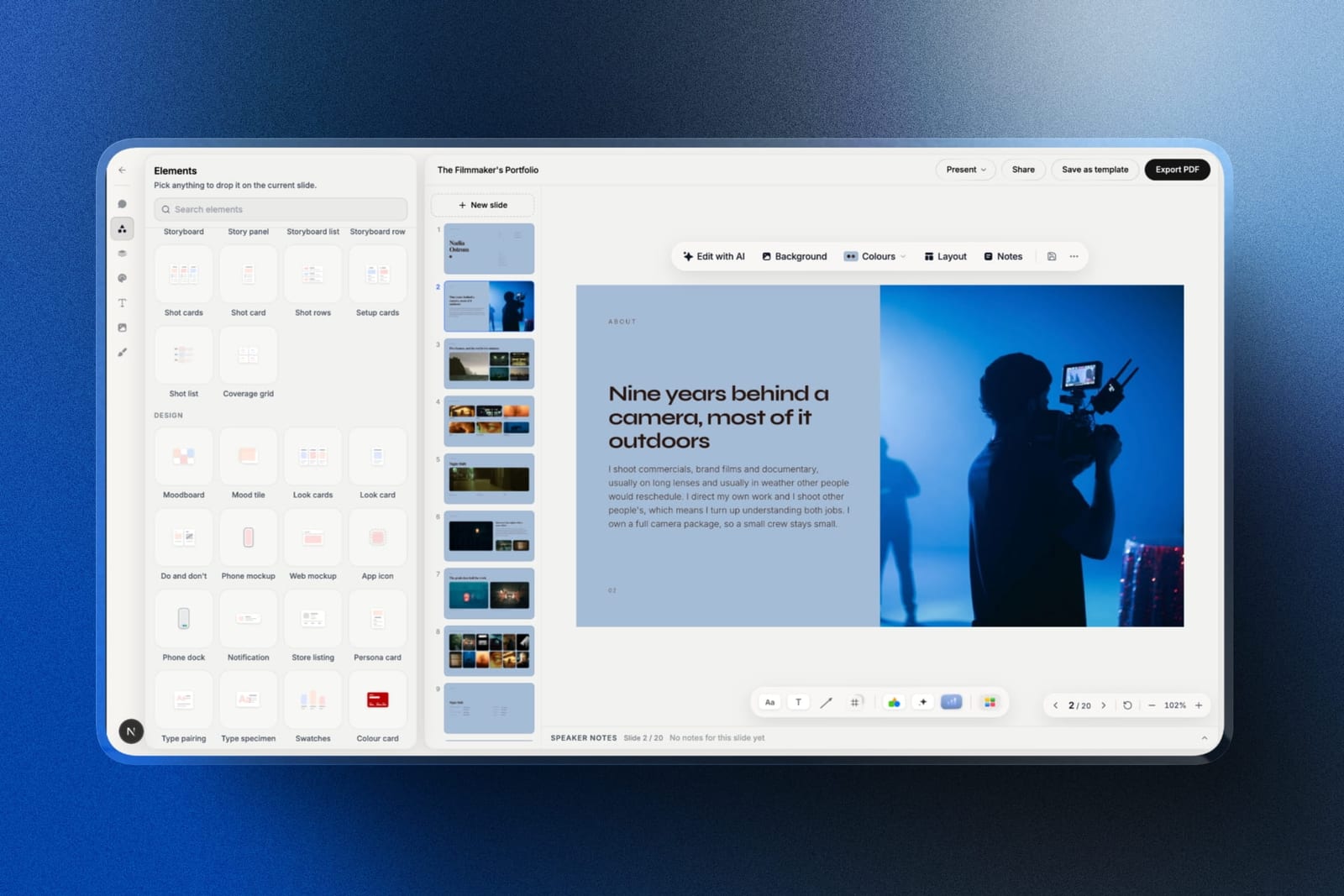
Framekit is an AI website builder, and two parts of it matter to a writer.
The first is Slides, where you describe the project and the AI writes and lays out a pitch deck or series lookbook that stays editable by hand: logline, world, characters, tone references on a moodboard, and comparables, with your own fonts and colours and speaker notes for a live pitch.
You can present it full screen, share it as a link or export a PDF on every plan, including free. Deck links have no password, so keep anything confidential in a PDF you send directly.
The second is the site: a page per project with the logline and status, an about page, and a contact route you control, which is also the text search engines and language models read when someone half-remembers a title.
Neither replaces a script-sharing service with watermarked PDFs and view tracking.
Note that Coverfly and several sibling platforms shut down during 2025, which we cover in the best film festival submission platforms.
What We Left Out of This Comparison and Why
Three well-known names are missing from the ranked list, and in each case it is because we could not read a price on the vendor's own site, which is the standard this guide holds itself to.
WriterDuet is a browser-based collaborative screenwriting tool with a strong reputation for real-time work, and its pricing page returned nothing quotable to us.
Movie Magic Screenwriter is the other long-standing professional program alongside Final Draft, and its product page likewise published no figure we could verify.
Scrivener is a long-form writing environment rather than a screenwriting program, though it formats screenplays competently; its store lists Scrivener for iOS and iPadOS at US 23.99 dollars, and its desktop prices did not render for us.
None of those three are bad software and their absence is not a judgement. If one of them is your program, the comparisons that matter are against Arc Studio for collaboration, Final Draft for format certainty, and Fade In for price.
We also excluded storyboarding and production management tools, which answer a different question.
If your problem is what happens after the script, our guides to storyboarding software, video editing software, and 2D animation software cover the production side.
A Test You Can Run This Weekend
Every program worth considering in this comparison offers a trial and two of them are free permanently, which means the only honest way to choose is to stop reading comparisons and spend an afternoon typing in two of them. Here is the version of that test we would run.
Write the same three pages in two of them.
Pick a scene with two characters talking, one interruption, and one piece of action that runs long, and type it rather than pasting it, because what you are testing is whether the formatting gets in your way while your hands are moving.
Nine times out of ten one program will feel invisible and the other will not, and that is most of the decision.
Then run the handoff test, which almost nobody does before they need it. Export your three pages to .fdx, open the file in a second program, and look for what changed.
Scene numbers, dual dialogue, notes, and revision marks are the four things most likely to be lost. Whatever your program drops, you now know before a producer's assistant discovers it for you.
Third, do the revision. Lock the pages, change three lines, and produce a coloured revision. If your program cannot do this or requires a workaround, that is fine for now and it is the reason you will buy something else later, and knowing which later is useful.
Last, do the ten-year arithmetic on the option you are leaning toward. Multiply any subscription by ten and set it against a one-time purchase.
That number is not automatically an argument against subscribing, and it is an argument for knowing what the service half is worth to you.
The Decision Guide
Take these in order and stop at the first one that describes you, because they are arranged so that the earliest match is the strongest signal.
You have no budget and you are on a Mac. Beat, which is free and open source and better than free software has any obligation to be.
You have no budget and you are on Windows or Linux. Trelby, or Arc Studio's free tier if you want cloud sync and .fdx export, which the free tier includes.
You want one program, one payment, and no further thought. Fade In at 79.95 dollars. Three platforms, free updates, and the cleanest .fdx round trip of the eight.
Someone is going to send you .fdx files with their notes inside them. Final Draft 13. This is the case the 249.99 dollars is actually for, and no amount of export support in another program is the same thing.
You write with a partner in real time. Arc Studio Pro at 99 dollars a year, and check that the free tier is not already enough before you subscribe.
You want the writing itself to feel best and you are on a Mac. Highland Pro at 59.99 dollars a year, accepting that it is a subscription and that .fdx is export only.
You are making the film as well as writing it. Celtx, for the breakdown and scheduling side, and verify its current price on its own site because we could not.
You want to try a whole program on a real short film before paying. Slugline 2, which is free for six pages and 49.99 dollars after that.
Frequently Asked Questions
What is the best screenwriting software in 2026?
Fade In is the best screenwriting software for most writers in 2026, at 79.95 dollars once for Windows, Mac, and Linux with free updates and full .fdx support.
Final Draft 13 at 249.99 dollars remains the right choice when a production will send you .fdx files and expect them back, and Beat and Trelby are genuinely good free options.
Do I have to use Final Draft to be taken seriously?
No, but you do have to be able to produce a clean .fdx file, because that is the format the industry exchanges. Fade In reads and writes it, and Highland, Arc Studio, Slugline, and Beat export it. Nobody reading your script can tell which program made the PDF.
How much does Final Draft cost?
Final Draft 13 is listed at USD 249.99 on Final Draft's own products page, with a sale price of USD 199.99 shown at the time of writing in August 2026.
It is a one-time purchase, one licence activates on two computers, and it carries a 30-day money-back guarantee. Major version upgrades have historically been paid.
What is the best free screenwriting software?
Beat on macOS and iOS, which is free and open source and Fountain-native, and Trelby on Windows and Linux. Arc Studio's free tier is also genuinely usable, including cloud sync, automatic backups, and export to both Fountain and Final Draft format at no cost.
What is Fountain and should I use it?
Fountain is a plain-text markup for screenplays, where a scene heading is a line starting with INT or EXT and a character cue is a line in capitals.
Use it as your archive format regardless of which program you write in, because a text file opens anywhere, goes into version control, and cannot be made unopenable by a vendor's business decisions.
Is a screenwriting subscription worth it?
Only if you are using the service half. Arc Studio Pro at 99 dollars a year comes to 990 dollars over a decade and Highland Pro at 59.99 dollars a year comes to 599.90, against 79.95 dollars once for Fade In.
Collaboration, cloud sync, and cross-device writing are real things to pay for, and if you write alone on one machine you are paying for them anyway.
Can screenwriting software produce coloured revision pages?
Final Draft and Fade In did it correctly in our test without any workaround, and Highland's Revision Mode tracks changes in colours with stars in the margin. Beat and Trelby are weak here, which is the clearest practical line between a writing tool and a production tool.
What is the difference between .fdx and Fountain?
An .fdx file is Final Draft's own format and the one productions exchange. A Fountain file is plain text with a light markup and is readable in any text editor forever.
Use Fountain for your own storage and export .fdx when someone asks for it, because the two formats serve different jobs rather than competing.
Which screenwriting software is best for collaboration?
Arc Studio for real-time simultaneous editing across browser, desktop, and mobile, and Celtx if the collaboration extends into scheduling and breakdowns. Final Draft offers in-app collaboration too.
Fade In, Highland, Slugline, Beat, and Trelby are single-writer programs that expect you to exchange files.
Does screenwriting software run on Linux?
Fade In states support for Windows, Mac, and Linux, which makes it the only paid program in this comparison to cover all three. Trelby is free and runs on Windows and Linux. Everything else here is Mac, Windows, or browser only.
Do I need a pitch deck for my screenplay?
For television and most independent features, yes: producers usually want a pitch deck or lookbook before they read the script. It needs a logline, the world, the characters, tone references and comparables.
Framekit Slides builds one from a description and exports PDF free; Canva and Keynote also work if you prefer to lay it out by hand.
Final Verdict: The Best Screenwriting Software in 2026
Fade In wins because it does the whole job for 79.95 dollars once, on three operating systems, with free updates and the cleanest .fdx round trip in the test.
Nothing in our writing or revision passes made the case that the 170 dollar gap to Final Draft buys anything a reader of your script could detect.
Where Fade In loses is worth naming plainly. It has no cloud sync, no collaboration, and no mobile app, its interface looks a decade old, and if you write with a partner it is simply the wrong tool. Arc Studio is better at that job and we would not try to argue otherwise.
Final Draft keeps its place for one reason, and it is a good one. When a production hands you a marked-up .fdx and expects it back, the program that defines the format removes an entire class of problem.
Buy it the week that becomes true and not before, and until then put the 249.99 dollars somewhere more useful.
The broader point is the one the price list makes for you.
Two of the eight programs here cost nothing and format a screenplay correctly, one costs 49.99 dollars and lets you finish a short film before deciding, and the industry standard costs 249.99 dollars for compatibility rather than capability.
Write in whatever disappears while you work, keep a plain-text copy of every draft, and spend the money at the point where someone else has to open your file.