
Framekit templates
Start from a designer-made template
 Use template
 Use template
 Use template
 Use template
 Use template
 Use template
 Use template
 Use template
Two hundred licences at $79 is $15,800 a month. Paddle takes $890 of it.
You can get that number down to $330 by moving to a flat-plan store on your own site. What you cannot do is get it down to $330 and keep the thing you were paying Paddle for, because roughly $560 of that $890 is not a payment fee at all.
It is somebody else agreeing to be the legal seller of your product in every country you sell into.
That is the choice hiding inside every list of Paddle alternatives, and it is worth naming before you read a single rate.
A merchant of record is a company that becomes the seller on the invoice, which means it collects and remits VAT and sales tax, carries the compliance liability and pays you the balance. Paddle is one.
So are four of the nine alternatives below. The other five are cheaper and leave the obligation with you, and any comparison that lists all nine in one column without saying so is comparing two different products.
Lemon Squeezy is the best Paddle alternative for most creators and small software sellers in 2026, at an identical 5% plus 50 cents with a friendlier onboarding and no requirement to look like a software company.
Polar is the better choice if you have volume, because its published rates step down to 3.4% plus 30 cents and its fee documentation is the most complete in the category.
If you would rather keep the money and take the tax job back, Stripe with Stripe Tax costs roughly $370 a month on the same sales, and Framekit's Business plan costs $330 - but neither is a merchant of record, and that difference is the entire point of this guide.
We rank our own product seventh here.
Framekit is not a merchant of record, does not file tax on your behalf and does not sell subscriptions or issue licence keys, which is precisely what most people searching for a Paddle alternative are looking for.
We re-verified Framekit's entry in September 2026 against its current pricing page; the other vendors' fees are dated August 2026 in place.
How We Priced This
One scenario throughout: a $79 digital licence sold 200 times a month, or $15,800 in monthly revenue, with buyers spread internationally.
Where a platform does not include card processing, we have used the standard European rate Stripe published to us during testing, 1.5% plus EUR 0.25, converted at 1.08.
Three grades of claim below. Read at the vendor's own pricing page or fee documentation in the first week of August 2026: Paddle, Lemon Squeezy, Polar, Stripe, Gumroad, Payhip, Mollie and Framekit's own plan file. Built and transacted covers Lemon Squeezy, Gumroad and Stripe, where we have moved real money. Could not verify applies to FastSpring and Chargebee, both of which block automated access to pricing, and both entries say so rather than estimating.
One standing caveat that matters here more than usual: Stripe and several others serve pricing by country. Our figures are the ones served to a European visitor, and a US seller will see different card rates on the same pages.
By the numbers:
- $890 is what Paddle and Lemon Squeezy each take from $15,800 in a month.
- $597.20 is what the same month costs on Polar's top published tier.
- $330 is the cheapest total here, and it leaves the tax liability with you.
- $560 is the approximate monthly premium for merchant-of-record status at this volume.
- 4 of 9 alternatives are a merchant of record.
- $10 is the product price below which Paddle's pricing page says you need a custom quote.
- $15 is the dispute fee Polar publishes, charged win or lose.
The Rubric
We scored on five criteria, weighted for someone already running on Paddle and deciding what to move to rather than choosing a first platform. That shifts the emphasis onto migration risk and onto who carries the liability, and away from feature breadth.
| Criterion | Weight | What it covers |
|---|---|---|
| Total cost at $15,800 a month | 30% | Platform cut, fixed fees and processing together |
| Who carries the tax liability | 25% | Merchant of record, or you with assistance |
| Fee transparency | 20% | Whether payouts, disputes and surcharges are published |
| Fit for creative products | 15% | Whether a non-software seller gets approved and served |
| Subscription handling | 10% | Renewals, dunning, migration of active plans |
Transparency is weighted at a fifth because this category hides more of its pricing than any other in commerce.
Two of nine here would not show us a rate at all, and among those that did, the difference between a headline percentage and the all-in cost is routinely a point or more.
What $15,800 a Month Costs
Every row is the same month: a $79 licence sold 200 times, or $15,800 gross, run through that platform's published rate. Card processing is added separately for platforms that do not bundle it, and the final column is the one that splits this table in two.
| Platform | Model | Platform cost | Processing | Total | Merchant of record |
|---|---|---|---|---|---|
| Framekit | Business, $39, 0% | $39 | $291 | $330 | No |
| Mollie | 1.80% + EUR 0.25 | Included | $338.40 | $338.40 | No |
| Stripe plus Stripe Tax | 1.5% + EUR 0.25, Tax 0.5% | $79 | $291 | $370 | No |
| Payhip | Pro, $99, 0% | $99 | $291 | $390 | Partly |
| Polar | Scale, 3.4% + 30c | $597.20 | Included | $597.20 | Yes |
| Polar | Growth, 3.6% + 35c | $638.80 | Included | $638.80 | Yes |
| Polar | Pro, 3.8% + 40c | $680.40 | Included | $680.40 | Yes |
| Paddle | 5% + 50c | $890 | Included | $890 | Yes |
| Lemon Squeezy | 5% + 50c | $890 | Included | $890 | Yes |
| Polar | Starter, 5% + 50c | $890 | Included | $890 | Yes |
| Gumroad | 10% + 50c | $1,680 | Included | $1,680 | Yes |
| FastSpring | Quoted per account | Not published | Not published | Not published | Yes |
| Chargebee | Not published | Not published | Not published | Not published | No |
That table should be read in two halves rather than top to bottom.
The top four rows cost between $330 and $390 and leave you as the seller of record. That means registering where you owe, filing returns, and answering if a tax authority asks. The middle and lower rows cost between $597.20 and $1,680 and make that somebody else's job.
The gap between the cheapest merchant of record here and the cheapest option overall is about $267 a month, or $3,204 a year.
That is what the liability transfer costs at this volume, and whether it is expensive depends entirely on what an accountant charges you to do the same work - which for a seller with obligations in the EU, the UK and several US states is frequently more than $3,204.
In one linedecide whether you want to be the seller of record before you compare a single rate, because that decision picks your half of the table and the rates only matter within it.
1. Lemon Squeezy: Best Overall Paddle Alternative
Lemon Squeezy does the same job as Paddle at the same price, and the difference is who it is built for. Paddle expects a software company; Lemon Squeezy expects a creator with a product, and the onboarding reflects that.
The real number5% plus 50 cents per transaction with card processing inside the rate, so $890 on our $15,800 month - identical to Paddle to the cent.
The standout detailthe email tool is included free up to 500 subscribers, which means the buyer list and the mailing list are the same list. For a seller moving off Paddle, that quietly removes a separate subscription that most people were paying for alongside it.
The honest gotchathe pricing page carries a footnote that some payments may be subject to additional fees, without enumerating them there.
Flat pricing that is flat in the headline and footnoted underneath is worth an email to support before you model a year on it.
There is also a live strategic question worth naming: Stripe acquired Lemon Squeezy, and the pricing page now advertises a 2026 update covering Lemon Squeezy and Stripe Managed Payments.
Products inside a larger parent get repositioned, which is a reason to keep your customer list somewhere you control rather than a reason to avoid it.
Skip it ifyour product is genuinely enterprise software with procurement, invoicing and net-30 terms. Paddle and FastSpring are built for that and this is not.
What reviewers say elsewhereLemon Squeezy's G2 profile is strongest on setup speed and tax handling, with reporting depth the most common request.
Verdict: the default move off Paddle for anyone who is not a software company. Same price, less friction, better fit for creative products.
2. Polar: Best Rates and the Most Honest Fee Page
Polar is a newer merchant of record and it does something nobody else in this category does: it publishes the entire fee schedule, including the parts that usually appear on your statement as a surprise.
The real numberStarter is 5% plus 50 cents, Pro is 3.8% plus 40 cents, Growth is 3.6% plus 35 cents and Scale is 3.4% plus 30 cents.
On our $15,800 month that is $890 at the entry tier falling to $597.20 at the top - a saving of $292.80 a month against Paddle for the same service.
The standout detailthe published extras. International cards add 1.5%. Disputes are $15 each regardless of outcome.
Payouts cost $2 for each month in which you take one, plus 0.25% and 25 cents per payout, and cross-border payouts add 0.25% inside the EU rising to 1% elsewhere.
Polar also states plainly that it does not refund the transaction fee on a refunded sale, and explains why. No other vendor in this comparison tells you all of that before you sign up.
The honest gotchathe rate went up. Starter moved from 4% plus 40 cents to 5% plus 50 cents in May 2026, with organisations created before that date grandfathered on the old rate. A young company that has repriced once can reprice again, and you should size your dependency accordingly.
Skip it ifyou need a large support organisation behind your billing. This is a small, fast-moving product.
Verdict: the best value in the merchant-of-record half of this table, and worth reading even if you choose something else, because its fee page is the standard the rest should be held to.
3. FastSpring: Enterprise Merchant of Record
FastSpring is the long-established merchant of record for software companies, offering global tax handling, localised checkout, subscription management and reseller channels.
It is the most direct like-for-like competitor Paddle has, and the one whose pricing is hardest to establish without talking to somebody.
The real numberthere is not one we can give you. FastSpring quotes per account and its site blocks automated access, so no figure here would be verified. Any specific FastSpring percentage you read in a comparison article came from somewhere other than FastSpring.
The standout detailit is the most likely of these to already support whatever unusual thing your business does - multi-currency invoicing, reseller pricing, entitlement management - because it has been serving software companies far longer than the newer entrants.
Skip it ifyou are a solo creator or a small team. Quote-based pricing and a sales call are a poor fit for someone selling a $79 licence.
Verdict: the right tool at a scale where somebody else signs off the contract. Revisit when you have a finance function.
4. Stripe With Stripe Tax: Cheapest, and You Stay the Seller
The most common answer to "how do I stop paying 5%" is to run payments directly through Stripe and buy tax calculation separately. It works, it is dramatically cheaper, and it changes what you are responsible for.
The real numberon the pricing served to us, standard European cards are 1.5% plus EUR 0.25 and Stripe Tax Basic is 0.5% per transaction where you are registered.
On our month that is roughly $291 in processing plus $79 in tax calculation, or $370 all in - $520 a month less than Paddle.
The honest gotcha, and it is the entire tradeStripe Tax calculates and records. It does not register you anywhere and it does not file anything. You remain the seller of record, which means the registrations, the returns and the liability are yours.
That is a real job, and for a seller with EU, UK and US obligations it is not a small one.
The standout detailyou can hold balances in multiple currencies rather than converting on every payout, which on international sales is worth more than most people realise. Stripe's automatic conversion on the pricing we were served is 2%.
Skip it ifthe reason you are leaving Paddle is that you want less admin. This is the option with the most.
Verdict: the cheapest credible route by a wide margin, on condition that you are willing to be the seller. Price an accountant's time before deciding it is cheaper.
5. Payhip: Cheapest Store That Handles EU VAT
Payhip sits between the two halves of this table. It is not a full merchant of record, but it does handle EU VAT on digital goods, and it connects to your own Stripe or PayPal account rather than holding your money.
The real numberthe free plan takes 5%, Plus is $29 a month at 2% and Pro is $99 a month with no transaction fee. At our volume Pro plus processing is $390 - $500 a month less than Paddle.
The standout detailfunds settle into your own processor account. After a merchant of record, where your money sits in someone else's balance until a payout cycle, that structural difference is the thing sellers notice first.
The honest gotchapartial tax handling is the most confusing position in this guide. EU VAT on digital goods is covered; US state sales tax and UK obligations are not the same arrangement. If you want one answer to the whole tax question, this is not it.
Skip it ifyou need the liability gone entirely.
Verdict: the best value in the middle of the table, provided you understand exactly which part of the tax problem it solves.
6. Gumroad: Simplest Merchant of Record, Highest Rate
Gumroad is a merchant of record too, which is easy to forget because nobody markets it that way. It handles VAT and sales tax on your behalf as part of its platform fee.
The real number10% plus 50 cents per sale, or $1,680 on our $15,800 month. That is $790 a month more than Paddle and $1,082.80 more than Polar's top tier for the same liability transfer.
The honest gotchayou are not paying that premium for tax. You are paying it for the platform, and the tax comes along with it. Anyone choosing Gumroad to solve compliance is spending roughly $9,480 a year more than the identical arrangement at Polar.
Skip it ifyou have volume of any kind. This is the clearest overpay in the guide.
Working through the arithmetic? Gumroad's fees explained covers it in detail.
Verdict: genuine compliance relief at a price set by something other than compliance.
7. Framekit: Your Own Site, Your Own Liability

Framekit is an AI website builder for photographers, filmmakers, designers and other creators, and one of the five tools in its account is a digital-download store that sells from the same site as your portfolio.
Each product also gets a direct buy link to a hosted checkout under your name and logo, and each sale is a direct charge on your own connected Stripe account, so the money never sits in a platform balance the way it does with a merchant of record.
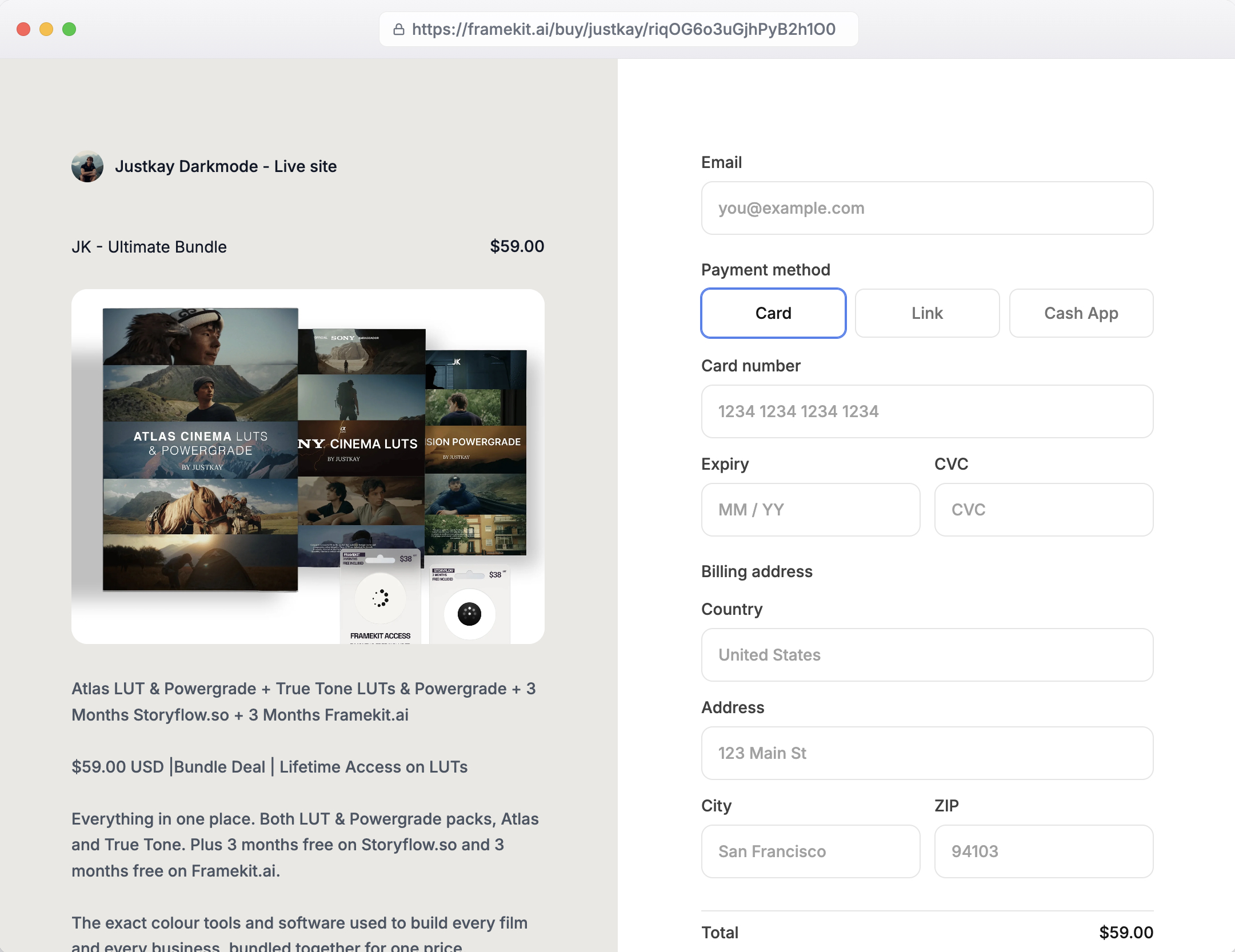
The real numberFramekit charges 5% on its Free and Starter tiers, 3% on Pro at $19 a month, and nothing at all on Business at $39, with card processing separate. At our volume, Business plus processing is $330 - the cheapest total in this comparison.
The crossover where the flat plan beats the percentage is $780 a month in sales, which is $39 divided by 5%.
The honest gotcha, and it is why this is seventh rather than first: Framekit is not a merchant of record.
We do not register you for VAT anywhere, we do not file returns, and the liability on every sale stays with you exactly as it would selling through Stripe directly.
If the reason you are reading a guide to Paddle alternatives is that you want the tax question to disappear, this does not do that, and Lemon Squeezy or Polar does.
The second gotchait sells one-off digital downloads only. There are no subscriptions, no licence keys and no licence server, so a software product that checks entitlements on startup cannot move here at all, and Framekit keeps its own fee on refunded sales on the 5% and 3% plans.
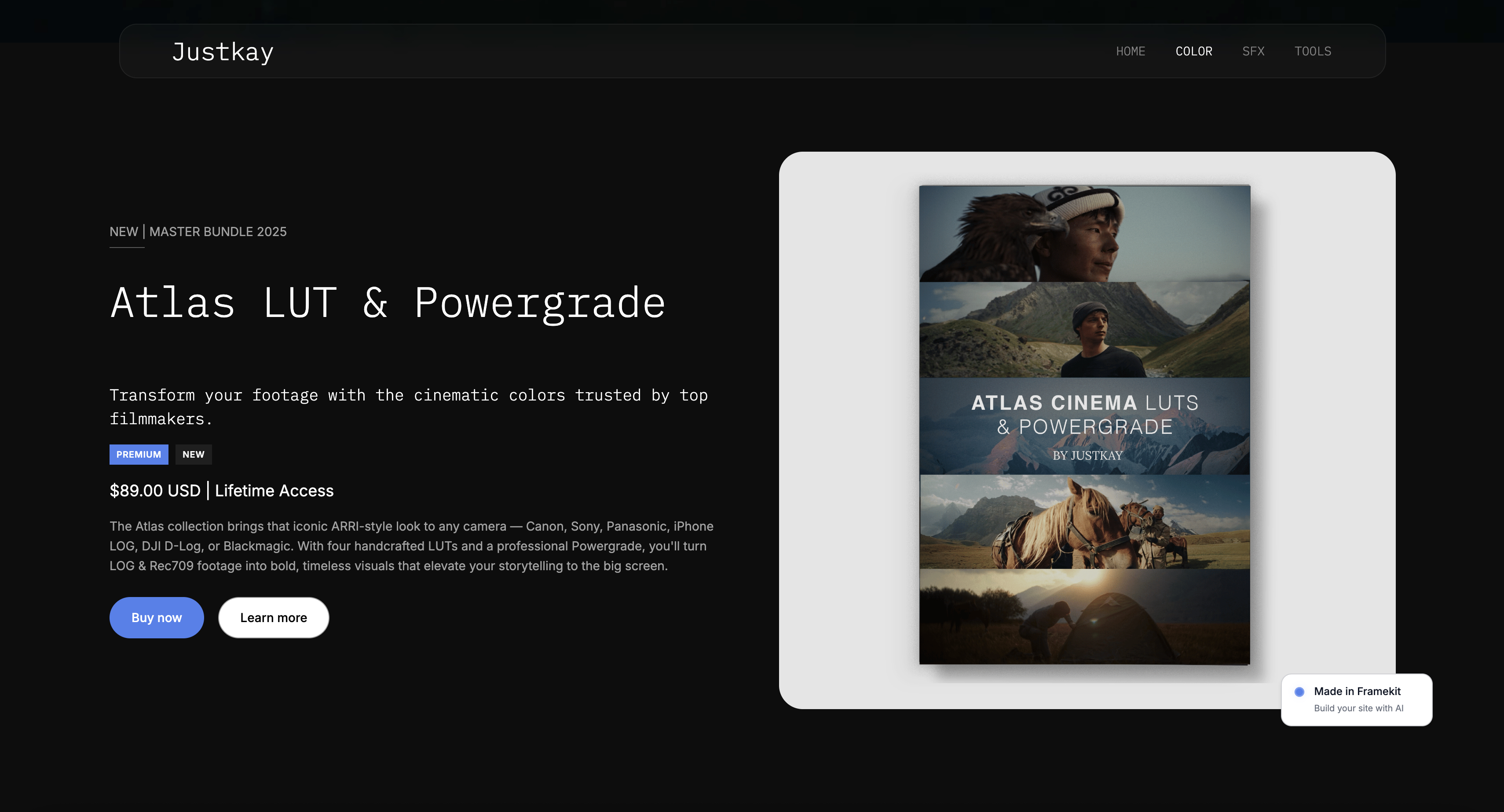
Where it is genuinely the right answera creator selling templates, presets, LUTs or plug-in packs as one-off files to an audience that finds them through their work, who is already registered where they sell, and who wants the storefront to be their own portfolio site rather than a page on a platform that also lists other sellers.
Skip it iftax is the problem you are solving. That is most people here.
Verdict: the cheapest row in the table and the wrong half of it for anyone who came looking for a merchant of record or a subscription engine. See how the Framekit store works.
8. Mollie: European Gateway, No Liability Transfer
Mollie is a payment gateway rather than a merchant of record, and it earns a place here for one specific seller: the one whose buyers are mostly European and who cares about local payment methods more than about tax handling.
The real number1.80% plus EUR 0.25 for European cards and 3.25% plus EUR 0.25 for non-EEA cards. At our volume, assuming mostly European buyers, that is about $338.40.
The standout detailiDEAL, Bancontact and SEPA as first-class payment methods rather than afterthoughts. If a meaningful share of your buyers reach for those, the conversion difference will outweigh any fee comparison in this guide.
The honest gotchathe VAT job is entirely yours, exactly as with Stripe. Choose Mollie for the checkout, not for the compliance.
Skip it ifyour buyers are mostly American.
Verdict: the right gateway for a European seller with European buyers, and not an answer to the question Paddle was answering.
9. Chargebee: Enterprise Billing, Unpublished Price
Chargebee manages subscription billing complexity at a scale where revenue recognition, entitlements and multi-entity invoicing stop being features and become separate problems with separate owners inside a finance team.
It appears on Paddle comparison lists constantly and solves a genuinely different half of the problem.
The real numbernot published in any form we could verify. The pricing page did not render tiers for us and there is no rate card sized for a seller at $15,800 a month.
The honest gotchait is also not a merchant of record, so even at enterprise scale it does not replace what Paddle was doing for you. It replaces the billing engine, not the liability.
Skip it ifyou are here because of tax. This solves a different problem entirely.
Verdict: included as a boundary marker. If you need it, you already know.
The Merchant-of-Record Premium, Priced Properly
In one linethe premium is about $560 a month at this volume, and whether that is expensive depends on a number most sellers have never worked out.
Here is the same $15,800 month, split by what you are actually buying.
| Route | Monthly cost | What you still have to do |
|---|---|---|
| Framekit Business | $330 | Register, calculate, file, and carry the liability |
| Stripe plus Stripe Tax | $370 | Register and file, with calculation automated |
| Payhip Pro | $390 | Everything outside EU VAT on digital goods |
| Polar Scale | $597.20 | Nothing |
| Paddle or Lemon Squeezy | $890 | Nothing |
| Gumroad | $1,680 | Nothing |
The honest way to evaluate that: take the cheapest merchant of record here, $597.20, and subtract the cheapest self-managed option, $330. The difference is $267.20 a month, or $3,206 a year.
Now price the alternative. A seller with obligations across the EU one-stop-shop, the UK and three US states is looking at roughly 20 filings a year.
Our guide to sales tax tools prices that work at $1,500 a year with Numeral or $1,800 with Anrok, on top of the accountant time to oversee it.
Add registrations and the odd question, and the two routes converge fast.
The conclusion is not that merchant of record always wins. It is that the honest comparison is not 5% against 0%, it is 5% against 0% plus a compliance bill plus your evenings, and the answer flips depending on how many jurisdictions you actually sell into.
The test to run before switching
- Count the jurisdictions where you have a registration obligation today. If the answer is one, and it is your own country, the merchant-of-record premium is buying you almost nothing.
- Multiply your annual sales by the difference between your current rate and the alternative's. That is the gross saving.
- Subtract what compliance costs you: filing service, accountant time, and registrations at roughly $150 each.
- If the number is still comfortably positive, move. If it is close, stay, because compliance risk is not worth a marginal saving.
Migrating Off Paddle Without Losing Subscribers
In one lineone-off products move in an evening and active subscriptions do not move at all without work, which is the real cost of leaving any merchant of record.
One-off sales carry no state. Export your product list and your customers, rebuild the products on the new platform, repoint your buy buttons, and keep the old checkout live for a fortnight so nobody mid-purchase is stranded.
Subscriptions are the problem. Stored payment credentials cannot move between processors without a formal migration agreement between the two companies. Several platforms here will arrange one; several will not.
Without it, every subscriber has to re-authorise, and a share will not.
Your invoices stay where they are. Because a merchant of record issued them, historical invoices and the tax records behind them live with the old platform.
Export everything before you close the account, because business buyers ask for receipts years later and your accountant will want the records regardless.
Entitlements break silently. If your product checks a licence server on startup, and that licence was issued by Paddle, moving the billing without moving the licensing leaves customers with software that stops working. Test this specifically rather than assuming.
The sequence that works: run both in parallel, send new customers to the new platform, migrate one-off products immediately, and let subscriptions churn across naturally at renewal rather than forcing them.
Decision Guide
This is ordered by the one question that determines which half of the table you belong in, which is whether you want to remain the legal seller. Everything after that is a rate comparison within your half. Work down and stop at the first yes.
1. Do you want the tax liability to stop being yours?
No: skip to question 5. Yes: continue.
2. Are you doing more than about $10,000 a month?
Yes: Polar, on the tier your volume qualifies for, where the rate steps down to 3.4% plus 30 cents and the fee schedule is fully published.
No: Lemon Squeezy at 5% plus 50 cents, which matches Paddle's price with better onboarding for non-software products.
3. Is your product enterprise software with procurement and invoicing?
Yes: FastSpring, accepting that you will need a sales conversation to get a price.
4. Do you sell anything under $10?
Paddle itself requires a custom quote below that price, and the fixed 50-cent fee makes every option in this half of the table punishing. Consider bundling into a higher price point before choosing a platform.
5. Are you registered where you sell, and willing to stay the seller of record?
Yes and your buyers are mostly European: Mollie at 1.80% plus EUR 0.25.
Yes and you want the cheapest overall: Stripe with Stripe Tax at roughly $370 a month, or Framekit's Business plan at $330 if your products are one-off files and you also want the store on your own portfolio site.
6. Do you want EU VAT handled but not the rest?
Payhip Pro at $99 with no transaction fee, understanding precisely which part of the obligation that covers.
Frequently Asked Questions
These are the questions that come up once someone has decided Paddle is not right and discovered that the alternatives are not all the same kind of thing.
What is the best Paddle alternative in 2026?
Lemon Squeezy is the best Paddle alternative for most creators and small software sellers in 2026, at an identical 5% plus 50 cents per transaction with onboarding built for products rather than companies.
Polar is better if you have volume, because its published tiers step down to 3.4% plus 30 cents, which on $15,800 a month saves $292.80 against Paddle for the same merchant-of-record service.
What does Paddle actually cost?
Paddle publishes 5% plus 50 cents per checkout transaction, with tax registration, filing and remittance, fraud handling and subscription billing included in that rate. On $15,800 a month across 200 sales that is $890.
Products priced under $10 require custom pricing according to Paddle's own page, which is a useful disclosure about where the fixed-fee model stops working.
Is a merchant of record worth 5%?
It depends on how many jurisdictions you sell into. The premium over the cheapest self-managed route in this guide is about $267 a month, or $3,206 a year.
A seller with EU, UK and US obligations typically faces around 20 filings a year, which costs $1,500 to $1,800 in filing services alone plus accountant time and roughly $150 per registration.
At that point the two routes converge and the merchant of record is buying certainty rather than savings.
Lemon Squeezy vs Paddle: which is better?
They cost exactly the same and serve different sellers. Both are 5% plus 50 cents with processing included and both are full merchants of record.
Paddle is built for software companies and its onboarding expects one; Lemon Squeezy is built for creators and includes email marketing free up to 500 subscribers.
If you sell templates, presets or licences rather than an application, Lemon Squeezy will be a smoother fit.
Is Polar cheaper than Paddle?
At volume, yes, and at entry, no. Polar's Starter tier is 5% plus 50 cents, identical to Paddle.
Its Pro, Growth and Scale tiers drop to 3.8% plus 40 cents, 3.6% plus 35 cents and 3.4% plus 30 cents respectively, so a seller doing $15,800 a month can pay $597.20 instead of $890.
Polar also publishes international card surcharges, dispute fees and payout costs that most competitors leave off the page.
Can I just use Stripe instead of a merchant of record?
Yes, and it is roughly $520 a month cheaper on our test volume, at the cost of becoming the seller of record yourself.
Stripe with Stripe Tax costs about $370 a month on $15,800 of sales, but Stripe Tax calculates and records rather than registering or filing.
You take on the registrations, the returns and the liability, which is real work rather than a formality.
Do I still owe VAT if my platform is the merchant of record?
No, on those sales. When a platform is the merchant of record it is legally the seller, so it collects and remits the VAT and carries the obligation.
You owe income or corporation tax on what it pays you, which is a different matter and still yours. This is the single clearest benefit of the model and the reason the premium exists.
What happens to my subscribers if I leave Paddle?
They have to re-authorise unless the two platforms arrange a formal card migration, because stored payment credentials do not transfer between processors by default. Some platforms will negotiate this and some will not.
Expect to lose a share of subscribers in any forced re-subscription, and plan to migrate one-off products immediately while letting subscriptions move across at renewal.
Which Paddle alternative is cheapest?
Framekit's Business plan at $39 a month plus card processing, totalling about $330 on $15,800 of sales, is the cheapest in this comparison - but it is not a merchant of record and leaves the tax liability with you.
Among genuine merchants of record, Polar's Scale tier at $597.20 is the cheapest, followed by Paddle and Lemon Squeezy at $890.
Does Paddle handle sales tax in the US as well as EU VAT?
Yes. As merchant of record, Paddle handles sales tax obligations across the jurisdictions it operates in, including US state sales tax and EU VAT, which is the substance of what the 5% buys.
That breadth is why the comparison against a tax tool is misleading: a tax tool typically covers one region well and charges per filing.
Is there a Paddle alternative for products under $10?
Not a comfortable one in the merchant-of-record half of this table, because a 50-cent fixed fee is 5% of a $10 product before the percentage applies. Paddle itself requires custom pricing below $10.
The practical answers are to bundle into a higher price point, or to use a flat-plan store where the fixed cost does not scale with order count.
Does Framekit replace Paddle?
Only for sellers of one-off files who are already registered where they sell.
Framekit is a website builder and digital-download store with no subscriptions or licence keys, not a merchant of record, so it does not register you, file for you or take the liability.
It is the cheapest option in this guide at $330 a month on our test volume precisely because it does not do the thing Paddle does.
What is the difference between Paddle and Chargebee?
Paddle is a merchant of record and Chargebee is a billing engine. Paddle becomes the legal seller and handles tax; Chargebee manages subscriptions, invoicing and revenue recognition while you remain the seller.
They are frequently listed as competitors and they solve different halves of the problem, which is why moving from one to the other rarely works as a straight swap.
The Verdict
Lemon Squeezy wins for the seller most likely to be reading this: someone leaving Paddle because the product does not quite fit rather than because the price does.
It costs the same to the cent, it approves creative products without an argument, and it bundles an email tool most sellers were paying for separately.
Polar deserves more attention than it currently gets.
Its top published tier is $292.80 a month cheaper than Paddle on our volume, and its fee documentation is the only one in this category that tells you what a dispute, an international card and a payout will cost before you sign up.
The caveat is that it repriced once already in 2026.
The bigger decision is the one above the ranking. Four of these are merchants of record and five are not, and the cheap half of the table is cheap because you stay the seller.
That is a legitimate choice - it saves about $3,206 a year at this volume - but only if you actually do the registrations and the filings, and most people who choose it on price do not.
Where Framekit losesFramekit is not a merchant of record. We do not register you for tax anywhere, we do not file returns, and every obligation Paddle was absorbing comes back to you.
For most people searching for a Paddle alternative that is disqualifying, which is why we rank seventh in our own guide and why Lemon Squeezy and Polar are above us.
Framekit is also not for anyone selling subscriptions or licence-keyed software, where Paddle's replacements need to be billing engines, not stores.
Verdict: if you want the liability gone, Lemon Squeezy under $10,000 a month and Polar above it. If you are registered and want the money, Stripe with Stripe Tax, or Framekit if the store should be your own site. And work out your filing count before you decide the cheap half is cheap.
Rates here were read from each vendor's published pricing page or fee documentation during the first week of August 2026, except FastSpring and Chargebee, which do not publish one and are flagged in place.
Stripe and several others serve pricing by country, so confirm your own rates before modelling a year.
Related readingthe best payment processors for digital products, the best sales tax tools for digital sellers, do you need a merchant of record, the best ways to get paid selling digital products, and what it costs to sell digital products online.