Framekit templates
Start from a designer-made template
 Use template
 Use template
 Use template
 Use template
 Use template
 Use template
 Use template
 Use template
Every other product in this series keeps working. A LUT looks the same in 2029. A mockup opens fine next year. A prompt pack stops working when the model behind it changes, and that happens two or three times a year.
That single fact should reorder how you choose where to sell them, and it almost never does. The question is not which venue keeps the most of a $15 sale - the spread there is $2.04.
The question is what it costs you to rewrite the pack in March and get the new version to the four hundred people who bought the old one.
An AI prompt marketplace is a storefront that sells prompt templates for image or text models, either taking a commission on sales it brings you or charging nothing while you bring your own buyers.
The good news, and the genuine surprise of this guide, is that the category leader charges on exactly that basis.
PromptBase is the best place to sell AI prompts in 2026, because it publishes the fairest structure in this entire series: 0% via your own link and 20% via its marketplace, so you pay a commission only on buyers it actually found for you.
Whop keeps the most of a $15 sale at $14.30 on published processing alone, and Framekit is third, the pick if a gallery of your own outputs does the selling, at 0% on its $39 plan - though it cannot push version two to past buyers.
But read the depreciation section first, because this is the only product in this series with a shelf life, and update delivery matters more than any fee here.
Disclosure: Framekit is our product and it ranks third, behind a marketplace that brings buyers and a venue that keeps more per sale. We priced every venue the same way, link to each, and name where each one beats us.
In September 2026 we re-verified Framekit's fees and delivery behaviour against its current pricing page and shipped product; the other venues were read in August 2026 and are dated in place.
How We Priced This
One product, one volume: a $15 prompt pack sold 200 times a month, or $3,000 in monthly revenue, rewritten three times a year as models change.
Card processing at 2.9% plus 30 cents is added where a venue does not include it, which on $15 is 74 cents.
Three grades of claim. Read at the vendor's own page in the first week of August 2026 covers PromptBase, Gumroad, Payhip, Big Cartel, Sellfy, Podia, Lemon Squeezy, Whop's fee documentation and Framekit's plan file. Purchased through covers Gumroad, Payhip and Lemon Squeezy. Not verifiable at source covers Etsy and Creative Fabrica, which block automated access to fee pages.
By the numbers:
- 0% and 20% are PromptBase's published rates, depending on who found the buyer.
- $14.30 is the highest take-home on a $15 pack here.
- $12.26 is the lowest among own-store venues.
- $2.04 separates them, which at 200 sales is $408 a month.
- 3 rewrites a year is a realistic refresh cycle for a prompt pack.
- 1,200 past buyers need notifying each year at this volume, if you honour updates.
- 3 of 11 venues push updates to past buyers without you exporting a list.
The Rubric
We scored on five criteria, weighted for something no other product in this series is: a product that expires. That single property moves update delivery above price and makes the usual fee comparison the second question rather than the first.
| Criterion | Weight | What it covers |
|---|---|---|
| Update delivery | 30% | Whether past buyers get version two without manual work |
| Commission model | 25% | Whether you pay for buyers the venue found, or for all of them |
| Take-home on a $15 pack | 20% | Platform cut plus processing |
| Discovery | 15% | Whether the venue supplies prompt buyers |
| Buyer ownership | 10% | Whether you can reach buyers when the model changes |
Update delivery is weighted first, ahead of every fee. In a category where the product breaks on a schedule, a venue that makes you export a CSV and send 1,200 emails three times a year is charging you in hours rather than percentages.
What a $15 Prompt Pack Nets
| Venue | Model | Cut per sale | Processing | You keep |
|---|---|---|---|---|
| Whop | Published processing only | $0.41 | $0.30 | $14.30 |
| PromptBase, own link | 0% via your own link | $0 | Handled by the platform | About $15 less processing |
| Big Cartel | Platinum, $15/mo | $0.08 | $0.74 | $14.18 |
| Framekit | Business, $39/mo, 0% | $0.20 | $0.74 | $14.07 |
| Sellfy | Business, $79/mo, 0% | $0.40 | $0.74 | $13.86 |
| Podia | Shaker, $84/mo, 0% | $0.42 | $0.74 | $13.84 |
| Payhip | Pro, $99/mo, 0% | $0.50 | $0.74 | $13.76 |
| Lemon Squeezy | 5% + 50c | $1.25 | Included | $13.75 |
| Gumroad | 10% + 50c | $2.00 | $0.74 | $12.26 |
| PromptBase, marketplace | 20% | $3.00 | Handled by the platform | About $12 |
| Etsy, reported | Listing, fees and ads | About $3 | Included | About $12 |
| Creative Fabrica, reported | Pooled or commission | Not published | Not published | Not published |
The own-store rows span $2.04, which at 200 sales is $408 a month and worth having. It is also, for once, not the most interesting thing in the table.
The interesting thing is that PromptBase appears twice with a $3 difference between the two rows, and that difference is entirely determined by who found the buyer.
Everywhere else in this series, a marketplace charges its commission on every sale including the ones you drove yourself. PromptBase charges nothing on those.
In one linethis is the only category in this series where the leading marketplace only charges you for the customers it actually supplied, which makes the usual store-versus-marketplace argument mostly disappear.
The Depreciation Nobody Prices
In one linea prompt pack is the only product in this series with an expiry date, and the venue you choose determines whether honouring updates costs you an afternoon or a weekend.
Models change. Outputs drift. A pack tuned to one image model produces different results after an update, and buyers who paid $15 in January notice in April.
At 200 sales a month you accumulate 2,400 buyers a year. If you rewrite the pack three times - a realistic cadence - you face this question three times: do the people who already paid get the new version, and how much work is it to give it to them?
| Approach | What it costs you | What it costs the buyer |
|---|---|---|
| Push updates to past buyers automatically | Minutes, where supported | Nothing, they get an email |
| Manual export and send | An afternoon per refresh, three times a year | Nothing, if you actually do it |
| Sell version two as a new product | Nothing | $15 again, and some resentment |
| Do nothing | Nothing now | Refund requests and poor reviews later |
Only three venues in this comparison push a new file to existing buyers without you exporting a list and composing a send, and all three share the same trait: a proper customer account with a file library behind it.
On most of the rest, honouring an update means downloading a CSV, importing it into an email tool and writing the message - which is fine once and grinding three times a year forever.
There is a legitimate third position worth naming, because plenty of successful prompt sellers take it: do not promise updates at all.
Sell the pack as it is, dated, with the model version stated on the listing, and treat version two as a new product. That is honest as long as the listing says so, and it converts a recurring obligation into a recurring revenue line.
What is not defensible is implying perpetual free updates and then quietly not shipping them.
The practical recommendation: decide your update policy before you choose a venue, write it on the product page, and if you are promising updates, weight update delivery above the $2.04 fee spread when you choose.
1. PromptBase: Fairest Commission Structure in This Series
PromptBase is the category's default marketplace, and its published pricing does something no other marketplace in this entire series does: it distinguishes between buyers it found and buyers you brought.
The real number0% via your own link and 20% via the marketplace. Send a customer yourself and PromptBase takes nothing. Let its search and browse surfaces find one and it takes a fifth.
The standout detailthat structure removes the argument this series has been having for twenty-one posts.
Everywhere else, listing on a marketplace means paying a commission on your own audience too, which is why the honest advice has consistently been to move once you have one.
Here you can keep the listing for discovery and route your own audience through your own link at no cost.
The honest gotchayou are still building on someone else's platform, with their submission guidelines, their approval process and their category taxonomy. And a marketplace whose entire inventory depreciates has an incentive to keep listings fresh that may not align with yours.
Skip it ifyou are certain you will never need discovery, in which case a plain store is simpler.
Verdict: the default recommendation for this category, and the only marketplace in this series whose pricing we would call fair rather than defensible.
2. Whop: Highest Take-Home on Published Rates
Whop is built around selling access and digital goods, and on its published fee schedule it keeps less of a $15 sale than anything else here.
The real numberWhop's fee documentation publishes 2.7% plus 30 cents for domestic cards with no monthly platform fee stated, which on a $15 pack is 71 cents and leaves $14.30.
The standout detailno monthly fee and no platform percentage in the published schedule means a prompt seller testing a first pack risks nothing but the processing on sales they actually make.
The honest gotchathe schedule is a menu. Tax collection and remittance is an additional 2% per transaction, billing automation 0.5%, and an instant payout costs 4% plus $1.00 against $2.50 for next-day ACH. Turn several on and the cheapest option here is no longer cheapest.
Skip it ifyour buyers are not the community-and-access audience Whop is built around.
Verdict: the best published rate in the guide, with a fee menu to read carefully before you rely on it.
3. Framekit: Best If the Prompts Support Your Own Work

Framekit is an AI website builder for photographers, filmmakers, designers and other creators, with client galleries, video review, Slides and a download store sharing one account, and its case here is narrow: prompt packs sell best when the buyer has seen what the prompts produced.
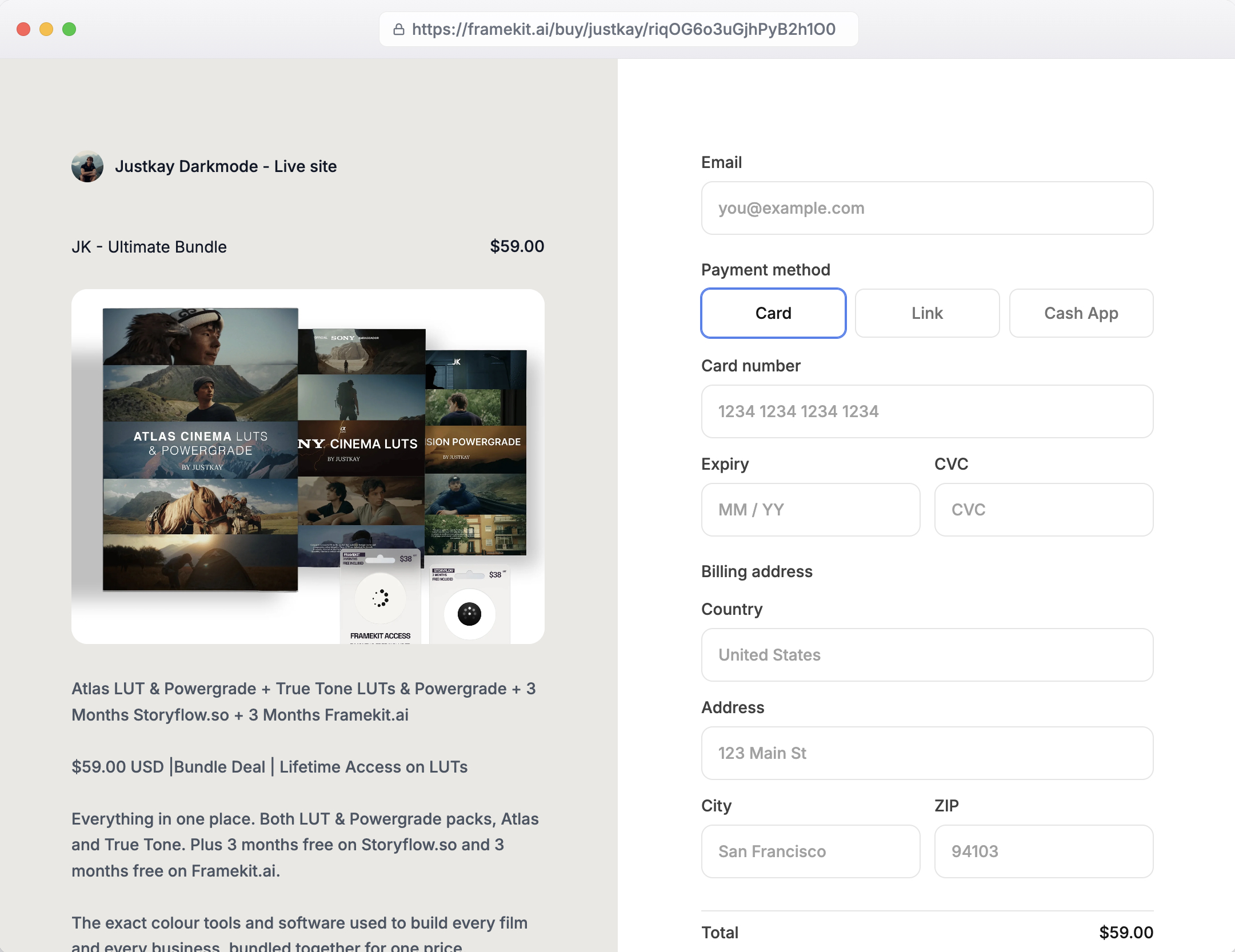
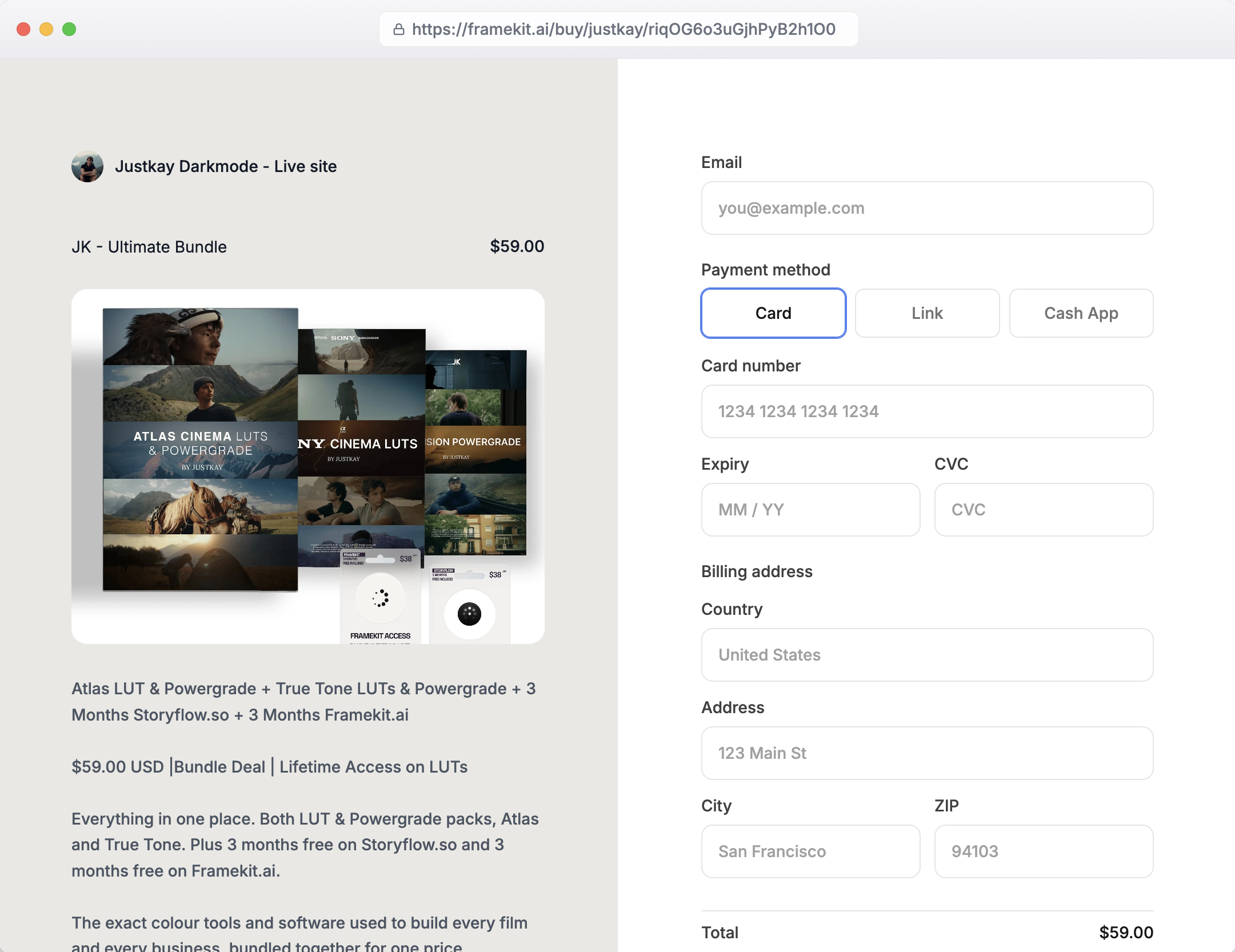
Each pack gets a product page beside your output gallery and a direct buy link to a hosted checkout under your name, which works in a bio or a newsletter.
Payment is a direct charge on your own connected Stripe account, so the buyer's email is in your order list, and the buyer gets the file instantly on a download page they can bookmark. Free sample packs work as lead magnets.
The real numberproduct sales are charged at 5% on Free and Starter, 3% on Pro at $19 a month and 0% on Business at $39, with the processor billed separately. At 200 sales, Business is 20 cents a sale and leaves $14.07. The flat plan overtakes the 5% at $780 a month in sales, which is 52 packs.
The standout detaila gallery of outputs on the same domain as the buy button is the strongest possible demonstration for this product, and it is exactly what a marketplace thumbnail cannot do.
The honest gotchatwo of them, and both land on this guide's heaviest criteria.
First, there is no built-in way to push version two to people who already bought: each order keeps the files it was sold with, so a refresh means emailing past buyers from your order list yourself.
Second, no discovery, and prompt buyers are overwhelmingly discovery-driven because almost nobody has a favourite prompt seller. Big Cartel is also 11 cents a sale cheaper, and PromptBase's own-link route costs nothing at all.
Skip it ifyou have no audience, which for a new prompt seller is the normal condition.
Verdict: good economics and the right presentation, in a category where the marketplace's structure is unusually hard to argue with and update delivery counts against us. See how the Framekit store works.
4. Big Cartel: Cheapest Own Store
Big Cartel produces the highest take-home of any conventional storefront in this comparison for a product this cheap, because a flat $15 plan divided across 200 sales is almost nothing per unit. It is also the entry least suited to a product you intend to keep revising.
The real numbera free Gold plan, Platinum at $15 a month and Diamond at $30, with digital products from Platinum. At 200 sales that is 8 cents a sale, leaving $14.18.
The honest gotchatransaction fees are not published, and neither is any mechanism for pushing updates to past buyers - which in this category is the feature that matters most.
Skip it ifyou are promising updates. This will make you do them by hand.
Verdict: the cheapest way to sell a prompt pack once, and poorly suited to selling one you intend to maintain.
5. Payhip: Best for Actually Shipping Updates
Payhip earns its place here on the criterion this guide weights first, because its customer-account model means a buyer can come back and download the current version rather than the one they bought.
The real numberfree at 5%, Plus at $29 a month with 2%, Pro at $99 with no transaction fee. At 200 sales, Pro is 50 cents a sale and leaves $13.76; the free plan leaves $13.51, so Pro is worth about $51 a month more.
The standout detailreplacing the file on the product updates what buyers can download. For a product that expires three times a year, that turns a recurring afternoon of exports into replacing one file.
The honest gotchait is 42 cents a sale worse than Big Cartel, and money it settles into your own Stripe account rather than holding is a benefit that has nothing to do with prompts.
Skip it ifyou sell dated packs and never revise them.
Verdict: the practical choice for a seller who intends to maintain the product rather than abandon it.
6. Lemon Squeezy: Best With Tax Handled
Lemon Squeezy acts as merchant of record and supports versioned file delivery, which is a useful pairing for a product sold worldwide and revised often.
The real number5% plus 50 cents per transaction with processing included, leaving $13.75 on a $15 pack.
The honest gotchaat $15 the 50-cent fixed component is 3.3%, so the all-in effective rate is about 8.3%. This fee shape punishes cheap products and prompt packs are cheap.
Skip it ifvolume is high and prices are low, which describes most of this category.
Verdict: the right call if international tax is a live concern, and expensive if it is not.
7. Sellfy and Podia: The Middle
Sellfy and Podia land within two cents of each other on a $15 pack, which means nobody should pick between them on price.
They are chosen for what surrounds the sale - large file allowances in one case, courses and email in the other - and for a prompt pack neither of those is the point.
The real numbersSellfy is $39, $79 and $159 a month with 0% transaction fees and annual sales caps of $10,000, $50,000 and $200,000 - our $36,000 a year needs Business at $79, or 40 cents a sale. Podia's Shaker plan is $84 with no transaction fee, at 42 cents a sale.
The honest gotchaboth are more platform than a prompt seller needs, and Podia's email subscriber caps of 100, 500 and 1,000 will move you up a tier quickly at 200 sales a month.
Skip either ifprompts are all you sell.
Verdict: competent and unnecessary for this product unless you already use them.

8. Gumroad: Fastest, Most Expensive
Gumroad will have a prompt pack selling within the hour, which in a category where a model update can create a two-week window of opportunity is worth something real.
The real number10% plus 50 cents per sale, or $2.00 on a $15 pack, with card processing of 74 cents charged on top, leaving $12.26. Against Whop that is $2.04 a sale, or $408 a month.
The standout detailGumroad does notify past buyers when you update a product file, which for this category is a genuine advantage over cheaper storefronts that do not.
The honest gotchayou are paying 10% for a checkout when PromptBase would charge nothing on the same self-driven sale.
If a pack has already gone through it, Gumroad's fees explained shows the cost and the best Gumroad alternatives covers the move.
Verdict: the fastest way to catch a model-update window, and expensive to sit on afterwards.
9. Etsy: Search Traffic, Unverified Fees
Etsy has become a genuinely significant venue for prompt packs, largely because its buyers search for outcomes rather than for technology - somebody wanting product photos for their shop, not somebody researching image models.
The real numbernot verifiable at source - Etsy blocks automated access to its fee documentation. Reported combined fees put the total around a fifth of a sale, which on $15 would leave roughly $12. Confirm before relying on it.
The honest gotchaa fifth on every sale, including those you drove yourself, which is precisely the arrangement PromptBase's own-link route avoids.
Skip it ifyou can drive your own traffic.
Verdict: genuine reach at a cost that the category leader has undercut structurally.
10. Creative Fabrica: Volume and Pools
Creative Fabrica has expanded into AI-adjacent assets alongside its fonts and graphics catalogue, and it operates substantially on subscription access rather than per-item sales, which changes what a download is worth to you.
The real numbernot verifiable at source. The site blocks automated access, and pooled payouts cannot be quoted per sale in any case, because your earnings depend on download share rather than on a price you set.
The honest gotchapooled economics and depreciating products combine badly. Your share depends on downloads this month, and a pack that has stopped producing good outputs stops being downloaded.
Skip it ifyou need predictable revenue.
Verdict: a reach channel whose economics you cannot model in advance.
11. Your Own Link Plus PromptBase
The arrangement that PromptBase's pricing actively encourages, and which no other category in this series makes available: list on the marketplace for discovery, and send everyone you reach yourself through your own link at 0%.
The real numberat 200 sales split evenly, 100 own-link sales at roughly $15 less processing and 100 marketplace sales at about $12 nets meaningfully more than either route alone, and you keep the discovery channel.
The honest gotchayou have to actually use the link. The default share button is the marketplace one, and every sale you send through it costs you 20% you did not have to pay.
Verdict: the specific arrangement most prompt sellers should run, and the reason this guide's top recommendation is a marketplace rather than a store.
Should You Sell Prompts at All?
In one linethis is the least durable product in this series and the easiest to copy, and it is worth being honest with yourself about both before building a catalogue.
Three things that are true and rarely said in guides to this category:
The product is trivially copyable. A prompt is text. A buyer can paste it anywhere, including into a post.
There is no watermarking, no licence key and no meaningful protection, and the only real defence is that the pack is a curated system rather than one clever line.
The shelf life is short. Models change, and packs tuned to a specific version degrade. Sellers who treat a prompt pack like a LUT - build once, sell for years - are usually disappointed by month eight.
The moat is your outputs, not your prompts. What makes someone buy is seeing work they want to reproduce.
That is why this guide ranks a portfolio-adjacent store highly despite it bringing no traffic, and why sellers with a visible body of work do far better here than sellers with a spreadsheet of clever text.
If those three are acceptable to you, the category is genuinely lucrative and the structure PromptBase publishes makes it more so. If they are not, the same effort spent on a preset pack or a template will produce something that still sells in three years.

Decision Guide
This is ordered by the question that decides it, and for prompts the first question is discovery while the second is depreciation - neither of which is about price. Work down and stop at the first yes.
1. Do you need buyers you do not already have?
Yes: PromptBase, and route every sale you drive yourself through your own link at 0% rather than through the marketplace link at 20%.
2. Are you promising updates when models change?
Yes: Payhip, Gumroad or Lemon Squeezy, all of which get a new file to past buyers without a manual export. Big Cartel does not.
3. Do you have an audience and a body of visible output?
Yes: Framekit on Business at $39, so the gallery and the shop are one site, with a plan for emailing buyers yourself when the model changes.
4. Do you want the highest published take-home?
Yes: Whop at 2.7% plus 30 cents, having read its fee menu for the add-ons.
5. Do you sell internationally and want the tax handled?
Yes: Lemon Squeezy at 5% plus 50 cents, accepting an 8.3% effective rate at this price.
6. Is a model update about to create a two-week window and you have no store?
Gumroad today, and move afterwards.
Frequently Asked Questions
These are the questions prompt sellers ask after the first model update, when the pack that sold well in January stops producing the same results.
Where is the best place to sell AI prompts in 2026?
PromptBase is the best place to sell AI prompts in 2026, because it publishes 0% via your own link and 20% via its marketplace - so you pay a commission only on buyers it found for you.
Whop keeps the most of a $15 sale at $14.30 on published processing alone, and Framekit or Big Cartel suit a seller who wants the pack sold from a site they control alongside the work it produced.
How much does PromptBase take?
PromptBase's seller page states 0% via your own link and 20% via the marketplace.
That structure is unusual and materially better than the norm in this series, because every other marketplace we priced charges its commission on every sale including the ones you drove yourself.
Route your own audience through your own link and the commission does not apply.
What happens to my prompt pack when the model changes?
It degrades, and how you handle that is the main decision in this category. Models are revised two or three times a year and packs tuned to a specific version drift.
Your options are pushing an updated file to past buyers, selling version two as a separate product, or stating the model version on the listing and not promising updates.
All three are defensible; implying updates and not shipping them is not.
Which venues push updates to past buyers?
Payhip, Gumroad and Lemon Squeezy all get a revised file to existing buyers without you exporting a customer list.
Big Cartel and several cheaper storefronts do not publish any such mechanism, which means honouring an update means downloading a CSV and sending the emails yourself - fine once, grinding three times a year at 2,400 buyers.
How much should I charge for a prompt pack?
Between roughly $9 and $29, with $15 a common middle for a curated set. The fee mechanics matter here: a 50-cent fixed fee is 3.3% of a $15 pack, so bundling several small packs into a larger system both improves your margin and makes the product harder to copy casually.
Can buyers just share my prompts?
Yes, trivially, because a prompt is text and there is no watermark or licence key that helps.
The realistic defence is that a good pack is a curated system - ordering, variations, negative prompts, parameter notes - rather than a few clever lines, which is far more work to redistribute usefully.
Price and structure accordingly rather than relying on protection.
Is selling AI prompts still worth it in 2026?
It can be lucrative and it is the least durable product in this series.
The three honest caveats: the product is trivially copyable, the shelf life is measured in months rather than years, and what actually sells a pack is the outputs you can show rather than the prompts themselves.
Sellers with a visible body of work do substantially better than sellers with a spreadsheet of text.
Should I sell on PromptBase and my own site?
Yes, and PromptBase's pricing is designed for exactly that. List for discovery, then route every buyer you reach yourself through your own link at 0%.
The only discipline required is remembering which link you are sharing, because the default share button is the marketplace one and each of those sales costs a fifth.
Which venue keeps the most of a $15 prompt pack?
Whop at $14.30, on published processing of 2.7% plus 30 cents with no monthly platform fee stated, followed by Big Cartel at $14.18 and Framekit at $14.07.
PromptBase's own-link route is effectively higher still at 0% commission, with processing handled by the platform. The full spread across own-store options is $2.04 a sale, or $408 a month at this volume.
Do I need to charge VAT on prompt packs?
Yes for EU consumers, from the first sale, as with every digital product.
A merchant of record such as Lemon Squeezy removes the obligation entirely at 5% plus 50 cents, and Whop offers tax collection and remittance as an add-on priced at 2% per transaction in its published fee schedule.
On the other venues here it remains yours.
How do I market a prompt pack without an audience?
Use the marketplace, because that is what its commission is for. PromptBase and Etsy both supply search traffic from people looking for outcomes, and at the start that traffic is worth more than the percentage costs.
Build an email list from those buyers immediately, because when the model changes you will need a way to tell them the pack has been updated.
Does Framekit work for selling prompt packs?
Yes, for a creator whose own outputs sell the prompts: Framekit keeps $14.07 of a $15 pack on its $39 Business plan and puts the pack beside the gallery of results.
What it does not do is bring you buyers or push version two to past buyers automatically, which in a discovery-driven, fast-depreciating category is why this guide ranks PromptBase first and us third.
The Verdict
PromptBase wins, and it wins on a structural decision rather than on features.
Charging 0% on sales you drive and 20% on sales it drives is the fairest arrangement any marketplace in this twenty-two-post series has published, and it dissolves the argument that has run through all of them - that a marketplace taxes your own audience as the price of reaching a new one.
Here, it does not.
Whop keeps the most of a $15 sale on published rates at $14.30.
Framekit is the right home if you have a body of visible output that does the selling, and Payhip is the practical pick if you intend to honour updates, because it makes shipping version two a file replacement rather than an afternoon.
The thing worth carrying away, though, is the depreciation. This is the only product in this series with an expiry date, and choosing a venue on its $2.04 fee spread while ignoring whether it can deliver version two to 2,400 past buyers is optimising the smaller number by an order of magnitude.
Where Framekit losesFramekit brings you no buyers, and prompt buyers are overwhelmingly people who have never heard of you, which makes a marketplace the better fit as a first move.
It does not push updates to past buyers either, so Payhip is the better fit if you have promised free refreshes.
Big Cartel is also cheaper per sale, and PromptBase's own-link route costs nothing at all - so on pure economics, we are the third-best answer here and we would rather say so.
Verdict: list on PromptBase, share your own link, and pick a store that can ship an update. Then write your update policy on the product page before the next model release makes it urgent.
Rates were read from each vendor's published pricing page or fee documentation in early August 2026. Etsy's and Creative Fabrica's figures are not verified, because both block automated access to their fee pages, and each is labelled where it appears.
Related readingthe best places to sell digital templates, the best AI tools for designers, the best places to sell icons and illustrations, how to price digital products, and what it costs to sell digital products online.
Where that work lives matters as much as where it sells, and the 10 best website builders for AI artists explains why platform policy makes an owned site a form of insurance.