Framekit templates
Start from a designer-made template
 Use template
 Use template
 Use template
 Use template
 Use template
 Use template
 Use template
 Use template
Snow overlays sell in November. Autumn textures sell in September. Christmas bokeh sells for about six weeks and then stops completely.
That pattern is worth more attention than it gets, because every fee comparison in this category - including the ones we have written for adjacent products - assumes a steady month. Overlays and textures are not a steady month.
A seller doing $22,800 a year commonly takes more than half of it in the final quarter, and the two fee models available behave in opposite ways when revenue is shaped like that.
A percentage costs you nothing in a dead month and a great deal in a good one. A flat plan costs the same in February as it does in December, which makes it dramatically cheaper across a year and painful in the quiet stretch.
A photo overlay is a layered image asset - snow, bokeh, dust, film grain, light leaks - that a photographer composites over their own work, and it is sold either through a marketplace that supplies buyers or through a store you control.
Framekit is the best place to sell photo overlays and textures in 2026 for a photographer with an audience, because overlays are bought by people who have seen what they did to your photographs, and Framekit puts the packs on the same site as that portfolio, pays into your own Stripe account and takes 0% on its $39 Business plan - $468 across a $22,800 year against $1,140 for a 5% fee.
The trade-off is price: Big Cartel is $288 a year cheaper at $15 a month if you only want a shop. And if you cannot face a monthly bill in February, Lemon Squeezy's 5% plus 50 cents costs you nothing in the months you sell nothing.
How We Compared and Weighted These Platforms
Overlay and texture packs are large files sold cheaply, which makes the fee structure matter more than in most categories. Here is the basis for each figure.
- Verified from primary sources: platform commissions, subscription costs and processing rates were read from each vendor's published terms in September 2026, kept as separate lines rather than combined.
- Assessed hands-on: how a multi-gigabyte pack is delivered to a buyer, whether delivery is automatic, and whose branding appears at checkout.
- Not assessed: marketplace search placement, which sellers cannot verify from outside.
The weighting: revenue kept per sale first, then ownership of the buyer, then how easily large files are delivered, with discovery weighted last.
Discovery is the criterion the marketplaces win, so a seller without an audience should read this ranking in reverse. No speed or performance figures appear here.
Disclosure: Framekit is our product and it ranks first for photographers whose work sells the overlays. Big Cartel is cheaper across the year and we say so in both reviews; we priced all eight venues the same way and link to every one.
In September 2026 we re-verified Framekit's fees and store features against its current pricing page; the other venues were read in August 2026 and are dated in place.
How We Priced This
One product, one year, shaped like the real thing: a $19 overlay pack sold 1,200 times across a year, or $22,800, with roughly 55% of it arriving between October and December.
We have priced the full year rather than a single month, because a single month is exactly what misleads you in this category.
Card processing at 2.9% plus 30 cents is added where a venue does not include it, which on a $19 pack is 85 cents.
Three grades of claim. Read at the vendor's own pricing page in the first week of August 2026 covers Big Cartel, Payhip, Sellfy, Podia, Gumroad, Lemon Squeezy and Framekit's plan file. Purchased through covers Gumroad, Payhip and Lemon Squeezy. Not verifiable at source covers Etsy and Creative Market, which block automated access to their fee pages; their figures are reported ranges and are labelled where they appear.
By the numbers:
- $180 a year is the cheapest venue here for $22,800 of overlay sales.
- $2,880 a year is the most expensive own-store option for the same revenue.
- $1,140 is what a flat 5% costs on that revenue, regardless of when it arrives.
- 55% of a typical overlay year lands in one quarter.
- 9.75% is what a $39 monthly plan costs you in a $400 month.
- 3% is what the same plan costs in a $1,283 month.
- 2 of 8 venues would not show us a fee page.
The Rubric
We scored on five criteria, weighted for a product whose revenue arrives in bursts rather than steadily. That single characteristic reorders the whole comparison, because a fee that is trivial across a year can be punishing in the month you sell almost nothing.
| Criterion | Weight | What it covers |
|---|---|---|
| Annual cost on $22,800 | 30% | What the venue takes across a full seasonal year |
| Off-season cost | 25% | What it charges in a month when you sell almost nothing |
| Discovery | 20% | Whether the venue supplies buyers during the peak |
| Bundling support | 15% | Whether seasonal packs can be combined without rebuilding |
| Ownership | 10% | Domain, list, whose payment account |
Off-season cost carries a quarter of the weight, which we have not done anywhere else in this series. For a steady product it would be meaningless.
For a product with an eight-month trough it is the difference between a plan you keep and one you cancel in January and forget to restart before the autumn.
What a Seasonal Year Costs
Every row is the same year: $22,800 in overlay sales with 55% of it arriving in the final quarter, priced through that venue's published rates. The second column is the one nobody publishes and every seasonal seller feels.
| Venue | Model | Annual cost on $22,800 | Cost in a $400 month |
|---|---|---|---|
| Big Cartel | Platinum, $15/mo | $180 | $15, or 3.75% |
| Framekit | Business, $39/mo, 0% | $468 | $39, or 9.75% |
| Sellfy | Business, $79/mo, 0% | $948 | $79, or 19.75% |
| Podia | Shaker, $84/mo, 0% | $1,008 | $84, or 21% |
| Framekit | Free plan, 5% | $1,140 | $20, or 5% |
| Payhip | Free plan, 5% | $1,140 | $20, or 5% |
| Payhip | Pro, $99/mo, 0% | $1,188 | $99, or 24.75% |
| Lemon Squeezy | 5% + 50c | $1,740 | $31, or 7.75% |
| Gumroad | 10% + 50c | $2,880 | $52, or 13% |
| Etsy, reported | Listing, fees and ads | About $4,000 to $4,600 | Scales with sales |
| Creative Market, reported | Commission per sale | About $7,000 to $11,000 | Scales with sales |
There are two columns in that table and they have two different winners, which is the entire reason this guide exists.
Across the year, flat plans win decisively. Big Cartel at $180 costs a sixth of what a 5% fee costs on the same revenue, and a sixteenth of Gumroad.
In the off-season the ranking inverts: a $99 monthly plan is a quarter of a slow month's revenue, while a percentage-based venue costs you almost nothing because you sold almost nothing.
In one lineon a seasonal product, the flat plan is cheaper over twelve months and the percentage is safer over the worst three, and which matters depends on whether you can carry the quiet months without resenting the bill.
The Question to Ask Before You Pick a Flat Plan
The table above assumes you pay the same plan fee in every month of the year. Whether that assumption holds is the single biggest variable in a seasonal business, and it is answered in a support article rather than on a pricing page.
In one linecan you downgrade or pause it in February, and if so the flat plan wins outright.
This is the single most useful thing a seasonal seller can check, and it appears on no comparison page including, until now, ours.
If a venue lets you drop to a cheaper tier or a free plan during the trough and return before the peak, a flat plan's worst property disappears. You pay $39 for four busy months and $0 or $15 for eight quiet ones, which on our test year is roughly $190 rather than $468.
If it does not - if downgrading loses your storefront, your custom domain or your product listings - then the annual figure in the table above is what you are actually committing to, and the percentage options deserve another look.
Three things to establish before you commit:
What happens to your store on a downgrade. Does it go read-only, lose the custom domain, or disappear? A store that vanishes each February is not a seasonal strategy, it is an annual rebuild.
Whether annual billing locks you in. Annual plans are typically 15% to 25% cheaper and remove the option to pause entirely. For a seasonal seller that discount is often a bad trade.
Whether your listings survive. Losing product pages means losing whatever search ranking they accumulated during last year's peak, which for seasonal products is the asset that makes the next peak easier.
The honest counter-argument: pausing and restarting is admin, and admin that has to happen in September is admin that gets forgotten in September. A seller who knows they will forget should buy the flat plan and treat the dead months as a subscription to their own reliability.
1. Framekit: Best If Your Photographs Sell the Overlays

Framekit is an AI website builder for photographers, filmmakers and designers, with client galleries, video review, Slides and a digital-download store in one account, and the case for it here is specific: overlays are bought by photographers who have seen what your overlays did to your photographs.
A before-and-after on the same page as the buy button is the strongest pitch this product has.
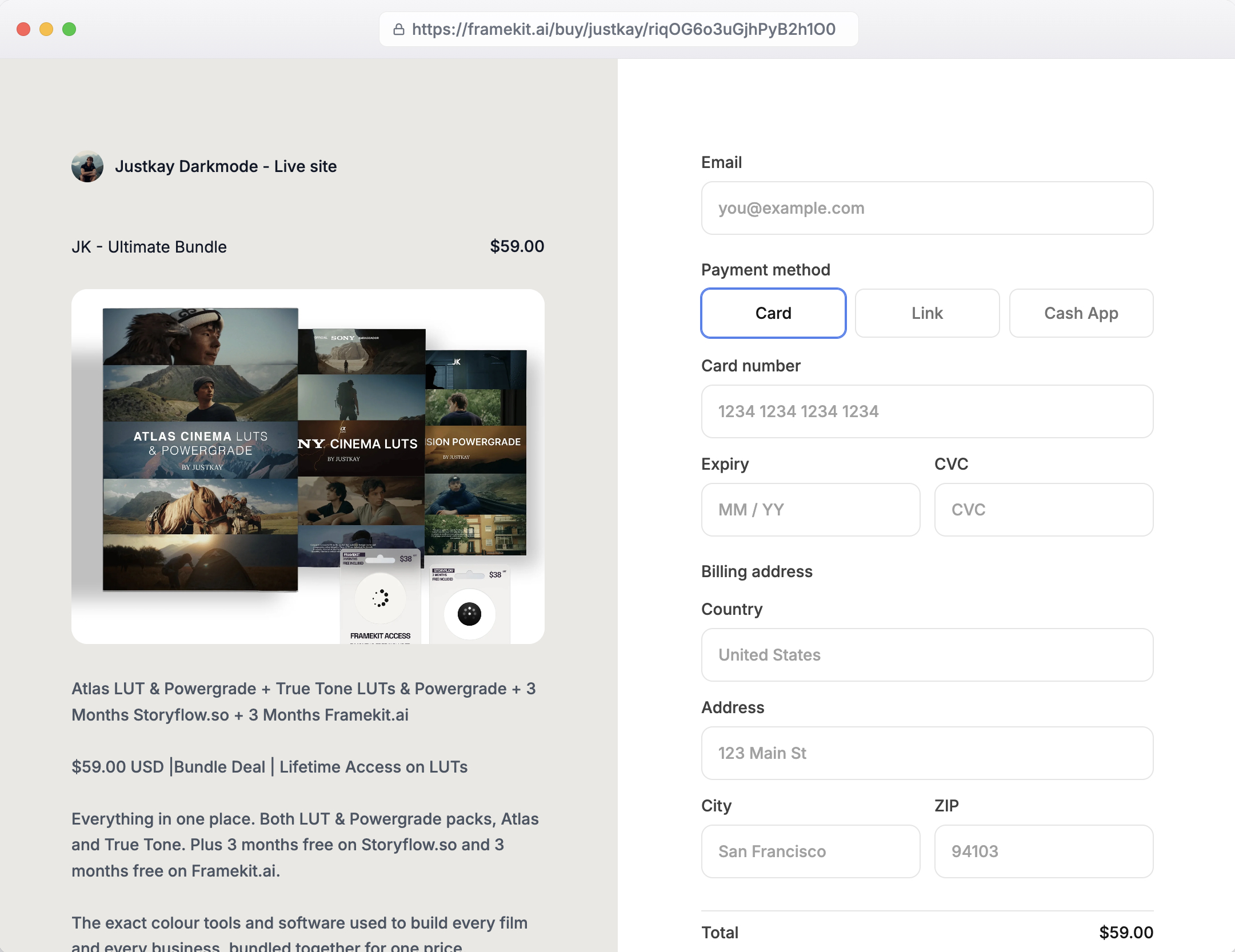
Each pack gets a product page on your site and a direct buy link to a hosted checkout under your name, which suits the November Instagram post that carries most of the season.
Payment is a direct charge on your own connected Stripe account, the buyer gets the file instantly, and the download page can be bookmarked for when they come back next winter. Discount codes for a seasonal sale arrive on Pro.
The real numberthe fee is 5% on Free and Starter, 3% on Pro at $19 a month, and 0% on Business at $39, with the card processor separate.
On our seasonal year, Business is $468 and the Free plan's 5% is $1,140, so the flat plan saves $672 across the year while costing more in any month under $780 in sales.
The standout detailplans are month-to-month, and the store with unlimited products stays on every plan including Free.
A seller who cannot stomach $39 in February can drop to Free at 5% for the trough without losing the listings, though a custom domain needs Starter at $9. Across our year, staying on Business still works out cheapest.
The honest gotchawe bring you no buyers, and overlays are heavily discovery-driven, particularly around seasonal search spikes. Big Cartel is also $288 a year cheaper, and Framekit is not a merchant of record, so VAT on sales to EU photographers is yours.
Skip it ifyou have no photography audience, or all you want is the cheapest shop.
Verdict: the right home when the photographs are the marketing, with the portfolio, the client galleries and the overlay store in one account. See how the Framekit store works.
2. Big Cartel: Cheapest Across a Seasonal Year
Big Cartel wins on the number a pure shop cares about most for a product like this: what it costs across twelve months rather than in one good one.
The real numbera free Gold plan, Platinum at $15 a month and Diamond at $30, with digital products from Platinum. On our $22,800 year that is $180 - a sixth of what a 5% fee costs on the same revenue.
The standout detailthere is a genuinely free tier. For a seller whose entire business is four months long, the option to sit on Gold through the trough and move to Platinum in September is exactly the pause-and-resume behaviour this category needs, and it is rarer than it should be.
The honest gotchatransaction fees are not published on the pricing page, so $15 is a plan price rather than a confirmed all-in figure. For a comparison built on annual totals that is a real gap, and worth an email before you rely on it.
Skip it ifyou want the shop to be part of a portfolio rather than a separate storefront.
Verdict: the cheapest credible way to sell overlays across a year, with a free tier that fits the seasonal pattern better than anything else here.
3. Lemon Squeezy: Safest Through the Trough
Lemon Squeezy is the most expensive option in this guide across a full year and the least frightening in a bad month, which for a seasonal seller is a real trade rather than a contradiction.
The real number5% plus 50 cents per transaction with processing included. On our year that is $1,740. In a $400 month it is about $31.
The standout detailyou pay nothing at all in a month with no sales, and it acts as merchant of record so the tax on international overlay sales is not yours. Overlays sell across borders as readily as any digital product.
The honest gotchaon a $19 pack the 50-cent fixed fee is 2.6%, pushing the effective rate to about 7.6%. Cheap products punish this fee shape and overlays are cheap.
Skip it ifyour revenue is predictable enough to carry a flat plan.
Verdict: buy this if the off-season worries you more than the annual total does.
4. Payhip: Best Structure, Awkward Tiers Here
Payhip settles into your own Stripe or PayPal account and covers EU VAT, which are both genuinely useful, and its tier structure fits this product less well than most.
The real numberfree at 5%, Plus at $29 a month with 2%, Pro at $99 with no transaction fee. On our year, the free plan costs $1,140 and Pro costs $1,188 - so Pro is marginally worse, which is unusual and entirely a function of the price point.
The standout detailthe free plan is the right Payhip plan for this product, which is not something we have been able to say elsewhere in this series.
The honest gotchaat $19 a pack you would need considerably more volume before Pro's $99 a month pays for itself.
Skip it ifyou want the cheapest annual figure. Big Cartel is $960 less.
Verdict: use the free plan, ignore Pro until your average order value rises.
5. Sellfy: Best If Your Textures Are Large
Sellfy earns its place here on file size, because a texture library at print resolution is a genuinely heavy product even though an overlay pack is not.
The real numberStarter is $39 a month billed monthly or $29 yearly, Business is $79 or $59, Premium is $159 or $119, all at 0% transaction fees with annual sales caps of $10,000, $50,000 and $200,000. Our $22,800 year needs Business, so $948 annually.
The standout detailpublished product file ceilings of 10 GB, 15 GB and 20 GB by plan. If you sell 300 MB texture collections rather than compressed overlay JPEGs, this is one of the few venues that tells you in advance that they will fit.
The honest gotcha$948 a year is more than five times Big Cartel's $180, and the annual sales caps mean a strong Q4 can push you into the next tier for the whole year.
Skip it ifyour packs are small and compressed.
Verdict: the right pick for heavy texture libraries and expensive for light overlay sets.
6. Podia: Only If You Teach Compositing
Podia belongs in this guide for one specific seller: the photographer whose overlay packs exist to bring students into a retouching or compositing course, where the packs are marketing and the course is the business.
The real numberMover is $42 a month with 5% transaction fees, Shaker is $84 with none and Earthquaker is $150. Shaker across our year is $1,008.
The honest gotchaat $84 a month you are paying $1,008 to sell a product that Big Cartel would sell for $180, and the difference only makes sense if the course is real revenue rather than an intention.
Skip it ifthe overlays are the business.
Verdict: correct as a course platform, expensive as an overlay shop.
7. Gumroad: Fastest, and the Most Expensive Own-Store Option
Gumroad will have a seasonal pack selling the same afternoon you finish building it, and for a product whose entire commercial window is six weeks long, that speed has genuine value that a fee comparison does not capture.
The real number10% plus 50 cents per sale, which on our year is $2,880 - sixteen times Big Cartel's $180 for the same revenue.
The standout detailspeed matters more here than in any other category in this series. If a seasonal opportunity is three weeks away, a platform you can launch on today is worth paying for, and the cost of missing the window is larger than the fee difference.
The honest gotchathat logic covers your first season, not your third. At $2,880 a year the convenience premium funds a decade of Big Cartel.
If a season has already gone through it, Gumroad's fees explained shows what that cost you, and the best Gumroad alternatives covers where to land next.
Verdict: launch a season on it if you must, then move before the next one.
8. Etsy and Creative Market: Where Seasonal Searches Happen
Marketplaces matter disproportionately for this product, because seasonal demand arrives as search traffic from people who do not know your name and want snow overlays this week.
The real numbernot verifiable at source. Etsy and Creative Market both block automated access to their fee pages.
Reported ranges would put Etsy's combined fees around a fifth of a sale and Creative Market's commission considerably higher, which on our $22,800 year would be roughly $4,000 to $4,600 and $7,000 to $11,000 respectively.
Confirm before deciding on either.
The standout detailthe seasonal search spike is the thing you are buying, and it is real. A pack that ranks for a holiday term in October is earning during exactly the six weeks that matter.
The honest gotchathose reported figures are between four and sixty times what a flat plan costs on the same revenue. That is defensible while the marketplace is finding your buyers and indefensible once your own audience is doing it.
Skip it ifyou have a photography following that already buys from you.
Verdict: the right acquisition channel for a seasonal product, and an expensive one to keep once the audience is yours.
Building a Product Line That Is Not All Fourth Quarter
Everything above treats your revenue shape as fixed and asks which fee model suits it. This section does the opposite, because the shape is more changeable than most sellers assume and changing it improves every number in this guide at once.
In one linethe fee model you need is downstream of your revenue shape, and the revenue shape is something you can change.
Three moves that flatten a seasonal overlay business, in rough order of how well they work:
Sell the off-season seasons. Spring light leaks, summer haze, autumn colour. The instinct is to build for the biggest holiday, and the result is a catalogue that earns for six weeks. A pack aimed at February earns in February.
Bundle across seasons at a higher price. A $59 all-year collection sold steadily beats a $19 pack sold in bursts, and it takes the fixed-fee drag from 2.6% to 0.8% at the same time.
This is the same bundling argument that applies to cheap products generally, with a seasonal reason to act on it.
Sell the technique, not only the asset. A short guide on compositing overlays convincingly sells year-round to people who bought the pack in December, and costs nothing to deliver.
None of this is a platform decision, and all of it changes which platform is right for you. A seller whose revenue is evenly spread should buy the cheapest flat plan without thinking about it.
A seller with 55% in one quarter has a genuine decision, and the section above is how to make it.
Decision Guide
This is ordered by revenue shape rather than by budget, because for a seasonal product the two questions that matter are how concentrated your year is and whether you can tolerate a bill in the quiet months. Work down and stop at the first yes.
1. Is more than half your revenue in one quarter, and can you tolerate a monthly bill in the trough?
Yes: Big Cartel Platinum at $15, which is $180 a year and the cheapest credible option here.
2. Same shape, but the off-season bill would bother you?
Use a percentage plan through the quiet months and a flat plan through the peak. Framekit and Payhip both have free tiers at 5% that make this possible inside one account.
3. Do your photographs sell the overlays?
Yes: Framekit on Business at $39 through the season, or its free plan at 5% outside it.
4. Are your textures large, at print resolution?
Yes: Sellfy, the only venue here publishing per-file ceilings big enough to be sure.
5. Do you have no audience and a seasonal deadline?
Yes: Etsy for the search traffic, accepting a reported fifth, and start building a list from day one.
6. Is there a season starting in three weeks and no store at all?
Gumroad today, and a calendar note to move before the next one.
Frequently Asked Questions
These are the questions overlay sellers ask in January, when the December revenue has stopped arriving and the monthly subscription has not stopped leaving.
Where is the best place to sell photo overlays and textures in 2026?
Framekit is the best place to sell photo overlays and textures in 2026 for a photographer whose own work sells them, at $39 a month with a 0% fee, or $468 across a year of $22,800 in sales, with the store on the same site as the portfolio.
Big Cartel at $15 a month, $180 a year, is the cheapest plain shop, and Lemon Squeezy at 5% plus 50 cents is the safest option if a monthly bill in the off-season would bother you.
Framekit vs Big Cartel: which is better for overlays?
Big Cartel is cheaper and Framekit is better for photographers whose work does the selling. On a $22,800 seasonal year Big Cartel's $15 plan costs $180 and Framekit's $39 Business plan costs $468, both before card processing.
Framekit adds a full portfolio website, client galleries and payment straight into your own Stripe account; Big Cartel adds physical products and a free tier.
Should I use a flat plan or a percentage fee for a seasonal product?
A flat plan is cheaper across the year and worse in your worst month.
On $22,800 with 55% in one quarter, a $15 monthly plan costs $180 and a 5% fee costs $1,140 - but in a $400 month the flat plan is 3.75% of revenue while the percentage is exactly 5% of a much smaller number.
The deciding question is whether your venue lets you downgrade in the trough and return before the peak.
Can I pause my store during the off-season?
Sometimes, and it is the most valuable thing to check before committing.
If a venue lets you drop to a free or cheaper tier without losing your storefront, custom domain or product listings, a flat plan's annual cost falls dramatically - roughly $190 instead of $468 on our test year.
If downgrading costs you your listings, you lose whatever search ranking last season built, which for seasonal products is the asset that makes the next peak easier.
How much should I charge for an overlay pack?
Between roughly $12 and $29 for a focused pack, with $19 common, and considerably more for an all-season collection.
The fee argument favours the higher end: a 50-cent fixed fee is 2.6% of $19 and 0.8% of $59, so bundling several seasonal packs into one collection improves your margin and flattens your revenue at the same time.
Do overlays and textures get pirated?
Frequently, because they are small, visual and easy to redistribute. No venue in this guide prevents it. Download limits and link expiry raise friction for casual sharing and stop nobody determined.
The realistic response is to price so buying is easier than searching, and to treat leakage as a marketing cost rather than a problem with a technical solution.
Is Etsy worth it for seasonal digital products?
While you need discovery, yes, and it is particularly well suited to this product because seasonal demand arrives as search traffic from people who do not know you.
Reported combined fees put Etsy around a fifth of a sale, which on our test year would be roughly $4,000 to $4,600 against $180 for a flat plan.
That is the price of the search spike, and it stops being worth it once your own audience is producing the spike.
How do I stop my sales collapsing outside the peak?
Build for the off-season deliberately: spring and summer packs, an all-year bundle at a higher price, and a short compositing guide that sells to people who bought in December.
Most overlay catalogues are all-holiday by accident rather than design, which produces a business that earns for six weeks and pays subscriptions for twelve months.
Which venue is cheapest for a $19 product?
Big Cartel at $15 a month, which works out at $180 a year regardless of how many packs you sell. The percentage-based options cost between $1,140 and $2,880 on $22,800 of revenue.
The gap is unusually large at this price point because a fixed 50-cent fee is 2.6% of a $19 sale before any percentage applies.
Do I need to charge VAT on overlays sold internationally?
Yes for EU consumers, from the first sale, since digital products are taxed at the buyer's location with no small-seller allowance for cross-border digital sales.
Payhip handles EU VAT on digital goods, and Lemon Squeezy removes the obligation entirely by acting as merchant of record. On the other venues here it remains yours.
Should I sell overlays and presets from the same store?
Yes - they sell to the same photographers, bundle naturally, and every own-store platform here handles multiple product types.
A buyer who wants your winter overlays is a strong candidate for your winter colour presets, and a combined bundle raises your average order value, which is the single most effective thing you can do about fixed transaction fees.
Are overlay files too big for Framekit?
Compressed overlay packs are no problem, and Framekit publishes no per-file ceiling for store downloads, though it has not published a tested maximum either.
For print-resolution texture libraries in the tens of gigabytes, upload your largest file on the free plan first, or use Sellfy, which publishes product file ceilings of 10 GB and above.
The Verdict
Framekit wins for the seller this category is mostly made of: a photographer whose own work is the reason anyone buys the overlays.
The packs sit beside the photographs, the money lands in your own Stripe account, and $468 a year on Business against $1,140 for a 5% fee is not a close comparison - though it is $288 a year more than Big Cartel, which we would rather state than bury.
Big Cartel is second and the better pick for a seller who just wants the cheapest shop: on a seasonal product the annual figure is the honest one, and it also has a genuinely free tier.
The thing worth taking from this guide is not the ranking but the shape of the question. Every fee comparison in this category, ours included until now, assumes a steady month. Overlays do not have steady months.
Once you price a full seasonal year instead, flat plans win by a margin that percentage-based comparisons never reveal - and the one question that decides whether you can capture that margin is whether your venue lets you downgrade in February.
Where Framekit losesFramekit sends you no buyers, and seasonal products depend heavily on search spikes from strangers, which makes Etsy the better fit for a seller without an audience.
Big Cartel is also cheaper, and Sellfy is the safer choice for print-resolution texture libraries because it publishes a file ceiling and we do not.
Verdict: price the year, not the month. Framekit if the photographs do the selling, Big Cartel for the cheapest plain shop, a free-tier percentage plan if you cannot carry the trough, and Etsy while you still need strangers to find you.
Plan pricing here was checked against each vendor's own page in the first days of August 2026. Etsy's and Creative Market's figures are reported ranges rather than verified rates, because both block automated access to their fee pages, and each is labelled where it appears.
Related readingthe best platforms to sell presets, the best places to sell Photoshop actions, the best places to sell mockups online, how to price digital products, and what it costs to sell digital products online.