
Framekit templates
Start from a designer-made template
 Use template
 Use template
 Use template
 Use template
 Use template
 Use template
 Use template
 Use template
A mockup bundle is a stack of layered PSDs with smart objects, high-resolution textures and a few scene variants. Four gigabytes is normal. Ten is not unusual.
Sell that 120 times in a month and you have moved 480 gigabytes of data. That single number rules out more venues in this category than price ever will, and almost no comparison of mockup marketplaces mentions it.
A mockup marketplace is a storefront somebody else runs that supplies buyers and takes a share, and the alternative is a store you control that supplies none and takes very little.
The wrinkle specific to this product is that several of the cheapest own-store options cannot physically handle the file.
Among the own-store half, Framekit is the one that puts the shop on the same site as the portfolio, so the renders that sell a bundle are also pitching you for commissioned work - though as the file column below shows, it is not the venue to bet your heaviest bundle on untested.
Sellfy is the best place to sell mockups in 2026 if you are running your own store, because it publishes product file size ceilings of 10 GB, 15 GB and 20 GB by plan and takes no percentage of your sales, which no other hosted storefront in this comparison matches.
Creative Market remains where mockup buyers actually browse, at a commission we could not verify.
And if your bundles are genuinely enormous, the arrangement that works is a cheap storefront paired with DPD at $10 a month, which is the only option here publishing unlimited bandwidth.
Framekit is fourth: the best pick if the mockups should sell beside a portfolio that wins you commissioned work, at 0% on a $39 plan, but like most stores here it publishes no file ceiling, so test your biggest bundle first.
Disclosure: Framekit is our product. In August this guide left it out because its plan comparison then listed a 25 MB upload cap; that figure has since been withdrawn, and in September 2026 we re-verified Framekit against its current pricing page and ranked it fourth on the same rubric as everyone else. It does not publish a per-file ceiling, which is why Sellfy and DPD stay above it.
How We Priced This
One product, one volume: a $32 mockup bundle weighing 4 GB, sold 120 times a month. That is $3,840 in monthly revenue and about 480 GB of file delivery.
Card processing at 2.9% plus 30 cents is added where a venue does not include it, which on $32 is $1.23.
Three grades of claim. Read at the vendor's own pricing page in the first week of August 2026 covers Sellfy, Payhip, Big Cartel, Podia, Gumroad, Lemon Squeezy and DPD. Purchased through covers Gumroad, Payhip and Lemon Squeezy. Not verifiable at source covers Creative Market and Yellow Images, both of which block automated access to seller terms - their figures are reported ranges, labelled where they appear.
By the numbers:
- 480 GB is what 120 sales of a 4 GB bundle moves in a month.
- 20 GB is the largest single product file any hosted storefront here publishes.
- $10 a month buys the only unlimited bandwidth in this comparison.
- $30.35 is the highest take-home on a $32 bundle.
- $25.57 is the lowest among own-store options.
- 2 of 10 venues would not show us a commission.
The Rubric
We scored on five criteria, weighted for the heaviest product in this series. File handling comes first because it is a hard constraint rather than a preference: a venue that cannot accept a 4 GB file is not a cheaper option, it is not an option.
| Criterion | Weight | What it covers |
|---|---|---|
| File size and delivery capacity | 35% | Published per-file ceiling and bandwidth allowance |
| Take-home on a $32 bundle | 25% | Platform cut plus processing |
| Discovery | 20% | Whether the venue supplies mockup buyers |
| Buyer experience on a big download | 15% | Resume, re-download, link expiry |
| Ownership | 5% | Domain, customer list, whose processor |
What a $32 Bundle Nets, and Whether the File Even Fits
Every row is the same product sold at the same price through that venue's published pricing, with card processing added where the venue does not include it. The final column is the one that eliminates most of the table before the money is even considered.
| Venue | Model | Cut per sale | You keep | Handles a 4 GB file? |
|---|---|---|---|---|
| Big Cartel | Platinum, $15/mo | $0.13 | $30.64 | Not published |
| Framekit | Business, $39/mo, 0% | $0.33 | $30.44 | Not published |
| Sellfy | Business, $79/mo, 0% | $0.66 | $30.11 | Yes, 15 GB ceiling published |
| Podia | Shaker, $84/mo, 0% | $0.70 | $30.07 | Not published |
| Payhip | Pro, $99/mo, 0% | $0.83 | $29.94 | Not published |
| Lemon Squeezy | 5% + 50c | $2.10 | $29.90 | Not published |
| Payhip | Free plan, 5% | $1.60 | $29.17 | Not published |
| Gumroad | 10% + 50c | $3.70 | $28.30 | Not published |
| DPD as delivery layer | $10/mo, unlimited bandwidth | $0.08 | Depends on storefront | Yes, unlimited bandwidth published |
| Creative Market, reported | Commission per sale | About $10 to $19 | About $13 to $22 | Yes |
| Yellow Images, reported | Commission per sale | Not published | Not published | Yes |
Read that last column before any of the money columns, because for this product it eliminates most of the decision on its own.
Only two entries here publish a figure that tells you a 4 GB file will work: Sellfy's per-plan product file ceilings of 10, 15 and 20 GB, and DPD's unlimited bandwidth.
Everything else in the own-store half of that table is silent on the question, which does not mean it will fail - it means you will find out after you commit.
In one linein this category the first question is not what a venue charges but whether it will accept your file, and only two of ten answer that in public.
1. Sellfy: The Only Hosted Store That Publishes a Big Enough Ceiling
Sellfy wins this guide on a single published number, and for once that is the right basis for a ranking, because the number is a hard constraint rather than a preference.
The real numberStarter is $39 a month billed monthly or $29 yearly, Business is $79 or $59, and Premium is $159 or $119, all at 0% transaction fees, with maximum product file sizes of 10 GB, 15 GB and 20 GB respectively.
Our $3,840 a month is $46,080 a year, which sits inside Business's $50,000 annual sales cap, so 66 cents a sale and $30.11 kept.
The standout detailit is the only hosted storefront in this comparison that states a per-file limit at all. Every other own-store option leaves you to discover yours during an upload, and for a 4 GB file that is a slow way to learn.
The honest gotchathe annual sales caps of $10,000, $50,000 and $200,000 are the actual pricing mechanism.
At $46,080 a year we are close enough to the Business ceiling that one good month moves us to the $159 Premium plan, and a 0% transaction fee behind a revenue cap is a percentage charged in large steps.
Skip it ifyour bundles are small and your volume is high. You are paying for headroom you never touch.
Verdict: the default hosted answer for mockup sellers, chosen on the one specification that actually constrains this product.
2. Creative Market: Where Mockup Buyers Browse
For mockups specifically, Creative Market is not one venue among several - it is the place a designer goes when they need a mockup this afternoon and have no particular maker in mind.
The real numbernot verifiable at source. Creative Market blocks automated access to its seller terms, and reported commissions would leave roughly $13 to $22 of a $32 bundle. Confirm at the source before deciding on it.
The standout detailthe buyers are art directors and designers with a live project, which is a fundamentally more valuable audience than general browsing traffic. They also buy repeatedly, because mockup needs recur with every client.
The honest gotchaat the reported range, the marketplace keeps between a third and a half of a product that took you a week to build and several gigabytes to store. At 120 sales a month that is $1,200 to $2,280 monthly.
Skip it ifyou have an audience of your own. The gap against a $79 flat plan is enormous.
Verdict: the strongest discovery in the category, at a rent you should calculate rather than assume.
3. DPD as a Delivery Layer: The Answer for Enormous Files
DPD is not a storefront and belongs in this guide anyway, because for very large mockup bundles it solves the problem nothing else here solves cheaply.
The real numberthree plans at $10, $16 and $30 a month, every one listing unlimited bandwidth. Against our 480 GB month, that is $10 - eight cents a sale.
The standout detailunlimited bandwidth at $10 a month is the single most cost-effective line in this entire series. A seller shipping 480 GB of mockups pays the same as one shipping 5 GB, which no metered platform can match.
The honest gotchathere is no shopfront worth the name. DPD handles payment and delivery, and if you want a designed store you are pairing it with something else, which means two subscriptions and two systems.
Skip it ifyour bundles are under a gigabyte. Sellfy will handle them inside a nicer product.
Verdict: the right delivery layer when the files are genuinely huge, and best paired with a storefront rather than used alone.
4. Framekit: Best Store Beside a Portfolio

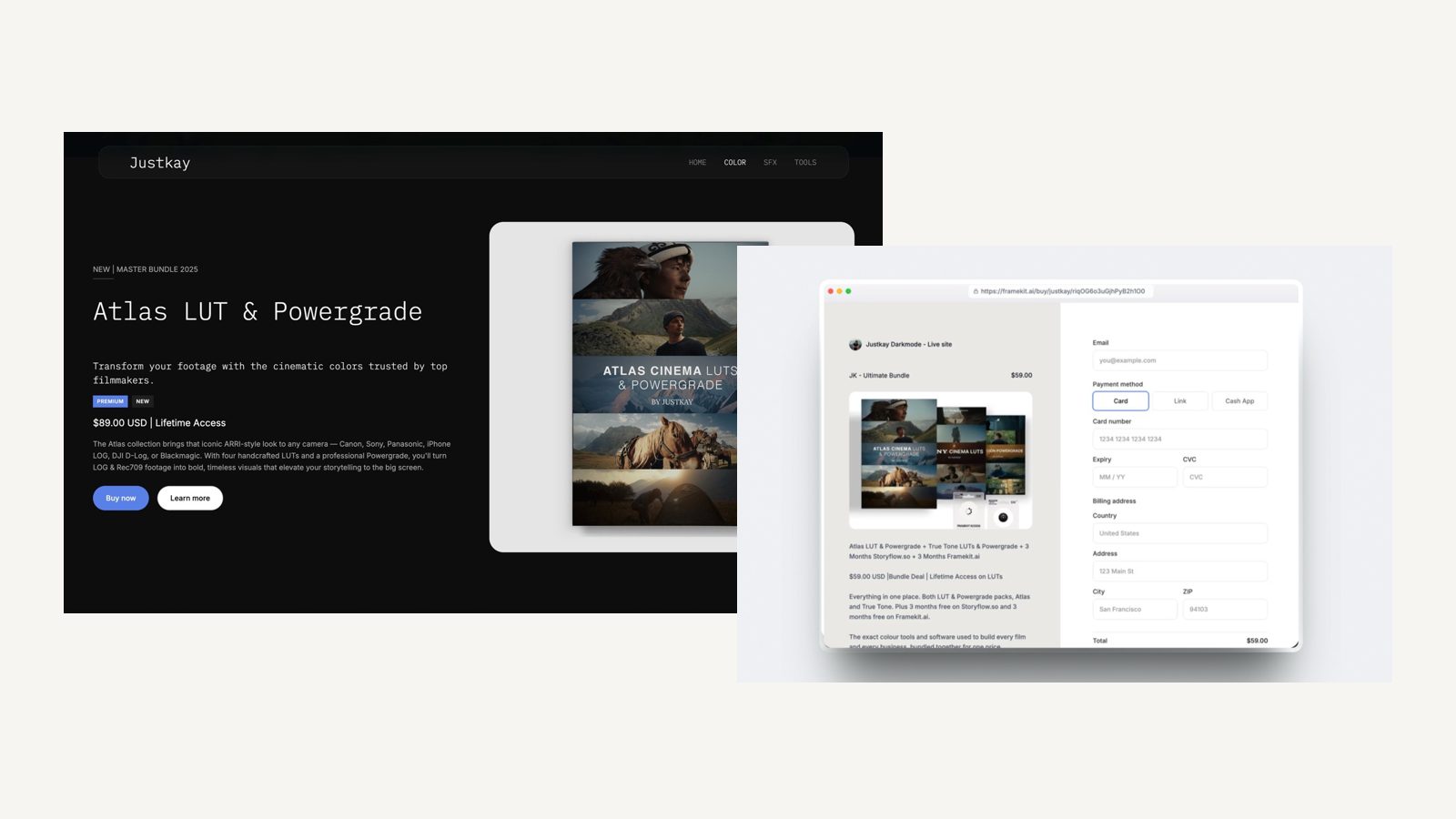
Framekit is an AI website builder for designers, photographers and filmmakers, and its digital-download store lives in the same account as the site, next to client galleries, video review and Slides.
For a mockup seller that matters in a specific way: the staging and rendering work that sells a bundle is the same work that wins commissioned jobs, and here both sit on one site.
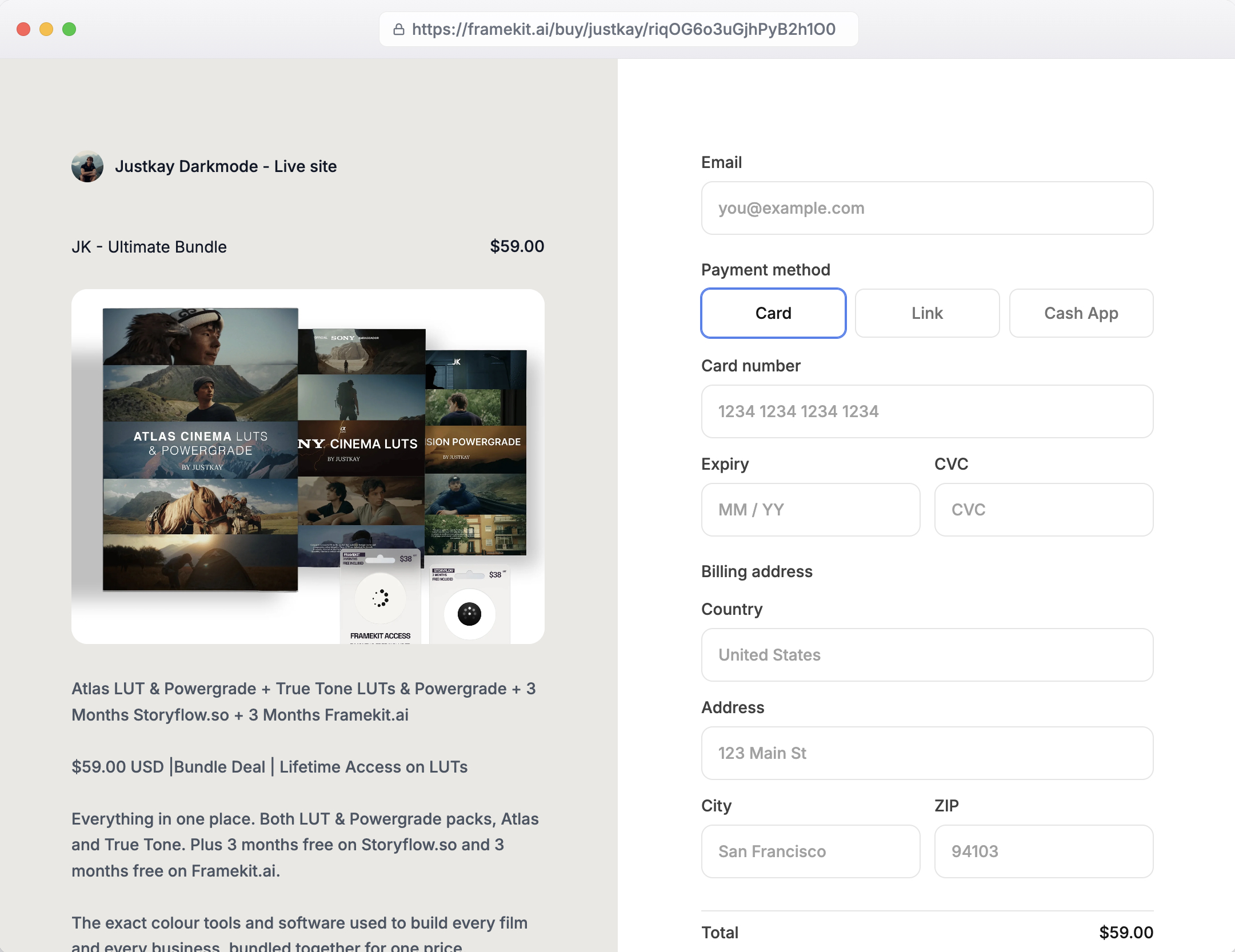
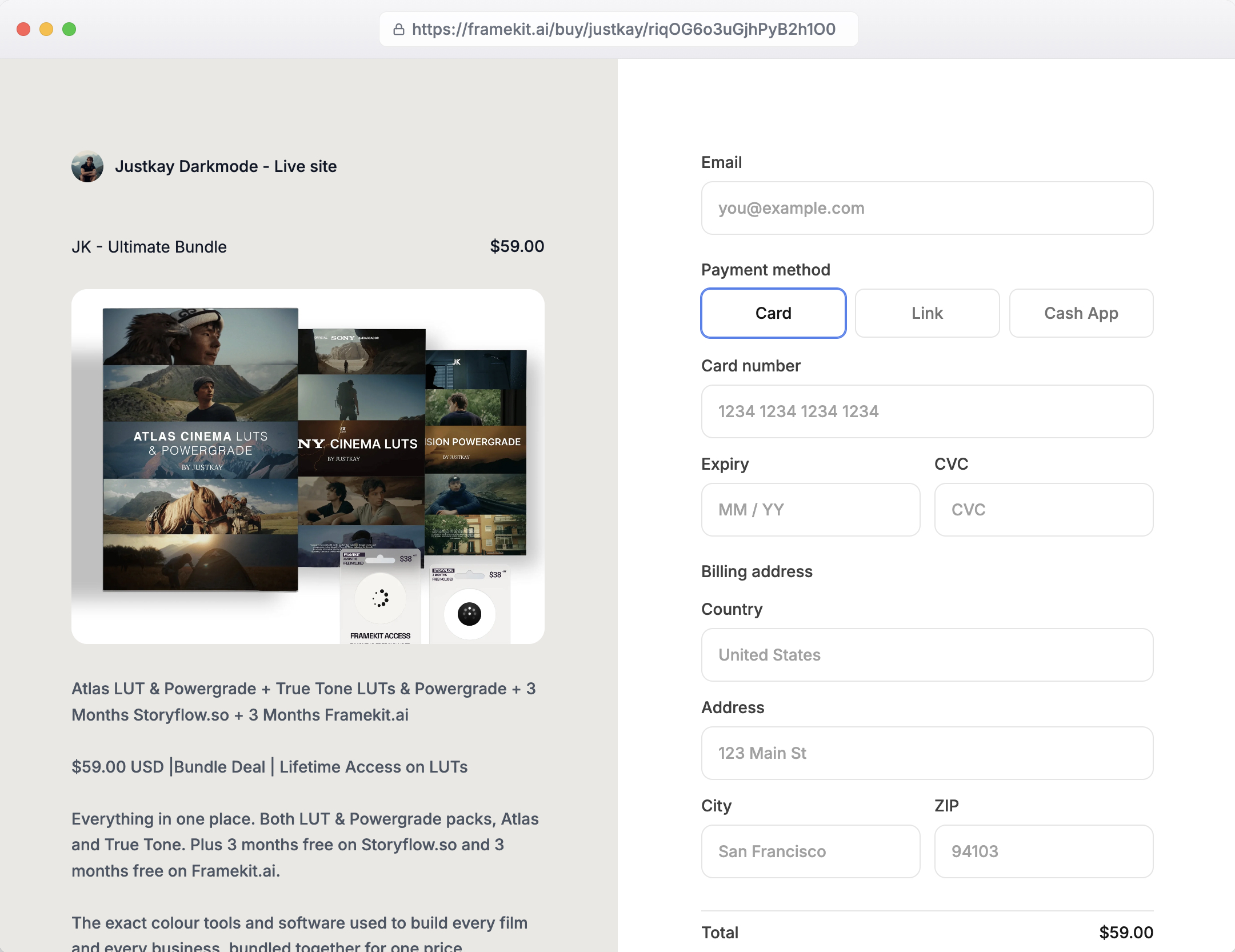
A product can hold several files or a whole uploaded folder, with the folder structure kept for the buyer. The uploader is resumable and retries a dropped connection, and payment is a direct charge on your own connected Stripe account.
After paying, the buyer lands on a download page they can bookmark and return to, the order email carries links valid for seven days, and you can resend a fresh set from the orders dashboard.
The real number5% on Free and Starter, 3% on Pro at $19 and 0% on Business at $39, plus card processing. At 120 sales Business is 33 cents a sale, leaving $30.44 of a $32 bundle - 20 cents behind Big Cartel and 33 cents ahead of Sellfy's Business plan.
The crossover where the flat plan beats the 5% is $780 a month, about 25 bundles.
The standout detailthe delivery page survives the realities of a 4 GB download. A buyer who switches machines or loses the email can go back to the bookmarked page, which removes the most common support request in this category.
The honest gotchaFramekit publishes no per-file ceiling and no bandwidth allowance, which is exactly the silence this guide marks down elsewhere, and we have not published a tested maximum. It also brings no buyers, has no licence keys and is not a merchant of record.
Skip it ifyour bundles run past 10 GB, or you need a published guarantee before launch day. Sellfy or DPD is the safer bet.
Verdict: the best choice for a designer whose portfolio sells the mockups and the commissions together, once your largest file has gone through a test upload. See how the Framekit store works.
5. Big Cartel: Cheapest Storefront, Unstated Limits
Big Cartel produces the highest take-home in the priced table and does not tell you anywhere on its pricing page whether your file will actually fit. Those two facts sit awkwardly together, and for a 4 GB bundle the second one wins.
The real numbera free Gold plan, Platinum at $15 a month, Diamond at $30, with digital products from Platinum. At 120 sales that is 13 cents a sale, netting $30.64.
The honest gotchaneither transaction fees nor file size limits appear on the pricing page. For most products in this series that is a minor gap; for a 4 GB mockup bundle it is the whole question, and it is the reason this ranks below Sellfy despite paying more.
Skip it ifyou cannot confirm the file limit before committing. Ask first.
Verdict: the best economics on paper, with the one specification you most need left unpublished.
6. Payhip: Best Structure
Payhip settles sales into your own Stripe or PayPal account rather than holding a balance on your behalf, and covers EU VAT on digital goods without an add-on. Both are genuinely useful; neither addresses the question this guide is built around.
The real numberfree at 5%, Plus at $29 a month with 2%, Pro at $99 with no transaction fee. At 120 sales, Pro is 83 cents a sale, netting $29.94 against $29.17 on the free plan - so Pro is worth about $92 a month more at this volume.
The honest gotchafile size limits are not published, which for this product is the same problem Big Cartel has.
Skip it ifyou need a stated ceiling before you commit a 4 GB upload.
Verdict: good plumbing, unstated capacity.
7. Lemon Squeezy: Best With Tax Handled
Lemon Squeezy acts as merchant of record, so the VAT question on international mockup sales stops being yours - and mockups sell internationally by default, because a designer in any country needs the same PSD.
The real number5% plus 50 cents per transaction with processing included, netting $29.90 on a $32 bundle. At 120 sales that is $252 a month against $79 for Sellfy's Business plan.
The standout detailat $32 the fixed 50-cent component is 1.6%, so the all-in effective rate is about 6.6% - reasonable by the standards of this fee model.
The honest gotchano published file size ceiling, and $173 a month more than Sellfy at this volume. You are paying for compliance rather than capacity.
Skip it ifyou are already registered where you sell.
Verdict: the right pick when tax is the problem and the files are moderate.
8. Gumroad: Fastest, Most Expensive
Gumroad will have a mockup bundle selling within the hour of you deciding to sell one, and it takes the largest share of any own-store option in this comparison.
For heavy files it is also the platform where the most large design assets are already being sold, which is worth something.
The real number10% plus 50 cents per sale, which is $3.70 on a $32 bundle, netting $28.30. Against Big Cartel that is $2.34 a sale, or $281 a month.
The honest gotchaneither file size nor bandwidth limits are published, and this is a platform where a great many people sell very large design files, so the practical ceiling is probably generous - but "probably" is doing real work in that sentence.
Skip it ifyou are doing volume. $281 a month is three Sellfy plans.
Already there? Gumroad's fees explained and the best Gumroad alternatives cover the move.
Verdict: a fine place to test whether a bundle sells and an expensive place to keep selling it.
9. Yellow Images: The Premium Mockup Specialist
Yellow Images is the most specialised venue in this guide, focused specifically on high-end mockups and staged 3D scenes, with a reputation for tight curation and higher price points than the general marketplaces.
It is a different proposition from a storefront and should be judged as one.
The real numbernot verifiable. The site blocks automated access to its contributor and seller pages, so we have no commission figure to report and will not estimate one.
The standout detailthe curation is the positioning. Acceptance signals quality to buyers in a way a general marketplace listing does not, and prices there run higher than the category average as a result.
The honest gotchacuration cuts both ways. Rejection is common, and building to a specific marketplace's standards is time you cannot reuse if they say no.
Skip it ifyour mockups are workmanlike rather than exceptional.
Verdict: worth applying to if your work is genuinely premium, on terms you will need to obtain directly.
10. Podia: Only If You Also Teach
Podia belongs in this guide for one specific mockup seller: the one whose real business is teaching product photography or 3D rendering, where the bundles exist to bring students in. As a place to sell heavy files it is unremarkable.
The real numberMover is $42 a month with 5% transaction fees, Shaker is $84 with none and Earthquaker is $150. At 120 sales, Shaker is 70 cents a sale, netting $30.07.
The honest gotchano published file ceiling, and the email subscriber caps of 100, 500 and 1,000 will move you up a tier for reasons unconnected to mockups.
Skip it ifthe bundles are the business.
Verdict: right when the mockups are a funnel, wrong when they are the product.
The Delivery Problem, Priced Properly
In one lineat 480 GB a month, how a venue delivers a file matters more than what it charges to sell one, and three specific mechanics decide whether you get support tickets.
Resumable downloads. A 4 GB file over an ordinary connection takes long enough that interruptions are normal rather than exceptional. A delivery system that cannot resume means a buyer who got to 80% starts again, and after the second failure they email you.
Download limits. A cap of three downloads per purchase sounds generous until you count a failed attempt as one of them. For heavy files, set the limit high or remove it - the piracy you prevent is worth less than the refunds you avoid.
Link expiry. Buyers of large design assets frequently download at work, on a different machine from the one they bought on, sometimes days later. A 24-hour expiry window on a 4 GB file is a support queue with a timer on it.
Cloud-storage workarounds. Some sellers dodge the whole problem by delivering a shared cloud folder link.
It works and buyers dislike it: there is no purchase record, the link is trivially shareable, and it feels unprofessional next to a proper download page.
If you do this because your platform cannot handle the file, that is a signal to change platform rather than to change expectations.
The test to run before you commit
- Multiply your bundle size by your expected monthly sales. That is your bandwidth, and it is the number to check against - not the storage figure, which vendors advertise because it is friendlier.
- Upload your largest single file to a trial account before you pay for a year.
- Buy your own product on a phone tethered to a slow connection, and see what happens when you interrupt it.
Decision Guide
This is ordered by the constraint that decides it, and for mockups that constraint is file size rather than price - which is why the first two questions are about gigabytes and none of them are about your budget. Work down and stop at the first yes.
1. Are your bundles over about 1 GB?
Yes: Sellfy, whose published per-file ceilings are 10 GB, 15 GB and 20 GB by plan. Everything else in the own-store half leaves the question unanswered.
2. Are they over 20 GB, or is your monthly delivery in the hundreds of gigabytes?
Yes: pair a cheap storefront with DPD at $10 a month, the only unlimited bandwidth published here.
3. Do you have no audience?
Yes: Creative Market, accepting a reported third to half as the price of buyers who are shopping with a live project.
4. Is your work premium and heavily staged?
Yes: apply to Yellow Images as well, and expect curation.
5. Does your portfolio win commissioned work as well as bundle sales?
Yes: Framekit, with the store beside the portfolio at 0% on the $39 Business plan, after a test upload of your largest bundle on the free plan.
6. Do you want the money in your own Stripe account without a website?
Yes: Payhip Pro at $99, after confirming its file ceiling with support.
7. Do you sell internationally and want VAT handled?
Yes: Lemon Squeezy at 5% plus 50 cents, same caveat about the file ceiling.
8. Are your mockups small and your catalogue large?
Then most of this guide's constraint does not apply to you, and Big Cartel at $15 is the cheapest way to sell them.
Frequently Asked Questions
These are the questions mockup sellers ask once the files get big, which is the point at which this category stops resembling every other kind of digital product and starts behaving like a hosting problem.
Where is the best place to sell mockups online in 2026?
Sellfy is the best place to sell mockups from your own store in 2026, because it publishes product file size ceilings of 10 GB, 15 GB and 20 GB by plan and takes no percentage of sales - the only hosted storefront in this comparison that states a limit big enough for a real mockup bundle.
Creative Market remains where mockup buyers browse, at a commission it does not publish.
For enormous bundles, pair a cheap storefront with DPD at $10 a month for unlimited bandwidth, and if your portfolio sells the work, Framekit puts the store beside it at 0% on its $39 plan.
How big can a mockup file be on these platforms?
Only two venues here publish an answer. Sellfy states 10 GB, 15 GB and 20 GB per product file by plan, and DPD publishes unlimited bandwidth on all three of its plans.
Big Cartel, Payhip, Podia, Lemon Squeezy, Gumroad and Framekit do not publish a per-file ceiling, so you would be finding out during your first upload.
How much bandwidth do I need to sell mockups?
Multiply your bundle size by your monthly sales.
A 4 GB bundle sold 120 times is 480 GB a month, which is far more than most metered plans include and is the reason DPD's unlimited bandwidth at $10 a month is disproportionately valuable in this category.
Check bandwidth rather than storage - vendors advertise storage because the number sounds better.
Is Creative Market worth its commission for mockups?
While you need discovery, yes. Its buyers are designers with a live client project, which is the most valuable audience in this category and one that buys repeatedly.
Reported commissions would leave roughly $13 to $22 of a $32 bundle, so at 120 sales a month you are paying $1,200 to $2,280 for that traffic. Once buyers come looking for you by name, that becomes an expensive habit.
Should I deliver mockups through Dropbox or Google Drive instead?
It works and it costs you more than it saves. There is no purchase record tied to the file, the link is trivially shareable, and it reads as unprofessional next to a proper download page.
Sellers usually do this because their platform cannot handle the file, which is a reason to change platform rather than to accept the workaround.
How many downloads should I allow per purchase?
More than you think, and ideally no limit for files this size. A 4 GB download fails often enough on ordinary connections that a three-download cap can be consumed entirely by interruptions, and the buyer who runs out emails you.
The copies you prevent are worth less than the refunds and support you avoid.
How much should I charge for a mockup bundle?
Between roughly $19 and $59 for a focused bundle, with $32 a common middle, and considerably more for premium staged scenes.
Fee mechanics barely matter at this price - a 50-cent fixed fee is 1.6% - so price on the production work and the exclusivity of the scenes rather than on fee arithmetic.
Do mockup buyers ask for refunds?
Less often than for cheap products, and the ones that happen are usually about expectations rather than quality: the smart objects behave differently than the preview implied, or the file will not open in an older Photoshop.
Both are prevented by honest previews and a stated version requirement, which is cheaper than any refund policy.
Can I sell mockups on my own site and a marketplace at the same time?
Yes, non-exclusively, and most established sellers do. The marketplace supplies discovery and your store supplies margin.
Price consistently across both, because marketplaces dislike being undercut and buyers notice, and make sure marketplace buyers end up on your email list - that relationship is the thing the commission is not buying you.
Do I need to charge VAT on mockups sold internationally?
Yes for EU consumers, from the first sale, because digital products are taxed at the buyer's location. A large share of mockup buyers are businesses, which are handled differently under reverse-charge rules.
A merchant of record like Lemon Squeezy removes the question entirely, at 5% plus 50 cents.
Can Framekit sell a 4 GB mockup bundle?
Framekit does not publish a per-file ceiling, so the honest answer is to upload your largest bundle on the free plan before you rely on it.
Its uploader is resumable, products can hold whole folders, and buyers get a bookmarkable download page, which suits heavy files. The 25 MB limit an earlier version of this guide cited has been withdrawn.
If you need a published guarantee, Sellfy states 10 GB to 20 GB.
Framekit vs Sellfy: which is better for selling mockups?
Sellfy is the safer choice for very large files and Framekit the better one if your portfolio sells the work. Sellfy publishes per-file ceilings of 10 GB, 15 GB and 20 GB and needs its $79 plan at our volume.
Framekit publishes no ceiling but keeps $30.44 of a $32 bundle on its $39 plan and includes a full portfolio website.
The Verdict
Sellfy wins because it answers the only question that actually blocks a mockup seller.
Ten, fifteen and twenty gigabytes per product file, published on the pricing page, with no percentage taken - and every other hosted storefront in this comparison leaves that specification blank.
Big Cartel nets 53 cents more per sale and does not tell you whether your file will upload. For most products in this series that would be a quibble.
For a 4 GB bundle it is the difference between a store and a dead end, which is why the cheaper option is ranked below the one that publishes a number.
If your bundles are genuinely enormous, the arrangement that works is not a single platform at all: a cheap storefront for the shop and DPD at $10 a month for unlimited bandwidth. Eight cents a sale to move 480 GB is the best value anywhere in this series.
Framekit is fourth: the right store for a designer whose portfolio sells both the bundles and the commissions, at 0% on its $39 plan.
Where Framekit losesFramekit does not publish a per-file ceiling or a bandwidth allowance, so it is not the tool to bet a 10 GB bundle on without testing; Sellfy and DPD are the better fit there.
It also brings no buyers, which makes Creative Market the better first venue for a seller without an audience.
Verdict: check the file ceiling before the price. Sellfy for most sellers, DPD paired with anything for the heaviest catalogues, Creative Market while you still need discovery. And raise your download limits.
Plan prices and file ceilings were read from each vendor's published pricing page during the first week of August 2026. Creative Market's and Yellow Images' commissions are not verified, because both block automated access to seller terms, and each is labelled where it appears.
Related readingthe best digital product delivery tools, the best places to sell web templates, the best places to sell icons and illustrations, the best places to sell digital templates, and how to price digital products.