Framekit templates
Start from a designer-made template
 Use template
 Use template
 Use template
 Use template
 Use template
 Use template
 Use template
 Use template
Sixty template sales a month at $59 is $3,540. The commission is the part everyone compares. The part that actually costs you is the inbox.
A web template is not a file, it is a file plus a relationship. Buyers install it wrong, want a section moved, ask whether it works with a plugin, and come back four months later when something breaks.
On a marketplace, answering them is generally a condition of selling there. On your own store it is optional, which is a genuine difference in what you are signing up for.
A template marketplace is a storefront run by somebody else that supplies buyers, sets the licence terms and usually sets expectations about author support, in exchange for a share of each sale.
The alternative is a store you control, which supplies none of that and takes very little.
Re-verified September 2026: the 25 MB Framekit file limit an earlier version quoted is no longer on its pricing page, so the file-size answer below was rewritten.
Framekit is the best place to sell web templates in 2026 for a designer with an audience, because a $39 flat plan with a 0% transaction fee keeps $56.34 of a $59 sale and you set your own support terms rather than inheriting somebody else's.
Big Cartel keeps 40 cents more per sale if you only want a shop.
ThemeForest and Creative Market are still where template buyers browse, and for a designer with no following they are worth their reported cut - but read the support section below before you list, because it is the largest cost in this category and no comparison table shows it.
How We Compared These Platforms
Marketplace commission rates and self-hosted platform fees are not directly comparable numbers, since one includes an audience and the other does not, so here is how each figure below was established and what it deliberately excludes.
- Verified from primary sources: commission rates, platform fees and subscription prices were taken from each vendor's own published terms in September 2026.
- Assessed hands-on: the listing process, how licence terms are presented to a buyer, and whether updates can be pushed to existing customers.
- Not assessed: marketplace visibility, which varies per listing and which no seller can measure reliably from outside.
No performance scores or load-time claims appear anywhere in this guide.
Disclosure: Framekit is our product and it ranks first here. We priced the others the same way and link to every one. Two things we do not do appear below: we send you no buyers, and Big Cartel nets more per sale on a cheaper plan.
How We Priced This
One product runs through every venue in this guide: a $59 web template sold 60 times a month, or $3,540 in monthly revenue. That is a working template business rather than a hypothetical, and it is large enough that a support obligation becomes a real weekly commitment rather than an occasional email.
Card processing at 2.9% plus 30 cents is added where a venue does not include it, which on a $59 sale is $2.01.
Three grades of claim, and this vertical needs all three. Read at the vendor's own page in the first week of August 2026 covers Gumroad, Payhip, Sellfy, Big Cartel, Podia, Lemon Squeezy, Framekit's own plan file, and ThemeForest's published licence terms. Transacted on covers Gumroad, Payhip and Framekit. Not verifiable at source covers every marketplace commission in this guide - Envato's help centre, Creative Market and UI8 all block automated access, and we could not find a public seller page for Webflow's template programme at the URLs we tried.
Those figures are reported ranges, labelled in place.
One thing we could verify and that matters: ThemeForest publishes its licence tiers, and the distinction is commercial rather than technical.
A Regular Licence covers an end product users do not pay to access; an Extended Licence is required when the end product is sold. That is a real pricing decision for you, not a formality.
By the numbers:
- $56.74 is the highest take-home on a $59 template here.
- About $26 to $41 is the reported range on a marketplace, depending on exclusivity.
- 9 hours a month is what buyer support costs at this volume on a six-month support window.
- $450 a month is what those hours are worth at a modest $50 an hour.
- $3.45 is what the most expensive non-marketplace option charges per sale.
- 5 of 12 venues here would not show us a commission.
- 2 licence tiers exist on the biggest marketplace, and choosing wrong costs you the difference.
The Rubric
We scored on five criteria, weighted for a product that is expensive, technical, and sold with an implied relationship attached. That last part is what separates templates from every other digital product in this series, and the weighting reflects it.
| Criterion | Weight | What it covers |
|---|---|---|
| Support terms | 25% | Whether the venue obliges you to answer buyers, and for how long |
| Take-home on a $59 sale | 25% | Commission or plan cost plus processing |
| Discovery | 20% | Whether the venue brings buyers who were not looking for you |
| Licensing control | 20% | Whether you set licence tiers or inherit them |
| Update delivery | 10% | Whether past buyers can get version two |
Support is weighted first, above price, and that is deliberate. At this price point the fee differences are a few dollars a sale and the support obligation is hours a week. Ranking on commission alone would be ranking on the smaller number.
What a $59 Template Nets
| Venue | Model | Cut per sale | Processing | You keep |
|---|---|---|---|---|
| Big Cartel | Platinum, $15/mo | $0.25 | $2.01 | $56.74 |
| Framekit | Business, $39/mo, 0% | $0.65 | $2.01 | $56.34 |
| Sellfy | Business, $79/mo, 0% | $1.32 | $2.01 | $55.67 |
| Podia | Shaker, $84/mo, 0% | $1.40 | $2.01 | $55.59 |
| Lemon Squeezy | 5% + 50c | $3.45 | Included | $55.55 |
| Payhip | Pro, $99/mo, 0% | $1.65 | $2.01 | $55.34 |
| Payhip | Free plan, 5% | $2.95 | $2.01 | $54.04 |
| Gumroad | 10% + 50c | $6.40 | Included | $52.60 |
| ThemeForest, reported | Author share by exclusivity | About $18 to $33 | Included | About $26 to $41 |
| Creative Market, reported | Commission per sale | About $18 to $29 | Included | About $30 to $41 |
| UI8, reported | Commission per sale | Not published | Included | Not published |
| Framer Marketplace | No public seller terms found | Not published | Not published | Not published |
| Webflow Marketplace | No public seller page found | Not published | Not published | Not published |
At $59, the own-store options cluster tightly: $52.60 to $56.74, a spread of about four dollars. Compared with the brush and action markets, where a fixed fee eats a painful share, this price point makes almost every platform look reasonable.
The marketplace gap is the opposite of tight. A reported author share leaving $26 to $41 means the venue keeps between a third and a half of a product you spent weeks building. At 60 sales a month that is $1,100 to $1,900 monthly.
In one lineat $59 the platform fee is a rounding error and the marketplace commission is a business decision, and neither is the largest number on this page.
The Support Cost Nobody Puts in a Table
In one lineat 60 sales a month with a six-month support window, you are supporting 360 buyers at any given moment, and that is worth more than every fee in this guide combined.
The arithmetic here is unglamorous and almost nobody does it, which is exactly why it is worth doing once properly: support time is the largest hidden cost in selling templates and it does not appear on any pricing page.
Sixty sales a month, with support owed for six months after purchase, means that in a steady state you are responsible for six cohorts at once - 360 buyers who can legitimately contact you.
If one in ten asks a question during their window, that is 36 conversations a month. At fifteen minutes each, allowing for reading, reproducing and replying, that is nine hours.
| What you are running | Monthly hours | Value at $50/hour | Compared with |
|---|---|---|---|
| Support at 10% contact rate | 9 | $450 | Every platform fee here |
| Support at 20% contact rate | 18 | $900 | A marketplace commission |
| Support at 5% contact rate | 4.5 | $225 | Six times a $39 flat plan |
Nine hours a month is a day of work. At $50 an hour it is $450, which is larger than the entire fee difference between the cheapest and most expensive own-store option at this volume, and comparable to what a marketplace takes.
Three things move that number more than any platform choice:
Documentation. A template shipped with a proper setup guide, a video walkthrough and an FAQ addressing the three questions everyone asks converts a support ticket into a link you paste. This is the single highest-return hour you will spend on the product.
Scope boundaries, stated up front. "Installation and bugs, yes. Customising the template to your brand, no, but here is my hourly rate." Buyers accept this readily when it is written down and resent it when it is improvised.
Whether you chose the obligation. On your own store you set the terms.
On a marketplace you generally inherit them, and the specifics vary by venue - Envato's author support terms sit in a help centre that blocks automated access, so confirm them yourself before listing rather than trusting any summary, including this one.
1. Framekit: Best If You Have an Audience

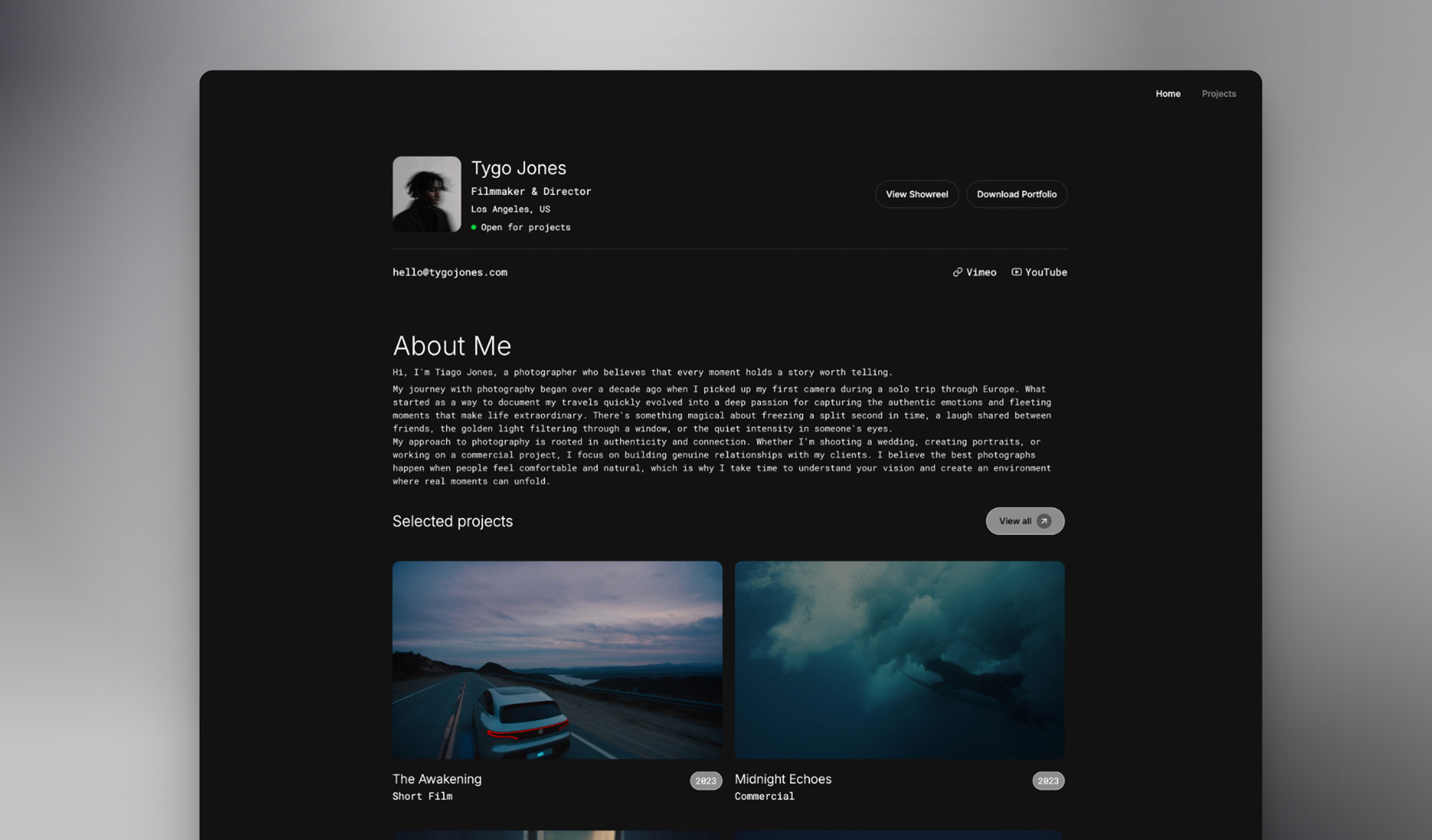
Framekit is an AI website builder for photographers, filmmakers, designers and other creators, and for a template seller the fit is unusually direct: your portfolio is a demonstration of exactly the skill the buyer is purchasing.
The real numberFramekit's product-sale fee runs 5% on Free and Starter, 3% on the $19 Pro plan and 0% on the $39 Business plan, with processing billed separately. At 60 sales, Business is 65 cents a sale, leaving $56.34 of a $59 template.
The crossover where the flat plan beats the 5% is $780 a month in sales, which is 14 templates.
The standout detailyou set the support terms. Not the marketplace, not a help-centre policy you agreed to in a signup flow - you. Given that support is the largest cost in this category, control over its scope is worth more than the fee difference.
The honest gotchawe bring you no buyers whatsoever. A template marketplace's commission is buying traffic from people searching for exactly what you made, and that is genuinely valuable to a designer nobody has heard of. Big Cartel also nets 40 cents more per sale on a cheaper plan.
Skip it ifyou have no audience, or you need the credibility that a curated marketplace listing confers on an unknown designer.
Verdict: the best economics and the only entry here where the support terms are yours to write.
2. Big Cartel: Cheapest Shop
Big Cartel is the cheapest genuine storefront in this comparison and produces the highest take-home in the table. It has served independent makers for well over a decade and does one job without asking you to configure much of anything.
The real numbera free Gold plan, Platinum at $15 a month and Diamond at $30, with digital products from Platinum. At 60 sales that is 25 cents a sale, netting $56.74.
The standout detailat this price point a flat plan is almost invisible. Twenty-five cents on a $59 sale is four tenths of one percent.
The honest gotchatransaction fees are not published on the pricing page, so $15 is a plan price rather than a verified total. Confirm it before relying on the figure above.
Skip it ifyou want the shop inside a portfolio rather than beside one.
Verdict: the best pure economics if all you need is somewhere to take the money.
3. Lemon Squeezy: Best at Low Volume, and for Licences
Lemon Squeezy charges no monthly fee at all, acts as your merchant of record for tax purposes, and includes licence-key infrastructure that suits template sellers who gate version updates behind a key. That combination is unusual at this price point.
The real number5% plus 50 cents per transaction with processing included, netting $55.55. At 60 sales that is $207 a month against $39 for a flat plan, so the crossover is around 14 sales.
The standout detailat $59 the fixed 50-cent component is under 1%, so the effective rate is about 5.8%. This is the price point where merchant-of-record pricing stops feeling punitive, which is worth knowing if you have been avoiding it because of what it does to cheap products.
The honest gotchait is still $168 a month more than Big Cartel at this volume. What you get for that is the tax obligation removed, which for a template selling worldwide is real work rather than a formality.
Skip it ifyou are already registered where you sell and doing volume.
Verdict: the right choice under about 14 sales a month, and a defensible one above it if tax is on your mind.
4. Payhip: Best Structure
Payhip settles sales into your own Stripe or PayPal account rather than holding a balance on your behalf, and it handles EU VAT on digital goods without an add-on. For a template selling to European agencies, that second point does more work than it appears to.
The real numberfree plan at 5%, Plus at $29 a month with 2%, Pro at $99 with no transaction fee. At 60 sales, Pro is $1.65 a sale, netting $55.34.
The honest gotchaat this volume Pro's $99 is not obviously better than the free plan's 5%, which costs $177. It is - by $78 a month - but the margin is narrower than at higher volumes, and if your sales are lumpy the free plan carries less risk.
Skip it ifpresentation matters and you have no separate portfolio.
Verdict: sensible plumbing, unremarkable shopfront, good tax handling.
5. Sellfy and Podia: The Middle of the Table
Sellfy and Podia land within a dollar of each other at this volume, which means the choice between them has nothing to do with the fee and everything to do with what else you need. One is built around large files and print-on-demand, the other around courses and email.
The real numbersSellfy is $39, $79 and $159 a month billed monthly with 0% transaction fees and annual sales caps of $10,000, $50,000 and $200,000 - our $42,480 a year puts us on the $79 plan, or $1.32 a sale, netting $55.67. Podia's Shaker plan is $84 with no transaction fee, netting $55.59.
The standout detailSellfy's large product-file allowance matters here more than in the brush or action markets, because a template package with a demo video, image assets and documentation is genuinely large.
The honest gotchaPodia's email subscriber caps of 100, 500 and 1,000 will move you up a tier for reasons unrelated to templates, and Sellfy's annual sales caps do the same.
Skip either ifyou want the simplest possible arrangement. Both are broader products than a template seller needs.
Verdict: competent, mid-priced, and chosen for their other features rather than for template selling specifically.
6. Gumroad: Fastest, Priciest Own-Store Option
Gumroad remains the shortest path from a finished template to a working checkout, and at $59 it is the most expensive non-marketplace option here.
The real number10% plus 50 cents per sale, which is $6.40 on a $59 template, netting $52.60. Against Big Cartel that is $4.14 a sale, or $248 a month at our volume.
The standout detailGumroad Discover at 30% is a marketplace inside a store platform, and for templates it is a genuine discovery channel worth assessing separately from the base rate.
The honest gotchamost sellers are paying 10% for a checkout rather than 30% for customers, and at $248 a month the move pays for itself immediately.
Already there? Gumroad's fees explained and the best Gumroad alternatives cover the arithmetic and the move.
Verdict: prove the template sells, then leave.
7. ThemeForest: Where Template Buyers Browse
ThemeForest remains the largest destination for people who want a website template and have no particular designer in mind, and for an unknown seller that reach is the product.
The real number, split into what we could and could not verify: ThemeForest publishes its licence tiers, and the distinction is commercial - a Regular Licence covers an end product users do not pay to access, and an Extended Licence is required when the end product is sold.
That is verified. The author commission is not: Envato's help centre blocks automated access, and reported author shares vary substantially with exclusivity.
On a $59 template, reported ranges would leave roughly $26 to $41.
The standout detailthe licence structure is a pricing lever most independent sellers ignore. Offering a standard and an extended licence at different prices is normal on marketplaces and rare on personal stores, and it captures revenue from the commercial buyers who need it.
The honest gotchathe approval queue is real, rejection is common, and author support expectations are set by the marketplace rather than by you. Confirm the current author terms at the source before listing - we could not.
Skip it ifyou have an audience. You are paying a large share for buyers you already have.
Verdict: the strongest discovery in this guide, with terms you should read carefully and cannot negotiate.
8. Creative Market: Curated Design Audience
Creative Market's buyers are working designers shopping deliberately for assets rather than browsing casually, which suits polished, opinionated templates considerably better than general-purpose ones. The curation is part of what the audience is paying attention to.
The real numbernot verifiable at source. The site blocks automated access to seller terms, and reported commissions would leave roughly $30 to $41 on a $59 template. Confirm before committing.
The standout detailthe curation is the value. Being accepted is a signal, and buyers treat it as one.
The honest gotchaa commission in that range is $1,100 to $1,700 a month at our volume, against $39 for a flat plan.
Skip it ifyou can drive your own traffic.
Verdict: a good shop window at a rent you should calculate before signing.
9. UI8: Premium Design Assets
UI8 sells to a professional design audience and positions firmly at the premium end of the market, which suits high-quality UI kits and complete template systems rather than single-page marketing templates. Its buyers expect polish and price accordingly.
The real numbernot published in a form we could read - the site blocks automated access. We are not going to estimate.
Skip it ifyour work is general-purpose rather than design-professional.
Verdict: a strong audience match for premium work, with terms you will have to request.
10. Framer Marketplace: Native Audience, Opaque Terms
Framer's marketplace puts your template in front of people who are already inside Framer with a project open, which is the most qualified audience a Framer template can possibly reach. Platform-native marketplaces convert well for exactly that reason.
The real numberwe could not find public seller terms. The marketplace page describes the catalogue rather than the creator programme, and the creator URLs we tried did not resolve. Any commission figure you read elsewhere was not verified at Framer's own page today.
The standout detailplatform-native marketplaces convert unusually well, because the buyer is already inside the tool and the template installs in one step.
Skip it ifyour templates are not built in Framer. This is not a general marketplace.
Verdict: the obvious channel for Framer templates specifically, on terms you will need to obtain directly.
11. Webflow Marketplace: Same Story
Webflow's template marketplace is the equivalent channel for Webflow templates, and it carries the same structural advantage as Framer's - a buyer already committed to the platform - alongside the same problem for a guide like this one, which is that its seller terms are not published anywhere we could read them.
The real numberwe could not locate a public seller page at the URLs we tried, so there is no verified commission to report here.
The honest gotchaplatform marketplaces typically enforce quality review, technical standards and support expectations. Those are usually good for buyers and are constraints on you, and you should read them before building to their spec.
Skip it ifyou build in something else.
Verdict: the right channel for Webflow work, with homework required before you commit.
12. Your Own Site Plus a Marketplace
The arrangement most established template sellers actually run is not one venue at all but two: a marketplace doing the work of discovery, and their own store capturing margin and repeat buyers. It is worth pricing as its own option rather than treating the choice as binary.
The real numberat 60 sales a month split evenly, thirty marketplace sales at a reported $33 average and thirty own-store sales at $56.34 nets $2,680 a month, against $2,391 on the marketplace alone or $3,380 on the store alone.
The blend earns less than the store and considerably more than the marketplace, and it keeps a discovery channel open.
The honest gotchatwo venues means two support inboxes, two sets of licence terms and a pricing consistency problem. Marketplaces generally dislike being undercut, so price the same in both places and compete on what you bundle rather than on headline price.
Verdict: the pragmatic answer for most working template sellers, and the reason the ranking above should be read as "which store", not "store or marketplace".
Licence Tiers Are a Pricing Lever You Probably Are Not Using
In one linemarketplaces sell the same template at two prices depending on what the buyer does with it, and independent sellers almost never copy that.
ThemeForest's published licence terms draw the line at whether the end product is sold. A Regular Licence covers a template used in something people access for free; an Extended Licence is required when the finished thing is itself sold.
Same files, different price, based on the value the buyer extracts.
Independent sellers typically offer one price and one implied licence, which leaves money with the buyers who need the most permission. Three tiers worth considering on your own store:
Personal or single-project. One site, no resale. The default most buyers need.
Commercial or multi-project. An agency using your template for several clients is getting several times the value and should pay accordingly.
Extended or resale. The buyer builds something they sell. This is the tier marketplaces price highest and independents forget exists.
The practical caution: licence tiers only work if they are enforceable in spirit rather than in code. You are not going to audit anybody. What they do is give honest commercial buyers a correct option to choose, and most of them will.
Decision Guide
These are ordered by the question that actually decides the choice rather than by feature count, so work down and stop at the first yes. The opening questions are about audience and tax obligations, which settle it outright.
1. Does your template only work inside one platform, like Framer or Webflow?
Yes: list on that platform's marketplace, because the audience is already inside the tool. Obtain the current seller terms directly, since neither publishes them at a URL we could reach.
2. Does anybody know your design work yet?
No: ThemeForest or Creative Market. The reported share is large and the traffic is the product. Read the author support terms before listing.
3. Do you have an audience and want the store beside your portfolio?
Yes: Framekit on Business at $39, netting $56.34 and letting you set your own support scope.
4. Do you just want the cheapest shop?
Yes: Big Cartel Platinum at $15, netting $56.74.
5. Are you selling fewer than about 14 templates a month?
Yes: Lemon Squeezy at 5% plus 50 cents, with no monthly fee and the tax handled.
6. Do you want the money in your own Stripe account and EU VAT covered?
Yes: Payhip Pro at $99.
7. Are you already selling on a marketplace and doing well?
Add your own store rather than replacing it. The blend earns more than the marketplace alone and keeps the discovery channel.
Frequently Asked Questions
These are the questions template sellers ask once sales start and the support inbox begins to fill, which is when the commission stops being the interesting number.
Where is the best place to sell web templates in 2026?
Framekit is the best place to sell web templates in 2026 for a designer with an audience, keeping $56.34 of a $59 sale on a $39 flat plan while letting you set your own support terms.
Big Cartel keeps $56.74 at $15 a month if you only need a shop. For a designer nobody has heard of, ThemeForest and Creative Market remain the places template buyers browse, and their reported cut is the price of that traffic.
How much commission do template marketplaces take?
We could not verify current commissions at source, because Envato's help centre, Creative Market and UI8 all block automated access to their seller terms.
Reported author shares would leave roughly $26 to $41 of a $59 template depending on venue and exclusivity, which means the marketplace keeps between a third and a half. Confirm the current rate at the venue before making a decision on it.
What is the real cost of selling templates?
Support, and it is not close. At 60 sales a month with a six-month support window you are responsible for 360 buyers at any time.
A 10% contact rate is 36 conversations a month, or about nine hours, which at $50 an hour is $450 - larger than any fee difference in this guide. Documentation and stated scope boundaries reduce it more than any platform choice.
Do I have to provide support if I sell on a marketplace?
Generally yes, and the specifics vary by venue and change over time. Marketplaces set author support expectations as a condition of listing, whereas on your own store you write the terms.
We could not verify Envato's current author support requirements because its help centre blocks automated access, so read them at the source before you list rather than relying on any summary.
What is the difference between a regular and an extended licence?
ThemeForest's published terms draw the line at whether the buyer's end product is sold.
A Regular Licence covers an end product that users do not pay to access; an Extended Licence is required when the finished thing is itself sold commercially.
It is a pricing tier based on the value the buyer extracts, and independent sellers rarely copy it even though most could.
Should I sell templates on my own site or a marketplace?
Both, if you can. At 60 sales a month split evenly, a blend of marketplace and own-store sales nets roughly $2,680 against $2,391 on the marketplace alone and $3,380 on your store alone.
The store earns more per sale and the marketplace supplies buyers you would not otherwise reach, so the blend trades some margin for a discovery channel that keeps working while you sleep.
How much should I charge for a web template?
Between roughly $39 and $99 for a single-site licence, with $59 a common middle, and more for commercial or extended tiers.
Unlike brushes or presets, this price point makes fixed transaction fees irrelevant - 30 cents on $59 is half a percent - so pricing here should be driven by the value to the buyer and the support you are committing to, not by fee mechanics.
Can I sell the same template on several marketplaces?
Usually yes on non-exclusive terms, and exclusivity is typically what unlocks a higher author share where marketplaces offer tiered rates.
That is a genuine trade: exclusivity pays more per sale on one venue, and non-exclusivity lets you list everywhere and keep your own store. Most sellers with an audience choose non-exclusive.
How do I deliver template updates to past buyers?
Check this before choosing a venue, because it varies more than any other feature here.
Some platforms notify past buyers and let them re-download the new version automatically; on others it is a manual export and an email you send yourself.
If you intend to maintain a template across framework versions, automatic update delivery is worth more than a point of commission.
Do template buyers ask for refunds?
Less often than for cheap products, and the ones that happen cost more. At $59, a chargeback fee of $15 to $20 is a third of the sale, so a disputed transaction is far worse than a refund.
The practical policy most sellers land on is refunding quickly and without argument, and investing in documentation and honest demos so the request does not arise.
Do I need to charge VAT on web templates?
Yes for EU consumers, from the first sale, because digital products are taxed at the buyer's location.
Business buyers in the EU are handled differently under reverse charge rules, which matters more for templates than for consumer products because a large share of your buyers are companies.
A merchant of record like Lemon Squeezy removes the question entirely.
Does Framekit have a file size limit for template packages?
Framekit publishes no per-file ceiling or bandwidth allowance for store products, which is not the same as promising any size will work.
A template package carrying documentation and a full asset library can run to hundreds of megabytes, so test your largest package before launch, or use a platform that states its ceiling - Sellfy publishes product file sizes up to 10 GB on its entry plan.
The Verdict
Framekit wins for the designer we think is reading this: someone with a portfolio that demonstrates the exact skill their template represents.
Keeping $56.34 of a $59 sale is good, and writing your own support terms is better, because support is the largest cost in this category and it is the one thing a marketplace takes out of your hands.
Big Cartel keeps 40 cents more per sale and we would rather say so than pretend our ranking is about the money. It is not: at this price point the own-store options are within four dollars of each other and the decision is about everything else.
The most useful thing in this guide is not the ranking. At 60 sales a month with a six-month support window, you are supporting 360 people at once, and nine hours a month at $50 an hour is $450 - more than the fee difference between any two platforms here and comparable to a marketplace's entire commission.
Every hour you spend on documentation before launch buys back several later.
Where Framekit loseswe send you no buyers, which for a designer without an audience makes ThemeForest or Creative Market the correct first venue rather than us.
We also publish no per-file ceiling, so for template packages that ship with video and full asset libraries, Sellfy's stated 10 GB ceiling is the safer bet until you have tested ours.
Verdict: platform-specific template, use that platform's marketplace. No audience, ThemeForest. Audience, your own store - Framekit for the portfolio pairing, Big Cartel for pure cost. And write the documentation before you write the listing.
Plan prices and ThemeForest's licence terms were read at source during the first week of August 2026.
Every marketplace commission in this guide is a reported range rather than a verified rate, because those venues block automated access to their seller terms, and each is labelled where it appears.
Related readingthe best places to sell digital templates, the best places to sell Photoshop actions, how to sell Canva templates online, the best payment processors for digital products, and how to price digital products.