Framekit templates
Start from a designer-made template
 Use template
 Use template
 Use template
 Use template
 Use template
 Use template
 Use template
 Use template
Somebody buys your $15 digital planner in January. Do they buy anything from you again?
For most digital products the answer is yes, eventually. A photographer who likes your presets buys the next pack. A designer who liked your template comes back for another.
That repeat behaviour is why every guide to selling online, including the twenty-two we have published before this one, eventually says the same thing: move off the marketplace, own the customer, stop paying a commission on people who already know your name.
Digital planners break that advice, and it is worth being precise about why. A planner buyer typically buys once, uses it for a year, and if they return at all it is next January.
When the repeat rate is that low, the customer relationship you are buying by paying more per sale is worth considerably less than it is in other categories - and the marketplace commission stops looking like a tax and starts looking like a fairly-priced introduction.
A digital planner is a hyperlinked PDF designed to be annotated in an app such as GoodNotes or Notability on a tablet, sold either through a marketplace that supplies buyers or a store you control.
Etsy is the best platform to sell digital planners in 2026 for most sellers, and unusually we would say that even once you have an audience, because planner buyers rarely purchase twice and the value of owning them is roughly equal to what the marketplace charges.
Whop keeps the most of a $15 sale at $14.30 on published rates.
Framekit ranks third as the best store for a seller with a genuine repeat catalogue, at 0% on a $39 plan with the money landing in your own Stripe account, and Big Cartel is 10 cents a sale cheaper if you only need a plain shop.
Read the repeat-rate section before deciding, because it is the whole argument.
Disclosure: Framekit is our product and it ranks third, below a marketplace, because this guide's central finding is that planner buyers rarely return. We priced every platform the same way, link to each, and say where each beats us.
In September 2026 we re-verified Framekit's fees and store features against its current pricing page; the other platforms were read in August 2026 and are dated in place.
How We Priced This
One product runs through every platform here: a $15 digital planner sold 250 times a month, or $3,750 in monthly revenue. That is a working planner shop rather than a hypothetical one, and it is large enough that a fifth of each sale becomes a number worth arguing about.
Card processing at 2.9% plus 30 cents is added where a platform does not include it, which on $15 is 74 cents.
Three grades of claim. Read at the vendor's own page in the first week of August 2026 covers Whop's fee documentation, Big Cartel, Payhip, Sellfy, Podia, Lemon Squeezy, Gumroad, Shopify and Framekit's plan file. Purchased through covers Gumroad, Payhip and Lemon Squeezy. Not verifiable at source covers Etsy, Creative Fabrica and Design Bundles, all of which block automated access to their fee pages; their figures are reported ranges and labelled where they appear.
By the numbers:
- $14.30 is the highest take-home on a $15 planner here.
- About $12 is what the same sale nets on a marketplace taking a fifth.
- $2.30 separates them, which at 250 sales is $575 a month.
- 1 to 2 purchases is all a typical planner buyer ever makes from one seller.
- $3 is roughly what a marketplace charges to introduce that buyer.
- $3 is also roughly what a second purchase from them is worth, at a 20% repeat rate.
- 3 of 12 platforms here would not show us a fee page.
The Rubric
We scored on five criteria, weighted for a product bought by largely non-technical buyers, usually once, and disproportionately in January. Each of those three characteristics moves the weighting somewhere unusual compared with the rest of this series.
| Criterion | Weight | What it covers |
|---|---|---|
| Discovery | 30% | Whether the platform supplies buyers who are searching |
| Take-home on a $15 planner | 25% | Platform cut plus processing |
| Delivery to a tablet | 20% | Whether a hyperlinked PDF reaches GoodNotes without help |
| Support burden | 15% | How much hand-holding a non-designer buyer needs |
| Repeat-purchase support | 10% | Whether you can sell the same person a second thing |
Discovery is weighted first, which we have done only once before in this series. For a product with a low repeat rate, the ability to keep meeting new buyers matters more than the ability to keep the old ones.
What a $15 Planner Nets
| Platform | Model | Cut per sale | Processing | You keep |
|---|---|---|---|---|
| Whop | Published processing only | $0.41 | $0.30 | $14.30 |
| Shopify | Basic plus a downloads app | $0.12 | $0.56 | $14.32 |
| Big Cartel | Platinum, $15/mo | $0.06 | $0.74 | $14.20 |
| Framekit | Business, $39/mo, 0% | $0.16 | $0.74 | $14.10 |
| Sellfy | Business, $79/mo, 0% | $0.32 | $0.74 | $13.94 |
| Podia | Shaker, $84/mo, 0% | $0.34 | $0.74 | $13.92 |
| Payhip | Pro, $99/mo, 0% | $0.40 | $0.74 | $13.86 |
| Lemon Squeezy | 5% + 50c | $1.25 | Included | $13.75 |
| Payhip | Free plan, 5% | $0.75 | $0.74 | $13.51 |
| Gumroad | 10% + 50c | $2.00 | $0.74 | $12.26 |
| Etsy, reported | Listing, fees and Offsite Ads | About $3 | Included | About $12 |
| Creative Fabrica, reported | Pooled or commission | Not published | Not published | Not published |
| Design Bundles, reported | Commission per sale | Not published | Not published | Not published |
The spread between the best own-store option and a marketplace is $2.30 a sale, or $575 a month at this volume. In every other guide in this series, that gap is the argument for leaving.
Here it is not, and the next section explains why.
In one linethe fee comparison in this category is straightforward and it answers the wrong question, because what you are really buying with the extra $2.30 is a customer relationship whose value depends entirely on how often planner buyers come back.
Why the Usual Advice Does Not Apply Here
The table above shows a $2.30 gap per sale, and in twenty-two previous guides a gap that size has been the argument for leaving the marketplace. Before accepting that here, it is worth asking what the extra $2.30 actually buys, because the answer in this category is different.
In one lineowning a customer is worth what they will buy from you again, and planner buyers mostly do not.
The standard argument for leaving a marketplace goes like this. The marketplace takes a fifth. Your own store takes almost nothing. Therefore every sale on the marketplace is money lost, and once you have an audience you should move.
That argument has a hidden assumption: that the buyer is worth something after the first sale. Work out what it is worth in this category and the conclusion changes.
| Repeat rate | Future value of one buyer at $15 | What a fifth costs you per sale | Which wins |
|---|---|---|---|
| 60%, typical of preset buyers | $9 | $3 | Own store, decisively |
| 35% | $5.25 | $3 | Own store |
| 20%, plausible for planners | $3 | $3 | Roughly level |
| 10% | $1.50 | $3 | Marketplace |
If one planner buyer in five ever buys from you again, the future value of owning them is about $3 - which is approximately what a marketplace charges to introduce them in the first place.
At a 10% repeat rate, the marketplace is straightforwardly the better deal, and you are paying $575 a month for an email list of people who will not open it.
Two honest qualifications, because this is a strong claim.
Your repeat rate is measurable and you should measure it. Take your buyer list from twelve months ago and count how many appear in this year's orders. That number, not our estimate, decides this.
Sellers with a genuine catalogue - weekly planners, budget planners, student planners, a fitness tracker - report far better repeat behaviour than sellers with one annual planner, and for them the standard advice applies normally.
Discovery compounds differently from ownership. A marketplace listing that ranks keeps working every January without further effort. An email list decays.
Neither is obviously better; they are different assets, and this category is unusual in that the first one is probably worth more.
The practical conclusion is not "never leave Etsy". It is: build a catalogue that gives people a reason to come back, measure whether they do, and let that number rather than a general principle decide where you sell.
1. Etsy: Where the Search Happens
Etsy is the centre of gravity for digital planners in a way it is not for most products in this series. People type "digital planner goodnotes" into Etsy specifically, with a card saved, in the first week of January.
The real number, with the standard caveatEtsy blocks automated access to its fee documentation, so we could not read its rates at source.
Reported figures put combined listing, transaction, payment and Offsite Ads charges around a fifth of a sale, leaving roughly $12 of a $15 planner. Confirm at Etsy's own fee page before planning around it.
The standout detailthe buyers are not shopping for a creator, they are shopping for a planner. That is exactly the condition under which a marketplace earns its commission permanently rather than temporarily, and it is why this is the only guide in this series where we would not push you to leave.
The honest gotchaOffsite Ads becomes mandatory above a sales threshold, which adds an advertising charge to a share of your sales that you did not opt into. At a $15 price point that is a meaningful part of the reported fifth.
Skip it ifyou have built a genuine multi-product catalogue and measured a repeat rate above about a third. At that point the arithmetic flips and the rest of this guide applies.
Verdict: the right home for most planner sellers, including successful ones, which is not a sentence we have written about a marketplace before.
2. Whop: Highest Published Take-Home
Whop's published fee schedule keeps more of a $15 sale than any conventional storefront in this comparison, and it does so without a monthly commitment, which suits a product whose demand arrives in one enormous January spike.
The real number2.7% plus 30 cents for domestic cards with no monthly platform fee stated, which is 71 cents on $15 and leaves $14.30.
The standout detailno monthly commitment means a planner seller testing the January rush risks nothing outside the season, which suits a product with a spiky demand curve.
The honest gotchathe fee schedule is a menu - tax collection and remittance adds 2% per transaction, and instant payouts cost 4% plus $1.00 against $2.50 for next-day ACH.
It is also built around community and access products rather than PDF downloads, so the fit is less natural than the rate suggests.
Skip it ifyou want a storefront designed for browsing a planner catalogue.
Verdict: the best published rate, in a product that was built for something else.
3. Framekit: Best If You Have a Catalogue and an Audience

Framekit is an AI website builder for designers, photographers and other creators, with a digital-download store in the same account as the site, and for a planner seller its case depends entirely on the repeat-rate question above.
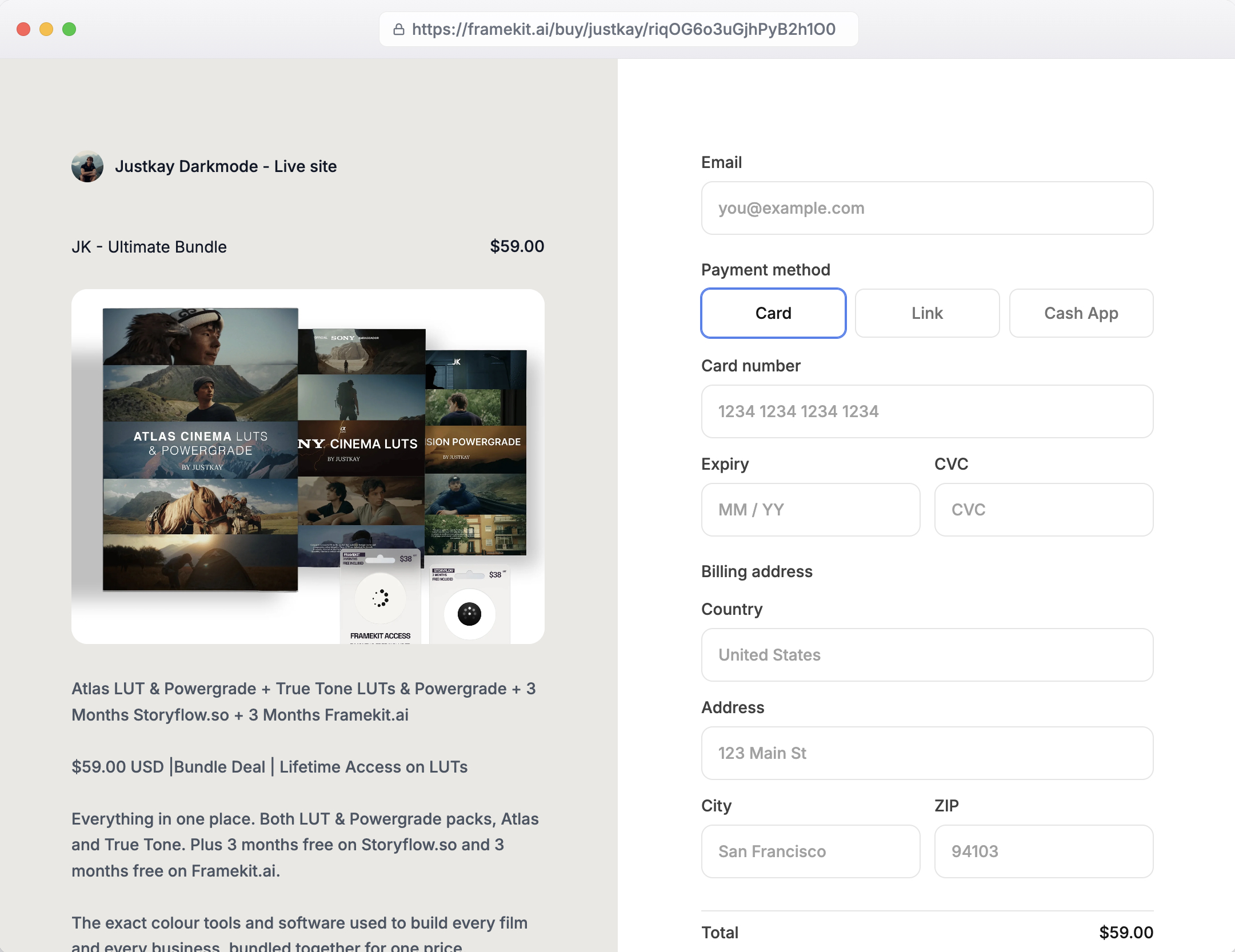
Every planner gets a product page on your site and a direct buy link to a hosted checkout under your name, which suits the January Pinterest pin and the newsletter alike.
Payment is a direct charge on your own connected Stripe account, so every buyer's email is in your order list for next January, and the buyer gets the PDF instantly on a download page they can bookmark. Free printables work as lead magnets.
The real numberproduct sales are charged at 5% on Free and Starter, 3% on Pro at $19 a month and 0% on Business at $39, processing separate. At 250 sales, Business is 16 cents a sale and leaves $14.10, against roughly $12 on a marketplace.
The flat plan overtakes the 5% at $780 a month in sales, which is 52 planners.
The standout detaila site is where a catalogue becomes browsable.
If you sell a weekly planner, a budget planner and a student planner, a store you control lets a buyer see all three, which is the mechanism that raises the repeat rate the section above depends on.
Discount codes for a January launch arrive on Pro.
The honest gotchawe send you no buyers, and in this category that is a heavier objection than usual, because planner buyers arrive by search rather than by following anyone.
If your repeat rate is under about a fifth, the $2.30 a sale you save here is buying an asset worth less than the traffic you gave up.
Framekit sells digital files only, so printed planners need another shop, and it is not a merchant of record, so VAT is yours.
Skip it ifyou sell one annual planner. Stay on the marketplace.
Verdict: the right destination for a genuine catalogue and the wrong one for a single product, more clearly than anywhere else in this series. See how the Framekit store works.
4. Big Cartel: Cheapest Real Storefront
Big Cartel is the cheapest conventional shop in this comparison, and at 250 sales a month a $15 monthly plan works out at six cents per sale, which is close enough to nothing that the plan fee stops being part of the decision at all.
The real numbera free Gold plan, Platinum at $15 a month and Diamond at $30, with digital products from Platinum. That is 6 cents a sale, leaving $14.20.
The standout detailit sells physical goods alongside digital, which matters for planner sellers who also sell printed versions or stickers.
The honest gotchatransaction fees are not published, so $15 is a plan price rather than a confirmed total.
Skip it ifyou need the discovery. This brings none.
Verdict: the best economics among own-store options, for a seller who already has traffic and also sells printed versions.
5. Payhip: Best Structure for a Seasonal Product
Payhip settles into your own Stripe or PayPal account and has a free tier, which suits a product whose revenue arrives in a January spike.
The real numberfree at 5%, Plus at $29 a month with 2%, Pro at $99 with no transaction fee. At 250 sales Pro is 40 cents and leaves $13.86; the free plan leaves $13.51.
The standout detailthe free plan means you can sit at 5% through the quiet spring and move to Pro for the season, which is the pause-and-resume behaviour a spiky product needs.
The honest gotchaat $15 a planner, Pro's $99 needs about 264 sales a month to beat the free plan's 5%, so for many sellers the free tier is simply correct.
Skip it ifyou want a designed storefront.
Verdict: sensible structure, and the free tier is the right plan more often than the paid one here.
6. Sellfy: Best If You Sell Bundles and Stickers
Sellfy suits the planner seller whose catalogue has expanded into sticker packs, printable inserts and multi-planner bundles, where the file sizes climb and a print-on-demand option starts to matter.
The real numberStarter is $39 a month billed monthly or $29 yearly, Business is $79 or $59, Premium is $159 or $119, all at 0% transaction fees with annual sales caps of $10,000, $50,000 and $200,000.
Our $45,000 a year fits Business at 32 cents a sale, leaving $13.94.
The standout detailprint-on-demand is built in, so a seller offering a printed companion to a digital planner does not need a second platform.
The honest gotchathe annual sales caps mean a strong January can push you into the next tier for the remainder of the year.
Skip it ifyou sell one PDF.
Verdict: good for a broad catalogue, oversized for a single planner.
7. Lemon Squeezy: Best With Tax Handled
Lemon Squeezy acts as merchant of record, which removes the VAT obligation on a product that sells internationally without you doing anything to make it.
The real number5% plus 50 cents per transaction with processing included, leaving $13.75.
The honest gotchaat $15 the 50-cent fixed fee is 3.3%, so the effective rate is about 8.3% - the highest of the non-marketplace options here, entirely because the product is cheap.
Skip it ifvolume is high and price is low, which describes this category.
Verdict: the tax handling is genuinely valuable and the fee shape fights the price point.
8. Shopify: Strong Checkout, Extra Moving Parts

Shopify's checkout is among the best-converting anywhere and its digital delivery requires an app, which for a single $15 PDF is a considerable amount of architecture to assemble and maintain around one file.
The real numberon the pricing served to us, Basic is EUR 29 a month with card processing at 1.9% plus EUR 0.25, which at 250 sales is about 12 cents a sale in plan cost and 56 cents in processing, leaving $14.32 - the highest figure in the table.
That is before any app subscription.
The honest gotcha, and it is why this is eighth rather than first: the figure above excludes the downloads app you must install, and using any payment provider other than Shopify Payments adds 2% on Basic.
Shopify also serves pricing by country, so your card rate will differ.
Skip it ifplanners are all you sell. You are running a physical-commerce platform to deliver a PDF.
Verdict: the best raw numbers and the most machinery, which for this product is the wrong trade.
9. Podia and Gumroad: Convenience at Two Prices
Podia and Gumroad both remove setup effort almost entirely, and they charge remarkably different amounts for doing so - which at 250 sales a month adds up to a $415 monthly difference for broadly the same convenience.
The real numbersPodia's Shaker plan is $84 a month with no transaction fee, which is 34 cents a sale and leaves $13.92. Gumroad is 10% plus 50 cents, which is $2.00, plus 74 cents of card processing on top, and leaves $12.26 - $415 a month more than Podia at this volume.
The standout detailGumroad notifies past buyers when you update a product file, which for planner sellers who ship a corrected version in February is genuinely useful.
The honest gotchaat 250 sales a month Gumroad's convenience costs $485 more than Big Cartel's. That is a lot for a checkout.
If a season has already run through it, Gumroad's fees explained shows what it cost and the best Gumroad alternatives covers the move.
Verdict: Podia if you also teach, Gumroad only to test.
10. Creative Fabrica and Design Bundles: Volume Channels
Both Creative Fabrica and Design Bundles are bundle and subscription marketplaces where planner and sticker assets perform on volume rather than on price, which makes them a fundamentally different proposition from anything else in this table.
The real numberneither is verifiable at source. Both block automated access to their seller terms, and subscription-pool payouts cannot be quoted per sale in any case, since your earnings depend on download share rather than a price you set.
The honest gotchapooled payouts convert a $15 sale into a fraction of a pool. That can be excellent for reach and is not comparable to a direct sale, which is why they carry no figure in the table.
Skip it ifyou need predictable per-sale revenue.
Verdict: reach channels to add, not to build on.
Getting a Hyperlinked PDF Into GoodNotes Without a Support Ticket
In one lineplanner buyers are frequently not technical, and the gap between "downloaded" and "working in GoodNotes" is where this category's support burden lives.
Four things that decide whether your inbox fills up in January:
Do not ship a zip if you can avoid it. On an iPad, a zip requires a detour through the Files app before GoodNotes can import the PDF. A bare PDF opens directly. This single choice removes more support email than anything else you can do.
State the app compatibility on the listing. GoodNotes, Notability, Xodo and Noteshelf handle hyperlinks slightly differently. Naming the apps you have tested, and the ones you have not, prevents the most common refund request in the category.
Include a one-page import guide with screenshots. Not a video, a PDF - because the buyer is already in a PDF reader. Three screenshots and four sentences is enough.
Make re-download self-service. Planner buyers change tablets, and a buyer who has to email you a year later for a file they paid for is a buyer who leaves a poor review while waiting.
None of this is platform choice, and all of it costs less than a month of any subscription in this guide.
Planners are one of the few digital products with genuine repeat-purchase behaviour, which is unusual enough to be worth comparing against the rest of the category in our survey of what is actually worth selling.
Decision Guide
This is ordered by the question that decides it, and for planners that question is your repeat rate rather than your budget - which is why the first item is about your catalogue and the last is a warning about generic advice. Work down and stop at the first yes.
1. Do you sell one planner a year, or a small handful of unrelated ones?
Yes: Etsy, and stay there. The commission is roughly equal to what owning those buyers is worth.
2. Have you measured a repeat-purchase rate above about a third?
Yes: move to your own store. Framekit at $39 if the catalogue needs browsing beside a real site, Big Cartel at $15 for the cheapest plain shop.
3. Do you also sell printed planners or stickers?
Yes: Sellfy, which includes print-on-demand, or Big Cartel, which handles physical goods.
4. Is your revenue heavily concentrated in January?
Yes: use Payhip's free plan at 5% outside the season and Pro during it, or keep it simple and stay on the marketplace.
5. Do you sell internationally and want VAT handled?
Yes: Lemon Squeezy at 5% plus 50 cents, accepting an 8.3% effective rate at this price.
6. Are you being told to leave Etsy by a general guide to selling online?
Check your repeat rate first. In this specific category, that advice is frequently wrong.
Frequently Asked Questions
These are the questions planner sellers ask in February, once the January rush has ended and the numbers are in.
Where is the best platform to sell digital planners in 2026?
Etsy is the best platform to sell digital planners for most sellers in 2026, and unusually we would say that even for established sellers, because planner buyers rarely purchase twice and the value of owning that customer is roughly equal to the commission.
Whop keeps the most of a $15 sale at $14.30 on published rates, and Big Cartel at $15 a month or Framekit at $39 are the right moves once you have a catalogue with a measured repeat rate above about a third.
Should I move off Etsy once I have an audience?
Only if your buyers come back. The usual advice to leave a marketplace assumes the customer relationship is worth something after the first sale.
At a 20% repeat rate on a $15 planner, a buyer's future value is about $3 - roughly what the marketplace charged to introduce them.
Measure your own rate by counting how many of last year's buyers appear in this year's orders, and let that decide rather than a general principle.
How much does Etsy take on a digital planner?
We could not verify it, because Etsy blocks automated access to its fee documentation.
Reported figures put the combined listing fee, transaction fee, payment processing and Offsite Ads charge at around a fifth of a sale, which on a $15 planner leaves roughly $12.
Offsite Ads becomes mandatory above a sales threshold, which is the part sellers most often find surprising.
How do I stop buyers emailing me about GoodNotes?
Ship a bare PDF rather than a zip, state which apps you have tested on the listing, and include a one-page import guide with screenshots.
On an iPad a zip forces a detour through the Files app before GoodNotes can import anything, and that single step generates more support email than every other issue in this category combined.
How much should I charge for a digital planner?
Between roughly $8 and $25 for a single planner, with $15 common, and more for a bundle.
The fee mechanics push toward the upper end - a 50-cent fixed fee is 3.3% of $15 and 1% of $50 - and bundling a weekly, monthly and budget planner into one product raises both your margin and your chance of a repeat buyer.
What is a normal repeat-purchase rate for digital planners?
Lower than most digital products, and it depends entirely on whether you have a catalogue.
A seller with one annual planner should expect very few repeat buyers; a seller with weekly, budget, student and fitness planners plus sticker packs can do considerably better.
The number is measurable from your own order history and it is the single most important figure in this guide.
Which platform keeps the most of a $15 planner?
Whop at $14.30 on published processing of 2.7% plus 30 cents, and Shopify at $14.32 before its required downloads app is added. Among conventional storefronts, Big Cartel keeps $14.20 at $15 a month and Framekit $14.10 at $39.
The gap between the best own-store option and a marketplace is $2.30 a sale, or $575 a month at 250 sales.
Can I sell the same planner on Etsy and my own site?
Yes, and most established sellers do. Price consistently so the marketplace is not undercut, and use the marketplace listing as the discovery channel while your site carries the full catalogue.
The important habit is capturing emails from marketplace buyers where the platform's terms allow, because that is the asset the commission is not buying you.
Do I need to charge VAT on digital planners?
Yes for EU consumers, from the first sale, as with any digital product taxed at the buyer's location. Lemon Squeezy removes the obligation by acting as merchant of record, and Payhip handles EU VAT on digital goods.
Marketplaces generally handle it as part of their own arrangements, which is another quiet argument in their favour for small sellers.
Is January really the only month that matters?
It is the largest month by a wide margin and it is not the only one. Academic planners sell in August and September, budget planners sell in January and again around tax deadlines, and undated planners sell steadily all year.
Building for those windows is the most effective way to raise both your annual revenue and your repeat rate.
Do digital planners get shared and pirated?
Yes, and no platform prevents it. A PDF is a PDF. Download limits and link expiry add friction for casual sharing and nothing more.
Sellers who worry about this usually get more value from adding a second product than from any protection measure, because the copy that was shared was rarely a sale you were going to make.
Does Framekit handle hyperlinked planner PDFs?
Yes. Framekit delivers a hyperlinked planner PDF as a bare file straight after payment, on a download page the buyer can bookmark, and sells it at 0% on the $39 Business plan.
What it does not provide is discovery, which in this category matters more than in most, and it is why this guide ranks Etsy first and us third.
Framekit vs Etsy: where should I sell digital planners?
Etsy is the better fit for a single planner and Framekit for a catalogue buyers come back to. Etsy's search supplies new buyers at a reported fifth of each sale, leaving about $12 of a $15 planner.
Framekit keeps $14.10 on its $39 Business plan and puts the whole range on one browsable site, but brings no buyers, so it pays off only once your repeat rate is above about a third.
The Verdict
Etsy wins, and we want to be clear that this is not the answer we expected to write.
Across twenty-two previous guides in this series the conclusion has consistently been that a marketplace is a starting point and your own store is the destination, because owning the customer compounds.
Digital planners are the exception, and the reason is arithmetic rather than sentiment. At a 20% repeat rate, a $15 buyer's future value is about $3, and a marketplace charging a fifth is charging about $3 to introduce them.
Those numbers are close enough that the standard advice stops holding, and at a 10% repeat rate the marketplace is straightforwardly the better deal.
What changes the answer is a catalogue. A seller with one annual planner should stay on Etsy.
A seller with four planners, sticker packs and a printable range has a genuine reason for buyers to return, and at that point Framekit at $14.10 per sale, with the range on one browsable site, or Big Cartel at $14.20 for a plain shop, is worth the $575 a month it saves.
Where Framekit losesFramekit is not for a seller with one annual planner. It brings no buyers, and planner buyers arrive by searching rather than by following anyone, which makes discovery worth more here than in any other category we have priced.
If your repeat rate is low, the money you save with us is buying an asset worth less than the traffic you gave up, and we would rather you knew that before signing up.
Verdict: measure your repeat rate before you move anywhere. Under a third, stay on Etsy and spend the effort on a second product instead. Above it, Framekit for a browsable catalogue or Big Cartel for cost. And ship a bare PDF, not a zip.
Rates were read from each vendor's published pricing page or fee documentation in early August 2026.
Etsy's, Creative Fabrica's and Design Bundles' figures are reported ranges rather than verified rates, because all three block automated access to their fee pages, and each is labelled where it appears.
Related readingthe best Etsy alternatives for digital products, how to sell Notion templates online, the best places to sell digital templates, how to price digital products, and what it costs to sell digital products online.
Pinterest is the platform these products are most often discovered on, and 8 best tools to sell digital products on Pinterest explains why it is a landing-page problem rather than a checkout one.