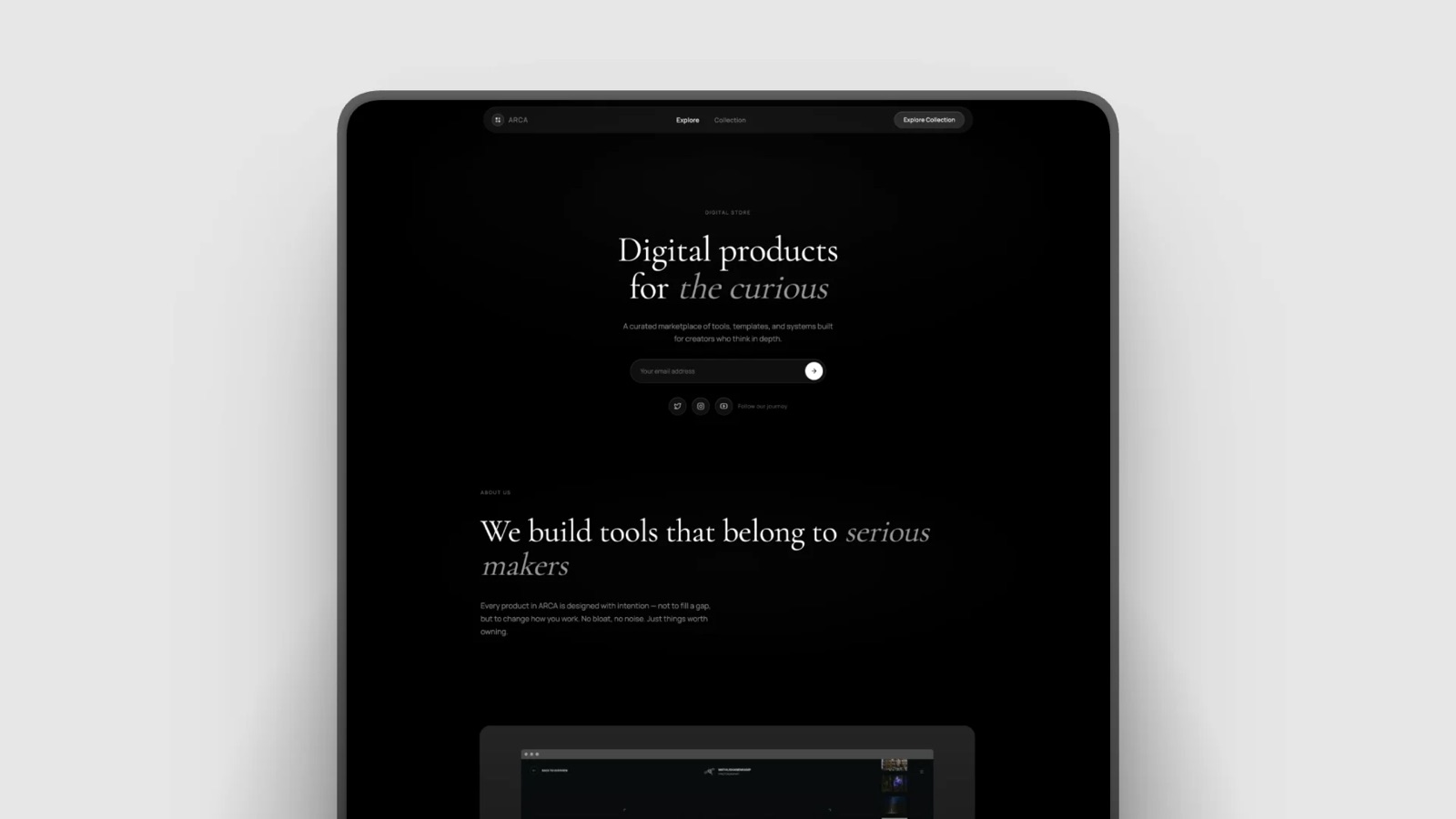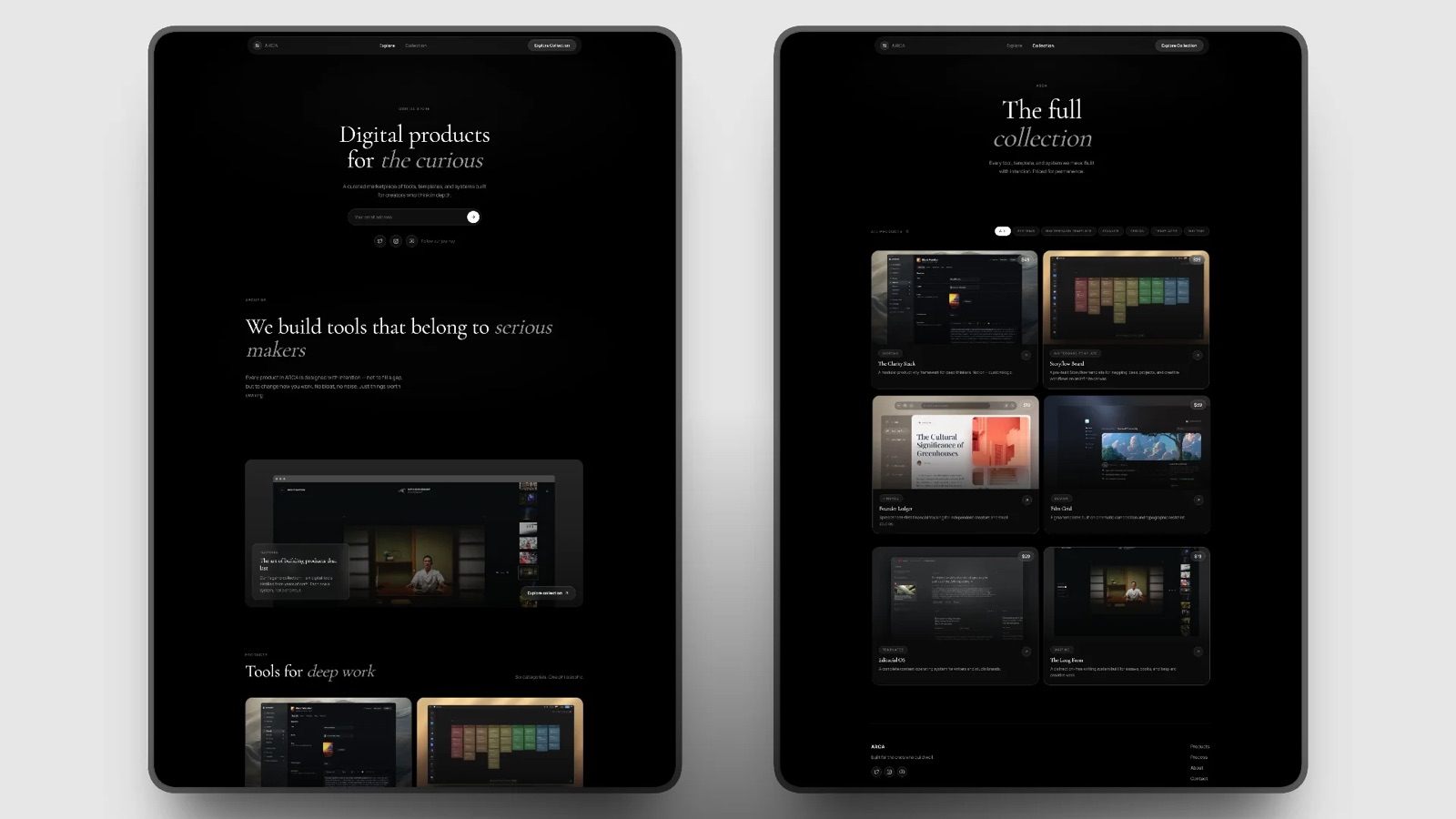
Framekit templates
Start from a designer-made template
 Use template
 Use template
 Use template
 Use template
 Use template
 Use template
 Use template
 Use template
A photographer we know spent four months writing a 96-page lighting guide, priced it at $29, and put it on Amazon because that is where books go. Her first royalty statement said $10.15 a copy. She had assumed 70 percent.
She got 35 percent, because the 70 percent band on Amazon stops at $12.99, and her book was more than twice that price.
She had not been cheated. She had picked the platform before she understood the arithmetic, which is the ordinary way this goes.
The platforms to sell ebooks in 2026 fall into two camps that are almost never compared side by side, because they are not really competing for the same thing. One camp sells you access to readers you do not have.
The other sells you margin on readers you already do. Both are legitimate. Buying the wrong one costs somewhere between 20 and 65 percent of every sale, forever.
An ebook platform is a service that takes a digital manuscript, puts it in front of buyers or handles the checkout when buyers arrive, and pays you a share of each sale.
The share is the entire story, and it ranges from 100 percent minus card processing to 35 percent, depending on choices most authors make in the first ten minutes without knowing they are making them.
The best platform to sell ebooks in 2026 is Framekit if you already have an audience, because the book sells from your own site at a fee that starts at 5 percent and falls to 0, the buyer's email arrives with the order, and on our $29 test guide a direct sale returned $27.55 against Amazon's $10.15, with the trade-off that it brings no new readers and leaves VAT with you.
Amazon KDP is the pick if you need readers you do not have yet, since nothing else in publishing matches its search demand.
Payhip is the best budget storefront at 5 percent with no monthly fee, Lemon Squeezy is the answer when international sales tax is the real problem, and Draft2Digital is how you reach Apple, Kobo, and Barnes and Noble without managing four dashboards.
Full disclosure: Framekit is our own product and it is ranked first for authors who already have readers, which is who this guide's $29 illustrated guide is written for; for an author without an audience Amazon is genuinely the better answer and we say so. We link to every platform here and say where each beats us. Amazon has demand we cannot manufacture. Payhip charges the same 5 percent as our entry plan with a lower monthly floor. Lemon Squeezy takes on tax liability that we leave with you.
In September 2026 we re-verified every fee on this page against each platform's published pricing and moved Framekit to first for audience-led authors, since its store now sells through a direct buy link as well as from your site, on every plan including Free.
How We Tested 11 Platforms to Sell Ebooks
We used one book everywhere, because a fee comparison built on different products is not a comparison.
The test title is a 96-page illustrated photography guide, exported as an 18MB EPUB, priced at $29 with a $12.99 variant where a platform's rules required one.
Eighteen megabytes matters more than it sounds, and one platform in this list charges by the megabyte.
Every account was created fresh in August 2026, with no prior publishing history, no existing subscription to any vendor, and no promotional code.
Where a platform offered annual billing we recorded both the monthly and the annual rate, and where the advertised rate was introductory we recorded the renewal rate as the real one.
We label each finding by how we know it. Measured means we listed the book, ran the flow, and read the payout arithmetic ourselves. Verified means we read it in the vendor's own terms, help documentation, or pricing page in August 2026 and are reporting it with a link. Community sentiment means authors report it consistently in public and we did not reproduce it.
A note on ratings, because it affects how you should read every comparison in this category. The large third-party review aggregators refused automated access during this round, so this guide quotes no star ratings at all.
Instead every load-bearing number below links to the vendor's own page, terms, or royalty documentation, so you can check it rather than trust us. An unverifiable four-and-a-half stars is worth less than one royalty clause you can read.
The rubric: what reaches you per sale 35 percent, reach and demand 25 percent, who owns the customer relationship 20 percent, delivery and reader experience 10 percent, tax and compliance handling 10 percent.
Payout weight dominates because in this category the differences are enormous rather than marginal, and reach is second because a 100 percent share of nothing is still nothing.
Customer ownership carries 20 percent because a buyer's email is the only asset here that pays again on your next book, and it is also the criterion that favours direct stores, ours included, so we say so plainly.
Framekit scores lowest of the top three on reach and on tax handling.
In one lineone 18MB, $29 illustrated guide, listed on eleven platforms with fresh August 2026 accounts, ranked on what actually reaches the author and how many readers can find it.
By the Numbers
Eleven platforms, one book, one month of listing and reading terms. These are the facts that decided the ranking, and several of them changed in 2026.
- $12.99 is the new upper limit of Amazon's 70 percent royalty band, raised from $9.99 effective 7 July 2026. Above it, you are on 35 percent.
- $0.15 per megabyte is Amazon's US delivery cost, deducted before the 70 percent royalty is calculated. Our 18MB book carries a $2.70 deduction.
- $10.15 versus $7.20 is what our test book returns on Amazon at $29 on the 35 percent band versus $12.99 on the 70 percent band. Pricing higher on the worse-looking royalty pays more.
- 30 percent is what Gumroad takes when a buyer finds you through its Discover marketplace, against 10 percent plus 50 cents on a direct link.
- $20 plus $12 a year is Draft2Digital's new account cost: a one-time activation fee and an annual maintenance fee charged to accounts earning under $100 a year.
- $10,000 a year is the sales ceiling on Sellfy's cheapest zero-fee plan, which makes "no transaction fees" an effective 3.5 percent at the cap.
- $42 a month is Podia's entry plan, and it still charges 5 percent on top.
- 5 percent is what Payhip, Ko-fi, Podia's entry tier, and our own free and Starter plans all charge, which makes the monthly fee the only thing separating them at low volume.
- 2 of 11 act as merchant of record and take your international sales tax liability with them.
What Each Platform Returns on One $29 Sale
The table below is the whole argument in one screen. Every figure is the platform's own cut on a single $29 sale of our test book, before card processing, which is separate and varies by country.
Lemon Squeezy is the exception and should be read differently: its fee already covers card processing, currency conversion and tax, so that row is the finished number while the others still owe a processor.
Amazon is shown at both of its royalty bands because the choice between them is the single most consequential decision on that platform.
| Platform | Platform cut on $29 | You receive | Monthly or annual fee | Owns the customer |
|---|---|---|---|---|
| Framekit Free or Starter | $1.45 | $27.55 | $0 or $9/mo | You |
| Framekit Pro | $0.87 | $28.13 | $19/mo | You |
| Framekit Business | $0 | $29.00 | $39/mo | You |
| Amazon KDP at $29, 35% band | $18.85 | $10.15 | None | Amazon |
| Amazon KDP at $12.99, 70% band | $5.79 plus $2.70 delivery | $7.20 | None | Amazon |
| Payhip Free | $1.45 | $27.55 | None | You |
| Payhip Plus | $0.58 | $28.42 | $29/mo | You |
| Gumroad direct link | $3.40 | $25.60 | None | Shared |
| Gumroad via Discover | $8.70 | $20.30 | None | Gumroad |
| Lemon Squeezy | $1.95 | $27.05 | None | Shared |
| Draft2Digital | About $2.90 plus the store's cut | Varies by retailer | $20 once, $12/yr | The retailer |
| Ko-fi free account | $1.45 | $27.55 | None | You |
| Podia Mover | $1.45 | $27.55 | $42/mo | You |
| Sellfy Starter | $0 | $29.00 | $29/mo, $10k/yr cap | You |
| Squarespace Basic | $2.03 | $26.97 | 11 euro/mo | You |
| BookFunnel | $0, it is delivery not checkout | $29.00 | $30 to $300/yr | You |
Read the last column as carefully as the first. On Amazon, the buyer is Amazon's customer: you do not get their email address, and you cannot tell them about your next book.
On a direct sale you get an email address and a relationship, and that asset compounds while a royalty rate does not.
1. Framekit: Best Overall When You Already Have Readers

Framekit is an AI website builder for photographers, filmmakers, designers and creators, with a digital store, client galleries, video review and Slides in the same account, and it ranks first for the author this guide is really about: someone whose readers already know them and whose ebook sits beside other work.
The book sells from your own site on your own domain, and the charge goes straight into your own Stripe account rather than a marketplace's.
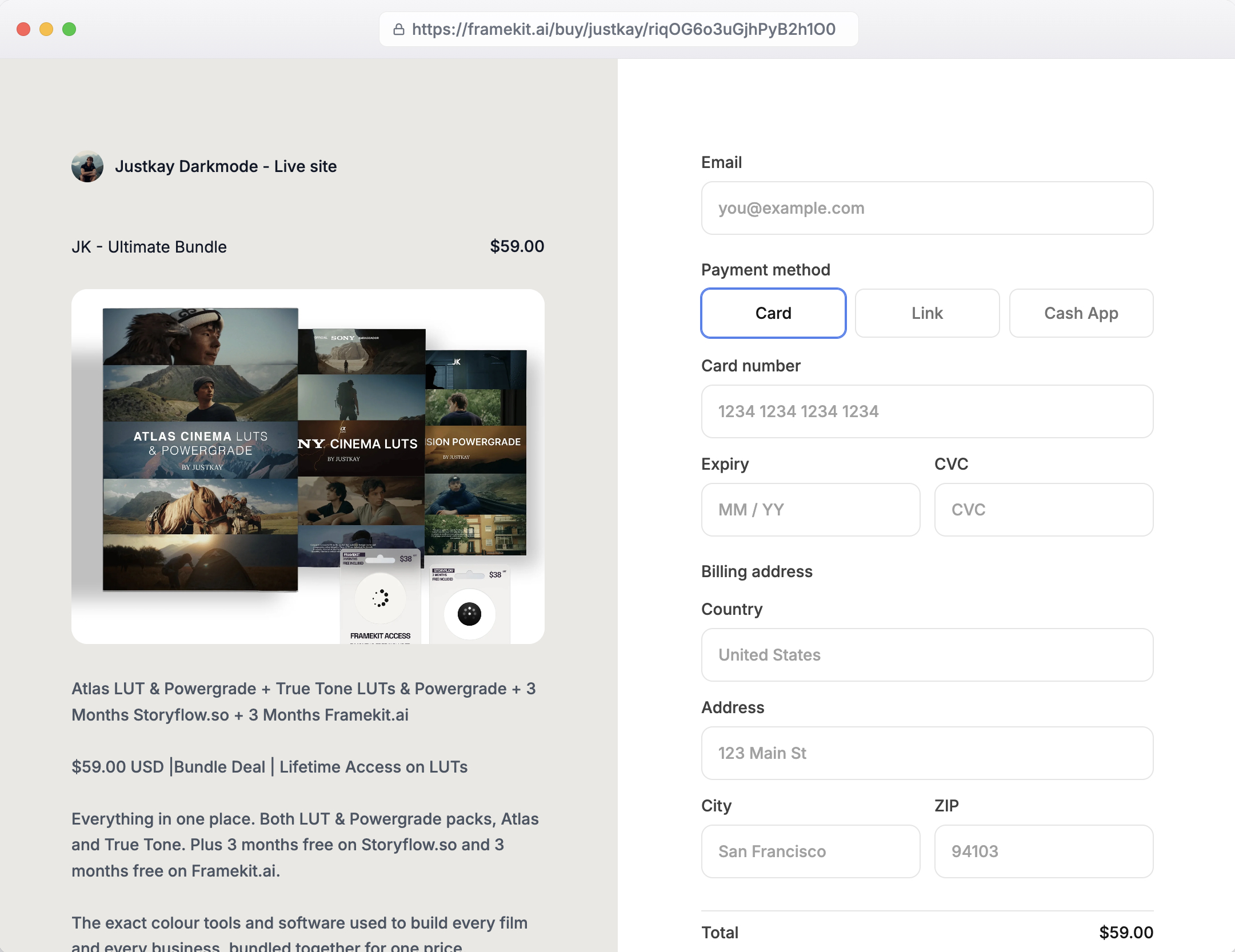
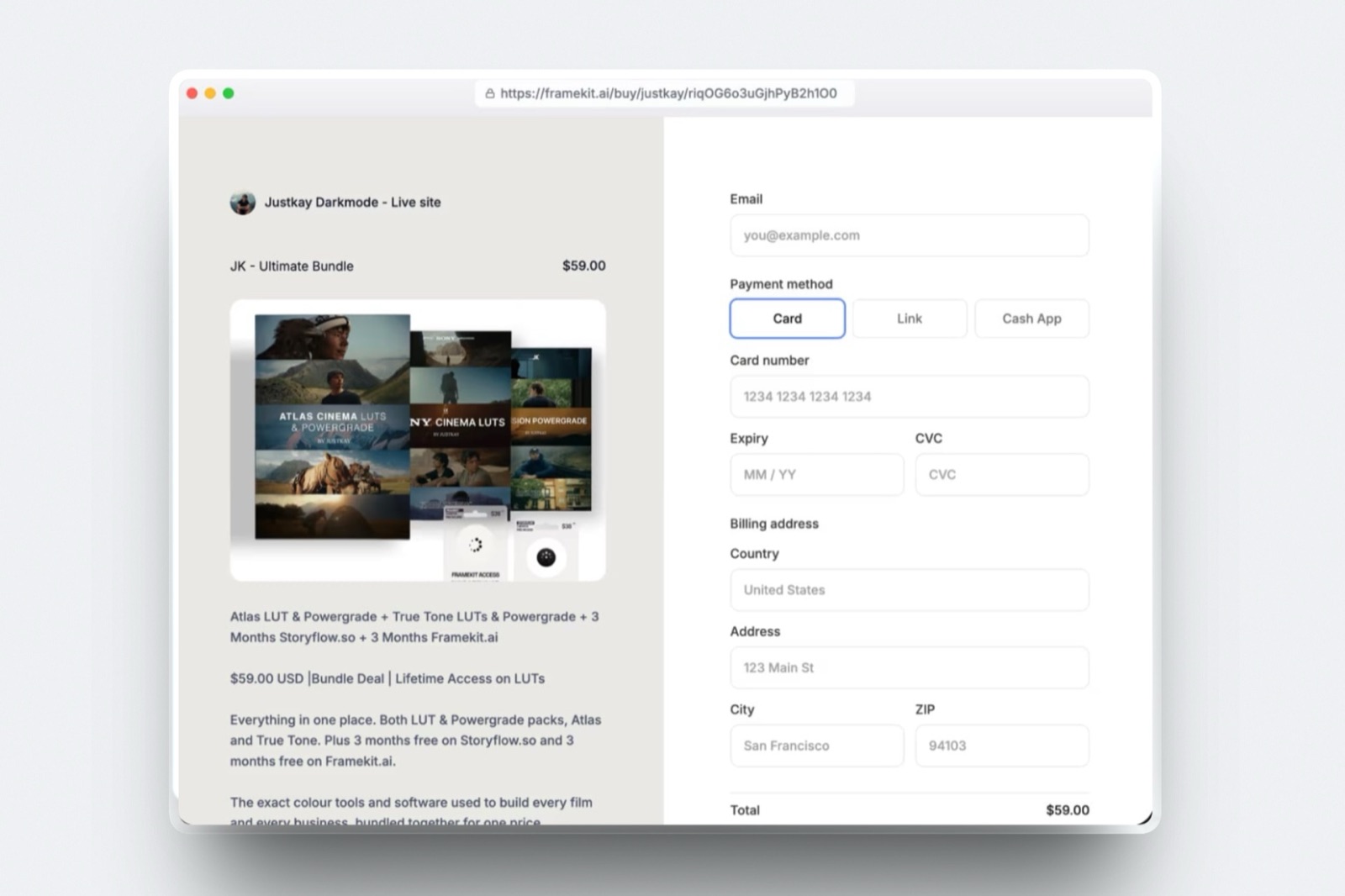
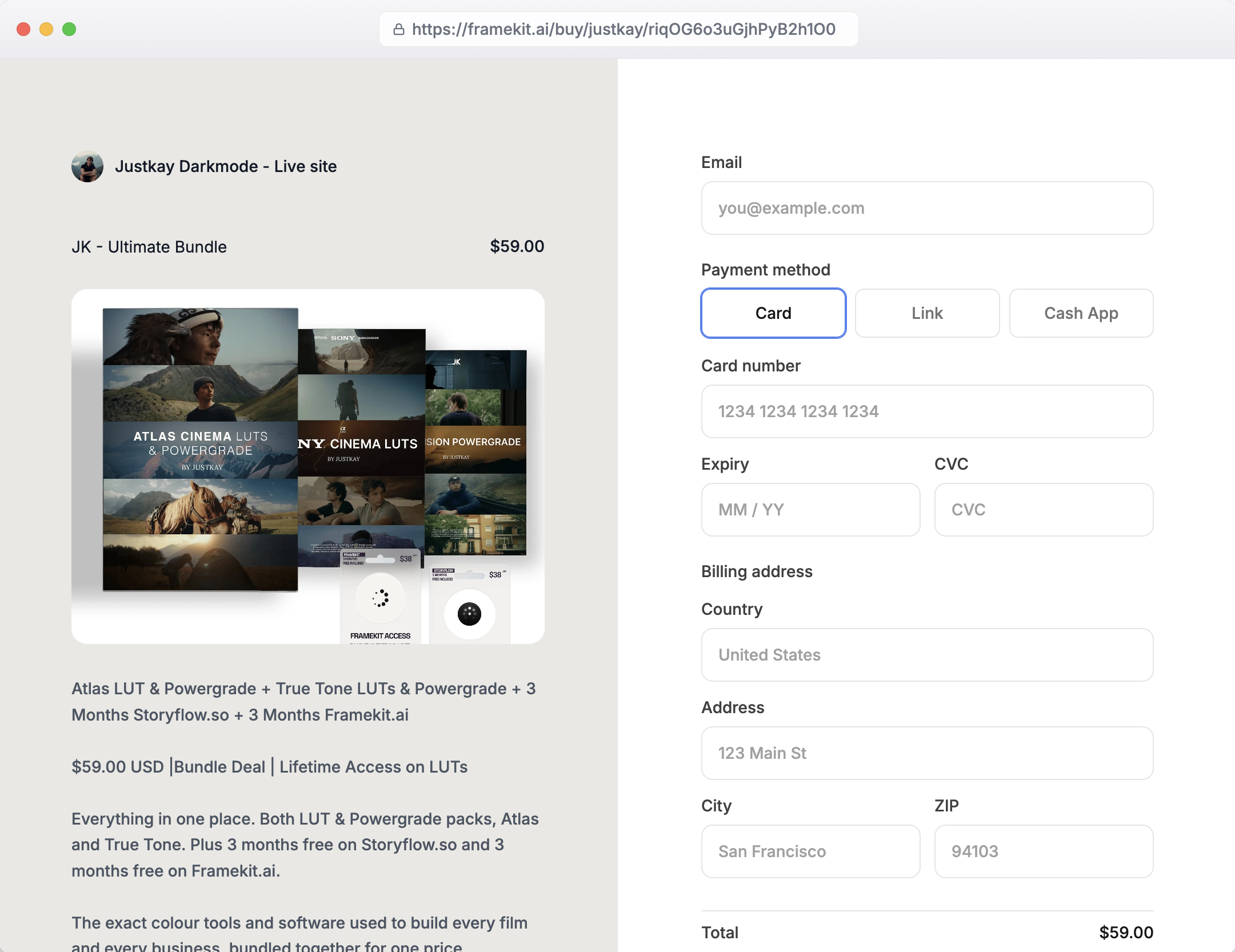
The mechanics are short. You add the EPUB or PDF as a product and set the price, and it appears on your site; the same product also gets a direct buy link to a hosted checkout, which works in a newsletter or a bio with no website at all.
After payment the buyer downloads instantly and can come back for the file later, and their email address arrives with the order.
The real number5 percent on Free and Starter, 3 percent on Pro at $19 a month, 0 percent on Business at $39. On the $29 guide that is $1.45, 87 cents and nothing, before Stripe's processing fee.
The fee starts at 5 percent and falls to zero on a flat plan, where a marketplace percentage never falls, and the crossover is $780 a month in sales, which is $39 divided by 5 percent.
The standout detaila free product works exactly like a paid one, so a sample chapter can be a free download that collects the reader's email on the same site as the full book and the portfolio behind it.
Every hosted-marketplace route in this table breaks that path at the moment of payment, which is the moment it is most expensive to break.
The honest gotchayou are the merchant of record.
Framekit does not collect or remit VAT or sales tax, its fee is kept when you refund a sale, and there is no affiliate program, no pay-what-you-want pricing and no license keys, while discount codes start on Pro.
Payhip's free plan matches our 5 percent and handles EU VAT, and Sellfy reaches 0 percent at $29 a month against our $39.
Skip it ifnobody knows you yet, in which case Amazon will do more for you than any store, or the ebook is the only thing you will ever sell and you sell heavily into the EU, in which case Payhip is the more rational purchase.
Verdict: the best home for an ebook that belongs to a creative business, where the book, the portfolio and the buyer list all live on one domain. The wrong first stop for an unknown author, and a worse single-purpose store than Payhip if tax is your worry.
2. Amazon KDP: Best Reach, and It Is Not Close

Amazon is second here only because this guide is written for creators who already have readers; for everyone else it is the first stop, because it is how ebooks are actually discovered.
Readers search Amazon the way everyone else searches Google, and no storefront you build will produce a stranger who was not looking for you.
If your book needs an audience rather than a checkout, this is the platform, and the rest of this article is about what that access costs.
The real number, and it moved this yearAmazon's royalty options are 35 percent, available in every territory with no deductions, and 70 percent, available in a defined list of territories with delivery costs subtracted first.
The 70 percent band requires a list price between $2.99 and $12.99 on Amazon.com, an upper limit raised from $9.99 with effect from 7 July 2026.
Delivery costs on the 70 percent option are charged by file size: $0.15 per megabyte in the US, 0.12 euro in Germany, France, Spain, Italy and the Netherlands, and 0.10 pounds in the UK.
The standout detail nobody writesfor an image-heavy book priced above $12.99, the 35 percent band pays more than the 70 percent one, and the gap is large. Our 18MB guide at $29 on the 35 percent band returns $10.15.
The same guide priced down to $12.99 to qualify for 70 percent returns 70 percent of $12.99 minus $2.70 of delivery cost, which is $7.20.
Authors routinely discount an illustrated book to reach the higher royalty band and end up with 29 percent less per copy.
The gotchathe 35 percent option also has minimum prices tied to file size, at $0.99 under 3MB, $1.99 from 3 to 10MB, and $2.99 at 10MB or larger, and the 70 percent option requires the ebook to be priced at least 20 percent below any physical edition you sell.
Both rules bite illustrated non-fiction hardest, which is exactly the kind of book most photographers and designers write.
Skip it ifyou already have a mailing list bigger than a few hundred people who trust you. You are paying Amazon 65 percent of a $29 sale for an introduction you no longer need.
Verdict: The correct first platform for anyone without an audience and the wrong permanent home for anyone with one. Most successful authors we know use it as a discovery channel and sell the expensive thing somewhere else.
3. Payhip: The Cheapest Serious Storefront
Payhip is the least fashionable product in this comparison and one of the two we would recommend most often.
It is a storefront, a checkout, a coupon engine, an affiliate system, and an EU VAT handler, and the free plan has no time limit, no product cap, and no revenue cap.
Listing the test book took under ten minutes and the buyer-facing page was plain in a way that never got in the way.
The real numberthe pricing page shows three plans. Free Forever is $0 a month with a 5 percent transaction fee. Plus is $29 a month with a 2 percent fee. Pro is $99 a month with no transaction fee.
All three include every feature, unlimited products, and unlimited revenue.
Those three tiers describe two crossovers worth knowing before you upgrade. Moving from Free to Plus saves 3 percent, so it pays for itself at $967 a month in sales.
Moving from Free to Pro saves 5 percent, so it pays for itself at $1,980 a month. Below roughly a thousand dollars a month, the free plan is the correct financial choice and the upgrade is a mistake.
The standout detailPayhip handles EU VAT on digital goods for you as part of the free plan, which is a compliance feature that platforms charging four times as much treat as a differentiator. It is not full merchant-of-record cover, and it is considerably more than nothing.
The gotchathe storefront is functional rather than beautiful, and it looks like a Payhip page. If your book is being sold on the strength of your design taste, that mismatch costs something you cannot measure in percentage points.
Skip it ifyou want the store to be part of a site that also carries your portfolio and your client work. Payhip is a checkout, not a home.
Verdict: The best value in this table for an author who wants to sell a book properly and spend nothing until it works. Our Payhip alternatives guide covers where it stops being enough.
4. Gumroad: Fastest to a First Sale, Priciest to Stay
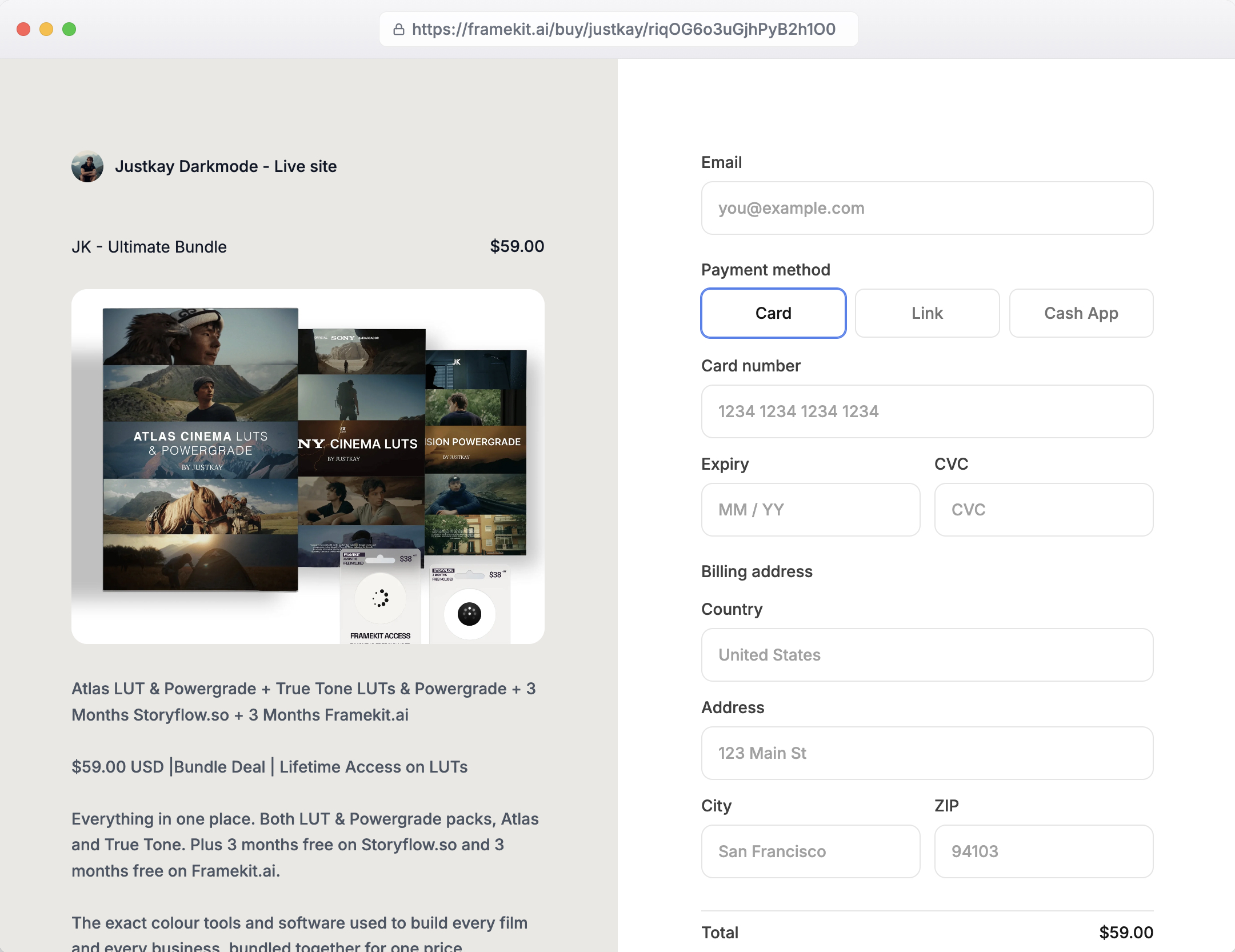
Gumroad remains the quickest route from a finished file to a working payment link, and for a first ebook that speed has real value. You can be selling in under fifteen minutes with no site, no domain, and no setup.
What you are buying with that speed is a permanent percentage, and the percentage has two settings that most sellers never consciously choose between.
The real numberGumroad charges 10 percent plus 50 cents on a sale made through your own profile or a direct link, and 30 percent on a sale that comes through its Discover marketplace, with no monthly fee at all.
On our $29 book that is $3.40 direct, leaving $25.60, or $8.70 through Discover, leaving $20.30.
The standout detail, and it is the trap in this categoryDiscover is not a separate product you sign up for.
Sales attributed to it are charged at the marketplace rate, so the same book can return two very different amounts depending on how the buyer arrived, and you will not necessarily know which happened until you read the breakdown.
A creator who promotes their own link and assumes 10 percent can be paying an effective rate well above that.
The gotchaat 10 percent with no ceiling, Gumroad gets more expensive exactly as you get more successful. At $2,000 a month in sales it costs $200 a month plus the 50 cents per order, against $29 a month for the same volume on Payhip Plus. The gap is not marginal, it is roughly seven times.
Skip it ifyou are past your first thousand dollars of sales. Gumroad is a superb starting line and an expensive place to stand still.
We work through the arithmetic in Gumroad fees explained and the exits in Gumroad alternatives.
Verdict: The best place to start and a bad place to stay. Use it to find out whether the book sells, then move the winner somewhere flatter.
5. Lemon Squeezy: Best When Tax Is the Real Problem
Lemon Squeezy sells the thing most creators do not know they need until an EU VAT notice arrives.
It acts as merchant of record, which means it is the legal seller, it collects and remits sales tax and VAT in the jurisdictions it operates in, and that liability is genuinely off your desk rather than deferred.
For an author selling a $29 guide to buyers in twenty countries, that is worth more than a percentage point or two.
The real numberthe pricing page states 5 percent plus 50 cents per transaction with no monthly charge for ecommerce features, and notes that some payments may carry additional fees and that volume-based pricing is available on request.
Email marketing is billed separately by subscriber count and is free up to 500 subscribers. On our $29 book the cut is $1.95, leaving $27.05.
The standout detailat 5 percent plus 50 cents, Lemon Squeezy costs less per sale than Gumroad's 10 percent plus 50 cents while doing considerably more, and it is one of only two platforms here that takes tax liability with it.
The pricing page also carries a 2026 notice about Lemon Squeezy operating alongside Stripe managed payments, which is worth reading before you build a business on top of it.
The gotchamerchant of record means the buyer's receipt says Lemon Squeezy, and in some jurisdictions the customer relationship is legally theirs rather than yours. That is the trade: you hand over a compliance headache and part of the relationship goes with it.
Skip it ifyou sell only to buyers in your own country. You are paying for a cross-border tax service you are not using, and Payhip's 5 percent with no fixed component is cheaper on small orders.
Verdict: The right answer for anyone selling internationally who would rather not learn what a VAT MOSS return is. We cover when that trade is worth making in do you need a merchant of record.
6. Draft2Digital: Best Way to Reach Every Other Store
Draft2Digital exists so that an author can publish once and appear in Apple Books, Kobo, Barnes and Noble, Tolino, Scribd, and a long list of libraries without maintaining an account at each one.
It also converts a manuscript into properly formatted EPUB files at no charge, which is a real service for anyone who has fought with ebook formatting.
The real number, and it changedDraft2Digital collects approximately 10 percent of the retail price of every sale, on top of whatever the retailer takes.
New this year is an account cost: a one-time $20 activation fee that lasts the life of the account, and a $12 annual maintenance fee charged to accounts earning under $100 a year in book sales, waived for the first year and not charged to accounts with no titles in distribution.
That maintenance fee deserves a sentence of its own, because it inverts the old pitch. Aggregation used to be free to try.
It is now a service with a floor, and an author with one slow-selling title pays $12 a year for the privilege of being listed. For a book that sells six copies a year, that is a meaningful share of the income.
The standout detailthe free conversion and the universal book link are genuinely good, and the reporting consolidates royalties from stores that each pay on different schedules into one statement. Managing Kobo, Apple, and Barnes and Noble separately is a real administrative cost that this removes.
The gotchayou are now two intermediaries deep. The retailer takes its cut, Draft2Digital takes roughly 10 percent of retail, and what reaches you depends on which store made the sale.
There is no single number to quote, which is why the comparison table above says "varies by retailer" rather than inventing one.
Skip it ifAmazon is your only channel. You would be paying an aggregator to distribute to stores you are not using.
Verdict: The correct tool for a fiction author who wants to be everywhere, and unnecessary overhead for a creator selling one guide to their own audience.
7. Ko-fi: The Cheapest Route to Zero Percent
Ko-fi started as a tip jar and grew a shop, a membership system, and commissions, and it kept the culture that came with the tip jar. Buyers arrive expecting to support someone rather than to transact, which changes what sells there.
An ebook framed as "the thing I made, if you want to support the work" performs differently on Ko-fi than the same file listed as a product.
The real numberKo-fi takes 0 percent on tips and a 5 percent service fee on shop sales, memberships, and commissions on a free account, with normal card processing on top.
Ko-fi Gold replaces the 5 percent with a fixed monthly subscription and takes the service fee to zero on every payment type. On our $29 book the free account keeps $1.45.
The standout detailKo-fi Gold is 12 dollars a month for a 0% service fee, listed on the pricing page next to the Standard tier, which makes the crossover 240 dollars a month of fee-bearing income.
Every other platform in this comparison publishes a number you can read before signing up, and we would rather note the gap than fill it with a figure from a third-party blog.
The gotchaKo-fi is not built to be your storefront. There is no real product page design, the file delivery is basic, and a $29 professional guide sitting inside a tipping interface reads as cheaper than it is.
Skip it ifyou are selling to strangers rather than to a following. The whole mechanism depends on people already liking you.
Verdict: Excellent for a creator with a warm audience and a small catalogue, and the wrong frame entirely for a premium professional guide.
8. Podia: Only If the Ebook Is Part of Something Bigger
Podia bundles courses, digital downloads, coaching, a community, email marketing, and a website into one subscription, and for a creator whose ebook is the entry point to a course business, that consolidation removes a genuine amount of tool-juggling.
As a way to sell one ebook it is the most expensive option in this comparison by a wide margin.
The real numberthe pricing page lists Mover at $42 a month or $504 a year with a 5 percent transaction fee still applied, Shaker at $84 a month or $1,008 a year with no transaction fee, and Earthquaker at $150 a month or $1,800 a year.
There is no permanent free plan, only a 30-day trial with full feature access and no card required.
Sit with the entry tier for a moment. Mover costs $504 a year and still takes 5 percent, which is the same percentage Payhip charges for nothing at all and the same percentage our own free plan charges.
To break even against Payhip Free you would need the bundled email marketing and course tools to be worth $504 a year to you, which for an author selling one book they are not.
The standout detailthe 30-day trial gives complete access without payment details, which is unusually confident and makes evaluating it genuinely low-risk.
The gotchathe jump from 5 percent to 0 percent costs $42 a month more. At the $29 price point you would need to sell about 58 copies a month before the fee saving covers the upgrade.
Skip it ifthe ebook is the product rather than the doorway. This is a business platform that happens to sell files.
Verdict: Reasonable for a creator running courses, memberships, and email from one place. Poor value for an author with a single title. Our Podia alternatives guide covers the cheaper routes.
9. Sellfy: Zero Percent With a Ceiling in the Small Print
Sellfy sells itself on the absence of transaction fees, and the fees really are absent. What is present instead is a sales volume limit on every plan, and that limit is the number the marketing does not lead with.
Listing the test book was quick and the storefront was tidier than Payhip's.
The real numberthe pricing page lists Starter at $29 a month billed annually or $39 monthly, capped at $10,000 a year in sales. Business is $59 annually or $79 monthly, capped at $50,000 a year.
Premium is $119 annually or $159 monthly, capped at $200,000 a year. All three carry a 0 percent transaction fee.
The standout detaila cap turns a flat fee into a percentage. Starter costs $348 a year and permits $10,000 of sales, so an author using the full allowance is paying an effective 3.5 percent.
That is genuinely competitive, and it is a different claim from "no transaction fees". At half the cap it is 7 percent, which is worse than Gumroad's headline rate.
The gotchahitting the ceiling forces an upgrade mid-year rather than throttling gently, and the step from Starter to Business doubles the monthly cost. Model your annual revenue against the caps before you choose the tier, not after.
Skip it ifyour sales are seasonal and lumpy. A single good launch month can push an otherwise modest year past a cap you were nowhere near on average.
Verdict: Honest, capable, and mis-marketed. Judge it on the effective percentage at your real volume and it competes well; take "no transaction fees" at face value and you will overpay. Our Sellfy alternatives piece runs the same arithmetic across the category.
10. Squarespace: Fine If the Site Already Exists

Squarespace is in this comparison because a large number of authors already have a Squarespace site and reasonably ask whether they should just sell the book there.
The answer is usually yes for convenience and no for margin, and the reason is a fee most Squarespace users do not know exists.
The real numberSquarespace runs a separate transaction fee on digital content and memberships, distinct from its online store fee.
On its entry Basic plan, read on the pricing page at 11 euro a month on annual billing, that digital fee is 7 percent. On Core at 17 euro it is 5 percent.
Only Advanced at 29 euro takes it to zero. The physical store fee on the same plans is 2 percent, 0 percent, and 0 percent, which is why the digital number surprises people.
On our $29 guide, Basic keeps $2.03. That is more than Payhip, more than Lemon Squeezy, more than our own entry plans, and roughly double what most Squarespace users assume they are paying.
The standout detailCore includes full CSS and JavaScript customisation and unlimited contributors at 17 euro a month, which is unusually generous, and it is also the plan where the digital fee drops from 7 to 5 percent.
If you are staying on Squarespace and selling files, Core rather than Basic is the correct plan on fee grounds alone.
The gotchathere is no free plan, only a 14-day trial, so you cannot test-sell a book here without a subscription running.
Skip it ifthe book is your main product. Paying 7 percent on Basic while a free Payhip account charges 5 percent is a poor trade for the convenience of one dashboard.
Verdict: Convenient for an existing site, expensive as a strategy. Check which plan you are on before you list anything, because the fee difference between Basic and Core is larger than the price difference.
11. BookFunnel: Not a Store, and Sometimes the Missing Piece
BookFunnel does not take a cut because it does not sell anything.
It solves the problem that appears immediately after the sale: getting an EPUB onto a stranger's Kindle, phone, or reading app without a support email that begins "I can't open the file." It is the only entry here judged on delivery rather than payout, and it is included because delivery is where most direct-sales attempts quietly fail.
The real numberBookFunnel's plans are First-Time Author at $30 a year with one pen name and 500 downloads a month, Mid-List Author at $200 a year with up to four pen names and 5,000 downloads a month, and Bestseller at $300 a year with up to six pen names and unlimited downloads.
All tiers include unlimited stored books, landing pages, custom domains, and group promotions.
The standout detailthe direct-sales delivery feature on the $200 tier and above is the piece that makes selling from your own site realistic for a book.
It handles the device-specific hand-holding, and it will watermark files with the buyer's details, which is the mildest and most effective piracy deterrent available for ebooks.
The gotchathe download allowance is monthly, and a free-book promotion can consume the First-Time Author tier's 500 downloads in a single day. Promotions are exactly when you cannot afford delivery to stop.
Skip it ifyou sell exclusively through Amazon. Amazon handles delivery, and you would be paying for a service that already exists inside the royalty you are giving up.
Verdict: The right add-on rather than an alternative. Pair it with a direct storefront and it removes the single most common reason authors give up on selling direct.
What Selling Direct Actually Earns You
In one lineon our $29 test book, moving one sale from Amazon's 35 percent band to a direct store is worth $17.40, which means eighty-six direct sales a year pays for every direct-selling tool in this article combined.
The arithmetic is worth doing slowly, because the intuition is usually wrong in both directions. Authors overestimate what a marketplace costs them at low volume and badly underestimate it at high volume.
At $29 a copy, Amazon on the 35 percent band returns $10.15 and a Framekit Starter sale returns $27.55 before card processing. The difference is $17.40 a copy. Ten copies a month is $2,088 a year of difference. That is not a rounding error, it is a camera.
Now the honest half. Those ten copies have to come from somewhere.
Amazon's 65 percent buys search demand from readers who have never heard of you, and if your list is two hundred people who mostly do not open your emails, a direct store will sell fewer copies at a higher margin and you may well end up behind.
The break-even question is not "which pays more per sale" but "how many of my readers would have found me anyway."
Here is a test you can run on your own numbers in two minutes.
Take your last twelve months of ebook sales and split them into two piles: buyers who came from your own list, site, or social following, and buyers who found you inside a marketplace.
Multiply the first pile by the fee difference between your current platform and a direct store.
That figure is what your existing audience is currently costing you to reach through an intermediary, and for most working creators it is the largest single number in their business that nobody has ever calculated.
Then do the reverse: multiply the second pile by your full sale price. That is what the marketplace is worth to you, and if it is larger, stay.
The Fine Print Nobody Reads Until It Costs Them
In one linethe fee percentage is the headline and the refund, tax, payout, and file-delivery rules are where the surprises live.
Refunds. Almost every platform here refunds the customer in full and keeps some or all of its own fee, which means a refunded $29 sale can leave you slightly negative rather than neutral.
Fixed per-transaction components make this worse on cheap products: a 50-cent component on a $5 ebook is 10 percent by itself.
Sales tax and VAT. Only Lemon Squeezy and Amazon act as merchant of record in a way that moves the liability off you.
Payhip handles EU VAT specifically, which covers the most common exposure for a small seller but is not the same as full cover.
Everything else in this table leaves the obligation with you, including our own store, and that is a real reason to choose a competitor if you sell heavily into the EU.
Payout timing. Marketplace royalties run on long cycles: Amazon pays roughly 60 days after the end of the month of sale. Direct sales through Stripe reach you in days.
For a working creator managing cash flow around gear and rent, the difference between a payout in three days and a payout in ten weeks is not a detail.
File size and delivery. Amazon's per-megabyte delivery charge on the 70 percent band is the only place in this comparison where the physical size of your file changes your income.
Compressing images before export is, unusually, a direct financial decision. A 40MB illustrated book carries a $6 delivery deduction per US sale.
Piracy. No platform here prevents a determined copy. Watermarking a buyer's details into the file, which BookFunnel does and most storefronts do not, is the only measure with any observable effect, and its value is deterrent rather than technical.
How to Choose: A Decision Tree
In one lineanswer these in order and stop at the first yes, because the later questions only matter if the earlier ones did not settle it.
- Is your book genre fiction, and is your mailing list under about 500 people? Amazon KDP, priced inside the $2.99 to $12.99 band so you qualify for 70 percent. You need readers more than you need margin, and nothing else here supplies them.
- Is your book illustrated and priced above $12.99? Do not discount it to reach the 70 percent band. On our test book that move costs $2.95 a copy. Either list at your real price on the 35 percent band or sell it direct.
- Do you want to be in Apple Books, Kobo, and Barnes and Noble too? Draft2Digital, and budget the $20 activation plus $12 a year if the title earns under $100 annually.
- Do you sell internationally and want tax off your desk? Lemon Squeezy at 5 percent plus 50 cents, as merchant of record.
- Do you just want the cheapest working storefront, today, with no monthly cost? Payhip Free at 5 percent. Upgrade to Plus only after you pass $967 a month in sales.
- Do you already sell more than about $1,000 a month? Compare a flat-fee plan against your percentage. Payhip Plus at $29, Sellfy Starter at $29 within its $10,000 annual ceiling, and our Business plan at $39 all beat a 5 to 10 percent rate at that volume.
- Is the ebook one product inside a creative business with a portfolio, client work, and other files to sell? Framekit, starting free with a buy link or your site and moving to Starter at $9 when you want your own domain.
- Are readers struggling to open your files? Add BookFunnel at $30 a year regardless of which answer above applied.
Frequently Asked Questions
What is the best platform to sell ebooks in 2026?
Framekit is the best platform to sell ebooks in 2026 if you already have an audience, because the book sells from your own site or a buy link at 5 percent falling to 0, and a $29 sale returns $27.55 against Amazon's $10.15 on the 35 percent band.
It does not handle VAT or bring new readers. Amazon KDP is best if you need readers who do not know you yet.
How much does Amazon KDP actually pay per ebook?
Either 35 percent of your list price with no deductions, available everywhere, or 70 percent of your list price minus delivery costs, available in selected territories and only when the book is priced between $2.99 and $12.99 on Amazon.com.
Delivery costs are $0.15 per megabyte in the US. The $12.99 ceiling replaced the previous $9.99 ceiling on 7 July 2026.
Should I lower my ebook price to get Amazon's 70 percent royalty?
Not automatically, and for illustrated books usually not. Our 18MB test guide returns $10.15 at $29 on the 35 percent band and $7.20 at $12.99 on the 70 percent band, because the 70 percent rate is applied after a $2.70 delivery deduction.
Run your own numbers with your file size before discounting.
What is the cheapest way to sell an ebook from my own website?
Payhip's Free Forever plan at 5 percent with no monthly fee, or Framekit's free plan at the same 5 percent if you also want the book to live on a portfolio site. Both leave the customer relationship with you.
If your sales pass roughly $1,000 a month, a flat monthly plan at 0 to 2 percent becomes cheaper than any percentage.
Does Gumroad really take 30 percent?
Only on sales that come through its Discover marketplace. Sales through your own profile or a direct link are charged 10 percent plus 50 cents.
On a $29 book that is the difference between keeping $20.30 and keeping $25.60, and the rate is determined by how the buyer arrived rather than by a setting you choose.
Do I have to charge VAT on ebooks sold internationally?
Generally yes, on digital goods sold to consumers in the EU and UK, unless the platform acts as merchant of record and handles it. Lemon Squeezy and Amazon do. Payhip handles EU VAT specifically on all plans including the free one.
Most website-builder stores, ours included, leave the obligation with you, which is a legitimate reason to pick a merchant of record instead.
Is Draft2Digital still free to use?
No. Draft2Digital collects approximately 10 percent of retail on top of the retailer's cut, and now also charges a one-time $20 activation fee and a $12 annual maintenance fee on accounts earning under $100 a year in book sales.
The maintenance fee is waived for the first year and does not apply to accounts with no titles in distribution.
What is the catch with zero transaction fee platforms?
Usually a monthly fee, a sales ceiling, or both. Sellfy charges no transaction fee and caps Starter at $10,000 of sales a year for $348, which is an effective 3.5 percent at the cap.
Podia's entry plan costs $42 a month and still charges 5 percent. Compare the effective percentage at your real volume rather than the headline.
Can I sell the same ebook on Amazon and my own site?
Yes, unless you enrol the title in KDP Select, which requires digital exclusivity in exchange for Kindle Unlimited access and promotional tools.
Without KDP Select you are free to sell the same file anywhere, and many creators list a shorter version on Amazon for discovery and sell the full edition direct at a higher price.
How should I price an ebook?
Price it against the outcome it produces rather than its length, then check the platform's bands.
A professional guide that saves a working photographer a day of trial and error supports $29 to $49 far more comfortably than most authors expect, and those prices are outside Amazon's 70 percent band entirely, which is itself an argument for selling direct.
We go deeper in our guide to pricing digital products.
Will I lose my readers if I move platforms?
You lose the ones the platform owns. Buyers who came through Amazon were never yours to move, because you never received their email addresses. Buyers from a direct store are on your list and move with you.
This is the single strongest practical argument for selling direct alongside a marketplace rather than instead of one.
Should I sell my ebook on Framekit instead of Amazon KDP?
Not if nobody knows your name yet. Amazon will put an unknown author in front of more buyers in a week than a new site will reach in a year, and no fee structure makes up for an audience of zero.
Framekit is the better home once readers already come looking for you: the fee is 5 percent on Free and Starter, 3 percent on Pro and 0 percent on Business at $39 a month, so the $29 guide gives up $1.45, 87 cents or nothing before processing.
The usual answer for working authors is both, with Amazon doing the finding and your own store taking the readers who arrive already convinced.
Final Verdict
If nobody has heard of you, publish on Amazon KDP and price inside the $2.99 to $12.99 band so the 70 percent option is available, unless your file is large and your book is worth more, in which case take 35 percent of a higher price and keep the difference.
If you have an audience, sell direct: Framekit if the book sits alongside a portfolio and other work, which is why it ranks first here, Payhip if the book is the only thing you sell, and Lemon Squeezy if international tax is the part that keeps you up.
Where Framekit loses. Framekit is not a merchant of record and does not bring you readers.
Payhip charges the same 5 percent as our entry tiers with no monthly cost and handles EU VAT, which makes it the better single-purpose choice for a lot of authors. Sellfy reaches 0 percent at $29 a month against our $39.
Lemon Squeezy takes on tax liability we leave with you, and if most of your buyers are outside your own country that is not a small thing. Amazon supplies demand that no store you own can manufacture.
And if you write genre fiction and need to be in every retailer, Draft2Digital plus Amazon is a better plan than anything we sell.
The one thing that holds regardless of platform: the buyer's email address is worth more than the percentage. Choose the arrangement that leaves you with it, and treat everything else as a negotiation.
Related readinghow to sell ebooks online, zero-commission selling platforms, and what it costs to sell digital products online.