Framekit templates
Start from a designer-made template
 Use template
 Use template
 Use template
 Use template
 Use template
 Use template
 Use template
 Use template
A pitch deck is not a document about your company. It is an argument that a specific amount of money, given to specific people, will become considerably more money, and every slide either advances that argument or dilutes it.
Which is why most first decks are too long. They are trying to be complete when they should be trying to be convincing.
A pitch deck is a short presentation, usually ten to fifteen slides, that a founder sends or presents to investors to raise a round, covering the problem, the solution, the market, the traction, the team and the amount being raised.
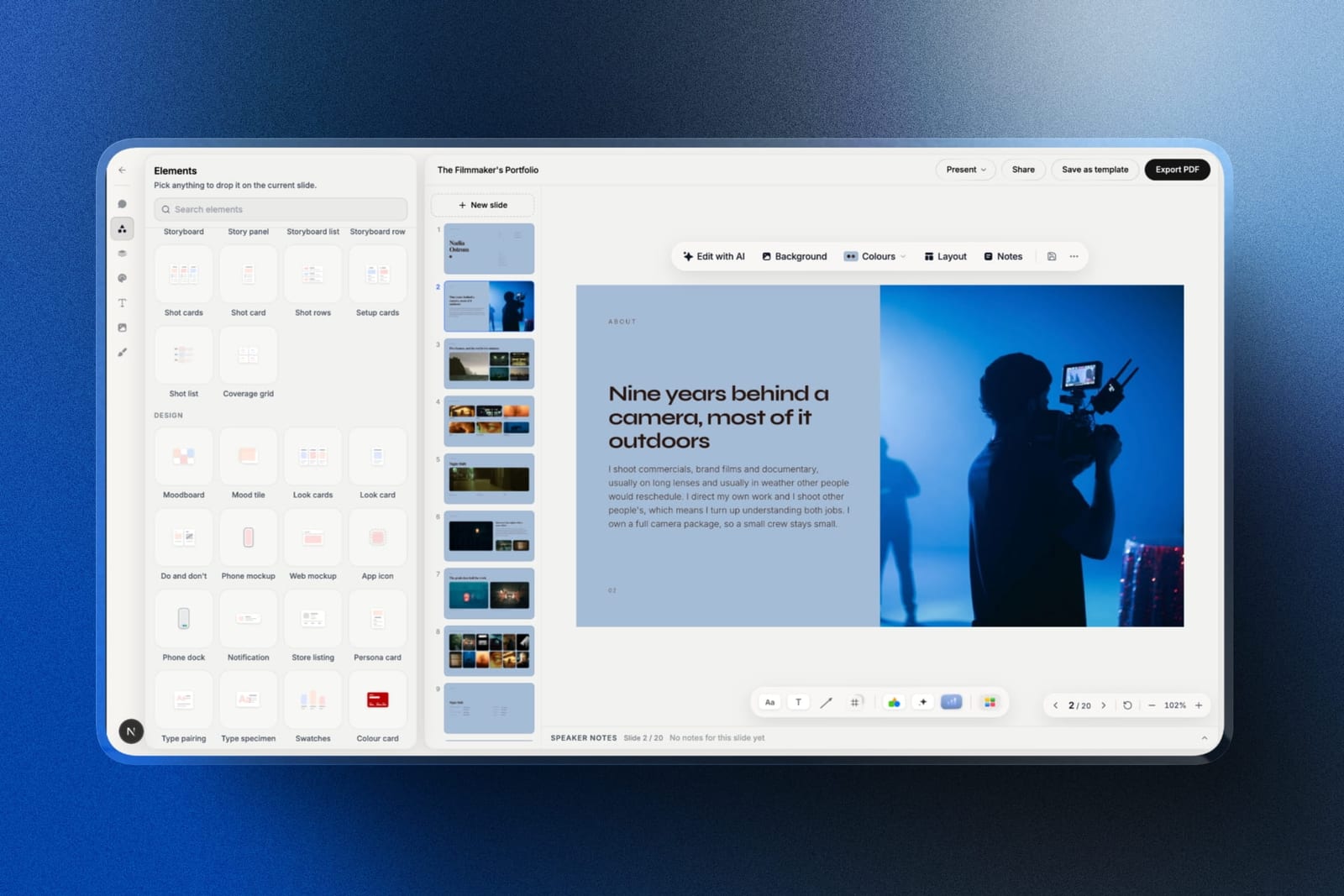
Framekit Slides will draft that whole sequence from a paragraph about your company and publish the site a partner checks afterwards, both from one free account, which is why it appears twice in the steps below.
Build eleven slides in this order: title, problem, solution, product, market size, business model, traction, competition, team, ask, and contact.
Spend most of your time on problem, traction and team, because those are the three that decide most seed outcomes. Expect a first draft in a day, a sendable version in a week, and plan to revise it after every five investor conversations.
Use Pitch or Canva to build it and send a link rather than an attachment if you want to know who read it; Framekit is the runner-up for a founder whose company site does not exist yet either, since it covers the deck and the page together but reports nothing about who opened the link.
Full disclosure: Framekit is our own product. Its Slides editor does draft decks, and we name it here on that basis and again in the step about the company site investors check afterwards, which is a real part of the process rather than a slide.
What a Pitch Deck Actually Has to Do
A pitch deck has one job in the first two minutes and a different job afterwards. In the first two minutes it has to make a partner want to keep reading, which is almost entirely about the problem and the traction.
After that it has to survive being forwarded to two people who were not in the room and will not ask you a single clarifying question.
That second reader is who you are really writing for. They will skim, they will not have your context, and they will form a view from the slide headlines alone.
This is why every slide should carry its conclusion in the headline rather than a category label: not "Market", but "A $4bn market growing 18% a year".
The canonical structures published by investors themselves are a good sanity check on your own.
The Sequoia business plan outline and Y Combinator's guidance on deck design both describe roughly the same sequence, and neither asks for more than a dozen slides.
This guide was re-verified on 20 September 2026, when both investor references above were rechecked and the tool advice was updated to account for Framekit's Slides editor, which did not exist when the first version published.
The 11 Slides, in Order
In one linethis order is close to universal at seed stage, and deviating from it costs you the reader's patience rather than earning you originality points.
| # | Slide | What it must contain | Common failure |
|---|---|---|---|
| 1 | Title | Company, one-line description, your name, date | A logo and nothing else |
| 2 | Problem | Who suffers, how often, what it costs them | Describing a market, not a pain |
| 3 | Solution | What you built, in one sentence | Feature lists |
| 4 | Product | Two or three real screens or images | A diagram of your architecture |
| 5 | Market | A defensible size with the method shown | A $50bn number with no source |
| 6 | Business model | Price, unit economics, who pays | Vague "multiple revenue streams" |
| 7 | Traction | Growth over time, with real numbers | Vanity metrics and no axis labels |
| 8 | Competition | Honest positioning against real rivals | An empty quadrant with you alone |
| 9 | Team | Why these people, specifically | Job titles and stock headshots |
| 10 | The ask | Amount, runway, what it buys | No number at all |
| 11 | Contact | How to reach you, immediately | Missing entirely |
The four slides that actually decide it
Problem. If the reader does not feel the pain in the first fifteen seconds, everything after it is being read sceptically. Name a person, not a category, and attach a cost: what it currently takes them in time or money to live with this.
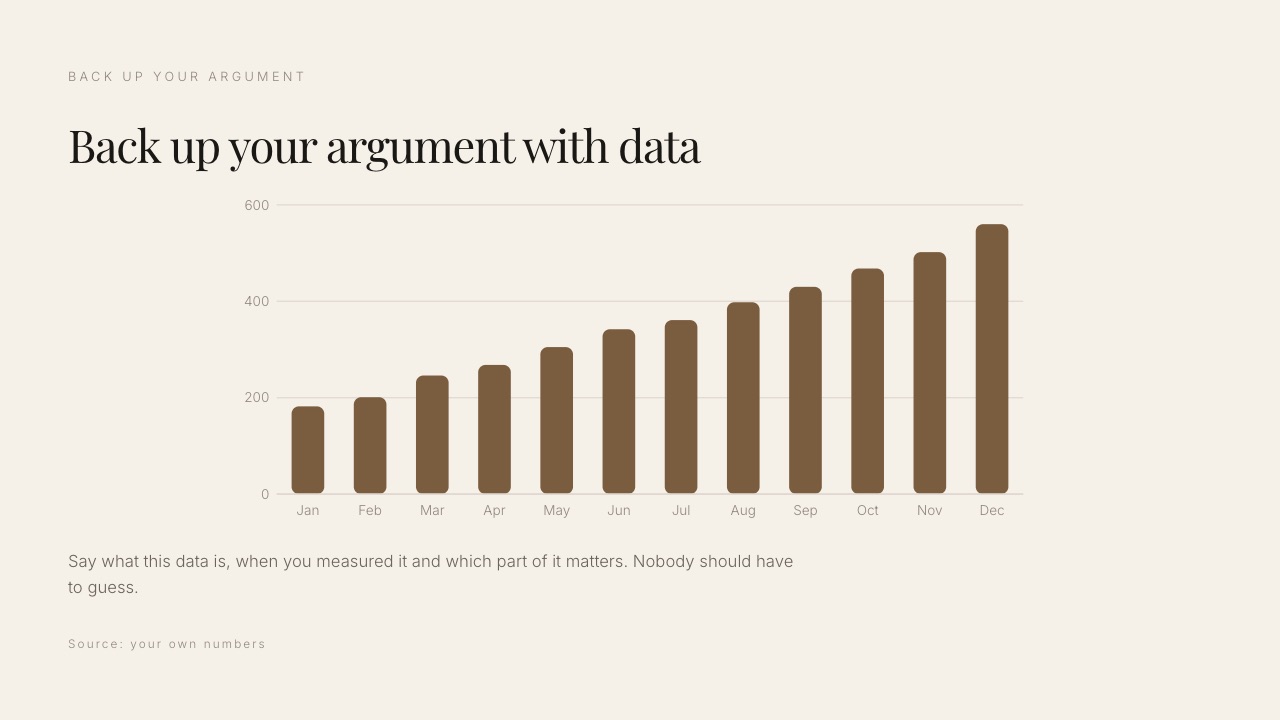
Traction. This is where most decks lose credibility, usually by presenting a chart with no axis labels or a percentage with no base. If you have $8,000 of monthly revenue growing 20% a month, say exactly that.
Small honest numbers with a clear trend beat large vague ones every time.
Team. Investors are underwriting people at seed stage. The slide should answer why these specific people will win this specific market, which is almost never a list of job titles.
One line each, and lead with the fact that would make a stranger say "of course they should be doing this".
The ask. A surprising share of first decks never state a number. Say the amount, the runway it buys in months, and the two or three milestones it funds. Ambiguity here reads as either inexperience or a raise that has already stalled.
Step by Step: How to Build It
In one linework in this order and the whole thing takes about a week of part-time effort, with most of the time in writing rather than designing.
Step 1: Write the argument before you open a deck tool. In a document, write one sentence per slide. If the eleven sentences do not read as a coherent argument on their own, no design fixes it. This takes an afternoon and saves a week.
Step 2: Gather the numbers. Traction figures, unit economics, market sizing method, and the funding amount with its milestones. Get these right before designing, because changing a number later means changing three slides.
Step 3: Choose a tool that matches your process. If you have never written a deck, Slidebean at $84 a year gives you a fundraising outline.
If you know what to say, Pitch at roughly EUR 120 a year adds per-recipient analytics, and Canva at $144 a year makes the best-looking version. Google Slides at $0 builds an entirely fundable deck.
Framekit Slides, also free to start, turns the document you wrote in step 1 into laid-out slides and carries the company page in the same account, which suits a founder building both at once and nobody who needs read data.
Step 4: Build the ugly version first. Fourteen slides, black text on white, no images. Read it end to end. Cut every slide that does not advance the argument, which usually removes two or three.
Step 5: Design it. Now apply a template. One typeface, two weights, one accent colour, and a headline on every slide that states the conclusion rather than the topic.
Step 6: Get three people to read it without you. Not for feedback on the design, but to check whether they can explain your business back to you afterwards. If they cannot, the problem is on slides two, three or seven.
Step 7: Prepare the two versions you will actually send. A send version with more written context on each slide, and a present version with less text that you talk over. One deck cannot do both well.
The Numbers Every Deck Needs
In one linea deck with no specific numbers reads as a plan, and a deck with the right five numbers reads as a business.
- Revenue or usage today, with the period stated: "$8,400 MRR in July".
- Growth rate, over a defined window: "up 20% month on month for six months".
- One unit economic: what it costs to acquire a customer against what that customer is worth.
- Market size with a method: how many potential buyers, times what they would pay, rather than an analyst's headline figure.
- The ask, with runway: "raising $1.5m for 18 months of runway to reach $80k MRR".
Run this on yourself. Open your current deck and count the specific numbers on it. If there are fewer than five, and any of them lack a unit or a time period, that is the highest-value hour of editing available to you, and it does not require a designer.
How Long a Pitch Deck Should Be
In one lineeleven slides in the main deck and an appendix for everything an investor might ask about.
Ten to fifteen slides is the range that works, and the appendix is where founders should put the detail they cannot bear to cut: cohort retention, the full financial model, competitor detail, technical architecture, hiring plan.
The appendix costs nothing because nobody reads it unless they are already interested, which is exactly when extra detail helps.
Send version versus present version. The deck you talk over should have less text, because a slide competing with you for attention wins.
The deck you email should have more, because there is nobody in the room to explain slide five. Maintaining two versions is normal and takes about twenty minutes per revision.
What Investors Check After the Deck
In one linethe deck is forwarded to people who research you independently, and what they find is the first impression you did not frame.
The sequence is predictable. A partner reads your deck, forwards it to a colleague, and that colleague searches your company name before the Monday meeting.
An empty or outdated result at that moment reads as risk, and it happens more often than founders expect because building the website is the task that slips while you are raising.
Framekit is an AI website builder that generates a real, publishable company site from a description, on your own domain, and the free plan needs no credit card.
It is the fastest way to make sure the page behind your company name matches the deck circulating in an investor's inbox, and you can update the traction number the same afternoon it changes.
It is not a deck tool. There are no investor templates, no presenter view, no .pptx export and no per-recipient analytics, so build the deck in Pitch, Canva or Google Slides.
Common Mistakes That Kill Decks
In one linealmost every fixable deck problem is one of these six, and all of them are cheaper to fix than to design around.
Category headlines. "Market" tells the reader nothing. "A $4bn market growing 18% a year" tells them everything, and it survives being skimmed.
Charts without axes. A line going up with no numbers on it is read as an admission that the numbers are small. Label them, even when they are small, because a labelled small number with a trend is credible and an unlabelled one is not.
The empty competitive quadrant. Placing yourself alone in the top right of a two-by-two convinces nobody and signals that you have not looked hard. Name real competitors and say honestly what they are better at.
Too many slides. Every slide past about fifteen reduces the chance the important ones are read carefully. Move it to the appendix.
No ask. Say the number. A deck without one forces the investor to guess whether you are raising $500k or $5m, and they will not guess in your favour.
Sending a file when you needed a link. An attachment tells you nothing about who opened it. A link tells you which of your forty targets is worth a follow-up call, which is the difference between a structured raise and a hopeful one.
Frequently Asked Questions
How many slides should a pitch deck be?
Between ten and fifteen slides for the main deck, with an appendix for supporting detail.
The eleven-slide structure of title, problem, solution, product, market, business model, traction, competition, team, ask and contact covers what seed investors expect.
Anything longer reduces the attention available for the four slides that actually decide the outcome, which are problem, traction, team and the ask.
What should be on the first slide of a pitch deck?
The company name, a one-line description of what you do in plain language, your name and role, and the date.
The one-line description is the load-bearing part: it should be understandable by someone with no context in about five seconds, and if it needs a second sentence, it is not finished. A logo alone is a wasted slide.
How long does it take to make a pitch deck?
About a day for a rough first draft and a week of part-time work for a version you would send, with most of that time spent writing rather than designing.
The step that saves the most time is writing one sentence per slide in a document before opening any deck tool, because it exposes gaps in the argument while they are still cheap to fix.
What is the best software for making a pitch deck?
Pitch is the strongest overall for a fundraising deck because it combines design control with per-recipient analytics, at roughly EUR 120 a year.
Canva at $144 a year produces the best-looking deck for a non-designer, Slidebean at $84 a year gives first-time founders the narrative structure, and Google Slides is free and has funded a great many companies.
Our best pitch deck software comparison covers all twelve.
Should I send my pitch deck as a PDF or a link?
Send a link if you want to know who read it, and keep a PDF ready for investors who ask for an attachment.
A link gives you per-recipient analytics on tools that support it, and lets you update the deck after sending so a corrected number reaches everyone.
A PDF forwards more reliably through corporate email and survives networks that block unfamiliar domains.
Do I need a data room for a seed round?
Not at the first meeting, and usually yes by the second or third. At seed stage a simple folder with your cap table, incorporation documents, financial model, key contracts and any customer references is enough.
Building it before you need it saves a week of scrambling at the exact moment momentum matters most.
What traction do I need to raise a seed round?
There is no universal threshold, and the honest answer is that investors are buying a trend rather than a level. A small number with a consistent growth rate over six months is more persuasive than a larger number with no history.
If you have no revenue, the substitutes are usage, retention, waiting-list conversion, or a signed pilot, and all of them need real figures attached.
Should I include financial projections?
Include a simple three-year revenue outline and put the detailed model in the appendix.
Everyone knows seed-stage projections are wrong; what they show is how you think about the business, which drivers you believe matter, and whether your assumptions are sane.
A five-year model with monthly detail on slide nine signals inexperience rather than rigour.
How do I show competition without looking arrogant?
Name real competitors, say plainly what each is better at, and then say what you do differently and why that matters to the customer you named on slide two.
The empty two-by-two quadrant with your logo alone in the corner is read by experienced investors as either naivety or dishonesty, and conceding a genuine strength to a rival makes your own claim more believable.
Do I need a website to raise money?
Yes, because the deck gets forwarded to people who will research you independently before agreeing to a meeting, and an empty search result reads as risk.
It does not need to be elaborate: what you do, who is building it, and how to make contact is enough.
Framekit is an AI website builder that generates that site from a description, free to start, and it takes an afternoon rather than a week.
Final Verdict
Build the argument before you build the deck, keep it to eleven slides, and put your effort into the problem, traction, team and ask, because those four decide most seed outcomes.
Design matters, but it matters less than a labelled chart and a stated number, and a plain deck with specific figures beats a beautiful one with vague ones.
The two habits that separate founders who run a process from founders who hope: sending a link rather than an attachment so you know who read what, and revising the deck after every five conversations rather than defending the version you started with.
Where this guide will not help: if the business itself is unclear, no slide structure fixes it, and time spent on the deck is time spent avoiding the harder question. Write the eleven sentences first, and if they do not convince you, the deck is not the problem.
Keep reading: our best pitch deck software comparison, the best presentation software roundup, and the best Slidebean alternatives for founders who want the structure written for them.