Framekit templates
Start from a designer-made template
 Use template
 Use template
 Use template
 Use template
 Use template
 Use template
 Use template
 Use template
The pitch for every AI presentation maker is the same thirty seconds: type a sentence, watch a deck appear, feel briefly amazed.
What none of the landing pages tell you is the second half of that experience, which is opening the tool three weeks later, finding your credits gone, and discovering that the plan which refills them costs more than the design software you already pay for.
We wanted the number nobody publishes. So we gave ten AI presentation makers the same brief and counted what each generation actually consumed, then worked out how many real decks a free tier survives.
The generation is free. The second draft is where they charge you.
An AI presentation maker is a tool that turns a prompt, an outline, or an uploaded document into a structured deck, writing the copy, choosing a layout, and usually sourcing images, so you start from a draft rather than a blank slide.
The good ones are drafting tools. The weak ones are template fillers with a chat box attached.
The best AI presentation maker for creative work in 2026 is Framekit Slides, because its AI writes and lays out any slide from a description and everything it produces stays editable by hand, with shot lists, storyboards and moodboards shipped as ready-made elements.
The trade-off: it has no editable .pptx export, no viewer analytics and no live co-editing, so office decks are better served elsewhere.
Gamma is the best general-purpose generator for web-first drafts, Canva's Magic Design pairs AI with the best template library, and Plus AI is the pick if you cannot leave PowerPoint.
Framekit is an AI website builder that also includes Slides, an AI deck tool for treatments, lookbooks and pitch decks.
In September 2026 we re-verified Framekit's plans against its live pricing page and moved it up this list after Slides shipped; competitor credit allowances were last checked in August 2026.
Full disclosure: Framekit is our own product and it is ranked first here for creative decks, so read the ranking with that in mind. We ran the same brief through the other ten tools, we review Framekit from what Slides ships rather than from our own test, we link to all of them, and we mark Framekit down on export and portability, where Plus AI, Canva and Pitch all beat it. Each review names what that tool does better than us.
How We Tested 11 AI Presentation Makers
Every tool got the same brief, typed as a single paragraph: a 2026 rebrand pitch for a mid-sized coffee roaster, twelve slides, including a market slide with a chart, a three-tier pricing slide, and a closing slide with a call to action.
We accepted the first generation without editing, then counted what the tool had actually produced against what we asked for.
Framekit is our own product, so we did not run it through our own brief; its review describes what Slides ships and what its published pricing includes.
Three kinds of finding are labelled separately below. Measured means we generated the deck and counted: slides produced, sections that matched the brief, images that were relevant, and how much of the copy survived a read. Verified means it comes from the vendor's published pricing or documentation and we did not test it, which covers every credit allowance and price here, checked in August 2026. Community sentiment means creators report it and we could not reproduce it, and the sentence says so.
What we scored, and how it is weighted
Draft quality is 30%, because the whole promise of the category is that the first draft is worth keeping. Credit economics is 25%, since it is the cost that surprises people. Design output is 20%. Editing and control is 15%.
Export and portability is 10%, which turned out to matter more than we expected after what happened to Tome.
Credit economics carries an unusually high weight for a reason: in this category, the price you see is almost never the price you pay, because the unit being sold is a generation rather than a month.
What Generating 10 Decks Showed
Here are the figures the ranking rests on. Each one was either counted in the product or verified against the vendor's own pricing page in August 2026.
- 4 of the 10 we ran produced a deck that matched the brief's structure on the first generation without a re-prompt: Gamma, Canva, Beautiful.ai, and Plus AI.
- 2 of the 10 sell one-time credits on the free plan that never refresh, so the free tier expires by use: Gamma at 400 credits and Pitch at 100.
- Decktopus is the only tool here that publishes a credit-to-slide ratio: 750 credits a month covers roughly 150 slides, which is about 5 credits a slide.
- 0 of 11 published a per-deck cost anywhere on their pricing page. The unit sold is a credit; the unit you use is a deck; nobody bridges the two.
- The cheapest annual plan with refreshing credits is Gamma Plus at $108 a year. The most expensive individual plan is Storydoc Pro at $432 a year.
- 9 of the 10 wrote at least one factual claim about the coffee market that we could not source. Treat every generated statistic as a placeholder.
Jump to the decision tree for a pick matched to your situation, or read on for the field.
Quick Comparison: AI Presentation Makers Ranked
How the ratings work: the five weighted criteria above, scored out of 10.
The top two are visibly imperfect on the criterion weighted least - Framekit's 9.2 includes a 6 on export and portability, because its PowerPoint file is picture-based and Pro-only, and Gamma's 9.1 includes a 6 there too, because its scrolling layout flattens the moment it becomes a file.
| Tool | Best for | Free AI | Cheapest refreshing plan | Rating |
|---|---|---|---|---|
| Framekit | Creative decks that stay hand-editable | AI writer on the free plan | $84 a year | 9.2/10 |
| Gamma | Structured web-first drafts | 400 one-time credits | $108 a year | 9.1/10 |
| Canva Magic Design | AI plus the best template library | ~200 standard uses a month | $144 a year | 8.8/10 |
| Plus AI | AI inside PowerPoint and Slides | 7-day trial, 1,000 credits | $120 a year | 8.3/10 |
| Beautiful.ai | Layout that corrects itself | None | $144 a year | 8.0/10 |
| Pitch | Team libraries with AI drafting | 100 one-time credits | About EUR 120 a year | 7.9/10 |
| Decktopus | Published credit maths | Generator trial | $119.88 a year | 7.4/10 |
| Visme AI | Data-heavy generated decks | Free with a logo | $147 a year | 7.3/10 |
| Storydoc | Generated decks with read tracking | 5 live documents | $237.60 a year | 7.1/10 |
| Slidebean | Investor-deck structure | Free, no time limit | $84 a year | 6.9/10 |
| Prezi AI | Non-linear generated canvases | Free but public | $84 a year | 6.6/10 |
Competitor credit allowances and prices verified against each vendor's published pricing in August 2026, Framekit's in September 2026. Pitch lists prices in EUR.
What a Generated Deck Actually Costs
In one linethe only tool that publishes enough information to price a deck is Decktopus, and using its own ratio, a twelve-slide deck costs about 60 credits, which reframes every free tier in the category.
Decktopus states that 750 monthly credits cover roughly 150 slides on its pricing page. That is 5 credits a slide.
Applying that as a rough industry benchmark to the tools that publish credit counts but not slide costs gives you the first honest picture of what these free tiers are worth.
| Tool | Free allowance | Refreshes | Twelve-slide decks it plausibly covers |
|---|---|---|---|
| Gamma | 400 credits | No | About 6, then it is over permanently |
| Pitch | 100 credits | No | About 1 to 2, then it is over |
| Canva | ~200 standard AI uses | Monthly | Dozens; Canva meters uses, not slides |
| Decktopus Pro | 750 credits | Monthly | About 12 a month |
| Pitch Plus | 500 credits | Monthly | About 8 a month |
| Pitch Business | 750 credits | Monthly | About 12 a month |
| Gamma Plus | 1,000 credits | Monthly | About 16 a month |
| Gamma Pro | 4,000 credits | Monthly | About 66 a month |
| Figma | 150 a day, 500 a month | Monthly | Not slide-priced; credits cover all AI |
Framekit is left out of this table on purpose: its AI credits are token-based, reset monthly on paid plans, and are not published per slide, so any deck count we printed would be a guess.
Treat the deck counts as an order of magnitude rather than a promise, because only Decktopus publishes the ratio and generating images costs more than generating text everywhere.
What the table does establish is the shape of the problem: a free tier of 400 non-refreshing credits is roughly six decks total, not six decks a month.
Run this on yourself. Count the decks you made in the last six months, double it for the redraws you will do when the first generation is wrong, and multiply by 60 credits.
If the answer is over 400, the Gamma free plan is a two-week trial for you, and you should compare $108 a year against Canva's $144 rather than against $0.
1. Framekit: Best AI Presentation Maker for Creative Decks

Our rating: 9.2/10
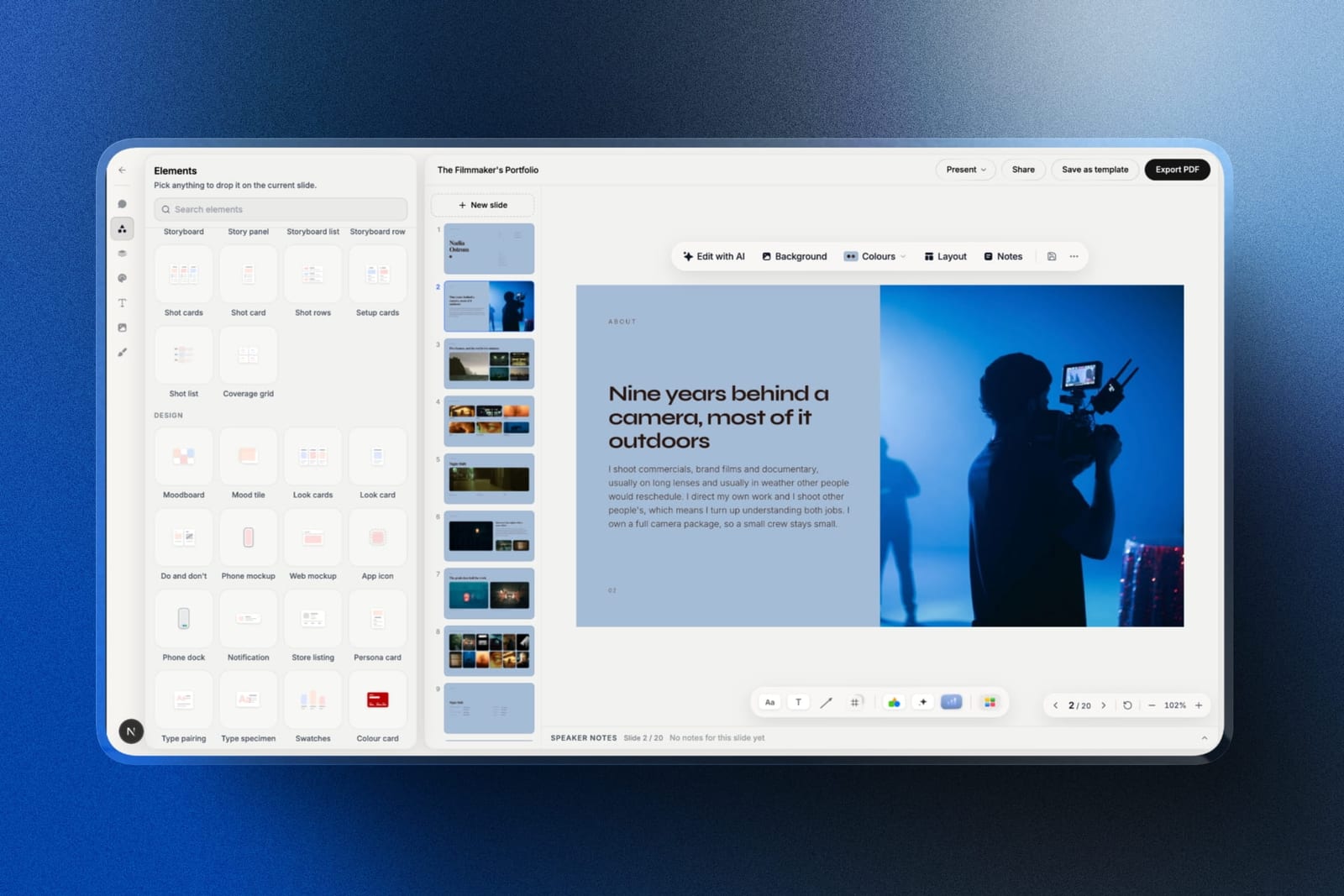
Framekit Slides pairs an AI writer with an ordinary editor.
You describe a slide in a sentence, the AI writes the copy and lays it out, and everything it produces stays editable by hand, so you drag, retype or delete pieces as if you had placed them yourself rather than re-prompting.
That matters most on creative slides. Slides ships a shot list, a storyboard row of panels, a moodboard, a look card or a coverage grid, because those exist as ready-made elements rather than as a picture of a table. When a drafted line is wrong, you fix that line by hand.
Best forDirectors, photographers, designers and creative studios generating treatments, lookbooks, portfolio decks and pitch decks who want a head start without giving up hand control.
Key features:
- AI that writes and lays out any slide from a description, on every plan including Free
- Every generated element stays editable by hand, with no locked cards
- Creative elements: shot lists, shot cards, storyboard panels and rows, moodboards, look cards, coverage grids, phone and web mockups, swatches, type specimens and charts
- Templates for treatments, lookbooks, portfolio, campaign and pitch decks
- Your own fonts and colours across every slide, speaker notes, full-screen presenting, link sharing and PDF export
The real number$0 gets you the AI writer, unlimited decks, a share link and PDF export.
Starter at $84 a year on annual billing adds custom fonts, the full template library and removes the "Made with Framekit" badge that free decks carry, which ties Slidebean and Prezi as the cheapest paid plan in this comparison and sits $12 below Gamma Plus.
The standout detailSlides sits in the same account as Framekit's website builder, client galleries, video review and store. The pitch deck, the review link for the cut and the final delivery gallery all come from one login.
The gotchait does not publish a credit-to-slide ratio either, so you cannot price a generated deck in advance any better than with Gamma.
PowerPoint export needs Pro, tops out at 60 slides and turns each slide into a picture, and there is no deck password, no comments on a deck, no viewer analytics, no live multi-cursor co-editing and no Google Slides import.
Skip it ifyour generated deck has to go back to a client as an editable .pptx, or you need to see who opened it. Plus AI and Storydoc are built for exactly those two jobs.
Verdict: Framekit is the AI presentation maker to use when the deck is creative work, because its AI drafts into shot list and storyboard elements and then leaves every piece in your hands. For a quarterly business review it is overqualified in the wrong places.
2. Gamma: Best for Structured Web-First Drafts
Our rating: 9.1/10
Gamma is the only tool in this test that behaved like it understood the brief rather than the words in the brief.
Asked for a rebrand pitch, it produced a problem slide, a positioning slide, a competitive frame, and a closing ask, in that order, without being told the structure. Every other tool produced twelve slides; Gamma produced an argument.
The output format is the second reason it wins. Gamma decks are web cards that reflow rather than fixed 16:9 canvases, so opening one on a phone gives you a readable page instead of a shrunken slide.
In our test that was the single biggest difference in how the deck felt to a recipient.
Best forAnyone who needs a structured, defensible draft in minutes and will share it as a link.
Key features:
- Prompt, outline, or document input, producing structure as well as copy
- Web-native cards that reflow on mobile instead of letterboxing
- Built-in analytics on who opened a link and how far they read
- Image generation and stock search inside the editor
- Export to PDF and PowerPoint, flattening as it goes
The real numberthe free plan is 400 credits, once, with no refresh. Plus is $9 a month billed annually, $108 a year, and refreshes 1,000 credits monthly. Pro is $18 a month billed annually, $216 a year, at 4,000 credits.
Ultra is $90 a month billed annually at 20,000. Team seats are $20 and Business $40.
The gotchathe free credits do not refresh, and the only ways to earn more without paying are referrals worth 200 credits each.
That is a genuinely unusual model in software, and it means the free tier's lifespan depends entirely on how much you use it. Most people hit the wall in the second week and mistake it for a bug.
What reviewers say elsewherecommunity sentiment, not our result - creators consistently praise the speed and consistently complain that decks made in Gamma are recognisable as decks made in Gamma. We saw the house style ourselves and could override it, but only by working against the defaults.
Pros:
- The only tool that reliably produced a structure, not just slides
- Output that genuinely works on a phone, where most links are opened
- Analytics at a price where nothing else in this comparison offers them
Cons:
- Free credits never refresh, so the free plan ends by use rather than by date
- A recognisable house aesthetic that takes deliberate work to escape
- Exports flatten the scrolling layout that makes the tool good
Skip it ifthe deck's final form is a printed PDF or an editable PowerPoint file for someone else's brand team. Gamma is excellent while the link is the deliverable and mediocre the moment it has to become a file.
Verdict: Gamma is the strongest general-purpose generator in 2026 and the one to try first for business decks, provided you understand that the free tier is roughly six decks in total. Budget $108 a year if you generate regularly and stop treating it as free. Visit Gamma
3. Canva Magic Design: Best AI With a Real Template Library
Our rating: 8.8/10
Canva's AI is not the most impressive in this comparison, and it produces the most usable decks anyway, because the generation lands inside the best template and asset library in the category.
Where Gamma writes you a better argument, Canva hands you a better-looking artefact that you can immediately fix by hand.
That editability is the real advantage. Every AI generation here needs work, and Canva is where that work feels most like ordinary design.
Dragging a generated slide apart and rebuilding it took under a minute; doing the same in Decktopus or Storydoc meant fighting a layout engine.
Best forCreatives who want AI to start the deck and a proper design tool to finish it.
Key features:
- Magic Design generation into Canva's own template system
- The largest well-designed template and stock library in the category
- Brand Kit on Pro, applying fonts, colours, and logos across a deck
- Exports to PDF, PPTX, MP4, and GIF
- The same editor handles decks, social, video, and print
The real numberCanva Pro is $18 a month or $144 billed annually, which is about $12 a month, and Business is $25 per user per month.
The free plan meters AI at roughly 200 standard uses and 20 premium uses a month, which is a monthly refresh rather than a one-time grant, making it the most generous genuinely free AI allowance in this comparison.
The gotchapremium stock assets are watermarked until you upgrade, and the watermark is not obvious in the editor. AI generations frequently pull premium assets in, so the first place people notice is the exported PDF, after the deck is finished.
What reviewers say elsewhereCanva holds 4.7 out of 5 on G2 across more than 6,800 reviews, by far the largest verified review base of any tool in this comparison.
Pros:
- Fixing the AI's output happens in a full design editor
- A monthly-refreshing free AI allowance rather than a one-time grant
- Exports to every format a recipient is likely to want
Cons:
- Generation quality is a step behind Gamma on structure
- Premium assets get watermarked, and AI likes choosing them
- Template ubiquity means clients can recognise the source
Skip it ifyou want the AI to do the thinking. Canva's generation is a starting layout, not an argument, and if you were hoping to skip the writing you will be disappointed.
Verdict: Canva is the best AI presentation maker for people who can design a bit, because it fails gracefully - a bad generation is thirty seconds from being a good manual deck. Gamma is the better generator; Canva is the better tool. Designers comparing their whole kit should read our best AI tools for designers roundup.
4. Plus AI: Best AI Inside PowerPoint and Google Slides
Our rating: 8.3/10
Plus AI solves the problem nobody else in this comparison addresses, which is that most people cannot actually change tools.
It runs inside Google Slides and PowerPoint, generating and rewriting slides in the file your organisation already uses, in the format your client already expects.
The generated structure was the third-best in our test, behind Gamma and Canva, and the output was immediately a native file with no export step. For anyone who has ever lost a Friday to a PPTX conversion, that alone is worth the price.
Best forAnyone locked into Google Slides or PowerPoint who wants AI drafting without a migration.
Key features:
- Generates and edits slides inside Google Slides and PowerPoint
- Rewrites and reformats existing slides in place
- Custom templates and themes that the generation respects
- No export step; the output is already the file everyone wants
- A 7-day trial with 1,000 AI credits
The real numberBasic is $10 per user a month on annual billing, or $15 monthly; Pro is $20 or $25; Team is $30 or $40; Max is $200 or $240, per Plus AI's pricing page.
Budget it on top of your suite, not instead of it - Basic plus Microsoft 365 Personal is about $220 a year against Gamma Plus at $108 doing both jobs.
The gotchathe design ceiling is whatever the host application can render. Plus AI cannot make PowerPoint look like Gamma, and no amount of prompting changes that. You are buying a better first draft in an existing aesthetic, not a new one.
Pros:
- Zero migration and no export step at all
- The output is instantly editable by colleagues with no new accounts
- The only tool here that fits an organisation that will never switch
Cons:
- You pay for it on top of a suite subscription you already have
- Design quality is capped by the host application
- No standalone value the moment you leave Slides or PowerPoint
Skip it ifyou get to choose your own tools. The entire value proposition is that you do not.
Verdict: Plus AI is the correct answer to a constraint rather than a preference, and it is very good at that job. If your client's brand team will only accept a .pptx, this is the cheapest way to stop dreading the first slide.
5. Beautiful.ai: Best for Layout That Corrects Itself
Our rating: 8.0/10
Beautiful.ai's AI is less about writing and more about arrangement. Its Smart Slides rebalance themselves as you add content, so a four-item row becomes a properly spaced four-item row rather than three items and an orphan.
Against our brief it produced the tidiest deck in the test and the least distinctive one.
That is the trade in one sentence. If your decks look wrong and you cannot articulate why, this fixes it permanently. If you have a design opinion, the engine will overrule you and there is no clean way out.
Best forNon-designers who need consistent, tidy slides and are happy to stop making layout decisions.
Key features:
- Smart Slides with over 300 layouts that rebalance automatically
- AI content generation constrained to those layouts
- Custom branding applied across a whole deck
- Dynamic data visualisations linked to live sources
- Viewer analytics on shared links
The real numberthere is no free plan. Pro is $12 a month billed annually, Team is $40 per user a month annually or $50 monthly, and a single One-Time Project licence is $45, per Beautiful.ai's pricing page.
The 14-day trial requires a credit card, which is unusual in this category in 2026.
The gotchathe Team price cliff. Two seats is $960 a year against one seat at $144, a 6.7 times jump at exactly the moment a freelancer becomes a two-person studio. Nothing else in this comparison has a step that steep.
Pros:
- The most consistently well-spaced output of any tool here
- The $45 one-off project licence is a fair option for a single big deck
- Genuinely solves a problem non-designers have and cannot name
Cons:
- No free plan and a card-gated trial
- The layout engine cannot be overridden when it is wrong
- The one-seat to two-seat price jump is the steepest in this comparison
Skip it ifyou are a designer. The constraint that rescues your finance colleague will feel like a cage by slide six.
Verdict: Beautiful.ai is a good product for a person who is not reading a creative blog, and an honest one about what it does. Buy the $45 project licence for a single important deck rather than the subscription.
6. Pitch: Best AI for a Shared Team Library
Our rating: 7.9/10
Pitch's AI is competent rather than remarkable, and the reason to choose it is what surrounds the generation: shared template libraries, teamspaces, and link controls that let you track, expire, or revoke a deck.
For a studio that sends the same shape of proposal repeatedly, generation into a house template beats generation into a stranger's aesthetic.
Against our brief the output was well-organised and visually restrained, which is more useful for client work than it sounds. It was also the fastest tool to a second deck, because the first one became a template.
Best forSmall teams standardising on a house deck and using AI to fill it.
Key features:
- AI drafting into your own shared templates rather than generic ones
- Advanced links with tracking, expiry, and per-recipient control
- Teamspaces and shared rooms for organising decks by client
- PowerPoint export on paid plans
- Real-time collaboration in a modern editor
The real numberthe free plan gives one seat, unlimited presentations, 100 one-time AI credits, and two external guests.
Plus is EUR 10 a month annually with 500 monthly credits, Team is EUR 15, and Business is EUR 20 with 750 credits, per Pitch's pricing page.
The gotcha100 one-time credits is the smallest free AI allowance in this comparison, roughly one or two generated decks. Pitch's free plan is generous about presentations and stingy about AI, which is the reverse of how it reads at first glance.
Pros:
- Generation into your own templates, not a vendor house style
- The best link controls in this comparison at this price
- A properly modern editor for a team
Cons:
- The smallest free AI allowance here at 100 one-time credits
- Prices listed in EUR, which complicates dollar budgeting
- Little advantage for a solo user sending varied one-off decks
Skip it ifyou work alone. Almost everything good about Pitch requires a team and a repeated deck shape to pay off.
Verdict: Pitch is the best AI presentation maker for a small studio and close to pointless for a freelancer, which is a cleaner line than most tools here can draw. Visit Pitch
7. Decktopus: Most Honest Credit Maths
Our rating: 7.4/10
Decktopus earns its place in this comparison for a single unglamorous reason: it is the only tool that tells you what a credit buys.
Its pricing page states that 750 monthly credits cover roughly 150 slides, which is the only published ratio in the entire category and the anchor for the cost table above.
The product itself is a competent, quick generator aimed at business users. The generated deck against our brief was serviceable and generic, and the built-in delivery-practice feature is a genuine differentiator for people who present nervously.
Best forBusiness users who want a fast generated deck and a plain answer about what it costs.
Key features:
- Published credit-to-slide ratio, which nobody else offers
- Presentations and carousels from a single prompt
- PDF, PPT, and PNG export on all paid plans
- Delivery practice with recorded run-throughs
- Version history and mobile access
The real numberPro is $24.99 a month, or $9.99 a month billed annually at $119.88 a year, with 750 credits a month covering about 150 slides. A three-month plan is $19.99 a month.
Business is 1,000 credits per seat a month, per Decktopus's pricing page. Students get 50% off with a code.
The gotchathe monthly price is 2.5 times the annual equivalent, the widest gap in this comparison. Decktopus monthly at $24.99 costs more per month than Gamma Pro, and annual at $9.99 costs about the same as Gamma Plus.
Which of those two products you are buying depends entirely on the billing toggle.
Pros:
- The only published credit-to-slide ratio in the category
- Delivery practice is a real feature that others do not have
- Export to PPT included on every paid plan
Cons:
- The generated design is generic next to Gamma or Canva
- Monthly billing is 2.5 times the annual rate
- No standing free plan, only a generator you can try
Skip it ifdesign quality is the reason you are shopping. Decktopus is competent and plain, and plain is not what a creative pitch needs.
Verdict: Decktopus is a fair, transparent tool that will not win a design argument. Its real contribution to this category is the ratio it publishes, which lets you price every competitor's free tier honestly.
8. Visme AI: Best for Data-Heavy Generated Decks
Our rating: 7.3/10
Visme's generation is unremarkable and its chart library is the best here, which makes it the right tool when the AI's job is to frame numbers rather than write prose.
Against our brief, its market slide was the only generated chart in the test that we would have shipped without rebuilding.
Everything around that strength is a step behind. The editor is busier than Canva's, the general templates are less refined, and the free plan stamps a Visme logo on published work, which rules it out for anything client-facing until you pay.
Best forGenerated decks where charts and data carry the argument.
Key features:
- The deepest chart and data-visualisation library in this comparison
- AI generation into report and infographic formats as well as slides
- Brand Kit, analytics, and privacy controls on Pro
- Exports to JPG, PNG, PDF, MP4, GIF, PPTX, and HTML5 on paid plans
- Content blocks that bridge slides and long-form documents
The real numberthe free plan publishes with a Visme logo and downloads only as JPG, PNG, or PDF. Starter is $12.25 a month billed at $147 a year, Pro is $24.75 a month at $297 a year, and Enterprise starts at ten seats, per Visme's pricing page.
The gotchathe free watermark is on the published project, not only the download, so a share link carries it too. Several tools here watermark exports; Visme watermarks the thing you send.
What reviewers say elsewhereVisme holds 4.5 out of 5 on G2 across roughly 469 reviews, with the chart tooling the most consistently praised element.
Pros:
- The best generated charts of any tool in this comparison
- Genuinely useful for reports as well as slides
- Broad export formats once you are paying
Cons:
- The free plan brands your published work, not just downloads
- Generation quality is mid-table
- $147 is above the median first paid tier here
Skip it ifyour slides carry photographs rather than figures. Everything Visme is best at is wasted on an image-led deck.
Verdict: Visme is a data tool with AI attached rather than an AI tool with charts attached, and it is worth the $147 only if the numbers are doing the persuading.
9. Storydoc: Best Generated Decks With Read Tracking
Our rating: 7.1/10
Storydoc generates scrolling web decks with instrumentation built in, so you find out which section a prospect read and where they stopped. For sales work that data changes what you do next, which is worth more than any template.
For creative work it is expensive and corporate. The generated deck against our brief looked like a SaaS landing page, and the entry tier's five-live-document cap collides with any studio that keeps old proposals reachable.
Best forSales and business development, where knowing who read what changes the follow-up.
Key features:
- AI generation into scrolling, interactive web decks
- Section-level read analytics on every share link
- Personalisation variables for per-recipient versions
- Embedded video and live data
- Version automation for sending variants of one deck
The real numberStarter is $19.80 a month, billed $237.60 a year, capped at 5 active documents with 20 AI image and 25 AI text credits a month.
Pro is $36 a month, billed $432 a year, at 30 active documents, per Storydoc's pricing page. Those AI credit counts are the tightest of any paid plan in this comparison.
The gotcha"active documents" counts what stays live rather than what you create. Archiving an old proposal to make room takes its link offline, which is precisely the wrong behaviour when a client resurfaces months later.
Pros:
- The best read analytics in this comparison by a clear margin
- Interactive decks that genuinely work on mobile
- Personalisation that makes a repeated pitch feel bespoke
Cons:
- The most expensive entry plan here at $237.60 a year
- 25 AI text credits a month is very tight for a tool sold on AI
- Templates read corporate and need heavy overriding for creative work
Skip it ifyou will not act on the analytics. The entire premium is the tracking.
Verdict: Storydoc is a sales tool wearing AI-presentation clothes, and a good one. Creatives sending portfolios rather than proposals are paying $237.60 for a dashboard they will not open.
10. Slidebean: Best AI for Investor Decks
Our rating: 6.9/10
Slidebean's AI pitch-deck builder fills a specific narrative - problem, solution, market, traction, ask - because that is the only deck it is trying to make. For a founder that constraint is a feature; it stops you inventing a structure that investors will not recognise.
As a general AI presentation maker it is narrow. Design control is deliberately limited, the template range outside investor decks is thin, and creative work does not fit its shapes at all.
Best forFounders drafting an investor deck who want structure more than freedom.
Key features:
- AI builder that fills a standard investor narrative
- Templates modelled on the structure of funded decks
- View tracking so you know which investor opened what
- A cap-table tool and financial-modelling material bundled in
- A free tier with no time limit and no card
The real numberStarter is $7 a month billed yearly, which is $84 a year and the cheapest paid plan in this comparison.
Accelerate is $99 a month and buys human help rather than software, per Slidebean's pricing page. The free tier allows unlimited presentations with a template subset, no card, no time limit.
The gotchaAccelerate at $99 a month is a consulting product priced against a pitch consultant, not against Gamma. Comparing it on features misses what you are actually buying.
Pros and consthe most genuinely useful free tier of any specialist tool here, plus investor-deck structure baked in at $84 a year, against deliberately limited design control, a thin template range outside investor decks, and an upgrade path that is really a services purchase.
Skip it ifyou are not raising money. Every advantage here is specific to an investor audience.
Verdict: Slidebean is right for a seed deck and wrong for everything else, which at least makes the decision easy. Founders should also think about where the deck lives afterwards, which is what our best client portal tools for creatives guide covers.
11. Prezi AI: Best for Non-Linear Generated Canvases
Our rating: 6.6/10
Prezi's AI generates onto its zooming canvas rather than into slides, which produces something genuinely different from every other tool in this comparison. When the content is a set of relationships rather than a sequence, it works.
When the content is an argument that moves forward, the format fights it.
Prezi Video, which places the presenter beside the content on a call, remains the quietly useful half of the product and the reason remote teams keep licences.
Best forLive presenters who improvise or teach, and who want AI to lay out a canvas rather than a stack.
Key features:
- AI generation onto a zooming canvas instead of linear slides
- Prezi Video for presenting alongside content on calls
- Templates built around structure and relationships
- Analytics on shared presentations for paid plans
- Runs in a browser with nothing to install
The real numberBasic is $0, Standard about $7 a month, Plus about $15, and Premium about $25, all billed annually, with Teams around $39 per user a month. The $84 a year Standard plan ties Slidebean as the cheapest paid tier in this comparison.
The gotchaon the free plan your presentations are public, not unlisted. For any client work or fee-bearing pitch, the free tier is unusable and Standard is the real entry price.
Pros and consgenuinely distinctive output and a strong video feature at the joint-cheapest paid price, against public free-plan presentations, a format that actively hurts a linear argument, and an editor that feels dated next to Pitch or Canva.
Skip it ifthe deck will be read rather than presented. Prezi's advantage exists in a live room and disappears in an inbox.
Verdict: Prezi AI is a specialist sold to generalists, which is why its reputation trails the product. Teachers and live improvisers should look at it; everyone else should not.
What AI Still Gets Wrong in Every Tool
In one lineevery tool in this test invented at least one fact, none of them designed a slide as well as a competent human, and the time you save on the first draft is partly repaid checking the output.
Invented statistics. Nine of the ten we ran generated a market claim about the coffee sector that we could not source. The numbers are plausible, formatted confidently, and sometimes wrong.
Treat every generated figure as a placeholder that needs a source before the deck leaves your hands.
Generic imagery. Where tools generate or auto-select images, the results skew toward stock-shaped abstraction. In creative work this is the fastest way to make a deck look cheap, and the fix is manual in every tool here.
Structure over substance. The best generators produce a good skeleton and hollow muscle. Gamma's argument structure was genuinely useful; the sentences inside it were still filler until rewritten.
Budget the saved time into editing rather than into finishing early.
Format lock. Storydoc, Gamma, and Prezi all produce something that is not really a slide deck, and converting it into one loses what made it good. Decide your final format before you generate, not after.
The tools themselves are not permanent. Tome reached about 20 million users and shut its presentation product down on 30 April 2025, pivoting to sales software after revenue stayed under $4 million.
That is a category pattern rather than one company's bad luck, as Forbes reported in its coverage of AI startups pivoting to products that pay.
Keep an exportable copy of anything important.
Which AI Presentation Maker Should You Actually Use
Work down these in order and stop at the first yes.
1. Does your client or employer require a .pptx file? Plus AI. The generation happens inside PowerPoint or Google Slides, so there is nothing to convert and nothing to lose.
2. Is the deck a treatment, lookbook, portfolio or pitch deck for creative work? Framekit. Its AI drafts the slides, including shot lists and storyboards, and nothing it produces is locked against hand edits.
3. Do you need a structured draft in under ten minutes and the link is the deliverable? Gamma, budgeting $108 a year rather than treating the free credits as a plan.
4. Will you rebuild most of the generation by hand anyway? Canva. Its AI is second-best and its editor is first by a distance, so the total time is lower.
5. Is the problem that your slides look badly spaced rather than badly written? Beautiful.ai, ideally the $45 one-off project licence rather than a subscription.
6. Does your team send the same deck shape more than ten times a year? Pitch, generating into your own shared templates.
7. Do charts carry the argument? Visme. Do you need to know who read which section? Storydoc.
8. Are you raising money? Slidebean, on the free tier until the structure is right.
Frequently Asked Questions
What is the best AI presentation maker in 2026?
The best AI presentation maker for creative work in 2026 is Framekit Slides, because its AI writes and lays out any slide from a description, every result stays hand-editable, and it can generate shot lists, storyboards and moodboards as real elements.
Gamma is the best general-purpose generator, Canva's Magic Design suits heavy editors, and Plus AI fits anyone who cannot leave PowerPoint.
How much does an AI-generated deck actually cost?
About 60 credits for a twelve-slide deck, using the only published ratio in the category. Decktopus states that 750 monthly credits cover roughly 150 slides, which is about 5 credits a slide.
On that basis Gamma's 400 free credits are roughly six decks in total, Pitch's 100 free credits are one or two, and Gamma Plus at $108 a year covers around 16 decks a month.
Is Gamma free, and what is the catch?
Gamma is free to start with 400 AI credits, and the catch is that they never refresh. Unlike a monthly allowance, Gamma's free credits are a one-time grant, so the free plan expires by use rather than by date.
You can earn 200 more per referral, or move to Plus at $9 a month billed annually, $108 a year, for 1,000 refreshing credits a month.
Gamma vs Canva: which AI presentation maker is better?
Gamma is better at generating and Canva is better at finishing.
Gamma produced the only draft in our test with a genuine argument structure and works best when the deliverable is a link; Canva's generation is a step behind but lands in the strongest template and asset library, so fixing it takes seconds.
Choose Gamma for speed to a structured draft, Canva if you will redesign it anyway.
Do AI presentation makers make things up?
Yes. Nine of the ten tools we ran the brief through generated at least one market statistic we could not source, presented in the same confident formatting as the accurate content.
AI presentation makers are drafting tools, not research tools, so treat every generated number as a placeholder and attach a real source before the deck leaves your hands.
Which AI presentation tool has the best free plan?
Canva has the best genuinely free AI allowance, because it refreshes monthly at roughly 200 standard and 20 premium AI uses rather than granting a one-time pool.
Slidebean's free tier is the best among specialist tools, with no time limit and no card required. Gamma's 400 credits and Pitch's 100 credits are one-time grants, and Beautiful.ai has no free plan at all.
Can AI presentation makers export to PowerPoint?
Most can, and none do it cleanly. Gamma flattens its scrolling layout on export, Canva drifts on spacing in complex slides, and Pitch puts PowerPoint export behind a paid plan entirely.
Plus AI is the only tool here with no export step at all, because it generates natively inside PowerPoint and Google Slides.
What happened to Tome, the AI presentation tool?
Tome shut down its presentation product on 30 April 2025. The pivot was announced in October 2024 and the sunset confirmed in March 2025, after the product reached about 20 million users while revenue stayed under $4 million.
The team rebranded as Lightfield, an AI-native CRM, and AngelList acquired the Tome brand. It is the clearest reason to keep an exportable copy of any important deck.
Framekit vs Gamma: which AI presentation maker is better for a film treatment?
Framekit is better for a film treatment, because it ships shot lists, storyboard rows, moodboards and look cards as editable elements and ships templates cut for treatments and lookbooks.
Gamma is better for a business pitch that lives as a scrolling link and needs open-tracking analytics, which Framekit does not offer.
Is it worth paying for an AI presentation maker?
It is worth paying when you generate more than about six decks a year and the link is your deliverable, which is roughly where free tiers run out. Below that, Canva's free plan and a manual first draft cost nothing.
Above it, Gamma Plus at $108 a year is the cheapest refreshing allowance, and paying for two tools at once is the most common way people overspend in this category.
Which AI presentation maker is cheapest?
The cheapest paid AI presentation plans in 2026 are Slidebean Starter, Prezi Standard, and Framekit Starter, all at $84 a year.
Gamma Plus is $108, Decktopus Pro is $119.88 on annual billing, and Plus AI Basic is $120 before your suite subscription. The most expensive individual plan is Storydoc Pro at $432 a year.
Final Verdict
Framekit is the best AI presentation maker for creative work in 2026, because it drafts treatments, lookbooks and pitch decks with the elements those decks need and then leaves every piece editable by hand.
Gamma is the best general-purpose generator: it reliably produces structure rather than slides, and its output reads like a page on a phone. Price Gamma honestly at $108 a year; its free plan is roughly six decks in total.
Canva is the better buy for anyone who will edit the output, Plus AI is the right answer inside a locked-down suite, and Beautiful.ai's $45 project licence is the smartest one-off purchase in this whole comparison.
Where Framekit losesFramekit is not the better fit for office and sales decks.
Its PowerPoint export is picture-based and needs Pro, so Plus AI wins when the file must stay editable; it has no viewer analytics, so Storydoc or Gamma wins when you chase opens; there is no deck password or live multi-cursor co-editing; and it does not publish a per-slide credit cost, so the arithmetic in this post cannot be run on it.
The most useful thing to take from this comparison is the arithmetic. Once you know a deck costs roughly 60 credits, every free tier in this category becomes a number of decks rather than a marketing word, and most of them turn out to be smaller than they look.
Keep reading: are AI website builders any good, the best AI tools for filmmakers, and the best easy to use AI website builders.