Framekit templates
Start from a designer-made template
 Use template
 Use template
 Use template
 Use template
 Use template
 Use template
 Use template
 Use template
Every design system documentation project starts the same way and fails the same way.
Someone writes beautiful pages for twenty-four components, everyone admires them for a fortnight, and then a developer changes a button's disabled state in code, nobody updates the docs, and within a quarter the documentation is a description of a design system that no longer exists.
The interesting question about these tools is therefore not which has the nicest page layouts. It is which parts of the documentation stay true without a person remembering to make them true, because the parts that need a human are the parts that will be wrong.
A design system documentation tool is software that publishes the reference for a component library and its design tokens, connecting the design files, the code, and the written guidance so that designers, engineers, and anyone else can find what exists and how to use it.
Framekit is on this list for one narrow reason, set out in full at number nine: it publishes the public brand page and the client handover deck that sit on top of a system documented in one of the eight tools above, and it syncs nothing from Figma or code.
The best design system documentation tool in 2026 is zeroheight, because it connects to both Figma and Storybook so component examples and token values update from their sources rather than from a person, and because its free tier is genuinely usable for a single-system team.
The trade-off is per-editor pricing at $49 a month that gets expensive as contributors grow.
Supernova is the pick if token automation and code generation matter most, Storybook is the best free option for component-first teams, and Notion is a perfectly reasonable place to start if your system has twelve components rather than two hundred.
Full disclosure: Framekit is our own product and it is ranked ninth and last below, because eight of these are design system tools and we are a website builder. Our entry covers one narrow case and names everything we cannot do.
In September 2026 we re-verified Framekit's own features and added a short section on the one moment Framekit does fit, the client handover deck, without changing the ranking.
How We Tested These Design System Documentation Tools
We documented the same system in every tool: twenty-four components including a button with five variants and three states, a form input set, a modal, and a data table, plus ninety-one design tokens across colour, spacing, and typography, sourced from a Figma library and a React component library in Storybook.
Then we did the thing that actually matters. We changed a token value in the source, changed a component's props in code, and renamed a Figma component, and measured what updated automatically and what needed a person.
Sync. Which parts of the documentation reflect the source without human intervention.
Audience fit. Whether an engineer, a designer, and a product manager can all find what they need, since a system's documentation has at least three readerships and most tools serve one.
Setup effort. Time from an empty account to twenty-four documented components.
Cost as contributors grow, priced at three editors and at ten, because per-editor pricing is where these tools become budget conversations.
Three kinds of finding, kept apart. Ours by hand in August 2026: the nine setups, the sync tests, the rename tests, and the timings. From published pricing: every figure below, linked where it matters.
From other people: recurring themes in public reviews, always labelled as sentiment.
What Documenting One System Nine Times Showed
The sync test separated these tools far more sharply than any feature list did, and the results were not what the marketing pages suggested, because several tools that advertise integrations turned out to be storing a copy rather than reading from a source.
- 4 of 9 updated a component's rendered example automatically when the code changed. The rest showed a screenshot that quietly became wrong.
- 5 of 9 pulled token values from a source of truth rather than from a table someone typed.
- 2 of 9 flagged a renamed Figma component rather than silently breaking the link.
- Setup for twenty-four components ranged from 35 minutes to just over 6 hours.
- Cost at three editors ranged from $0 to $1,764 a year, and at ten editors from $0 to $5,880.
- 3 of 9 are free at a scale a real small team could use.
Design System Documentation Tools Compared
The weighting: automatic sync 30%, audience fit 20%, setup effort 15%, cost at ten editors 20%, governance and adoption tracking 15%.
Sync carries almost a third because documentation that requires a human to stay true is documentation that will be false, and that is the failure mode this entire category exists to prevent.
| Tool | Free tier | Entry paid price | Live component examples | Token sync |
|---|---|---|---|---|
| zeroheight | 1 editor, 1 styleguide | $49/editor/mo | Yes, via Storybook | Yes |
| Supernova | Yes, 5 members | From $20/builder seat/mo | Yes | Yes, with code generation |
| Storybook | Yes, fully open source | $0 | Yes, natively | Partial |
| Frontify | No | Quote only | Limited | Limited |
| Figma | Yes, 3 files | $16/mo Full seat | In the file only | Yes, variables |
| Notion | Yes, personal | $10/user/mo | No, images only | No |
| Knapsack | No | Quote only | Yes | Yes |
| Confluence | Yes, up to 10 users | From about $5/user/mo | No | No |
| Framekit | Yes | $0 to $228/yr | No | No |
1. zeroheight: The Best Design System Documentation Tool
Best forteams who have both a Figma library and a component library in code and need one place that reflects both.
zeroheight won our sync test because it connects at both ends. Figma components appear as live embeds rather than screenshots, Storybook stories render as interactive examples, and token values pull from their source.
When we changed a spacing token and a button's props, both updated in the published documentation without anyone touching it.
Setup took about ninety minutes for twenty-four components, which was mid-range, and most of that was writing guidance rather than wiring connections.
The real numberzeroheight's free plan includes one editor, one styleguide, and one token set, which is enough for a single small system.
Starter is $49 per editor a month with a maximum of five editors, two styleguides, and three token sets, with 15% off annual billing. Three editors is $1,764 a year at the monthly rate.
The standout detailit was one of only two tools that flagged a renamed Figma component rather than silently showing a stale embed. Silent breakage is the specific way documentation rots, and being told about it is worth more than most features on this page.
The gotchathe per-editor price and the five-editor ceiling on Starter together create an awkward middle. A team with six contributors is pushed to Enterprise, which is quote-only, and there is no tier between $49 a seat and a sales conversation.
Skip it ifmore than five people need to edit and you are not ready for an enterprise contract.
What reviewers say elsewherezeroheight holds a 4.6 out of 5 across more than 40 reviews on G2, where Figma and Storybook integration are the most cited strengths.
Verdict: the best-connected documentation tool available and the one whose pricing forces a decision at six contributors. If you have Figma and Storybook, start here.
2. Supernova: Best for Token Automation
Best forteams whose main pain is design tokens drifting between design and code.
Supernova approaches the problem from the token layer rather than the documentation layer, and for teams whose colours and spacing values have quietly diverged between Figma and the codebase, that is the right end to start from.
It reads tokens from Figma, publishes documentation, and generates code in multiple formats so the values in the app come from the same source as the values in the docs.
The real numberSupernova has a free plan supporting five members, with Pro starting from around $20 per builder seat or $35 per full seat a month billed annually.
The distinction between builder and full seats is the most useful part of its pricing, because most contributors only read.
The standout detailthe seat split is the thing zeroheight lacks. A team where two people maintain the system and eight consume it pays for two rather than ten, which changes the ten-editor arithmetic entirely.
The gotchathe written-guidance side is less refined than zeroheight's. Pages are functional rather than editorial, and teams that want the documentation to read like a considered product will do more work here.
Skip it ifyour system's problem is guidance and adoption rather than token drift.
Verdict: the strongest token pipeline in this comparison, with a seat model that actually suits how design systems are used. Best paired with a writer.
3. Storybook: The Best Free Option
Best forengineering-led teams who want documentation that cannot go stale because it is the code.
Storybook is free, open source, and solves the sync problem by not having one: a story renders the actual component from the actual codebase, so a documented example is by definition current.
Our button's five variants and three states documented themselves as we wrote the stories.
The real numberfree, with no seat count and no licence. Chromatic, the hosted visual review and publishing service from the same team, is a separate paid product.
The standout detailbecause documentation lives in the repository, it goes through code review. A component change and its documentation change arrive in the same pull request, which is the only structural guarantee of accuracy on this page.
The gotchait documents components and nothing else. Design tokens, usage guidance, accessibility notes, content principles, and the reasoning behind decisions all live outside it, and designers who do not work in a repository will not contribute to it.
Skip it ifyour system's documentation needs to serve designers and product managers as much as engineers.
Verdict: the correct foundation and half of a documentation system. Most serious setups run Storybook underneath something else, which is exactly why zeroheight and Supernova both connect to it.
4. Frontify: Best When Brand and System Are One Thing
Best fororganisations where the design system and the brand guidelines are maintained by the same team.
Frontify is the most complete platform here in scope, covering brand guidelines, digital asset management, and design system documentation in one place.
For a company where marketing and product both need a source of truth, consolidating them is a real organisational simplification.
The real numberFrontify is quote-only, and its pricing is based on monthly active users averaged over a period rather than on named seats.
That model can work well for occasional readers and is difficult to forecast, which is worth raising in the sales conversation rather than discovering later.
The gotchaits component documentation is weaker than zeroheight's or Supernova's. Live code examples are limited, so the parts of the system that engineers rely on are the parts Frontify serves least well.
Skip it ifengineers are your primary documentation audience.
Verdict: excellent as a brand platform that also documents a design system, and second-best as a design system tool. If brand guidelines are the actual job, our guide to brand guidelines software covers that comparison properly.
5. Figma: Best If the System Lives Where It Is Designed
Best fordesign-led teams whose system has not yet reached code.
Documenting a system inside Figma itself is more viable than it used to be. Variables handle tokens with modes, component properties describe variants clearly, and annotation and Dev Mode give engineers measurements and code hints without leaving the file.
The real numbera Full seat is $16 a month billed annually, which is $192 a year, and the free Starter plan allows three files. For a team already paying for Figma, this approach costs nothing extra.
The gotchait serves one audience. A product manager or a content designer will not open a Figma file to check whether a component exists, and engineers get code hints rather than real usage documentation.
Systems documented only in Figma tend to be well understood by designers and invisible to everyone else.
Skip it ifmore than one discipline needs the documentation.
Verdict: the cheapest starting point for a design-led team and a ceiling you will hit. Fine for a system's first year, insufficient by its second.
6. Notion: The Best Cheap Starting Point
Best forsystems with twelve components rather than two hundred.
There is an honest case for Notion that this category rarely makes.
If your system is small, your team is small, and your alternative is documentation that never gets written because a tool never gets chosen, a Notion database of components with screenshots and usage notes is better than nothing by a wide margin, and it takes about thirty-five minutes to set up.
The real numberNotion is free for personal use and Plus is $10 per user a month billed annually. Three editors cost $360 a year against zeroheight's $1,764.
The gotchanothing syncs. Every component example is a screenshot that becomes wrong the moment someone changes the component, and every token value is a number someone typed. Notion is the tool most likely to be documenting a system that no longer exists.
Skip it ifthe system changes more than monthly.
Verdict: the right answer for a small, slow-moving system and the wrong one for a growing product. Its honest role is as a first step you plan to leave.
7. Knapsack: Best for Design-to-Code Governance
Best forlarger organisations where the gap between design and shipped code is a governance problem.
Knapsack is aimed at the enterprise end of this category and its strength is treating the system as infrastructure rather than as documentation.
Live component rendering across multiple frameworks, design-to-code mapping, and adoption tracking that shows which teams are using which versions.
The real numberquote-only, positioned at the enterprise tier. Expect a sales process rather than a signup.
The gotchathe setup effort was the highest of the nine at just over six hours, and it assumes a system that already exists in code with real structure. For a team still deciding what their button variants are, it is much too early.
Skip it ifyou have fewer than about fifty engineers.
Verdict: the most serious governance tooling here and the least appropriate for a small team. Right problem, larger scale.
8. Confluence: Best If Your Company Already Runs Atlassian
Best fororganisations where documentation lives in Confluence and always will.
Nobody chooses Confluence for design system documentation on its merits.
They choose it because the company already runs Atlassian, engineers already have accounts, and a system documented where people already look gets read more than a better system documented somewhere they do not.
The real numberConfluence has a free tier for up to ten users, with paid plans starting at around $5 per user a month, which is the cheapest paid option in this comparison.
The gotchano live components, no token sync, and no design tooling of any kind. Everything is a screenshot and a table, with the same rot problem as Notion and a worse editing experience.
Skip it ifyou have any choice at all.
Verdict: the pragmatic answer inside Atlassian organisations and technically the weakest tool here. Adoption sometimes beats capability.
9. Framekit: Best for the Public-Facing Version

Best forthe outward-facing brand and design page rather than the internal system reference.
We rank ourselves last because eight tools above document design systems and we do not document anything.
Framekit is an AI website builder for studios and product teams, and its only relevance here is a distinction worth drawing: the internal system reference and the public brand page are different documents with different readers, and small studios often try to make one serve both.
The internal reference needs component sync, token pipelines, and version history. The public page needs to be findable, well designed, and shareable with a client or a contractor who will never have a seat in your documentation tool.
The real numberfree to start, $9 a month on Starter, $19 on Pro, with 20% off annual billing, and no per-editor charge.
The gotchawe have no component rendering, no token management, no Figma or Storybook integration, no versioning of a system, and no adoption tracking.
Framekit cannot document a design system in any meaningful sense, and every tool above does that job better than we do.
Its deck tool, Slides, helps with presenting a system to a client, which we cover further down, and that is a different job.
Skip it ifyou need documentation, which on this page you do.
Verdict: relevant only to the public half of the problem, and ranked ninth of nine for that reason.
Why Design System Documentation Goes Stale
Design system documentation goes stale for four specific mechanical reasons rather than because anyone is careless, and understanding those four is more useful when choosing a tool than any feature comparison, because each one maps directly onto a capability some tools have and others do not.
Screenshots are the main culprit. A screenshot of a component is accurate for exactly as long as nobody changes the component, and nothing tells you when that stops being true.
Four of nine tools render live examples instead; the other five will eventually be describing something that no longer exists.
Typed token tables drift silently. If your documentation says the primary blue is one hex value and the codebase says another, both look authoritative. Five of nine tools pull tokens from a source; the rest rely on a person remembering.
Renames break links quietly. We renamed a Figma component in every tool. Two flagged it. The rest either showed a stale embed or an empty frame, and neither is something anyone notices until a designer asks why the docs are broken.
Guidance rots slowest and matters most. The written parts, when to use this component and what to use instead, have no automatic source and are also the parts that change least often.
This is the argument for writing less documentation and writing it about decisions rather than about properties.
In one linechoose the tool that removes the most human steps between the source and the page, because every step that needs a person is a step that will eventually be skipped.

What These Tools Cost as a Team Grows
Per-editor pricing is the defining commercial characteristic of this category, and it is the reason the free and open-source options stay genuinely competitive against tools that are better in every other respect. Here is the same team priced at three editors and at ten.
| Tool | 3 editors / year | 10 editors / year | Notes |
|---|---|---|---|
| Storybook | $0 | $0 | Open source, no seats |
| Figma, existing seats | $0 extra | $0 extra | If you already pay for Figma |
| Confluence | ~$180 | ~$600 | Free up to 10 users |
| Notion Plus | $360 | $1,200 | No sync of any kind |
| Supernova Pro | ~$720 | ~$2,400 | Builder and full seats priced separately |
| zeroheight Starter | $1,764 | Not available, 5-editor cap | Enterprise quote above five editors |
| Frontify | Quote | Quote | Priced on monthly active users |
| Knapsack | Quote | Quote | Enterprise positioning |
A test that will tell you which tool you need. Count how many people have edited your current documentation in the last three months, not how many could.
In most teams the answer is two or three, which means per-editor pricing is far less frightening than it looks and the real question is whether the two or three people doing the work have the integrations they need.
In one linethe cheapest credible setup is Storybook for components plus a small paid tool for tokens and guidance, and the most expensive mistake is buying seats for people who will only ever read.
Where Framekit Fits: The Deck That Hands a System to a Client
Framekit fits one moment in a design system's life, and it is not the documentation: it is the handover presentation a studio gives a client before the system lives in zeroheight or Storybook.
That meeting is usually a deck, and it is usually built by hand in Keynote with screenshots of swatches and type that are wrong by the next revision.
Framekit Slides, the deck tool inside Framekit, has colour swatches and type specimens as ready-made slide elements, alongside phone and web mockups and charts, and your own uploaded fonts carry across every slide on paid plans.
You describe the slide and the AI lays it out, then you edit by hand. The deck goes to the client as a link that updates in place when you publish a change, or as a PDF they can keep.
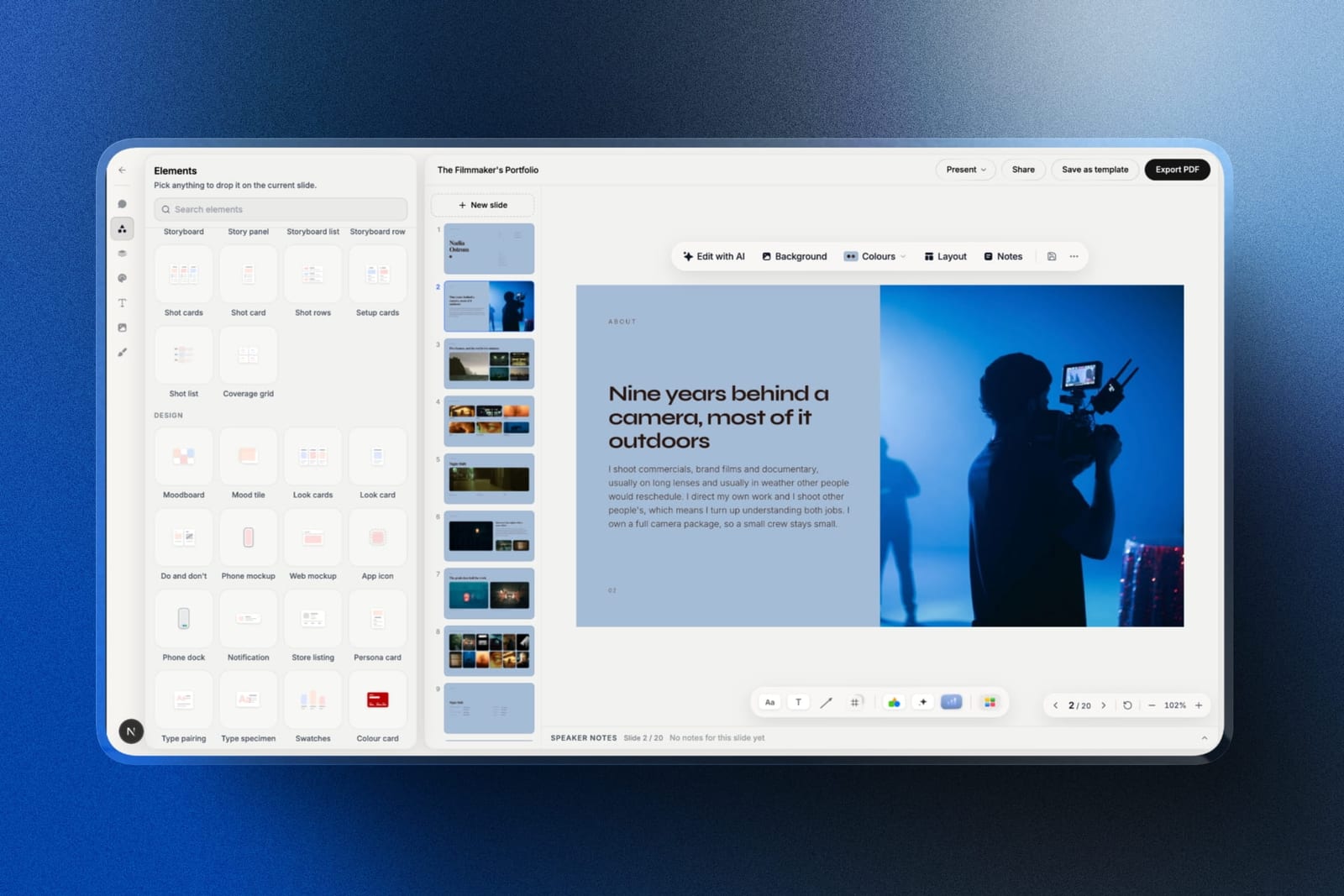
Be clear about the limit. Those swatches are typed values, not tokens pulled from Figma variables, so the deck is a snapshot for a meeting and it will drift exactly like the screenshot-based documentation this page warns about.
Present the system in the deck, then maintain it in one of the tools above.
Which Design System Documentation Tool Should You Choose?
The right tool depends on whether your system exists in code yet and on how many people genuinely maintain it, so work down these questions in order and stop at the first yes.
1. Do you have both a Figma library and components in Storybook? zeroheight, which connects to both and updates from them.
2. Is your main problem tokens drifting between design and code? Supernova, for the token pipeline and code generation.
3. Is your team engineering-led and cost-sensitive? Storybook, free, with documentation that lives in the repository and passes through code review.
4. Do brand guidelines and the design system need to live together? Frontify, accepting weaker component documentation.
5. Does your system exist only in Figma so far? Document it in Figma, and plan to move within a year.
6. Is the system small and slow-moving? Notion, at $360 a year for three editors, knowing nothing will sync.
7. Does your company already live in Confluence? Use Confluence, because documentation nobody visits is worse than documentation with no live examples.
8. Do you have fifty or more engineers and an adoption problem? Knapsack, and expect a sales process.
9.
Is what you actually need a public brand page rather than an internal reference? Publish it as a page and keep the two separate, which is the one branch Framekit answers: the public version and the client handover deck live there while the internal reference stays in whichever of the eight tools above you picked.
Frequently Asked Questions
What is the best design system documentation tool in 2026?
zeroheight is the best design system documentation tool for most teams, because it connects to both Figma and Storybook so component examples and token values update from their sources rather than from a person.
Supernova is the stronger choice when design token automation is the main problem, and Storybook is the best free option for engineering-led teams.
Is there a free design system documentation tool?
Storybook is free and open source with no seat limits, and documents components by rendering them from the actual codebase. zeroheight offers a free plan with one editor, one styleguide, and one token set, Supernova's free plan supports five members, and Confluence is free for up to ten users.
Why does design system documentation go out of date?
Documentation goes out of date because most of it is screenshots and typed values that have no connection to the source, so a component or token change leaves the documentation describing something that no longer exists.
Only four of the nine tools we tested render live component examples, and only five pull token values from a source of truth.
How much does zeroheight cost?
zeroheight's Starter plan is $49 per editor per month with a 15% discount on annual billing, and it caps at five editors, two styleguides, and three token sets.
The free plan includes one editor, one styleguide, and one token set, and anything beyond five editors requires an Enterprise quote.
Is Storybook enough on its own for design system documentation?
Storybook is enough for component documentation and not for a full design system, because it does not cover design tokens, usage guidance, accessibility notes, or the reasoning behind decisions, and designers who do not work in a repository rarely contribute to it.
Most mature setups run Storybook underneath zeroheight or Supernova rather than instead of them.
Can you document a design system in Notion?
You can document a design system in Notion, and it is a reasonable choice for a small, slow-moving system at $10 per user per month.
Nothing syncs, so every component example is a screenshot and every token is a typed value, which means the documentation begins to drift from reality the first time anyone changes a component.
What is the difference between design system documentation and brand guidelines?
Design system documentation describes components, tokens, and code for the people building a product, while brand guidelines describe logo usage, colour, tone, and asset rules for anyone representing the brand.
They have different audiences and update on different cycles, which is why tools that try to serve both usually do one of them noticeably better.
Which tools sync design tokens automatically?
Supernova, zeroheight, Knapsack, and Figma's own variables all handle tokens from a source rather than from a typed table, with Supernova going furthest by generating code in multiple formats from the same source.
Notion, Confluence, and Frontify all rely on someone entering and maintaining token values by hand.
How many people actually need editor seats?
In most teams two or three people edit design system documentation in a given quarter even when many more could, which makes per-editor pricing less costly than it first appears.
Supernova's split between builder and full seats is the pricing model that best matches this reality, since readers do not consume a paid seat.
Should design system documentation be public?
Internal design system documentation is usually private because it moves fast and contains unreleased work, while a public version is worth publishing when you work with contractors, agencies, or an open-source community.
Keeping them as two documents rather than one avoids either restricting the internal reference or leaking unfinished work.
What should a studio use to present a design system to a client?
A studio should present a new design system to a client in a deck and maintain it afterwards in a documentation tool, because the two jobs need different things.
Framekit Slides suits the presentation, with colour swatches and type specimens as ready-made elements and a share link or PDF for the client, but its values are typed rather than synced, so the living reference belongs in zeroheight, Supernova or Storybook.
Final Verdict
zeroheight is the right choice for most teams with a Figma library and a component library in code, because it removes the largest number of human steps between the source of truth and the published page, and that is the only thing that reliably keeps documentation true.
Supernova is the better pick when tokens are the pain and its builder-versus-full seat split is the fairest pricing in the category.
Storybook deserves more attention as a foundation than it usually gets. Documentation that lives in the repository and passes through code review cannot silently rot, which no hosted tool can fully promise.
Where Framekit loseswe do not document design systems and ranked ourselves ninth of nine for that reason.
Framekit has no component rendering, no token pipeline, no Figma or Storybook integration, and no version history for a system, so every tool above is a better answer to the question in the title.
Our narrow point is that the public brand page and the internal system reference are two documents, not one.
The number worth remembering is four of nine. Most tools in this category will happily let you document a system with screenshots, and screenshots are how documentation dies.
Related reading: our guides to the best brand guidelines software, the best brand guidelines tools, the best Figma alternatives, and the best client feedback tools for designers.
Pricing above was read from each vendor's published pricing in August 2026, except for Frontify and Knapsack, which are quote-only. Seat definitions vary considerably in this category, so confirm whether readers consume a licence before budgeting.