Framekit templates
Start from a designer-made template
 Use template
 Use template
 Use template
 Use template
 Use template
 Use template
 Use template
 Use template
The most expensive tool in this comparison costs $1,200 once. The second most expensive costs $1,068 a year, every year, and does considerably less.
Both of them stream video to the internet, both are good at it, and the difference between them over five years is roughly $4,100 for one person running the same seventy-minute broadcast once a month.
That is the shape of live streaming software in 2026, and it is not the shape the category advertises. Browser studios are sold on how quickly you can go live, which is a real benefit and a small one, because going live is the easy part.
What separates these tools is what happens when you need two cameras, a screen share, a guest whose wifi drops, and a clean recording afterwards that does not look like a video call.
So we ran the same launch through eight of them and wrote down what broke.
Live streaming software is an application that composites video sources, audio, and graphics into a single broadcast and sends it to one or more streaming destinations in real time, and the meaningful difference between products is how much production it can do before you have to add another tool.
OBS Studio is the best live streaming software in 2026 for anyone willing to spend an afternoon learning it, because it is free, open source, runs on Windows, macOS, and Linux, and does more than most paid tools, though it will not host remote guests without help.
StreamYard is the easiest browser option at $35.99 a month billed annually, Ecamm Live is the best Mac production tool at $192 a year, and vMix is the serious Windows answer with perpetual licences from $60 to $1,200.
Re-verified in September 2026: Framekit's plans were checked again and so was the note on where a stream lives once it is over, since Framekit gives the launch a page of its own and keeps the recording in a gallery instead of a feed; streaming prices are as checked in August 2026.
How We Ran the Same Broadcast Eight Times
We produced one real event in every tool rather than reviewing features on paper: a seventy-minute live product launch for a photographer releasing a preset pack.
Two camera angles, a screen share showing the presets applied in an editing application, lower-third name graphics, a live question and answer segment with two remote guests joining from different countries, a simulcast to two destinations at once, and a clean recorded master afterwards for a replay page.
Same script, same guests, same hardware, in August 2026.
That event was chosen because it crosses every boundary these tools draw. Two cameras separates a switcher from a webcam app. A screen share at readable quality is where cheap tools reveal their bitrate.
Remote guests are the single hardest thing in live production and the reason browser studios exist. Two destinations at once is a paid feature almost everywhere.
And a usable recording afterwards is the thing most people forget to check until the stream has ended.
Confidence labels run through the entries. Where we say something broke, held, or dropped, it happened during our broadcast.
Where a price is published, we read it on the vendor's own pricing page in August 2026.
Where a price is reported, it comes from third-party sources because the vendor page did not respond to our checks, which here applies only to Castr and is flagged in its entry.
Four tools we paid for and ran a full broadcast on: StreamYard Core, Ecamm Live Standard, Riverside Pro, and Switcher Studio Studio. Two we ran entirely free, which for one of them is the actual product: OBS Studio and Restream's free tier.
Two we ran on trials, and their entries say so rather than implying a longer test.
Our weighting, which you can reject: production capability 25 percent, remote guest handling 20 percent, five-year cost 20 percent, recording quality 20 percent, and setup time 15 percent.
Recording quality carries as much as cost because for most creatives the live audience is smaller than the replay audience, and a broadcast that streams beautifully and records badly has failed at the more valuable half of the job.
In one linewe produced the same seventy-minute two-camera product launch with two remote guests and a simulcast in eight tools in August 2026, weighting production capability and recording quality as heavily as price.
By the Numbers
Eight tools, one launch, one replay file. These figures decided the ranking, and the spread between the cheapest and most expensive credible option is larger here than in any category we have compared this year.
- $0 is the full price of the tool we ranked first, permanently, on Windows, macOS, and Linux.
- $60 buys vMix Basic HD as a perpetual licence, and $1,200 buys vMix Pro, both one-time payments with free updates for the first 12 months.
- $1,068 a year is StreamYard Advanced at $88.99 a month, the highest recurring cost in this comparison for an individual.
- 2 hours a month of local recordings is what StreamYard's free plan allows, and it puts a StreamYard logo in your stream.
- 2 channels at once is Restream's free simulcast limit, at 4K, with Restream branding.
- 720p is the export ceiling on Riverside's free plan, alongside 2 hours of one-off multi-track recording.
- $540 a year is Switcher Studio at $45 a month billed annually, the cheapest genuine multi-camera switcher here that runs on hardware you already own.
- 3 of 8 work without a monthly subscription: OBS Studio free, and vMix and, in effect, any tool you already own outright.
- $4,140 is the five-year difference between vMix HD at $350 once and StreamYard Advanced at $1,068 a year.
The Full Comparison Table
Prices below were read on the vendor's own pricing page in August 2026, except Castr's, which is marked reported. Five-year totals assume one user, annual billing where available, and no promotional discount.
| Tool | Best for | Entry price | Licence | Five-year cost |
|---|---|---|---|---|
| OBS Studio | Anyone willing to learn it | Free | Open source | $0 |
| StreamYard | Going live in ten minutes | $35.99/mo yearly Core | Subscription | About $2,159 |
| Restream | Streaming to many places | Free 2 channels, $16/mo yearly | Subscription | $0 to $950 |
| Ecamm Live | Mac production without OBS | $16/mo or $192/yr Standard | Subscription | $960 |
| Riverside | Recording quality first | Free 2h, $24/mo yearly Pro | Subscription | About $1,440 |
| vMix | Serious Windows production | $60 to $1,200 perpetual | One-time | $60 to $1,200 |
| Switcher Studio | Multi-camera from iPhones | $45/mo yearly Studio | Subscription | $2,700 |
| Castr | Streaming infrastructure | $16.67/mo yearly, reported | Subscription | About $1,000 |
The fourth column is the one to read first, because it is the only structural difference in this table. Two products here are bought. The other six are rented, and one of them is free forever.
1. OBS Studio: The Best Live Streaming Software Is Free
OBS Studio won on the least fashionable grounds available: it did the whole job, it did it better than tools costing $1,000 a year, and it cost nothing.
Two cameras, the screen share, lower thirds, scene transitions, and a local recording at full quality all worked, and the recording was the best of any tool in this comparison because it was written straight to disk uncompressed by a service in the middle.
The real number is zero. OBS Studio describes itself as free and open source software for video recording and live streaming, and it supports Windows 10 and 11, macOS 12.0 or newer with separate Intel and Apple Silicon builds, and Linux.
There is no paid tier, no watermark, no account, and no telemetry-driven upsell. The project is funded by sponsors rather than by users.
Over five years against StreamYard Advanced at $1,068 a year, that is a $5,340 difference for a tool that does more scenes, more sources, more encoders, and better recordings.
The honest cost of OBS is not money, it is one afternoon of setup and a second afternoon six months later when you want something you did not know it could do.
The standout detail nobody mentions in a comparison: OBS records and streams simultaneously with independent settings, so you can broadcast a 1080p stream and record a 4K local master of the same broadcast at once.
Almost every subscription tool here couples the two, which is why so many replays look like a compressed livestream rather than a video.
The gotcharemote guests. OBS has no native way to bring a person into your show, and our two Q and A guests required a browser source plus a third-party service to appear at all. This is the single reason browser studios exist and it is a real limitation rather than a snobbish one.
Skip it ifthe broadcast is next Tuesday and you have never used it. The learning curve is not steep so much as wide, and there is no version of "quick" here.
Verdict: Free, more capable than anything paid in this article, and genuinely harder to use. If you produce more than three streams a year, learn it once and stop paying anyone.
Live launches convert best when the replay lives somewhere permanent; our guide to selling digital products from your own site covers where that traffic should land.
2. StreamYard: Live in Ten Minutes, Expensive Forever
StreamYard is the fastest route from a decision to a broadcast in this comparison, and for many creatives that is worth paying for.
Our two remote guests joined by clicking a link with no software, no account, and no explanation, which is the thing OBS cannot do and the thing that most often ruins a live show.
The real numbers: StreamYard's free plan puts a StreamYard logo in your stream, limits local recordings to 2 hours a month, allows 6 on-screen participants, and gives limited storage.
Core is $44.99 a month or $35.99 billed annually, a 22 percent discount, with 1080p, no logo, 3 multistream destinations, and 50 hours of permanent storage.
Advanced is $88.99 a month or $68.99 billed annually, with 4K local recordings, 8 destinations, 15 backstage participants, and webinars for 100 viewers.
Both Core and Advanced are described as individual use only, with organisations directed to business plans.
At $431.88 a year for Core and $827.88 for Advanced, StreamYard is the most expensive recurring option here for an individual, and the "individual use only" note on both tiers is worth reading twice if you are a studio rather than a person.
The standout detail: the guest experience genuinely is the product. Guests never install anything, never see your scenes, and cannot accidentally end the broadcast, and in a category where the most common failure is a guest who cannot get in, that is not a small feature.
The gotchaeverything is browser-based, which means your production quality is bounded by your upload connection and your browser rather than by your machine. Our screen share of an editing application was noticeably softer here than the same share out of OBS or Ecamm.
Skip it ifyou never have remote guests. You are paying $431.88 a year for the one thing you do not need.
Verdict: The right answer for interview shows, panels, and anything with guests, at $431.88 a year. The wrong answer for a solo broadcast, where OBS does more for nothing.
3. Restream: The Multistreaming Layer, Not the Studio
Restream is best understood as plumbing rather than as a studio.
Its job is to take one outgoing stream and deliver it to many destinations at once, and it does that more reliably and more cheaply than the multistream features built into the studios in this comparison.
It also has a browser studio of its own, which is competent and not the reason to be here.
The real numbers: Restream's free plan streams to 2 channels at once at up to 4K with Restream branding. Standard is $19 a month or $16 billed annually at $190 a year.
Professional is $49 a month or $39 annually at $470. Business is $239 a month or $199 annually at $2,390. Enterprise is quoted.
Free 4K simulcasting to two destinations is the most generous free tier in this comparison and it is a genuinely useful product rather than a teaser.
For a creative going out to YouTube and Instagram simultaneously, the free plan plus OBS is a complete professional setup at zero cost, with the only compromise being Restream branding.
The standout detail: because Restream sits downstream of your encoder, it works with whatever studio you already use.
Pairing it with OBS gets you multistreaming without paying StreamYard's per-destination tiering, which is the cheapest path to a multi-platform broadcast that we found.
The gotchathe branding on the free tier appears in your stream, and removing it is the main reason to reach Standard at $190 a year, which is a lot to pay for the absence of a logo.
Skip it ifyou broadcast to one destination. There is no multistreaming problem to solve and the studio alone is not the strongest here.
Verdict: The best free simulcast in this comparison and the correct partner for OBS. Buy Standard at $190 a year only when the branding starts to matter commercially.
4. Ecamm Live: The Mac Production Tool That Should Be Better Known
Ecamm Live is what OBS would be if someone had designed it.
It is Mac-native, it handles multiple cameras and a screen share without a configuration file, and its interface assumes you are making a show rather than configuring a broadcast engine.
Our seventy-minute launch was the least stressful production of the eight, and the second fastest to set up after StreamYard.
The real numbers: Ecamm Live offers a 14-day free trial, Standard at $16 a month or $192 a year billed as one payment, and Pro at $32 a month or $384 a year, with the annual plans representing a 20 percent saving.
It is a Mac application, which is the constraint that decides whether it is available to you at all.
At $192 a year, Ecamm Standard costs less than half of StreamYard Core and does considerably more production.
Against OBS at zero it costs $960 over five years, which buys you setup time, native performance, and an interface that does not require you to understand what an encoder preset is.
The standout detail: Interview Mode brings in remote guests without a browser studio, which closes the one real gap between a local production tool and something like StreamYard. It is not as frictionless as StreamYard's guest link, and it exists, which is more than OBS can say.
The gotchaMac only, permanently, and there is no meaningful path to a Windows collaborator running your show.
Skip it ifyou are on Windows, where vMix occupies this exact position, or you are unwilling to pay anything, where OBS occupies it for free.
Verdict: The best value in this comparison for Mac users who want production quality without the OBS learning curve, at $192 a year. Underrated against tools costing twice as much.
5. Riverside: Records Beautifully, Streams Adequately
Riverside solves the problem that ruins most creative livestreams: the recording.
Instead of capturing the compressed stream, it records each participant locally at full quality and uploads those tracks separately, so a guest whose connection stuttered live still appears clean in the replay.
Our Q and A guests both had visible drops during the broadcast and neither drop exists in the recorded master.
The real numbers: Riverside's free plan gives 2 hours of multi-track recording as a one-off with export up to 720p. Pro is $29 a month or $24 billed annually at $288 a year.
Grow is $39 a month or $34 annually at $408. Webinar is $99 a month or $79 annually. Business is quoted.
The 720p ceiling on free is the honest line: you can evaluate the local-recording model completely and you cannot deliver from it.
At $288 a year, Pro is mid-priced in this comparison and is the only tool here where the recording is architecturally better rather than incidentally better.
The standout detail: separate tracks per participant. For anyone who intends to cut the replay into a proper edited video rather than posting the stream as-is, that is the difference between an editable project and a flat file, and no other tool in this comparison offers it.
The gotchaas a live production tool it is basic. Scene composition, graphics, and multi-camera switching are all limited compared with OBS, Ecamm, or vMix, and it is best thought of as a recording studio that can also go live.
Skip it ifthe live broadcast is the deliverable and the replay is an afterthought. You are paying for the wrong half.
Verdict: The best recording quality here at $288 a year and the reason to choose it is the replay, not the stream. Pair it with OBS if you want both halves done well.
6. vMix: Broadcast Production You Buy Once
vMix is the professional Windows answer and the only tool in this comparison that scales into genuine broadcast territory: instant replay, multi-camera recording, NDI, unlimited inputs, and hardware integration that the browser studios do not attempt.
Our launch was overkill for it, which is the correct relationship to have with a tool like this.
The real numbers, which are unusual in 2026 and worth stating plainly: vMix sells perpetual licences at $60 for Basic HD, $350 for HD, $700 for 4K, and $1,200 for Pro, each including free updates for the first 12 months, with a $60 upgrade for a further 12 months of version updates.
A MAX subscription is $50 a month. There is a fully functional 60-day trial.
Look at the arithmetic against a subscription. vMix HD at $350 once, against StreamYard Advanced at $827.88 a year, breaks even in under six months and then costs nothing except an optional $60 a year for updates.
Over five years that is roughly $350 to $650 against $4,139, which is the largest gap in this article.
The standout detail: the 60-day trial is fully functional. In a category where trials are 14 days and feature-limited, two months of unrestricted professional software is enough to produce a real season of shows before deciding.
The gotchaWindows only, and the entry-level Basic HD at $60 is genuinely basic, with instant replay and MultiCorder starting at the 4K tier. Work out which edition you need before anchoring on the $60.
Skip it ifyou are on a Mac, or your production will never involve more than two cameras and a screen share.
Verdict: The best long-run value for serious Windows production, at $350 once for the edition most creatives would actually use. Buy the tier you need rather than the cheapest one.
7. Switcher Studio: Multi-Camera From Phones You Already Own
Switcher Studio does something no other tool here attempts: it turns several iPhones and iPads into a synchronised multi-camera rig, controlled from one device, with no capture cards, no cables, and no dedicated computer.
For a photographer with two old iPhones in a drawer, that is a three-camera production for the price of software.
The real numbers: Switcher Studio prices Studio at $65 a month or $45 a month billed annually at $540 a year, and Suite at $99 a month or $79 annually at $948 a year, with promotional first-period rates advertised.
A three-month Studio Seasonal option is offered at $55 a month, $165 in total. It runs on Mac, iPad, and iPhone.
At $540 a year, Studio is more expensive than Ecamm and cheaper than StreamYard Core, and the comparison that matters is against hardware.
A comparable multi-camera setup using conventional gear starts well above $540, so for one or two events a year the Seasonal option at $165 for three months is the shrewdest purchase in this article.
The standout detail: that seasonal plan. A creative who does a product launch each spring and nothing else in between can produce two professional multi-camera events a year for $330, which no subscription-only competitor allows.
The gotchait is an Apple-ecosystem product, and stream quality depends heavily on the wifi carrying several phones at once. Wire the controlling device if you can.
Skip it ifyou have a computer, a capture card, and a Windows machine. vMix does more for less over time.
Verdict: The cheapest genuine multi-camera production available if you own iPhones, at $540 a year or $165 for a season. A specialist tool that is excellent at its specialism.
8. Castr: Infrastructure Rather Than a Studio
Castr belongs in this comparison because a portion of people searching for streaming software actually need streaming infrastructure: an ingest point, a player they can embed on their own site, cloud recording, and in some cases a paywall.
It is the layer beneath the studio rather than a competitor to it.
The real numbers are reported rather than published, because Castr's pricing page did not respond to our automated checks.
Third-party sources in 2026 report a Starter plan at $19.99 a month or $16.67 billed annually including roughly 2.4TB of bandwidth and 6 multistream destinations, with a Premium tier reported around $199.99 and higher event and OTT packages above that.
Confirm at the source before acting on those figures.
The reason a creative would want this rather than a studio is embedding.
Streaming to YouTube puts your launch next to recommendations for other people's work; streaming to a player embedded on your own page keeps the viewer where they can buy something, and that is a commercial difference rather than a technical one.
The standout detail: cloud recording and the embeddable player together mean the replay lives on your own page from the moment the stream ends, with no upload step. For a launch with a limited-time offer, that removes the gap where momentum is usually lost.
The gotchabandwidth is metered, and a successful stream costs more than an unsuccessful one. Model your expected viewer count against the included allowance before choosing a tier, because overage is where this category surprises people.
Skip it ifyou are happy broadcasting to YouTube or Instagram and do not need the video on your own site.
Verdict: The right tool when the stream must live on your own domain rather than a platform, at a reported $16.67 a month. Not a studio, and it should be paired with OBS or vMix rather than replacing them.
Subscription or Perpetual: The Five-Year Arithmetic
This category still contains one-time purchases, which is rare enough in 2026 to be worth taking seriously, and the numbers are not close. Here is what one person producing a monthly seventy-minute broadcast pays over five years, using the figures above.
Buy once and the total stops. OBS Studio is $0. vMix Basic HD is $60, HD is $350, 4K is $700, and Pro is $1,200, each with 12 months of updates and an optional $60 a year afterwards.
Even vMix Pro, the most expensive item in this article, is $1,200 over five years, or $1,440 with updates maintained throughout.
Subscribe and the total compounds. Ecamm Live Standard is $960 over five years. Restream Standard is $950. Riverside Pro is $1,440. StreamYard Core is about $2,159 and Advanced about $4,139. Switcher Studio is $2,700.
The comparisons that matter are the ones people rarely make. vMix Pro, a genuine broadcast switcher, costs less over five years than StreamYard Core, a browser studio. vMix HD at $350 costs less over five years than a single year of StreamYard Advanced.
And OBS Studio, which is more capable than every subscription tool here except vMix, costs nothing at all.
The defensible argument for subscribing is the same as in every software category: continuous updates, hosted infrastructure you do not maintain, and remote guest handling that a local application cannot easily provide.
Two of those are real. The third, guests, is genuinely the thing browser studios sell and the reason StreamYard's price survives contact with this table.
In one linevMix Pro at $1,200 once costs less over five years than StreamYard Core at $431.88 a year, and OBS Studio does more than either for nothing, so the honest justification for a subscription is remote guests rather than capability.
What Free Tiers Actually Let You Broadcast
Free is unusually meaningful here because one genuinely free product tops the ranking, but the free tiers attached to paid products are a different thing entirely and they stop in very specific places.
No limits at allOBS Studio has no paid tier, no watermark, no time limit, and no account. It is free in the way open-source software is free rather than in the way a trial is free.
Branded but usableRestream's free plan streams to 2 channels at once at up to 4K with Restream branding, which is a complete multistreaming solution with a logo attached.
StreamYard's free plan puts a StreamYard logo in your stream, allows 6 on-screen participants, and caps local recordings at 2 hours a month.
Evaluation onlyRiverside's free plan gives 2 hours of one-off multi-track recording with export capped at 720p, which proves the model works and cannot deliver a client-quality file.
Ecamm Live offers a 14-day trial rather than a free tier, and vMix offers a fully functional 60-day trial, which is by far the most generous evaluation period in this comparison.
The practical conclusion for a creative doing two or three streams a year is that this category can cost nothing.
OBS Studio for production, Restream free for simulcasting to two destinations, and a local recording written straight to disk is a complete setup with no subscription and no expiry, and its only real deficiency is remote guests.
In one lineOBS Studio plus Restream's free 2-channel tier is a complete no-cost streaming setup with no expiry, and the only thing it cannot do is bring a remote guest into the show.
The Recording Is the Part Most People Get Wrong
For most creatives the live audience is smaller than the replay audience, sometimes by an order of magnitude, which makes the recording the more valuable output and the one least examined during a purchase decision. Three mistakes account for almost every disappointing replay.
Recording the stream instead of the source. If your tool saves the outgoing broadcast, you have a file compressed for live delivery, with every dropped frame and bandwidth dip baked in permanently.
OBS records and streams simultaneously with independent settings, so a 1080p stream can sit alongside a 4K local master of the same show.
Riverside goes further and records each participant locally before uploading, which is why a guest who stuttered live can look clean in the replay.
Accepting a single flattened file. A replay you intend to edit needs separate tracks, and only Riverside provides them per participant as a matter of architecture. Everything else here gives you a finished composite, which is fine to publish and painful to cut.
Ignoring the storage cap. StreamYard free allows 2 hours of local recordings a month and Core includes 50 hours of permanent storage.
Cloud storage limits are where hosted studios quietly meter you, and a year of monthly seventy-minute shows is fourteen hours before you have re-recorded anything.
The habit that fixes all three costs nothing: always write a local recording in parallel, whatever tool you are using, and download the cloud copy within a week. Every product in this comparison can do the first, and no product will remind you to do the second.
In one linealways capture a local master in parallel with the stream, because a recording of the outgoing broadcast carries every dropped frame permanently and the replay is usually the larger audience.
The Twenty-Minute Test to Run Before Your First Real Stream
Do this once, with your actual gear, a week before anything matters. Set up your two cameras and your screen share, start a private or unlisted broadcast, and run it for twenty minutes while doing three specific things.
First, watch your own stream on a phone using mobile data rather than your wifi, because that is what your audience sees and it is the only reliable test of your upload.
Second, have one person join as a remote guest, since guest onboarding is the most common live failure and the only feature that reliably justifies a subscription.
Third, stop the stream and open both the recording and the stream archive side by side, because if they look the same you are recording the compressed broadcast and should change that setting before it costs you a replay.
Twenty minutes now saves the launch.
The Gear That Changes a Stream, in Order
Software choice is the question people ask and roughly the fourth most important thing about how a broadcast lands. After producing the same seventy-minute launch eight times, the order that actually matters is consistent and it is not the order people buy in.
Audio first, by a distance. An audience will watch a soft picture for an hour and will leave a good-looking stream with hollow, roomy sound in about ninety seconds.
A microphone close to your mouth, on a stand rather than in a hand, in a room with something soft in it, outperforms every other single change available to you. This is also the cheapest fix on the list.
Upload second. Everything a browser studio can do is bounded by the connection carrying it, and a wired connection removes the single most common cause of a stream that judders at the worst moment.
Test by watching your own broadcast on a phone using mobile data rather than on the machine producing it, because the machine producing it always looks fine.
Light third. One soft source in front of you, roughly at eye level, beats a better camera in worse light every time. A window works.
The reason lighting outranks the camera is that every camera in the world looks acceptable when the light is good and no camera looks acceptable when it is not.
Camera fourth. The phone you already own, mounted and lit properly, is genuinely sufficient for a product launch, and Switcher Studio exists specifically to turn several of them into a multi-camera rig.
Upgrading the camera while the audio is still poor is the most common way creatives spend money on this without improving anything.
In one lineaudio, then upload, then light, then camera, and a phone in good light with a close microphone beats an expensive camera in a bright room every time.
Running the Show, Not Just Building It
The part of live production that nobody documents is the twenty minutes before you go live and the structure you follow once you are, and it is where most broadcasts are won or lost regardless of software.
Write a rundown, which is simply a list of segments with a rough duration against each. Ours for the seventy-minute launch was nine lines long.
It is not a script and it is not for the audience; it exists so that when something goes wrong you know what you were about to do next, which is the thing that disappears from your head the moment a guest's connection drops.
Then run the same pre-flight every time, and keep it short enough that you actually will. Check that the recording is running and writing where you expect.
Check audio levels on every source, including the guests, because a guest who joined late is the one who is inaudible. Confirm your simulcast destinations are connected rather than merely configured.
And watch thirty seconds of your own stream on a phone on mobile data.
Two habits from the broadcasts that went smoothly. Start the recording a couple of minutes before you go live and stop it a couple of minutes after, so the edit has handles rather than clipped starts.
And have one holding card or slide ready to cut to, because the only reliable fix for a technical problem happening live is to put something else on screen while you solve it, and improvising that card at the moment of failure never works.
In one linewrite a nine-line rundown, run the same four-item pre-flight every time, record with a two-minute pad at each end, and prepare one holding card to cut to when something breaks.
The Decision Guide
Take these in order and stop at the first one that fits. The ranking says which tool is strongest; this says which one belongs on your machine, and in this category those differ for almost everyone.
Start with guests. Will remote people appear in your broadcast regularly? If yes, you need a browser studio or Interview Mode, which means StreamYard Core at $431.88 a year or Ecamm Live Standard at $192 a year on a Mac.
If no, continue, because you have just removed the main reason to pay anyone.
Are you willing to spend one afternoon learning a tool that then costs nothing forever? If yes, OBS Studio, plus Restream's free tier if you need to reach two destinations at once. That combination is a complete professional setup at $0. If no, continue.
Are you on a Mac? If yes, Ecamm Live at $192 a year is the best production quality per dollar in this comparison and requires no configuration files. If no, continue.
Are you on Windows and producing regularly enough to buy rather than rent? If yes, vMix, and choose the edition rather than the price: Basic HD at $60 for simple work, HD at $350 for most creative productions, 4K at $700 if you need instant replay or MultiCorder, Pro at $1,200 for broadcast.
Use the fully functional 60-day trial first.
Is the replay more important to you than the live show? If yes, Riverside Pro at $288 a year, because separate locally-recorded tracks per participant is an architectural advantage no other tool here has.
Do you own two or more iPhones or iPads and no capture hardware? If yes, Switcher Studio at $540 a year, or $165 for a three-month season if you produce one or two events a year rather than a monthly show.
Does the stream need to play on your own website rather than on a platform? If yes, add Castr at a reported $16.67 a month for the embeddable player and cloud recording, and keep OBS or vMix as the studio in front of it.
Any branch. Are you about to go live for the first time? Run a twenty-minute private test with a guest and check that your recording is not simply a copy of the compressed stream.
Where Your Website Fits In
A live launch has a shape that every tool in this comparison ignores.
Something happens for seventy minutes, a few hundred people watch, and then the thing that determines whether it made any money is a page: the replay, the offer, the checkout, and the reason to trust you, all in one place, still working at two in the morning when someone finally clicks the link a friend sent them.
Framekit is where we work on that page, and it is our own product, so weigh this section accordingly. It is not streaming software and we deliberately kept it out of the rankings.
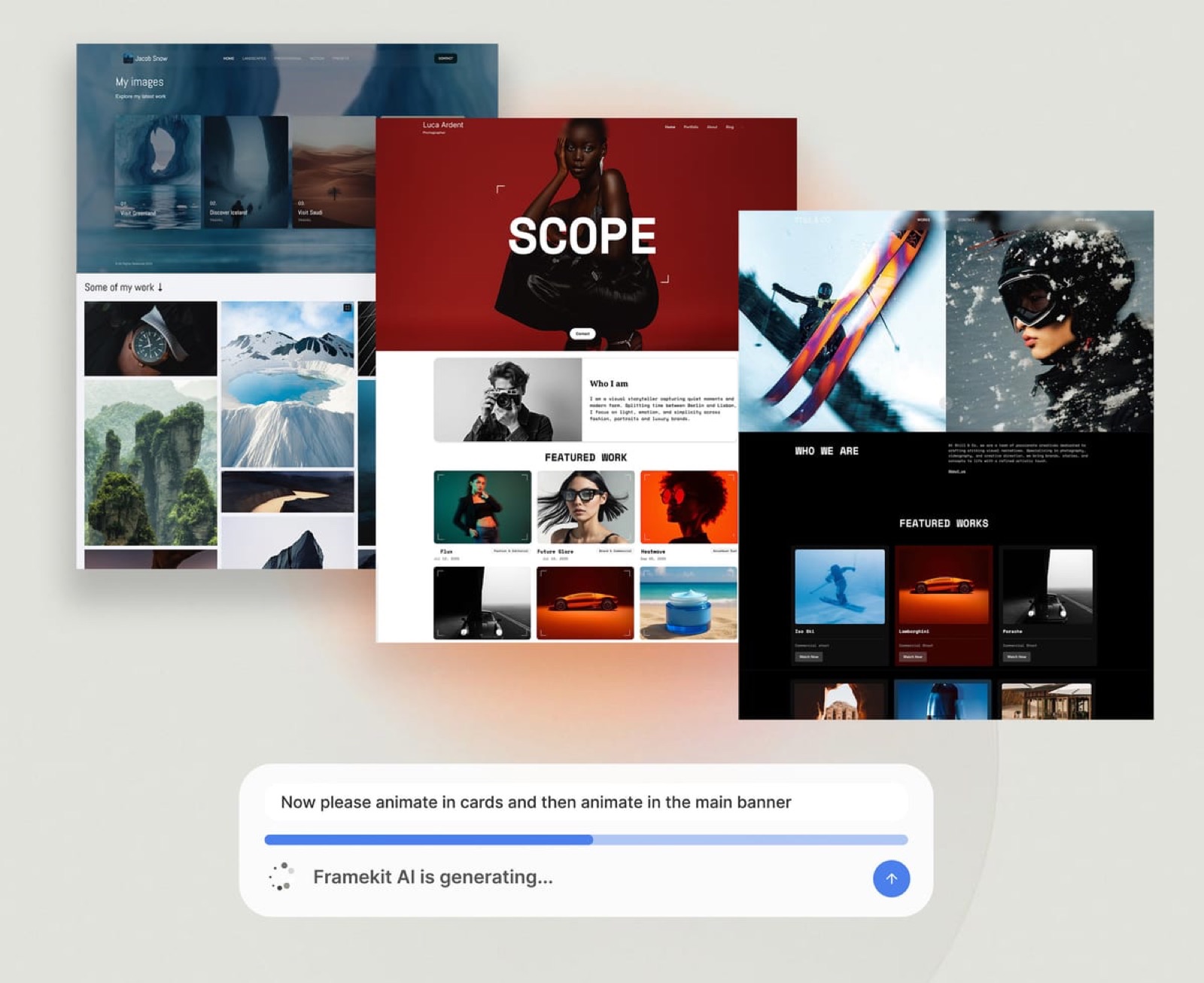
Framekit is an AI website builder for photographers, filmmakers, designers, and illustrators, and what it produces is the destination a launch points at: a portfolio establishing why you are worth watching, a store that sells the preset pack or the course, and client galleries, on your own domain.
The practical connection is a conversion one and it is easy to underestimate. A stream on YouTube ends with recommendations for other people's work.
The same stream embedded on your own page ends with your product, your price, and your checkout, which is the difference between an audience and a customer list.
Framekit plans start at $0 with a 5 percent fee on product sales, Pro is $19 a month with a 3 percent fee, and Business is $39 a month with no transaction fee, which is the tier that matters on a launch day that goes well.
If your broadcast quality is better than the page it drives traffic to, more production is not the fix.
Frequently Asked Questions
What is the best free live streaming software?
OBS Studio is the best free live streaming software and the best overall in this comparison. It is free and open source, runs on Windows 10 and 11, macOS 12.0 or newer, and Linux, and has no paid tier, watermark, or time limit.
It handles multiple cameras, screen shares, graphics, and simultaneous streaming and recording with independent settings. Its one real weakness is remote guests, which it cannot host without a third-party service.
Restream's free tier adds simulcasting to 2 channels at up to 4K with Restream branding.
Is StreamYard worth the price?
StreamYard is worth $431.88 a year on Core if remote guests appear in your broadcasts regularly, because guests join by clicking a link with no software and no account, which is the most common point of failure in live production and the thing OBS cannot do.
It is poor value for a solo broadcaster: Core costs about $2,159 over five years for a browser studio, while OBS is free and vMix Pro, a full broadcast switcher, is $1,200 once.
OBS vs StreamYard: which should a creator use?
Use OBS if you broadcast alone and can spend an afternoon learning it, and StreamYard if you regularly have remote guests and want zero setup.
OBS is free, more capable, and records a separate high-quality local master while streaming at a lower bitrate.
StreamYard is $44.99 a month or $35.99 billed annually, browser-based so production quality is bounded by your connection, and dramatically easier for guests.
Many creators end up running OBS and paying for a guest solution only when they need one.
Can I stream to YouTube and Instagram at the same time for free?
Yes. Restream's free plan streams to 2 channels at once at up to 4K, with Restream branding shown. Paired with OBS Studio as the encoder, that is a complete two-destination broadcast setup at no cost.
Removing the branding requires Standard at $19 a month or $16 billed annually at $190 a year. StreamYard includes 3 destinations on Core at $35.99 a month billed annually and 8 on Advanced.
Is vMix better value than a subscription?
Over any period longer than about a year, yes, for Windows users. vMix sells perpetual licences at $60 for Basic HD, $350 for HD, $700 for 4K, and $1,200 for Pro, each with 12 months of free updates and an optional $60 a year afterwards.
StreamYard Core is $431.88 a year and Advanced $827.88, so vMix HD pays for itself in under a year against Core and in about five months against Advanced. There is a fully functional 60-day trial, which is unusually long.
Which streaming tool records the best quality?
Riverside, because it records each participant locally at full quality and uploads those tracks separately, so connection problems during the broadcast do not appear in the recording.
Its free plan allows 2 hours of one-off multi-track recording with export capped at 720p, and Pro is $29 a month or $24 billed annually at $288.
OBS is the best of the local tools, since it can record a 4K master while streaming 1080p with independent settings, but it captures your own feed rather than each guest's.
Do I need a powerful computer to live stream?
Less than the category implies, and the constraint is usually upload bandwidth rather than processing.
Browser-based tools like StreamYard and Restream do the compositing on their servers, so a modest machine is fine and your connection is the ceiling.
Local tools like OBS, Ecamm Live, and vMix use your machine to encode, which produces better quality on good hardware and struggles on old hardware.
Test by watching your own stream on a phone using mobile data before your first real broadcast.
What is the cheapest way to do a multi-camera livestream?
If you own two or more iPhones or iPads, Switcher Studio at $45 a month billed annually, or $55 a month for a three-month season at $165 total, turns them into a synchronised multi-camera rig with no capture hardware.
If you have a computer and capture cards, OBS Studio does multi-camera for free. On Windows, vMix HD at $350 once is the long-run cheapest professional route.
The expensive path is a browser studio, which is not designed for multi-camera work.
Should my livestream be on my own site or on YouTube?
Both, ideally, and the reason is commercial rather than technical. Streaming to YouTube gives you discovery and ends the viewing session with recommendations for other people's work.
Embedding the stream on your own page keeps the viewer next to your product and your checkout.
Castr, at a reported $16.67 a month billed annually, provides the ingest, embeddable player, and cloud recording to do the second, and it is paired with OBS or vMix rather than replacing them.
What happens to my streams and recordings if I cancel?
Cloud storage is where hosted studios meter you, and it is the thing to check before you cancel rather than after.
StreamYard's free plan allows 2 hours of local recordings a month and Core includes 50 hours of permanent storage, so a year of monthly hour-long shows approaches the limit.
The habit that removes the risk entirely is to write a local recording in parallel with every stream, which every tool in this comparison supports, and to download cloud copies within a week of each broadcast.
Final Verdict
OBS Studio is the best live streaming software in 2026, and it costs nothing.
It composites more sources than any paid tool here except vMix, it streams and records simultaneously with independent settings so your replay is not a compressed copy of your broadcast, and it runs on Windows, macOS, and Linux with no account, no watermark, and no expiry.
Against StreamYard Advanced at $827.88 a year, that is a $4,139 difference over five years in favour of the more capable tool.
Where OBS loses is specific and it is the reason this category has a paid tier at all: remote guests.
It has no native way to bring a person into your show, and if your broadcasts are interviews, panels, or anything with a co-host, that gap will cost you more in failed shows than a subscription costs in money.
It is also genuinely harder than everything else here, and if your first stream is next week you should not be learning it now.
The honest summary after producing the same launch eight times: if you stream alone, use OBS and Restream's free tier and pay nothing.
If you have guests, pay for Ecamm Live at $192 a year on a Mac or StreamYard Core at $431.88 a year anywhere.
If you are on Windows and producing regularly, buy vMix rather than renting a studio, because $350 once beats $431.88 a year in the first twelve months and every year after.
And if the replay matters more than the broadcast, Riverside at $288 a year is the only tool here whose recording is architecturally better rather than accidentally better.
Whatever you choose, remember that the stream is the event and the page is the business. A launch that goes perfectly and points at a weak site has produced an audience rather than a customer, which is a good use of seventy minutes and a poor use of a product.
Related readingThe best screen recording tools for creators, podcast hosting platforms, and website builders for filmmakers.
Also in this seriesvideo editing software, AI avatar video tools, and podcast editing software.