Framekit templates
Start from a designer-made template
 Use template
 Use template
 Use template
 Use template
 Use template
 Use template
 Use template
 Use template
Everyone's Miro story is the same. You start free, the canvas is genuinely great, and about eight weeks later you hit three boards and the archive prompt appears.
Now it is $8 per member per month, and you are looking at a team of ten and doing arithmetic you did not expect to be doing about sticky notes.
That arithmetic is why most people search for Miro alternatives, and it is worth being precise about it: Miro Starter is $96 a year per person, and Business is $240. For ten people that is $960 or $2,400 a year.
A whiteboard tool is a shared infinite canvas where a distributed team can post notes, sketch diagrams, cluster ideas, and vote, in real time, usually with templates and facilitation features layered on top.
Framekit, which we make, is none of that and is not ranked here; it is where the decision a workshop reached gets written up as a page or a deck that outlives the board.
The best Miro alternative in 2026 is FigJam, because a Figma Collab seat costs $3 a month, which is $36 a year against Miro Starter's $96, and content moves cleanly in and out of Figma design files.
The honest trade-off is that FigJam's diagramming and facilitation tooling are both a clear step behind Miro's, so large structured workshops are harder to run.
Milanote is the pick for creative and visual work rather than product process, Mural is the closest like-for-like at scale, and Excalidraw is free, open source, and better than it has any right to be.
Full disclosure: Framekit is our own product and it is deliberately not ranked below, because neither its website builder nor its Slides deck tool is a whiteboard. It appears once, in a clearly labelled section about what happens to a board after the session.
Re-verified on 19 September 2026 to describe Framekit's current products accurately, and read through again on 20 September 2026; the whiteboard prices below are as published in August 2026.
How We Tested These Miro Alternatives
We ran the same discovery workshop in every tool with the same eight participants: roughly a hundred and forty sticky notes, affinity clustering into six themes, dot voting, a timed silent-writing round, and a twenty-two-node systems diagram built afterwards from the results.
The carried scenario is a ten-person product and design team running one workshop a week.
Facilitation. Timers, voting, private mode, and the ability to bring everyone's viewport to yours. These are what separate a canvas from a workshop tool.
Diagramming. Whether connectors stay attached and reroute sensibly when you move a box, tested on the same twenty-two-node diagram in every tool.
Free-tier reality. What the free plan actually allows, since every product in this category has a generous-sounding free tier with one specific cap that matters.
Cost for ten people a year, at annual rates, which is the number that brought most readers here.
What happens to the board afterwards. Export options, searchability, and whether anyone can interpret it three months later.
Kept apart so you can weigh them separately. Ours by hand: the twelve workshop runs, the diagram builds, the export tests, and the free-tier checks, all in August 2026.
From vendor pricing pages: every price, linked inline where the figure is doing real work in the argument. From other people: recurring themes in public reviews, always labelled as sentiment rather than as our result.
What Twelve Whiteboards Have in Common
Running one workshop twelve times makes the shape of this category obvious in a way no feature grid does.
- 3 of 12 are genuinely free with no board cap: Excalidraw, tldraw, and Apple Freeform.
- 7 of 12 cap their free plan at three boards or fewer. This is the industry's standard conversion point.
- 4 of 12 have facilitation tooling comparable to Miro's. The rest are canvases with a timer bolted on.
- Cost for ten people ranged from $0 to $2,400 a year.
- 2 of 12 move content into and out of a design file without becoming an image.
- Only 1 of 12 stores boards as plain files on your own machine, which is the single best answer to what happens when a subscription lapses.
Miro Alternatives Compared
The weighting: cost 25%, facilitation 20%, canvas quality 20%, diagramming 20%, what survives afterwards 15%. Cost carries the most because it is the stated reason people leave Miro, and if your reason is different you should re-weight and expect the order to change.
| Tool | Free plan | Entry paid price | Facilitation depth | Diagramming |
|---|---|---|---|---|
| Miro | 3 editable boards | $8/member/mo annual | Strong | Strong |
| FigJam | 3 files | $3/mo annual (Collab seat) | Moderate | Basic |
| Milanote | 100 items, 10 uploads | $9.99/mo annual | Low | Low |
| Mural | Limited murals | From about $12/member/mo | Strong | Moderate |
| Lucidspark | 3 editable boards | From about $9/mo | Moderate | Strong |
| Canva Whiteboards | Yes, in free Canva | $144/yr with Canva Pro | Low | Basic |
| Excalidraw | Unlimited, free | Free, plus optional Excalidraw Plus | Low | Moderate |
| Whimsical | Limited boards | From about $10/editor/mo | Low | Strong |
| Microsoft Whiteboard | With a free account | Included with Microsoft 365 | Low | Basic |
| Apple Freeform | Free on Apple devices | Free | None | Basic |
| tldraw | Unlimited, free | Free, open source | None | Moderate |
| Obsidian Canvas | Free, local files | Free for personal use | None | Basic |
1. FigJam: The Best Miro Alternative Overall
Best forteams whose whiteboarding happens around design and product work.
FigJam ran our workshop competently and won on two things Miro cannot match. The first is price.
The second is that screens pasted from a Figma file arrive as real vector content rather than screenshots, and anything annotated on the board can go straight back into the design file without being transcribed.
That round trip is the whole argument. In every other tool here, a design critique produces notes on a board that someone then retypes into Figma, and the retyping is where decisions quietly get lost.
The real numbera Figma Collab seat is $3 a month billed annually, which is $36 a year and includes full editing in FigJam and Figma Slides with no design-file editing.
Ten people cost $360 a year against Miro Starter's $960 and Miro Business's $2,400.
The standout detailthe free Starter plan gives three FigJam files plus unlimited drafts, and drafts can be shared view-only. For a solo designer running occasional sessions, that is often enough indefinitely.
The gotchadiagramming is the weak point. Our twenty-two-node systems diagram took thirty-eight minutes against Miro's twenty-six, and one section had to be laid out by hand because the connectors stopped keeping it readable at density.
Skip it ifyou run workshops of twenty-plus people. Clustering a hundred and forty notes without Miro's frame and grid tools is noticeably slower.
What reviewers say elsewhereFigma holds a 4.7 out of 5 across more than 1,200 reviews on G2, where collaboration is the most consistently praised attribute.
Verdict: the correct default for any team with designers in it, at roughly a third of Miro's price. You trade facilitation depth and diagramming for cost and a round trip that removes real work.
Already deciding between exactly these two? Our Miro versus FigJam head-to-head puts the workshop, the diagram, and the pricing side by side.
2. Milanote: Best for Creative and Visual Thinking
Best forcreative teams, art directors, and writers rather than product squads.
Milanote is the only tool here that feels made for creative work rather than process work. Boards nest inside boards, images sit properly alongside text, and the whole thing behaves more like a pinboard than a canvas.
Our workshop ran less smoothly and the follow-up mood and reference boards ran far better.
The real numberMilanote's free plan gives you 100 notes, images, or links and exactly 10 file uploads, which is the most misread limit in this category.
The upload cap, not the item cap, is what stops creative teams. Paid is $9.99 a month billed annually, or $12.50 monthly, with a Team plan at $49 a month billed annually.
The gotchathere is no timer, no voting, and no facilitation tooling at all. Running a structured session in Milanote means running it verbally with the board as a record.
Skip it ifyour sessions need facilitation. It is a thinking surface, not a workshop tool.
Verdict: the best pick on this page for creative direction, mood boards, and research collection, and a poor Miro replacement for product process. Check the ten-upload free limit before you plan around it.
3. Mural: The Closest Like-for-Like Replacement
Best fororganisations that want everything Miro does from a different vendor.
Mural is the direct competitor and the one tool here that matched Miro on facilitation.
Private mode, where participants add notes without seeing each other's until you reveal them, is genuinely better than Miro's equivalent for avoiding anchoring in a workshop, and our silent-writing round produced visibly more diverse ideas because of it.
The real numberMural's Team+ plan starts at about $12 per member a month billed annually, with Business above it. That is more than Miro Starter, so switching to Mural is a facilitation decision rather than a cost-saving one.
The gotchathe free plan is more restrictive than Miro's in practice, and several reviewers report the canvas feeling heavier on large boards. We did not benchmark performance and are reporting that as sentiment rather than measurement.
Skip it ifcost is why you are here. Mural is the wrong direction on that axis.
Verdict: the right move when you like Miro's model and dislike Miro, particularly for facilitators, whose private mode is the best implementation in this comparison.
4. Lucidspark: Best for Diagram-Heavy Teams
Best forteams whose boards routinely become architecture diagrams.
Lucidspark's advantage is what sits next to it. It shares infrastructure with Lucidchart, so a messy workshop canvas can become a properly structured diagram without leaving the product, and our twenty-two-node systems diagram was the cleanest of the twelve after Miro's.
The real numberLucidspark's free plan includes three editable boards, matching Miro's cap exactly, with an individual plan from around $9 a month and team pricing around $10 per user a month.
Check the current figure, since Lucid has restructured its tiers more than once.
The gotchathe two products are separate purchases in practice, so the workflow that makes Lucidspark compelling tends to mean paying for Lucidchart too.
Skip it ifyou never make formal diagrams. You are paying for the half of the suite you will not open.
Verdict: the strongest option for engineering-adjacent teams, and the one whose real cost depends on whether you also buy the diagramming product it is designed to feed.
5. Canva Whiteboards: Best If You Already Pay for Canva
Best formarketing and creative teams who already have Canva open.
If your team already has Canva, you already have whiteboards, and this is worth knowing because a lot of teams pay for both without realising.
The canvas is basic against Miro, with simple sticky notes, shapes, and a timer, and it does one thing nothing else here does: a finished board converts into a presentation or a document with the content intact.
The real numberincluded with the free Canva plan and with Canva Pro at $144 a year. For a team already on Canva Teams at $25 per user a month, the marginal cost of whiteboarding is zero.
The gotchadiagramming is weak, connectors are simple, and there is no facilitation depth beyond a timer. A hundred and forty sticky notes was the point where the board became hard to manage.
Skip it ifworkshops are a weekly habit rather than an occasional need.
Verdict: the best free lunch on this page if Canva is already in your stack, and not a reason to adopt Canva if it is not.
6. Excalidraw: The Best Open-Source Option
Best forteams who want a canvas without an account, a seat count, or a subscription.
Excalidraw is free, open source, works with no login, and its deliberately hand-drawn aesthetic does something subtle and useful: a sketchy diagram reads as provisional, so people critique the idea rather than the rendering.
Our systems diagram took twenty-nine minutes, second only to Miro.
The real numberzero. Unlimited boards, no seat cost, no cap. Excalidraw Plus adds hosted collaboration and workspaces as a paid layer, and the free version handles real work without it.
The standout detailboards save as .excalidraw files you can keep in a repository, which means version control, code review, and no vendor to lose them to.
The gotchano facilitation whatsoever. No voting, no timer, no private mode. It is a drawing surface with excellent multiplayer, and running a structured workshop on it means bringing your own structure.
Skip it ifyou facilitate sessions for a living.
Verdict: the best value in this entire category and the wrong tool for a workshop. For diagrams, sketches, and thinking out loud with two other people, nothing here beats free.
7. Whimsical: Best for Flows and Product Docs
Best forproduct teams whose boards become flowcharts and wireframes.
Whimsical is the most opinionated tool here and the fastest at the specific things it does.
Flowcharts snap together with keyboard shortcuts faster than any other tool in this comparison, and its wireframe library produces low-fidelity screens quickly enough to use live in a session.
The real numberpaid plans start at around $10 per editor a month billed annually, with a free tier limited by board count. Confirm the current tier structure on their pricing page before planning a rollout.
The gotchathe canvas is constrained rather than infinite in feel, and free-form sticky-note workshops are not what it is for. Our clustering round was the most awkward of the twelve.
Skip it ifyour sessions are divergent and messy rather than structured.
Verdict: excellent at flows, wireframes, and docs, and a narrow Miro replacement. Buy it for what it is good at rather than as a general canvas.
8. Microsoft Whiteboard: Best If You Already Have Microsoft 365
Best fororganisations standardised on Microsoft who need a whiteboard in Teams meetings.
The case for Microsoft Whiteboard is that it is already paid for and already inside the meeting. Opening a board from a Teams call takes no setup, no invitations, and no new accounts, which in a large organisation removes more friction than any feature.
The real numberfree with a Microsoft account, and included with any Microsoft 365 subscription, so for a team already paying $199.99 a year for Microsoft 365 Family the marginal cost is nothing.
The gotchait is much simpler than Miro. Templates are limited, diagramming is basic, and there is no meaningful facilitation tooling. Our workshop worked and produced a board that was harder to make sense of afterwards.
Skip it ifthe workshop output needs to be a durable artefact rather than a meeting aid.
Verdict: the correct choice inside a Microsoft organisation and nowhere else. Free is a strong argument when the alternative is $2,400 a year.
9. Apple Freeform: Best Free Option on Apple Devices
Best forsmall Apple-only teams and solo thinking with an iPad and a pencil.
Freeform is free, comes with every Mac, iPad, and iPhone, syncs through iCloud, and handles handwriting better than anything else on this page. For sketching with an Apple Pencil while thinking, it is the best experience here by a distance.
The real numberzero, with no board limit, on any Apple device.
The gotchacollaboration is limited to people with Apple Accounts, there is no web version for Windows or Android users, and there is no facilitation tooling. A mixed-platform team cannot use it.
Skip it ifanyone on your team is not on Apple hardware.
Verdict: a genuinely good free canvas trapped inside one ecosystem. For a two-person Apple-only studio it is all the whiteboard you need.
10. tldraw: Best for Embedding a Canvas in Your Own Product
Best forteams who want a canvas and developers who want to ship one.
tldraw is free, open source, and unusually pleasant to use, with the fastest shape and arrow handling of any tool here. The reason it is on this list rather than buried is that it is also a library, so a product team can embed the same canvas inside their own application.
The real numberfree to use, with the SDK licensed separately for commercial embedding.
The gotchano accounts, no workspace, no permissions model, and no facilitation. Boards are shared by link and organising a year of them is your problem.
Skip it ifyou need to find a board from four months ago.
Verdict: the best canvas feel per dollar in this comparison, and organisationally the thinnest. Use it for sessions, not as a system of record.
11. Padlet: Best for Simple Shared Walls
Best forteams collecting contributions from people who will never learn a whiteboard tool.
Padlet is the only tool here that a non-technical participant can use with zero explanation, because it is a wall you post things to rather than a canvas you navigate.
For gathering input from clients, customers, or a wider organisation, that simplicity converts better than any feature.
The real numbera real free tier limited by the number of active padlets, with a personal paid plan around $9.99 a month and education-focused plans above it.
The gotchait is not a whiteboard. There is no infinite canvas, no connectors, and no diagramming, so it replaces Miro only for the collection half of a workshop.
Skip it ifyou need to arrange, connect, or diagram what you collect.
Verdict: the highest participation rate of anything here, and the lowest ceiling. Useful as a front door to a workshop rather than as the workshop.
12. Obsidian Canvas: Best If You Want to Own the Files
Best forindividuals and small teams who have been burned by a tool shutting down.
This is the answer to the question nobody in this category asks: what happens to your boards when you stop paying. Obsidian Canvas stores every board as a plain .canvas file in a folder on your own machine, in an open JSON format, alongside your notes.
The real numberfree for personal use, with no seat count and no board cap. Optional paid add-ons cover syncing and publishing.
The gotchareal-time multiplayer is not the model. Collaboration means syncing files, which suits a pair and does not suit a workshop of eight.
Skip it ifyou need several people on a canvas at the same time.
Verdict: the only tool here where the boards are yours in a literal sense. A poor Miro replacement for teams, and the right answer for anyone building a long-term thinking archive.
What Ten People Cost Over Two Years
The whole reason this page exists is a seat multiplication, so here it is done properly for a ten-person team at annual rates.
| Tool and tier | 2 years, 10 people | What the money buys |
|---|---|---|
| Excalidraw, tldraw, Apple Freeform | $0 | A canvas, no facilitation, no admin |
| Microsoft Whiteboard | $0 with existing Microsoft 365 | A board inside the meeting |
| FigJam, 10 Collab seats | $720 | Full FigJam and Slides, Figma round trip |
| Milanote, Team plan | $1,176 | Creative boards, nested structure |
| Miro Starter | $1,920 | Unlimited boards, full facilitation |
| Lucidspark, team tier | ~$2,400 | Diagramming that feeds Lucidchart |
| Canva Teams | $6,000 | Whiteboards plus all of Canva |
| Miro Business | $4,800 | Private boards, SSO, governance |
A test you can run this week. Count the boards your team made last quarter and count how many anyone has opened since.
In our experience the second number is under a fifth of the first, which means most of what you are paying per seat for is storage of things nobody revisits.
If that ratio holds for you, a free tool plus a written summary of each session is the cheaper and more useful setup.
In one linethe honest reason to pay for Miro is facilitation and diagramming depth, not the canvas, because at least four tools on this page have a canvas as good as Miro's and three of them are free.
What Happens to a Board After the Session
In one lineevery tool above is good at generating material and weak at what happens to it afterwards, because a board with a hundred and forty stickies and one decision becomes a URL nobody outside the session can read.
This is the labelled section and the only place our own product appears.
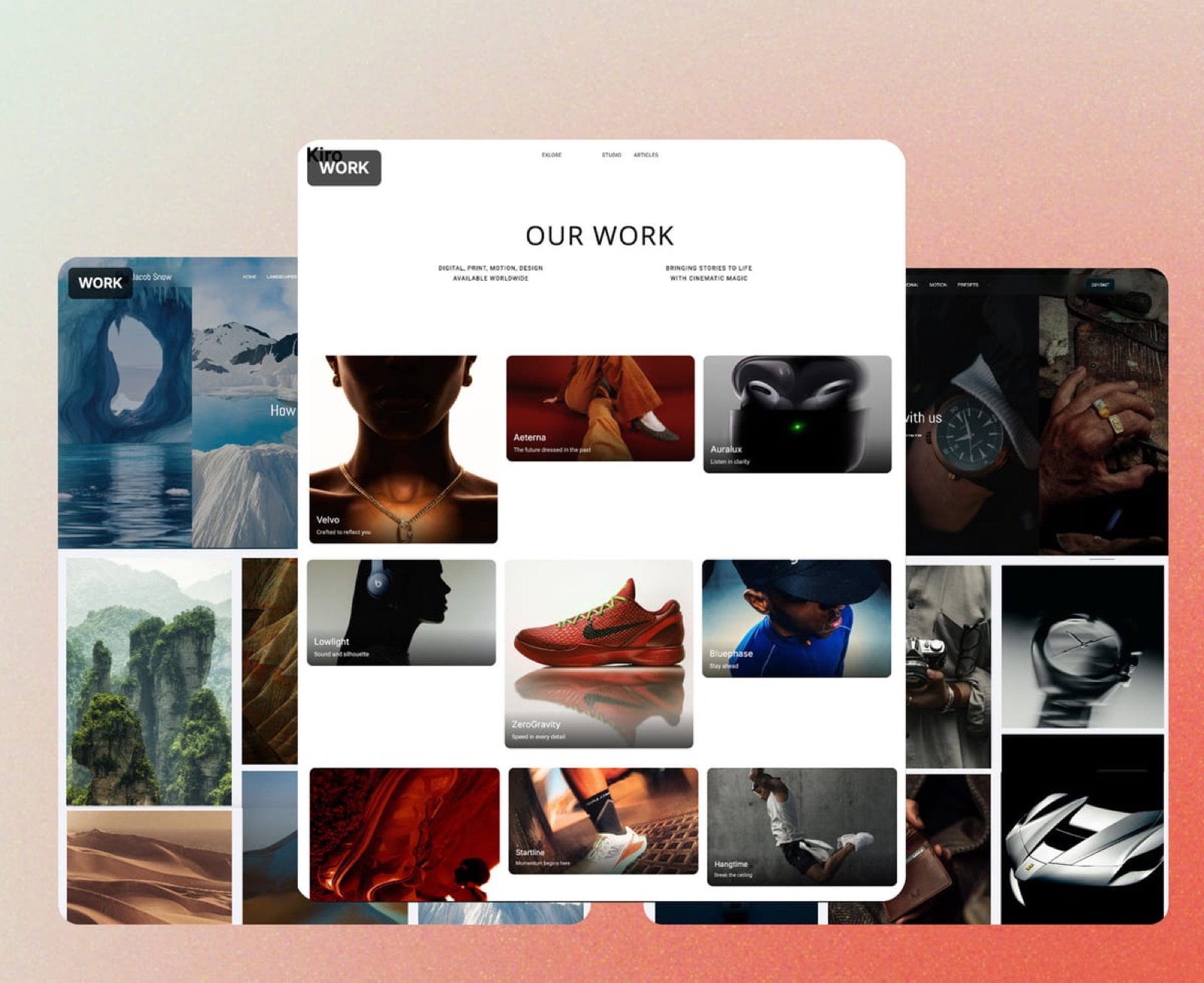
Framekit is an AI website builder that also ships Slides, a deck tool in the same account as your site, client galleries and video review, and it fits after the whiteboard rather than instead of it.
For a creative team, the output of a Miro session is usually a direction: a moodboard, a shot list, a campaign idea. The client does not want the board; they want the direction, laid out.
In Framekit Slides that is a deck built from ready-made moodboards, look cards, swatches, shot lists and storyboard rows, written and laid out by AI from a description, shared as a link or a PDF on the free plan with unlimited decks.
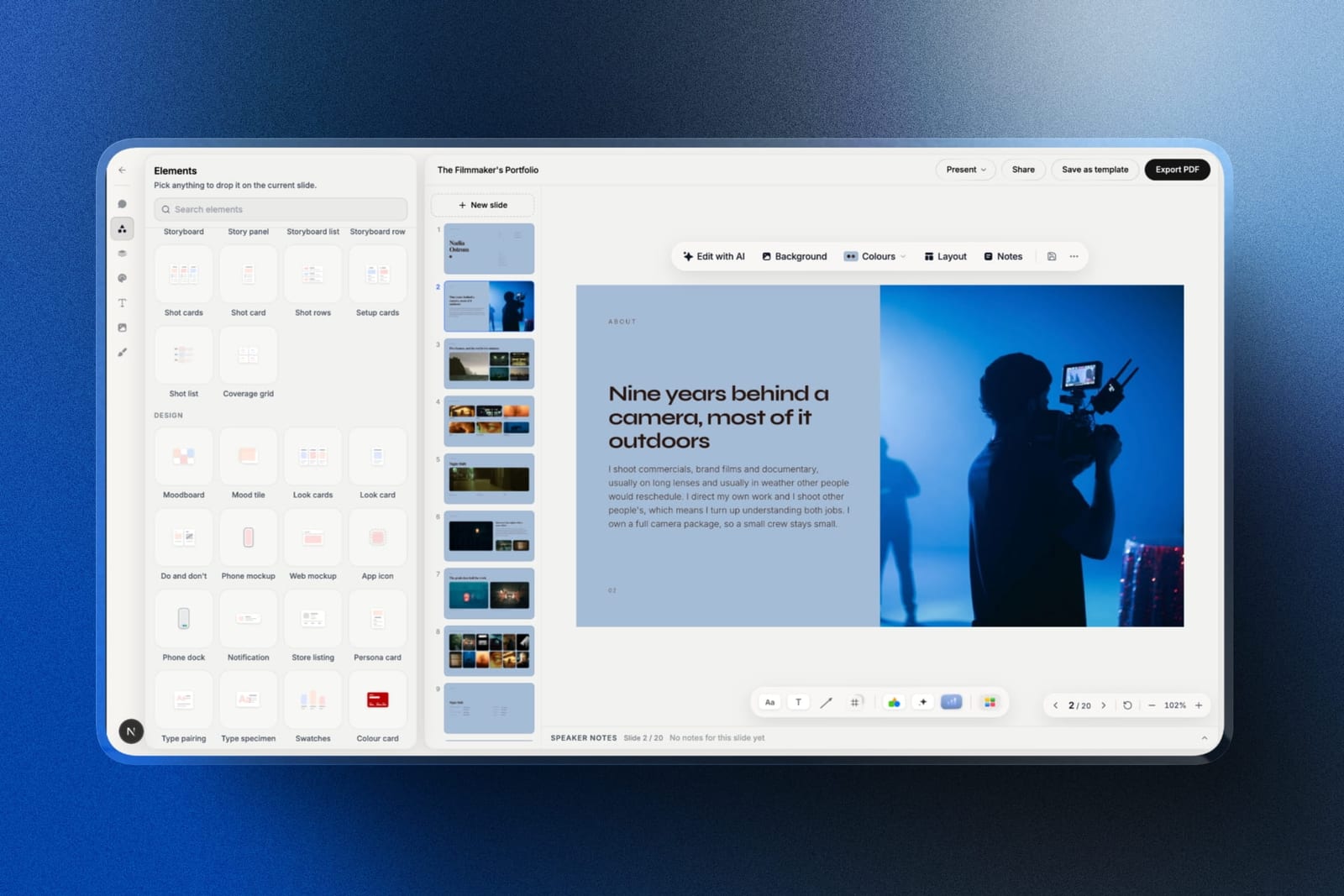
The limits, plainly: Slides is not a whiteboard. It has no infinite canvas, no sticky notes, no real-time cursors, no timers and no voting, so it is not an alternative to any of the twelve tools above for running a session.
Keep the board for the session, and bring the conclusion here.
Which Miro Alternative Should You Choose?
The right answer depends far more on what kind of sessions you run than on the canvas itself, so work down these questions in order and stop at the first one you can answer yes to.
1. Does your whiteboarding happen around design files? FigJam, on Collab seats at $36 a year each.
2. Is cost the whole reason you are here, and are your sessions informal? Excalidraw or tldraw, both free with no board cap.
3. Do you facilitate large structured workshops? Mural, for private mode, or stay on Miro.
4. Do your boards become architecture diagrams? Lucidspark, budgeting for Lucidchart alongside it.
5. Is the work creative direction rather than product process? Milanote, checking the ten-upload free limit first.
6. Are you already paying for Canva or Microsoft 365? Use the whiteboard you already own before buying another.
7. Are you an Apple-only team of two or three? Apple Freeform, free, with the best handwriting on this page.
8. Do you want the boards to survive any vendor? Obsidian Canvas, which stores them as files on your own machine.
9. Do you need contributions from people who will never learn a canvas? Padlet.
10. Is the thing you actually need a durable record rather than a board? Write it up as a page instead.
Frequently Asked Questions
What is the best free alternative to Miro?
Excalidraw is the best free Miro alternative, with unlimited boards, no seat cost, real-time collaboration, and boards that save as open .excalidraw files you can keep in version control. tldraw and Apple Freeform are also genuinely free with no board cap, while FigJam, Lucidspark, and Miro itself all stop at three boards.
How much does Miro cost per person?
Miro Starter is $8 per member per month billed annually, which is $96 a year, or $10 per month billed monthly. Business is $20 per member per month annually, which is $240 a year. For a ten-person team that is $960 or $2,400 a year respectively.
Is FigJam a good replacement for Miro?
FigJam is a good Miro replacement for teams working around design files, costing $36 a year per person on a Collab seat against Miro's $96, with content moving cleanly between FigJam and Figma.
It is a weaker replacement for large facilitated workshops and for dense diagramming, where Miro's tooling is a clear step ahead.
Which Miro alternative is best for creative teams?
Milanote is the best Miro alternative for creative teams, because it is built around nested boards, images, and written notes rather than workshop process.
Its free plan allows 100 notes, images, or links and only 10 file uploads, and the upload cap is what most creative teams hit first.
Do any whiteboard tools store boards as files you own?
Obsidian Canvas stores every board as a plain .canvas file in an open JSON format on your own machine, which means no vendor can take them away and nothing disappears when a subscription lapses.
Excalidraw and tldraw both export to open formats too, though they are cloud-first by default.
Is Mural cheaper than Miro?
Mural is not cheaper than Miro at the entry tier, with Team+ starting at about $12 per member a month billed annually against Miro Starter's $8.
Switching from Miro to Mural is a decision about facilitation quality, particularly Mural's private mode for anonymous idea capture, rather than a way to reduce cost.
What happened to Google Jamboard?
Google discontinued Jamboard, ending support for the app at the end of 2024 and directing users toward third-party whiteboards including FigJam, Miro, and Lucidspark.
Teams that relied on it had to export their boards, which is a useful reminder that boards left inside a vendor's product are only as durable as the vendor's roadmap.
Which whiteboard is best for diagramming?
Miro and Lucidspark are the strongest for diagramming, with connectors that stay attached and reroute sensibly on dense diagrams, proper shape libraries, and swimlanes.
Whimsical is the fastest for flowcharts specifically, and FigJam is the weakest of the major tools, with connectors that struggle once a diagram passes about twenty nodes.
Can you run a workshop without paying for a whiteboard tool?
You can run a workshop on Excalidraw, tldraw, Apple Freeform, or Microsoft Whiteboard for nothing, and what you give up is facilitation tooling: timers, dot voting, private mode, and viewport control.
Those are worth paying for if you facilitate regularly and are easy to replace with a stopwatch and clear instructions if you do not.
Should workshop output stay on the board?
Workshop output should not stay only on the board, because an image or PDF export loses the reasoning and nobody outside the session can interpret a canvas months later.
The durable form is a short written page recording what was decided and why, linked to the board rather than replaced by it.
For creative teams whose output is a direction for a client, a short deck in a tool such as Framekit Slides, with the moodboard and shot list laid out, does the same job.
Final Verdict
FigJam is the Miro alternative most teams should try first, because it is roughly a third of the price and structurally better for anyone working near design files.
Excalidraw is the answer if cost is the entire issue and your sessions are informal, and it is genuinely good rather than merely free.
Mural is the right move for facilitators, and Milanote is the right move for creative direction, which is a different job from the one Miro is usually bought for.
Where Framekit loseswe do not make a whiteboard and never will, so on every criterion in this comparison all twelve tools beat us.
Framekit has no whiteboard canvas, no sticky notes, no cursors, no timers, and no voting, which is why we excluded ourselves from the ranking rather than finding a place in it.
The only thing we would argue is that the conclusion of a workshop belongs somewhere a client can read it: a page on your site, or a deck in Framekit Slides.
If you take one number away, take the ratio. Most teams open under a fifth of the boards they make, which means most of what a per-seat whiteboard subscription buys is storage.
Related reading: our Miro versus FigJam comparison, the best mood board tools, the best project management tools for creative teams, and the best note-taking apps for creatives.
Prices above come from each vendor's published pricing during August 2026. Several of these companies changed tier structures in the past year, so confirm the current seat rules before rolling a tool out to a team.