Framekit templates
Start from a designer-made template
 Use template
 Use template
 Use template
 Use template
 Use template
 Use template
 Use template
 Use template
A video does 100,000 views. Half a percent of viewers tap the link, so 500 people. Three percent of those buy a $19 product, so fifteen sales.
That is $285 for a video that reached a hundred thousand people, or $2.85 per thousand views.
That number is the one worth carrying around, because it is the only way to compare selling a digital product against every other way a TikTok account makes money.
It is also small enough that the fee structure matters enormously - at $285 a month, a $39 flat plan is 13.7% of your revenue, which is worse than the percentage-based options everybody warns you about.
A TikTok selling tool is whatever turns a bio link into a paid transaction and a delivered file, because TikTok's own commerce features are built around physical goods and the practical route for a digital product is off-platform.
The best tool to sell digital products on TikTok in 2026 is Framekit's free plan, because one bio link can show your work and sell the file, with instant delivery, free lead-magnet products and no monthly fee, for 5% per sale.
The trade-off is cost: Whop keeps the most of a $285 month, about $272.80 against Framekit's $257.98, and Lemon Squeezy is the pick if international sales tax worries you. The thing to avoid is a flat monthly plan: at $285 a month, $39 is 13.7% of everything you make.
Full disclosure: Framekit is our product and ranks first here on a rubric that weights a page that sells the work, which we explain below. Remove that criterion and Whop wins on price alone, so its review says so plainly, as do Payhip's and Lemon Squeezy's where they beat us.
How We Priced This
One funnel throughout, built from the metric TikTok creators actually have: 100,000 views, a 0.5% link click-through, and a 3% purchase rate on a $19 product. That is 500 clicks, fifteen sales and $285 in monthly revenue.
Those conversion assumptions are deliberately modest rather than flattering. Click-through from TikTok is low because the audience is passive and the link is one tap away from a feed people are scrolling for entertainment.
Card processing at 2.9% plus 30 cents applies where the tool does not include it, which on fifteen sales of $19 is $12.77.
In September 2026 we re-verified Framekit's fees, buy links and free products against its plan table; its entry describes the product, not a test.
Three grades of claim. Read at the vendor's own page in the first week of August 2026 covers Whop's fee documentation, Payhip, Lemon Squeezy, Big Cartel, Gumroad, Sellfy and Framekit's plan file. Used directly covers Payhip, Lemon Squeezy and Gumroad. Could not verify covers Stan Store, whose pricing page did not resolve, and - importantly - TikTok Shop's current policy on digital and intangible goods, whose policy pages returned no readable text to us.
If you intend to sell inside TikTok Shop rather than off-platform, check that policy yourself rather than trusting any article.
By the numbers:
- $2.85 is the revenue per thousand views on this funnel.
- $285 is what 100,000 views produces at these conversion rates.
- 13.7% of that revenue is what a $39 monthly plan costs you.
- 4.3% is what the cheapest option here costs on the same month.
- $39.57 separates the cheapest and most expensive tool, on $285 of revenue.
- 500 clicks is what a 100,000-view video produces at a 0.5% tap rate.
- 1 policy we could not verify, and it is TikTok's own.
The Rubric
We scored on six criteria, weighted for a funnel that is enormous at the top and very small at the bottom - which is the defining shape of TikTok selling and the reason the usual ranking order does not survive contact with it.
| Criterion | Weight | What it covers |
|---|---|---|
| Cost at low revenue | 25% | What the tool takes from a $285 month |
| No fixed commitment | 20% | Whether a bad month costs you anything |
| A page that sells the work | 20% | Whether the link shows a body of work, not just a checkout |
| Mobile checkout | 15% | Behaviour inside an in-app browser |
| Setup speed | 10% | Time from decision to a working link |
| Buyer capture | 10% | Whether you get the email for the next launch |
The absence of a fixed commitment carries a fifth of the score, which is specific to this platform.
TikTok reach is volatile in a way Instagram's is not - one video can do ten times your average and the next can do a tenth - and a monthly subscription is a bet that next month happens.
The page criterion is weighted as heavily because a TikTok viewer arrives knowing fifteen seconds of you, and the link has to answer the question the video could not.
| Score out of 10 | Framekit | Whop | Lemon Squeezy | Payhip |
|---|---|---|---|---|
| Cost at low revenue | 6 | 10 | 8 | 6 |
| No fixed commitment | 10 | 10 | 10 | 10 |
| A page that sells the work | 10 | 4 | 5 | 5 |
| Mobile checkout | 8 | 8 | 8 | 8 |
| Setup speed | 8 | 8 | 9 | 9 |
| Buyer capture | 10 | 10 | 10 | 10 |
| Weighted total | 8.5 | 8.3 | 8.1 | 7.6 |
Framekit's 6 on cost is the visible weakness: it is mid-table on price, and Whop's 10 is why Whop is second rather than further down.
What 100,000 Views Actually Pays
Every row below is the same month: fifteen sales of a $19 product, or $285 gross, priced through that tool's published rates with card processing added where it is not included.
| Tool | Model | Cost on $285 | You keep | Effective rate |
|---|---|---|---|---|
| Whop | 2.7% + 30c published | $12.20 | $272.80 | 4.3% |
| Lemon Squeezy | 5% + 50c, processing included | $21.75 | $263.25 | 7.6% |
| Payhip | Free plan, 5% | $27.02 | $257.98 | 9.5% |
| Framekit | Free plan, 5% | $27.02 | $257.98 | 9.5% |
| Big Cartel | Platinum, $15/mo flat | $27.77 | $257.23 | 9.7% |
| Gumroad | 10% + 50c | $36 | $249 | 12.6% |
| Framekit | Business, $39/mo flat | $51.77 | $233.23 | 18.2% |
| Sellfy | Starter, $39/mo flat | $51.77 | $233.23 | 18.2% |
| Stan Store | Not verifiable | Not published | Not published | Not published |
Look at the bottom of that table rather than the top, because it contains our own product and it is the single most useful row in this guide.
A $39 flat monthly plan costs 18.2% of a $285 month. That is worse than Gumroad's 10% plus 50 cents, which is the option this series has spent twenty-seven posts describing as expensive.
Flat plans win at volume and lose badly beneath it, and a TikTok funnel at 100,000 views a month is beneath it.
If you are reading a guide that tells you to get off percentage pricing and onto a flat plan, check what your actual monthly revenue is first. At $285, the advice is exactly backwards.
In one lineat TikTok scale the correct structure is a percentage with no monthly fee, and you should switch to a flat plan only when your revenue makes the arithmetic flip - which is around $780 a month.
Revenue Per Thousand Views Is the Number to Compare
In one lineevery other way a TikTok account earns is quoted per thousand views, and until you convert your product sales to the same unit you cannot tell whether selling is worth the posting.
Our funnel produces $2.85 per thousand views. That figure moves enormously with three inputs, and knowing which one to push is more valuable than any tool in this guide.
| What changes | New figure | Revenue per 1,000 views |
|---|---|---|
| Baseline: 0.5% click, 3% buy, $19 product | $285 | $2.85 |
| Click-through doubles to 1% | $570 | $5.70 |
| Purchase rate rises to 5% | $475 | $4.75 |
| Price rises to $39 | $585 | $5.85 |
| All three improve | $1,950 | $19.50 |
The single biggest lever is price, followed by click-through. Purchase rate is the hardest of the three to move and the one most people spend their time on.
Two honest observations about this table.
First, the compounding case at the bottom is real but not easy - doubling click-through and raising price simultaneously usually means a different product and a different video style, not better optimisation of what you have.
Second, none of these numbers are affected by which tool you choose, which is why the tool comparison is the shorter half of this guide.
What the figure is genuinely useful for is comparison. Whatever your account earns per thousand views from other sources, you can now put selling a digital product next to it in the same unit and decide where your posting time goes.
The Off-Platform Problem, and What We Could Not Verify
In one lineTikTok's commerce features are built around physical goods, we could not confirm its current policy on digital items, and every tool in this guide sidesteps the question by taking the buyer off-platform.
We tried to verify TikTok Shop's stated position on digital, downloadable and intangible goods and could not.
TikTok's prohibited-products policy page returned no readable content to us, which means we have no verified quotation to give you and will not paraphrase one from elsewhere.
What we can say without qualification: every tool ranked below works by sending the buyer from your bio to a checkout somewhere else, which is the route creators overwhelmingly use for digital products and which does not depend on TikTok Shop's policy at all.
If you want to sell inside TikTok Shop specifically, read the current policy yourself before building anything.
Two mechanics that apply regardless of policy:
The in-app browser. As on Instagram, links tapped inside TikTok open in an embedded browser where saved cards and wallet buttons behave inconsistently. No tool in this guide fixes it.
What helps is fewer form fields, no account creation and a single-page checkout.
Comment-to-DM funnels. Routing viewers through a comment reply or a DM rather than the bio link is a widely used TikTok pattern, and it changes nothing about which selling tool you need - it changes where the link is pasted.
Whatever automation you use for it, the checkout at the end is still one of the options below.
1. Framekit Free Plan: Best When the Work Sells the Product

Framekit is an AI website builder with a digital-download store built in, and on TikTok it solves the problem this guide keeps returning to: the viewer has seen fifteen seconds of you and nothing else.
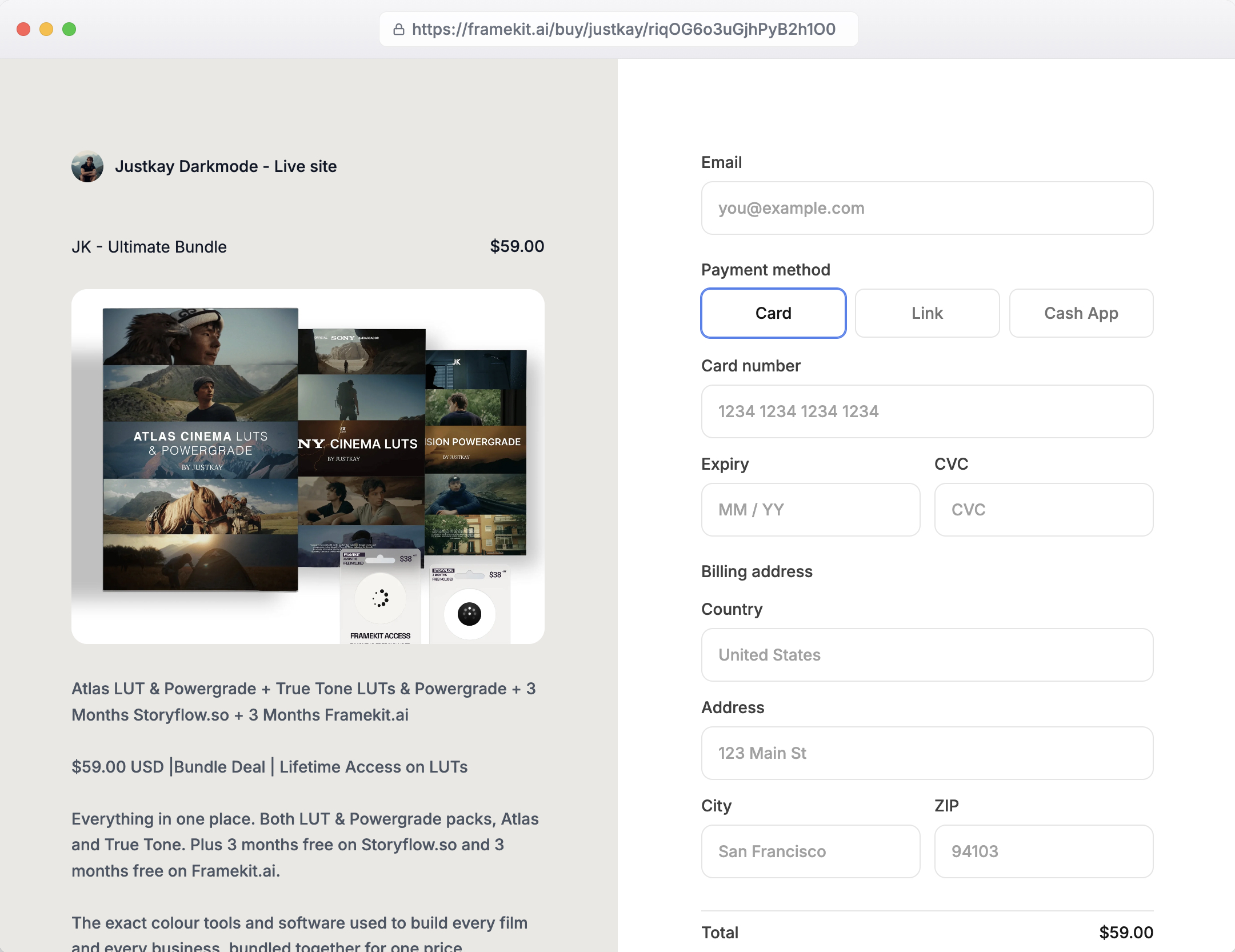
The bio link can go to a page that shows a body of work with the product beside it, or, if you have no site yet, straight to a hosted checkout through a direct buy link.
Either way the file downloads the moment the payment clears and the buyer can come back for it later.
The real number0 dollars a month and a 5% fee on the free plan, with Stripe processing on top, which is $27.02 on a $285 month, the same as Payhip and $14.82 more than Whop.
The fee falls to 3% on Pro at $19 a month and to 0% on Business at $39, and the flat plan only wins above $780 a month in sales, so stay on free until then.
The standout detaila free product works as well as a paid one. At a 0.5% click-through most of your 500 visitors will not buy a $19 pack, and a free sample that collects their email is the second chance a TikTok funnel usually does not get.
Unlimited products, free or paid, are included on every plan, and the payment lands in a Stripe account in your name rather than a platform balance.
The honest gotchawe cost more than Whop at this revenue, we bring no traffic, and we do not fix the in-app browser.
Framekit is not a merchant of record, so sales tax on an international audience stays with you, which Lemon Squeezy takes on for 5% plus 50 cents. Discount codes for a launch need Pro.
Skip it ifthere is no body of work behind the product and the lowest fee is all you want, in which case Whop keeps $14.82 more of the same month.
Verdict: the best tool for selling a digital product on TikTok when your work is the argument, on the free plan until your revenue passes $780 a month.
2. Whop: Cheapest at This Scale
Whop's published rates make it the cheapest complete option for a funnel this size, and the absence of a monthly commitment is exactly right for volatile TikTok reach.
The real number2.7% plus 30 cents for domestic cards with no monthly platform fee stated, which on fifteen sales of $19 is $12.20 - a 4.3% effective rate, leaving $272.80 of $285.
The standout detaila month where nothing goes viral costs you nothing. On a platform where reach varies by an order of magnitude between videos, that is worth more than a slightly better rate with a subscription attached.
The honest gotchathe fee schedule is a menu, with tax collection at an additional 2% per transaction and instant payouts at 4% plus $1.00 against $2.50 for next-day ACH. The platform is also oriented toward community and access products rather than single file downloads.
Skip it ifyour product does not fit the access-and-community shape.
Verdict: the best economics in this guide for a TikTok-scale funnel, and the first pick if price is the only criterion you care about.
3. Payhip Free Plan: Best Complete Free Option
Payhip's free plan gives you a storefront, a checkout and automatic file delivery for a percentage and nothing monthly, which is the correct structure at this revenue.
The real numberthe free plan takes 5%, with Plus at $29 a month and 2% and Pro at $99 with no transaction fee. On our funnel the free plan costs $27.02 all in; Pro would cost $111.77, or 39% of revenue.
The standout detailthat Pro comparison is the flat-plan trap in miniature. The plan that is correct for a large seller is catastrophic for a small one, and nothing in a pricing page tells you which you are.
The honest gotchathe storefront is generic, and TikTok audiences arriving cold form an impression fast.
Skip it ifyour brand is the product.
Verdict: the strongest free complete option, and a useful illustration of why you should not upgrade early.
4. Lemon Squeezy: Best With Tax Handled
Lemon Squeezy costs nothing monthly and becomes your merchant of record, which matters because a TikTok audience is international whether you planned it or not.
The real number5% plus 50 cents per transaction with processing included, or $21.75 on our funnel - the second-cheapest option here.
The standout detaila video reaching 100,000 people reaches them in a dozen countries, and international sales tax applies from the first sale rather than at a threshold. Having that handled at no monthly cost is unusually well matched to this platform.
The honest gotchaon a $19 product the 50-cent fixed fee is 2.6%, pushing the all-in rate to 7.6%. Cheaper products make it worse.
Skip it ifyour audience is domestic and you are registered.
Verdict: the best combination of no-monthly-fee and compliance for an international audience.
5. Big Cartel: The Cheapest Flat Plan, and Still Not Yet
Big Cartel is the cheapest flat-fee storefront anywhere in this twenty-eight-post series, and it is included here mainly to mark where the crossover between flat and percentage pricing actually falls for a funnel this size.
The real numbera free Gold plan, Platinum at $15 a month and Diamond at $30, with digital products from Platinum. On our funnel Platinum costs $27.77 all in, which is almost exactly what Payhip's free 5% plan costs.
The standout detail$15 a month is the point at which a flat plan becomes competitive at this revenue - and only just. Anything more expensive is worse than a percentage until your sales roughly triple.
The honest gotchatransaction fees are not published, so the $15 is a plan price rather than a verified total.
Skip it ifyour reach is unpredictable and a quiet month would make $15 feel like a subscription to nothing.
Verdict: the first flat plan that makes sense at TikTok scale, and the last one that does.
6. Gumroad: Fast, and the Expensive Middle
Gumroad remains the quickest way to put a product behind a bio link, and on this funnel it sits awkwardly between the cheap percentage options and the flat plans.
The real number10% plus 50 cents per sale, or $36 on our funnel - a 12.6% effective rate.
The standout detailits checkout is well-tuned for mobile, which given the in-app browser problem is worth real money on a platform this mobile-heavy.
The honest gotcha12.6% is three times Whop's rate for a broadly comparable job, and the fixed 50 cents hurts more at $19 than at $49.
Already using it? Gumroad's fees explained covers where the money goes, and the best Gumroad alternatives covers the move.
Verdict: good checkout, poor rate, and defensible only while you value setup speed over margin.
7. Sellfy: Built for a Larger Funnel
Sellfy is a capable storefront that takes no percentage of your sales at all, and it is priced for a business several times the size of the one this guide describes - which makes it a useful demonstration of a point rather than a recommendation.
The real numberStarter is $39 a month billed monthly or $29 yearly with 0% transaction fees. On a $285 month that is 18.2% of revenue including processing - the joint worst in this guide.
The honest gotchanothing is wrong with the product. The mismatch is entirely scale, and it is the clearest illustration in this guide of why "0% transaction fees" is not the same as cheap.
Skip it ifyou are at this funnel size. Revisit above about $800 a month.
Verdict: the right store at the wrong revenue.
8. Stan Store: Built for This and Unpriceable
Stan Store is designed precisely for the creator-with-a-bio-link funnel this guide describes, and is widely used by exactly the audience reading it, which makes our inability to verify its price genuinely frustrating rather than a technicality.
The real numberwe do not have one. Its pricing page did not resolve to company pricing during our checks, so unlike every verified row above there is no figure we can stand behind, and we will not repeat one from elsewhere.
The honest gotchait charges a monthly subscription rather than a percentage, which per this entire guide is the structure that suits a $285 month least. Without a verified price you cannot work out which side of the crossover you are on, and at this revenue that is the only question that matters.
Skip it ifyou need to compare cost before committing.
Verdict: well matched to the funnel and impossible for us to price. Get the current figure and compare it against the $12.20 to $51.77 range above.
Decision Guide
This is ordered by revenue rather than by preference, because at TikTok scale your monthly revenue determines which fee structure is correct far more than any feature does. Work down and stop at the first yes.
1. Are you making under about $500 a month from this?
Yes: a percentage-based option with no monthly fee. Framekit's or Payhip's free plan at 5%, or Whop at 2.7% plus 30 cents if price is all that matters. Do not buy a subscription.
2. Is your audience international and the tax question bothering you?
Yes: Lemon Squeezy at 5% plus 50 cents, which handles it from your first sale at no monthly cost.
3. Is your work the reason people would buy rather than the product description?
Yes: Framekit's free plan, so the one link leads to the work and the checkout together, with a free product to catch the viewers who do not buy.
4. Are you consistently above about $800 a month?
Yes: now a flat plan wins. Big Cartel at $15, or Framekit's Business plan at $39 with no percentage.
5. Are you being told to switch to a flat plan for the 0% transaction fee?
Check your monthly revenue first. At $285 a month, a $39 flat plan costs 18.2% and a 5% plan costs 9.5%.
6. Do you want to sell inside TikTok Shop rather than off-platform?
Read TikTok's current policy on digital and intangible goods yourself. We could not verify it, and no article should be your source for that.
Frequently Asked Questions
These are the questions TikTok creators ask after a video has done well and the sales have conspicuously failed to match it, which is where most of these funnels stall.
What is the best tool to sell digital products on TikTok in 2026?
Framekit's free plan is the best tool to sell digital products on TikTok in 2026 for creators whose work sells the product, because one link can show the work and sell the file with instant delivery and free lead-magnet products, for 5% and nothing monthly.
Whop keeps the most of a $285 month at about $272.80, so it is the pick on price alone. Avoid flat monthly plans until you are consistently above about $800 a month.
How much can you actually make selling digital products on TikTok?
On a modest funnel - 100,000 views, a 0.5% link click-through and a 3% purchase rate on a $19 product - about $285 a month, or $2.85 per thousand views.
Doubling the click-through or roughly doubling the price takes that to around $5.70 to $5.85 per thousand views. Those conversion figures are deliberately conservative rather than optimistic.
Can you sell digital products on TikTok Shop?
We could not verify TikTok's current policy on digital and intangible goods, because its prohibited-products page returned no readable content to us, and we are not going to paraphrase a policy we have not read.
What is certain is that every tool in this guide works by sending buyers to an external checkout, which is the route most creators use and which does not depend on that policy.
Why do my TikTok views not turn into sales?
Because the funnel is lossy at every step and the losses multiply. A 0.5% click-through on 100,000 views is 500 people, and a 3% purchase rate on those is fifteen sales.
Improving click-through is usually easier than improving purchase rate, and raising your price is easier than both - a $39 product on the same traffic produces roughly double the revenue of a $19 one.
Should I use a monthly subscription tool or a percentage-based one?
Percentage, until you are consistently above about $800 a month in sales.
At $285 a month, a $39 flat plan costs 18.2% of your revenue while a 5% plan costs 9.5% - so the flat plan that every scaling guide recommends is roughly twice as expensive at this size.
The crossover for a $39 plan against a 5% fee is $780 a month.
What is a realistic click-through rate from a TikTok bio link?
Somewhere between 0.2% and 1% of views for most accounts, which is why this guide uses 0.5%.
TikTok traffic is passive and entertainment-seeking, so the tap requires more motivation than it does on a platform where people arrive with intent.
A video that explicitly demonstrates the product performs far better than one that mentions it.
Does the in-app browser hurt sales on TikTok too?
Yes, in the same way it does on Instagram. Links tapped inside TikTok open in an embedded browser where saved cards and wallet buttons behave inconsistently, which turns a two-tap purchase into typing a card number.
No tool in this guide fixes it; what helps is fewer fields, no required account creation and a single-page checkout.
Is a comment-to-DM funnel better than a bio link?
It changes where the link goes rather than which tool you need.
Routing viewers through a comment reply or a DM is a widely used TikTok pattern and can improve click-through because it feels personal, but the checkout at the end is still one of the options in this guide, and the fee comparison is unchanged.
How does selling compare with other TikTok monetisation?
Convert everything to revenue per thousand views and compare directly. This guide's funnel produces $2.85 per thousand, and a better-optimised one produces $5 to $19.
Whatever your account earns per thousand views from other sources, that is the number to put beside it - and it is the only fair comparison because it accounts for the reach each route needs.
Should I raise my price instead of optimising my funnel?
Usually yes, and it is the most under-used lever here. Moving from $19 to $39 doubles revenue per thousand views on identical traffic, requires no change to your videos, and reduces the proportional damage done by fixed transaction fees.
The constraint is whether the product justifies it, which is a product question rather than a marketing one.
Do I need my own website to sell on TikTok?
No. Every tool here, including Framekit's direct buy links, works without a site, and a site becomes worth it later. At $285 a month, a free-tier percentage plan is the right answer and a paid site plan costs more than it saves.
The crossover is around $780 a month, at which point a flat plan and your own domain start winning on both cost and everything a site accumulates.
Framekit vs Whop: which is better for TikTok?
Whop is cheaper: on a $285 month it keeps about $272.80 against Framekit's $257.98, a $14.82 difference.
Framekit is the better fit when a viewer needs to see your work before buying, because the same link can be a portfolio with the product on it, and it handles single file downloads and free products directly, where Whop is built around access and community products.
Which tool should I avoid at TikTok scale?
Any flat monthly subscription, including our own paid plans. At $285 a month, a $39 plan takes 18.2% of your revenue - worse than Gumroad's 10% plus 50 cents, which this series has repeatedly described as the expensive option.
Flat pricing is genuinely better at volume and genuinely worse beneath it.
The Verdict
Framekit's free plan wins for creators whose work is the argument: one link that shows the work and sells the file, free products to catch the viewers who do not buy, and nothing monthly on a platform where reach swings by an order of magnitude between videos.
Whop wins on the arithmetic, keeping about $272.80 of a $285 month, and Payhip and Lemon Squeezy are close behind.
The genuinely useful output of this guide is not the ranking though.
It is the unit: $2.85 per thousand views, which lets you put selling a digital product side by side with every other way your account could earn, in a number you already track.
Improve the price and the click-through and that becomes $5 to $19 per thousand, on the same videos.
And one warning that runs against the grain of almost every guide in this category, including several of ours: at this revenue, flat monthly plans are the expensive option. A $39 plan costs 18.2% of a $285 month.
The advice to escape percentage pricing is correct and it applies above roughly $800 a month, not below it.
Where Framekit losesour Business plan is the joint most expensive option in this guide's table at 18.2%, and we have left it there rather than quietly omitting it.
Framekit is not the cheapest option at this scale: Whop takes less than half of what our free tier does.
It is not a merchant of record, it brings no traffic, and if you have no body of work to show then a plain storefront does the same job for less.
Verdict: stay on a percentage until roughly $800 a month. Use Framekit's free plan if the work sells it, Whop if price is everything. Spend the effort on price and click-through rather than on fees, because at $2.85 per thousand views the fee is not what is limiting you.
Fees and plan prices were read from each vendor's published page in early August 2026, with Framekit's re-verified in September 2026.
Stan Store's pricing and TikTok's own policy on digital goods could not be verified and are labelled where they appear. Conversion assumptions in this guide are deliberately conservative estimates rather than measured data.
Related readingthe best tools to sell digital products on Instagram, 9 ways to sell digital products without a website, how to price digital products, the best free product-selling software, and the 25 best digital products to sell.