Framekit templates
Start from a designer-made template
 Use template
 Use template
 Use template
 Use template
 Use template
 Use template
 Use template
 Use template
An agency runs two review loops on every job and only talks about one of them. There is the internal pass, where a creative director says the second act is not working and an account lead notes that the client will hate the music.
Then there is the client pass, where a version of that conversation is presented as a considered recommendation.
The moment those two loops share a comment thread, someone reads the wrong one. It is not usually catastrophic, it is usually just expensive: a client sees the internal debate, loses confidence in the recommendation, and asks for a round that would not have existed.
So the feature that actually distinguishes agency review tools is not annotation or storage.
It is whether internal comments and client comments can live in the same project without meeting, and that capability is consistently sold a tier above where you would expect.
We re-verified Framekit's entry in September 2026, including a fresh look at how its hidden Team comments work, and the ranking held.
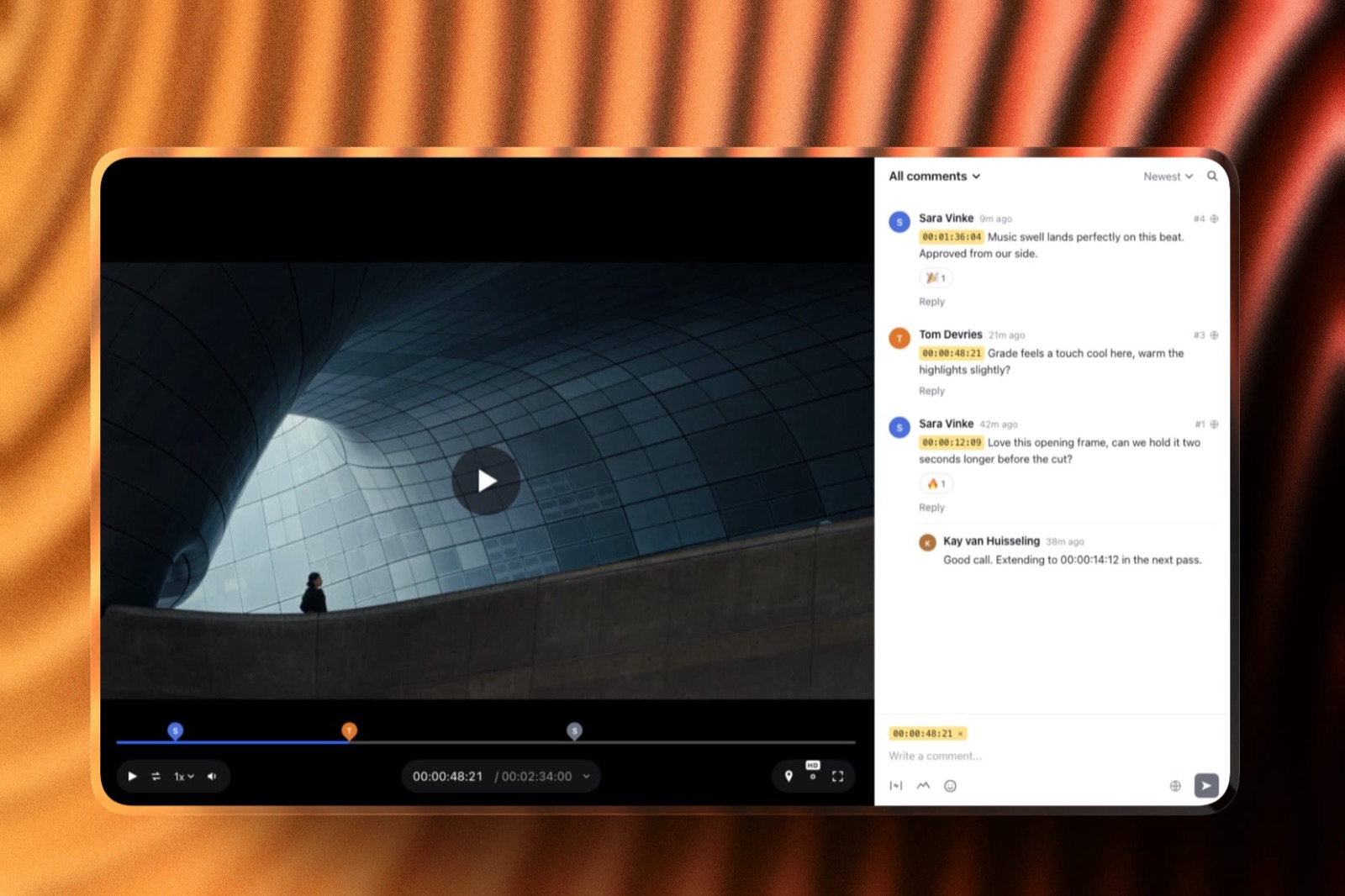
A video review tool for creative agencies is a platform that collects timestamped feedback from both internal reviewers and external clients on the same asset, while keeping the two audiences separated by permission rather than by convention.
The best video review tool for creative agencies in 2026 is Frame.io Team at 25 dollars per member, because internal comments plus restricted projects and folders are the cleanest separation of the two loops in this comparison.
Filestage at 199 dollars a month is the better fit when approval runs through reviewer groups in sequence, and ReviewStudio Advanced at 20 dollars per user is the cheapest tool with genuine comment privacy.
Framekit, ranked eighth, can hide the account holder's own notes from clients but has no roles or restricted projects, so it suits a two-person studio rather than an agency.
Full disclosure: Framekit is our own product and it ranks eighth of eleven here, because the internal lane this page is about only half exists in it: notes posted from the account can be hidden from clients, but there are no per-person roles, no restricted folders and no exportable audit trail. Seven tools on this page are better built for an agency, and our entry says exactly where the line falls.
How We Tested 11 Tools for Agency Work
We ran a campaign the way an agency actually does: a 45-second hero film plus three social cuts, an internal review with a creative director and an account lead, then a client review with a brand manager and a legal reviewer, across two rounds, with the internal notes deliberately blunt to see where they surfaced.
Eleven tools, fresh accounts, August 2026.
The decisive test was simple and most comparisons never run it. After the internal pass, we shared the asset with the client-side reviewers and checked what they could see. On several tools the answer was everything.
Measured means we ran both loops. Verified means the figure was read at the vendor's own published pricing page and linked inline. Enterprise tiers on Frame.io, Filestage, Ziflow and PageProof carry no published price and were not tested.
Why the two loops must not share a thread
The internal pass exists to be unguarded. A creative director who has to phrase notes diplomatically because a client might read them is doing a worse job, slower. The client pass exists to be considered.
Collapse them and you get the worst of both: internal notes soften into uselessness, or client confidence takes a hit it did not need to.
Agencies usually solve this with convention, meaning a second project, a separate upload, or a rule that everyone forgets under deadline. Every one of those is a copy of the same file drifting out of sync.
Permission solves it properly, and permission is what you are paying the tier-up price for.
What an Internal Comment Lane Costs
Every figure below was read at the vendor's own published pricing page in August 2026 and priced for a six-person agency team plus external client reviewers.
- Internal comments are a tier-up feature almost everywhere. Frame.io puts them on Team at 25 dollars per member, not on Pro at 15. Filestage puts team-only comments on Starter at 199 dollars a month. ReviewStudio puts comment privacy on Advanced.
- The cheapest genuine internal lane here is ReviewStudio Advanced at 20 dollars per user annually, which is 1,440 dollars a year for a six-person team; its five-user minimum sets a floor of 1,200 dollars even if you are three.
- Frame.io Team for six people is 1,800 dollars a year and adds restricted projects and folders as well as internal comments.
- Filestage Starter at 199 dollars a month includes ten members, so a six-person team pays for ten at 2,388 dollars a year and gets reviewer groups and due dates.
- 7 of 11 tools can separate internal from client comments in some form, Framekit only for notes posted from the account itself. 4 cannot, and on those the separation is a convention rather than a control.
- 3 of 11 offer restricted projects or folders, so an account team can be kept out of work that is not theirs: Frame.io on Team, Ziflow, and ReviewStudio on Advanced.
- 0 of the tools priced under 15 dollars per user offer both an internal lane and restricted access, which is the honest reason agency tooling costs what it does.
| Tool | Internal comment lane | Restricted projects | Six-person team, 1 year | External reviewers |
|---|---|---|---|---|
| Frame.io | Yes, on Team | Yes, on Team | 1,800 dollars on Team | Unlimited as guests |
| Filestage | Team-only comments on Starter | Reviewer groups | 2,388 dollars, 10 seats | Unlimited |
| Ziflow | Comment labels and filtering on Pro | Yes | 2,388 dollars, 15 users | Unlimited |
| PageProof | Yes, workflow-based | Enterprise | 2,988 dollars, unlimited | Unlimited |
| ReviewStudio | Comment privacy on Advanced | Client and project teams | 1,440 dollars at 6 users | Unlimited guests |
| Approval Studio | Task assignment | On higher tiers | 1,920 dollars on Pro | Unlimited on Pro |
| Wipster | Team-only comments on Team | No | 1,436.40 dollars | Unlimited |
| Krock.io | No | No | 720 dollars | Unlimited |
| Framekit | Team-only notes from the account holder | No | 108 dollars on Starter | Unlimited guests |
| GoVisually | Approval checklists | Project-level | 2,376 dollars on Pro | Unlimited on Pro |
| Kollaborate | No | No | 300 dollars | Unlimited |
Jump to the decision tree if you already know whether your two loops need separating by permission.
The Best Video Review Tools for Creative Agencies in 2026
Ranked on how cleanly each separates internal from client review, since that is the requirement agencies have that freelancers and studios do not. The first four get full reviews.
1. Frame.io: Cleanest Separation of the Two Loops
Frame.io solves the agency problem more directly than anything else here, and it does it on a specific tier that is worth naming precisely. Team at 25 dollars per member per month adds internal comments and restricted projects and folders on top of everything in Pro, with up to 15 members and 3TB included plus 2TB per additional member.
The real numbersix people on Team is 1,800 dollars a year. The same six on Pro at 15 dollars is 1,080, and Pro has no internal comments at all, so the internal lane costs you 720 dollars a year.
That is the actual price of the feature, stated plainly, and it is the number to weigh rather than the headline rate.
The standout detailrestricted projects and folders matter as much as the comment lane and get discussed far less.
An agency with three clients on one account should not have every account manager able to browse every project, and this is the only tool in this comparison under a custom-priced enterprise tier that offers it alongside internal comments.
The gotchathe split is per-member, so cost scales with your whole team rather than with the people who need privacy. A twelve-person agency pays 3,600 dollars a year on Team whether or not all twelve leave internal notes.
Skip it ifyour approval runs in a defined sequence with deadlines. Frame.io models status per asset, not routing, and Filestage or Ziflow will serve you better.
Verdict: the best agency review tool in 2026 for teams whose work is video, because it separates the two loops by permission and keeps the deepest review toolkit in the category underneath.
2. Filestage: Best When Approval Runs in Sequence
Filestage is built for the agency shape where review is a process with named stages rather than a conversation. Starter is 199 dollars a month with 10 members, reviewer groups, due dates, version comparison, team-only comments, custom branding and password-protected links.
The real number2,388 dollars a year for ten included members, so a six-person team overpays by four seats and an eleven-person team pays the same as a fifteen-person one, since seats are added in bundles of five.
The standout detailteam-only comments are on the entry paid tier rather than a tier up, which is unusual. Where Frame.io makes you climb from Pro to Team for an internal lane, Filestage includes it at its floor, and reviewer groups give you the sequencing on top.
The gotchareview reports, automations and external partner uploads all sit on Business at 329 dollars a month, and verified approval is Enterprise only.
Verdict: the right buy when your problem is getting eleven people to approve in order. Expensive and correct for that; expensive and wrong for a six-person team that just needs privacy.
3. Ziflow: Best for Mixed-Media Agencies
If your agency ships packaging and print alongside video, Ziflow handles all of it in one approval system, with over 1,200 file types, 15 users on Standard at 199 dollars a month and 20 on Pro at 329, where workflow stages are the explicit pricing axis.
The standout detailcustom comment labels and resolved-comment filtering on Pro are the practical version of separating conversations.
You are not hiding internal notes so much as tagging and filtering them, which suits agencies whose internal and client reviewers overlap rather than being distinct groups.
The gotchathe free Personal tier keeps review history for 60 days and then removes it, so it cannot serve as a record for any campaign you might revisit.
Verdict: the strongest choice for an agency whose deliverables are not only video. For a video-only shop, Frame.io separates the loops more cleanly for less.
4. PageProof: Best When Reviewer Count Is Unpredictable
Team is 249 dollars a month or 2,499 a year with unlimited reviewers, unlimited proofs and unlimited versions of any file type, with automated workflows and reminders on every tier and a basic audit tracking proof activity.
The real number2,988 dollars a year flat. Against Filestage and Ziflow at 2,388, it is more expensive until your reviewer count passes their included seats, at which point it stops moving and they start selling seats in packs of five.
The standout detailit publishes the difference between a basic audit and a full audit with compliance export and digital signing on Enterprise, rather than leaving you to discover which one you bought on a sales call.
Verdict: the agency answer when client-side reviewer counts vary wildly by account, and the one to choose if a sign-off might ever be disputed.
5. ReviewStudio: Cheapest Real Comment Privacy
Advanced at 20 dollars per user annually adds comment privacy, client and project teams, workflow automations and API access, with a five-user minimum, on top of a free tier that already gives unlimited users and guests on 5GB.
Verdict: the cheapest genuine internal lane in this comparison, at 1,440 dollars a year for six people. Client and project teams are a real permission model rather than a tag, which is more than the price suggests.
6. Approval Studio: If Print Is Half the Work
Pro is 160 dollars a month for 5 or more users with a spellchecker, on-screen ruler and barcode scanner, colour separation, 1000% zoom, task assignment, analytics and unlimited external reviews, with video review supported alongside.
Verdict: genuine print tooling at roughly two thirds of Ziflow's price. Its separation of internal and client conversation is task-based rather than permission-based, which is weaker than the tools above.
7. Wipster: Team-Only Comments Without the Workflow
Team is 19.95 dollars per user monthly with team-only comments, custom branding, closed captions and 250GB to start, plus annotation and Premiere Pro and After Effects extensions.
Verdict: an internal lane at 1,436.40 dollars a year for six, with no restricted projects and no routing. Suits a small agency that is really a group of editors rather than a department.
8. Framekit: Best for Two-Person Studios, Not Agencies

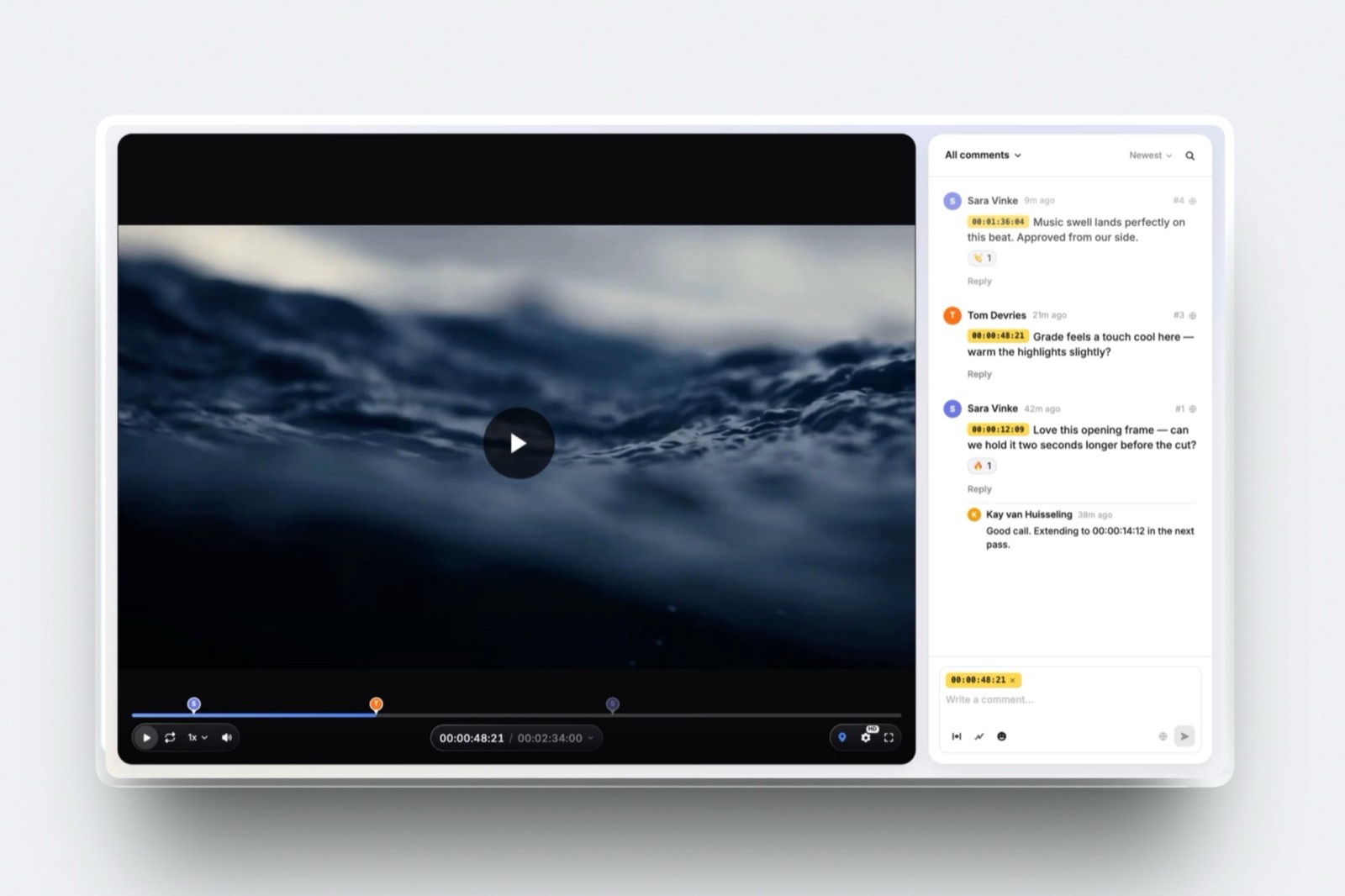
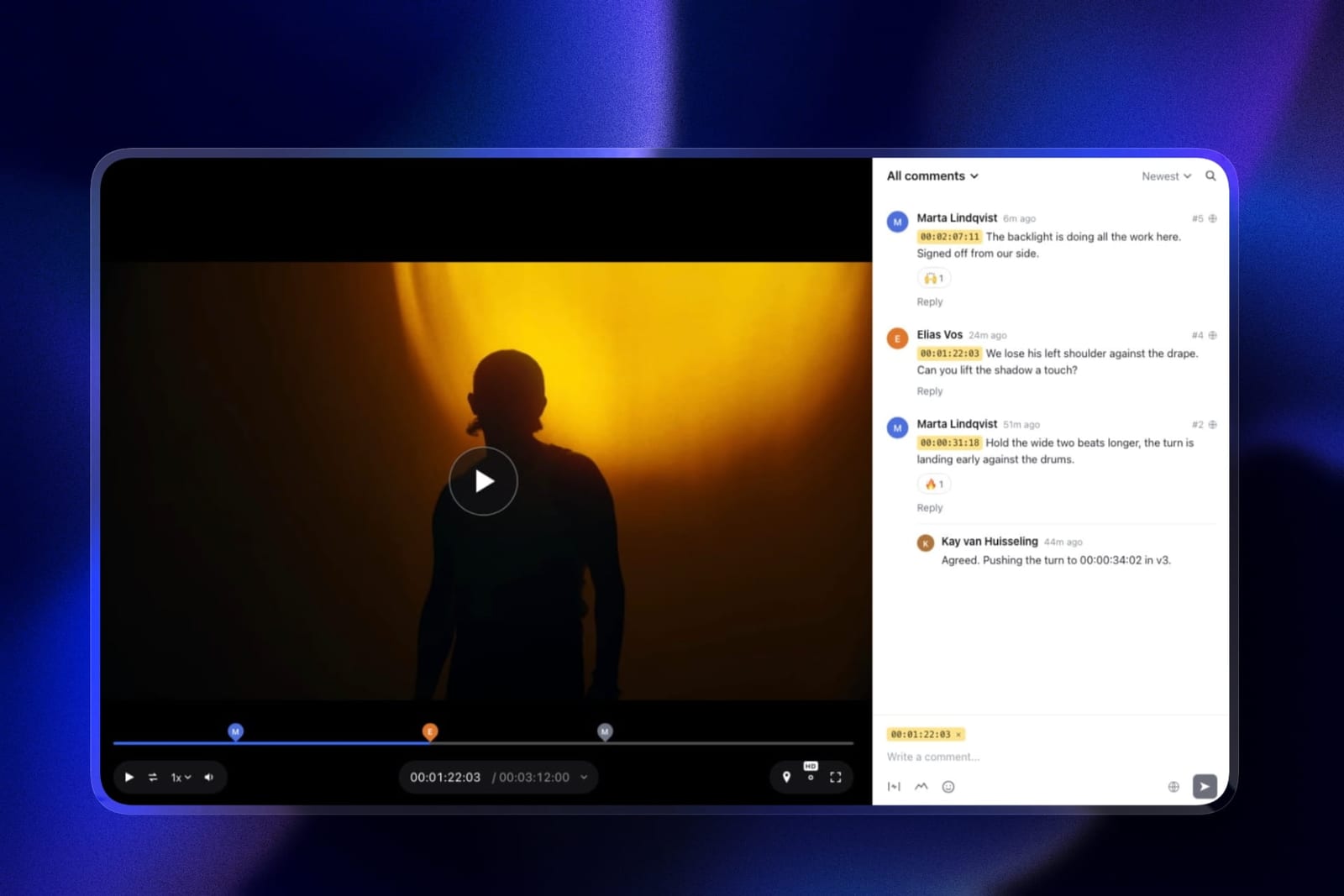
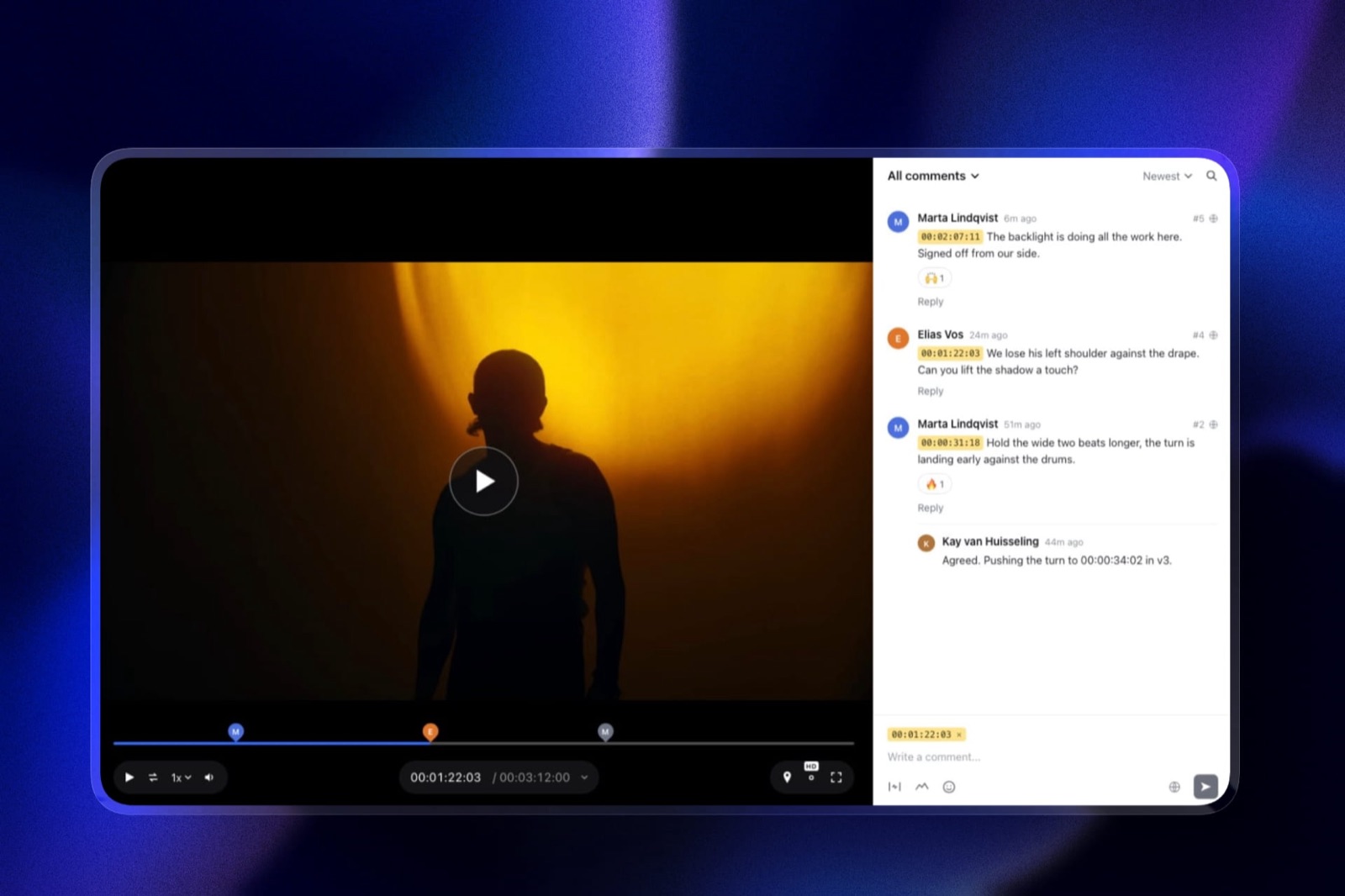
Framekit is an AI website builder with video review built in, and on the question this page asks it gets partway. Every comment you post from your own account carries a Public or Team switch.
Team comments show a lock, and they are filtered out on the server before a guest's page loads, so a client cannot see them, reply to them or find them by guessing a link.
For a studio where the creative director is also the person who holds the account, that is a real internal lane for one voice.
What it does not have is the rest of the agency stack.
Clients, brand managers and legal reviewers all comment as guests, which is why they cost nothing, but there are no per-person roles, no restricted projects or folders, and no way to give an account lead their own hidden lane or to keep one client's team out of another client's review.
The real number108 dollars a year on Starter against Frame.io Team's 1,800 for six people. That gap describes two different products rather than a bargain, and an agency that needs Frame.io's restricted folders should pay for them.
The standout detailthe activity log. Each review records who commented, who changed an approval status and who downloaded, with the email when the link is gated, which answers "what did the client actually approve" without an exportable audit report.
Password, email gate and expiry are free on every plan.
The honest gotchathe hidden lane belongs to the account, not to a team. A six-person agency with a creative director, an account lead and a producer each leaving blunt notes has nothing here that separates them properly.
Skip it ifmore than one person on your side needs to leave notes the client must never read.
Verdict: ranked eighth because seven tools here separate the two loops for a whole team and Framekit does it for one person. The right pick for a two-person studio that wants a branded client page, hidden notes for the lead and a portfolio on the same account.
9. Krock.io: Cheap, No Separation
Pro is 10 dollars per user with unlimited team size and from 2TB, unlimited reviewers on every plan, 4K playback and review across video, image, audio and PDF.
Verdict: 720 dollars a year for six people with real storage and no internal lane. The best value here if your two loops genuinely do not need separating.
10. GoVisually: Compliance-Led
Pro is 33 dollars per user with a three-user minimum, 250 active projects and unlimited external reviewers, with a compliance suite from 499 dollars a month covering more than twenty regulatory frameworks.
The gotchaLite at 16 dollars per user supports no video or GIF at all, so the real agency entry price is Pro.
Verdict: for agencies whose work is regulated packaging and claims. Overspecialised for a video shop.
11. Kollaborate: Flat and Unstructured
Kollaborate is one of very few tools here that sells real team members at a flat account price rather than per seat: Small Business is 25 dollars a month for 60GB and 5 team members, rising through twelve published tiers with unlimited projects and unlimited bandwidth on every one.
Verdict: real team members at a flat price, which is rare, and no internal comments, no roles and no routing. Listed last for agency use specifically.
What Mixing the Loops Actually Costs
In one linethe cost of a client reading an internal note is almost never the note itself, it is the round of work that follows from a client who has stopped trusting the recommendation.
Price it against the feature. Frame.io's internal lane costs 720 dollars a year for a six-person team, being the difference between Pro at 1,080 and Team at 1,800. ReviewStudio's costs 1,440 at six users on Advanced. Filestage includes it at a floor of 2,388.
Now price one incident. A client who sees "the second act does not work" from your own creative director, three days after you presented that act as intentional, will ask for options. Options mean a round.
At agency rates, one unplanned round on a campaign will exceed 720 dollars comfortably, and it also spends credibility you cannot re-buy.
That is the whole business case, and it is why the tier-up pricing across this category is defensible rather than cynical. The vendors have correctly identified that permission separation is worth more to an agency than any amount of annotation.
The test you can runopen your current tool, share a project with an external reviewer address you control, and read it as the client. Whatever you can see is what they can see, and most agencies have never actually checked.
Where Agency Tools Break at Scale
In one lineper-member pricing punishes an agency for employing people who never open the tool, and per-seat-block pricing punishes it for growing by a single person, so the model matters more than the headline rate at every size above about five.
Two pricing shapes cause almost all the friction here. Per-member tools such as Frame.io and Wipster charge for everyone on the account, so a twelve-person agency on Frame.io Team pays 3,600 dollars a year even if only five people ever leave a note. Seat-block tools such as Filestage and Ziflow sell in bundles of five, so going from ten people to eleven costs the same as going to fifteen.
PageProof is the outlier that avoids both, at 249 dollars a month flat with unlimited reviewers and no seat arithmetic, which is why it climbs the rankings for agencies with unpredictable client-side headcounts even though it is more expensive at small scale.
The practical advice is to price your real headcount at three points before choosing: today, plus two people, and plus five.
Several tools on this page reorder completely between those three numbers, and the one that looks cheapest today is frequently not the one that is cheapest at the size you are trying to reach.
Which Agency Review Tool Fits You? A Decision Tree
Work through these in order and stop at the first yes. The first question is the one this whole article exists for, and if you answer no to it you can ignore most of the pricing above and buy on storage instead.
- Do internal notes need to be invisible to clients? Frame.io Team at 25 dollars per member, ReviewStudio Advanced at 20 dollars per user, or Filestage at 199 dollars a month. Nothing cheaper does it properly.
- Must approvals happen in a defined sequence with deadlines? Filestage for reviewer groups, or Ziflow where workflow stages are the pricing axis.
- Do you also ship print, packaging or regulated claims? Ziflow for breadth, Approval Studio for depth at a lower price, GoVisually if compliance checking is the work.
- Does client-side reviewer count vary wildly by account? PageProof, at a flat 249 dollars a month with unlimited reviewers.
- Do account teams need to be kept out of each other's clients? Frame.io Team, Ziflow, or ReviewStudio Advanced. Only three tools here do restricted access.
- Is your agency really five editors with no internal review to hide? Krock.io at 10 dollars per user, or Kollaborate flat, and skip the tier-up entirely.
- Are there two of you, with one person leading review? Framekit at 9 dollars a month, accepting that only the account holder's notes can be hidden and there are no roles or restricted projects.
- Do you also need agency portfolio and case-study pages? Framekit runs those on the same account. Our website builders for creative agencies guide covers that half.
Frequently Asked Questions
What is the best video review tool for creative agencies in 2026?
Frame.io Team at 25 dollars per member per month is the best video review tool for creative agencies in 2026, because it combines internal comments with restricted projects and folders, which is the cleanest separation of internal and client review in this comparison.
Filestage at 199 dollars a month is better when approval must run through reviewer groups in sequence, and ReviewStudio Advanced at 20 dollars per user is the cheapest tool with genuine comment privacy.
Which review tools keep internal comments hidden from clients?
Six of the eleven here, in some form.
Frame.io offers internal comments on its Team tier, Filestage offers team-only comments from Starter, Wipster offers them on Team, ReviewStudio offers comment privacy on Advanced, Ziflow offers custom comment labels and filtering on Pro, and PageProof separates by workflow.
Framekit hides notes posted from the account itself, which covers one creative lead but not a team. Krock.io and Kollaborate do not provide an internal lane at all.
How much does an internal comment lane cost?
It is consistently a tier-up feature, and the cleanest way to see the price is the gap between tiers.
On Frame.io, six people cost 1,080 dollars a year on Pro without internal comments and 1,800 on Team with them, so the lane costs 720 dollars a year. ReviewStudio Advanced is 1,440 for six users.
Filestage includes team-only comments at its 2,388 dollar floor.
Framekit vs Frame.io for an agency: which separates internal notes better?
Frame.io, clearly. Frame.io Team at 25 dollars per member gives every team member an internal comment lane plus restricted projects and folders.
Framekit lets the account holder post Team comments that clients never see, and records comments, approvals and downloads in an activity log, but it has no roles, restricted projects or exportable audit trail.
Framekit suits a two-person studio at 9 dollars a month; Frame.io suits an agency.
What is the difference between internal review and client review?
Internal review is the unguarded pass where a creative director and account lead say what they actually think, and it is faster and more useful for being blunt. Client review is the considered pass where a recommendation is presented.
Mixing them in one comment thread either softens internal notes into uselessness or costs you client confidence, and the resulting unplanned round usually exceeds the annual price of the feature that would have prevented it.
Which tool is best for an agency with unpredictable client headcount?
PageProof, at a flat 249 dollars a month with unlimited reviewers, unlimited proofs and unlimited versions and no seat arithmetic.
Filestage and Ziflow both sell seats in bundles of five, so growing by one person costs the same as growing by five, and Frame.io and Wipster charge per member across your whole team regardless of who actually reviews.
Do any tools let me restrict which projects staff can see?
Three. Frame.io offers restricted projects and folders on its Team tier at 25 dollars per member, Ziflow offers project-level restriction, and ReviewStudio offers client and project teams on Advanced.
This matters for agencies holding several clients in one account, and it is discussed far less than annotation despite being the more consequential permission.
Is Filestage or Ziflow better for an agency?
Both cost 199 dollars a month at entry, and the choice is structural. Ziflow includes 15 users against Filestage's 10, supports over 1,200 file types, and prices workflow stages explicitly.
Filestage organises around reviewer groups with due dates and includes team-only comments at its floor. Choose Ziflow if you ship print as well as video, Filestage if your bottleneck is getting people to approve in order.
What happens if a client sees an internal comment?
Practically, they question the recommendation you presented, and you get a revision round that would not otherwise have existed. That round at agency rates typically costs more than a year of the feature that would have prevented it.
It also spends credibility, which is the part that does not appear in any cost comparison and is usually the more expensive loss.
Are free tiers usable for agency work?
Not for the internal-lane problem, which is the defining agency requirement and is paid everywhere. ReviewStudio's free tier is the most capable for pure client review, with unlimited users and guests on 5GB.
Ziflow's free tier keeps review history only 60 days. Frame.io's free tier caps at 2 projects and 2 members. Treat free tiers as evaluation for this use case rather than as plans.
How should an agency price these tools before committing?
At three headcounts: today, plus two people and plus five. Per-member tools such as Frame.io and Wipster scale linearly with your whole team, seat-block tools such as Filestage and Ziflow jump in fives, and PageProof does not move at all.
Several tools in this comparison reorder completely between those three numbers, so the cheapest option today is often not the cheapest at the size you are aiming for.
Do clients need accounts to review agency work?
No on every tool in this comparison. External reviewers work by link across Frame.io, Filestage, Ziflow, PageProof, ReviewStudio, Wipster, Krock.io, Approval Studio and Framekit, without consuming a paid seat.
What differs is what those guests can see, which is the entire subject of this page, so test the guest view with an address you control before running a real client through it.
Final Verdict
Frame.io Team is the best video review tool for creative agencies in 2026 because it solves the problem agencies actually have, which is keeping two review loops apart, and it does so by permission rather than by convention.
Internal comments plus restricted projects and folders at 25 dollars per member is the cleanest implementation here, and the internal lane costs a measurable 720 dollars a year for a six-person team.
Filestage is the better buy if your bottleneck is sequencing rather than privacy, Ziflow if you ship more than video, and PageProof if client-side reviewer counts are unpredictable.
Where Framekit loses, and why an agency should not buy it. Framekit's hidden Team comments work for the person who holds the account, not for a team, and it has no roles, no restricted projects and no exportable audit trail.
Seven tools on this page separate the two loops for a whole agency and Framekit does not, which is why it ranks eighth.
Unless you are two people with one person leading review, Frame.io Team or ReviewStudio Advanced is the better fit, and we would rather say so than sell you a low price.
Check your current tool's guest view today. Most agencies have never looked, and the ones that have are usually surprised.
Related readingthe 12 best video review tools, client approval software compared, the best Filestage alternatives, and website builders for creative agencies.
Competitor prices were read at each vendor's published pricing page in August 2026, Framekit's were checked again in September 2026, and all were priced for a six-person agency team plus external client reviewers, since per-member and seat-block models are not comparable at their headline rates.