Framekit templates
Start from a designer-made template
 Use template
 Use template
 Use template
 Use template
 Use template
 Use template
 Use template
 Use template
How much a pitch deck costs is one of those questions where the honest answer is a range so wide it sounds evasive. Nothing, if you build it yourself in Google Slides.
Around twenty-five thousand dollars, if a specialist agency writes the narrative, builds the financial model's visualisation, and shepherds it through four rounds with your board.
Both of those are real prices people pay this year, and the gap between them is not mostly about visual quality. It is about who does the thinking.
A pitch deck is a short presentation used to raise investment or win business, and its cost is determined less by how many slides it has than by whether you arrive with the story already written.
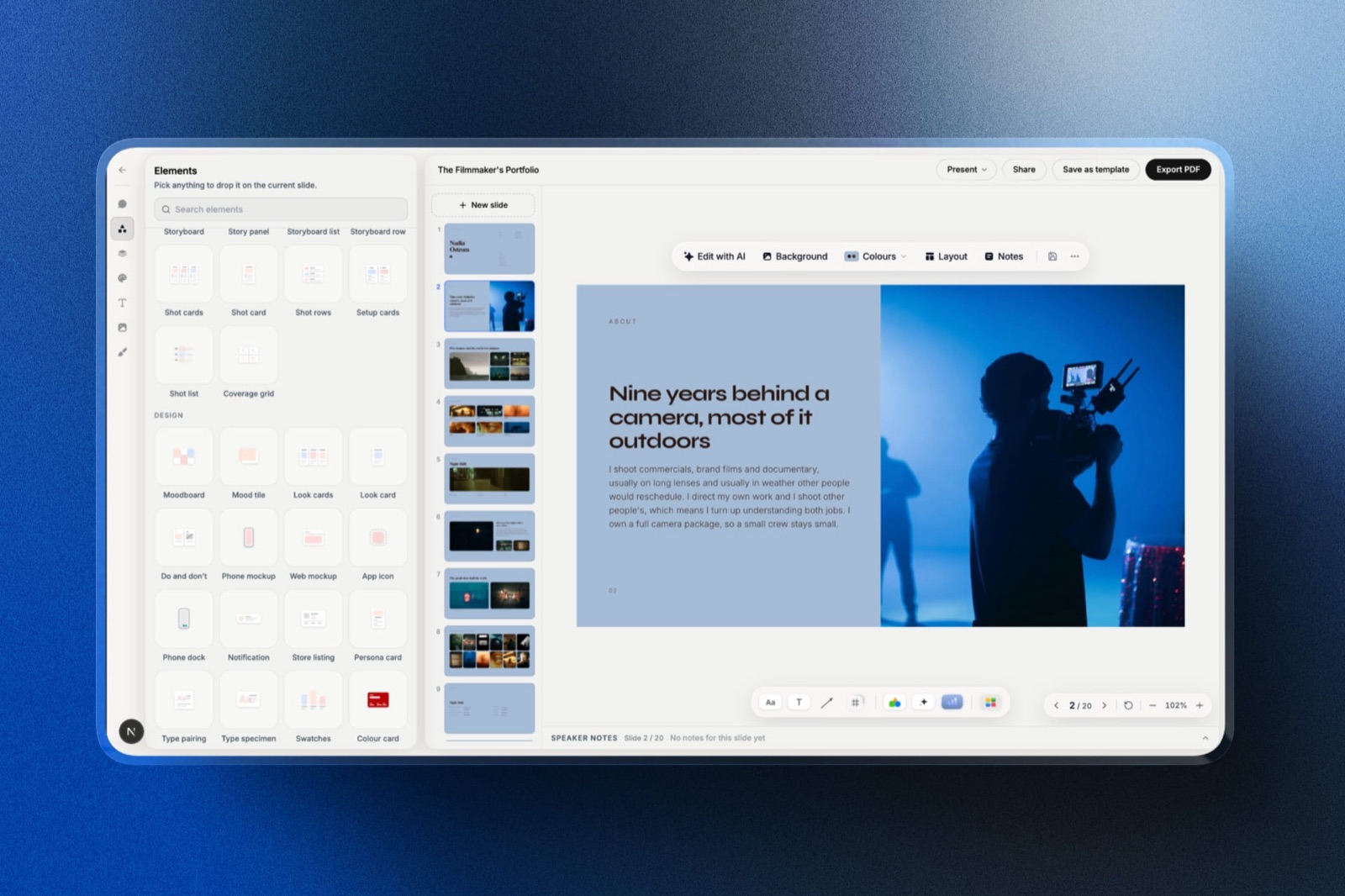
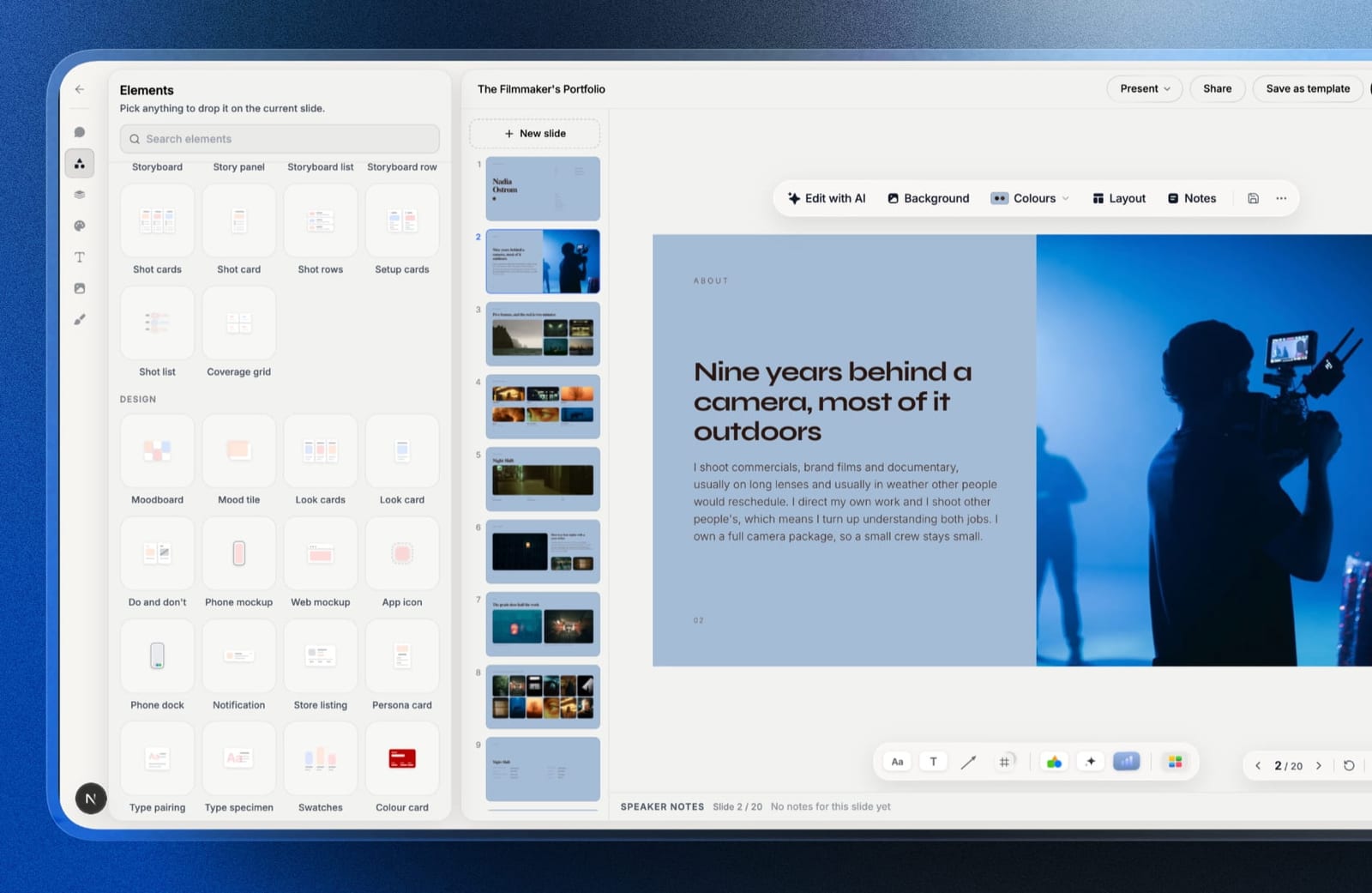
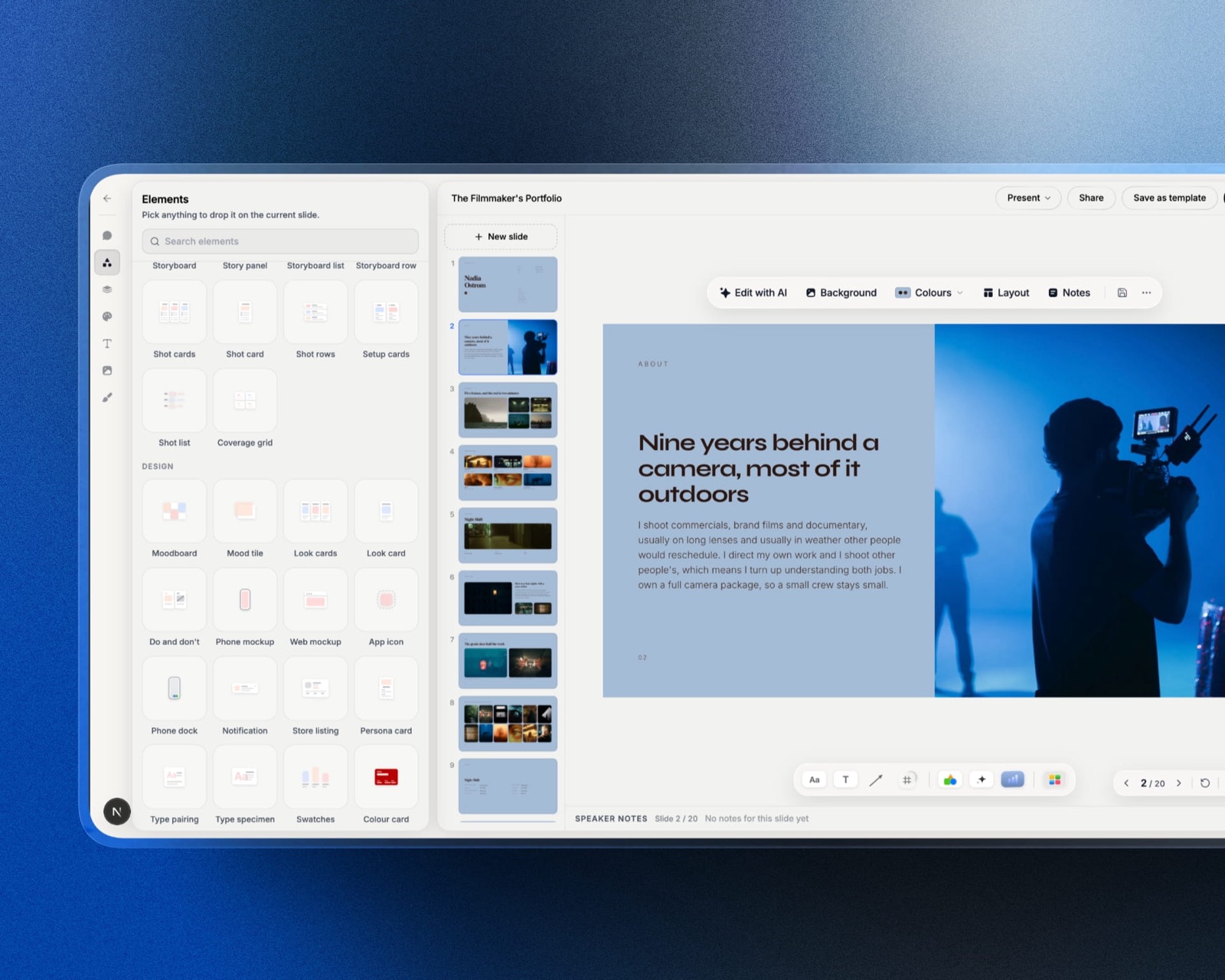
Framekit is an AI website builder for startups and studios, and its Slides editor puts it in the do-it-yourself tier priced below: unlimited decks on the free plan, AI that drafts and lays out a slide from a description, and PDF export on every plan.
It has no per-investor link analytics, which is the one thing an active raise genuinely needs and the reason it does not replace a sending tool.
A pitch deck costs $0 to $150 to build yourself using existing tools, $500 to $3,000 for a freelance designer working from your content, $3,000 to $12,000 for a specialist deck studio that also shapes the narrative, and $12,000 to $25,000 or more for a full strategic engagement with financial visualisation and multiple rounds.
The single biggest cost driver is whether you supply finished copy or expect the designer to write it, which typically doubles the price. Per-slide pricing is common, at roughly $50 to $300 a slide freelance and $300 to $1,000 a slide at specialist studios.
What Each Tier Actually Costs
Two kinds of number appear below and it matters which is which. Software prices were re-verified from vendors' published pricing in September 2026.
Service prices are observed ranges drawn from published agency rate cards and freelance marketplace listings, which vary by market and are quoted here as ranges rather than as facts.
| Tier | Typical cost | Who writes the story | Typical turnaround |
|---|---|---|---|
| Do it yourself, free tools | $0 | You | Days |
| Do it yourself, paid tools | $45 to $300 a year | You | Days |
| Template plus your own work | $15 to $50 one-off | You | Days |
| AI-assisted first draft | $108 a year | AI drafts, you rewrite | Hours |
| Freelance designer | $500 to $3,000 | You supply copy | 1 to 2 weeks |
| Deck studio, design-led | $3,000 to $12,000 | Shared | 2 to 4 weeks |
| Full strategic engagement | $12,000 to $25,000+ | They do | 4 to 8 weeks |
In one linethe price roughly doubles at the point where you stop supplying finished copy, which means the cheapest way to reduce a quote is to arrive with the narrative already written rather than to ask for fewer slides.
Doing It Yourself: $0 to $300
The honest floor is zero, and it is not a compromise for a first raise. Google Slides is free, opens everywhere, and has produced a very large number of funded decks.
Paid tools that are worth the money at this tier are specific and cheap. Canva Pro at $144 a year raises the visual floor substantially if nobody on the team designs.
Gamma at $108 a year produces a structurally sensible first draft in about two minutes, which is worth more than it sounds when the real blocker is a blank file. Beautiful.ai sells a One-Time Project plan at $45, which is the sensible way to use a subscription tool for exactly one deck.
Framekit Slides is free to start in the same bracket, with unlimited decks, AI drafting, and PDF export on every plan, and the trade is a Made with Framekit badge on decks shared from the free tier.
Add DocSend Personal at $10 a month billed annually if you are actually raising, because per-investor link analytics change your follow-up sequence and cost less than a single hour of a designer's time.
What you geta deck that communicates clearly and does not look designed.
What you do not geta narrative someone else has stress-tested, which is the part that most affects whether the deck works.
In one linea self-built deck plus a $120-a-year sending tool covers the whole job for a pre-seed round, and the money saved is better spent on the thing the deck describes.
Templates: $15 to $50
A template is the cheapest way to buy design without buying a designer.
Creative Market sells individual deck templates typically between $15 and $40 with a commercial licence, and Envato Elements is $198 a year for unlimited downloads including the fonts and stock those templates depend on.
The catch is the same one every template category has. The fonts shown in the preview are often not included, and they substitute silently on your machine, so the deck you build looks nothing like the image that sold it.
Check the exact typeface named in the listing before buying.
In one linebudget for the template and the typeface separately, because roughly three quarters of template listings show a font they do not include.
Freelance Designers: $500 to $3,000
The most common paid option and the one with the widest quality spread. Rates are usually quoted per slide, in the region of $50 to $300, or as a project fee for a standard twelve to eighteen slide deck.
What moves a quote within that range, in rough order of impact:
Whether you supply finished copy. A designer laying out your written slides is a different job from a designer deciding what each slide should say. This single factor typically doubles a quote.
Data visualisation. Three charts built from a spreadsheet are quick. A traction chart with two metrics on different scales, a cohort retention curve, and a market sizing build are a day's work each.
Custom illustration or iconography. Anything drawn rather than sourced adds meaningfully, and it is the first thing to cut if the quote comes back high.
Revision rounds. Two rounds is standard. Unlimited revisions either does not exist or is priced in.
Source files. Confirm you receive the editable file rather than a PDF, and in which format. This is the most common unpleasant surprise at handover.
In one lineask for the quote broken down by copywriting, layout, charts, and illustration, because the line you can most easily remove is usually the one you assumed was included.
Deck Studios: $3,000 to $25,000
Specialist studios that do only decks sit above freelancers and charge for judgement rather than for hours. At the design-led end, roughly $3,000 to $12,000 buys a team that has seen several hundred decks in your category and will tell you that slide four is doing nothing.
Above that, a full engagement includes narrative development, financial visualisation, and often rehearsal support. Per-slide rates at this level commonly run $300 to $1,000.
Whether that is worth it depends almost entirely on what the deck is for. For a seed round of a few hundred thousand, it is difficult to justify.
For a Series B, an acquisition conversation, or a sales deck that will be used by a team for two years, the arithmetic changes completely, because the deck is being amortised across many uses or a very large decision.
Slidebean's Accelerate tier at $99 a month, which is $1,188 a year, sits deliberately between these tiers by combining software with hands-on deck support, and is worth knowing about if the studio quotes come back higher than the round justifies.
In one linepay studio rates when the deck is amortised across many uses or a very large decision, and not because a first round feels important, since it always does.
The Four Hidden Costs
Four costs appear after the quote is agreed rather than in it, and between them they account for most of the difference between a budget and a final invoice in this category.
Font licensing. A designer's brand recommendation may involve a typeface you do not own. Desktop licences for a professional family commonly run into the hundreds, and web licences are separate. Ask early whether the proposed type is licensed and by whom.
Stock imagery. Images in a concept presentation are often comps. Licensing them properly for a deck that will be sent to hundreds of people is a separate line, and it is the one most likely to be forgotten until the invoice.
Revision overruns. Two rounds is standard and three is common in practice. Agree what constitutes a round in writing, because "small tweaks" is where most disputes in this category happen.
Source files and fonts at handover. If you receive a PDF and a .pptx that references fonts you do not have, you cannot update the deck yourself, and every future change is a paid change.
Confirm the deliverable format and whether outlined type is acceptable to you.
In one linethe four hidden costs are all questions that cost nothing to ask before signing and several hundred dollars to discover afterwards.
What a Deck Is Worth
Cost is only half the question, and the other half is uncomfortable to write about honestly because it cannot be measured cleanly by anyone, including the studios whose business depends on the answer.
A pitch deck is read for a very short time by people making a decision worth a great deal more than the deck cost. That asymmetry is the argument for spending, and it is also the argument the entire deck industry uses, so it deserves scepticism.
The honest position is that design quality has a floor effect rather than a ceiling effect. A deck that looks unconsidered creates doubt about execution, and fixing that is worth real money.
A deck that looks exceptional does not create belief that was not already available from the business, which is why $25,000 decks and $1,500 decks raise money at rates nobody has ever credibly separated.
A test that costs nothing. Send your current deck to three people who do not know your business and ask them to tell you what the company does and why it will win, in one sentence each.
If they cannot, the problem is the narrative, and paying for design will produce a well-designed version of the same problem.
In one linespend to clear the credibility floor and stop, because above that line the returns are on the story rather than on the slides.
How to Pay Less Without Getting Less
Four things reliably reduce a quote without reducing the quality of what you get back, and all four are decisions you make before you approach a designer rather than negotiations you have afterwards.
Arrive with finished copy. This is the single largest lever and it typically halves a quote. Write the slides badly yourself rather than asking someone to write them well from a conversation.
Reduce the slide count before you ask. Most decks that arrive at a designer are four slides longer than they should be, and you pay per slide to have the surplus laid out beautifully.
Supply your own imagery. Product screenshots, team photographs, and real customer material all cost nothing and beat stock in a pitch context.
Buy a template and a designer's time to adapt it. A $30 template plus four hours of a freelancer's time produces something closer to a $2,000 deck than to a $300 one, and it is the most under-used option at the bottom of the market.
There is a fifth route if the deck is for winning business rather than raising money.
In that case the follow-up is usually your website rather than a data room, and a tool that carries the deck and the site on one free plan, which is what Framekit does, removes a subscription from the total without changing what the client receives.
In one linethe cheapest deck is not the one with the fewest slides, it is the one that arrives with the words already decided.
Frequently Asked Questions
How much does a pitch deck cost in 2026?
A pitch deck costs $0 to $150 to build yourself with existing tools, $500 to $3,000 with a freelance designer working from your copy, $3,000 to $12,000 at a design-led deck studio, and $12,000 to $25,000 or more for a full strategic engagement.
Service figures are observed market ranges rather than published list prices, and vary by region.
How much does a designer charge per slide?
Freelance designers commonly charge roughly $50 to $300 per slide, and specialist deck studios roughly $300 to $1,000 per slide.
The rate moves most according to whether you supply finished copy, how much data visualisation is involved, and whether any illustration is drawn rather than sourced.
Is it worth paying for a pitch deck?
Paying for a pitch deck is worth it when the deck will be used many times or supports a large decision, such as a later-stage round or a sales deck a team will use for two years.
For a first raise, design quality has a floor effect rather than a ceiling effect, so clearing the credibility threshold matters and spending beyond it rarely changes outcomes.
Can you make a good pitch deck for free?
You can make a good pitch deck for free in Google Slides, and a very large number of funded decks were built that way.
Free tools cost you visual polish rather than clarity, and clarity is the thing investors are actually assessing, which is why a well-argued free deck outperforms a beautiful unclear one.
What makes a pitch deck expensive?
The largest single driver is whether the designer has to write the narrative rather than lay out copy you supply, which typically doubles a quote.
After that, data visualisation, custom illustration, the number of revision rounds, and rush turnaround are the main factors, and slide count matters less than most people expect.
What are the hidden costs of a pitch deck?
The four common hidden costs are font licensing for a typeface you do not already own, proper licensing for stock imagery used in the final deck, revision rounds beyond the two usually included, and receiving source files in a format you can actually edit.
All four are cheap to ask about beforehand and expensive to discover afterwards.
How long does a pitch deck take to make?
A self-built deck takes days, a freelance project typically one to two weeks, a design-led studio engagement two to four weeks, and a full strategic engagement four to eight weeks.
Rush work is usually available at a premium, and the part that cannot be compressed is deciding what the deck should say.
Should you use a template for a pitch deck?
A template is a reasonable way to buy design without buying a designer, at $15 to $40 for an individual purchase.
Check which typeface the preview uses and whether it is included, because most template listings show a font they do not license, and the deck you build will substitute it silently.
How much should a seed-stage startup spend on a deck?
Most seed-stage companies are best served spending nothing on design and around $120 a year on a sending tool with per-investor analytics, then putting effort into the narrative.
If the team genuinely cannot produce something that clears the credibility floor, a $500 to $1,500 freelance engagement with copy supplied is the sensible ceiling.
Do investors care how a pitch deck looks?
Investors respond to a deck that looks unconsidered, because it raises a question about execution, and they respond much less to a deck that looks exceptional.
The practical implication is that design spend has a threshold rather than a curve, and effort above the threshold is better directed at what the deck says.
The Bottom Line
The useful way to think about pitch deck cost is not by tier but by who is doing the thinking. If you arrive with the story written, you are buying layout, and layout is available from $0 to $3,000 depending on how good you need it to look.
If you arrive with a conversation, you are buying strategy, and strategy is what the $12,000-and-up engagements actually sell.
For most early-stage companies the right answer is unglamorous. Build it yourself, spend $120 a year on a sending tool that tells you who read it, and put the saved money into the business the deck describes.
Revisit that when the deck is being used weekly by a sales team or when a single decision is large enough to justify professional judgement.
_Re-verified 19 September 2026: our own closing passage was corrected after Framekit's Slides editor shipped._
Framekit's Slides editor can build the deck itself, from investor-deck layouts with an AI slide writer, and it exports a PDF on every plan, though it cannot tell you who opened the file, which is the job the $120-a-year sending tool above is doing.
The adjacent point worth making is that the first thing most investors do after reading a deck is look up the company, and a landing page that has not been touched in eighteen months undoes a well-designed deck at no cost to anyone but you.
Related reading: our guides to the best pitch deck software, how to make a pitch deck, the best pitch deck templates, and the best presentation tools for startups.
Software prices in this guide were read from published vendor pricing in August 2026. Service prices are observed ranges from published agency rate cards and freelance marketplace listings, and are quoted as ranges because they vary substantially by market and by scope.