Framekit templates
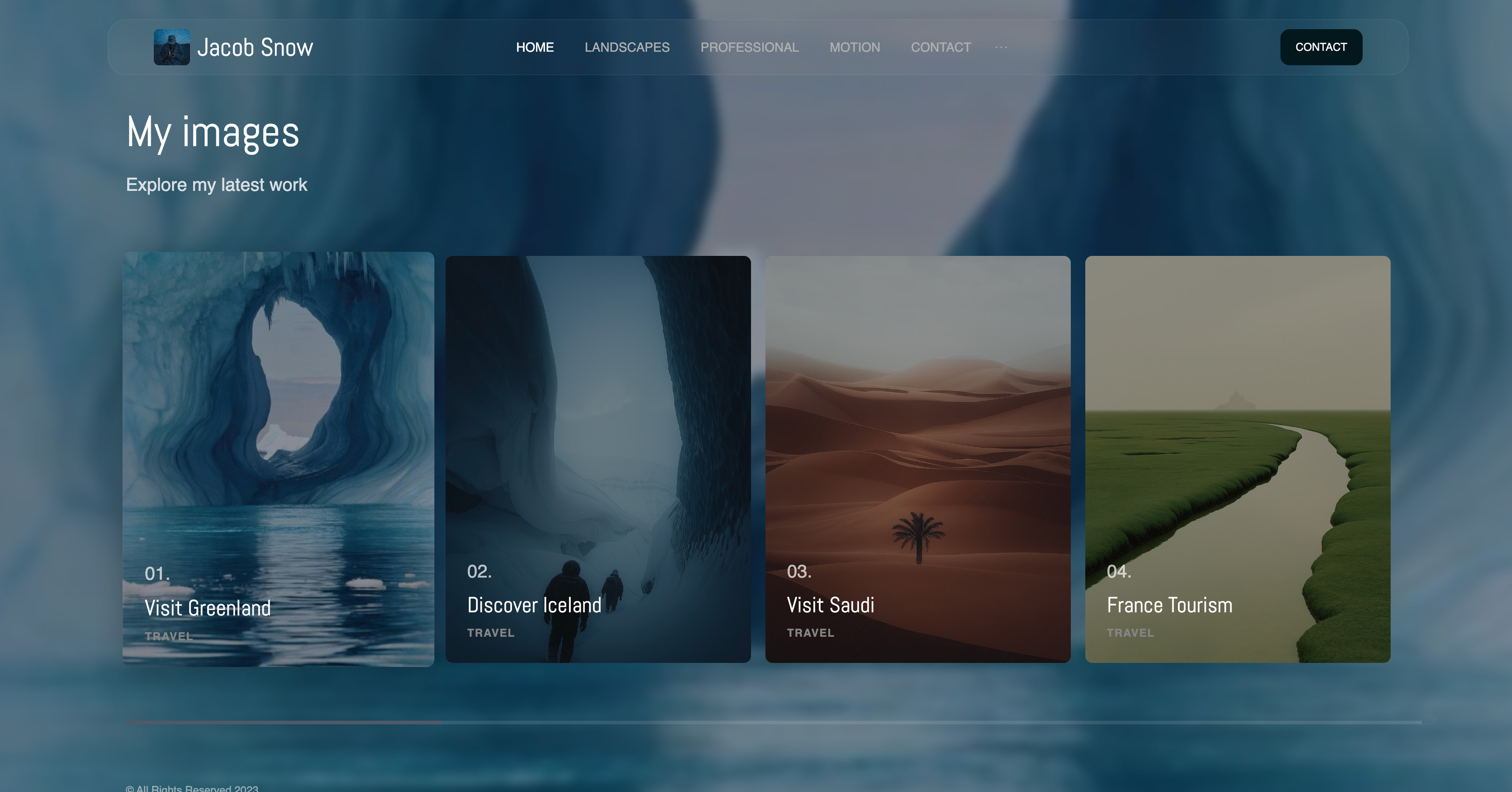
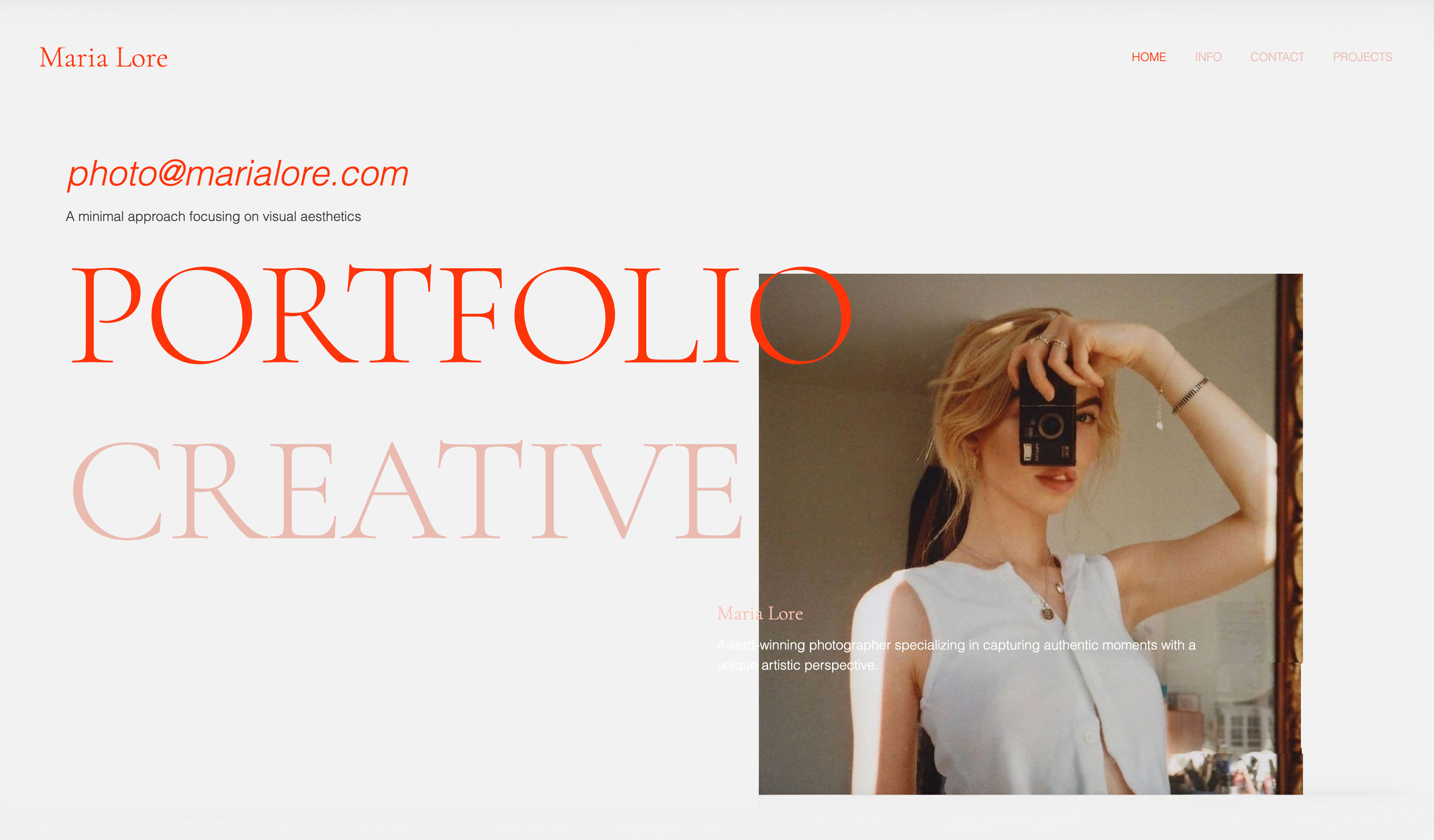
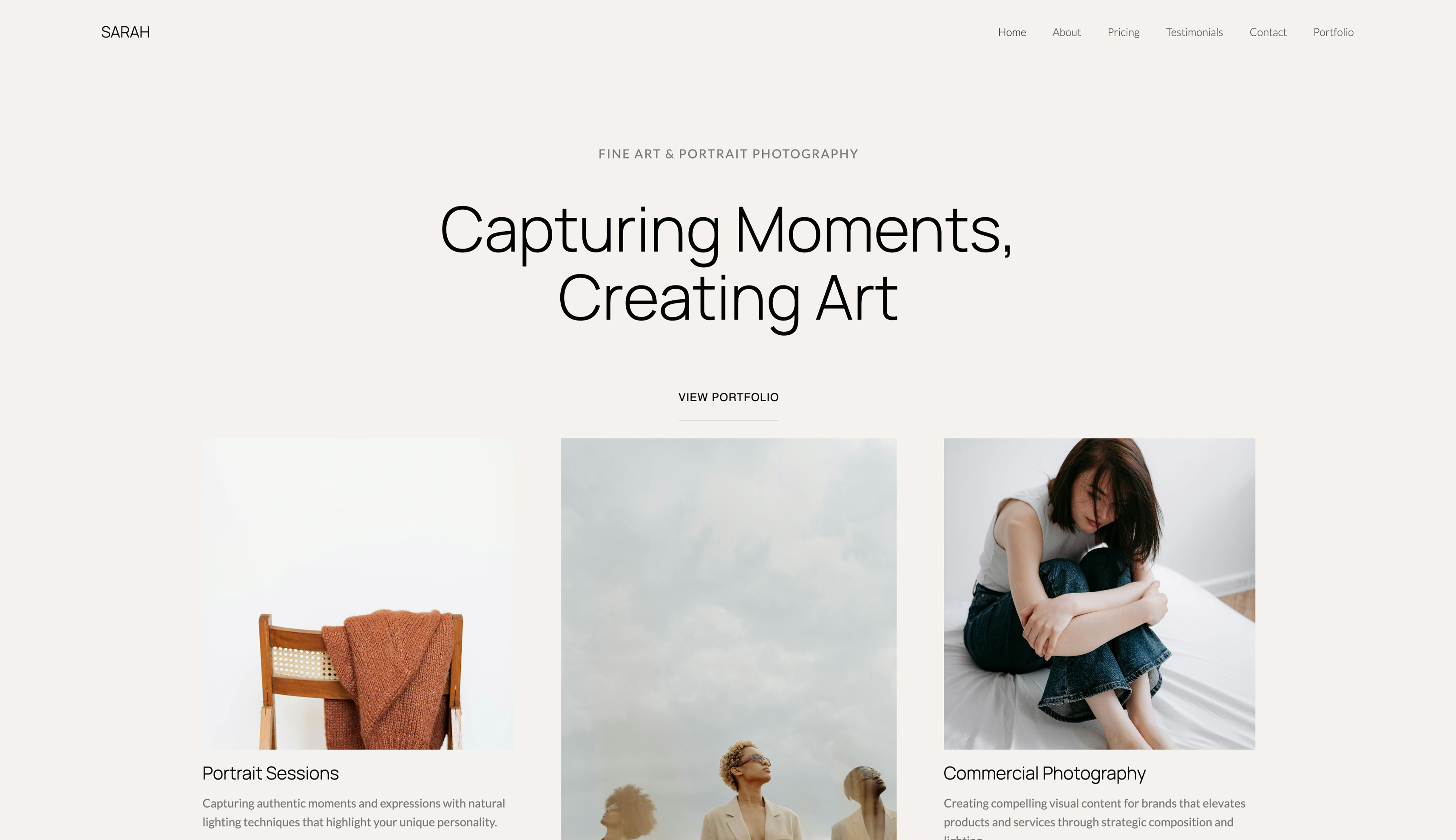
Start from a designer-made template
 Use template
 Use template
 Use template
 Use template
 Use template
 Use template
 Use template
 Use template
The client says yes on a Tuesday call. You send the proposal Tuesday night. They read it Wednesday, forward it to a business partner Thursday, print it to sign Friday, scan it Monday, and ask about the deposit invoice Tuesday.
One week of enthusiasm spent on paperwork, and about a third of the time the momentum does not survive it.
Every hour between yes and signed is an hour the yes can decay.
Client proposal software is a tool that turns a scope, a price and a set of terms into a document a client can read, sign and often pay from in one session, with the sender able to see whether it was opened at all.
The best client proposal software in 2026 is Better Proposals, because it produces a good-looking web proposal with legally usable e-signature and payment collection at the lowest credible entry price in this comparison, from about $13 per user a month.
The trade-off is that it is a proposal tool and nothing else, so it will not run your bookings or your invoicing.
Qwilr is the pick when the proposal should look like a designed web page, HoneyBook and Dubsado are better if you want the proposal inside a full booking workflow, Framekit Slides is a designed proposal document beside your portfolio but with no signature or payment, and Google Docs remains a legitimate free answer for a freelancer sending four proposals a year.
Full disclosure: Framekit is our own product. Its Slides editor now has proposal layouts, so it is ranked, but only eighth, because it has no e-signature, no payment collection and no read tracking, and seven tools here close a deal faster. It is scored from its published features, not from our ten test sends.
How We Compared 11 Client Proposal Tools
We built and sent the same document through every tool: an $8,500 brand identity proposal with a scope of work, a three-phase timeline, three pricing options, terms, and a 50% deposit request.
The sender in every case is a two-person studio sending about 24 proposals a year, which is the shape most independent creative businesses run at.
Time from send to signed. The number that matters. We measured how many steps a client takes between opening the document and being finished, including signature and deposit.
Signature quality. Not all e-signature is equal. We checked whether each tool captures an audit trail and produces a signed artefact you could actually rely on, rather than a typed name in a box.
Payment in the same session. Can the client pay the deposit without waiting for a separate invoice? This is the single largest lever on cash-flow speed in the whole category.
Presentation. Creative work is sold on taste, and a proposal that looks like an insurance form undercuts a premium price.
Real cost for 24 proposals a year. Per-seat monthly pricing quoted as an annual figure for a two-person studio, because that is how the bill actually arrives.
Three kinds of finding, kept apart. Measured by hand: building the document, sending it to a test recipient, signing it, and counting the steps in a clean browser.
Verified from published sources: prices, checked against each vendor's own pricing page in August 2026 and linked where the page allows access.
Reported as community sentiment: reports of recent price increases and support complaints, flagged as sentiment each time.
On 19 September 2026 we added Framekit as an eleventh tool, now that its Slides editor ships proposal and pricing layouts, and re-verified its plans against its own pricing page; it was not part of the ten test sends, and competitor prices are as read in August.
What Sending the Same Proposal 10 Times Showed
The counts behind the ranking, from our own sends and from each vendor's published pricing in August 2026.
- 7 of 11 collect a signature and a deposit payment in the same session. The four that do not are Canva, Google Docs, Notion and, per its own feature list, Framekit, which are document tools rather than proposal tools.
- The fastest send-to-signed path was 3 client steps, achieved by Better Proposals and Qwilr. The slowest was 9, using a PDF emailed from a document tool.
- Entry pricing spans from $0 to $35 per seat a month, a difference of about $840 a year for a two-person studio.
- 4 of 11 are really business platforms with proposals attached rather than proposal tools: HoneyBook, Dubsado, Bonsai and PandaDoc.
- 2 of 11 publish an entry plan under $20 per user a month with both signature and payment included, which are Better Proposals and Bonsai.
- HoneyBook's entry price is now commonly listed at about $39 a month following a substantial increase reported during 2026, which we report as sentiment and which anyone budgeting should confirm on its own pricing page.
Skip to the decision tree if you want the fast answer, or read the field first.
The 11 Best Client Proposal Software Tools in 2026: Full Comparison
How the ratings work: send-to-signed speed 25%, signature and payment capability 25%, presentation 20%, fit for creative work 15%, and cost 15%.
Speed and capability carry half between them because a proposal's only job is to convert a yes into a signed engagement before the yes cools.
Better Proposals leads at 9.0 while scoring 6 on breadth, because it does one thing; HoneyBook scores 9 on breadth and 6 on presentation, because its documents look like software rather than like a studio's work. No tool in this comparison scored above 7 on both.
| Tool | Best for | Signature | Payment in document | Cost per user a month | Our rating |
|---|---|---|---|---|---|
| Better Proposals | Freelancers and small studios | Yes | Yes | From about $13 | 9.0/10 |
| Qwilr | Proposals as designed web pages | Yes | Yes | About $35 | 8.8/10 |
| HoneyBook | Photographers and event creatives | Yes | Yes | From about $39 a month | 8.6/10 |
| Dubsado | Studios wanting deep automation | Yes | Yes | About $35 to $55 a month | 8.4/10 |
| PandaDoc | Volume and integrations | Yes | Yes | From about $19 | 8.1/10 |
| Proposify | Agencies with a content library | Yes | Yes | From about $29 | 7.9/10 |
| Bonsai | Solo freelancers on a budget | Yes | Yes | From about $9 annual | 7.7/10 |
| Framekit | A designed proposal beside your portfolio | No | No | $0 to $7 | 7.2/10 |
| Canva | A designed proposal, no platform | No | No | $0 to $12 | 7.0/10 |
| Notion | Proposals inside a workspace | No | No | $0 to about $10 | 6.3/10 |
| Google Docs | The free baseline | No | No | $0 | 6.0/10 |
Prices verified against each vendor's published pricing in August 2026 and quoted per user per month unless a tool prices per account. Several vendors in this category changed pricing within the last year, so confirm before committing.
What the client actually has to do
The step count is the difference between a proposal signed on Wednesday and a proposal signed next month. We counted every action a recipient takes from opening the link to being finished, including paying a 50% deposit.
| Approach | Client steps to signed and paid | Where it stalls |
|---|---|---|
| Better Proposals or Qwilr | 3 | Rarely |
| HoneyBook, Dubsado or Bonsai | 3 to 4 | Account prompts on some flows |
| PandaDoc or Proposify | 4 | Signature setup on first use |
| Canva or Notion link, invoice later | 6 | Waiting for the separate invoice |
| PDF by email, print and scan | 9 | The printer, then the scanner |
1. Better Proposals: Best Overall for Freelancers and Small Studios
Our rating: 9.0/10
Better Proposals does one job and finishes it. The proposal is a web document rather than a PDF, the signature is captured with an audit trail, the deposit is collected in the same view, and the whole thing looks like a studio produced it rather than a legal department.
Our $8,500 identity proposal took under an hour to build from a template and reached signed and paid in three client steps, which was the joint fastest here. The template library is aimed at agencies and freelancers, which shows in the language as much as the layout.
Best forFreelancers and studios whose main friction is the gap between a verbal yes and a signed contract with a deposit.
Key features:
- Web-based proposals with signature and payment in the same document
- Payment collection through common processors at the moment of signing
- Notifications when a proposal is opened, and where the reader spent time
- Template library written for agencies and creative freelancers rather than for enterprise sales
- Reusable content blocks for scope and terms you send repeatedly
The real numberthe entry plan is about $13 per user a month, with higher tiers around $29 and $49, per Better Proposals' pricing page.
For a two-person studio that is roughly $312 a year at the entry tier, against about $840 for two seats of Qwilr.
The standout detailthe open notification includes where the reader stopped. On our test send, the notification showed the reader spent most of their time on the pricing section and never reached the timeline, which is exactly the intelligence that tells you what to address on the follow-up call.
The gotchait is a proposal tool and only a proposal tool. There is no booking calendar, no client portal, no invoicing beyond the deposit, so a studio wanting one system will end up with two subscriptions.
What reviewers say elsewhereBetter Proposals rates well on Capterra and G2 for ease of use and value, with the recurring criticism being limited customisation compared with a design tool.
Skip it ifyou want one platform running bookings, contracts, invoices and proposals together, because that is HoneyBook or Dubsado rather than this.
Verdict: Better Proposals is the best client proposal software for most independent creative businesses, and the cheapest credible way to stop losing a week between yes and signed. Visit Better Proposals
2. Qwilr: Best Proposals as Designed Web Pages
Our rating: 8.8/10
Qwilr's premise is that a proposal should be a web page rather than a document, and it commits to that harder than anything else here.
Interactive pricing, embedded video, and blocks that behave like a modern site make a Qwilr proposal feel closer to a small microsite than to paperwork.
For creative work that is worth more than it costs. Our identity proposal looked more expensive in Qwilr than in any other tool, and presentation is not a vanity concern when the number at the bottom is $8,500.
Best forStudios and agencies selling premium creative work where the proposal itself is a demonstration of taste.
Key features:
- Web-page proposals with modern layout blocks and embedded media
- Interactive pricing where a client can select options and see the total change
- Signature and payment collection built in
- Analytics showing which sections were read and for how long
- Brand controls so every proposal matches the studio identity
The real numberthe Business plan is about $35 per seat a month on annual billing, or $39 monthly, per Qwilr's pricing page. For two seats that is roughly $840 a year, which is the highest per-seat cost in this comparison outside enterprise tiers.
The gotchainteractive pricing is a double-edged feature. Letting a client toggle options themselves is persuasive when your packages are well designed and quietly destructive when it invites them to remove the part of the scope that made the project work.
Skip it ifyou send fewer than about a dozen proposals a year, because the per-seat price is hard to justify on volume that low.
Verdict: Qwilr is the best-looking proposal in this comparison and the most expensive way to send one. Worth it when presentation is part of what you are selling. Visit Qwilr
3. HoneyBook: Best for Photographers and Event Creatives
Our rating: 8.6/10
HoneyBook is the default business platform for wedding photographers, event planners and portrait studios, and the proposal is one step in a flow that also covers the enquiry form, the contract, the invoice schedule and the payment reminders.
For a photographer booking thirty weddings a year, that continuity is worth more than a better-looking document.
The document itself is the weakest part. HoneyBook proposals are clean but obviously templated, and a studio selling on design taste will notice the ceiling quickly.
Best forPhotographers, videographers and event creatives who want enquiry, proposal, contract, invoice and payment in one system.
Key features:
- Proposal, contract and invoice as a single client-facing flow
- Automated payment schedules and reminders for staged payments
- Enquiry forms that feed straight into a project
- Scheduling and client communication in the same platform
- Mobile app that is genuinely usable on a shoot day
The real numberHoneyBook's entry plan is commonly listed at about $39 a month in 2026, following a substantial increase reported through the year.
Confirm the current figure on HoneyBook's pricing page before budgeting, because this is the number most likely to have moved since publication.
The gotchathe price increase caught a lot of existing users, and the platform's value depends on using most of it. A photographer who uses HoneyBook only for proposals is paying roughly three times what Better Proposals costs for a document that presents less well.
What reviewers say elsewhereHoneyBook rates highly for all-in-one convenience across review platforms, with the dominant 2026 criticism being the price change rather than the product.
Skip it ifyour bookings already run somewhere else, because the proposal alone does not justify the platform.
Verdict: HoneyBook is a business platform that includes proposals, and an expensive proposal tool if that is all you use. Buy the workflow or do not buy it. Visit HoneyBook
4. Dubsado: Best for Studios Wanting Deep Automation
Our rating: 8.4/10
Dubsado is what studios move to when HoneyBook's automation stops being flexible enough.
Its workflows can chain a proposal to a contract to an invoice to a questionnaire to a reminder sequence, conditionally, and a studio that invests a weekend in configuring it genuinely stops doing admin.
That weekend is the cost. Dubsado is the least immediately approachable tool in this comparison, and a meaningful number of people buy it, never finish setting it up, and conclude it is complicated rather than unfinished.
Best forEstablished studios sending enough repeat work that automation pays back the setup time.
Key features:
- Conditional workflows chaining proposals, contracts, invoices and forms
- Highly customisable client-facing forms and documents
- Scheduling, bookkeeping and time tracking in the same system
- Client portal with the whole project history
- Templates that can be branched by service type
The real numberDubsado is about $35 a month on Starter and about $55 on Premier billed monthly, cheaper annually, with additional users around $25 a month, per Dubsado's pricing page.
Note the unit: this is per account with extra users priced separately, which for a two-person studio is more favourable than per-seat pricing.
The gotchathe setup burden is real and front-loaded. Budget a full day before your first proposal goes out, and expect to revise the workflows twice in the first month.
Skip it ifyour services vary so much that every proposal is bespoke, because the automation has nothing repeatable to automate.
Verdict: Dubsado is the most capable workflow tool here for studios with repeatable services and the easiest to abandon half-configured. Commit the setup day or choose something simpler. Visit Dubsado
5. PandaDoc: Best for Volume and Integrations
Our rating: 8.1/10
PandaDoc is a document platform that happens to do proposals, and its strength is everything around the document: approval routing, CRM integrations, template governance, and a signature implementation that a client's legal team will not question.
For a creative studio that is mostly overhead. The templates are sales-shaped rather than studio-shaped, and the document that comes out reads as a business instrument rather than as part of the work.
Best forLarger studios and production companies sending high volumes of similar documents alongside contracts and statements of work.
Key features:
- Strong e-signature with a thorough audit trail
- Deep integrations with CRM and accounting systems
- Approval workflows before a document can be sent
- Content library with locked sections for governance
- Analytics across a whole document pipeline
The real numberplans start at about $19 per user a month with a Business tier around $49 per seat, per PandaDoc's published pricing. For a two-person studio the entry tier is about $456 a year, more than Better Proposals and less than Qwilr.
The gotchathe free and entry tiers have historically limited the features most people assume are included, particularly around templates and payments, so check the tier against the specific feature you are buying it for rather than the marketing page.
Skip it ifyou are a small creative business, because you will pay for governance features that exist to solve problems you do not have.
Verdict: PandaDoc is the right answer once documents become a process rather than a document, which is a threshold most independent studios never cross. Visit PandaDoc
6. Proposify: Best for Agencies With a Content Library
Our rating: 7.9/10
Proposify is built around the idea that an agency sends the same eight sections in different orders, and it manages that content properly: a central library, locked pricing, and version control so a junior cannot quietly discount the retainer.
For a two-person studio that governance is unnecessary. For a twelve-person agency where three people send proposals, it is the reason to choose this over anything cheaper.
Best forAgencies with several people sending proposals who need consistency and pricing control.
Key features:
- Central content library with locked sections and approved pricing
- Version control and role permissions across a team
- Signature and payment collection built in
- Pipeline reporting across all open proposals
- Templates aimed at agency services
The real numberplans start at about $29 a month with a team tier around $41 per user, per Proposify's pricing page. Higher business tiers carry seat minimums that put them out of reach for small studios.
The gotchathe seat minimum on upper tiers is the trap. Studios grow into a feature they need, then discover the plan carrying it requires far more seats than they have, which turns a modest upgrade into a large one.
Skip it ifone person sends every proposal, because the entire value proposition is coordination.
Verdict: Proposify is agency infrastructure and overkill for a studio of one or two. The library is the product; buy it when the library is the problem. Visit Proposify
7. Bonsai: Best for Solo Freelancers on a Budget
Our rating: 7.7/10
Bonsai bundles proposals, contracts, invoicing, time tracking and light accounting for solo freelancers at a price well under the studio platforms, and for a freelancer whose whole business runs on one laptop that combination is hard to argue with.
The documents are the compromise. Bonsai proposals are functional and plain, and the contract templates, while genuinely useful, are generic enough that anyone selling premium creative work should edit them rather than send them as written.
Best forSolo freelancers who want proposals, contracts and invoicing in one inexpensive subscription.
Key features:
- Proposals, contracts, invoices and time tracking in one place
- Contract templates written for freelance work
- Signature and payment collection included
- Expense and light accounting features for self-employed work
- The lowest all-in-one entry price in this comparison
The real numberplans start at about $15 per user a month, or about $9 billed annually, rising to roughly $39 for the top tier, per Bonsai's pricing page. At the annual entry rate that is about $108 a year, the cheapest paid option here.
The gotchathe templates are generic by design, and using the contract language as written on a $8,500 identity project is how freelancers end up without a kill fee or a revision limit. Treat them as a starting point, not as legal advice.
Skip it ifpresentation is part of your pitch, because a Bonsai proposal will not make an $8,500 number feel considered.
Verdict: Bonsai is the best value for a solo freelancer who needs the whole back office and the wrong choice if the proposal has to sell the work. Visit Bonsai
8. Framekit: Best Designed Proposal Beside Your Portfolio
Our rating: 7.2/10
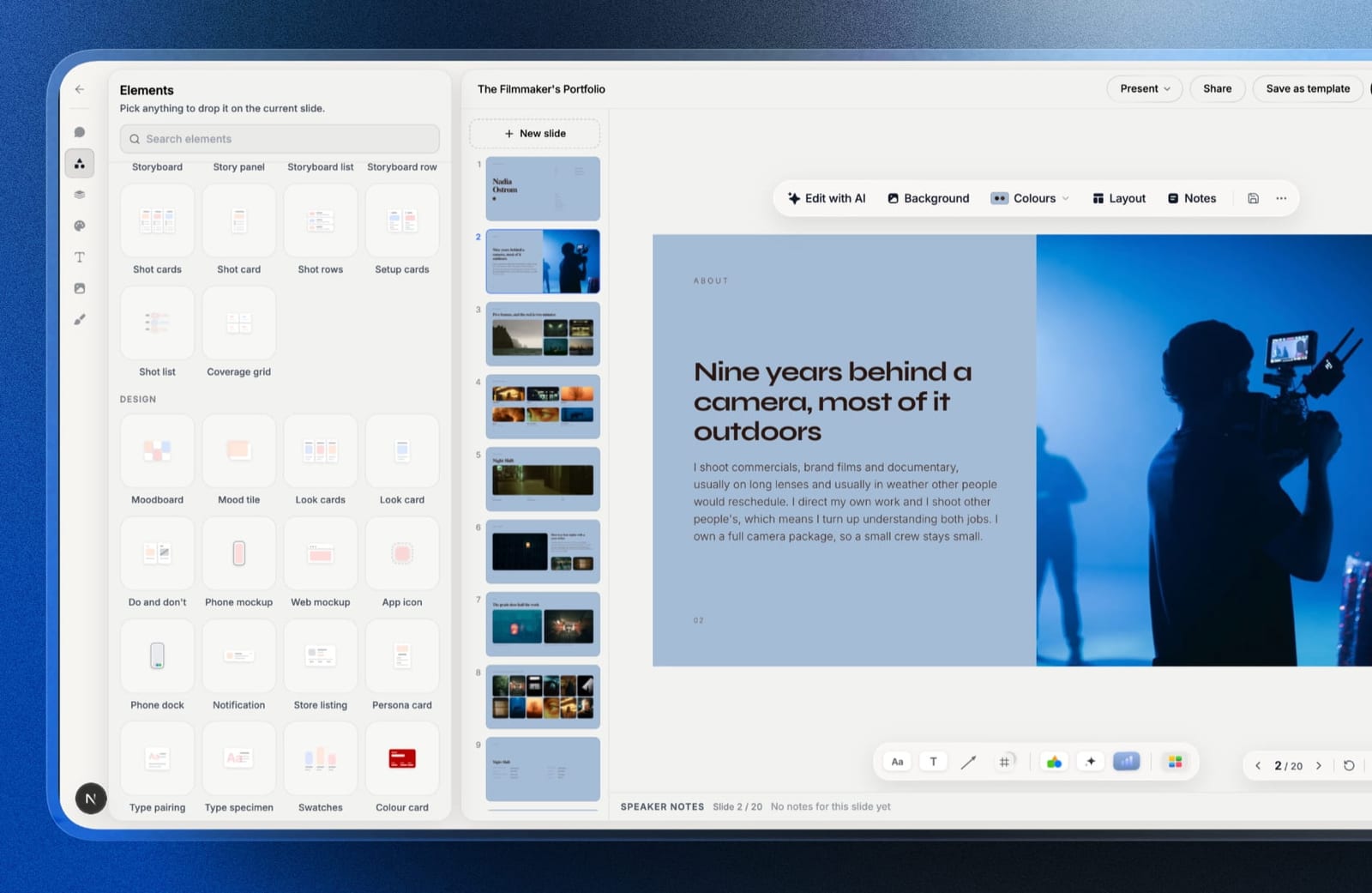
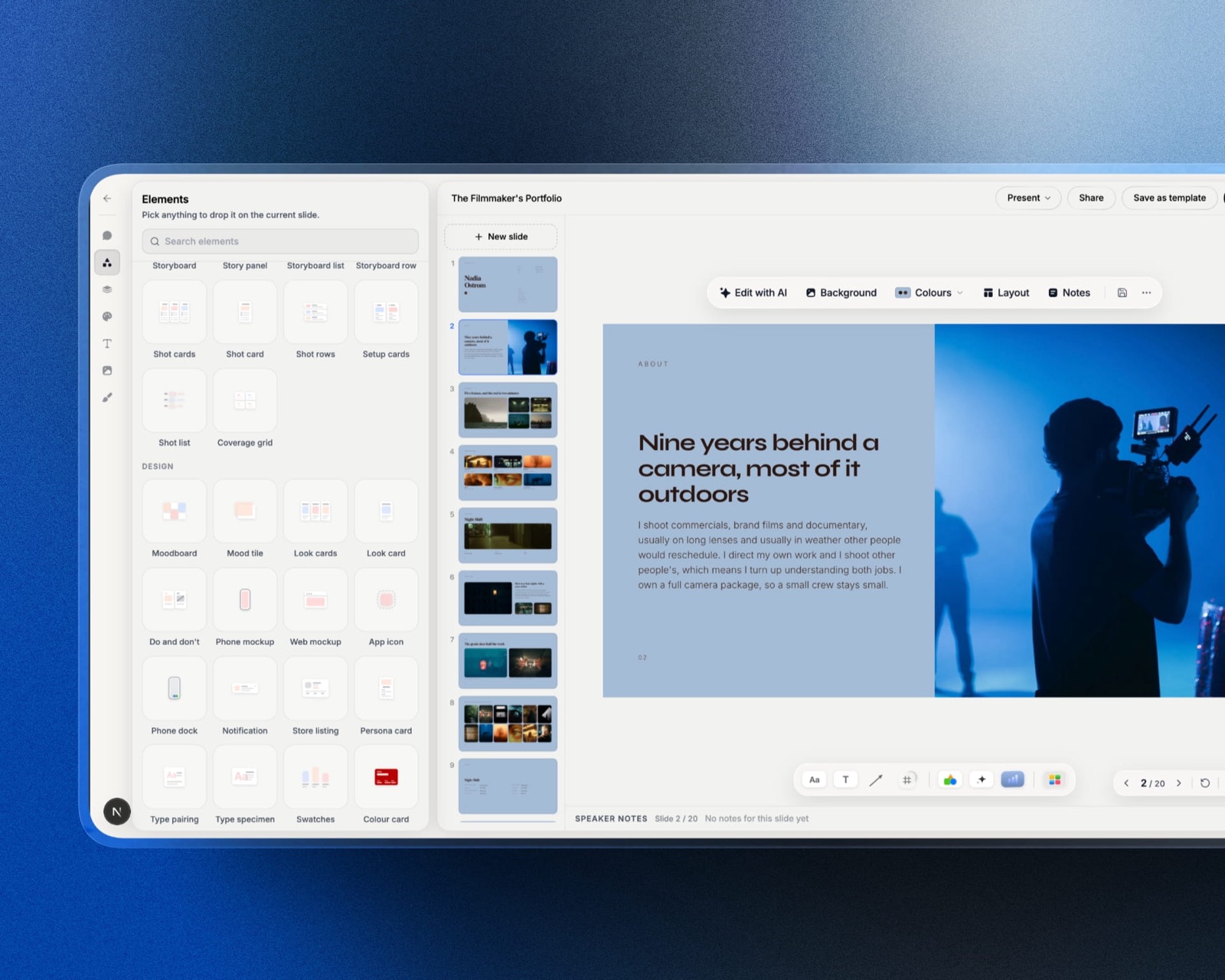
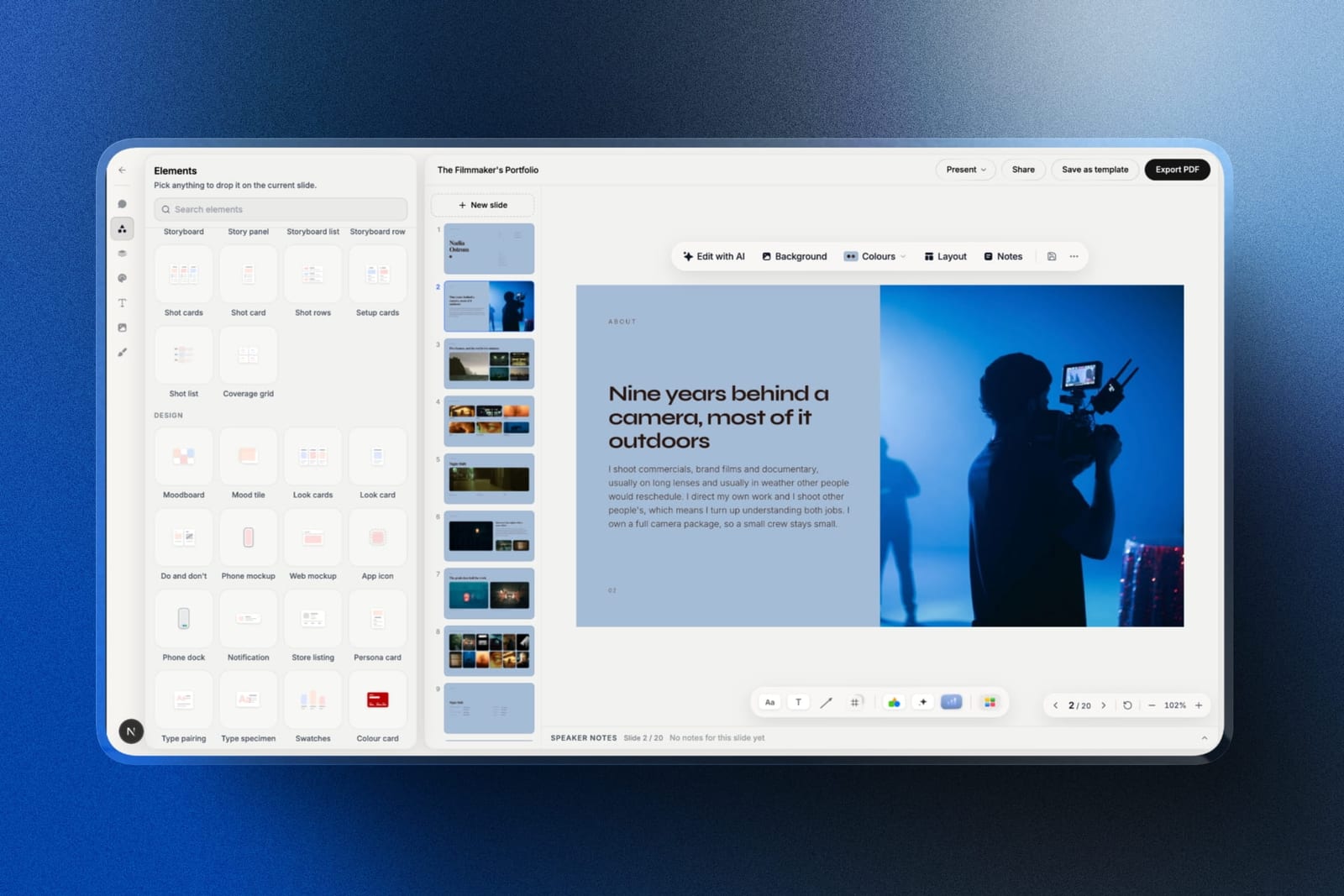
Framekit is an AI website builder, and its Slides editor now covers the document half of a creative proposal well: it ships proposal layouts for an executive summary, scope of work, deliverables, included and not included, rate card, licence and usage, payment terms, availability, next steps and an investment summary, plus pricing layouts for two, three or four tiers.
Client proposal is one of the suggested starting prompts, so you describe the job and the AI drafts those pages, and everything stays editable.
The reason it ranks eighth rather than higher is the other half of the job. There is no e-signature and no deposit collection, so it sits with Canva on process: a beautiful document, then a separate contract and invoice.
Best forDesigners, photographers and filmmakers whose proposal is itself a showcase, who already handle contracts elsewhere, and who want the proposal and the case studies it links to in one account.
The real numberthe free plan drafts the proposal with AI and shares it as a link or a PDF, with no card. Starter at $84 a year on annual billing adds your own fonts, the template library and removal of the Framekit byline, which is less than one Better Proposals seat for a year.
The standout detailthe proof and the price travel together. The same account hosts the portfolio site and case studies your proposal points at, so the three pricing options and the two case studies share the studio's fonts and colours.
The gotchano signature, no payment, no read tracking. By the step counts above, that puts it on the six-step path of a document with an invoice to follow, and you will not know whether a forwarded proposal was ever opened.
Skip it ifthe delay between yes and signed is your real problem. Better Proposals, Qwilr and Bonsai all close that gap and this does not.
Verdict: A designed proposal on a par with Canva for a studio that already has a contract tool, and the right place for the portfolio behind it. As a proposal system on its own, it is a document, not a closer.
9. Canva: Best Designed Proposal Without a Platform
Our rating: 7.0/10
Canva produces the best-looking proposal here for the least money, and a meaningful number of designers send exactly this: a beautifully laid out PDF or share link, followed by a separate contract and a separate invoice.
That separation is the whole cost. The document is excellent and the process around it is the slowest in this comparison, at nine client steps if a printed signature gets involved.
Best forDesigners and studios whose proposals are visual documents and who already have contracts and invoicing handled elsewhere.
Key features:
- Proposal templates that look designed rather than templated
- Free plan that completes a full proposal document
- Share link or PDF export, whichever the client prefers
- Brand kit on Pro so proposals match the studio identity
- Fast to produce once a template exists
The real numberthe free plan produces the document. Pro is $18 a month or $144 billed annually, about $12 a month. The hidden cost is the separate contract and invoicing tools you still need.
The gotchathere is no signature and no payment, so every Canva proposal generates two follow-up messages. Across 24 proposals a year that is roughly 48 extra emails and, in our step count, six additional client actions per deal.
Skip it ifthe delay between yes and signed is your actual problem, because Canva does not touch it.
Verdict: Canva makes the best document and the worst process. Pair it with a signature tool or accept the extra week. Visit Canva
10. Notion: Best Proposals Inside a Workspace
Our rating: 6.3/10
Notion earns a place because studios that already run projects there can keep the proposal next to the brief, the schedule and the notes, and the link can be updated after sending rather than resent.
It is a workspace rather than a proposal tool. There is no signature, no payment, and the visual result reads as an internal document, which for a premium creative price is a real handicap.
Best forStudios whose entire operation already lives in Notion and whose clients are comfortable with it.
Key features:
- Proposal lives beside the project it becomes
- Public link sharing with no viewer account
- Editable after sending, with no version confusion
- Free plan covers a solo practice
- Databases that can track proposal status across clients
The real numberthe free plan handles proposals for a solo practice, and paid tiers are roughly $10 per member a month, per Notion's pricing page.
The gotchaa client who is not a Notion user reads a Notion page as a work-in-progress rather than as a formal offer, which changes how readily they treat it as something to sign.
Skip it ifthe proposal is the first document a new client sees, because first impressions are the one thing this tool cannot help with.
Verdict: Notion is a reasonable place to draft a proposal and a poor place to close one. Visit Notion
11. Google Docs: The Free Baseline
Our rating: 6.0/10
Google Docs is where most freelancers start, and for four proposals a year it is a defensible choice. It costs nothing, the client can comment, and the link stays current if you correct a number after sending.
Everything else is friction. No signature, no payment, generic presentation, and a document that arrives looking exactly like every other document the client received that week.
Best forFreelancers sending occasional proposals who are not yet losing deals to delay.
Key features:
- Free with nothing gated
- Comment threads for scope negotiation
- Editable after sending, so corrections do not need resending
- Exports to PDF when a static copy is required
- Works on anything with a browser
The real number$0 on a personal account, or $7 per user a month on a company domain through Google Workspace Business Starter, per Google's published pricing.
The gotchasignature by typed name in a document has a weak audit trail. For a $8,500 engagement that is a risk most freelancers do not think about until a dispute makes it matter.
Skip it ifyou send more than about ten proposals a year, because at that volume a $13-a-month tool pays for itself on one saved week.
Verdict: Google Docs is a fine start and a bad habit. The upgrade threshold is lower than most freelancers assume. Visit Google Docs
The Proof Your Proposal Links To
In one lineevery tool above optimises the document, and the thing that most often decides a creative proposal is what the client finds when they check whether you can actually do the work.
Watch what a client does with a proposal for creative work. They read the scope, they look at the price, and then, almost without exception, they go looking for evidence: previous projects, similar work, the studio behind the number.
If the proposal links to a portfolio that loads properly and shows work like theirs, the price reads as justified. If it links to an Instagram grid or nothing at all, the price reads as a question.
That gap is not a signature problem and no signature tool solves it. Better Proposals will tell you the client spent four minutes on your pricing page; it cannot tell you they then searched your studio name and found a dead link.
The fix is a case study for the sector you are pitching, published before you send the proposal rather than after you lose it.
Framekit's website builder does that from the same account as its Slides proposal layouts, and a studio that closes with Better Proposals or Qwilr can still host the proof there on the free plan.
What a Year of Proposals Actually Costs
In one linethe annual difference between the cheapest and most expensive tools here is about $840 for a two-person studio, which is one tenth of a single project in our carried example.
For a studio sending 24 proposals a year, this is the shape of the bill.
| Tool and plan | Annual cost for two people | Signature and payment | Notes |
|---|---|---|---|
| Google Docs or Notion free | $0 | No | Add a separate signature tool |
| Bonsai, annual entry | About $216 | Yes | Cheapest all-in-one |
| Framekit Starter, one account | $84 | No | Designed document plus portfolio site |
| Canva Pro, two seats | About $288 | No | Best document, no process |
| Better Proposals, entry | About $312 | Yes | Best balance in this comparison |
| PandaDoc, entry | About $456 | Yes | Integrations you may not need |
| HoneyBook | About $468 | Yes | Whole booking workflow |
| Dubsado, Starter plus a user | About $720 | Yes | Deep automation |
| Qwilr Business, two seats | About $840 | Yes | Best presentation |
Run this on yourself. Take your last ten proposals and write down the date you sent each one and the date it was signed.
If the average gap is more than five days, and any of that gap was printing, scanning or waiting on an invoice, the tooling is costing you more than the subscription would.
One project pulled forward by a week usually pays for a year of any tool on this page.
The Three Things That Actually Delay a Signature
In one lineproposals stall on process rather than on price far more often than creatives assume, and all three common causes are fixable with tooling.
The separate invoice. A client who has decided to hire you and cannot pay in the same session has to wait for an email, open another document, and act a second time.
Each of those is a place the deal pauses, and we counted six extra client actions for a proposal sent as a document with an invoice to follow.
The printed signature. Any flow that involves printing has an unpredictable delay attached to whether the client owns a working printer, which in 2026 is a genuinely uncertain thing.
Nine steps in our test, and the two longest gaps we have seen in practice both involved a scanner.
The missing decision-maker. Proposals forwarded to a partner or a finance person die silently, and without open tracking you cannot tell the difference between forwarded and ignored.
Every tool ranked above sixth here reports opens, and that single signal changes when you follow up and what you say.
What this means for the choice. If your proposals are losing on price, better software will not help. If they are losing on delay, the fix is mechanical and costs about $13 a month.
How to Choose Client Proposal Software: A Decision Tree
In one lineanswer these in order and stop at the first yes, because the first yes is the constraint that is actually costing you deals right now.
1. Do you already run bookings, contracts and invoices somewhere? If yes, buy a proposal tool rather than a platform: Better Proposals at about $13 a user, or Qwilr if presentation sells your work.
2. Are you a photographer or event creative with enquiries, contracts and payment schedules? HoneyBook, and expect about $39 a month at current listed pricing.
3. Do you have repeatable service packages and a day to configure automation? Dubsado, and block out the setup day before you send anything.
4. Are you solo, on a tight budget, and needing contracts and invoices too? Bonsai at roughly $9 a month billed annually, and rewrite the contract templates before you use them.
5. Do three or more people send proposals at your studio? Proposify, for the content library and pricing locks rather than for the document.
6. Is the proposal itself a demonstration of your design ability? Qwilr for the web-page version with signature and payment, or Framekit Slides or Canva for a designed document if you can live without both; Framekit also hosts the case studies it links to.
7. Sending fewer than about six a year? Google Docs, and revisit this the year you send twelve.
Anyone specifically weighing Storydoc's price and its lack of any slide export will find the alternatives priced out in our guide to the best Storydoc alternatives.
Most proposal disputes start earlier than the proposal, which is why our guide to how to write a creative brief is worth reading alongside this one.
Frequently Asked Questions
What is the best client proposal software in 2026?
The best client proposal software in 2026 is Better Proposals, because it delivers a good-looking web proposal with e-signature and deposit collection in one session from about $13 per user a month, which is the lowest credible entry price for that combination.
Qwilr is better when presentation is part of what you are selling, HoneyBook and Dubsado are better when the proposal should sit inside a full booking workflow, and Bonsai is the cheapest all-in-one for a solo freelancer.
Do I need proposal software or is Google Docs enough?
Google Docs is enough below roughly ten proposals a year and expensive above it.
The cost is not the document, it is the process: no signature, no deposit, and no open tracking, which in our step count adds six client actions and typically several days per deal.
If you send twelve or more proposals a year, a $13-a-month tool pays for itself the first time a project starts a week earlier.
Can a client sign and pay a deposit in the same session?
Yes on seven of the eleven tools compared: Better Proposals, Qwilr, HoneyBook, Dubsado, PandaDoc, Proposify and Bonsai all collect a signature and a payment in one flow.
Canva, Notion, Google Docs and Framekit do not, which means a separate invoice and a second decision from the client. That single difference was the largest factor in send-to-signed speed across every proposal we sent.
Is e-signature on a proposal legally valid?
Electronic signatures are broadly enforceable in the United States, the United Kingdom and the European Union under legislation including the ESIGN Act and eIDAS, and the practical question is the quality of the audit trail rather than the signature itself.
A dedicated proposal tool records the signer's identity, timestamp and IP address and produces a sealed copy; a typed name in a shared document does not.
For engagements of a few thousand dollars and up, use a tool that produces the audit trail.
HoneyBook vs Dubsado: which is better for photographers?
HoneyBook is easier to start and Dubsado is more capable once configured.
HoneyBook gets a photographer from enquiry to signed contract in an afternoon with sensible defaults; Dubsado requires a setup day and then automates conditional workflows that HoneyBook cannot.
Price is close, at about $39 a month for HoneyBook against roughly $35 to $55 for Dubsado with extra users around $25, so the honest decision is whether you will invest the setup time.
How much should proposal software cost a small studio?
Between $0 and about $840 a year for two people, and most independent studios land between $200 and $500.
Bonsai's annual entry rate is roughly $108 per person, Better Proposals about $156 per person, and Qwilr about $420 per person, which is the top of the sensible range.
Anything above that is buying team governance features rather than proposal capability.
Does proposal design actually affect whether you win the work?
It affects perceived value more than win rate on its own, and it matters most where price is being justified rather than compared.
In our sends, the same $8,500 scope read as more expensive in a plain document and more reasonable in a designed one, which is why Qwilr and Canva earn their place despite Qwilr being the priciest tool here.
Design will not rescue a proposal aimed at the wrong problem.
What should a creative proposal include?
A restatement of the client's problem in their words, a defined scope with explicit exclusions, three pricing options rather than one number, a timeline with dependencies named, terms covering revisions and kill fees, and proof in the form of two relevant case studies.
The exclusions and the kill fee are the two sections freelancers skip and the two that prevent the most damage later.
Framekit vs Better Proposals: which should a creative studio use?
Better Proposals is better at closing, because the client signs and pays the deposit in one session from about $13 per user a month.
Framekit is better if the proposal must look like your portfolio: Framekit is an AI website builder whose Slides editor has proposal and pricing layouts and whose site builder hosts the case studies, from $0 or $84 a year, but it has no e-signature, payment or read tracking, so pair it with a contract tool.
What happens to signed proposals if I stop paying for the tool?
Access to the signed copies usually ends with the subscription, which is a genuine risk given that a signed proposal is often the contract governing the work.
Download a PDF of every signed document to your own storage the week it is signed, regardless of which tool you use. Treat the platform as the sending mechanism and your own archive as the record.
How long should I wait before following up on a proposal?
Three business days if the tool shows the proposal was opened, and one if it shows it was not.
That distinction is the practical reason open tracking is worth paying for: an unopened proposal is an email problem and a read-but-unanswered proposal is a scope or price conversation, and the follow-up message should be completely different in each case.
Should the price be at the top or the bottom of a proposal?
Near the top for repeat clients and after the scope for new ones, and every tool with read analytics will show you why.
On our test sends the pricing section consistently attracted the most reading time, which means a client who reaches it before understanding the scope evaluates a number with no context attached to it.
Put the problem restatement first, the scope second, and the price where it can be read as a conclusion.
Final Verdict
Better Proposals is the best client proposal software in 2026 for independent creative businesses, because it closes the gap between yes and signed at the lowest credible price and produces a document that does not embarrass a premium number.
Qwilr is the better buy when the proposal is itself a demonstration of your design ability, and HoneyBook or Dubsado are the right answers when the proposal should be one step in a booking workflow rather than a standalone document.
The finding that surprised us most across ten sends is how much of the delay is mechanical. Nothing about a printed signature or a separate invoice improves a proposal, and both are the default in the tools most freelancers are still using.
Framekit ranks eighth: its Slides proposal layouts make a designed document and its site builder hosts the proof, but it cannot close the deal on its own.
Where Framekit losesFramekit is not for closing a proposal, because it has no e-signature, no deposit collection and no read tracking. Better Proposals, Qwilr, HoneyBook, Dubsado, PandaDoc, Proposify and Bonsai are all the better fit when speed from yes to signed is the problem.
Keep reading: our best pitch deck software comparison, the best brand guidelines software guide, and the best website builders for creative agencies.