Framekit templates
Start from a designer-made template
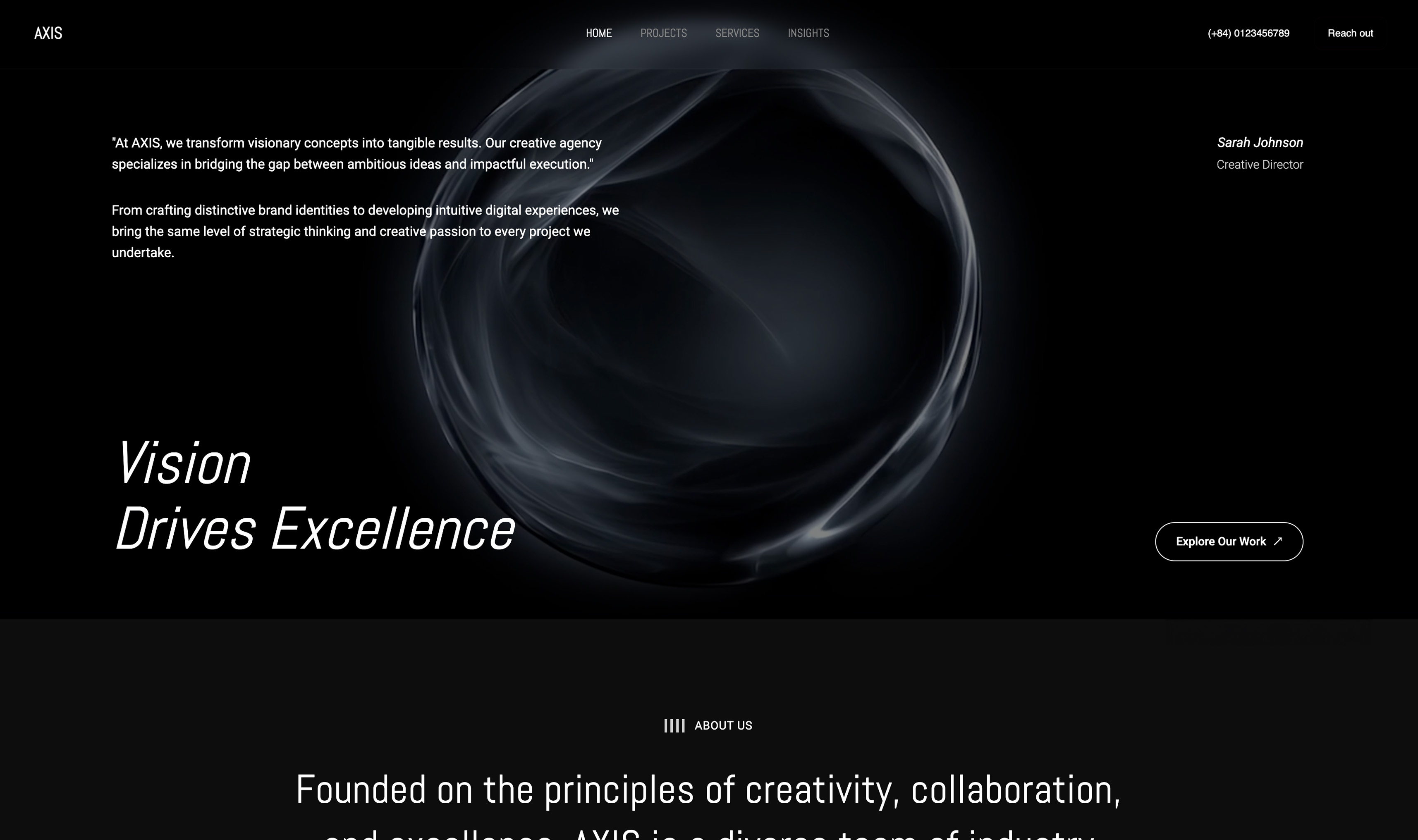 Use template
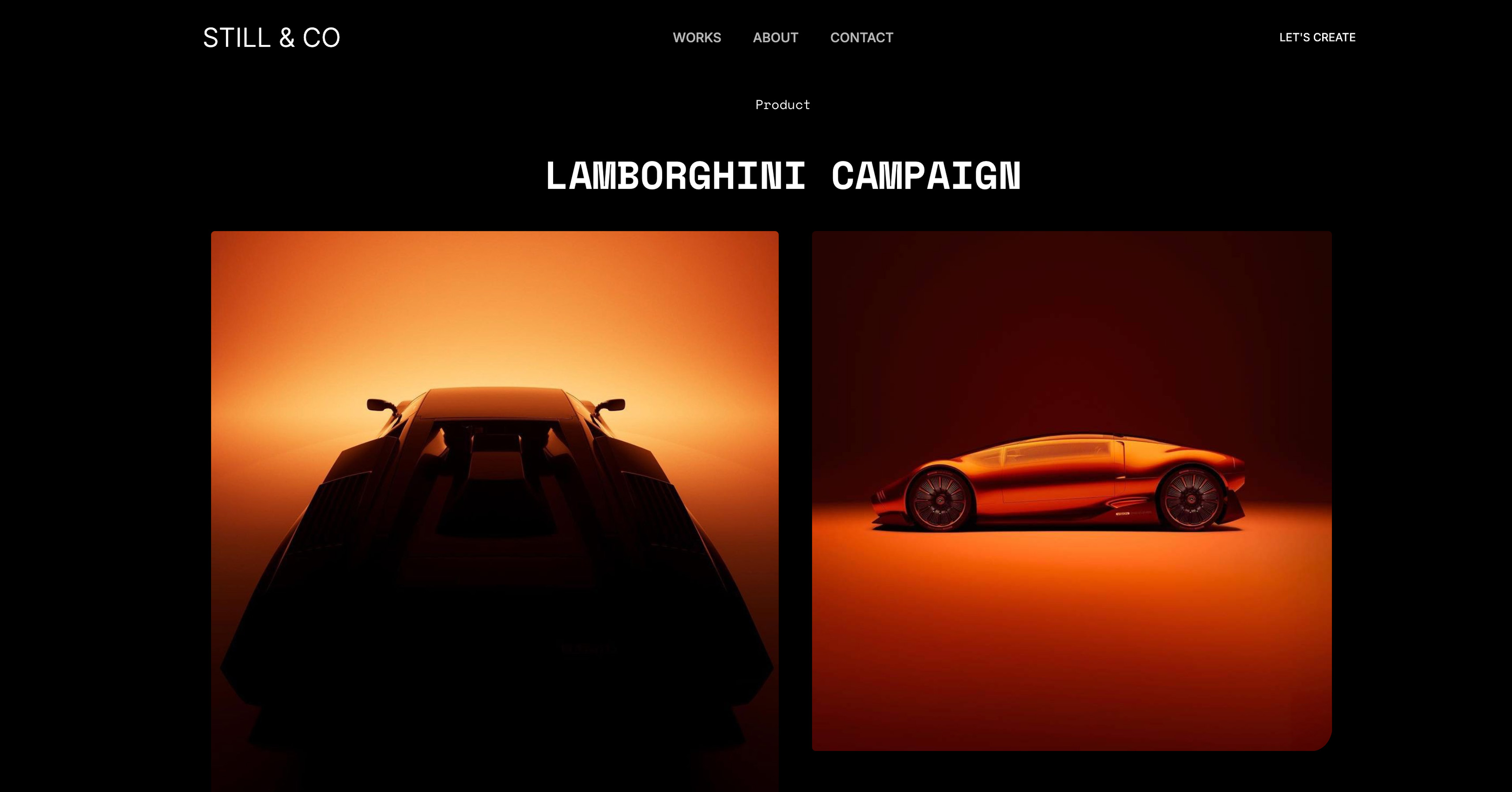 Use template
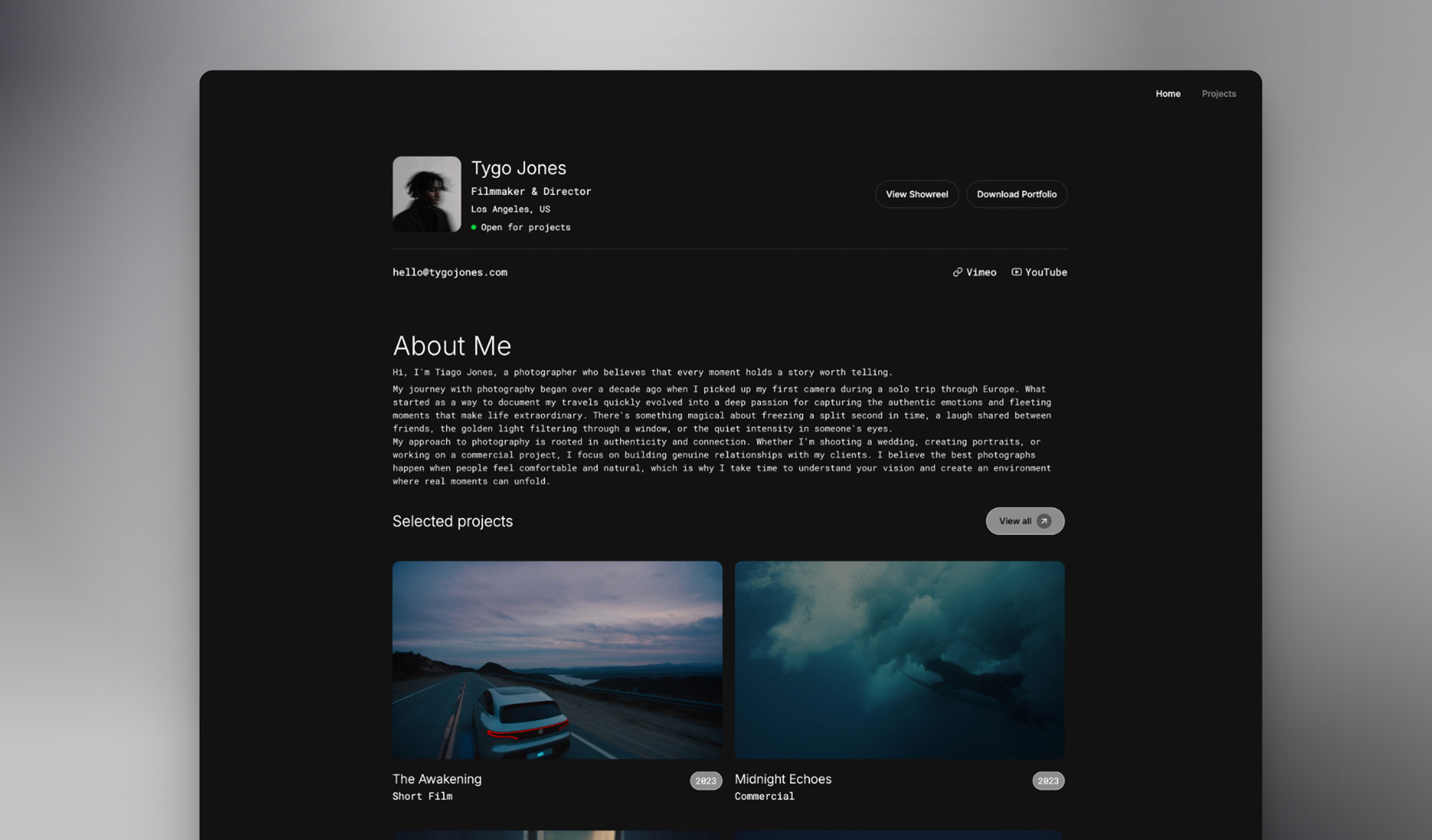 Use template
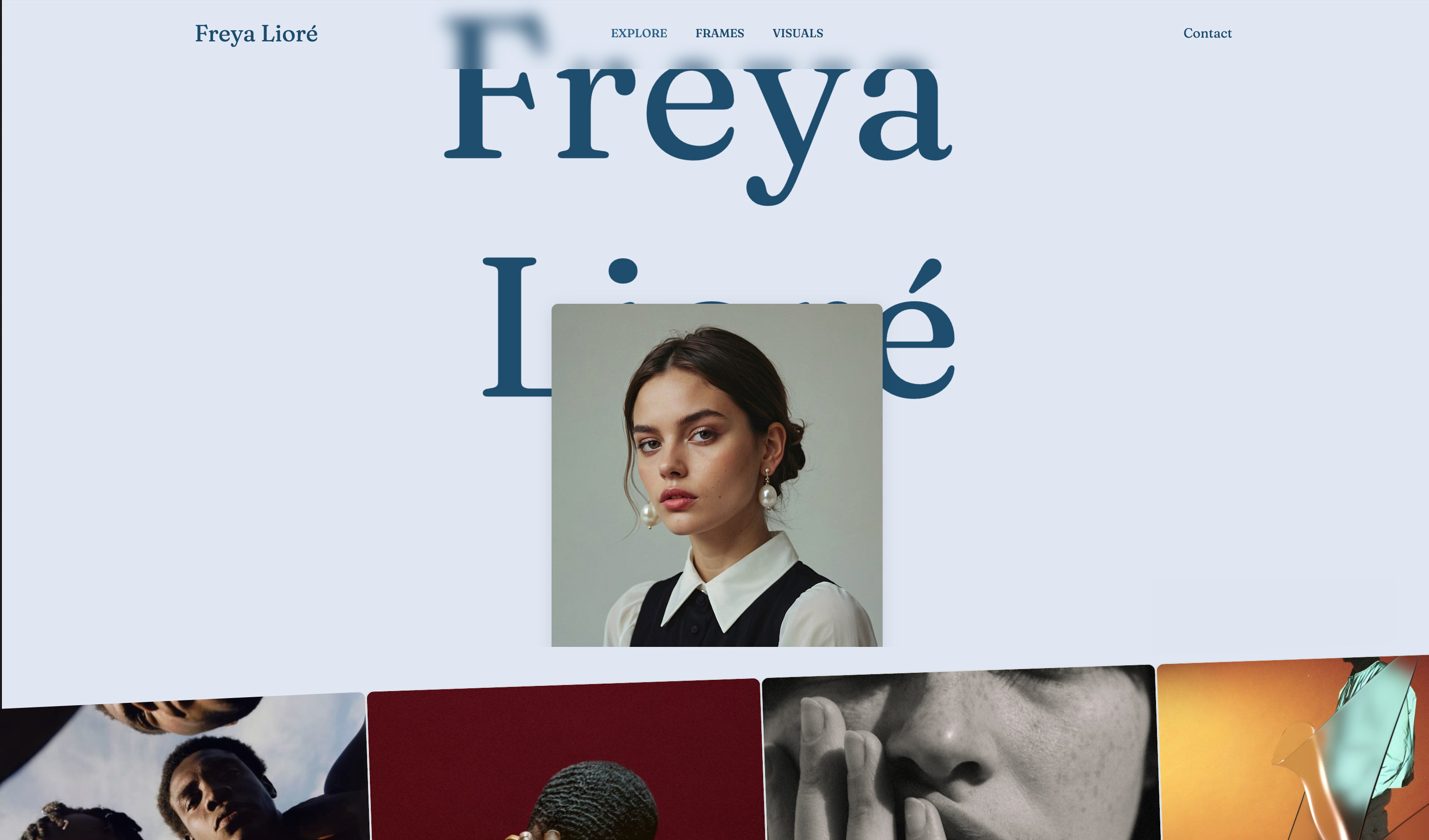 Use template
 Use template
 Use template
 Use template
 Use template
Almost every presentation software comparison is written for buyers with a budget line and a headcount.
Freelancers have neither, and the advice does not translate: half the recommended tools are priced per seat in a way that only makes sense above five people, and the other half are free tiers that stop working the week you get busy.
The useful question for one person is narrower. What is the cheapest thing that will not embarrass you in front of a client?
A presentation tool for a freelancer is software used to pitch work, present a proposal, and report on a project, chosen on the basis of what one person pays a year rather than what an organisation pays per user.
The best presentation tool for freelancers in 2026 is Framekit, because one free-to-start account holds an AI deck editor, the portfolio your proposal links to, and client delivery, and the paid plan that adds your own fonts is $84 a year.
The trade-off is no read data and no editable PowerPoint export. Canva is the pick for the widest template range, with a free plan that finishes a client deck and a $144 Pro tier for brand fonts.
If you own a Mac, Apple Keynote does most of the same job for $0 and handles licensed fonts better.
Gamma at $108 a year is the cheapest paid tool with AI drafting and basic read data, and Beautiful.ai's $45 one-off project licence is the smartest single purchase in the category for one important deck.
Full disclosure: Framekit is our own product and it is ranked first below, so weigh that. It is scored from its published features and plans rather than from our fourteen-slide build, and it scores below Gamma and Pitch on read data and below PowerPoint and Google Slides on editable export; each of those reviews says where it beats us.
How We Priced These for One Person
We built the same deck in every tool: a fourteen-slide client proposal with a scope section, three work examples, a timeline, a pricing table and a next-steps slide. Then we priced each tool the way a freelancer experiences it, which is one seat, annual billing, and no team plan.
Annual cost for exactly one person. Not per-seat rates, not team tiers, and not the enterprise price that makes a mid-tier look reasonable.
Where the free plan stops. Every tool here has one, and the interesting question is which limit a working freelancer hits first.
Client-facing quality. A freelancer's deck is competing against agency output, and the gap is real.
The seat cliffs you can ignore. Several tools in this category have brutal pricing steps at two or more users, which is either irrelevant to you or the reason a tool suddenly looks cheap.
Whether it does more than slides. Freelancers consolidate tools, and a presentation product that also handles proposals or a website earns its place twice.
Three kinds of finding, kept apart. Measured by hand: building the fourteen slides, exporting, and hitting free-plan limits deliberately. Verified from published sources: pricing against vendors' own pages in August 2026.
Reported as sentiment: recurring complaints, flagged where mentioned.
On 19 September 2026 we re-verified Framekit's plans and moved it from ninth to first: we had ranked it as a website builder, and it now ships Slides, a deck editor with proposal layouts and PDF export on every plan.
What Pricing These for One Person Showed
- The annual cost for one person ranges from $0 to $237.60 across this comparison, and five tools do the job at nothing.
- The cheapest paid tool with both AI drafting and basic read data is Gamma at $108 a year.
- Three tools here have a seat cliff that freelancers can completely ignore, most dramatically Beautiful.ai, where one seat is $144 a year and two are $960.
- Beautiful.ai's $45 One-Time Project licence is the only genuine one-off purchase in this category and the best value in it for a single important deck.
- Not one tool priced for a single user reports per-recipient read data except Gamma at a basic level and Pitch on its entry workspace tier.
- A complete, credible client deck is achievable at $0 on five of the nine, counting Framekit's free plan from its published limits, which is worth saying plainly before anyone subscribes to anything.
The 9 Best Presentation Tools for Freelancers in 2026
How the ratings work: annual cost for one person 30%, client-facing quality 30%, free-plan usefulness 20%, and consolidation value 20%. Cost carries the most weight because that is the constraint that actually distinguishes a freelancer's decision from an agency's.
Framekit leads at 9.3 on the strength of cost and consolidation while scoring 3 on read data and 4 on editable export, both below Pitch and PowerPoint. Canva follows at 9.1, scoring 5 on read data because it reports nothing about what a client did with your deck.
| Tool | Best for | Cost for one person | Free plan finishes a deck | Our rating |
|---|---|---|---|---|
| Framekit | A deck plus the portfolio it links to | $0 or $84 a year | Yes | 9.3/10 |
| Canva | The widest template range | $0 or $144 a year | Yes | 9.1/10 |
| Apple Keynote | Mac freelancers | $0 | Yes | 8.8/10 |
| Gamma | Drafting fast, cheaply | $108 a year | Credit-limited | 8.5/10 |
| Google Slides | Free and collaborative | $0 | Yes | 8.2/10 |
| Pitch | Knowing the client opened it | About EUR 120 a year | Limited | 7.9/10 |
| Beautiful.ai | One important deck | $45 once, or $144 a year | No free plan | 7.5/10 |
| Microsoft PowerPoint | Clients who edit your files | $99.99 a year | Web version only | 7.2/10 |
| Notion | Freelancers already living there | $0 to about $120 | Yes | 6.6/10 |
Prices confirmed against each vendor's published plans during August 2026 and quoted for a single user on annual billing.
What one person actually pays
| Tool and plan | One person, a year | What the money buys |
|---|---|---|
| Keynote, Google Slides, Canva free | $0 | A complete client deck |
| Beautiful.ai One-Time Project | $45 once | Tidy layouts for one deck |
| Framekit Starter | $84 | Decks with your own fonts, plus a site on your own domain |
| Microsoft 365 Personal | $99.99 | Native .pptx and font embedding |
| Gamma Plus | $108 | AI drafting plus basic read data |
| Notion paid | About $120 | Everything in one workspace |
| Pitch Plus | About EUR 120 | Per-recipient link analytics |
| Canva Pro | $144 | Brand fonts and premium assets |
| Storydoc Starter | $237.60 | Deepest read data, priced for teams |
1. Framekit: Best Overall for Freelancers

Our rating: 9.3/10
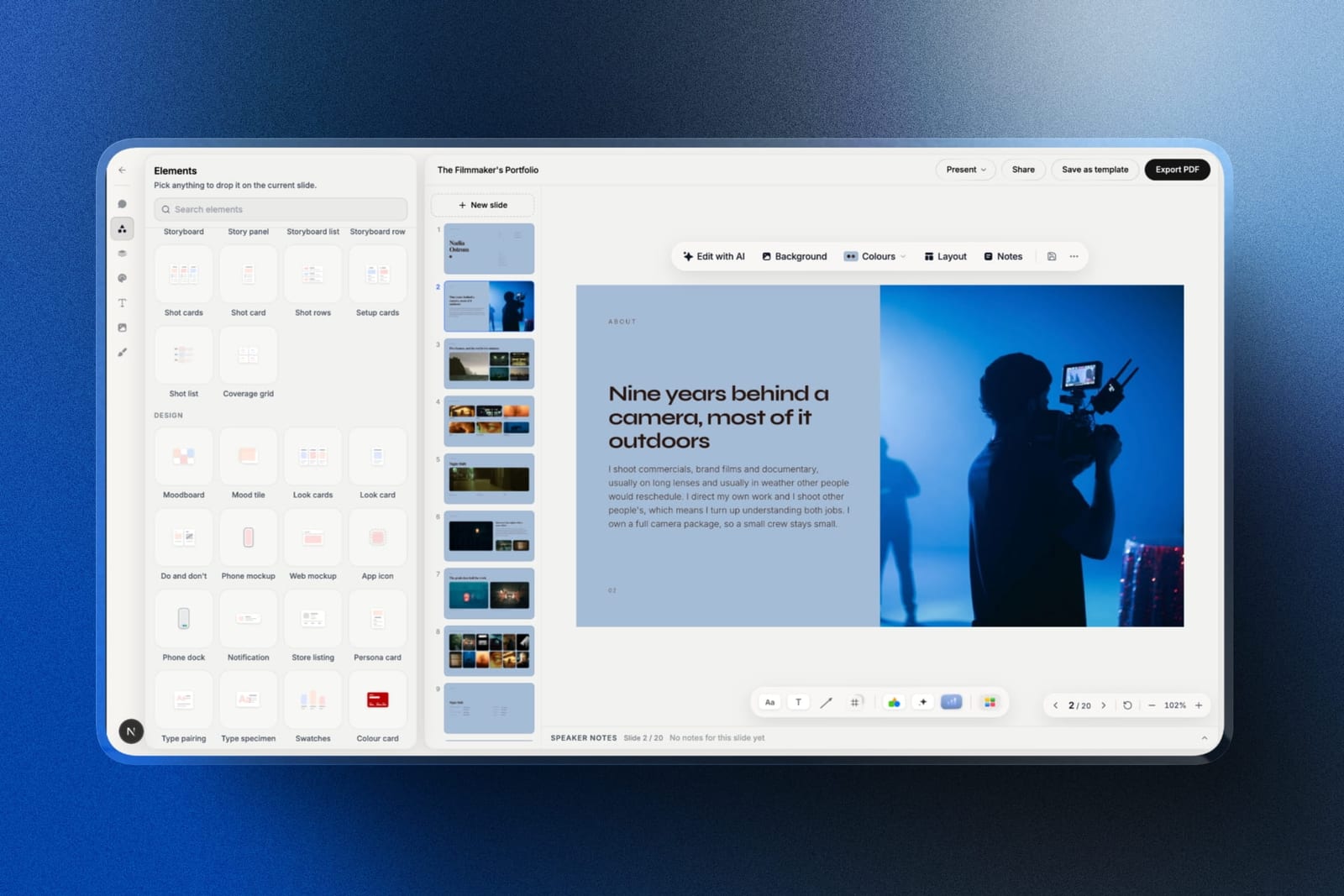
Framekit is an AI website builder whose account now includes Slides, a deck editor, and for one person that combination scores highest here on the criteria this guide weights: cost, and consolidation.
The deck, the portfolio it links to, client galleries for delivering finished work, video review for cuts and a digital-download store all come on one account, so a freelancer who would otherwise pay for a deck tool and a website builder pays for one thing, or nothing.
As a deck tool it is built for creative proposals rather than corporate reports.
Client proposal is one of the suggested starting prompts, the layouts cover scope of work, deliverables, rate card, licence and usage and payment terms, and pricing slides come in two, three or four tiers.
You describe the job, attach up to 12 images of past work, and the AI drafts the deck; everything stays editable by hand.
Best forFreelance photographers, filmmakers, designers and writers who pitch with their work and want the deck and the portfolio to match.
The real numberthe free plan covers the AI writer, unlimited decks, a share link and PDF export, with no card. Starter is $84 a year on annual billing, $60 less than Canva Pro, and adds your own fonts, the template library, a custom domain for the portfolio and removal of the Framekit byline.
The standout detailone link sends both halves of the argument. The proposal and the case studies it points at live on the same account, in the same fonts and colours, so a client clicking through from the pricing slide lands on work that looks like it came from the same person, because it did.
The gotchano read data, so you will not know which of three outstanding quotes was opened; free-plan decks carry a small Framekit byline; the PowerPoint export is Pro-only and picture-based; and there is no e-signature or deposit collection, so contracts still go through a separate tool.
Skip it ifyour clients edit your files in PowerPoint, you need to know who opened a quote, or you already pay for a portfolio site you are happy with and only want slides. PowerPoint, Pitch and Canva fit those better.
Verdict: For a creative freelancer this is the best value in the category, because a single purchase covers the deck and everything the deck points at, and the free plan is a real starting point rather than a trial.
2. Canva: Best Template Range for Freelancers
Our rating: 9.1/10
Canva is the right recommendation for freelancers outside creative work, and the one people feel slightly embarrassed to make.
The free plan finished our fourteen-slide client proposal with no watermark and no paywall, and the result looked like it came from someone with design training.
For a freelancer competing against agency decks, that is the whole point. The gap between a default Google Slides deck and a Canva one is visible to a client in about three seconds, and closing it costs nothing.
Best forFreelancers in any discipline who send client-facing decks and are not designers.
Key features:
- The largest template and asset library available anywhere
- Free plan that completes a full client deck with no watermark
- Reliable PDF export, with .pptx drift on complex slides
- Brand kit on Pro so every deck matches your identity
- Doubles as a design tool for social, documents and proposals
The real numberthe free plan finishes the deck. Pro is $18 a month or $144 billed annually, about $12 a month, per Canva's published pricing. At one seat there is no cliff to worry about, which is the freelancer's advantage here.
The standout detailthe consolidation value is the underrated part. A freelancer using Canva for decks is usually also using it for social posts, proposal covers and invoices, which makes the $144 a design budget rather than a presentation one.
The gotchano analytics at all. Canva tells you nothing about whether a client opened your proposal, which for a freelancer chasing three quotes is the single most useful thing to know.
Skip it ifclients routinely ask for editable .pptx files, because the export drift means repairing the same slides after every revision.
Verdict: Canva is the best general-purpose presentation tool for freelancers in 2026 and the free plan is genuinely enough for most. Pay the $144 when brand fonts become the blocker, not before. Visit Canva
3. Apple Keynote: Best for Mac Freelancers
Our rating: 8.8/10
If you own a Mac, Keynote does most of what Canva does for nothing, and it does two things better: image handling and licensed brand fonts. For a freelancer whose brand uses a purchased typeface, that second point saves the $144 outright.
The presenting experience is also the best here, which matters if you talk clients through proposals on a call rather than emailing them.
Best forMac-based freelancers, especially those presenting live and those with a licensed brand typeface.
Key features:
- Free on all Apple hardware with nothing gated
- Licensed brand fonts supported with no subscription
- The best large-image handling of any free tool here
- Presenter and rehearsal display better than anything else in this comparison
- PDF export that preserves typography accurately
The real number$0, permanently. Against Canva Pro at $144 a year for brand-font support, a Mac freelancer with a licensed typeface saves the entire subscription.
The gotchasharing outside the Apple ecosystem. A client on Windows needs an export, and collaborating with anyone not on a Mac is effectively unavailable, which for freelancers working with agency partners comes up more than you would think.
Skip it ifyou are not on a Mac, or you collaborate with clients inside the document.
Verdict: Keynote is the best free option for Mac freelancers and beats Canva on the two criteria where it competes. The template library is why most people still choose Canva anyway. Visit Keynote
4. Gamma: Best for Drafting Fast and Cheaply
Our rating: 8.5/10
Gamma is among the cheapest paid tools here and the fastest route from a brief to a complete draft, which for a freelancer quoting several jobs a week is a real time saving. Paste in the scope and you get a coherent fourteen-slide structure in about a minute.
It also reports basic view data, making it the cheapest way for a freelancer to know whether a proposal was opened at all.
Best forFreelancers producing frequent proposals who stall on structure rather than on design.
Key features:
- Text-to-deck generation producing a sensible slide order
- Real editing control after generation
- Link sharing with views and read distance
- Card format that adapts properly to a phone
- Export to PDF and .pptx
The real numberGamma Plus is $108 a year, the cheapest paid plan in this comparison with both AI drafting and read data, and $36 less than Canva Pro. The free plan is credit-limited and behaves as a trial for anyone regenerating a deck several times.
The gotchagenerated decks share a recognisable house style, and clients who receive several proposals notice. Twenty minutes of restyling removes most of it and almost nobody does it.
Skip it ifyou send one proposal a month, because the drafting speed is the whole value and it does not compound at low volume.
Verdict: Gamma is the best value paid tool for a freelancer who quotes often. See our best Gamma alternatives if credits become the constraint. Visit Gamma
5. Google Slides: Best Free and Collaborative
Our rating: 8.2/10
Google Slides is free, dependable, and the easiest place to build a deck with a client or a collaborator commenting alongside you. For freelancers working as part of a loose team on a project, that matters more than templates.
The ceiling is the problem. A default Slides deck looks like a document, and a freelancer whose proposal sits next to an agency's is starting from behind on appearance.
Best forFreelancers collaborating with clients or partners inside the document, and anyone whose budget is genuinely zero.
Key features:
- Free permanently with nothing gated
- The most reliable simultaneous editing here
- Comment threads clients can use without an account
- The cleanest .pptx export of any tool tested
- Deep version history
The real number$0 on a personal account, or $7 per user a month on a company domain through Google Workspace Business Starter, per Google's published pricing.
The gotchano custom font support at any level, so a freelancer with a brand typeface simply cannot use it, and no workaround exists short of setting headlines as images.
Skip it ifthe deck is competing against agency work on appearance, which for pitch documents it usually is.
Verdict: Google Slides is the right place to draft and a weak place to deliver from. Free is a genuine feature; the visual ceiling is a genuine cost. Visit Google Slides
6. Pitch: Best for Knowing the Client Opened It
Our rating: 7.9/10
Pitch is the cheapest way for a freelancer to get real per-recipient analytics, and for someone with three outstanding quotes that information changes which one you chase on Thursday.
The template library is small and the tool is built for teams, so a freelancer is buying a workspace product for one person, which works fine and is not what it was designed for.
Best forFreelancers sending proposals to several clients at once who want to know where to follow up.
Key features:
- Per-recipient link activity with slide-level detail
- Genuine link expiry and revocation
- Fast editor with version history on the same link
- Clean PDF export
- Workspace pricing, which is neutral at one person
The real numberPitch Plus is around EUR 120 a year, comparable to Canva Pro, and the analytics is what the money buys rather than templates.
The gotchathe template library is thin compared with Canva's, so a freelancer who starts from templates rather than a house style will find less to work with here.
Skip it ifyou build every deck from your own template anyway and never wonder whether a client opened it.
Verdict: Pitch buys information rather than design. Worth it for freelancers chasing quotes, unnecessary for those fielding inbound work. Visit Pitch
7. Beautiful.ai: Best for One Important Deck
Our rating: 7.5/10
Beautiful.ai has the best-value purchase in this whole category and almost nobody knows about it: a One-Time Project licence at $45, which for a freelancer with a single high-stakes deck is cheaper than any annual plan and produces consistently tidy slides without design skill.
As a subscription it is harder to justify, and the layout engine that guarantees consistency also overrules you when you disagree with it.
Best forFreelancers with one important deck and no design confidence.
Key features:
- Layouts that re-balance automatically as content changes
- A One-Time Project licence rather than a subscription
- Viewer analytics on shared links
- Clean .pptx export on paid plans
- Brand controls across a whole deck
The real numberPro is $12 a month billed annually at $144, and the One-Time Project licence is $45, per Beautiful.ai's pricing page. There is no free plan.
The gotchathe seat cliff that makes this tool notorious is irrelevant to you. One seat is $144 a year and two are $960, which is a disaster for a two-person studio and simply not your problem as a freelancer.
Skip it ifyou have opinions about layout, because you will lose every one of them.
Verdict: buy the $45 project licence for the deck that matters and skip the subscription. See our best Beautiful.ai alternatives for the wider field. Visit Beautiful.ai
8. Microsoft PowerPoint: Best for Clients Who Edit Your Files
Our rating: 7.2/10
PowerPoint matters to freelancers for one specific reason: some clients, particularly in large organisations, will put your deck into an internal document and edit it. When that happens, every conversion step damages the file, and building natively avoids it.
The desktop application also handles licensed fonts properly, which browser tools either charge for or refuse.
Best forFreelancers working with corporate clients who reuse deck content internally.
Key features:
- The native format corporate clients expect
- Licensed font embedding with no additional charge
- Offline presenting with no connection dependency
- Designer suggestions that genuinely help sparse slides
- A free web version covering basic needs
The real numberMicrosoft 365 Personal is $99.99 a year, less than Canva Pro, and many freelancers already pay it for other reasons, which makes the marginal cost zero.
The gotchathe free web version silently drops font embedding, so a deck edited there loses the typography you set on the desktop, and nothing warns you before you send it.
Skip it ifyour clients are small businesses and creative studios, where an editable file advantage is worth very little.
Verdict: PowerPoint is a compatibility purchase rather than a design one. See our best PowerPoint alternatives if it is what you have and dislike. Visit Microsoft 365
9. Notion: Best for Freelancers Already Living There
Our rating: 6.6/10
Freelancers who already run projects, notes and invoices in Notion can keep the client-facing document there too, and the consolidation is worth something real: one place, one link, no export.
As a presentation tool it is weak. Image handling is basic, the layout is a document, and a client reads a Notion page as work in progress rather than as a formal proposal.
Best forFreelancers whose whole practice already runs in Notion and whose clients are comfortable with it.
Key features:
- The proposal sits beside the project it becomes
- Free plan covers a solo practice comfortably
- Public link sharing with no viewer account
- Editable after sending, so corrections need no resend
- Databases to track proposal status across clients
The real numberthe free plan covers a solo freelancer, and paid tiers are roughly $10 per member a month, per Notion's pricing page.
The gotchapresentation quality is the weakest here, and for a freelancer already fighting an agency comparison, that is the wrong place to economise.
Skip it ifthe document is the first thing a new client sees.
Verdict: Notion is a good record and a poor pitch. Use it for the work, not the win. Visit Notion
The Freelancer's Advantage: Seat Cliffs Do Not Apply to You
In one linethree tools in this category are priced in a way that punishes small teams severely and leaves solo users untouched, which quietly makes them better value for you than for anyone else.
Beautiful.ai is the clearest example. One seat is $144 a year and two seats are $960, a jump of about 6.7 times that makes it near-unusable for a two-person studio.
As a freelancer you never encounter it, and its $45 one-off project licence is available to you at a price no team can use sensibly.
The same logic applies to Canva. Pro at $144 covers you completely, while a five-person studio needs Business at $25 per user, roughly $1,500 a year. The freelancer gets the same design capability at a tenth of the cost.
What to do with that. Ignore every comparison table that prices per seat, and check whether a tool has a solo tier or a one-off licence before dismissing it as expensive.
Two of the tools most often described as costly in this category are among the cheapest available to one person.
How to Choose: A Short Decision Guide
In one lineanswer in order and stop at your first yes, because the first yes describes what is actually limiting you.
1. Do you own a Mac and have a licensed brand typeface? Keynote, at $0, and you have just saved $144.
2. Do you pitch creative work and also need a portfolio site? Framekit, free to start and $84 a year for your own fonts and domain, with the deck and the site on one account.
3. Is your deck currently unattractive and you cannot design? Canva's free plan, and pay the $144 only when fonts or premium assets block you.
4. Do you send several proposals a week? Gamma at $108 a year for the drafting speed.
5. Do you need to know which client opened your quote? Pitch at about EUR 120 a year, or Gamma for a cheaper, shallower version.
6. Is there one high-stakes deck and no design confidence? Beautiful.ai's $45 project licence.
7. Do corporate clients edit your files? Microsoft 365 Personal at $99.99 a year, and build natively.
8. None of the above? Framekit or Canva free, or Keynote on a Mac, and spend the money on something that grows your practice instead.
Frequently Asked Questions
What is the best presentation software for freelancers?
The best presentation software for freelancers in 2026 is Framekit, because its free plan builds a client deck with AI and its $84-a-year Starter plan adds your own fonts and a portfolio site on your own domain in the same account.
Canva is the best pick for template range, with a free plan that completes a client-facing deck and a $144-a-year Pro tier.
Mac users should consider Apple Keynote first, since it costs nothing and handles licensed fonts and large images better than Canva does.
Can a freelancer get by with free presentation software?
Yes, and five tools here do the job at $0: Framekit's free plan, Canva's free plan, Apple Keynote, Google Slides and PowerPoint for the web.
The features you give up by staying free are custom fonts on Canva and Framekit, the Framekit byline, and read data everywhere, since no free tool in this comparison reports whether a client opened your proposal.
How much should a freelancer spend on presentation tools?
Between $0 and about $144 a year, and most freelancers should be at the lower end.
Free tools produce credible client decks, Framekit Starter at $84 adds your own fonts and a portfolio site, Gamma at $108 adds AI drafting and basic read data, and Canva Pro at $144 buys design range.
Anything above that is priced for teams and rarely worth it for one person.
Do clients care what tool a freelancer's deck was made in?
No, and they notice the failures a tool causes. A substituted font, a broken table in the exported PDF, or a proposal that will not open on a phone all read as carelessness.
What clients do compare, often unconsciously, is your document against an agency's, which is the argument for spending twenty minutes on presentation rather than nothing.
What is the cheapest way to know if a client opened my proposal?
Gamma at $108 a year is the cheapest tool here that reports views and read distance, and Pitch at around EUR 120 a year gives per-recipient, slide-level detail. Canva, Framekit, Google Slides, Keynote and PowerPoint report nothing at all.
For a freelancer with three outstanding quotes, knowing which one was opened twice is usually worth more than any design feature.
Is Beautiful.ai's one-off licence worth it?
For a single important deck, yes, and it is the best-value purchase in this category at $45.
It buys tidy, automatically balanced layouts without design skill and without an annual commitment, which suits a freelancer with one high-stakes pitch.
As a subscription it is harder to justify, and the layout engine will overrule you whenever you disagree with it.
Should freelancers use Canva or Google Slides?
Canva if the deck goes to a client and Google Slides if you are drafting with someone else or your budget is genuinely zero.
Canva's free plan produces a noticeably better-looking result, which matters when your proposal is compared with an agency's. Google Slides is more reliable for simultaneous editing and produces the cleanest editable .pptx export.
Do I need a website as well as a deck?
Yes, because a freelance proposal almost always ends with a link to previous work, and that link is where a client decides whether your price is justified. A dead or outdated portfolio undermines the proposal pointing at it.
Framekit is an AI website builder that generates a portfolio site from a description, and its Slides editor builds the deck in the same account, free to start.
What is the biggest mistake freelancers make with client decks?
Sending a document that looks like a document. The most common version is a default-theme deck with the price on slide two and no evidence of previous work, which invites a client to compare on cost alone.
Twenty minutes of presentation effort, a case study relevant to their sector, and a pricing slide placed after the scope changes the conversation more than any tool choice.
Framekit vs Canva: which is better for a freelancer?
Framekit is better for a creative freelancer who also needs a portfolio site, because the AI deck editor, the site and client delivery share one account and the paid plan is $84 a year.
Canva is better for template range and for freelancers who design social posts and documents too, at $144 a year for Pro. Neither reports whether a client opened your deck, and Canva's .pptx export is editable while Framekit's is pictures.
Can I use one tool for proposals and presentations?
Usually, and the honest exception is signature and payment.
Framekit, Canva or Keynote will produce both a pitch deck and a proposal document, but neither collects a signature or a deposit, which means a separate email and a separate decision from the client.
Our best client proposal software comparison covers the tools that close that gap.
Final Verdict
Framekit is the best presentation tool for freelancers in 2026, because for one person the cheapest setup is the one that replaces two subscriptions: the deck and the portfolio it links to, free to start and $84 a year with your own fonts and domain.
Canva is the best general-purpose pick, and its free plan is genuinely enough for many; pay the $144 when brand fonts or premium assets actually block you.
If you own a Mac, start with Keynote instead, because it is free, handles your images better, and solves the licensed-font problem that costs everyone else a subscription.
And if you quote frequently, Gamma at $108 a year buys back more hours than any design feature in this comparison.
Where Framekit losesFramekit is not for freelancers whose clients edit their files in PowerPoint, who need to know which quote was opened, or who want e-signature and deposits in the proposal itself. PowerPoint, Pitch and a dedicated proposal tool are the better fit for those.
Keep reading: our best presentation software roundup, the best client proposal software comparison, and the best free presentation software guide.