Framekit templates
Start from a designer-made template
 Use template
 Use template
 Use template
 Use template
 Use template
 Use template
 Use template
 Use template
Script breakdown is the least glamorous and most consequential job in pre-production. Miss a prop on page 61 and you find out on the day, in front of a crew, with the light going. Miss a stunt and you find out from your insurer.
Everything downstream, the schedule, the budget, the call sheets, the whole shape of the shoot, is built on a list of elements someone tagged from a script.
Which makes the interesting question about script breakdown software not how fast it tags, but what it misses, and whether it tells you it might have.
A script breakdown is the process of reading a screenplay and tagging every element that will cost time or money to produce - cast, extras, props, wardrobe, vehicles, stunts, effects, animals, locations - so those elements can be counted, scheduled, and budgeted before anyone books a day.
None of these tools is where that work then gets shown to a client, a financier, or a director, and that is the only part of the workflow Framekit touches: the treatment, the lookbook, and the cut that travel outward once the breakdown is settled, covered in its own section further down.
The best script breakdown software in 2026 is Filmustage, because its automated tagging found substantially more elements than a manual first pass on our 94-page test script and turned a two-day job into an afternoon of review.
The honest trade-off is accuracy: roughly a third of what it tagged needed reclassifying, so it saves time on finding elements and creates work on labelling them.
StudioBinder is the best choice when the breakdown has to feed a schedule and call sheets, Movie Magic Scheduling remains the industry standard for anything union or studio-facing, and a spreadsheet is still a legitimate answer for a short film.
Framekit is an AI website builder for production companies that also includes Slides, video review and client galleries; it does not break down scripts, so it is not ranked here. We re-verified Framekit's own features for this page in September 2026.
How We Tested This Script Breakdown Software
We broke down the same script in every tool: a 94-page contemporary feature with 41 scenes, 14 speaking parts, three vehicle scenes, two stunts, one animal, one practical effect, twelve locations, and roughly 180 taggable elements by our own manual count.
We did a careful manual breakdown first, by hand, and used that as the reference. Then we broke the same script down in each tool and compared.
Elements found. How many of our reference elements each tool tagged, and how many it found that we had missed.
Accuracy. How many tags were correct, and how many were the right element in the wrong category, which is the failure that quietly damages a budget.
Time. From importing the script to a breakdown someone could act on, including review.
What it feeds. Whether the breakdown produces a schedule, a budget, and call sheets, or a list you retype.
Cost, at published rates where they exist, and noted as quoted where they do not.
Three kinds of finding, kept apart. Ours by hand in August 2026: the reference breakdown, the eight tool breakdowns, the element counts, and the timings. From published sources: prices and plan rules, linked where they carry weight.
From other people: recurring themes in public reviews and production forums, always labelled as sentiment.
What Breaking Down One Script Eight Ways Showed
The results split sharply between tools that automate finding elements and tools that automate organising them, and those turn out to be very different problems with very different failure modes.
- The AI-assisted tools tagged more elements than our manual reference, finding on average nine we had missed, most of them props mentioned once in action lines.
- They also mislabelled roughly a third of what they tagged, most commonly filing wardrobe as props and set dressing as props.
- Manual breakdown of 94 pages took us just over 11 hours. The fastest assisted breakdown plus review took 2 hours 40.
- 3 of 8 produce a schedule and a budget from the breakdown without re-entry.
- 2 of 8 are perpetual-licence desktop applications rather than subscriptions.
- Every tool missed at least one element that our manual pass caught, usually something implied rather than named.
Script Breakdown Software Compared
The weighting: accuracy of tagging 30%, what it feeds downstream 25%, speed 20%, cost 15%, collaboration 10%. Accuracy carries the most because an element in the wrong category produces a budget line in the wrong department, which is discovered late and corrected expensively.
| Tool | Automated tagging | Feeds schedule | Feeds budget | Licence model |
|---|---|---|---|---|
| Filmustage | Yes, AI | Partial | Export | Subscription, free tier |
| StudioBinder | Manual, assisted | Yes | No | Subscription, free tier |
| Movie Magic Scheduling | Manual | Yes | Yes, with Budgeting | Perpetual licence |
| Celtx | Manual, from tagged script | Yes, Team plan | Yes, Team plan | Subscription, add-ons |
| Final Draft | Manual, via Tagger | Export only | No | Perpetual licence |
| Yamdu | Manual, assisted | Yes | Yes | Subscription |
| Gorilla | Manual | Yes | Yes | Subscription |
| Google Sheets | No | No | No | Free |
1. Filmustage: The Best Script Breakdown Software Overall
Best forproductions with a locked script and a deadline that does not allow eleven hours of tagging.
Filmustage reads the script and produces a categorised breakdown automatically, and on our 94-page test it was genuinely impressive at the finding half of the job.
It tagged 187 elements against our manual reference of 180, and nine of the extras were real props we had missed in action lines, including a wristwatch that becomes a plot point on page 71.
The review pass is where the work is. Roughly a third of its tags were the right element in the wrong category, with wardrobe repeatedly filed as props and set dressing landing in the same place.
Correcting those took about two hours, which still left us eight hours ahead of a manual pass.
The real numberthe entire breakdown plus review took two hours forty against just over eleven hours by hand on the same script. On a feature, that is a working day and a half returned.
The standout detailit flagged both stunts and the practical effect as high-risk elements without being asked, which is exactly the category of miss that becomes an insurance conversation.
The gotchathe misclassification rate means you cannot skip review, and the tool presents its output confidently enough that skipping it is tempting. A breakdown that looks finished and is one third miscategorised is more dangerous than an obviously incomplete one.
Skip it ifyour script is a short film. The time saved does not justify the learning curve below about forty pages.
Verdict: the biggest genuine time saving in this comparison, on the condition that you treat the output as a draft. Finding is solved; labelling is not.
2. StudioBinder: Best When the Breakdown Has to Feed Production
Best forproduction companies who want the breakdown to become a schedule and call sheets without retyping.
StudioBinder's breakdown is manual but well assisted, with a tagging interface that is faster than any other manual tool here and categories that match how production departments are actually organised.
Our breakdown took about six hours, roughly half the time of pure manual tagging.
Its advantage is downstream. Tagged elements flow into the shooting schedule, and the schedule produces call sheets carrying the elements for each day, so the props department receives a list rather than a script.
The real numberStudioBinder has a free tier with limited projects and paid tiers above it with an annual discount. Their tier structure has changed more than once, so confirm the current one before planning a budget.
The gotchathere is no budgeting module. The breakdown tells you what you need and not what it costs, so budgets happen in a spreadsheet or in Movie Magic alongside it.
Skip it ifyou need budget figures to come out of the same system.
Verdict: the best-connected breakdown for small and mid-size productions, and incomplete at the money end. Pair with a budget tool.
3. Movie Magic Scheduling: The Industry Standard
Best foranything union, studio-facing, or handed to a line producer who has done this for twenty years.
Movie Magic Scheduling is what professional first assistant directors and line producers use, and the reason is not features but interchange.
A stripboard produced here is a document everyone in the industry can read, and its breakdown categories are the ones the rest of the production ecosystem assumes.
The real numberit is sold by Entertainment Partners as a perpetual licence rather than a subscription, with pricing published through their site. Check the current figure directly, since it is quoted rather than listed as a simple plan table.
The standout detailthe stripboard is still the best scheduling interface ever built for this job, and the breakdown exists to feed it. Nothing newer has improved on the core interaction.
The gotchathe interface is dated, collaboration is weak by modern standards, and there is no AI assistance of any kind. Our breakdown took just over ten hours, barely faster than pure manual tagging, because the tool assumes you know exactly what you are doing.
Skip it ifyou are a solo filmmaker on a short. This is professional infrastructure and it will not meet you halfway.
Verdict: the correct answer above a certain scale and an unnecessary purchase below it. If your production has a line producer, they have already decided this.
4. Celtx: Best Continuity from Script to Breakdown
Best forwriter-producers whose script and breakdown should never desynchronise.
Celtx's argument is that the breakdown should come from the screenplay rather than from a copy of it.
Tag elements inside the script, and the breakdown, schedule, and call sheets all draw from the same document, so a page-61 rewrite updates the props list rather than orphaning it.
The real numberthe important detail is on Celtx's own pricing page: breakdown, shot lists, storyboards, scheduling, and call sheets are add-ons on the Free, Writer, and Writer Pro plans and included only on the Team plan.
A writer who subscribes expecting production tools does not have them.
The gotchathat gating is the single most common surprise in this category. Celtx is recommended constantly as an all-in-one, and the plan most individuals buy is the one where the all-in-one part costs extra.
Skip it ifyou are on an individual plan and do not want to move to Team.
Verdict: the best script-to-breakdown continuity available, on a plan tier most people do not realise they need. Read the pricing table before subscribing.
5. Final Draft: Best If You Already Write There
Best forscreenwriters who want a breakdown without leaving the application they already own.
Final Draft's Tagger lets you mark elements directly in the screenplay and produce breakdown reports from them, which for a writer-director is the shortest path from script to element list.
Our breakdown took about seven hours and the tagging interaction is comfortable because it happens where the words are.
The real numberFinal Draft is sold as a perpetual licence at $199.99 rather than a subscription, which over three years is cheaper than most tools here.
The gotchait stops at reports. There is no scheduling, no stripboard, no budgeting, and no call sheets, so the breakdown is exported and re-imported elsewhere. It is a writing application with a breakdown feature rather than a production tool.
Skip it ifthe breakdown needs to become a schedule.
Verdict: convenient for writers who already own it and a dead end for production. Useful as a first pass rather than as the system.
6. Yamdu: Best Full Production Platform
Best forseries and features with an actual production office.
Yamdu covers script, breakdown, schedule, cast and crew, locations, budget, and call sheets in one system, and for a production with a coordinator that consolidation removes a real amount of duplicated data entry.
Our breakdown took about eight hours and produced the most complete downstream package of the eight.
The real numberYamdu is sold on paid plans with a trial rather than a free tier, priced by production size on their site rather than as a flat per-seat figure.
The gotchathe system wants the whole production modelled before the breakdown is useful, which for a short or a commercial is a great deal of setup for a small job.
Skip it ifthe production is smaller than a few weeks of shooting.
Verdict: genuinely comprehensive at the right scale and heavy at any other. Right tool, specific size.
7. Gorilla: Best Value for Small Productions
Best forindependent producers who want scheduling and budgeting without industry-standard pricing.
Gorilla is the pragmatic middle of this category: a real breakdown, a real stripboard, real budgeting, and pricing aimed at independent production rather than at studios.
Our breakdown took about nine hours, and the resulting schedule and budget were usable without any additional tool.
The real numberGorilla is sold on subscription with plans published on their site, positioned well below the industry-standard options.
The gotchathe interface shows its age and the learning materials are thinner than the larger platforms'. Several users describe the first project as slow and subsequent ones as fast, which matches our experience.
Skip it ifyou need collaboration across a distributed team.
Verdict: the best value for independent features that need budgeting as well as scheduling. Unfashionable and capable.
8. Google Sheets: The Free Answer
Best forshort films, commercials, and any production small enough that the breakdown fits on one screen.
A breakdown is a table of elements by scene, and a spreadsheet is a table. For our 41-scene script this was viable if slow, taking just over eleven hours because every tag is typed.
What it gives back is total control, free access for the whole crew, and the ability to work offline.
The real numberfree at any team size.
The gotchanothing is connected. The schedule is a separate document, the budget is a third, and every change is made three times, which is precisely where errors reach a call sheet.
Skip it ifthe script is longer than about thirty pages.
Verdict: the legitimate floor for short-form work and a false economy on a feature. The eleven hours it costs are the same eleven hours a tool saves you.
What Automated Breakdown Actually Gets Wrong
Four specific failure patterns showed up in every automated breakdown we ran, and they are more useful than the general warning about AI accuracy because each one tells you exactly which part of the output to check.
Finding is nearly solved. The automated tools tagged more elements than our careful manual pass, and the extras were real. Single-mention props in action lines are exactly what a human eye skips at hour six of reading, and a machine does not get tired.
Categorising is not. Roughly a third of automated tags were the right element in the wrong department.
Wardrobe filed as props was the most common error by a wide margin, followed by set dressing, and both errors move money between departments in a budget without anyone noticing.
Implied elements are still missed by everything. A scene where a character arrives soaked implies a rain effect or a water truck, and no tool in this comparison caught it because the script never says rain. Implication is where human breakdown still wins.
Confidence is the risk. An automated breakdown presents as complete. A manual one visibly is not. The tool that looks finished and is a third miscategorised will be trusted more than it should be, particularly by someone who did not do the tagging.
In one linetreat automated breakdown as a very good research assistant and a poor department head, because it will find the wristwatch on page 71 and file it under the wrong budget line.
What Script Breakdown Software Costs
Priced for an independent production company making two features and a handful of shorts a year, with the two right-hand columns mattering more than the price for anyone who also has to schedule and budget the work.
| Tool | Cost | Feeds schedule | Feeds budget |
|---|---|---|---|
| Google Sheets | $0 | No | No |
| StudioBinder, free tier | $0 | Yes | No |
| Filmustage | Free tier, then paid plans | Partial | Export |
| Final Draft | $199.99, perpetual | Export only | No |
| StudioBinder, paid | Published on their site | Yes | No |
| Gorilla | Subscription, independent pricing | Yes | Yes |
| Celtx Team | Team plan required for breakdown | Yes | Yes |
| Yamdu | Priced by production size | Yes | Yes |
| Movie Magic Scheduling | Perpetual licence, quoted | Yes | With Budgeting |
A test worth running on your next script. Break down ten pages by hand, then run the same ten pages through an automated tool, and compare.
You will learn two things that decide your choice: how many elements you personally miss, and how often the tool puts something in the wrong department. Both numbers are specific to how you read and how the tool is trained.
Where Framekit Fits After the Breakdown
Framekit does not break down scripts, and none of the tools above need replacing with it.
It fits at the two points either side of the shoot, where the breakdown has to become something a client or a head of department actually reads, and where the footage has to come back for notes.
Before the shoot, the breakdown usually turns into a production meeting pack or a director's treatment.
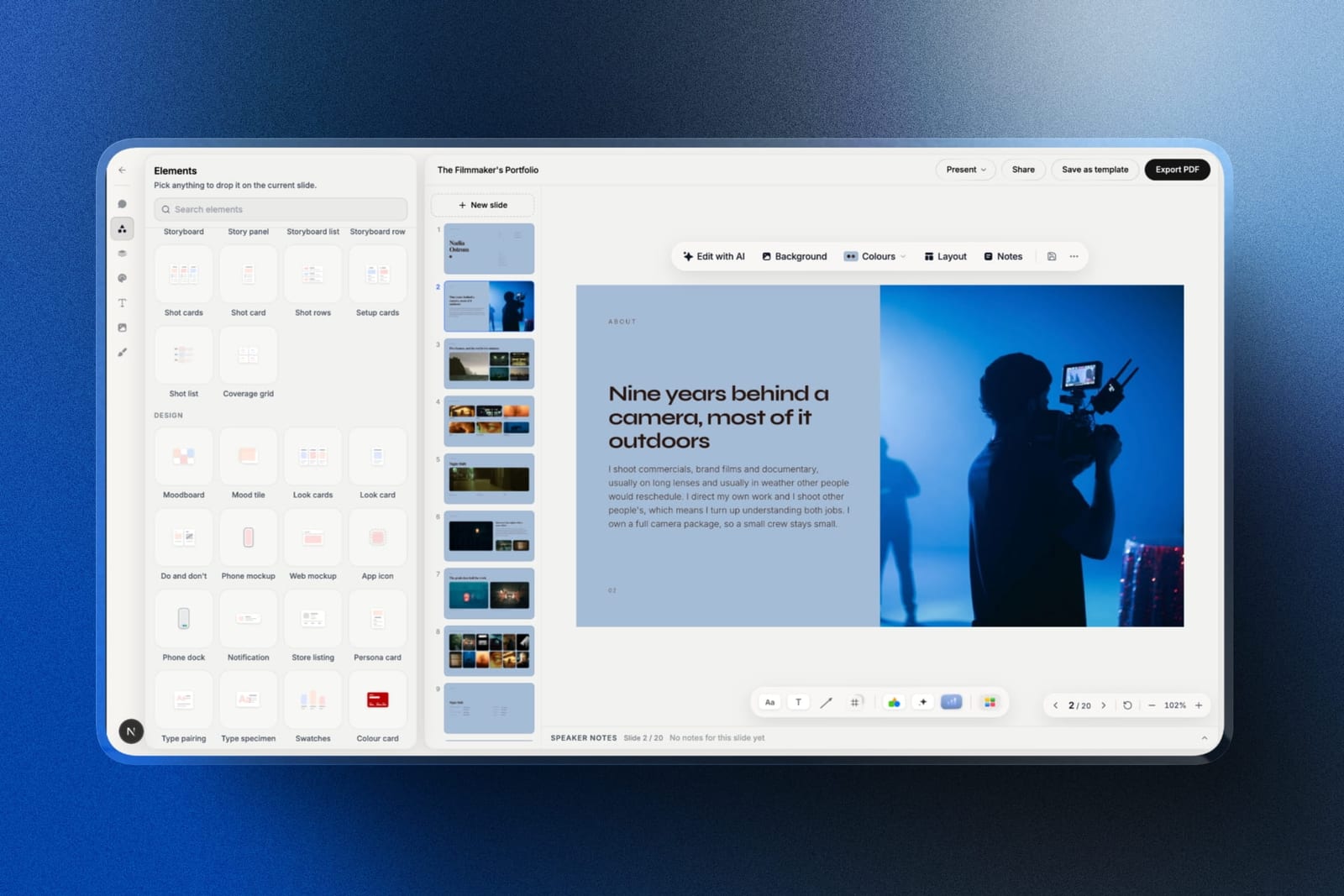
Framekit Slides, its deck tool, has shot list rows with a thumbnail per setup, a stripboard, a coverage grid, storyboard panels and moodboards as ready-made slide elements, so the department heads' pack or the client's approval deck is built from blocks rather than a pasted spreadsheet.
It goes out as a link that updates in place, or as a PDF.
After the shoot, Framekit's video review lets a producer or client leave notes at the exact frame of a cut, with version stacks and approval statuses, and reviewers need no account.
The limit: none of this reads a screenplay. Tagging, element reports, the schedule and call sheets stay in Filmustage, StudioBinder or Movie Magic.
Which Script Breakdown Software Should You Use?
The right tool depends on the length of the script, whether the breakdown has to feed a schedule and a budget, and who else will read it, so work down these questions in order.
1. Is the script feature length with a tight deadline? Filmustage, and budget two hours for review rather than skipping it.
2. Does the breakdown need to become a schedule and call sheets? StudioBinder for small and mid-size productions, Yamdu for larger ones.
3. Is the production union or studio-facing? Movie Magic Scheduling, because the stripboard is the interchange format everyone expects.
4. Do you need budgeting from the same system? Gorilla for independent budgets, or Movie Magic with Budgeting at the professional end.
5. Are you a writer-producer who wants the script to stay the source of truth? Celtx, on the Team plan, since breakdown is an add-on below it.
6. Do you already own Final Draft and need a quick element list? Use Tagger, and expect to move the output elsewhere.
7. Is the project a short or a commercial? Google Sheets, and spend the saved money on the shoot.
8. Are you unsure how much you miss by hand? Break ten pages down both ways before committing to anything.
Frequently Asked Questions
What is the best script breakdown software in 2026?
Filmustage is the best script breakdown software for most productions, because its automated tagging found more elements than a careful manual pass on our 94-page test script and reduced an eleven-hour job to under three hours including review.
StudioBinder is the better choice when the breakdown needs to feed a schedule and call sheets, and Movie Magic Scheduling remains the standard for union and studio work.
Can AI break down a script accurately?
AI breakdown tools find elements very well and categorise them poorly.
On our test script the automated pass tagged more elements than our manual reference, including several single-mention props we had missed, while roughly a third of its tags were placed in the wrong department, most often wardrobe filed as props.
Review is not optional.
Is there free script breakdown software?
StudioBinder has a free tier with limited projects that includes breakdown, Filmustage offers a limited free tier, and Google Sheets is free at any team size and is a reasonable choice for short films.
Celtx has a free plan, but breakdown is a paid add-on on it rather than an included feature.
Does Celtx include script breakdown for free?
Celtx does not include breakdown on its Free, Writer, or Writer Pro plans, where it is sold as an add-on, and includes it only on the Team plan. This is the most common pricing surprise in this category, because Celtx is widely recommended as an all-in-one production tool.
What does a script breakdown include?
A script breakdown includes every element that costs time or money: cast and extras, props, set dressing, wardrobe, makeup and hair, vehicles, animals, stunts, special and visual effects, sound, music, and special equipment, tagged scene by scene and grouped by department.
Locations, page count, and day or night are recorded alongside so the breakdown can be scheduled.
How long does it take to break down a feature script?
Breaking down a 94-page feature by hand took us just over eleven hours, and an automated pass plus a full review pass took two hours forty. Manual tools with good tagging interfaces landed between six and ten hours depending on how much of the work they assist.
What is the industry standard for script breakdown and scheduling?
Movie Magic Scheduling from Entertainment Partners is the industry standard for professional and union productions, because its stripboard output is the interchange format line producers and first assistant directors expect.
It is sold as a perpetual licence rather than a subscription and has no AI assistance.
Is Final Draft good for script breakdown?
Final Draft's Tagger produces a usable breakdown from a screenplay and is convenient for writers who already own the application at its $199.99 perpetual licence.
It stops at reports, with no scheduling, stripboard, budgeting, or call sheets, so the breakdown has to be exported into another tool to be acted on.
Can you break down a script in a spreadsheet?
You can break down a script in a spreadsheet, and for short films and commercials it is a completely legitimate approach that is free, works offline, and can be shared with the whole crew.
On a feature it costs roughly eleven hours of typing and leaves the schedule and budget as separate documents that must be updated by hand.
What do automated breakdown tools still miss?
Automated tools miss implied elements, meaning anything the script does not name directly. A character who arrives soaked implies a rain effect or a water truck, and none of the tools we tested tagged it because the word rain never appears.
Human reading remains better at inference and worse at exhaustive recall.
Can Framekit break down a script?
Framekit cannot break down a script: it has no screenplay import, no element tagging, and no scheduling or call sheets, so use Filmustage, StudioBinder or Movie Magic for the breakdown itself.
Where Framekit helps is afterwards, turning the breakdown into a production or pitch deck with shot list and stripboard elements in Framekit Slides, and collecting frame-accurate notes on the cut in its video review.
Final Verdict
Filmustage is the right first choice for feature-length work because it solves the half of breakdown that is genuinely tedious, which is finding every single-mention element across ninety pages.
What it does not solve is categorisation, and the two hours of review it requires are the difference between a useful document and a budget with money in the wrong departments.
StudioBinder is the better system for productions where the breakdown has to become a schedule and call sheets, Movie Magic remains correct above a certain scale, and a spreadsheet is a perfectly respectable answer for a short.
Celtx's add-on gating is the pricing detail most likely to catch you out.
Where Framekit losesFramekit is an AI website builder for production companies and filmmakers, and it does not break down scripts, schedule days, or produce call sheets, so it is not a competitor to anything on this page and we excluded it from the ranking rather than inventing a place.
Every tool above beats us at this job because we do not do this job.
Where we are useful is either side of it: the production or pitch deck built from the breakdown, the cut sent for frame-accurate notes, and the finished work on a site a future client can find.
If you take one habit from this page, break ten pages down twice, once by hand and once automatically, and count the differences before you trust either.
Related reading: our guides to the best screenwriting software, the best shot list software, the best call sheet apps for film production, and the best website builder for production companies.
Prices above were read from published vendor pricing in August 2026, and several tools in this category are quoted by production size or sold as perpetual licences rather than listed as plan tables, which we have noted where it applies.