Framekit templates
Start from a designer-made template
 Use template
 Use template
 Use template
 Use template
 Use template
 Use template
 Use template
 Use template
The catalogues at the best stock footage sites to license from in 2026 have converged, and the licences have not. That gap is invisible for about eighteen months, which is exactly how long it takes to become expensive.
Here is the shape it usually takes. You delivered a 90-second brand film for a regional coffee roaster, the spot performed, and now the client wants a 30-second cutdown running on regional television for a quarter.
You still have the project file, the graded masters, and the six licensed clips that carry the drone opener and two interiors. What you no longer have is the subscription, because you cancelled it in spring to save $360 a year.
So you open the licence you agreed to at signup, and there it is, one sentence inside a clause you never read: the Storyblocks Individual licence states plainly that "Licenses granted under this Agreement do not include the right to use Stock Files in Broadcast, Television, or OTT platforms unless explicitly set forth in the subscription plan." Those clips were never cleared for television, not even while you were paying.
Re-licensing equivalent shots from a broadcast-cleared agency starts around $219 a clip and climbs past $5,000 for national advertising, so a $360 subscription has become a four-figure line item, out of your margin, because you quoted the job assuming the footage was yours.
Every library now has a competent drone shot of a coastline and a competent slider move across a coffee grinder, so the clip is not what separates them. The licence is, and licence differences never bite in week one.
You are not buying a clip. You are renting a permission, and the term is written in a PDF you did not open.
A stock footage site is a marketplace that licenses pre-shot video clips to filmmakers, editors, and advertisers, selling not the file itself but a written permission to use it for defined purposes, territories, resolutions, and periods of time.
Where we stand: Framekit is not in this ranking and does not license footage - we build the website the finished film lives on, and run the timecoded client review before it, so we ranked these 13 purely on their own licence terms and published prices, and we say plainly where the free options are dangerous.
The best stock footage site in 2026 for most working filmmakers is Artgrid, because a Creator plan at $29.99 a month billed annually gives unlimited 4K to 8K downloads in ProRes and DNxHR, and the universal licence on anything you actually used while subscribed never expires - the honest trade-off is that Artgrid bills annually up front and its Trustpilot reviews are dominated by renewal and refund complaints.
Envato Elements is the cheapest broad subscription at $16.50 a month annually, Adobe Stock is the best per-clip buy for one-off client work with a perpetual standard licence, and Filmsupply is the only pick on this page whose pricing is actually built for national broadcast and paid advertising.
How We Compared These 13 Stock Footage Sites
Comparing stock libraries on catalogue size is close to useless, because every one of them claims millions of assets and nobody watches millions of assets.
We compared these 13 sites on five things that show up in an invoice or a legal letter, and each of them gets its own analysis section further down this page.
Licence durability. What happens to clips you already downloaded when you stop paying. This is the single most valuable and least-checked fact in the category, and the answer differs sharply between vendors that look identical on the pricing page.
Real cost per 4K clip. Not the headline monthly price. What one 4K clip actually costs on each route, and what six of them cost, because six is roughly what a 90-second brand film consumes.
Usage coverage. Whether the standard licence covers client work, broadcast and OTT, and paid advertising, and what the extended or enhanced upgrade costs when it does not.
Resolution and codec. Whether 4K is included or priced separately, and whether you can get ProRes, DNxHR, or log and RAW files rather than a heavily compressed rec709 H.264 that falls apart the moment you push the grade.
Releases and indemnity. Who obtained the model and property releases, who carries the risk when a claim arrives, and what the published indemnification ceiling is.
The test artifact was held constant.
Every site was judged against the same brief: the Halden Roasters film, a 90-second brand piece cut in Premiere Pro that needs six licensed clips - one aerial coastline opener, two roastery interiors, a hands-on-grinder insert, a street exterior, and a slow-motion pour - first delivered for web and social, then upgraded eighteen months later to a regional broadcast spot.
Three kinds of finding, kept apart, because conflating them is how comparison pages become fiction. Measured means we did it hands-on: searching for those six shots, judging codec and grade latitude on downloaded files, and running trials on Artgrid, Envato Elements, Storyblocks, Adobe Stock, Motion Array, and Pexels.
We previewed rather than paid for Filmsupply, Dissolve, and Getty Images, so our judgement on those three is about their published terms and their reels, not months of daily use. Verified means read from a primary source and not tested: every price, credit cost, download cap, indemnity ceiling, and licence clause in this guide was checked against the vendor's own pricing page, licence agreement, or help centre in August 2026, and the load-bearing ones are linked inline. Community sentiment means creators report it and we could not confirm it ourselves, which we label as such wherever it appears.
What Reading 13 Licence Agreements Turned Up
Opinions about stock libraries are cheap and mostly about taste in drone shots. These are the figures underneath the ranking, each verified from a vendor page in August 2026.
- 3 of 13 stop covering you for new work the moment you cancel: Storyblocks on its Individual and Small Business tiers, Motion Array for anything not already finished, and Vecteezy for content pulled after a Pro lapse. The rest let you keep using what you already used.
- 1 of 13 excludes broadcast, television, and OTT from its standard licence outright unless your specific plan says otherwise (Storyblocks).
- Published indemnity ceilings range across a factor of 100, from $10,000 on an Adobe Stock or iStock standard licence to $1,000,000 on a Pond5 Premium licence, with $0 on every free site.
- 4 of 13 deliver log or RAW source files rather than only graded rec709 deliverables (Artgrid on its Pro plan, Filmsupply, Dissolve, and parts of the Pond5 catalogue).
- 1 of 13 no longer exists as an independent product: Videvo was folded into Freepik and its old standalone plans are gone.
The 13 Best Stock Footage Sites in 2026: Full Comparison
How the scoring works: each site is rated on the five criteria above, weighted by what actually costs a filmmaker money or exposes them to a claim - licence durability 25%, usage coverage 25%, real cost per 4K clip 20%, resolution and codec 20%, releases and indemnity 10%.
Licence durability and usage coverage together carry half the weight on purpose, and that weighting is why Storyblocks sits at 7.4 despite being one of the cheapest unlimited subscriptions here: it loses points twice, once for excluding broadcast from its standard licence and once for ending your rights on cancellation outside Enterprise.
It is also why Filmsupply scores 8.9 while being by far the most expensive option - the licence it sells is the one that survives a client's legal review.
No site scored above 9.5, and the free tier scored well below every paid one on indemnity because it carries none.
| Site | Best For | Cheapest 4K Route | Clips Stay Licensed After Cancelling | Our Rating |
|---|---|---|---|---|
| Artgrid | Cinematic footage on subscription | $29.99/mo annual | Yes, for work made while subscribed | 9.4/10 |
| Envato Elements | Cheapest broad subscription | $16.50/mo annual | Yes, for completed licensed projects | 9.0/10 |
| Adobe Stock | One-off clips for client work | About $96-$200 per clip | Yes, perpetual | 8.9/10 |
| Filmsupply | Broadcast and paid advertising | From about $99-$219 per clip | Yes, for the licensed use | 8.9/10 |
| Getty Images and iStock | Releases and legal defensibility | About $128-$170 per clip | Yes, perpetual | 8.4/10 |
| Shutterstock | Library breadth and enhanced rights | About $92-$120 per clip | Yes, perpetual | 8.2/10 |
| Pond5 | Flat, honest per-clip pricing | $59 or $149 per clip | Yes, perpetual | 7.9/10 |
| Motion Array | Editors who also want templates | About $249.99/yr | Completed projects only | 7.6/10 |
| Storyblocks | Cheap volume B-roll, read the terms | $30/mo annual | No, outside Enterprise | 7.4/10 |
| Dissolve | Curated boutique and rights-protected | About $49-$549 per clip | Yes, perpetual | 7.2/10 |
| Vecteezy | Lowest paid subscription price | $9/mo annual | Only while Pro is active | 6.6/10 |
| Pexels and Mixkit | Free B-roll with real limits | $0 | Yes, but no indemnity | 6.3/10 |
| Videvo | Nothing, it is no longer standalone | Folded into Freepik | Unclear, terms migrated | 4.5/10 |
What one 4K clip actually costs on each site
The subscription sites and the per-clip sites are not comparable until you fix the volume.
This table holds the Halden Roasters brief constant - six 4K clips for one 90-second film - and shows the cheapest legitimate route to those six clips on each site, plus what a full year costs if you keep licensing at that rate.
| Site | One 4K clip | Six 4K clips | One year at this rate |
|---|---|---|---|
| Vecteezy Pro | Included | Included | $108 |
| Envato Elements | Included | Included | $198 |
| Motion Array | Included | Included | About $249.99 |
| Storyblocks Unlimited All Access | Included | Included | $360 |
| Artgrid Creator | Included | Included | $359.90 |
| Pond5 (standard) | $59 | $354 | Pay as you go |
| Pond5 (premium) | $149 | $894 | Pay as you go |
| Shutterstock (25-clip 4K pack) | About $92 | About $552 | $2,299 per pack |
| Adobe Stock (credit packs) | About $96-$200 | About $576-$1,200 | Pay as you go |
| iStock Signature | About $128-$170 | About $768-$1,020 | Pay as you go |
| Dissolve | About $49-$549 | Varies by licence | Pay as you go |
| Filmsupply | From about $99 internal, about $219 typical | About $594-$1,314 | Pay as you go |
| Pexels and Mixkit | $0 | $0 | $0 |
Licence coverage matrix
This is the table the category avoids publishing, because it is where the cheap options stop looking cheap. Each column is a question a client's legal reviewer will eventually ask you, and every answer here comes from the vendor's own licence or help pages in August 2026.
| Site | Client work | Broadcast and OTT | Paid advertising | After you cancel | Published indemnity |
|---|---|---|---|---|---|
| Artgrid | Yes | Yes | Yes | Keeps covering work made while subscribed | Not published |
| Envato Elements | Yes | Yes | Yes | Keeps covering completed licensed projects | Not published |
| Adobe Stock | Yes | Yes, under a 500,000 copy or viewer cap | Yes | Perpetual | $10,000 per asset |
| Filmsupply | Yes | Yes, priced into the licence | Yes, priced into the licence | Perpetual for the licensed use | Negotiated per deal |
| Getty Images and iStock | Yes | Yes, commercial content only | Yes, commercial content only | Perpetual | $10,000 standard, higher on Premium Access |
| Shutterstock | Yes | Yes | Yes | Perpetual | $10,000 standard, $250,000 enhanced |
| Storyblocks | Yes | No, excluded unless your plan says otherwise | Yes, with restrictions | Rights end outside Enterprise | $20,000 |
| Pond5 | Yes | Yes | Yes | Perpetual | $15,000 individual, $250,000 business, up to $1,000,000 premium |
| Motion Array | Yes | Yes, universal licence | Yes | Completed projects only | Not published |
| Dissolve | Yes | Yes | Yes, rights-protected available | Perpetual | Not published |
| Vecteezy | Yes on Pro | Limited | Yes on Pro | Only while Pro is active | Not published |
| Pexels and Mixkit | Yes | Yes | Risky, no releases obtained | Unaffected | None |
| Videvo | Terms migrated to Freepik | Check at asset level | Check at asset level | Unclear | Not published |
1. Artgrid: Best Overall for Filmmakers
Our rating: 9.4/10
Artgrid was built by people who understood that stock footage fails on grade latitude, not on subject matter.
The library is organised into story collections shot as coherent bodies of work, which is why searching for a roastery interior returns eight shots from the same shoot, in the same light, with the same lens character, instead of eight strangers you then have to match in the timeline.
Assembling the Halden Roasters six took about eleven minutes, and five of them came from two collections.
The Creator plan at $29.99 a month billed annually, $359.90 for the year, unlocks 4K through 8K in ProRes and DNxHR plus graded masters.
The Pro plan at $49.92 a month adds RAW and log source files, which is the difference between matching a clip to your own camera and merely cutting near it. Junior at $19.99 a month caps you below the codecs that make this worth buying.
The real numbersix 4K ProRes clips cost nothing extra on Creator, because the plan is unlimited - the whole year is $359.90. The same six as iStock Signature downloads run about $768 to $1,020. Artgrid pays for itself at roughly three premium per-clip purchases a year.
The standout detail nobody writes aboutArtgrid's licence is universal and does not expire when your subscription does.
Anything you downloaded and used in a project while subscribed stays licensed and monetisable afterwards, which is why a cancelled Artgrid year does not become a legal problem the way a cancelled Storyblocks year can.
The gotchaevery plan is billed annually, up front, and renews annually, with no month-to-month escape hatch. Once your access lapses you cannot re-download anything, including files you licensed and later lost in a drive failure.
Archive downloads and licence records the same week you get them.
What reviewers say elsewhereArtgrid's Trustpilot page sits at about 1.6 out of 5 across roughly 68 reviews, with complaints clustered almost entirely on renewal and refund handling rather than on the footage.
People love the clips and resent the billing.
Skip it ifyou license three clips a year for corporate explainers, or you need a documented indemnity ceiling to satisfy a broadcaster - Artgrid does not publish one.
Verdict: Artgrid is the best stock footage subscription in 2026 for anyone who edits for a living, because the footage cuts together, the codecs are real, and the licence outlives the subscription. Set a calendar reminder 30 days before renewal. Our best AI tools for filmmakers guide covers what sits around it. Visit Artgrid
2. Envato Elements: Best Value Subscription
Our rating: 9.0/10
Envato Elements is the widest net for the least money, and it is not close.
One subscription covers stock video, motion graphics, music, sound effects, LUTs, After Effects and Premiere templates, fonts, and mockups, so the brand film, the title cards, the lower thirds, and the track all come from one invoice.
For a solo editor that consolidation is worth more than any single category being the best available.
Pricing on the Envato plans page is $16.50 a month billed annually, $198 for the year, or $33 a month monthly - a 100% penalty for flexibility, the steepest annual-versus-monthly gap here.
The higher Plus and Ultimate tiers mainly raise AI generation allowances, from 10 a month at entry to unlimited at the top. Asset downloads are uncapped subject to a fair-use policy.
The real numberat $198 a year, Envato Elements is $161.90 cheaper than Artgrid Creator and $162 cheaper than Storyblocks Unlimited All Access, while covering categories neither touches. If you would otherwise pay separately for footage and music, the saving roughly doubles.
The standout detail nobody writes aboutEnvato's licence attaches per item per project through a registration step rather than floating over your account.
That feels bureaucratic until you cancel, at which point Envato confirms you keep the list of items you previously licensed and can keep using them for the completed projects they were licensed for.
The gotchathat same mechanic is the trap. The licence covers the project you registered the item against, not the item generally.
Pull a clip out of an old registered edit into a new client's spot after cancelling and you are outside the licence, even though the file is still on your drive.
What reviewers say elsewhereEnvato Elements holds about 4.8 out of 5 from 36 reviews on Capterra, with recurring notes about slow asset loading and specialised categories refreshing too slowly.
That is a small sample, so treat the enthusiasm as directional.
Skip it ifyour work is cinematic narrative or high-end commercial. The footage is broad and serviceable, but the top of the Artgrid and Filmsupply catalogues is visibly better shot and a creative director will spot it in a hero sequence.
Verdict: Envato Elements is the best value in stock media in 2026 and the correct default for social, corporate, and explainer video. It is not the best footage library here and does not pretend to be - it is the one that removes four other subscriptions. Selling your own assets too? See the best platforms to sell LUTs. Visit Envato Elements
3. Adobe Stock: Best Per-Clip Licence for Client Work
Our rating: 8.9/10
Adobe Stock's advantage is procedural rather than creative.
You search, preview, and license from inside Premiere Pro and After Effects through the Libraries panel, so a watermarked comp goes into the timeline, survives client review, and gets swapped for the licensed file without relinking anything.
On a job with three rounds of feedback that saves more hours than a marginally better clip would.
The model is credits. The Adobe Stock plans page sells packs from $49.95 for 5 credits up to $1,200 for 150, putting a credit between about $8.00 and $9.99 depending on pack size.
HD video runs roughly 6 to 8 credits and 4K roughly 12 to 20, so one 4K clip lands between about $96 and $200. Video-inclusive subscription plans carry a 20% discount on 4K and extended licence purchases.
The real numberthe Halden six cost roughly $576 to $1,200 here depending on pack size and whether the clips were 12-credit or 20-credit assets. That is more than a full Artgrid year for one film, and it is still right if this is the only film you make this year, because nothing renews.
The standout detail nobody writes aboutthe Adobe standard licence is perpetual and worldwide but caps total copies or viewers at 500,000. Nobody notices that on a corporate video and almost everybody blows through it on a successful broadcast or paid-social campaign.
Enhanced removes the cap, Extended adds resale-product rights, and published indemnification is up to $10,000 per asset.
The gotchacredits expire. Buying the largest discounted pack to lower your per-clip rate only pays off if you spend it inside the window, and 60 lapsed credits wipe out the saving that made the big pack attractive.
What reviewers say elsewhereAdobe Stock scores about 1.2 out of 5 on Trustpilot across roughly 284 reviews, with 88% of the last year at one star.
Read them carefully: they are overwhelmingly about cancellation and billing friction across Adobe's account system, not the footage or the licence.
Skip it ifyou license more than about four 4K clips a month. At that rate you are paying roughly $400 to $800 a month for what an unlimited subscription delivers for $30, and the Premiere integration is not worth a tenfold premium.
Verdict: Adobe Stock is the best per-clip option for occasional, project-billed licensing, because the licence is perpetual, the indemnity is documented, and the clip never leaves your editing application. Watch the 500,000 viewer cap before a campaign scales. Editors building the rest of the stack should read our best website builder for video editors comparison. Visit Adobe Stock
4. Filmsupply: Best for Broadcast and Paid Advertising
Our rating: 8.9/10
Filmsupply is not a stock library pretending to be cinematic. It is a licensing agency for footage shot for real commercials, features, and documentaries by named cinematographers, and the difference is obvious within one scroll.
Where a subscription library gives you a competent drone pass over a coastline, Filmsupply gives you the drone pass that was cut into a car campaign, with the production value that budget bought.
The pricing matches. Filmsupply prices per clip and scales to the client, the scope, and the usage, the way licensing has always worked outside the subscription world.
Reported rates run from around $99 a clip for small internal use, through a typical entry point near $219 a clip, up past $5,000 for national television and advertising.
An annual full-catalogue subscription exists but is priced on request rather than published.
The real numberthe Halden six at a typical $219 a clip is about $1,314, against $359.90 for a whole Artgrid year. If the film stays on a website, that is money burned. If it becomes a regional TV spot, it is the only one of those two numbers that was ever valid.
The standout detail nobody writes aboutbecause Filmsupply prices by usage rather than selling a flat licence, upgrading is a conversation instead of a re-purchase. The eighteen-months-later broadcast problem in our cold open is a quote here and a full re-license almost everywhere else.
The gotchathere is no meaningful cheap tier, and quotes require you to describe the project honestly - client, media, territory, duration. Understate the usage to lower the quote and you have created exactly the exposure you paid Filmsupply to avoid.
Budget at pitch stage or keep its clips out of the offline, because directors fall in love with temp footage they cannot afford.
What reviewers say elsewhereFilmsupply holds about 3.9 out of 5 from 9 verified reviews on G2, with none below three stars.
Nine reviews is a thin sample, but the shape matches the catalogue: nobody disputes the quality and the reservations are about cost.
Skip it ifyou are a solo creator making YouTube content or social cutdowns. The per-clip economics are irrational at that scale.
If you shoot your own footage and wonder whether it could sell here, read our guide to the best places to sell stock footage.
Verdict: Filmsupply is the right choice when the deliverable is broadcast or paid advertising and the licence has to hold up under scrutiny - it is the only site here whose pricing assumes your project might get big. Everyone else sells a flat permission and hopes you never test its edges. Visit Filmsupply
5. Getty Images and iStock: Best for Releases and Legal Defensibility
Our rating: 8.4/10
Getty and its lower-priced sibling iStock are the establishment answer, and the reason to pay their prices is paperwork rather than pictures.
Getty's licensing distinguishes commercial content from editorial content with a rigour the subscription libraries mostly gloss over, and that distinction is the one that gets independent filmmakers into trouble when a recognisable face or a stadium logo ends up in a paid advertisement.
Buying is credit-based on iStock.
Video clips run about 6 credits for an Essentials asset and 15 to 18 credits for a Signature 4K clip, with credits costing roughly $7 to $9.44 depending on pack size, which puts a Signature 4K clip at about $128 to $170.
Getty's own commercial licensing sits above that and is quoted rather than listed for most footage.
The real numberthe Halden six as iStock Signature 4K downloads costs about $768 to $1,020, roughly two to three times an Artgrid year.
What you are buying for that premium is the release trail and a documented $10,000 standard indemnity per asset, with higher ceilings available through Getty's Premium Access agreements.
The gotchaGetty's own agreement puts the release question back on you. It states that you are solely responsible for determining whether releases are required, and notes that releases are typically not obtained for editorial content.
Editorial clips cannot be used for commercial, promotional, advertising, endorsement, or merchandising purposes at all.
Filter for commercial-use content before you fall for a shot, because the editorial catalogue is large, cheap-looking, and completely unusable for the job you are probably doing.
What reviewers say elsewhereGetty Images holds about 3.5 out of 5 across 117 verified reviews on G2, where the recurring complaint is cost and licence complexity rather than content quality.
That matches our read: this is a platform you buy for its rigour and then find rigid.
Verdict: Getty and iStock are the defensible choice, not the economical one - the release trail, the perpetual royalty-free grant, and the published indemnity are what you are actually paying for. Buy here when a lawyer will read your credit list. Visit iStock
6. Shutterstock: Biggest Library and the Strongest Enhanced Licence
Our rating: 8.2/10
Shutterstock is the volume incumbent, with a footage catalogue running into tens of millions of clips and a search that has become genuinely good at narrowing by camera move, orientation, and mood.
If a shot exists as stock, it probably exists here, and that alone justifies keeping an account even when you buy elsewhere.
The pricing is the least legible on this page. Video subscriptions start around $59 a month on the largest annual commitment for five clips a month and rise past $119 a month for twenty, while a no-contract month runs materially higher.
On-demand packs are the alternative: 4K packs top out around $2,299 for 25 clips, about $92 each, while small packs push a single standard clip closer to $120.
The real numberthe enhanced licence adds a flat $370 to a pack and raises Shutterstock's maximum aggregate liability per asset from $10,000 to $250,000.
For a national campaign, $370 to multiply your indemnity by 25 is the cheapest insurance in this guide, and it is the specific reason agencies keep Shutterstock accounts they otherwise barely use.
The gotchathe plan sprawl is not accidental.
Between image subscriptions, video subscriptions, on-demand packs, an all-in-one plan around $69 a month billed yearly, and enterprise agreements, it is very easy to end up on a plan whose per-clip cost is triple the best available route.
Price the exact number of clips you will license this year before you subscribe, and re-price it every renewal.
Verdict: Shutterstock wins on breadth and on the enhanced licence, and loses on price legibility - it is the account you keep for the shot nobody else has and the indemnity nobody else sells. If you shoot more than you license, our guide to the best places to sell stock footage covers the other side of this marketplace. Visit Shutterstock
7. Pond5: Best Flat Per-Clip Pricing
Our rating: 7.9/10
Pond5 spent years as the marketplace where contributors set their own prices, which produced a catalogue of nearly 50 million clips and a checkout experience where the same quality of shot could cost $25 or $250 depending on who uploaded it.
That ended: Pond5 now sells video on a flat two-tier structure at $59 for a standard clip and $149 for a premium clip, which makes it the easiest site here to budget against.
The real numberthe Halden six at standard tier is $354, cheaper than a year of Artgrid Creator and far cheaper than the equivalent Adobe or iStock purchase. At premium tier the same six are $894.
There is also a Footage Plus subscription at around $199 a month or $999 a year for ten downloads a month, which only makes sense above roughly seventeen premium clips a year.
The standout detail nobody writes aboutPond5 publishes a tiered indemnity ladder that nobody else here matches for granularity.
The individual licence included with subscription downloads carries indemnification up to $15,000; upgrading to a business licence raises it to $250,000; a premium licence reaches up to $1,000,000.
You can buy exactly as much legal cover as the project warrants instead of accepting one ceiling for everything.
The gotchaquality variance means search fatigue. Finding six clips that cut together took noticeably longer here than on Artgrid, because the results are not shot as collections and the lighting jumps between adjacent thumbnails. Budget editing time, not just money.
Verdict: Pond5 is the honest per-clip pick and the best value for occasional licensing, with the most flexible indemnity structure in the category. It loses to Artgrid on coherence and to Filmsupply on production value, and it does not care, because it is competing on price clarity. Visit Pond5
8. Motion Array: Best for Editors Who Want Templates Too
Our rating: 7.6/10
Motion Array is aimed at the editor rather than the cinematographer.
Alongside stock footage it ships Premiere and After Effects templates, plugins, transitions, presets, and a review-and-approval tool, so it competes less with Artgrid than with the pile of one-off template purchases most editors accumulate over a year.
Pricing is roughly $249.99 a year for the Everything plan, about $20.83 a month, against about $39.99 a month if you pay monthly.
That yearly figure buys unlimited downloads across every category plus project storage, which is a reasonable amount of tooling for less than one Filmsupply clip.
The real numberat about $249.99 a year, Motion Array undercuts Artgrid Creator by roughly $110 while adding a template library that would cost several hundred dollars to assemble as individual purchases.
The footage itself is a step below Artgrid, so this is a tooling purchase with footage attached, not the reverse.
The gotchaMotion Array's Standard Universal License covers any project size or distribution while you are a member, with no extended licences to buy, which sounds excellent until you cancel.
After cancellation, assets remain usable in projects you already completed but cannot go into new ones. Since editors reuse their own template builds constantly, that restriction bites harder here than on a pure footage library.
Verdict: Motion Array is the right subscription for a working editor who needs graphics more than grade latitude, and the wrong one for anyone whose reputation rests on how the footage looks. Pair it with a review workflow from our best video review and approval tools guide. Visit Motion Array
9. Storyblocks: Cheapest Unlimited, With the Licence You Must Read
Our rating: 7.4/10
Storyblocks pioneered unlimited stock video subscriptions and remains one of the cheapest ways to get a lot of usable B-roll.
Essentials runs about $21 a month billed annually and Unlimited All Access about $30 a month billed annually, with monthly billing roughly doubling both.
For a YouTube channel or a social team burning through establishing shots, the value is real and the search is fast.
Then you read the licence, and the picture changes.
The Storyblocks Individual licence states that licences granted "do not include the right to use Stock Files in Broadcast, Television, or OTT platforms unless explicitly set forth in the subscription plan." It also caps indemnification at $20,000 and prohibits use in machine learning or AI training, in logos or trademarks, and in NFTs.
The real number$360 a year for unlimited All Access downloads is close to Artgrid Creator's $359.90 - and the two are not equivalent purchases.
One of them covers broadcast and keeps covering your published work forever; the other excludes broadcast and, outside Enterprise, stops covering you when you cancel.
The gotcha, and it is the biggest one in this guideon the Individual and Small Business tiers, your right to use downloaded content is tied to your active subscription.
The licence states that if your subscription expires you have no further right or authorisation to download and use additional stock files, and Storyblocks reserves perpetual rights for its Enterprise business licence.
Work you published while subscribed is treated as covered, but new campaigns cut after cancellation from files still on your drive are not.
This is the fact that separates Storyblocks from almost every rival at the same price, and it is three clicks deep on their site.
Verdict: Storyblocks is genuinely cheap and genuinely useful for owned-channel content, and it is the wrong tool for client work with any broadcast future. Pay attention to which of those two businesses you are actually in before you subscribe. Visit Storyblocks
10. Dissolve: Best Curated Boutique
Our rating: 7.2/10
Dissolve is a small, heavily curated agency with a house aesthetic - restrained, documentary-leaning, and noticeably free of the over-saturated corporate look that fills the big libraries.
It sells both royalty-free and rights-protected licences, and prices per clip according to what you intend to do with the footage rather than by a flat rate.
The gotchathe catalogue is a fraction of the size of Shutterstock's or Pond5's, so Dissolve works as a first stop for hero shots and a poor one for filling a timeline. Search for the two shots that carry the film here, then get the rest elsewhere.
Its indemnity terms are also not published as a headline figure, so ask directly if your project needs a documented ceiling.
Verdict: Dissolve is worth a look for the one or two shots that set the tone of a film, and is not a practical primary source. Treat it as a specialist supplier, not a library. Visit Dissolve
11. Vecteezy: Cheapest Paid Subscription
Our rating: 6.6/10
Vecteezy started as a vector and graphics site and added video later, which shows.
Pro costs about $9 a month billed yearly, $108 for the year, or about $15 a month month-to-month, and covers unlimited downloads of photos, vectors, and video with commercial rights and no attribution requirement.
The free tier is the part that catches people out.
Free Vecteezy downloads require attribution, and the requirement is real rather than decorative - a client-facing brand film with an unattributed free Vecteezy clip in it is out of licence, and putting a Vecteezy credit in a commercial's end card is usually a non-starter, which is precisely why Pro exists.
The gotchayour rights are tied to an active Pro subscription for content you pulled under Pro terms, so this is not a library you subscribe to for one month and mine.
It is also thin on the cinematic end - fine for motion backgrounds and abstract inserts, weak for anything with performance in frame.
Verdict: Vecteezy is the cheapest legitimate paid route to commercial-use video, and you get roughly what $108 a year buys. Use it for graphics and filler, not for the shots that carry a film. Visit Vecteezy
12. Pexels and Mixkit: Best Free, With Real Limits

Our rating: 6.3/10
Pexels and Mixkit are the two free libraries worth having bookmarked, and both are more permissive on paper than most people expect.
The Pexels licence states that all photos and videos are free to use, that attribution is not required, and that you may modify them freely.
Mixkit, owned by Envato, offers a free video licence covering commercial use on most of its clips, with a subset carrying a restricted licence instead.
The limits are where the risk lives.
Pexels forbids showing identifiable people in a bad or offensive light, implying endorsement by people or brands, redistributing content on other stock platforms, and using imagery in trademarks or business names.
What it does not do - and this is the part that matters - is obtain model or property releases on your behalf or offer any indemnification whatsoever.
The gotchacontributor-uploaded free footage is the most common source of a rights problem in small-studio video, because a clip can be uploaded by someone who did not have the right to upload it, and there is no agency standing behind it when the claim lands.
For a paid advertisement featuring a recognisable person, a recognisable building, or a visible brand, free footage is the wrong tool at any budget.
Use it for temp, mood, and mood-adjacent inserts, then license the shots that appear in the final cut.
Verdict: Pexels and Mixkit are genuinely useful and genuinely free, and they are not a licensing strategy for paid client work - the $0 price includes $0 of legal cover. Hosting the resulting film matters too; see our best Vimeo alternatives roundup. Visit Pexels
13. Videvo: No Longer a Standalone Site
Our rating: 4.5/10
Videvo appears on nearly every stock footage roundup published in the last five years, and it should not appear on one published in August 2026 without a warning.
Freepik Company acquired Videvo in 2022, and the product has since been absorbed into Freepik's video library.
The old standalone Lite, Plus, and Pro subscription plans are gone, and visitors now land inside the Freepik and Magnific ecosystem rather than on an independent stock video service.
Verdict: Videvo does not belong on a 2026 shortlist as an independent site, and we include it only to say so plainly. If you want what it used to offer, evaluate Freepik's video library on its current terms or use Pexels and Mixkit for free material. Visit Videvo
What Six 4K Clips Actually Cost at Three Volumes
In one linesubscriptions win decisively above roughly six premium clips a year and lose decisively below three, and the crossover point is far lower than most freelancers assume.
| Annual demand | Cheapest subscription route | Cheapest per-clip route | What we would actually do |
|---|---|---|---|
| 6 clips (one film a year) | $198 Envato Elements | $354 Pond5 standard | Buy per clip, keep the licence forever |
| 36 clips (six films a year) | $359.90 Artgrid Creator | $2,124 Pond5 standard | Subscribe, and archive every download |
| 120 clips (a busy studio year) | $359.90 Artgrid Creator | $7,080 Pond5 standard | Subscribe, plus per-clip for hero shots |
The crossover is stark. At six clips a year, per-clip licensing costs $156 more than the cheapest subscription and buys you something the subscription does not: a permission that never depends on your continuing to pay.
At 36 clips a year, the subscription is roughly a sixth of the per-clip cost and the argument is over. At 120 clips, per-clip licensing is a rounding error away from twenty times the price.
What Happens to Your Licence When You Stop Paying
In one linethree of these thirteen sites stop covering you for new work the day your subscription lapses, and the fact is buried in the licence rather than printed on the pricing page, which makes it the single most valuable thing to check before you subscribe.
This is the question that decides whether a cancelled subscription is a saving or a liability, and the vendors answer it in four genuinely different ways.
The licence survives for work you made while subscribed. Artgrid is the clearest example: its universal licence does not expire, so anything you downloaded and used in a project during your subscription stays licensed and monetisable afterwards.
Envato Elements works the same way with an extra step - your licence attaches to registered items in completed projects, and Envato confirms you keep access to that list and can continue using those items for those projects after your subscription ends.
Motion Array also grants continued use in completed projects and blocks new ones.
The licence is perpetual because you bought the clip outright. Every per-clip site behaves this way.
Adobe Stock, Shutterstock, iStock, Getty, Pond5, Dissolve, and Filmsupply all sell a permission attached to a purchase rather than to an account.
Getty's agreement states explicitly that royalty-free rights are perpetual with no expiration date.
The licence ends with the subscription. Storyblocks reserves perpetual usage rights for its Enterprise business licence, and the Individual and Small Business tiers do not carry them.
Work you published while subscribed is treated as covered, but recutting an old edit into a new campaign after cancelling puts you outside the grant. Vecteezy similarly ties Pro rights to an active Pro subscription.
Releases, Indemnity, and Who Pays When the Claim Arrives
In one linethe published indemnity ceiling tells you exactly how much of the risk the library is willing to carry, and it ranges from $1,000,000 down to nothing at all across the sites on this page.
Indemnification is the promise that if someone sues over the content, the library defends you up to a stated amount. It is a contractual cap rather than insurance, and it is the fastest read on how seriously a vendor takes its own supply chain.
Here is the ladder, verified in August 2026. Adobe Stock caps its total aggregate liability at $10,000 per indemnified asset. iStock's standard legal protection sits at the same $10,000 figure.
Shutterstock's standard licence carries $10,000 and its enhanced licence raises that to $250,000 for a flat $370 added to a pack. Storyblocks caps at $20,000.
Pond5 publishes the widest ladder of all: $15,000 on the individual licence included with subscription downloads, $250,000 on a business licence, and up to $1,000,000 on a premium licence.
Artgrid, Envato Elements, Motion Array, Dissolve, and Vecteezy do not publish a headline ceiling, which does not mean they offer nothing - it means you must ask, in writing, before a campaign that needs one. Pexels and Mixkit offer none.
Releases are the other half. A model release is the signed permission from a recognisable person to use their likeness commercially; a property release is the equivalent for a recognisable building, artwork, or private location.
The premium agencies obtain them for commercial-collection content and say so, and the same agencies are careful to tell you when they have not.
Getty's licence puts it bluntly: you are solely responsible for determining whether releases are required, and releases are typically not obtained for editorial content, which cannot be used for commercial, promotional, advertising, endorsement, or merchandising purposes.
Resolution, Codecs, and the Log Footage Question
In one line4K is now included on most subscriptions and charged as a premium on most per-clip sites, but the format that actually decides whether a clip cuts against your own camera is the codec, and only four of these thirteen give you log or RAW.
On the subscription side, 4K is included rather than surcharged.
Artgrid's Creator plan delivers 4K through 8K in ProRes and DNxHR, and its Pro plan adds RAW and log source files, which is the only way to genuinely match stock to footage from your own camera.
Envato Elements, Storyblocks, Motion Array, and Vecteezy deliver 4K where available, generally as compressed rec709 H.264 or similar, which is fine for a straight cut and fragile under a heavy grade.
On the per-clip side, top resolution usually costs more.
Adobe Stock charges roughly 6 to 8 credits for HD and 12 to 20 for 4K, so the same shot at 4K costs two to three times as much, and video-inclusive Adobe plans specifically advertise a 20% discount on 4K purchases because it is a surcharge line. iStock prices Signature 4K at 15 to 18 credits against 6 for an Essentials clip.
Filmsupply and Dissolve, being agencies for professionally shot material, are the two per-clip sources most likely to supply a mezzanine codec or log master on request.
AI-Generated Clips and Whether Anyone Labels Them
In one lineAI-generated video is now inside Shutterstock, Adobe Stock, and iStock as a first-class product, labelling practice varies, and the licence terms around AI-generated assets are the least settled part of this whole category.
Every major library has taken a position, and the positions are not the same.
Shutterstock, Adobe Stock, and iStock all offer AI generation or AI-generated content alongside their photographed catalogues, and iStock's generated imagery carries standard legal protection of up to $10,000 per asset under its licence, which is a meaningful signal - a library willing to indemnify generated content is a library confident about what it was trained on.
Freepik, which now houses the former Videvo catalogue, has built a large AI-generated video library where a substantial share of assets are synthetic.
Labelling practice is uneven, so do three things. Ask the client before using generated footage, because a growing number of brand guidelines now require disclosure or ban it outright.
Prefer libraries that flag generated assets in search results, and buy elsewhere for advertising if a site does not. Keep the provenance record with the project exactly as you would for live action.
Community sentiment, not our findingfilmmakers we read consistently report that generated clips are useful for abstract inserts, textures, and concept work, and still noticeably weak on human performance and on physical continuity across a cut.
We did not run a controlled test of that ourselves, so treat it as the field's opinion rather than a measurement.
Where the Finished Film Actually Lives
Every site on this page solves the same narrow problem - getting a licensed clip into your timeline - and none of them solve what happens after the export.
The film goes to the client, runs its campaign, and then usually disappears into a Vimeo link and a Dropbox folder, which is a strange fate for the work that is supposed to win you the next job.
Framekit is an AI website builder for filmmakers, photographers, and studios who want the finished work living on a domain they own rather than on a platform's URL.
You describe the studio, it generates the site, and your reel, your case studies, your stills, and your contact page sit in one place that belongs to you.
Plans run from a free tier through Starter at $9 a month, Pro at $19, and Business at $39, with 20% off when billed annually, and you can sell digital products - LUTs, presets, sound packs, project files - from a store on the same domain, at a 5% transaction fee dropping to 0% on Business.
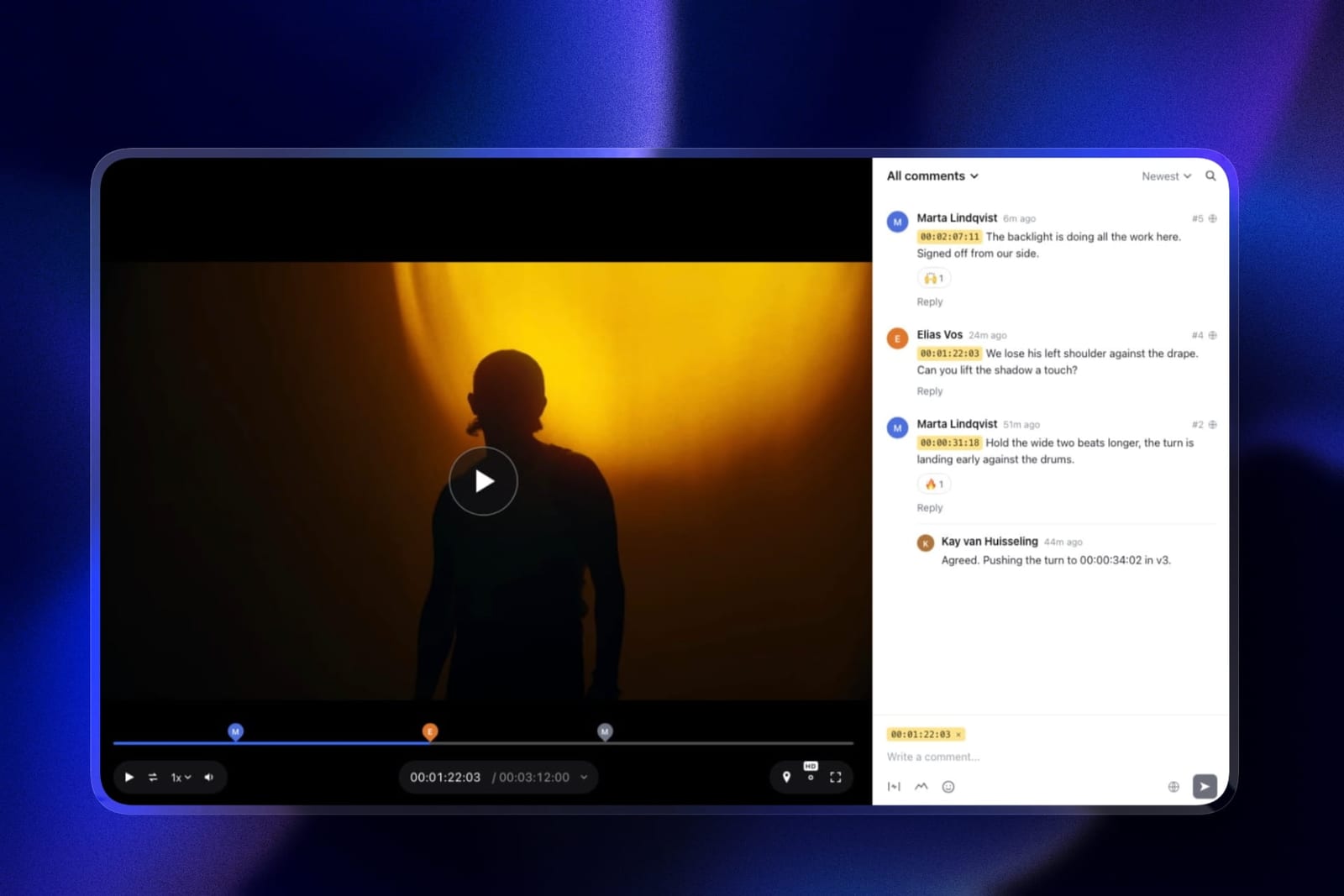
Before the film goes public, the same account's video review lets the client comment at the exact frame, a useful place to flag a stock clip that needs swapping before the licence is bought at full resolution. (Framekit details re-verified September 2026.)
If you are choosing where the reel lives, our best website builders for filmmakers comparison ranks the field honestly, including where we lose.
And since footage is only half of what you license for a brand film, the best stock music licensing sites guide covers the other half with the same licence-first lens.
The Test You Can Run on Your Own Numbers
Open your last twelve months of projects and count two things: how many licensed clips you actually used, and how many of those projects have run, or could still run, on television, in an OTT campaign, or as a paid advertisement.
If the clip count is under about eight, buy per clip from Adobe Stock or Pond5 and keep permanent licences instead of subscribing. If it is above about twenty, an Artgrid or Envato Elements year pays for itself several times over.
And if even one project in that list could end up on broadcast, remove any site whose standard licence excludes it from your shortlist before you compare prices, because a licence that does not cover the delivery is not cheaper, it is just not a licence for your work.
The Decision Guide
Most filmmakers pick a stock library by scrolling two homepages and choosing the prettier reel, which is why so many of them discover the licence terms during a dispute. Work through these questions in order instead, and stop at the first branch that describes you.
Start here. Could any project you deliver this year run on television, on an OTT platform, or as a paid advertisement?
- Yes, and the budget reflects that. Go to Filmsupply and price the hero clips per usage. Add Shutterstock's enhanced licence for anything that needs a $250,000 indemnity ceiling. Do not build the campaign out of an unlimited subscription library, and specifically do not build it out of Storyblocks.
- Yes, but the budget is small. Use Artgrid or Envato Elements, whose licences cover broadcast and survive cancellation, and avoid Storyblocks entirely. Keep every licence record.
- No, my work is web, social, and owned channels only. Go to the next question.
How many clips do you license in a year?
- Fewer than about eight. Buy per clip. Pond5 at $59 standard is the cheapest clear price, Adobe Stock is better if you live in Premiere Pro, and both give you a permission that never lapses.
- Eight to about thirty. Subscribe. Envato Elements at $198 a year if you also need music, templates, and graphics; Artgrid Creator at $359.90 if footage quality is what the work is judged on.
- More than thirty. Subscribe to Artgrid and keep a per-clip account for hero shots. This is the pattern most working studios land on.
Now the tiebreakers.
- Do you grade heavily, or cut stock against your own camera? Artgrid Pro for log and RAW, or Filmsupply and Dissolve per clip. Nothing else here reliably gives you a gradeable master.
- Is the budget genuinely zero and the work unpaid? Pexels and Mixkit, and stop before anything with a recognisable face or brand in frame.
Frequently Asked Questions
What is the best stock footage site to license from in 2026?
Artgrid is the best stock footage site to license from in 2026 for working filmmakers, because its Creator plan at $29.99 a month billed annually gives unlimited 4K to 8K downloads in ProRes and DNxHR, and its universal licence keeps covering work you made while subscribed after you cancel.
Envato Elements is the cheapest broad subscription at $16.50 a month annually, Adobe Stock is the best per-clip option for occasional client work, and Filmsupply is the only site here whose pricing model is genuinely built for national broadcast and paid advertising.
Can I keep using stock footage after I cancel my subscription?
It depends entirely on the vendor, and this is the most expensive thing people fail to check. Artgrid, Envato Elements, and Motion Array all let you keep using footage in projects you completed while subscribed.
Storyblocks does not carry perpetual rights on its Individual or Small Business tiers - those are reserved for its Enterprise business licence - so a new campaign cut after cancellation from files still on your drive is outside the grant.
Every per-clip purchase from Adobe Stock, Shutterstock, iStock, Getty, Pond5, Dissolve, or Filmsupply is perpetual, because you bought a permission rather than rented one.
Note that no subscription site here lets you re-download after your access lapses, so archive the files as well as the licences.
Artgrid vs Storyblocks: which is safer for client work?
Artgrid is clearly safer for client work at almost identical annual pricing.
Artgrid Creator is $359.90 a year and Storyblocks Unlimited All Access is about $360 a year, but the Storyblocks Individual licence states that licences granted do not include the right to use stock files in broadcast, television, or OTT platforms unless your specific plan says otherwise, and it ties your usage rights to an active subscription outside Enterprise.
Artgrid's licence covers broadcast and survives cancellation for work already made. Storyblocks is cheaper per download in practice and better for high-volume owned-channel content; Artgrid is the one to hand a client.
Does a standard stock footage licence cover broadcast television?
Usually yes, but with exceptions and caps that matter.
Adobe Stock's standard licence is perpetual and worldwide but limits total copies or viewers to 500,000, which a successful broadcast or paid-social campaign can exceed - the Enhanced licence removes that ceiling.
Shutterstock, Pond5, Getty, and iStock standard licences cover broadcast. Storyblocks excludes broadcast, television, and OTT from its standard grant unless explicitly included in your subscription plan.
Filmsupply prices broadcast usage into the licence directly rather than selling a flat permission. Always confirm the specific delivery before you cut the clip in.
How much does one 4K stock clip cost in 2026?
One 4K stock clip costs $0 on Pexels or Mixkit, $59 or $149 on Pond5's flat standard and premium tiers, about $92 to $120 through Shutterstock on-demand packs, roughly $96 to $200 on Adobe Stock credits depending on pack size and asset, about $128 to $170 for an iStock Signature clip, roughly $49 to $549 on Dissolve, and from about $99 to well past $5,000 on Filmsupply depending on the usage you license.
On unlimited subscriptions - Artgrid at $359.90 a year, Envato Elements at $198, Storyblocks at about $360, Motion Array at about $249.99, Vecteezy at $108 - the marginal cost of one more 4K clip is nothing.
Is free stock footage from Pexels safe to use in a paid advertisement?
Legally it is permitted but commercially it is risky, and we would not do it.
The Pexels licence allows commercial use without attribution, but Pexels does not obtain model or property releases on your behalf and offers no indemnification at all, so a claim over a recognisable person, building, artwork, or brand in a paid advertisement lands entirely on you and your client.
Free footage is excellent for temp edits, mood boards, pitch decks, internal video, and unpaid personal work. For anything running as advertising, license from a source that obtained releases and publishes an indemnity ceiling.
What is an extended or enhanced licence and when do I actually need one?
An extended or enhanced licence is an upgrade to the standard grant, and each vendor means something slightly different by it.
Adobe Stock's Enhanced licence removes the 500,000 copy or viewer cap on the standard licence, while its Extended licence adds rights for products you sell; an extended licence costs about 8 credits, and video-inclusive plans carry a 20% discount on those purchases.
Shutterstock's Enhanced licence adds a flat $370 to a pack and raises the indemnity ceiling from $10,000 to $250,000.
You need one when the audience is very large, when the footage appears in something being resold, or when a client's legal team asks for a higher ceiling.
Do stock footage subscriptions cap downloads, and do unused downloads roll over?
The unlimited subscriptions on this page do not cap downloads.
Envato Elements states that no limits apply to creative asset downloads subject to a fair-use policy, and Artgrid, Storyblocks Unlimited All Access, Motion Array, and Vecteezy Pro all advertise unlimited downloads too.
The capped plans are the per-clip subscriptions: Shutterstock video plans allocate a set number of clips per month, and Pond5's Footage Plus subscription includes ten downloads a month at around $199 a month or $999 a year.
On plans like those, rollover policies vary and unused allowances frequently do not carry forward, so confirm it before buying an annual commitment you will use unevenly.
Stills follow a different pricing logic from clips, priced per download with indemnity caps rather than per licence tier, which we set out across ten stock photo sites.
Final Verdict: The Best Stock Footage Site in 2026
After comparing thirteen sites on their licences rather than their showreels, the pattern is consistent: the catalogues have converged and the permissions have not.
Two sites can charge you $360 a year for near-identical libraries, and only one of them will still cover you when the client's spot goes to air eighteen months later.
Artgrid is the best stock footage site to license from in 2026 for filmmakers who cut for a living.
The Creator plan at $29.99 a month billed annually gives unlimited 4K to 8K in ProRes and DNxHR, the Pro plan adds log and RAW for anyone matching stock against their own camera, and the universal licence keeps covering work you made while subscribed after the subscription ends.
Where Artgrid loses: it bills annually up front with no monthly escape, it does not publish an indemnity ceiling, its Trustpilot score sits near 1.6 out of 5 on renewal and refund complaints, and it locks you out of re-downloading the moment your access lapses.
If your project is a national broadcast or advertising campaign, Filmsupply is the better fit, because its per-usage pricing and negotiated terms are what a legal review is looking for.
If you license fewer than about eight clips a year, Pond5 at $59 a clip or Adobe Stock on credits is cheaper and gives you a permission that never depends on a renewal.
Motion graphics templates follow the same logic with a lower crossover: see the best motion graphics template sites, where subscribing wins above about five templates a year.
For more, read our guide to the other side of this market in best places to sell stock footage, the licence-first companion on music in best stock music licensing sites, the best website builders for filmmakers if the reel needs a home, and the best AI tools for filmmakers for what sits around the edit.