Framekit templates
Start from a designer-made template
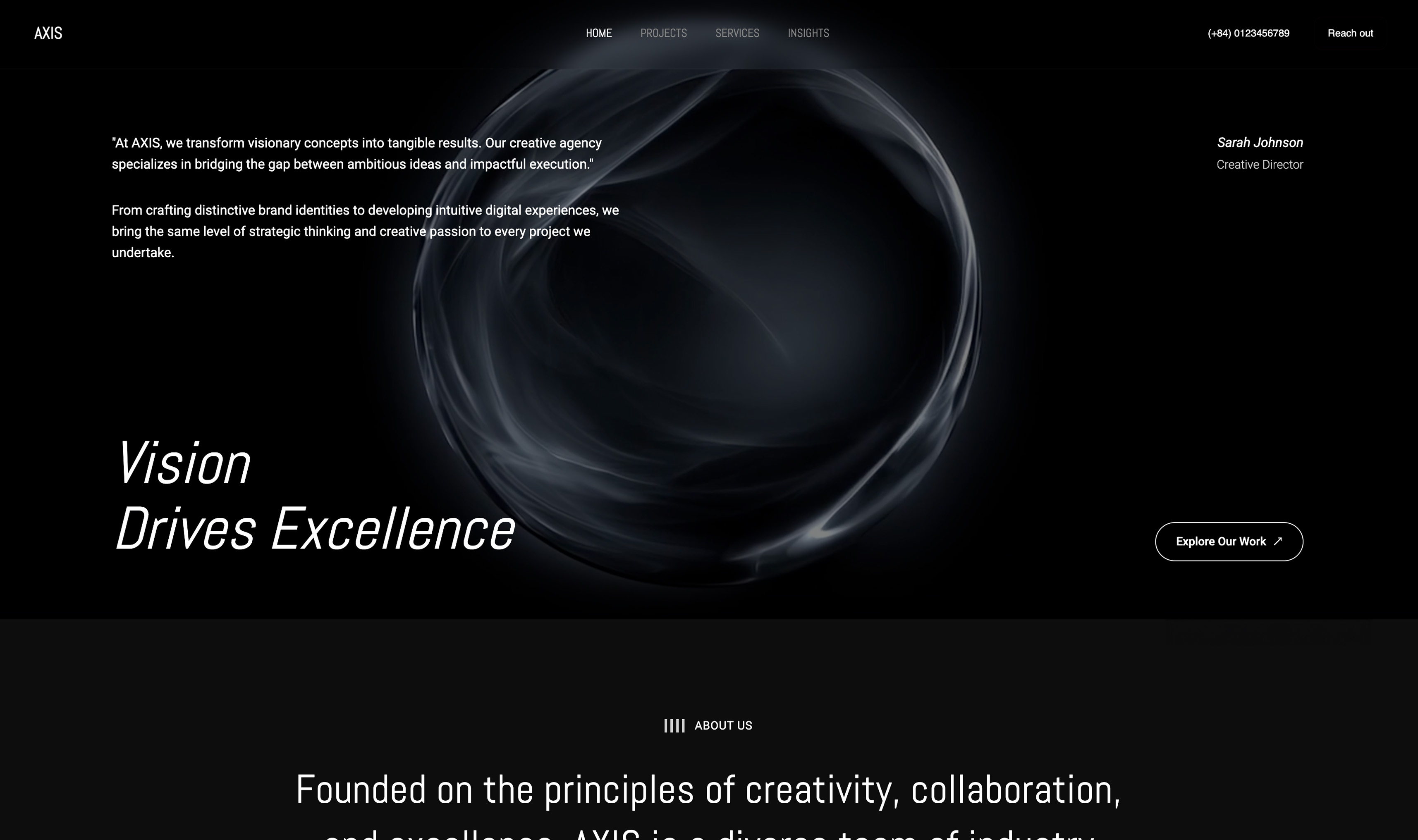 Use template
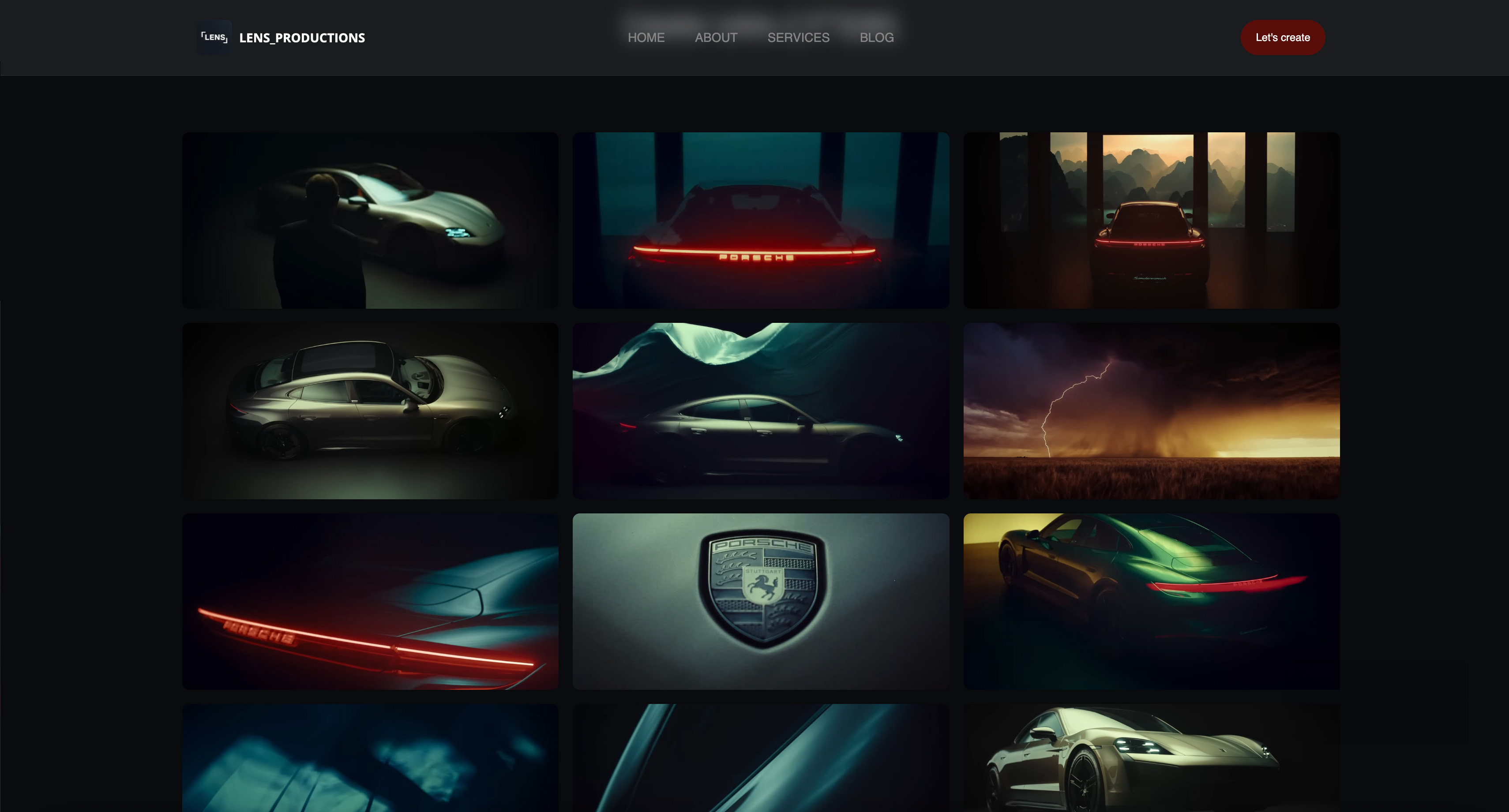 Use template
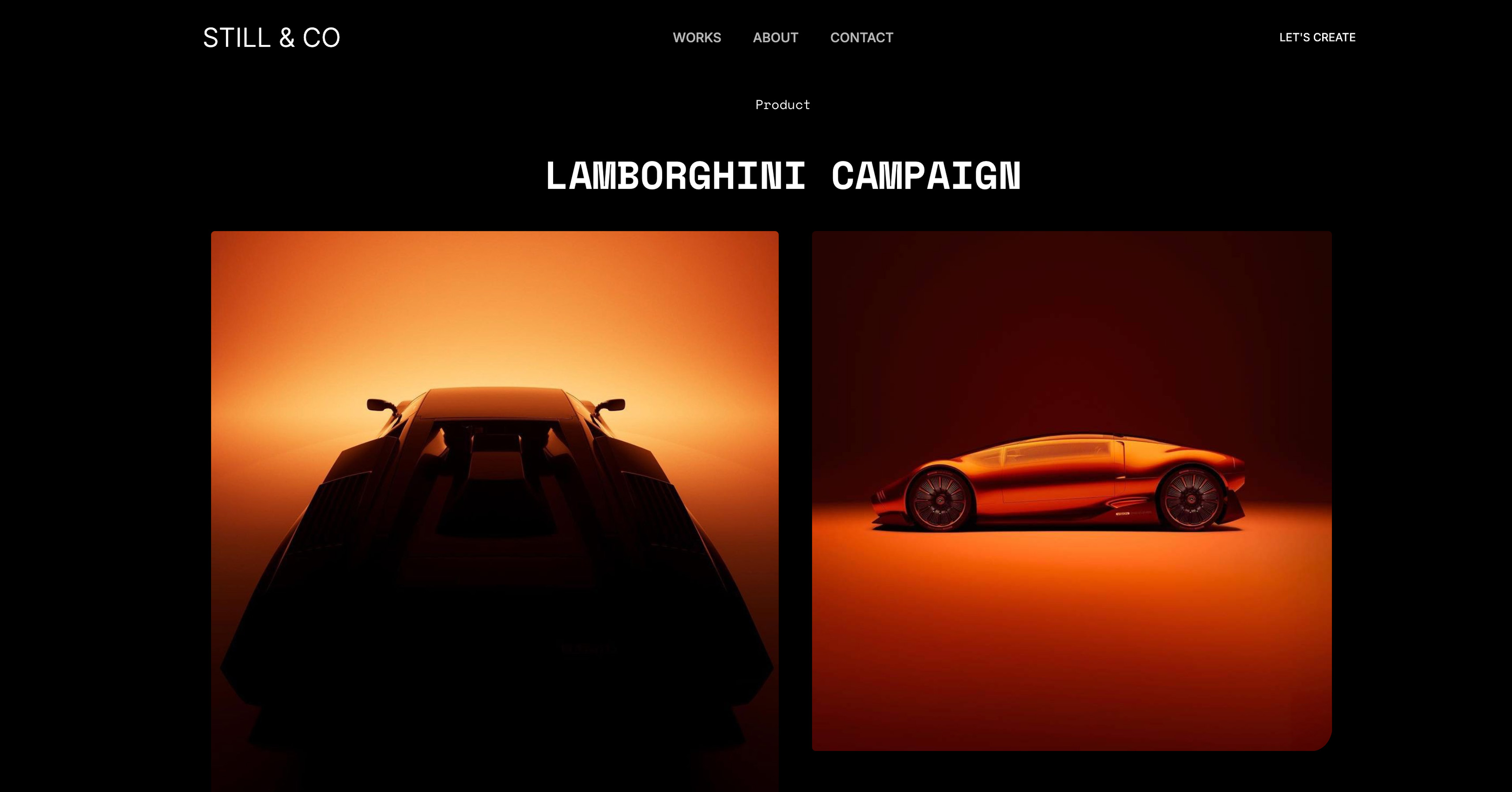 Use template
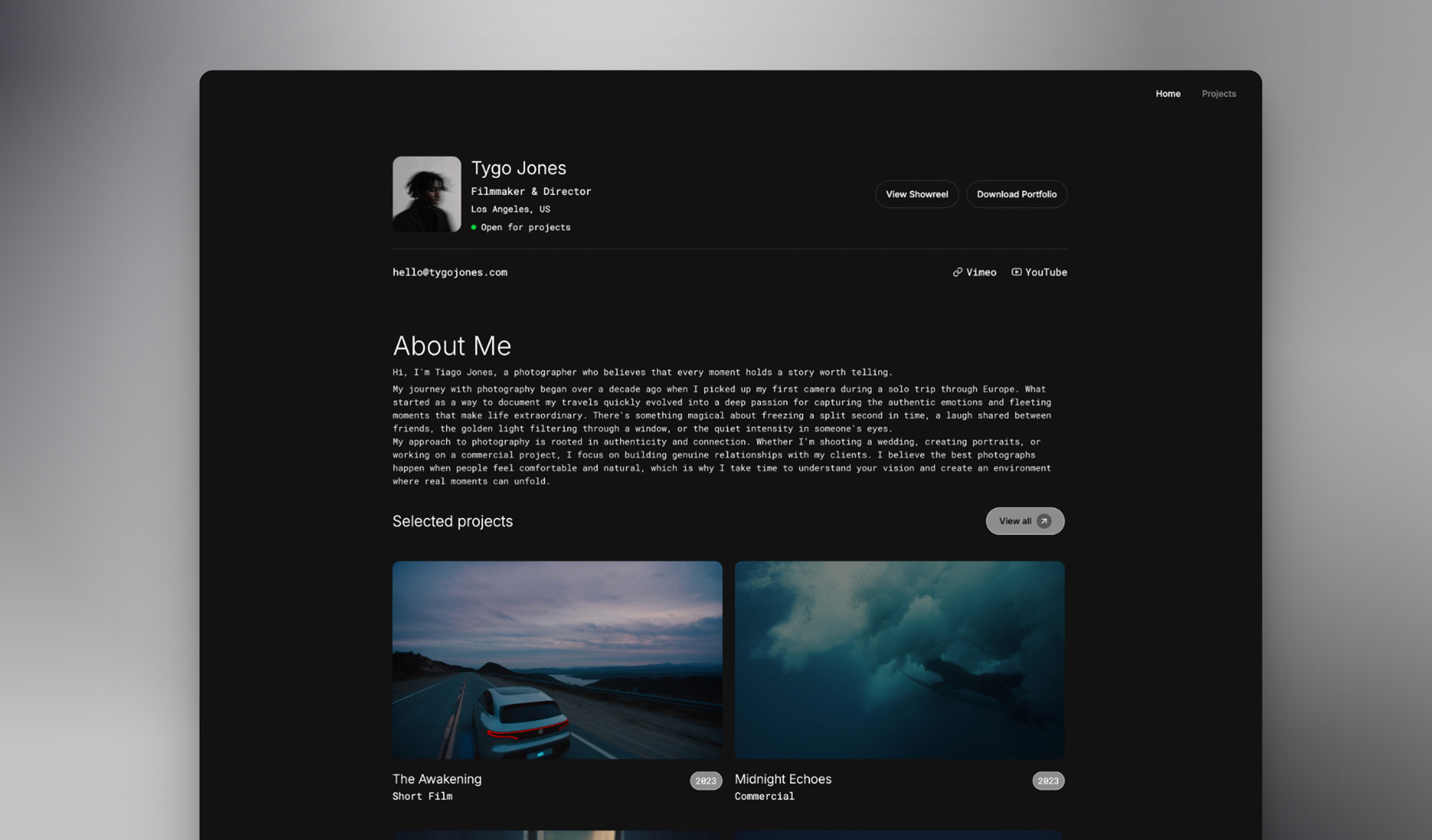 Use template
 Use template
 Use template
 Use template
 Use template
Boarding a commercial is two jobs pretending to be one. The first is working out the sequence, which is thinking.
The second is producing thirty-two panels a client can follow, with timings, dialogue and camera notes attached, which is production.
Most people choose their tool for the first job and then discover they bought the wrong one for the second.
The tell is always the same: you can draw the whole thing in an afternoon and cannot get it out as something a client will watch.
Storyboard software is a tool that turns a sequence of shots into ordered panels with shot descriptions, camera directions and timings, and in most cases assembles them into an animatic so a client can see the pacing rather than imagine it.
The best storyboard software in 2026 is Boords, because it takes you from panels to a timed animatic with client comments in one place, costs $7.99 a month on its entry plan, and does not require you to draw.
The trade-off is that it is a boarding tool rather than a production system, so it will not schedule your shoot.
StudioBinder is the pick when boards feed a whole production, Toon Boom Storyboard Pro is the standard for animation, Storyboarder is genuinely free for anyone who can draw, and Framekit Slides is the pick for a frame-assembled board inside a pitch deck, though it makes no animatic.
Full disclosure: Framekit is our own product. It now ships storyboard and shot-list elements in its Slides editor, so it is ranked, but seventh, because it cannot draw a panel, time one, or build an animatic. It is scored from its published features rather than from our 32-panel build.
How We Compared 11 Storyboard Tools
We boarded the same job in every tool: a 60-second commercial in 32 panels, with camera moves noted on nine of them, dialogue on six, timings throughout, and one revision round where four panels changed after client comments.
Panel production without drawing skill. Most people boarding commercials are directors and producers rather than illustrators. We scored how usable each tool is for someone who cannot draw, which is the majority of this category's real users.
Animatic output. Can the tool turn timed panels into something a client can watch? This is where boarding tools separate from drawing tools, and it carries 25% of the score.
Client review. Comments attached to specific panels, or a PDF and an email thread? Revisions are most of the work on commercial jobs.
Drawing quality for those who can. Pressure sensitivity, brushes, and whether an illustrator would tolerate it.
Real cost per project. Priced for a director or small production company boarding perhaps six jobs a year.
Three kinds of finding, kept apart. Measured by hand: building the 32 panels, exporting an animatic, and running the revision round in each tool.
Verified from published sources: pricing against each vendor's own pages in August 2026, linked where accessible. Reported as community sentiment: recurring complaints from storyboard artists, flagged as sentiment.
On 19 September 2026 we added Framekit as an eleventh tool, now that its Slides editor ships storyboard elements, and re-verified its plans against its pricing page.
It did not go through the 32-panel build or the timed revision round, so it is left out of those measured results; competitor prices are as read in August.
What Boarding the Same Commercial 10 Times Showed
The counts behind the ranking, from our build and from each vendor's published pricing in August 2026.
- 5 of 11 produce a timed animatic from the panels without a separate editing step: Boords, StudioBinder, Toon Boom Storyboard Pro, Plot and Storyboarder.
- 4 of the 10 we boarded in are usable by someone who cannot draw at all, because they combine stock figures, image import and text: Boords, StudioBinder, Canva and Milanote. Framekit, by its feature list, works the same way.
- 2 of 11 are free with no meaningful ceiling: Storyboarder, which is open source, and Canva's free plan.
- The cheapest tool with animatic output and client comments is Boords at $7.99 a month on annual billing, about $96 a year.
- The most expensive is Toon Boom Storyboard Pro at $252 a year on an annual subscription, roughly two and a half times Boords, and it is the only one built for animation production.
- Our revision round took under ten minutes in the tools with panel-level comments and closer to an hour anywhere the feedback arrived as an email listing panel numbers.
Skip to the decision tree for the fast answer, or read the field.
The 11 Best Storyboard Software Tools in 2026: Full Comparison
How the ratings work: animatic output 25%, usability without drawing skill 25%, client review 20%, drawing quality 15%, and cost 15%.
The first two carry half the score because the dominant use case in this category is a director who cannot draw needing a client to understand pacing.
Boords leads at 9.2 while scoring 4 on drawing quality, comfortably behind Toon Boom and Procreate. Toon Boom scores 10 on drawing and 3 on cost. Nothing in this comparison led on both.
| Tool | Best for | Animatic | Usable without drawing | Cost a year | Our rating |
|---|---|---|---|---|---|
| Boords | Directors and agencies | Yes | Yes | About $96 | 9.2/10 |
| StudioBinder | Boards inside a production | Yes | Yes | From about $348 | 8.8/10 |
| Toon Boom Storyboard Pro | Animation production | Yes | No | About $252 | 8.6/10 |
| Milanote | Reference-built boards | No | Yes | $0 to about $120 | 8.1/10 |
| Plot | Light collaborative boarding | Yes | Partly | From about $120 | 7.9/10 |
| Storyboarder | Anyone who can draw, free | Yes | Partly | $0 | 7.7/10 |
| Framekit | Boards inside a pitch deck | No | Yes | $0 to $84 | 7.5/10 |
| Canva | Presentable boards, no drawing | No | Yes | $0 to $144 | 7.4/10 |
| Procreate | Hand-drawn panels on iPad | No | No | About $13 once | 7.2/10 |
| Figma | Boards beside design work | No | Partly | $0 to $192 | 6.9/10 |
| StoryboardThat | Quick non-film boards | No | Yes | Published plans | 6.3/10 |
Pricing checked against each vendor's own published plans during August 2026, quoted on annual billing where offered. Rates in this category moved during the last year, so confirm before you subscribe.
What each tool does about the revision round
Revisions are where storyboarding time actually goes, and the difference between tools is larger here than anywhere else. We changed four panels after simulated client feedback and timed the round trip.
| Tool | How feedback arrives | Our revision round |
|---|---|---|
| Boords | Comments pinned to individual panels | Under 10 minutes |
| StudioBinder | Comments in the production workspace | Under 10 minutes |
| Plot | Comments on frames | About 15 minutes |
| Toon Boom Storyboard Pro | External, usually a review tool | About 30 minutes |
| Canva | Comments on the design | About 20 minutes |
| Storyboarder, Procreate, Figma | Email listing panel numbers | About an hour |
Framekit is not in this timed table. It has no comments on slides, so feedback on a board arrives the same way as for Storyboarder, unless you export an animatic and review it in Framekit's video review.
1. Boords: Best Overall for Directors and Agencies
Our rating: 9.2/10
Boords understands who is actually boarding commercials, which is directors, producers and agency creatives who cannot draw and need a client to understand the sequence by Thursday.
Everything about it is arranged around that: panels you can build from imported images or simple sketches, shot notes and camera directions as structured fields, and an animatic generated from your timings without opening an editor.
Our 32-panel board took the least total time of any tool here, and the revision round was the fastest by a wide margin because client comments pin to individual panels rather than arriving as an email that says "panels 9, 14, 22 and 27".
Best forDirectors, agencies and production companies boarding commercials, music videos and branded content on deadlines.
Key features:
- Animatic generation directly from panel timings, with audio
- Comments pinned to individual panels for client review
- Shot fields for camera, action, dialogue and duration
- Image import and simple drawing tools, so no illustration skill is required
- Shareable links that a client opens without an account
The real numberPlus is $7.99 a month on annual billing, about $96 a year, with Pro at $14 and Max at $39 a month annually, per Boords' pricing page. That makes the animatic-plus-review combination cheaper here than anywhere else in this comparison.
The standout detailthe animatic respects your per-panel timings rather than assigning an even duration, which sounds minor and is the difference between a client understanding your pacing and watching a slideshow.
The gotchathe drawing tools are basic, and an illustrator boarding by hand will find them limiting within an hour. Boords expects you to import artwork rather than to make it, which is the right call for its audience and the wrong tool for a storyboard artist.
What reviewers say elsewhereBoords rates strongly on G2 and TrustRadius for ease of use, with the recurring criticism being exactly that drawing limitation.
Skip it ifyou are a storyboard artist who draws every panel, or you need boards to flow into schedules and call sheets.
Verdict: Boords is the best storyboard software for people who need boards rather than drawings, which is most of this market. Cheapest credible route to an animatic a client can actually watch. Visit Boords
2. StudioBinder: Best When Boards Feed a Production
Our rating: 8.8/10
StudioBinder's argument is continuity. The board is not a document that gets abandoned once approved, it becomes the shot list, which becomes the schedule, which becomes the call sheet, with the same shots carrying the same numbers through all of it.
For a production company running several jobs at once, that saves more time than any boarding feature. For a freelance director boarding one commercial, it is a lot of platform to carry.
Best forProduction companies where the board is the first document in a chain that ends at a call sheet.
Key features:
- Boards that convert directly into shot lists and schedules
- Call sheets and crew management in the same system
- Client and crew sharing with permissions
- Animatic output from boarded panels
- Industry-standard production documents throughout
The real numberplans start at about $29 a month, roughly $348 a year, per StudioBinder's pricing page, which is more than three times Boords for a boarding job alone.
The gotchayou are buying a production platform to solve a boarding problem. If your scheduling already runs elsewhere, most of what you pay for sits unused, and the boarding half is not clearly better than the tool costing a quarter as much.
Skip it ifyou are a freelance director rather than a company, because the value is concentrated in the parts you will not touch.
Verdict: StudioBinder is a production decision that includes storyboards, and it is excellent as that. Judge it on the whole chain, not on the panels. Visit StudioBinder
3. Toon Boom Storyboard Pro: Best for Animation
Our rating: 8.6/10
Storyboard Pro is the industry standard in animation, and nothing else here is close for that work.
Camera moves are real camera moves with keyframes, panels carry proper layers, the drawing tools are professional, and the output feeds straight into an animation pipeline rather than into a PDF.
It is also the least approachable tool in this comparison. A director who cannot draw will not produce a usable board in it, and that is not a criticism, it is the product's intended audience.
Best forAnimation studios and professional storyboard artists working into an animation pipeline.
Key features:
- Professional drawing tools with layers and pressure sensitivity
- Real camera moves with keyframes rather than annotations
- Animatic output with audio and timing control
- Export into animation production pipelines
- Industry-standard in animation, so artists already know it
The real numberabout $30 a month, or $252 a year on an annual subscription, with a three-year option around $718, per Toon Boom's store.
That is the most expensive option in this comparison and the cheapest way into a professional animation pipeline.
The gotchait assumes drawing ability throughout. There is no stock-figure shortcut, no image-driven panel building, and no path for a non-drawing director to get a board out of it.
Skip it ifyou board live action, because you are paying for animation pipeline features and drawing tools you will not use.
Verdict: Storyboard Pro is the correct answer for animation and the wrong one for almost everything else in this comparison. Visit Toon Boom
4. Milanote: Best Reference-Built Boards
Our rating: 8.1/10
A great many commercial boards are not drawn at all, they are assembled: a frame from a reference film, a photograph of a location, a diagram of a camera move, arranged in sequence with notes.
Milanote is the best tool here for that method, because its canvas puts no structure on you at all.
What it will not do is produce an animatic or attach timings in any structured way, so the board stops at the point where a client wants to see pacing.
Best forDirectors who board by assembling references rather than by drawing, especially at the pitching stage.
Key features:
- Infinite canvas with completely free arrangement
- Images, video, notes and links side by side
- Templates for storyboards and shot planning
- Share links that a client opens without an account
- Web clipper for pulling reference frames quickly
The real numberPro is $9.99 per person a month billed annually, about $120 a year, per Milanote's published plans. The free tier allows 10 file uploads, which a 32-panel board exhausts immediately.
The gotchathere is no timing model and no animatic, so a client sees a sequence without pacing. On commercial work where the whole question is whether the idea fits in sixty seconds, that gap matters more than it sounds.
Skip it ifthe client needs to see timing, which on any broadcast or online spot they eventually will.
Verdict: Milanote is the best place to work out a sequence from references and never the place it should finish. See our best mood board tools comparison for how it fits the wider workflow. Visit Milanote
5. Plot: Best Light Collaborative Boarding
Our rating: 7.9/10
Plot is a lighter, newer take on the same job Boords does, aimed at video teams who want boards and animatics without the weight of a production platform. Frames, comments, timings and a shareable output, with an interface that gets out of the way.
It is less mature than Boords in the details that matter on a revision-heavy job, and its template and drawing options are thinner, but for small teams boarding social and branded content it is a reasonable fit.
Best forSmall video teams boarding short-form and branded content collaboratively.
Key features:
- Frame-based boarding with comments for review
- Animatic output with timings
- Collaborative editing for small teams
- Clean, uncluttered interface with a short learning curve
- A 14-day free trial before any charge
The real numberSolo is $9.99 a month, Pro is $14.99 and Business is $19.99, per Plot's pricing page, so the entry tier is about $120 a year, roughly $24 more than Boords Plus billed annually.
The gotchait is priced monthly rather than with a meaningful annual discount, so the effective cost sits above Boords for a comparable feature set unless the collaboration specifically suits you better.
Skip it ifyou are boarding alone, because the collaboration is the reason to choose it over the cheaper alternative.
Verdict: Plot is a competent, lighter alternative that has to justify costing more than the category leader. Try the trial against a real job before committing. Visit Plot
6. Storyboarder: Best Free Tool for Anyone Who Can Draw
Our rating: 7.7/10
Storyboarder is free, open source, and genuinely capable: draw panels, add shot notes and dialogue, and export an animatic or a PDF. For a student, a first-time director, or an artist who wants a dedicated boarding tool without a subscription, it is the obvious starting point.
The trade-offs are the ones you expect from free desktop software. Collaboration is nonexistent, client review means exporting and emailing, and development pace is slower than the commercial tools.
Best forStudents, independent filmmakers and artists who can draw and will not pay a subscription.
Key features:
- Free and open source with no account or limits
- Drawing tools with basic pressure sensitivity
- Shot notes, dialogue and timing fields
- Animatic and PDF export
- Runs locally, so it works with no connection
The real number$0, permanently, with no tier above it. Against Boords at $96 a year, the difference you are giving up is collaboration and panel-level client comments rather than boarding capability.
The gotchathe revision round is where it costs you. With no comment system, feedback arrives as an email listing panel numbers, and our test round took roughly six times longer than in the tools with pinned comments.
Skip it ifclients review your boards, because the review process is the expensive part and this is where it is most expensive.
Verdict: Storyboarder is the best free boarding tool and the most expensive one in revision time. Perfect for solo work, painful for client work. Visit Storyboarder
7. Framekit: Best Boards Inside a Pitch Deck, Without Drawing
Our rating: 7.5/10
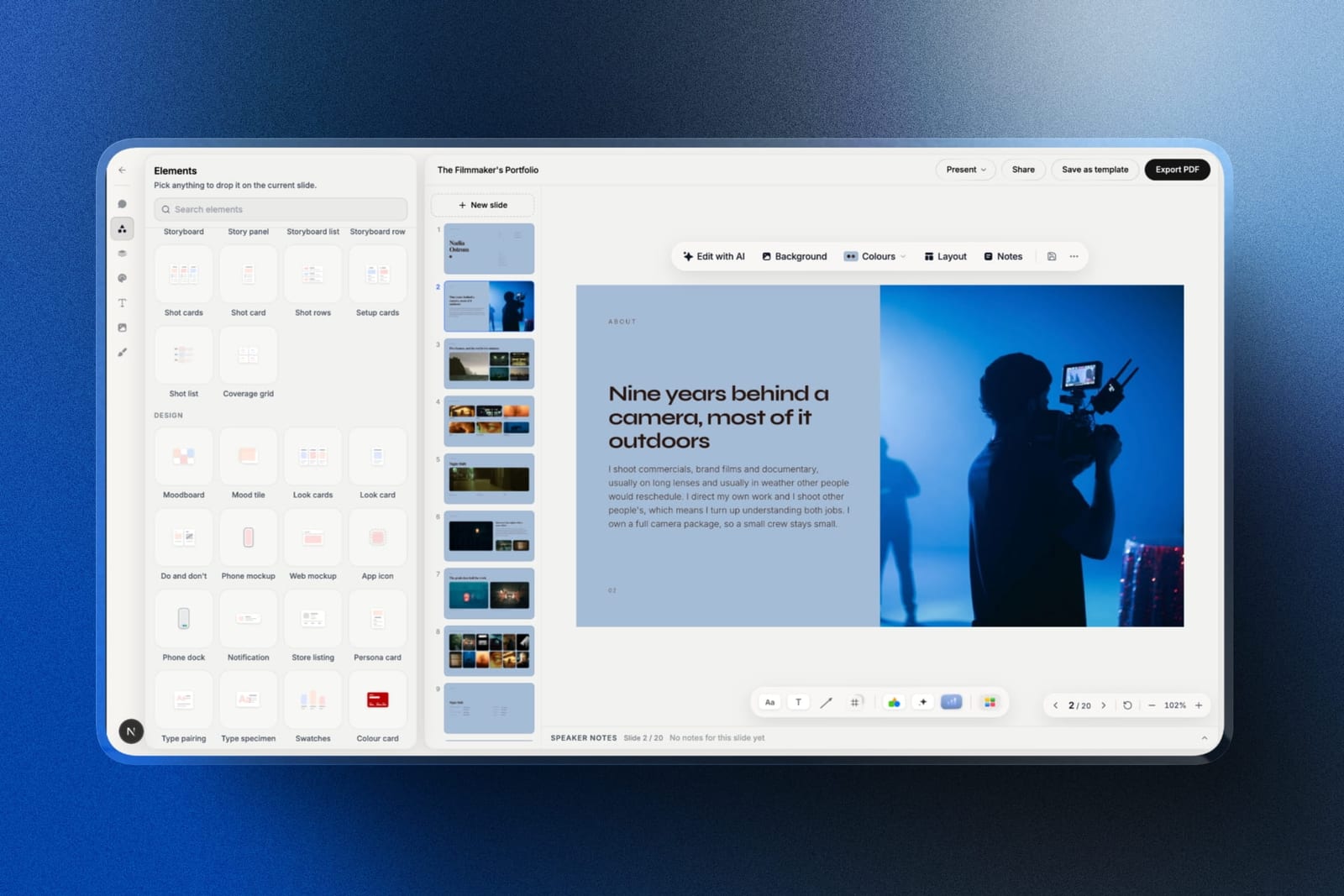
Framekit is an AI website builder, and its Slides editor handles the version of boarding most directors actually do on a pitch: assembling frames rather than drawing them.
It ships storyboard, story panel, storyboard row and storyboard list elements, plus shot cards, shot rows, a shot list, setup cards and a coverage grid, so a sequence of reference frames with camera notes and dialogue sits inside the same deck as the treatment and the budget.
You can describe the spot and attach up to 12 reference frames to the prompt, and the AI lays out panels with shot descriptions you then edit by hand.
What it cannot do is draw, time panels or play them back, which is why it ranks seventh: there is no animatic, and animatic output carries a quarter of this guide's score.
Best forDirectors and producers who board from reference frames for a pitch or treatment and want the board, the shot list and the rest of the deck in one document.
The real numberthe free plan covers unlimited decks, the AI writer, a share link and PDF export. Starter at $84 a year on annual billing, about $14 a job at six jobs, adds the template library, your own fonts and byline removal, which is $12 less than Boords Plus and buys no animatic.
The standout detailthe handoff to review. Once an animatic is cut in Boords or an editor, the same Framekit account runs video review, where a client leaves comments at the exact frame and you stack v2 and v3 without losing earlier notes, on every plan.
The gotchano drawing tools, no panel timings, no animatic, and no comments on the slides themselves, so the revision round happens by email or in video review. A deck also caps at 40 slides, which is fine for a 32-panel spot laid out several panels to a slide and tight for anything longer.
Skip it ifyou draw your own panels or the client needs to see pacing. Boords, Storyboard Pro and Storyboarder all do that and this does not.
Verdict: A strong way to put a frame-assembled board inside a pitch, and not a boarding tool for a timed job. Pair it with Boords for the animatic.
8. Canva: Best Presentable Boards Without Drawing
Our rating: 7.4/10
Canva is where a lot of agency boards are actually made, and dismissing that misses why: a producer with no drawing ability and no boarding software can assemble 32 frames from stills and reference images into something a client will look at, in an afternoon, for nothing.
What you do not get is anything boarding-specific. No timings, no animatic, no shot fields, and no sense of pacing, so it produces a document rather than a board.
Best forProducers and agency creatives making presentable reference-built boards with no specialist tool.
Key features:
- Free plan that completes a 32-panel document
- Templates that impose a clean, consistent panel grid
- Image import and arrangement anyone can manage
- Comments on the design for basic review
- Reliable PDF export for client circulation
The real numberthe free plan covers the job. Pro is $18 a month or $144 billed annually, about $12 a month, and nothing in a storyboard specifically requires it beyond brand fonts.
The gotchano timing means no animatic, and on any job where the question is whether the idea fits the runtime, that gap sends you back to an editor with your panels and a stopwatch.
Skip it ifpacing is part of what you are selling, which on commercials it usually is.
Verdict: Canva makes a document that looks like a storyboard rather than a storyboard. Good enough for internal alignment, weak for a client who needs to feel the timing. Visit Canva
9. Procreate: Best Hand-Drawn Panels on iPad
Our rating: 7.2/10
For artists who board by hand, Procreate on an iPad remains the most pleasant drawing experience available at any price, and at roughly $13 as a one-off purchase it costs less than a month of most tools here.
It is a drawing application, not a boarding tool. There is no panel structure, no shot metadata, no timing, and no animatic, so everything after the drawing happens somewhere else.
Best forStoryboard artists who draw every panel and will assemble the board in another tool.
Key features:
- Excellent drawing engine with full pressure and tilt support
- A one-off purchase rather than a subscription
- Works entirely offline on an iPad
- Layers and brushes an illustrator will actually want
- Exports panels in standard image formats
The real numberabout $13 as a single purchase, per Procreate's published price, which is the cheapest paid tool in this comparison by a wide margin and covers only the drawing half of the job.
The gotchayou will need a second tool for assembly, timing and review, so the real cost is Procreate plus Boords or Storyboarder rather than Procreate alone.
Skip it ifyou cannot draw, because there is no shortcut in this tool at all.
Verdict: Procreate is the best half of a storyboarding workflow and never the whole of one. Pair it with something that handles timing. Visit Procreate
10. Figma: Best Boards Beside Design Work
Our rating: 6.9/10
Figma appears here because a real number of agency boards are built in it, usually because the team already lives there and the alternative is asking for another subscription. The infinite canvas handles frames well, and comments make review workable.
It is a general design tool doing a specialist job. No timings, no animatic, no shot fields, and panels are frames you maintain by hand.
Best forAgency teams already working in Figma who want boards beside the rest of a campaign.
Key features:
- Infinite canvas with free frame arrangement
- Comment threads a client can use in a browser
- Components for repeated panel elements
- Free tier that covers a project
- Boards sit next to the campaign design work
The real numberFigma Professional is $16 per full seat a month on annual billing, $192 a year, per Figma's pricing page. The free tier handles a single board.
The gotchathere is no timing layer, so the board cannot answer the question a client most often asks about a commercial, which is whether it fits.
Skip it ifyou do not already pay for Figma, because nothing about it is better here than the dedicated tools.
Verdict: Figma is a convenience choice rather than a boarding choice, and a reasonable one if the alternative is a subscription nobody will approve. Visit Figma
11. StoryboardThat: Best Quick Non-Film Boards
Our rating: 6.3/10
StoryboardThat is built around drag-and-drop characters and scenes, which makes it fast for boards where the point is communicating a situation rather than a shot: training scenarios, UX flows, classroom work and pitch illustrations.
For film and commercial boarding it is the weakest tool here. The illustration style is fixed and cartoon-like, and no amount of arrangement makes it read as a camera plan.
Best forTraining, education and non-film storyboards where speed beats visual specificity.
Key features:
- Drag-and-drop characters, poses and scenes
- No drawing skill required at all
- Fast production of simple sequential scenes
- Templates aimed at education and business use
- Browser-based with published plans
The real numberStoryboardThat publishes tiered plans aimed at education and business use on its own site; check current rates there, because the pricing structure differs substantially from the film-oriented tools in this comparison.
The gotchathe fixed illustration style is not neutral. Presenting a commercial concept in cartoon characters changes how a client reads the idea, usually in the direction of taking it less seriously.
Skip it ifthe board is for a film, commercial, or anything where camera language matters.
Verdict: StoryboardThat is a good tool aimed at a different audience than this comparison's readers. Visit StoryboardThat
Where the Boards Go After You Draw Them
In one lineboarding tools are built for the approval round and mostly forget the six weeks afterwards, when a crew of fifteen needs the approved board in one findable place.
Once the board is signed off, the file starts moving. It gets emailed to the first AD, dropped into a production folder, printed for the shoot, and then someone on the day is working from a version that predates the last two changes.
Most tools above solve review well and few solve the shoot-day question of which version is current.
The practical fix is a single link the whole production points at, updated in place. StudioBinder does this inside its production workspace.
A shared deck link from Framekit, Canva or Pitch does it for the board alone, and Framekit keeps the same link when you edit, so the crew's bookmark always opens the current version.
What Storyboarding Actually Costs Per Job
In one linethe software is between $0 and about $42 per job for a director boarding six times a year, and the revision round costs more than any of it.
| Tool and plan | Annual cost | Cost per job at six a year | What it adds |
|---|---|---|---|
| Storyboarder or Canva free | $0 | $0 | Boards, no client comments |
| Framekit Starter | $84 | About $14 | Storyboard elements in a pitch deck, no animatic |
| Procreate | About $13 once | Negligible | Drawing only |
| Boords Plus | About $96 | About $16 | Animatic plus pinned comments |
| Milanote Pro | About $120 | About $20 | Reference assembly |
| Plot Solo | About $120 | About $20 | Collaborative frames |
| Toon Boom Storyboard Pro | About $252 | About $42 | Animation pipeline |
| StudioBinder | From about $348 | About $58 | The whole production chain |
Run this on yourself. Time your next revision round from the moment client feedback arrives to the moment the updated board goes back.
If it takes more than twenty minutes and the feedback came as an email listing panel numbers, the tool is costing you roughly six times the subscription in unbilled hours across a year of jobs.
How to Choose Storyboard Software: A Decision Tree
In one linework down in order and stop at your first yes, because that yes is the constraint that decides the tool more than any feature list.
1. Are you boarding animation into a production pipeline? Toon Boom Storyboard Pro at $252 a year. Nothing else here belongs in that conversation.
2. Can you draw, and do clients review your boards? Boords at $96 a year for the review and animatic, with panels drawn in Procreate if you want a better pen.
3. Can you not draw at all? Boords again, or Canva free if the client only needs to understand the situation rather than the pacing.
4. Does the board become a shot list, schedule and call sheet? StudioBinder, and treat the boarding as one part of the platform.
5. Do you board by assembling reference frames rather than drawing? Milanote for the assembly, or Framekit Slides if the board belongs inside a pitch or treatment deck, then Boords if a timed animatic is required.
6. Is your budget genuinely zero? Storyboarder, and expect the revision round to be the price.
7. Is the board a training or explainer sequence rather than a film? StoryboardThat, which is built for exactly that.
Studios using a whiteboard alongside their boards should compare the best Miro alternatives, where three of the twelve cost nothing at all.
Frequently Asked Questions
What is the best storyboard software in 2026?
The best storyboard software in 2026 is Boords, because it produces a timed animatic and collects client comments pinned to individual panels for $7.99 a month on annual billing, and it does not require drawing skill.
Toon Boom Storyboard Pro is the standard for animation at $252 a year, StudioBinder is better when the board feeds a whole production, and Storyboarder is genuinely free for anyone who can draw.
Is there free storyboard software?
Yes. Storyboarder is free and open source, with drawing tools, shot notes and animatic export and no tier above it, and Canva's free plan produces a presentable panel document with no boarding features.
The cost of both is the revision round: with no panel-level comments, client feedback arrives as an email listing panel numbers, which in our test took about six times longer to process than pinned comments did.
Do I need to be able to draw to storyboard?
No, and most people boarding commercials cannot.
Four of the tools we boarded in are genuinely usable without drawing ability, because they build panels from imported images, reference frames and stock elements: Boords, StudioBinder, Canva and Milanote, and Framekit Slides works the same way with dedicated storyboard elements.
Boards assembled from reference frames are standard practice on commercial work and read perfectly well to clients, provided the camera intent is written clearly on each panel.
What is an animatic and do I need one?
An animatic is your storyboard panels played back at their intended timings, usually with scratch audio, so a client watches the pacing rather than imagining it.
You need one on anything with a fixed runtime, which means commercials, music videos and most branded content, because the single most common note on a static board is a question about whether it fits.
Five of the eleven tools compared generate one directly from panel timings.
Boords vs StudioBinder: which should I choose?
Boords if you board and stop, StudioBinder if the board becomes a shot list, schedule and call sheet.
Boords is about $96 a year and better focused on boarding, review and animatics; StudioBinder starts around $348 a year and buys a whole production chain in which boarding is one step.
A freelance director boarding six jobs a year is usually better served by the cheaper, more focused tool.
How many panels does a commercial storyboard need?
Between about 20 and 40 panels for a 60-second spot, and the useful rule is one panel per distinct shot plus an extra for any move that changes the frame meaningfully. Our test board used 32 panels for 60 seconds.
Boarding every beat produces a board nobody reads; boarding too loosely produces an animatic that hides the timing problem you built it to find.
Can I storyboard in Canva or Figma?
Yes for the panels and no for the pacing. Both handle frame arrangement and basic review, and a great many agency boards are made in them because the team already pays for them.
Neither has timings, shot fields or animatic output, so on any job with a fixed runtime you will end up assembling the animatic in an editor by hand, which is usually more work than a $96-a-year boarding tool.
How do I share a storyboard with a client?
Send a link with panel-level comments rather than a PDF, because the revision round is where storyboarding time is lost.
In our test, feedback pinned to individual panels produced a ten-minute turnaround while feedback emailed as a list of panel numbers took about an hour.
If your tool has no comment system, at least number every panel clearly and send an animatic alongside the stills.
What happens to my boards if I stop paying for the tool?
Access to hosted boards usually ends with the subscription, which matters because an approved board is a production document you may need months later.
Export a PDF and an animatic of every approved board to your own storage the week it is signed off, whichever tool you use. Local tools like Storyboarder and Procreate avoid this problem entirely by keeping the files on your machine.
Is Toon Boom Storyboard Pro worth it for live action?
Rarely. At $252 a year it is the most expensive tool in this comparison, and its advantages are concentrated in animation: layered drawing, keyframed camera moves, and export into an animation pipeline.
A live-action director gets most of the practical benefit from Boords at roughly a third of the price, and the drawing tools only pay off if you are an illustrator boarding by hand.
Should storyboards be black and white or colour?
Black and white for sequence and staging, colour when the palette is part of the pitch.
Greyscale boards keep a client's attention on framing and blocking, which is what the board is arguing about, while colour boards invite notes on grading decisions that have not been made yet.
On commercial pitches where look is the selling point, a small number of key colour frames alongside a greyscale board works better than colouring everything.
Framekit vs Boords: which is better for storyboarding?
Boords is better for any job with a fixed runtime, because it times panels, builds an animatic and pins client comments to each frame for about $96 a year.
Framekit is an AI website builder whose Slides editor has storyboard, shot card and shot list elements, which suits a frame-assembled board inside a pitch deck at $0 or $84 a year, but it has no drawing tools, timings or animatic.
Final Verdict
Boords is the best storyboard software in 2026 for the people who do most of the boarding in this industry: directors, producers and agency creatives who need a client to understand the sequence and the pacing, and who are not illustrators.
At about $96 a year with a real animatic and pinned client comments, it costs less than the alternatives and removes the part of the job that actually consumes time.
Toon Boom Storyboard Pro remains correct for animation, StudioBinder is right when the board is the first link in a production chain, and Storyboarder is a genuinely capable free option whose cost shows up in revisions rather than in dollars.
Framekit ranks seventh: a good home for a frame-assembled board inside a pitch deck, with video review in the same account once the animatic exists.
Where Framekit losesFramekit is not for drawing panels, timing a sequence or building an animatic, and it does not take comments on slides. Boords, Toon Boom Storyboard Pro, Storyboarder and Plot are all the better fit for that core boarding work.
Keep reading: our best film treatment software comparison, the best mood board tools guide, and the best website builders for filmmakers.