Framekit templates
Start from a designer-made template
 Use template
 Use template
 Use template
 Use template
 Use template
 Use template
 Use template
 Use template
Every video review platform is designed around a 60-second commercial, and documentary breaks that design in two directions at once.
The cuts are long. A first assembly might be three hours, a rough cut ninety minutes, a fine cut still over an hour.
That is not a bigger version of a commercial, it is a different object, and it collides with limits most tools never advertise: duration ceilings, per-file size caps, and proxy encoders that quietly stop generating good playback past a certain length.
The projects are also long. A documentary can run three or four years from first assembly to delivery, with commissioning editors, funders and executive producers cycling in and out.
What a broadcaster asked for in year two matters in year four, which makes retention a feature rather than an afterthought, and one popular free tier deletes your review history after 60 days.
We re-verified Framekit's limits in September 2026 and moved it up two places after confirming that its reviewers can switch any cut to the original uploaded file rather than a downscaled proxy.
A video review tool for documentary filmmakers is a platform that can hold a feature-length cut, play it well enough to judge pacing, and keep the comment and version history intact across a production that outlasts most software subscriptions.
The best video review tool for documentary filmmakers in 2026 is Frame.io, because 2TB on Pro, version stacks and a comparison viewer handle feature-length cuts and multi-year version histories better than anything else here.
Vimeo is the strongest value at about 8 euros a month for 2TB if you also publish, and Kollaborate scales to 20TB on flat pricing for archive-heavy projects.
Framekit, ranked fifth, takes a feature cut only as a review export under 3GB and two hours, and cannot take a long assembly at all.
Full disclosure: Framekit is our own product and it ranks fifth of eight here, because a documentary cut is the shape of file it handles least comfortably: the per-file cap is 3GB even on Business and sources over two hours are rejected. Four tools above it hold an uncompressed feature-length cut without re-exporting, and we say where each one beats us.
How We Tested 8 Tools for Documentary Work
We used the shape of a real documentary edit rather than a commercial: a 94-minute rough cut at 4.8GB, a later 71-minute fine cut, five versions across the two, and reviewers who included a producer, an editor and a commissioning-editor stand-in who looked at the film roughly once a quarter.
August 2026, fresh accounts.
Then we tested the thing that only matters in this genre: we uploaded the 94-minute file and watched what each platform did with it. Some accepted it and generated good playback. Some accepted it and served a degraded proxy. One refused it.
Measured means we uploaded the cut and watched it back. Verified means the figure was read at the vendor's own published documentation or pricing page and linked inline.
The three limits that only bite long-form
Duration ceilings. Some platforms cap the length of a source file outright, and others cap the length at which they will generate each quality of proxy.
The second is more common and much less visible: your file uploads, and then plays back worse than you expected because the encoder skipped a rung.
Per-file size. A 94-minute cut is measured in gigabytes, not megabytes. Tools sized for compressed review exports have per-file caps well below what a feature-length file needs, even when their total storage looks generous.
Retention across years. A documentary outlives most subscriptions.
If your review history is deleted after 60 days, or vanishes when a project is removed to free a slot, you lose the record of what a funder approved two years ago at the exact moment someone disputes it.
What Long-Form Review Actually Costs
Every figure below was read at the vendor's own published pricing or documentation page in August 2026 and tested against the same 94-minute, 4.8GB rough cut.
- 1 of 8 tools cannot take our 4.8GB file as exported: Framekit, which caps individual files at 3GB even on Business and rejects sources over two hours. A lighter 1080p H.264 export of the same 94 minutes fits under that cap.
- The most storage available on a flat account price is Kollaborate at 20TB, which suits a multi-year project that never deletes anything.
- Frame.io Pro includes 2TB plus 2TB per additional member at 15 dollars per member, which held all five versions of both cuts comfortably.
- Vimeo Starter is 2TB for about 8 euros a month with one user, the cheapest large-storage option in this comparison by a wide margin.
- Ziflow's free tier retains review history for 60 days, which is disqualifying for a genre where a four-year project is normal. It is not ranked here for that reason.
- ReviewStudio's 25GB per user on Pro holds roughly five feature-length cuts, which is the tightest ceiling among the tools that accept the file at all.
- 3 of 8 offer version stacks or a comparison viewer, which is how you answer "is this cut better than the last one" across a long edit.
| Tool | Holds a 94-minute cut | Storage | Version compare | Cost, 1 year |
|---|---|---|---|---|
| Frame.io | Yes | 2TB on Pro | Version stacks and comparison viewer | 180 dollars |
| Vimeo | Yes | 2TB on Starter | Versions | About 96 euros |
| Krock.io | Yes | From 2TB on Pro | Compare | 120 dollars |
| Kollaborate | Yes | 30GB to 20TB, flat | Basic | 84 dollars and up |
| Framekit | Only as an export under 3GB, 2-hour limit | 750GB of video on Business | Version stacks | 468 dollars on Business |
| Wipster | Yes | 50GB on Light | Side-by-side compare | 119.40 dollars |
| Dropbox Replay | Yes | Follows Dropbox plan | Versions | From 120 dollars plus storage |
| ReviewStudio | Yes, but tight | 25GB per user on Pro | Compare mode | 144 dollars |
Jump to the decision tree if you already know your cut length.
The Best Video Review Tools for Documentary Filmmakers in 2026
Ranked on whether each tool can actually hold and play a feature-length cut, and keep its history for years, since those are the two requirements documentary has that no other genre shares. The first four get full reviews.
1. Frame.io: Best for Feature-Length Cuts
Frame.io is the only tool in this comparison that felt designed by people who had watched a long cut back. Our 94-minute file uploaded without complaint, played cleanly, and the tools around it are the ones a documentary edit actually uses.
The real numberPro is 15 dollars per member per month with 2TB included plus 2TB per additional member, so 180 dollars a year for one editor. All five versions of both cuts, roughly 21GB, occupied about 1% of the allowance.
The standout detailversion stacks and the comparison viewer together are the feature that matters most in long-form and gets the least attention.
Documentary editing is iterative over years, and the question "is this actually better than the version we had in March" is the hardest one to answer from memory.
Being able to stack five cuts of the same film and compare them directly is worth more here than annotation.
The gotcharange-based comments become genuinely important at this length and are easy to overlook when evaluating.
On a 94-minute cut, a note anchored to a single frame is often the wrong unit; the observation is usually "this ten-minute stretch drags". Frame.io supports ranges and most tools here do not.
Skip it ifyou are a one-person production with no funding yet. 180 dollars a year is real money against a self-funded doc, and Vimeo does the core job for roughly half.
Verdict: the right tool for a funded documentary, and the only one here whose feature set maps cleanly onto a multi-year, multi-version edit.
2. Vimeo: Best Value for Long-Form
For a documentary, Vimeo's economics are unusually favourable, because the thing docs need most is room and Vimeo sells room cheaply. Starter is about 8 euros a month billed annually with 1 user and 2TB, with review and collaboration tools included.
The real numberabout 96 euros a year for the same 2TB that Frame.io charges 180 dollars for. For a self-funded documentary, that difference is a shooting day.
The standout detailthe file the funder reviews can become the film you publish, without a second upload. Documentaries end up on festival platforms, funder microsites and eventually somewhere public, and Vimeo is the only tool here that carries a cut from review through to distribution.
The gotchathe review layer is shallow and does not deepen at any tier. There are no version stacks in the Frame.io sense, no comparison viewer, and drawing on the frame is not confirmed anywhere in Vimeo's published material.
Paying more buys livestreaming and lead capture, not better review.
Verdict: the best value in this comparison for long-form, and the right answer for an unfunded or self-funded documentary. Choose it knowing the review tooling is basic.
3. Krock.io: Storage With Real Review
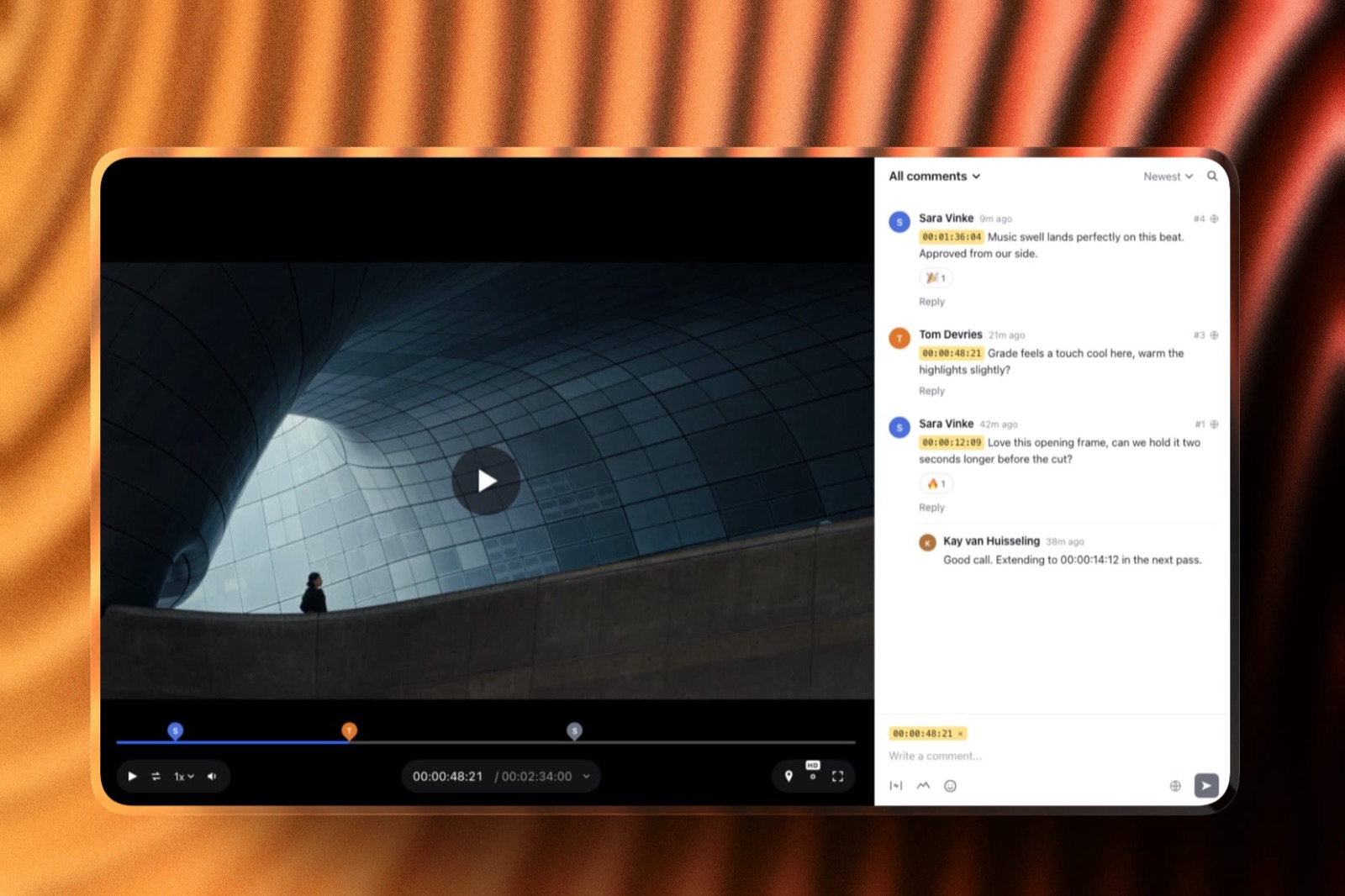
Pro is 10 dollars per user per month with unlimited team size and from 2TB, extra terabytes at 10 dollars, unlimited reviewers on every plan including free, 4K playback named explicitly, and review across video, image, audio and PDF.
The real number120 dollars a year for 2TB with drawing and unlimited reviewers, which sits between Vimeo's price and Frame.io's capability.
The standout detailunlimited reviewers on every plan suits documentary's scattered stakeholder pattern, where a funder, a commissioning editor, an archive producer and a legal reviewer each look at the film once or twice a year and none of them justifies a seat.
The gotchathe free tier is one user on 2GB, and above Pro the next step is an Enterprise plan from 400 dollars with 100 users included, so there is no middle ground for a growing production company.
Verdict: the balanced choice, with more review depth than Vimeo and more headroom than most, at a price a documentary budget can absorb.
4. Kollaborate: Best for Archive-Heavy Projects
Twelve published tiers from 7 dollars a month for 30GB up to 539 dollars for 10TB, flat per account rather than per seat, with unlimited projects and unlimited bandwidth on every tier.
The standout detailflat pricing with a granular storage ladder is the right shape for a project that accumulates for years.
You move up a tier when the archive grows rather than when the crew does, which is exactly how documentary costs actually behave, and unlimited bandwidth means a funder rewatching a 94-minute cut repeatedly costs nothing.
The gotchathe interface shows its age, which matters when the person opening the link is a commissioning editor at a broadcaster forming an impression of your production.
Verdict: the most sensible cost curve here for a long project, with the weakest presentation.
5. Framekit: Best for Review Exports and the Film's Public Face

Framekit is an AI website builder with video review built in, and for documentary it is useful in a narrower way than the four tools above: it reviews a feature cut well once that cut is a review export, and it cannot hold the assembly or the master.
The limits are exact. Sources over two hours are rejected, so a three-hour first assembly cannot go up at all.
One file can be 500MB on free, 1GB on Starter, 2GB on Pro and 3GB on Business, so a 94-minute rough cut has to be exported at roughly 4 megabits per second in 1080p H.264 to fit, which is fine for judging pacing and not for judging grain.
Business at 39 dollars a month allows 750GB of video inside a 2TB pool, enough to keep every version of several films.
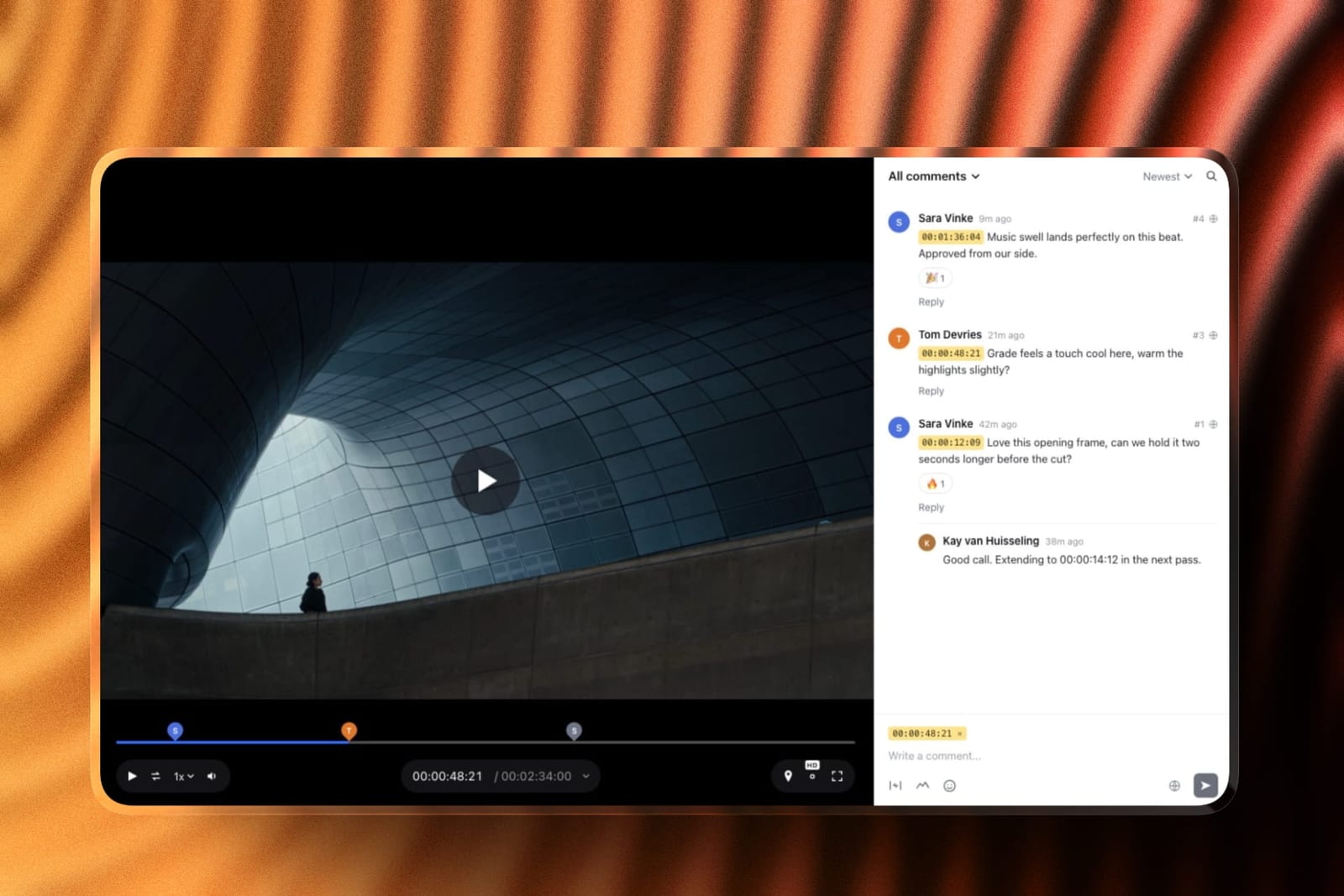
The standout detailthe original is one click away. The player's quality menu includes the uploaded file itself, so a funder watching an H.264 export can see exactly what you exported rather than a proxy, at any length up to two hours.
And comments can cover an in-and-out range, the "this ten-minute stretch drags" note this genre runs on, which the Frame.io entry above rightly calls the important one.
The honest gotchathe default is a proxy, and the ladder makes 1080p only up to 25 minutes and 720p up to 55, so a 94-minute cut opens at 360p until the reviewer picks Original. Tell funders to do that, or their pacing notes will be about a soft copy.
There is no side-by-side comparison viewer, only switching between stacked versions.
Skip it ifyour reviewers watch assemblies over two hours, or they judge the image rather than the edit.
Verdict: a strong reviewer experience for feature cuts that are exported for review, with free guest access for funders and the film's site, trailer and press kit on the same account. The four tools above hold the heavy files; this one presents the film.
6. Wipster: Good Compare, Small Storage
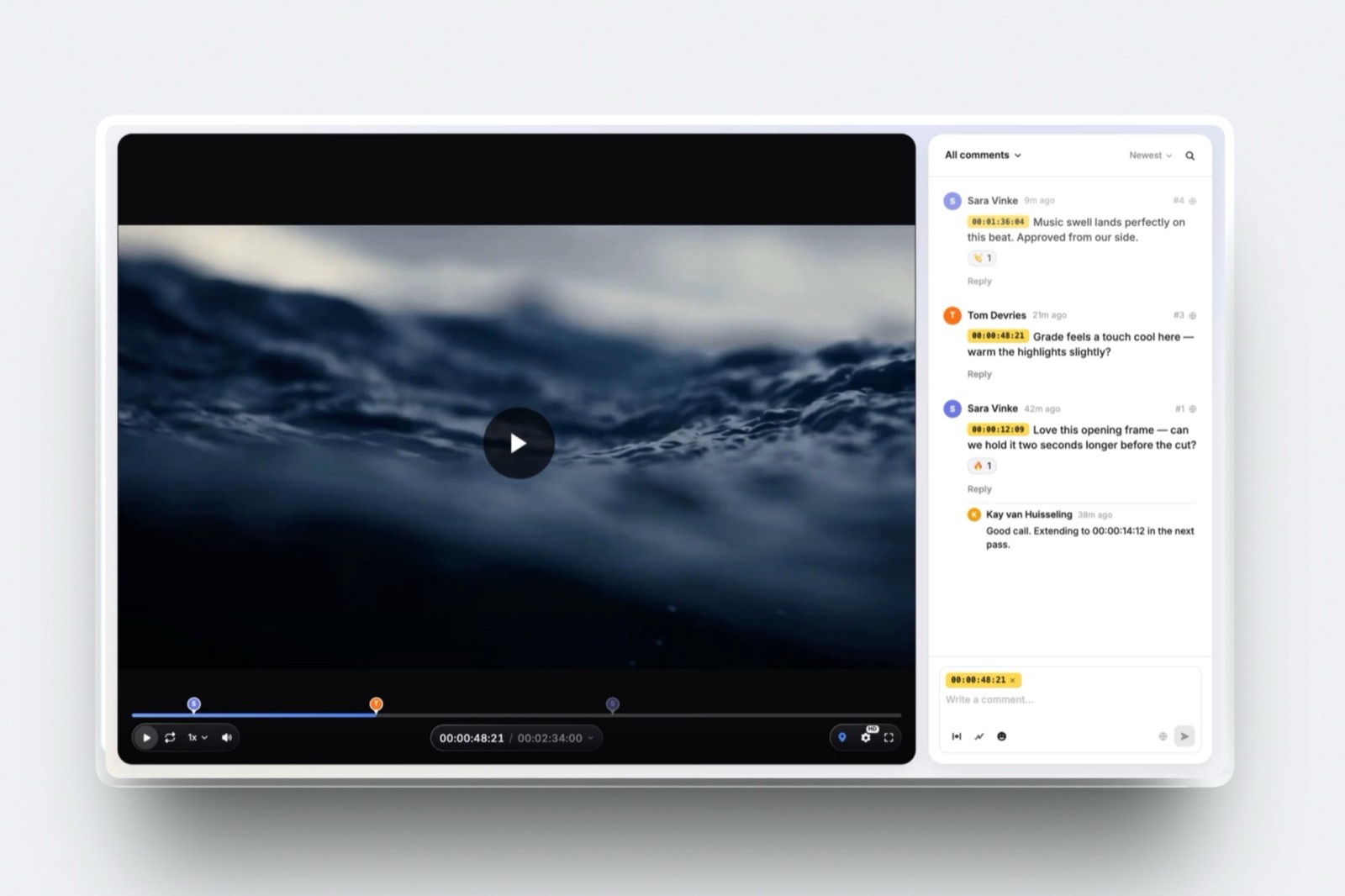
Light is 9.95 dollars a month with 50GB for one person, with annotation, Premiere Pro and After Effects extensions, side-by-side version comparison and comments that become checkable tasks.
Verdict: the compare mode and task list suit a long edit well, and 50GB does not. Ten feature-length cuts will fill it, which on a four-year project is a constraint rather than a comfort.
7. Dropbox Replay: Fine Storage, Wrong Entitlement
Dropbox holds long files without complaint and Replay adds frame-accurate comments, drawing and live shared-cursor sessions with no account needed for reviewers.
The gotchathe Replay entitlement bundled into paid Dropbox plans is four file uploads in total. A documentary with five versions of two cuts exceeds that before the first year ends, so the add-on from 10 dollars a month is not optional here, it is the actual price.
Verdict: good if Dropbox is already your archive, which for documentary it often is. Budget the add-on from the start.
8. ReviewStudio: Generous Seats, Tight Storage
Unlimited users and unlimited guests on a free 5GB tier, with compare mode, present mode, versioning and approvals; Pro is 12 dollars per user annually with 25GB per user.
Verdict: the seat generosity is ideal for documentary's scattered reviewers and the storage is not. 25GB per user holds about five feature-length cuts, and the free 5GB holds one. Ranked last for this genre on storage alone.
Why Duration Ceilings Are the Hidden Limit
In one linemost platforms will accept a long file and then quietly serve you a worse proxy, which is harder to detect than an outright rejection and more damaging to a pacing judgement.
An outright refusal is annoying and honest. You know immediately, and you find another tool.
The failure mode that actually costs documentary editors is subtler: the file uploads, the reviewer watches it, and the playback is softer than it should be because the encoder skipped a quality rung it could not finish in time.
Framekit's ladder makes a useful illustration because, as our own product, we can state it exactly: 1080p proxies are made up to 25 minutes, 720p up to 55 and 360p up to 120, with the hover-scrub preview skipped past 60 minutes.
Past 55 minutes the default stream is 360p, and the way round it is the Original option in the player, which plays the uploaded file itself when the browser can decode it.
Most vendors do not publish equivalent numbers at all, which means the only way to know is to upload a long file and watch it.
That matters because pacing is the thing documentary reviewers are judging. A funder watching a soft 360p stream of a 94-minute cut is not evaluating your film, they are evaluating a bad copy of it, and their notes will reflect that.
The test you can runupload your longest cut to any tool you are considering, then watch ten minutes from the middle at full screen. If it looks worse than your export, the encoder skipped a rung and no feature list will have told you.
Retention Across a Four-Year Project
In one linedocumentary is the only genre where the review platform is likely to outlive several of its own subscription cycles, so the question of what happens to your history is a real risk rather than a hypothetical.
Three failure modes recur. Time-based deletion: Ziflow's free Personal tier retains review history for 60 days, which is why it is not ranked in this comparison at all despite being a capable platform. Slot-based deletion: on tools that cap projects, freeing a slot deletes the project's comment and approval history with it, so a filmmaker juggling several films loses records to make room. Subscription-based deletion: on every tool here, access follows payment, and a documentary that pauses for a year between funding rounds is a documentary whose review history may lapse.
The practical defence is unglamorous. Export the comment history at each milestone, not at the end.
Frame.io lets you download and print comments with annotation thumbnails on every tier including free, and SyncSketch produces a PDF session summary.
Those exports are the only artifacts that reliably survive a four-year project, and they cost nothing to make while the subscription is live.
The test you can runask what you could produce today if a funder disputed a note from eighteen months ago. If the answer depends on a subscription still being active, export something.
Which Tool Fits a Documentary Edit? A Decision Tree
Work through these in order and stop at the first yes. The first question eliminates more of this page than all the others combined.
- Is your cut longer than two hours? Frame.io, Vimeo, Krock.io, Kollaborate or Dropbox. Framekit will refuse it.
- Is your file larger than 3GB? Same list. Only the tools with terabyte storage handle feature-length comfortably.
- Is the project self-funded? Vimeo Starter at about 8 euros a month for 2TB, which is roughly half of everything comparable.
- Do you need to compare two cuts side by side? Frame.io for version stacks and the comparison viewer, or Wipster for side-by-side compare at a lower price.
- Will the archive grow for years? Kollaborate, whose flat ladder runs to 20TB and charges by storage rather than by crew.
- Do funders and commissioning editors review occasionally? Krock.io or ReviewStudio, both of which give unlimited reviewers without seats.
- Will the film be published from your own account afterwards? Vimeo, where the reviewed file becomes the public one.
- Do you want the cut, the trailer and the film's site in one account? Framekit on Business, provided your review export stays under 3GB and two hours. Our filmmaker website builders guide covers that half.
Frequently Asked Questions
What is the best video review tool for documentary filmmakers in 2026?
Frame.io is the best video review tool for documentary filmmakers in 2026, because 2TB on Pro at 15 dollars per member, version stacks and a comparison viewer handle feature-length cuts and multi-year version histories better than anything else in this comparison.
Vimeo at about 8 euros a month for 2TB is the best value for self-funded work, and Kollaborate scales to 20TB on flat pricing for archive-heavy projects.
Can I upload a 90-minute rough cut for review?
On six of the eight tools here, yes, as exported. Frame.io, Vimeo, Krock.io, Kollaborate, Wipster and Dropbox Replay all accepted our 94-minute, 4.8GB cut.
Framekit caps individual files at 3GB on Business and rejects sources over two hours, so the same cut fits only as a lighter 1080p H.264 export, which reviewers can then watch as the original file.
ReviewStudio accepted it but its 25GB per user on Pro holds only about five such files.
What is the maximum video length for review platforms?
It varies and most vendors do not publish a figure, which is the underlying problem.
Framekit sets an explicit two-hour source limit and a proxy ladder generating 1080p only up to 25 minutes, 720p up to 55 and 360p up to 120, with an Original option in the player for watching the uploaded file itself.
Most other platforms limit total storage and per-file size rather than duration, so the practical ceiling is your file size rather than your runtime.
Why does my long cut play back badly even though it uploaded?
Because the platform's encoder skipped a quality rung it could not finish in the time allowed, and served a lower-resolution proxy instead. This is far more common than an outright rejection and much harder to notice.
The only reliable check is to upload your longest cut and watch ten minutes from the middle at full screen; if it looks softer than your export, you are watching a degraded proxy.
How do I keep review history across a multi-year documentary?
Export at milestones rather than at the end, because access follows your subscription on every tool here. Frame.io lets you download and print comments with annotation thumbnails on every tier including free.
Avoid free tiers with time-based deletion, notably Ziflow's Personal plan which retains review history for 60 days, and avoid project-capped tiers where deleting a project to free a slot also deletes its approval record.
Which tool is cheapest for a self-funded documentary?
Vimeo Starter at about 8 euros a month billed annually, which gives 2TB and one user with review and collaboration tools included, roughly half the cost of Frame.io Pro for the same storage.
Kollaborate Basic at 7 dollars a month is cheaper still but only 30GB, which will not hold many feature-length cuts. Both are flat rather than per-seat.
Can funders and commissioning editors review without accounts?
Yes on every tool in this comparison, and it matters more in documentary than most genres because stakeholders check in quarterly rather than daily.
Krock.io advertises unlimited reviewers on every plan including free, ReviewStudio gives unlimited users and unlimited guests on its free tier, and Frame.io, Wipster and Dropbox Replay all support external reviewers by link without buying seats.
Framekit vs Frame.io for documentary: which should I use?
Frame.io for the heavy files, Framekit for presenting review exports. Frame.io Pro at 15 dollars per member holds feature-length cuts of any size in 2TB and adds a comparison viewer.
Framekit rejects sources over two hours and caps one file at 3GB on Business, so a 94-minute cut must be a lighter H.264 export, which reviewers can watch as the original file, with range comments, versions and free guest access, alongside the film's site.
How much storage does a documentary edit actually need?
Budget for every version you will not delete.
Our test project, five versions across a 94-minute rough cut and a 71-minute fine cut, was roughly 21GB, and a real four-year documentary with assemblies, rough cuts, fine cuts and picture lock across several years will comfortably exceed 200GB.
That rules out 5GB and 50GB tiers and makes the 2TB options, Frame.io, Vimeo and Krock.io, the realistic shortlist.
Are range-based comments important for long-form?
Yes, more than for any other genre. On a 94-minute cut the useful note is usually "this ten-minute stretch drags" rather than a remark about one frame, and a comment anchored to a single instant misrepresents it.
Frame.io supports range-based comments spanning several seconds, Framekit lets a comment cover an in-and-out range, and Dropbox Replay allows commenting on a range; most other tools in this comparison anchor to a single point.
What happens if my documentary pauses between funding rounds?
Your review history remains only while the subscription does, on every tool here. A film that pauses for a year is a film whose comment and approval records may lapse in the interim.
Either keep the cheapest tier active through the pause, which on Vimeo or Kollaborate is under 100 dollars a year, or export the comment history before you cancel and treat those exports as the record.
Should I review the whole cut or sections?
Both, and the tool choice differs. Section review works on almost anything, since a twenty-minute extract is a manageable file everywhere.
Whole-cut review is what actually surfaces pacing problems and it is what breaks the platforms, so if your reviewers watch the full film, choose from the terabyte-storage tools and verify playback quality before you send the first link.
Final Verdict
Frame.io is the best video review tool for documentary filmmakers in 2026 because it is the only platform here whose feature set maps onto how documentary is actually edited: feature-length files it accepts without complaint, version stacks and a comparison viewer for answering whether this cut beats the last one, and range-based comments for the notes that cover ten minutes rather than one frame.
Vimeo is the honest recommendation for self-funded work at about half the price for the same 2TB, and Kollaborate has the most sensible cost curve for a project that accumulates footage for years.
Where Framekit loses, and who should not use it for the film. Framekit rejects sources over two hours and caps files at 3GB even on Business, so an assembly cannot be uploaded and a feature cut must be re-exported to fit.
Long cuts open on a 360p proxy past 55 minutes unless the reviewer switches to the original, and there is no side-by-side comparison viewer.
If your reviewers judge the image, or watch three-hour assemblies, Frame.io, Vimeo, Krock.io or Kollaborate is the better fit, which is why Framekit ranks fifth.
Before you commit to anything, upload your longest cut and watch ten minutes of it. That single test tells you more than every feature comparison on this page, including this one.
Related readingthe 12 best video review tools, post-production collaboration tools, website builders for documentary filmmakers, and video review tools for freelance editors.
Prices and limits were read at each vendor's published pricing or documentation page in August 2026, Framekit's were confirmed in September 2026, and the others were tested against the same 94-minute, 4.8GB rough cut, since duration and file-size behaviour is the axis this genre is judged on and it is rarely documented.