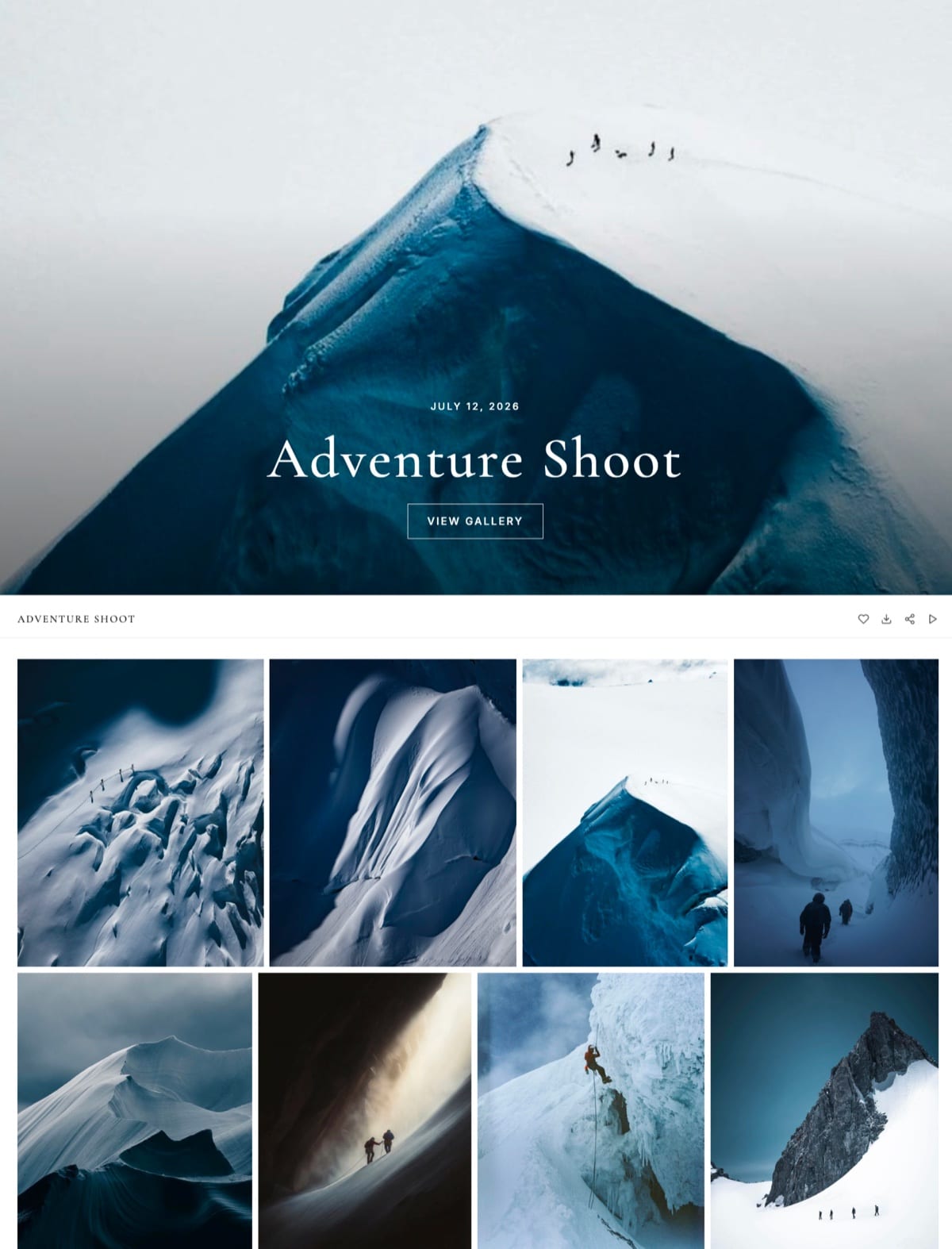
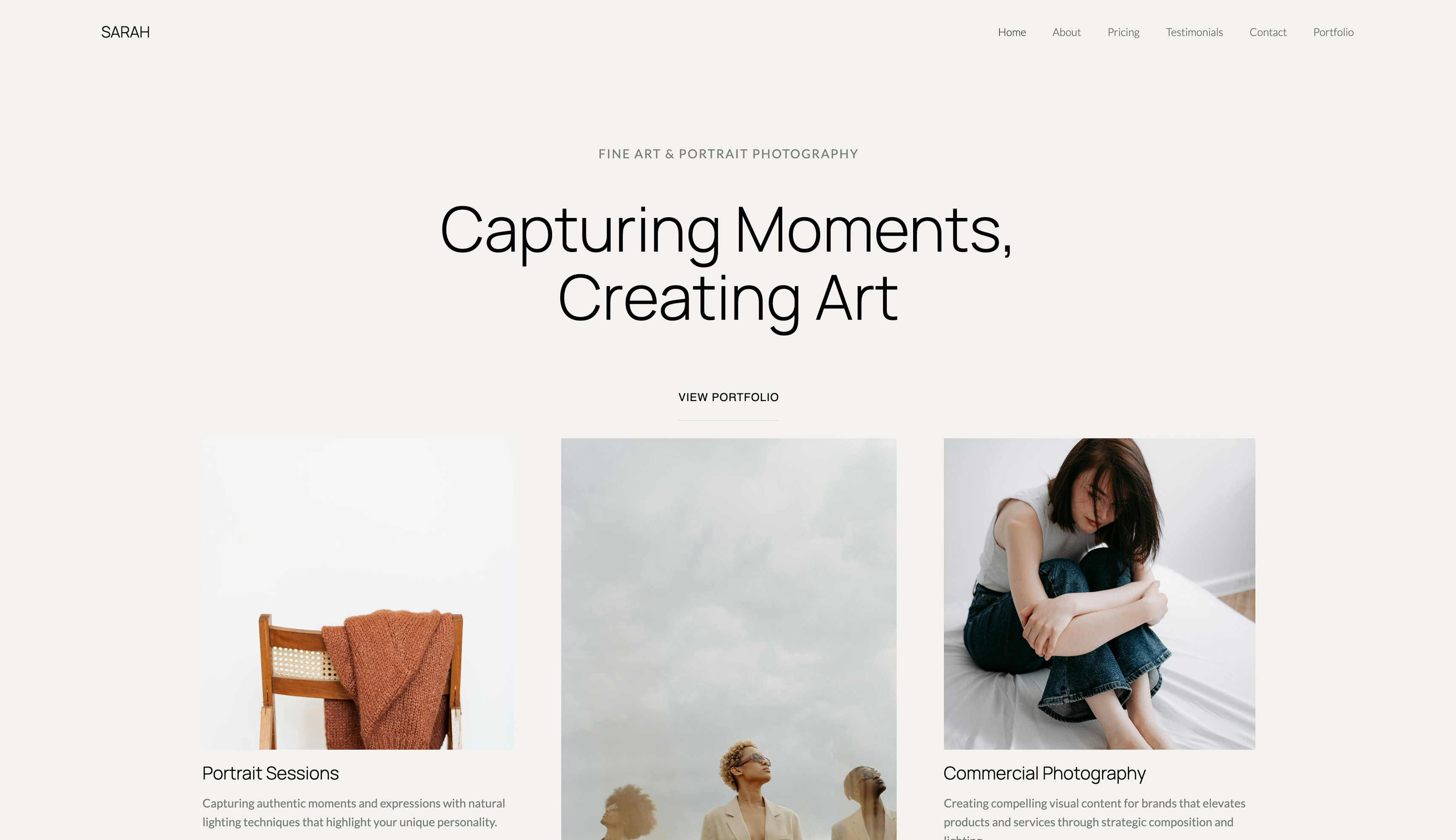
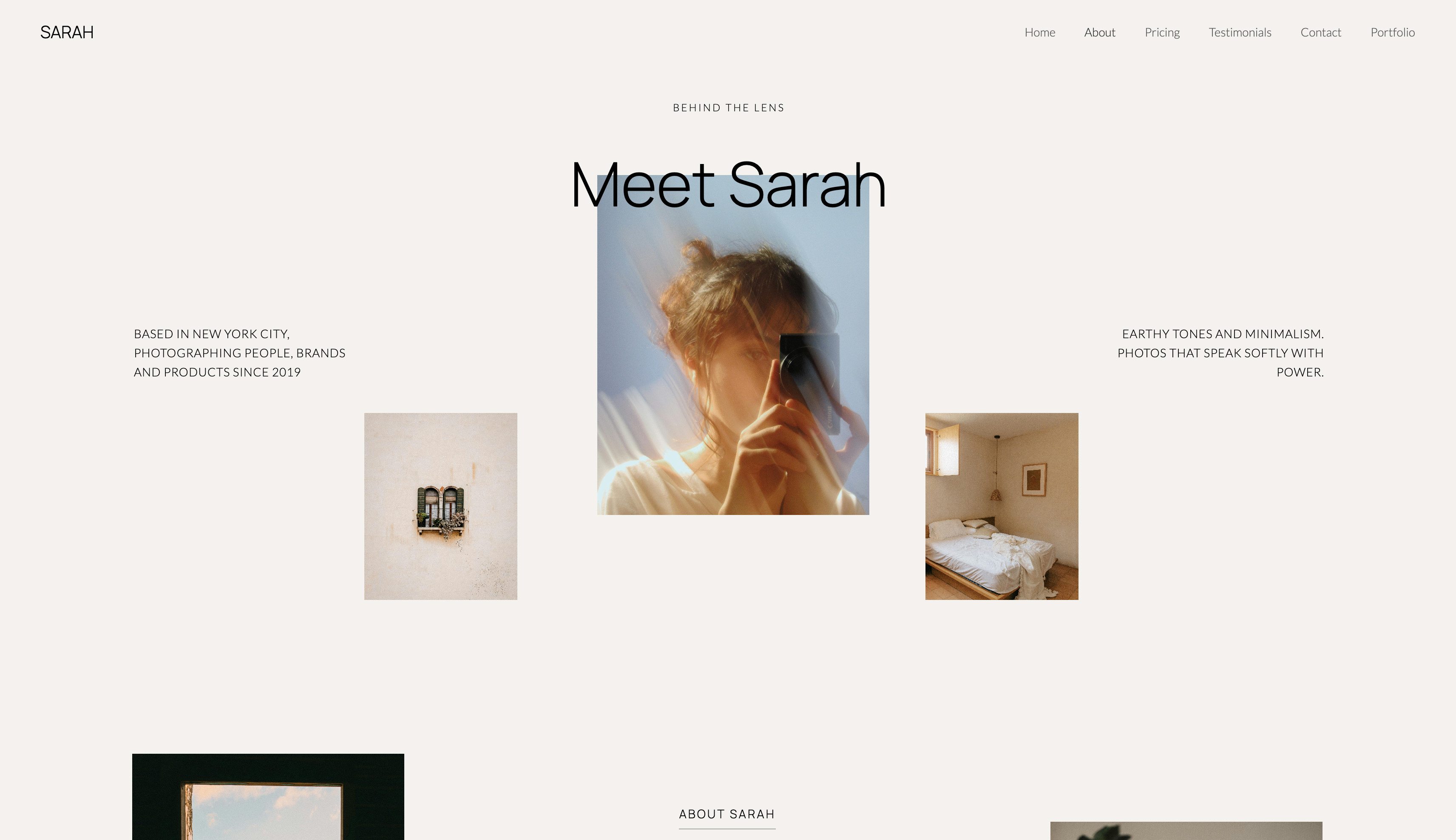
Framekit templates
Start from a designer-made template
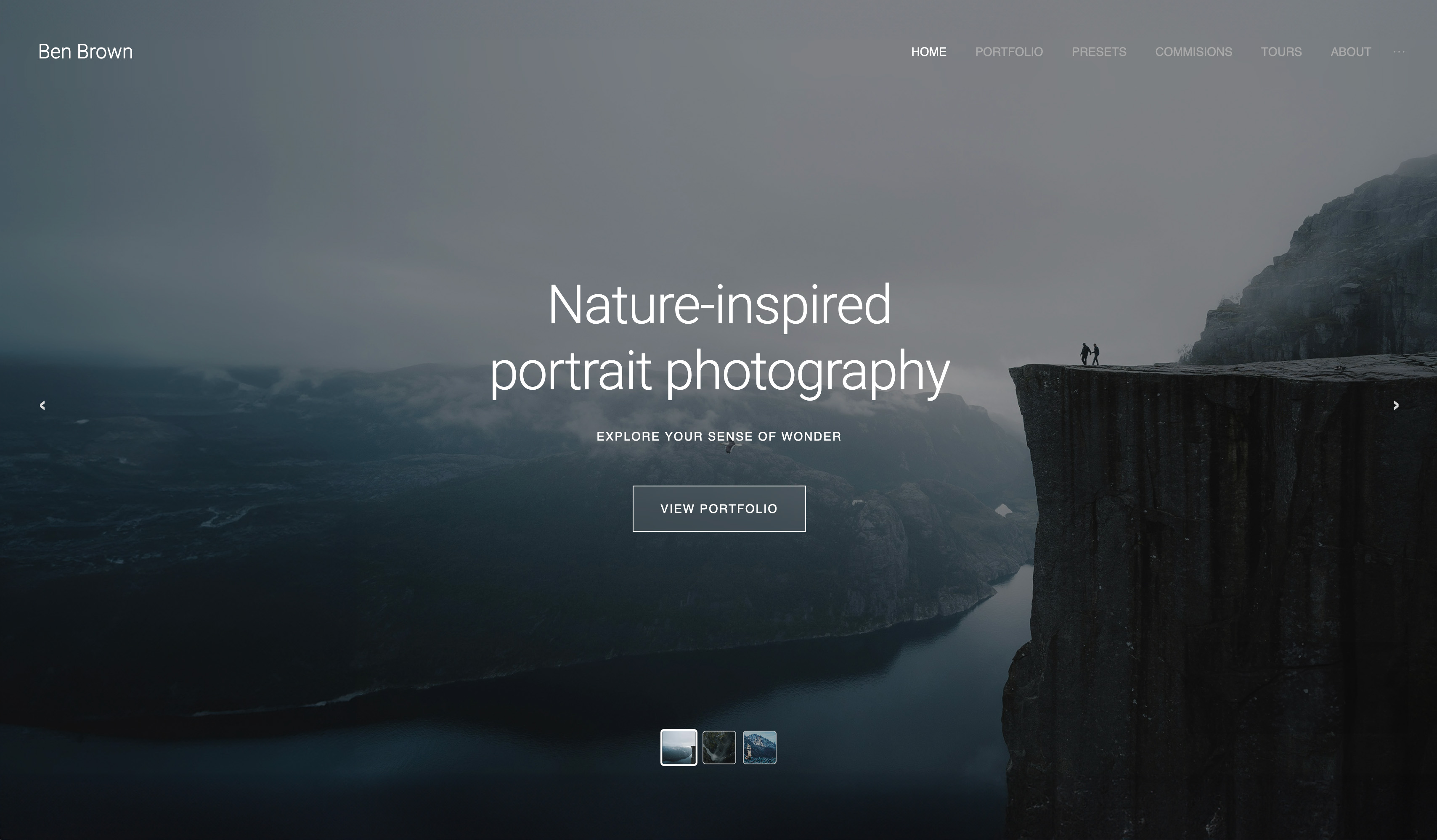 Use template
 Use template
 Use template
 Use template
 Use template
 Use template
 Use template
 Use template
Every other photographer's website exists to win clients.
A concert photographer's website exists to win a photo pass, and that is a different job with a different audience: a tour publicist with two hundred requests in their inbox, checking your link on a phone, deciding in about fifteen seconds whether you are credible enough for the first three songs.
That reframes the whole comparison. Print sales barely matter. Store fees barely matter.
What matters is whether your most recent work is visible immediately, whether the artists and publications you have shot for are named where a publicist can see them, and whether you can put fifteen selects in front of an editor before their deadline the same night.
A website builder is a hosted tool that turns your portfolio, your gallery delivery and your credentials into a site on your own domain without writing code.
For concert photographers the right measure is what it costs per show across a working year, and whether it slows you down at one in the morning.
For concert photographers in 2026 Framekit is the best website builder, because unlimited client galleries come on every plan including the free one, which suits a photographer delivering sixty small galleries a year rather than a few large ones.
At $9 a month on Starter that works out at about $1.80 per show for the site and the delivery together.
Pixieset Basic is cheaper for delivery alone at about $1.60 a show, and Format at $10 a month is the tidiest portfolio if you deliver by other means.
The limitation is that Framekit has no print lab, so selling prints of a famous frame means fulfilling it yourself.
How This Ranking Was Weighted
The criteria were applied in a deliberate order, and music photography weights them differently from general portfolio work.
How quickly a set can be delivered to a publicist or label carries the most weight, because the value of a live shot decays within days. Then how the portfolio presents low-light work, then cost, then print revenue.
Under the opposite weighting, where selling prints of a famous frame is the business, SmugMug wins and Framekit does not place, since there is no print store here at any tier.
Disclosure: Framekit is our product and we rank it first. We built the same eleven sites with the same portfolio, the same 15-image delivery and the same credentials page, we link to every competitor, and we say where each beats us. Pixieset beats us on delivery cost alone, SmugMug beats us on print fulfilment, and Cargo beats us on making a site look like it belongs to someone with taste.
How We Tested Eleven Builders
Each site got identical contents: a 30-image portfolio across six artists, a credentials page listing publications and venues, a 15-image delivery gallery standing in for a same-night filing, and a contact route.
We built and reviewed every one on a phone as well as a desktop, because that is where the person granting your pass will open it.
We separate three kinds of finding. Things built and observed were done inside the product.
Things read at source are prices and limits taken from vendor pages or shipped plan configurations in August 2026, cited where the figure matters.
Things attributed to photographers' reports are marked in the sentence, since a widely repeated experience shows a pattern exists without measuring it.
Conditions: fresh accounts, USD where offered, annual rates as each vendor presents them, no publication or press discounts. Where a delivery feature needed a paid tier we configured and previewed it rather than completing a transaction, and the entry says so.
We publish no star ratings. G2, Capterra and Trustpilot all refuse automated requests, so rather than reprint scores we could not open, this guide quotes none at all.
By the numbers11 builders built out. 60 shows a year, 15 selects each, about 7.2GB of delivered files annually. $1.60 to $3.80 is the range this works out at per show. 4 of 11 include client delivery without a second subscription. 2 of 11 are usable one-handed on a phone in a dark room, which is where you will edit the site.
The Comparison Table
The rubric follows the job: gallery delivery and turnaround 30%, how the site reads to a publicist on a phone 25%, portfolio presentation 20%, cost per show 15%, selling 10%.
Delivery leads because filing selects the same night is the recurring work.
Selling is weighted lowest deliberately, because in this field it is a bonus rather than the business, and guides that lead with print commission are describing a different profession.
| Builder | Best for | Galleries included | Gallery count limit | Cost per show at 60 shows | Our rating |
|---|---|---|---|---|---|
| Framekit | Site and same-night delivery together | Yes, every plan | Unlimited on every plan | $1.80 on Starter | 9.0/10 |
| Pixieset | Cheapest delivery on its own | Yes | Limited on free tier | $1.60 for delivery only | 8.6/10 |
| Format | Tidiest portfolio with proofing | Yes | Plan-based | $2.00 | 8.4/10 |
| SmugMug | Selling prints of famous frames | Yes | Generous | $4.70 | 8.0/10 |
| Squarespace | A site with invoicing attached | No | Not applicable | $3.80 site only | 7.5/10 |
| Cargo | Looking like you belong on the bill | No | Not applicable | Plan-based | 7.4/10 |
| Webflow | A designed archive you control | No | Not applicable | $3.00 site only | 7.2/10 |
| Pixpa | Cheapest way to have both | Limited | Plan-based | $1.44 | 7.0/10 |
| Wix | Broad needs, one subscription | Limited | Not applicable | $3.40 site only | 6.7/10 |
| Adobe Portfolio | Already paying Adobe | No | Not applicable | $4.00, already spent | 6.5/10 |
| Carrd | A link with a portfolio behind it | No | Not applicable | $0.32 | 6.0/10 |
Framekit is not the cheapest row on that table and does not pretend to be. Pixpa and Carrd are both cheaper, and Pixieset is cheaper for delivery considered on its own.
1. Framekit: Best Overall for Concert Photographers

Framekit is an AI website builder for photographers, filmmakers and designers that generates a site from a description or a reference image and lets you deliver and sell from your own domain.
The reason it suits this profession specifically is a detail most comparisons skip: galleries are unlimited in count on every plan, including the free one.
That matters because a concert photographer's delivery pattern is the opposite of a wedding photographer's.
You are not sending three enormous galleries a year, you are sending sixty small ones, and platforms that meter active galleries rather than storage punish exactly that shape. Framekit meters only storage.
The real numberat 15 selects per show and roughly 8MB each, sixty shows is about 7.2GB a year.
That fits the 10GB free plan for a first year and sits well inside the 50GB on the $9 Starter plan, which is $108 a year, or about $1.80 per show for the website and the delivery together.
Storage is one pool covering the site, the galleries and video review: 10GB on the free plan, 50GB on Starter, 300GB on Pro at $19 and 2TB on Business at $39.
The standout detailevery gallery feature is on every plan.
Watermarking, password and PIN protection, favourites, downloads and email sharing do not move as you pay more, so a photographer on the free plan gets the same delivery tool as one on Business, with less room.
For someone filing at 1am after a show, that means no upsell in the way.
The gotchathere is no print lab. If a frame of yours becomes the shot of the tour and people want it on a wall, you are printing and shipping it yourself or sending buyers elsewhere. SmugMug exists for that and we will not pretend otherwise.
The second gotchathe per-file cap is 100MB, which is irrelevant for JPEG selects and would matter if you delivered layered files, which in this field you rarely do.
Skip it ifprint sales are a real income line, or you need a threaded approval round rather than favourites.
Verdict: the best fit for the actual delivery pattern of music photography, and the reason is a limit that is absent rather than a feature that is present.
2. Pixieset: Cheapest Pure Delivery
Pixieset is a delivery product first, and for a photographer who already has a site they like, it is the cheapest credible way to get selects to an editor.
The real numberthe free tier gives 3GB with a 15% commission on any store sales, Basic is $8 a month on annual billing or $10 monthly with 10GB and 0% commission, Plus is $16 annual or $20 monthly, and Pro is $24 annual or $30 monthly.
At $96 a year, Basic works out at about $1.60 per show across sixty shows.
The standout detailthe buyer and recipient experience is genuinely polished, and the mobile gallery is the best here for someone opening a link on a phone backstage.
The gotchathe free tier limits active galleries as well as storage, which for a sixty-show year is the wrong shape entirely, and the 15% store commission on that tier means it is only free if you never sell.
Skip it ifyou also need the website, since this is delivery alone and stacking it on a site subscription is how photographers end up paying twice.
Verdict: the cheapest delivery in this guide and half a solution. Our Pixieset alternatives guide covers what people move to when they want both halves.
3. Format: Tidiest Portfolio
Format is the most restrained portfolio here, and for concert work, which is visually loud by nature, restraint does more than it does in most fields.
The real numberBasic is $10 a month billed annually with a stated normal rate of $14, Pro is $12 annually or $17 monthly, Pro Plus $15 annually or $26 monthly. Across sixty shows Basic is about $2.00 a show including its proofing galleries.
The standout detailproofing is included rather than upsold, which puts Format in the small group here that covers both the portfolio and the delivery in one subscription.
The gotchait is built around a photographer with a considered body of work rather than one adding a gallery twice a week, and the publishing flow shows that assumption.
Skip it ifyou file constantly and want the fastest possible path from card to client.
Verdict: the best-looking option that still covers delivery, at a small speed cost.
4. SmugMug: For Selling the Famous Frame
SmugMug earns its place here for one specific reason: if you have the frame from that tour, the one that circulates for years afterwards, this is the easiest way to sell prints of it without ever touching a printer yourself.
The real numberselling requires the Portfolio plan at about $23.50 a month on annual billing, with Pro around $37, and SmugMug takes 15% of print and download sales. Across sixty shows that is about $4.70 a show, the most expensive real option here, justified only if prints sell.
The standout detailunlimited storage, which for a photographer with a decade of gigs on disk is a genuine archive solution rather than a marketing claim.
The gotchafulfilment is restricted to SmugMug's approved labs, and the site design is dated next to Format or Cargo, which matters when a publicist is judging you.
Skip it ifprints are occasional rather than a line of income.
Verdict: the right answer for the small number of music photographers with a genuinely saleable archive, and overpriced for everyone else.
5. Squarespace: A Site With Paperwork

Squarespace makes sense for a music photographer who invoices publications directly and wants the chasing, the invoicing and the website living in the same subscription rather than scattered across three tools.
The real numberBasic is $19 a month billed annually, which is about $3.80 a show and covers no delivery at all.
The standout detailinvoicing and scheduling are the best of any general builder here, which for someone chasing payment from three magazines is not nothing.
The gotchano client galleries, so delivery is a second subscription, and the image re-encoding is aggressive enough that photographers notice it.
Skip it ifyou count total cost rather than site cost.
Verdict: a decent site attached to the wrong problem for this field.
6. Cargo: Looking the Part
Cargo is worth considering here for a reason that sounds superficial and is not: in music, looking like you belong in the culture is part of getting access, and Cargo sites look designed rather than configured.
The real numberplan-based and modest, with the real cost being the delivery and commerce tooling that does not exist.
The standout detaillayout control that produces genuinely distinctive pages, which for photographers working with artists rather than publications can be worth more than any feature.
The gotchano galleries, no store, and an interface that assumes you enjoy design decisions at midnight.
Skip it ifyou need the site to do work rather than to signal.
Verdict: the best-looking option and the least useful on a deadline.
7. Webflow: The Controlled Archive
Webflow suits a music photographer sitting on a long archive who wants it structured by artist, venue and year rather than presented as one undifferentiated feed that nobody scrolls to the bottom of.
The real numberBasic is $15 a month annually with no CMS and Premium is $25, the renamed CMS tier. The $39 Business site plan is retired and Team above it is $2,500 a month on an annual contract.
Workspace seats are separate at Free, Core $19 and Growth $49. Basic is about $3.00 a show and carries no delivery.
The standout detaila real CMS, so a decade of shows becomes filterable rather than scrollable.
The gotchathe build time, which photographers consistently name as the reason they abandon it.
Skip it ifyou would rather be shooting.
Verdict: the best archive here and the slowest to get to.

8. Pixpa: Cheapest Both-Halves Option
Pixpa is the cheapest way in this guide to get a portfolio and working client galleries in a single subscription, which for a photographer shooting small venues on small fees is a more relevant fact than any design consideration.
The real numberLite is about $4.80 a month on annual billing with 20GB and Standard about $7.20 with 100GB. Standard across sixty shows is about $1.44 a show, the lowest real cost here for both halves.
The standout detailit does more at the bottom of its range than the price suggests, including galleries that genuinely work.
The gotchaeverything is adequate and nothing is excellent, and the templates will not impress a publicist who looks at a hundred of these.
Skip it ifthe site is doing credential work rather than utility work.
Verdict: the value pick, with a ceiling.
9. Wix: Everything, Loosely
Wix covers more ground than anything else here, with plans running Light $17, Core $29, Business $39 and Business Elite $159 on annual billing, plus an app market that fills most remaining gaps.
The real numberLight at $17 a month is about $3.40 a show and includes no real delivery.
The standout detailcontributor roles and a marketing suite, which matter if you shoot as part of a small collective.
The gotchaphotographers report heavy image handling on large galleries, which is the wrong weakness when your entire product is images.
Skip it ifimage quality is the point.
Verdict: broad, blunt and not aimed at you.
10. Adobe Portfolio: Already Paid For
Adobe Portfolio comes with Creative Cloud, and the Adobe plans page lists the Photography plan at US$19.99 a month with 1TB, Lightroom alone at US$11.99 and Creative Cloud Pro at US$69.99.
Every music photographer pays one of these already.
The real numbernothing extra. The $19.99 is money you have already spent on Lightroom.
The standout detailpublishing straight from Lightroom after a show is the fastest path from card to public page of anything here.
The gotchano client galleries with passwords or downloads, so editor delivery happens elsewhere, and the site ends when the subscription does.
Skip it ifyou file to editors, which is most of this field.
Verdict: the fastest free portfolio and not a delivery tool.
11. Carrd: The Link in the Bio
Carrd is $19 a year and builds exactly one page, which works out at about $0.32 a show and is genuinely all a photographer needs in the first season, before there is an archive worth navigating.
The real number$57 over three years, less than three months of most alternatives.
The standout detailit is fast enough to build that a photographer with no site can have a credible link before the next pass application closes.
The gotchano galleries, no archive, no delivery.
Skip it ifyou are applying for passes at a level where the publicist expects depth.
Verdict: the right first move and a poor second year.
What a Photo Pass Application Actually Checks
In one linethe publicist granting your pass is confirming two things, that a publication has commissioned you and that your work is competent and current, and your site either answers both in fifteen seconds or it does not.
Lead with the last six months. This is the single most consequential structural rule in music photography and the most commonly broken.
A homepage whose newest work is two years old reads as a photographer who has stopped working, regardless of how good it is. Date your galleries or sequence them so the recent work is first.
Name the artists. Not "live music", but the acts. A publicist scanning for whether you have shot at their level needs names, and a portfolio of anonymous silhouettes with dramatic backlighting tells them nothing at all.
Name the publications and the venues. Where the work ran, and where you have shot. This is the credential half of the site, and it should be a page a publicist can reach in one click rather than a paragraph in an About section.
Make the phone view the priority. Publicists check on phones, usually between other things. If your site presents a full-screen slideshow that needs a mouse, you have lost the fifteen seconds.
Put a working email on the site. Not a form. Pass approvals come back as replies to emails, often from an assistant, and a contact form loses that thread.
What to leave off. Every frame from a single show, gear lists, and photographs of you at the barrier holding a camera.
What Sixty Shows a Year Actually Costs
In one linemeasured per show, the difference between the cheapest and the most expensive credible setup is about four dollars, which is less than the parking at most venues and worth deciding on features rather than price.
At fifteen selects a show and roughly 8MB per file, sixty shows is about 7.2GB of client-facing files a year. Here is what each realistic configuration costs across that year.
| Configuration | Per year | Per show | Covers |
|---|---|---|---|
| Carrd Pro | $19 | $0.32 | One page, no delivery |
| Pixpa Standard | $86 | $1.44 | Site and galleries |
| Pixieset Basic | $96 | $1.60 | Delivery only |
| Framekit Starter | $108 | $1.80 | Site, galleries, store |
| Format Basic | $120 | $2.00 | Site and proofing |
| Webflow Basic | $180 | $3.00 | Site only |
| Squarespace Basic | $228 | $3.80 | Site only, plus invoicing |
| SmugMug Portfolio | $282 | $4.70 | Site, galleries, print sales |
| Squarespace plus Pixieset | $324 | $5.40 | Site and delivery, two bills |
The row worth pausing on is the last one, because it is the setup a lot of music photographers actually have: a site on one platform and delivery on another, paying $5.40 a show for a combination that costs $1.80 in one place.
Two subscriptions is the default in this field mostly through habit.
The test to run: count the shows you shot last year, add up what you paid for your site and your delivery tool across the same period, and divide. If the number is over three dollars a show and you are not selling prints, you are paying for a split you do not need.
Rights, and What Your Site Should Say
In one linemusic photography has a rights problem that other fields do not, and a short, clear statement on your site is worth more than an argument at the barrier.
Concert photographers are routinely handed release forms at the door, sometimes minutes before doors open, that assign broad rights over the images to the artist or their management.
This has been contested for years and the practice varies enormously by tour, but the situation is the same every time: you are being asked to sign something under time pressure with no bargaining power.
Your website cannot fix that, but it can do two useful things. It can state plainly what you license and what you retain in the normal course of business, so that a publicist or an editor who reads it already knows your default.
And it can host a copy of your standard terms, so that a conversation about an unusual release starts from a document rather than from nothing.
Two practical notes.
Register the work you care about, because copyright registration is what gives a claim real force in the jurisdictions that offer it, and a photograph that circulates widely is exactly the kind you will wish you had registered.
And keep your own archive of what you shot and what you filed, since the most common rights dispute in this field is not about ownership but about what was actually agreed on a specific night.
The NPPA publishes useful background on professional standards that is worth reading once even if you never join.
How Concert Photographers Get Found
In one lineeditors and publicists find you through the work circulating and through other photographers, so the site's role is to be the credible destination that the reshared image leads back to.
The realistic route to more work in this field is that an image travels. It gets reposted by the artist, picked up by a fan account, run by a publication, and somewhere in that chain your name appears.
What happens next decides whether it becomes work: someone searches your name and lands on your site. If the site is current and the credentials are visible, you get the next pass. If it is two years stale, the chain stops there.
The second route is other photographers, since pit access is a small world and recommendations move through it constantly. That is not something a website influences except by existing and looking professional.
Search is a minor channel here, but not zero. "Concert photographer" plus a city is a real query from small venues, promoters and emerging artists who cannot afford a name, and it is winnable because the field is local.
Google's SEO starter guide is enough for that purpose.
How to Choose in Four Questions
Work down these and stop at the first yes, rather than reading a restatement of the picks above.
- Do you file selects to editors after shows? Then you need galleries, which rules out Squarespace, Webflow, Cargo, Wix and Adobe Portfolio unless you pay for delivery separately.
- Do you already have a site you like and only need delivery? Pixieset Basic at $8 a month on annual billing, about $1.60 a show.
- Do you want both in one subscription at the lowest cost? Pixpa Standard at about $1.44 a show, or Framekit Starter at $1.80 if you also want a store and unlimited galleries.
- Do prints of your archive genuinely sell? SmugMug, and accept the 15% and the higher cost per show.
Frequently Asked Questions
What is the best website builder for concert photographers in 2026?
Framekit is the best choice for most concert photographers in 2026, because client galleries are unlimited in count on every plan including the free one, which fits a delivery pattern of sixty small galleries a year rather than a few large ones.
At $9 a month on Starter that is about $1.80 per show for the site and delivery together. Pixieset is cheaper for delivery alone and Format is the tidiest portfolio if you deliver elsewhere.
What does a publicist actually look at before granting a photo pass?
Whether a publication has commissioned you and whether your work is competent and current, usually checked on a phone in about fifteen seconds.
That means recent work first, named artists rather than anonymous live shots, and a credentials page listing the publications and venues you have shot for that is reachable in one click.
How much should a music photography website cost?
Between about $1.44 and $2.00 per show for a setup that covers both the portfolio and delivery, at sixty shows a year.
The common mistake is paying for a site on one platform and delivery on another, which typically costs about $5.40 a show for the same result you can get for $1.80 in one place.
Do I need client galleries as a concert photographer?
If you file selects to editors or send images to management, yes, and the shape matters more than the size.
You are sending many small galleries rather than a few large ones, so platforms that limit the number of active galleries rather than total storage are the wrong fit.
Framekit's galleries are unlimited in count on every plan and metered only by storage.
Can I sell prints of concert photographs?
Technically often yes and legally it depends entirely on what you signed at the door, since many tours require a release assigning broad rights over the images.
Where you do have the rights, SmugMug is the easiest route because it handles fulfilment, at 15% of the sale. Framekit has no print lab, so selling prints there means fulfilling them yourself.
How do I handle the release form they hand me at the door?
You will rarely negotiate it successfully minutes before doors, so the useful preparation is having your own standard terms published on your site and knowing in advance which clauses you will not accept.
Read what you sign, keep a copy, and record which show it applied to, because most disputes in this field turn on what was agreed on a specific night rather than on ownership in principle.
How recent does my portfolio need to be?
Within about six months on the homepage. A publicist reading a site whose newest work is two years old concludes the photographer has stopped working, and no amount of quality in the older images overcomes that impression.
This is the single most common structural failure in music photography portfolios.
Should I use Instagram instead of a website?
Alongside, not instead. Instagram is where the images circulate and where artists find you, and it is genuinely the more important discovery channel in this field.
What it cannot do is present credentials, host a private delivery gallery for an editor, or survive a platform's algorithm changing, which is what your own domain is for.
What is the cheapest way to get online before a pass deadline?
Carrd at $19 a year builds a credible single page in under an hour, and Framekit's free plan gives you a real site with unlimited galleries at no cost.
Both are fast enough to stand up before an application closes, and the free plan is the one that also lets you deliver files afterwards.
Do I need a separate archive for old shows?
Not a separate product, but a structure that keeps recent work first.
Webflow handles a large filterable archive best if you have a decade of shows and want them navigable by artist or venue, while most photographers are better served by keeping the site current and holding the full archive on their own drives.
Can I sell prints of a concert frame through Framekit?
Not as physical prints. There is no print lab, so if one of your frames becomes the shot of the tour and people want it on a wall, you are printing and shipping it yourself or sending buyers to a platform that does it.
SmugMug exists for exactly that.
What Framekit costs for the rest of the job is small: at 15 selects a show and roughly 8MB each, sixty shows is about 7.2GB a year, which fits the free plan's 10GB for a first year and sits well inside the 50GB on Starter at $108 a year, or about $1.80 a show for the website and the delivery together.
The Verdict
For a working concert photographer in 2026, Framekit is the pick: unlimited galleries on every plan including the free one, 50GB of pooled storage at $9 a month, and the site and the delivery in one subscription at about $1.80 a show across a sixty-show year.
Pixieset is the better answer if you already have a site you like and only need delivery, and Pixpa is the cheaper answer if you want both halves and nothing else.
Where Framekit loses, plainly: no print lab, so a frame that becomes famous is yours to print and ship yourself. No threaded approval round, only favourites.
A 100MB per-file cap, which never matters for JPEG selects and would matter for layered files.
And Cargo and Format both make better-looking sites, which in a field where a publicist judges you in fifteen seconds is a real consideration rather than a vanity one.
Whatever you choose, put the last six months at the top and name the artists. That decision matters more than the tool.
Related reading: best website builders for musicians, best website builder for event photographers, best client gallery platforms, and best ways to deliver client photos.
Also in this series: website Builders for Boudoir Photographers, website Builders for Drone Photographers and client Galleries for Corporate Photographers.
Prices were read at each vendor's own pricing page in August 2026, with Adobe and Webflow re-verified on 9 August 2026. Framekit's gallery limits were checked against the shipped plan configuration rather than marketing copy.