Framekit templates
Start from a designer-made template
 Use template
 Use template
 Use template
 Use template
 Use template
 Use template
 Use template
 Use template
Choosing a website builder as a photojournalist is a different problem from choosing one as a photographer, and the difference is the caption. A portrait photographer's image can stand alone.
A photojournalist's image without who, where, when and a credit line is not documentation, it is decoration, and the caption is the part that most website builders quietly throw away.
Here is what actually happens when you upload. Most builders re-encode images on the way in, to serve smaller files and to strip location data for privacy reasons that are perfectly sensible for a wedding photographer.
That re-encode takes the IPTC block with it, which means the caption, the credit, the date and the location you embedded in Photo Mechanic are gone from the file the world downloads.
A website builder is a hosted tool that turns your stories, your archive and anything you sell into a site on your own domain without writing code.
For a photojournalist the question is which one respects your metadata, keeps your story URLs stable for years, and does not take a cut of the zine sales that fund the next trip.
For most working photojournalists in 2026, Framekit is the best website builder, because the story archive, the client galleries and any zine or print sales sit on a domain you own, which keeps your story URLs citable and your buyers yours.
Format is the strongest alternative if you want a pure archive with no store, and Cargo is the pick if the design of the story matters as much as the sequence.
The honest limitation is that Framekit has no print lab, so physical print sales mean your own fulfilment or a separate lab, and its store fee starts at 5% on the free and $9 Starter plans.
How This Ranking Was Weighted
Photojournalism weights the criteria unusually, because the archive frequently earns more over time than any single commission does.
How a story reads as a sequence carries the most weight, then how quickly new work can be published, then cost.
Licensing and rights management are weighted lower here than a working photojournalist may want, and that is worth knowing: under the opposite weighting, where the archive is licensed repeatedly, PhotoShelter wins outright and Framekit does not place at all.
Disclosure: Framekit is our product and we rank it first. We built the same seven sites with the same three-story archive, the same captioned images and the same $18 digital zine, we link to every competitor, and we name where each beats us. PhotoShelter beats us outright on archive search and licensing infrastructure, and Format beats us on the plain discipline of its story pages.
How We Tested Seven Builders
Each site got identical contents: three photo stories of twelve to twenty frames, every image carrying a full IPTC caption, credit and date written before upload, a long-form text piece, a contact page, and one $18 digital zine for sale.
Using pre-captioned files was the point of the exercise rather than an incidental detail.
Three kinds of claim appear below and we keep them apart. Things built and observed were done in the product and watched.
Things read at source are prices and policies taken from a vendor's own page in August 2026 and linked where it matters.
Things reported by other photographers are labelled as such in the sentence, because a widely shared frustration is evidence a pattern exists and not evidence of its size.
Conditions were fresh accounts, USD billing where offered, annual rates quoted as each vendor presents them, and no press, NGO or education discounts, several of which exist in this field and will change your real number.
Two limits worth stating up front. We quote no star ratings, because G2, Capterra and Trustpilot all refuse automated requests and a score we cannot open is not evidence.
And two of the seven tools here do not publish prices we could read: PhotoShelter's public pricing page now leads with its brands product, and Visura refused automated access entirely. Both entries below carry no price rather than a guess.
By the numbers7 builders built out. 3 stories, 48 captioned frames. 1 carried product, an $18 digital zine. 2 of 7 publish no readable price for an individual photographer. 1 of 7 is built specifically around licensing and archive search. 0 of 7 promise in writing to preserve your IPTC block.
The Comparison Table
The rubric is weighted for documentary work rather than commercial portfolio work: metadata and caption handling 25%, archive structure and URL stability 25%, story presentation 20%, selling and funding 20%, price 10%.
Metadata leads because it is the professional obligation specific to this field.
URL stability shares top billing because a photo story gets cited in grant applications, syllabuses and other people's articles for a decade, and a dead link is a lost credit.
| Builder | Best for | Story archive | Sell from your domain | Entry price | Our rating |
|---|---|---|---|---|---|
| Framekit | Owning the archive and the funding | Strong, your domain | Yes, digital | $0, $9/mo Starter | 9.0/10 |
| PhotoShelter | Licensing and searchable archives | Best in class | Yes, licensing built in | Not published for individuals | 8.6/10 |
| Format | A disciplined pure archive | Very strong | Print-oriented | $10/mo annual | 8.4/10 |
| Squarespace | Long-form stories with text | Good | Yes, with fees | $19/mo annual | 7.8/10 |
| Visura | Community and grant visibility | Good | Limited | Not published to us | 7.6/10 |
| Cargo | Designed sequences and photo books | Good | Limited | Plan-based | 7.4/10 |
| Adobe Portfolio | Photojournalists already paying Adobe | Adequate | No | Included with CC Photography $19.99/mo | 6.9/10 |
Framekit does not lead on archive infrastructure and the table says so: PhotoShelter's licensing and search are a different class of product, built for exactly this problem over two decades.
1. Framekit: Best Overall for Photojournalists

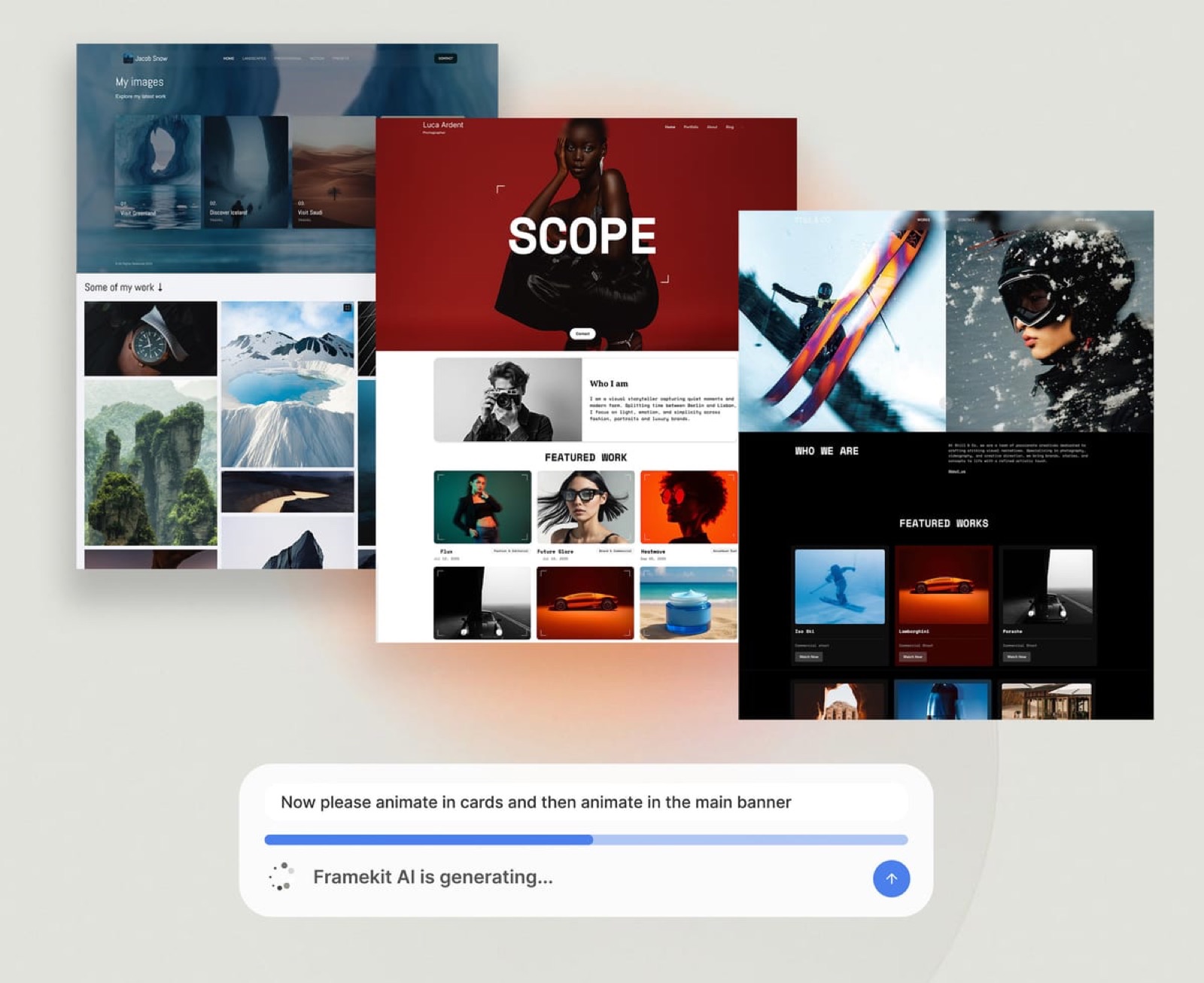
Framekit is an AI website builder for photographers, filmmakers and designers that generates a site from a description or a reference image and lets you sell and deliver from your own domain.
For a photojournalist the argument is ownership in a very literal sense: the URL where your Rohingya story lives is a URL you keep, and the person who buys your zine is your contact rather than a marketplace's.
Building the archive took about half an hour, most of it sequencing rather than configuring.
The generated story layout kept captions attached to frames rather than collecting them in a lump at the end, which is the correct choice and not the default in several of the more design-led tools here.
The real numberon the carried $18 zine, the platform fee is 5% on the free and $9 Starter plans, 3% on Pro at $19 and 0% on Business at $39 a month, plus standard card processing. That is $0.90, $0.54 or nothing per copy.
The crossover is $39 divided by 5%, which is $780 a month in sales, and almost no photojournalist funding trips through zine sales will reach it, which means the honest recommendation for this audience is usually the free or Starter plan rather than an upgrade.
The standout detailclient galleries come on every plan including the free one, with unlimited galleries, watermarking, password and PIN protection, favourites, downloads and email sharing, and only storage scales with price.
For a photojournalist filing to an editor, that is a real delivery tool included rather than a second subscription, and the password protection is genuinely useful for work under embargo or where a subject's safety is a consideration.
The gotchathere is no print lab. Framekit's store sells digital products, so a signed print edition means your own fulfilment or a separate lab and a manual process.
For a photographer whose funding model is print sales rather than zines, that is a serious gap and PhotoShelter or a dedicated print platform will serve you better.
The second gotchalike every builder here, Framekit makes no written commitment about preserving your IPTC block through upload. Run the test in the metadata section below before you commit an archive to any of these tools, including ours.
Skip it iflicensing is your main income and you need an archive with keyword search, rights-managed pricing and an automated licence flow. That is PhotoShelter's job and it does it properly.
Verdict: the best home for a photojournalist who wants the archive, the delivery and the funding on one domain they control, and the wrong tool for a licensing-led business.
2. PhotoShelter: Best for Licensing and Archive Search
PhotoShelter has been the archive-and-licensing platform for working photojournalists for two decades, and nothing else on this list is really trying to do what it does.
Searchable keywords across tens of thousands of frames, rights-managed licensing, and delivery built for editors on deadline rather than for clients choosing wedding favourites.
On pricing, an honest notewe could not verify current individual-photographer rates.
PhotoShelter's public pricing page now presents PhotoShelter for Brands, tiered by library seats and storage from 1TB upward with prices available only on request, and no readable individual plan sits alongside it.
The photographer product still exists; we are simply not going to print a number we could not open. Check the current rate directly before budgeting.
The standout detailmetadata is treated as load-bearing rather than as clutter. If your captions and keywords matter, this is the only tool here architected around that assumption.
The gotchaphotographers report that development attention has shifted toward the brands product in recent years, which is worth weighing if you are choosing a home for a twenty-year archive. Treat that as a widely repeated observation rather than a measured fact.
Skip it ifyou want a designed site rather than an archive with a front end. The presentation has never been the strong suit.
Verdict: still the professional answer for a licensing-led practice, and increasingly a specialist tool rather than a default.
3. Format: Best Pure Archive
Format is quiet in a way that suits documentary work. The templates do not compete with the pictures, the sequencing tools are straightforward, and a twenty-frame story reads as a story rather than as a grid.
The real numberBasic is $10 a month billed annually, with the page noting a normal rate of $14, Pro is $12 annually or $17 monthly, and Pro Plus $15 annually or $26 monthly. Store commission is 0% on all plans, although the store is built around prints rather than digital editions.
The standout detailproofing galleries are included, so filing selects to an editor does not need another product.
The gotchathe site is Format's. Your story URLs live inside their structure, and moving means every citation of your work in a grant application, a syllabus or another publication breaks at once.
For a field where work is cited for a decade, that is the cost that matters and it does not appear on any pricing page.
Skip it ifyou sell digital editions, or you expect your archive to outlive your relationship with any one vendor.
Verdict: the most disciplined archive presentation here, on rented ground.
4. Squarespace: Best for Long-Form Text

Squarespace handles the essay half of photojournalism better than the photo-first tools do. If your stories carry two thousand words alongside the frames, its editorial layouts and typography are a genuine advantage.
The real numberBasic is $19 a month billed annually. If you sell digital editions, the digital-content fee ladder of 7%, 5%, 1% and 0% by plan applies on top of processing, so the $18 zine costs $1.26 on the entry ladder against $0.90 on Framekit's 5% tier.
The standout detailpage-level password protection is built in, which is the cleanest way to share a sensitive story with an editor before publication.
The gotchaimage handling is aggressive. Squarespace re-encodes and resizes on upload, and photographers report that embedded metadata does not survive intact, which is the specific failure this profession cannot shrug off.
Skip it ifthe caption block travelling with the file matters to you.
Verdict: the best writing environment here and the least careful with your files.
5. Visura: Best for Community and Grants
Visura occupies a space nothing else here does: a portfolio platform built specifically around documentary and photojournalism, with a community, grant and open-call visibility attached to the portfolio rather than bolted on.
On pricing, the same honest noteVisura refused automated access, so this guide quotes no figure. It publishes membership tiers including a free level; confirm the current rates on their site before committing.
The standout detailthe audience. A portfolio there is seen by editors, curators and grant juries who are specifically looking for documentary work, which is a discovery advantage no self-hosted site provides.
The gotchait is a community platform, so the same rented-address logic applies as with any profile-based service. Your visibility depends on the platform's health and its feed.
Skip it ifyou are looking for your primary professional site rather than an additional channel.
Verdict: worth having alongside your own domain rather than instead of it, in the same way ArtStation works for animators.
6. Cargo: Best for Designed Sequences
Cargo appeals to photographers whose work sits closer to the photo book than to the wire, where pacing, scale changes and white space are part of the argument the pictures are making.
The real numberplan-based and modest, though the meaningful cost is the business tooling it does not include rather than the subscription it charges.
The standout detailthe layout control produces sequences that genuinely could not have been assembled from a template menu, which for book-oriented work is the whole point.
The gotchathin commerce and a design-first interface that assumes you enjoy this part.
Skip it ifyou need licensing, delivery or a store that works.
Verdict: the right tool for a photographer making books, and an incomplete one for a photographer making a living. Our Cargo alternatives guide covers the usual next steps.
7. Adobe Portfolio: Free With Creative Cloud
Adobe Portfolio costs nothing extra to anyone already paying for Lightroom, which is most of this profession.
The Adobe plans page lists the Photography plan at US$19.99 a month with 1TB, Lightroom alone at US$11.99 and Creative Cloud Pro at US$69.99.
The real numberzero marginal cost, which nothing else here can claim.
The standout detailLightroom sync into galleries is genuinely quick, which suits a photographer filing from the field.
The gotchano store, no licensing, and the site ends when the subscription does. For an archive intended to outlast a software budget, that is a structural problem rather than an inconvenience.
Skip it ifthe archive is meant to be permanent.
Verdict: an excellent free portfolio and a poor permanent home.
The Caption Problem: What Happens to Your Metadata
In one linethe IPTC block you wrote in Photo Mechanic is the professional part of your file, and a website builder that re-encodes on upload is very likely deleting it without telling you.
The IPTC Photo Metadata standard is what the industry uses to carry caption, credit, source, date and location inside the image file.
Agencies depend on it, picture desks depend on it, and it is the reason a frame that travels away from your website can still be attributed correctly.
It is also, from a website builder's perspective, a few kilobytes of stuff to strip out while resizing.
There is a defensible reason platforms do this. Stripping metadata removes GPS coordinates from ordinary users' photos, which is a real privacy protection for most of their customers.
It is simply the wrong default for a profession whose entire evidentiary claim lives in that block.
The test, and it takes two minutes. Embed a distinctive caption in one image. Upload it, publish, then open the live page, download the file the site actually serves, and inspect it with ExifTool or Photo Mechanic.
Either your caption is there or it is not. Run this before you migrate an archive, not after.
What to do when the answer is no, which it often will be. Put the caption in the page text as well as the file, so it is at least visible and indexable where the image is published.
Keep your captioned masters in your own archive and treat the website copy as a derivative. And where a frame will travel, such as a submission or a syndication, send the original file rather than the web version.
None of the seven tools tested makes a written commitment to preserving IPTC data, ours included. That is the honest state of the category, and a photojournalist should plan around it rather than assume it.
Why Your Story URLs Are Worth More Than Your Homepage
In one linea photo story gets cited in grant applications, syllabuses and other people's articles for a decade, so the address it lives at is a professional asset and moving it destroys value in a way moving a portfolio does not.
Think about where links to your work actually sit. A grant jury reading your application next year. A university course page. A journalist quoting the series in a piece about the region. An editor's bookmark from 2023.
Each one is a small piece of accumulated credibility, and each one points at a specific URL.
If that URL is on a platform, three things follow. The link dies when you leave, and it dies silently. The search authority the story accumulated belongs to the platform's domain rather than to yours. And the platform, not you, decides how long the address exists.
If the URL is on your own domain, all three invert. You can change builder five times and keep every citation intact by keeping the same paths, which is a thing you can only do if you own the domain.
This is the least glamorous argument for owning your address and by some distance the most important one for this field specifically.
The practical rules that follow: buy the domain first and separately, keep story slugs descriptive and stable, never put the year in a URL you might update, and when you do restructure, redirect rather than delete.
What Funds the Work
In one linefor most photojournalists the site is not a shop, but the small money it does make matters disproportionately, so the fee structure deserves more attention than the subscription price.
The funding stack for independent documentary work in 2026 is usually some combination of grants, assignments, teaching, prints and self-published editions. The website's job is to support four of those five, and the fee arithmetic only bites on the last two.
| Route for an $18 digital zine | Fee per copy | Kept per copy | On 200 copies a year |
|---|---|---|---|
| Gumroad (10% + $0.50, plus processing) | $3.12 | $14.88 | $624 |
| Framekit Free or Starter (5% + processing) | $1.72 | $16.28 | $344 |
| Squarespace Basic (7% digital fee + processing) | $2.08 | $15.92 | $416 |
| Framekit Business $39/mo (0% + processing) | $0.82 | $17.18 | $632 including subscription |
The row that matters is the last one, and it argues against upgrading. At 200 copies a year the $39 Business plan costs more than the 5% it saves, so a photojournalist selling a modest zine edition should be on the free or Starter plan.
We would rather say that plainly than let a table imply otherwise.
Prints are the honest gap. Framekit has no lab, so a print edition means printing and shipping yourself, which many photojournalists already do for signed editions and which is genuinely unsuitable if you want an automated fulfilment chain.
If prints are the main funding line, look at the dedicated platforms in our guide to the best print fulfilment for photographers.
How to Structure a Photojournalism Site
In one linethe structure that works is the story, not the gallery, and the difference shows up in whether an editor can tell what a body of work is about without clicking twelve times.
Lead with three stories, not thirty frames. A photojournalist's homepage should present a small number of bodies of work with a title and one line of context each.
The single-image grid is a commercial photographer's convention and it strips the meaning out of documentary work.
Give every story a text introduction. Two hundred words on what this is, where, when and why it matters. Editors and jurors read these.
It is also the text that lets a search engine or an assistant understand what your pictures are of, which the pictures alone cannot communicate.
Caption every frame in the page text. Whatever happens to your embedded metadata, the visible caption is under your control. Who, what, where, when.
Keep a clear tearsheet or published-work page. Where the work ran matters in this field in a way it does not in others.
State your availability and your region plainly. Assignments come from editors who need someone who is already there. Say where you are based and where you can work.
Keep an archive page that is honest about depth. If you have twenty years of work, say so and make it navigable. Depth is credibility here.
What to leave off. A gear list, a photo of you in body armour, and any story you would not stand behind if a subject read it.
How Photojournalists Get Found
In one linecommissions come from editors who already have your name or who found you through a grant, a festival or a colleague, so the site's job is verification rather than discovery.
The realistic pattern is that someone hears about you, searches your name, and lands on your site with a specific question: can this person do this story, in this place, at this standard.
That takes about a minute and is decided by the top three items on your homepage. It is a conversion problem, and the argument for owning the domain that answers your own name is the same one that runs through this whole guide.
The second pattern is geographic and topical: an editor needs someone in a particular country who covers a particular subject. These are low-volume, high-intent searches, winnable by saying plainly where you are and what you cover.
Google's SEO starter guide covers everything most photojournalists need to know about it.
The third is the one that has changed most recently. Assistants and search summaries increasingly answer "photographers covering X in Y" by reading text.
Sites that describe their stories in words get cited, and sites that are a wall of uncaptioned images do not, because there is nothing for a machine to read.
Writing proper captions and introductions is now a discovery strategy as well as a professional obligation.
How to Choose in Four Questions
Most guides end by listing their picks again. Work down these four instead and stop at the first yes, because that is the constraint that decides your tool rather than your preference.
- Is licensing a significant part of your income, with an archive that needs keyword search and rights-managed pricing? PhotoShelter, and confirm current individual pricing directly.
- Do you sell zines, editions or digital work at all, and do you want the buyers to be yours? Framekit, on the free or Starter plan rather than the expensive one.
- Is your work book-shaped, where sequence and design carry the argument? Cargo, and accept the missing business tooling.
- Do you need long-form text alongside the pictures more than anything else? Squarespace, and keep captioned masters elsewhere because its re-encoding is aggressive.
Frequently Asked Questions
What is the best website builder for photojournalists in 2026?
Framekit is the best choice for most working photojournalists in 2026, because the story archive, the editor-facing galleries and any zine sales sit on a domain you own, which keeps story URLs citable for the decade they get cited.
PhotoShelter remains the better answer if licensing and archive search are your main income, and Format is the strongest pure-archive alternative at $10 a month annually.
Do website builders delete my IPTC captions?
Many do, as a side effect of re-encoding images on upload, and none of the seven tools tested commits in writing to preserving the IPTC block.
Test it in two minutes: embed a distinctive caption, publish, download the file the live site actually serves, and inspect it in ExifTool or Photo Mechanic.
Whatever the answer, also put the caption in the visible page text, which stays under your control.
Why does owning my domain matter more for photojournalism?
Because photo stories are cited for years in grant applications, syllabuses and other people's articles, and every one of those citations points at a specific URL.
On a platform, those links die when you leave and the accumulated search authority stays with the platform. On your own domain, you can change builders repeatedly and keep every citation working by keeping the paths the same.
Can I sell prints through Framekit?
Not through a print lab. Framekit's store sells digital products, so a signed print edition means printing and shipping yourself rather than an automated fulfilment chain.
Photographers whose funding depends mainly on print sales should look at a dedicated print platform instead, and we would rather say that than sell you the wrong tool.
How much does PhotoShelter cost for an individual photographer?
We could not verify it.
PhotoShelter's public pricing page now leads with its brands product, tiered by library seats and storage with prices supplied on request, and no readable individual plan sits alongside it, so this guide quotes no figure rather than reprinting one from a third party.
Contact PhotoShelter directly for a current rate.
Should I use Visura as well as my own site?
For most documentary photographers, yes, in the same way animators keep an ArtStation profile. Visura's audience of editors, curators and grant juries is a discovery advantage a self-hosted site does not provide.
Treat it as a channel rather than your professional home, because the same rented-address logic applies to any profile-based platform.
How should I present a photo story on a website?
Lead with three bodies of work rather than thirty single frames, give each a title and a two-hundred-word introduction, and caption every frame in the visible page text.
The single-image grid is a commercial convention that strips documentary work of its meaning, and the introductions are also what lets a search engine or an assistant understand what your pictures show.
What is the cheapest way to put a photojournalism archive online?
Framekit's free plan gives you a real site with galleries and a store at no cost, with a 5% fee only when you actually sell something, and Adobe Portfolio costs nothing extra if you already pay for Lightroom at US$11.99 a month or the Photography plan at US$19.99.
Both are genuinely usable; only one of them survives you cancelling Adobe.
How do I share sensitive work with an editor before publication?
Use a password-protected gallery shared with a named recipient rather than an unlisted public page, because an unlisted URL is obscurity rather than protection.
Framekit includes gallery passwords and PINs on every plan including the free one, and Squarespace offers page-level passwords if you need the work inside the public site structure.
Do I need a separate tool to deliver files to picture editors?
Not necessarily. Framekit's client galleries are on every plan with unlimited galleries, watermarking, passwords, favourites, downloads and email sharing, which covers filing selects to an editor.
If you deliver at very high volume or need rights-managed licensing attached to the delivery, that is where a dedicated platform earns its price, and our best client gallery platforms guide compares them.
The Verdict
For a working photojournalist in 2026, Framekit is the recommendation: the archive, the editor galleries and the zine sales on a domain you own, at $0 or $9 a month, with story URLs that stay citable no matter what you build them with next.
PhotoShelter is the better answer for a licensing-led practice, and Format is the better answer if you want the most disciplined story presentation and no store at all.
Where Framekit loses, plainly: no print lab, so print editions are your own fulfilment problem, and if prints fund your work that alone should send you elsewhere.
No rights-managed licensing engine and no keyword archive search, which is PhotoShelter's category and not ours.
No written guarantee about preserving your IPTC metadata, which is true of every tool here and which you should test rather than trust.
And a 5% store fee on the free and Starter plans, which for the small print runs typical in this field is the plan you should be on anyway.
If you license heavily, buy PhotoShelter. If you sell prints, buy a print platform. If you want your stories to still resolve at the same address in 2036, own the domain.
Related reading: best website builders for photographers, best website builder for travel photographers, best photo backup solutions for photographers, and how to SEO a photography website.
Also in this series: website Builders for Wildlife Photographers, website Builders for Landscape Photographers and client Galleries for Product Photographers.
Prices were read at each vendor's own pricing page in August 2026, with Adobe re-verified on 9 August 2026. PhotoShelter and Visura publish no individual pricing we could read and are quoted without figures for that reason.