Framekit templates
Start from a designer-made template
 Use template
 Use template
 Use template
 Use template
 Use template
 Use template
 Use template
 Use template
The chasing email about photo delivery arrives on day nineteen and takes the same form every time.
"Just wondering when we might see the photos!" It is polite, it is reasonable, and it means the same thing every time: the client had no idea what to expect and filled the silence with worry.
Photographers usually respond by working faster. The better fix is to say the number out loud before the shoot and send something small within 48 hours.
Photo delivery turnaround is the time between the shoot and the client receiving their finished gallery, measured in business days and stated in the contract, with a preview set typically delivered inside the first two days to bridge the gap.
Framekit is an AI website builder with client galleries included, so the preview and the full gallery can be published to the same address rather than sent as two unrelated links. We re-verified the gallery details on this page in September 2026.
Deliver a preview of five to ten edited images within 48 hours of any shoot, then the full gallery in two to four weeks for weddings, one to two weeks for portraits and events, three to five business days for commercial and product work, and 24 to 48 hours for press and live music.
State the window in business days in your contract, and quote the longest number you can comfortably beat. The honest trade-off is that fast delivery is a positioning choice, not a virtue, and pricing should reflect it.
Turnaround by Genre
These are the working windows most professional studios quote, expressed in business days and measured from the shoot date to the full gallery going live rather than to the moment you finish editing.
| Shoot type | Preview | Full delivery | What drives the number |
|---|---|---|---|
| Wedding | 24 to 48 hours | 2 to 4 weeks | Volume plus consistency across a whole day |
| Elopement or half-day | 24 hours | 1 to 2 weeks | Fewer frames, same standard |
| Family or portrait session | 24 to 48 hours | 5 to 10 business days | Small set, heavy retouching per frame |
| Newborn | 48 hours | 1 to 2 weeks | Slow, retouch-intensive editing |
| Headshots | Same day | 2 to 5 business days | Client picks, then you retouch |
| Branding session | 48 hours | 1 to 2 weeks | Content volume plus crop variants |
| Corporate event | Same day, 5 to 10 frames | 3 to 7 business days | Marketing teams have dated needs |
| Conference or trade show | Same day | 2 to 5 business days | Content is time-sensitive |
| Commercial or product | 24 hours | 3 to 5 business days | Listing and campaign deadlines |
| Real estate | Same day | 24 to 48 hours | The listing cannot go live without it |
| Editorial assignment | Same day | 24 to 72 hours | Publication schedule |
| Concert or press | 2 hours | 12 to 24 hours | The photo has a one-day shelf life |
Two patterns are worth noticing. Consumer work runs in weeks and commercial work runs in days, because commercial images are inputs to something with a date attached. And every row has a preview, because the preview is what makes the full window tolerable.
The Preview Is the Whole Trick
In one linea preview of five to ten edited images sent within 48 hours removes almost every chasing email you would otherwise receive, because clients are not impatient about the gallery so much as anxious about the silence, and a small set answers the anxiety without shortening your edit.
It is the highest-shared message you will send. A couple posting three frames the day after their wedding generates more reach than the full gallery will three weeks later, when the moment has passed.
It buys you the full window. A client who has seen your work stops counting days. A client who has seen nothing counts them carefully.
It sets the standard early. The preview frames are your strongest, so the client's first impression is your best work rather than image 214.
Keep it small. Five to ten images, chosen for variety rather than completeness, with a line saying the full gallery follows on the agreed date. Twenty preview images starts to feel like a delivery and raises expectations for the timeline.
Publish it as a gallery, not as attachments. Attachments get compressed by mail clients, cannot be shared cleanly, and give you nothing back. A small gallery on your own domain is shareable and points at your portfolio.
What Clients Actually Expect
Client expectations arrive pre-set by whoever photographed their friend's wedding last year, which means they are anchored to a specific number rather than to any standard you can argue with after the fact.
For weddings, most couples have absorbed a two-to-eight-week range, and anything inside four weeks reads as normal. Beyond six weeks you need to have said so in advance, repeatedly.
For commercial work, the expectation is days rather than weeks, and it is frequently tied to a campaign date the client did not tell you about. Ask when the images are needed rather than when they would like them.
For events and conferences, marketing teams increasingly expect same-day frames for social, with the full set following. A photographer who cannot supply anything on the day is competing against one who can.
Where photographers get into trouble is silence rather than duration. A studio quoting six weeks and delivering in five with a preview on day one has happier clients than one quoting two weeks and delivering in three with nothing in between.

Quote in Business Days, Then Beat It
The single line in your contract about turnaround does more work than any workflow change you could make, because it decides whether the same delivery date reads as early or late to the client.
Say business days. "Within 20 business days" survives a bank holiday and a Christmas week; "within four weeks" does not, and the client will count calendar days.
Quote the longest number you can beat comfortably. Delivering in three weeks against a four-week promise is a delight. Delivering in three weeks against a two-week promise is a complaint, for identical work.
Start the clock at the shoot, and say so. Otherwise clients start it when they think you should have started.
Name the preview in the contract too. "A preview of five to ten images within two business days, with the full gallery within 20 business days" turns your best habit into a promise you get credit for.
Add one line about peak season. "Delivery windows may extend by up to 10 business days for weddings shot between June and September" is honest, standard, and prevents the conversation entirely.
A workable clause reads: a minimum of 400 edited high-resolution images delivered via online gallery within 20 business days of the shoot date, with a preview of five to ten images within two business days.
Where the Time Actually Goes
Photographers trying to deliver faster almost always attack the wrong stage of the process. Here is the honest breakdown of where the hours go on a wedding, in the order they actually cost you time.
Culling is the largest recoverable cost. Three passes, done decisively, is the difference between a two-day cull and a two-week one.
The counts by genre are in our guide to how many photos to deliver to clients.
Editing scales with the count you chose. At a realistic 25 to 40 finished images an hour, delivering 550 instead of 900 saves nine to fourteen hours per wedding, which is most of a working day and a half.
Export and upload is the stage people forget. Eleven gigabytes of finished JPEGs takes real time to export and upload, so schedule it rather than assuming it happens while you write the email.
Gallery assembly should take five to eight minutes once you have a house style: cover, named sets, password, download PIN, dates, and the email. Photographers who configure every gallery from scratch add half an hour per job.
The queue is the real delay. Most late deliveries are not slow edits, they are a backlog of four jobs and no policy about which comes first. Deliver oldest-first and stop taking bookings you cannot service.
Fast Delivery as a Positioning Choice
Being quick is a product decision rather than a virtue, and like any product decision it should be priced deliberately rather than absorbed as unpaid pressure on your week.
Some studios build their whole positioning on 72-hour delivery and charge accordingly. That is legitimate and it constrains what else you can shoot in a week.
Others deliver in four weeks and win on craft. Also legitimate, provided the preview lands on day one and the number was stated up front.
What does not work is quoting fast to win the booking and delivering slow. It converts an operational problem into a trust problem, and trust problems produce reviews.
If you want to sell speed, sell it explicitly: a rush option at 30% to 50% of the shoot fee, with a stated turnaround. Clients who need images by Friday will pay for Friday, and clients who do not will stop asking.
Where Framekit Fits in the Delivery Timeline
Framekit fits the delivery half of this timeline, from the 48-hour preview to the day the gallery closes, and it has no part in culling or editing, which is where most of the time goes.
On day one or two, create the gallery, upload the five to ten preview frames, and send it by email from Framekit. Every gallery feature is on every plan, including free, and galleries are unlimited, so a preview gallery costs nothing extra.
On delivery day, add the full set to the same gallery rather than sending a second link. If the shoot included video, the film goes in the same gallery, transcoded for playback and never watermarked.
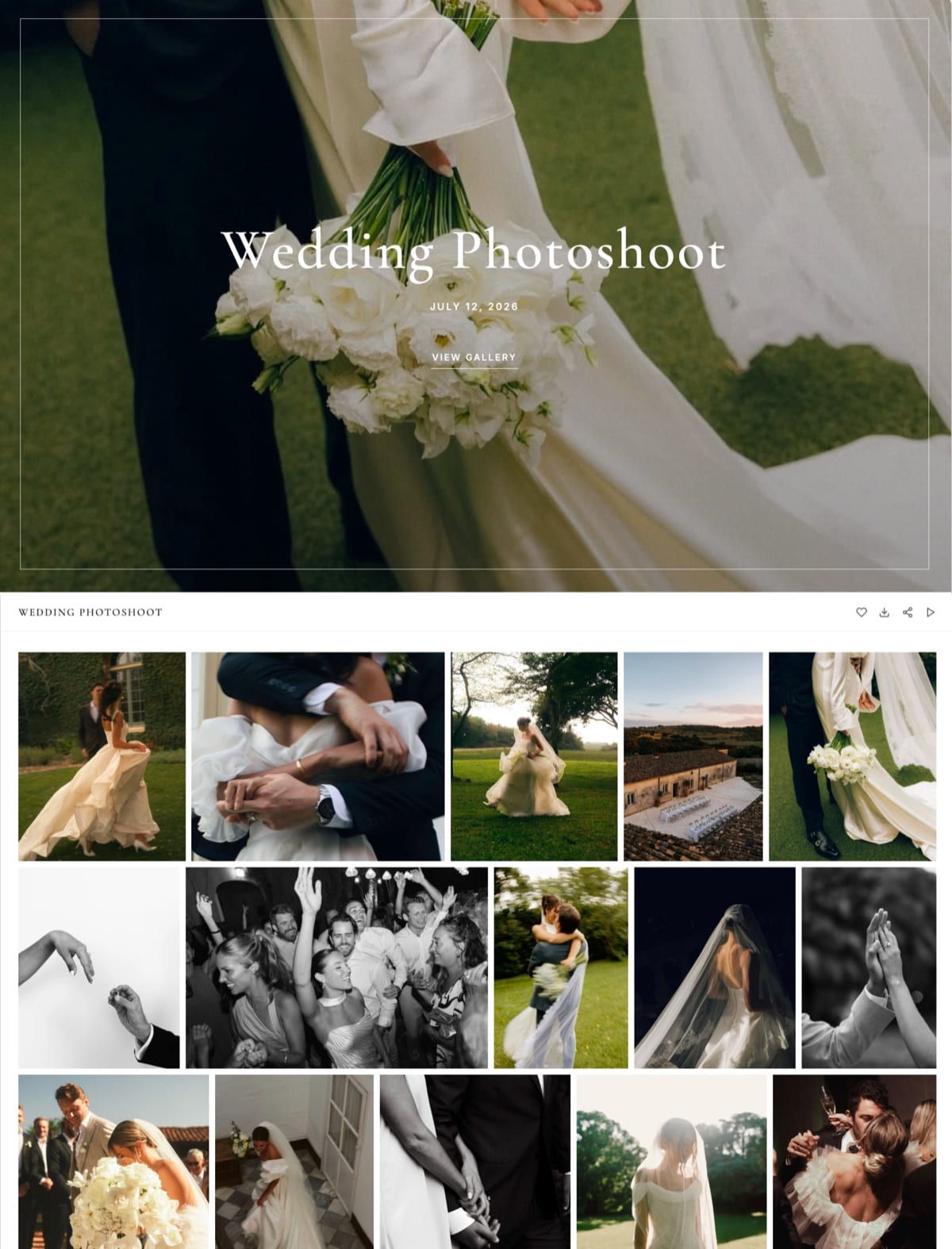
The dates in your contract can be enforced by the gallery rather than by memory. Set an expiry date with an optional reminder email, protect downloads with a PIN, and let clients heart favorites and download only those for the album.
Storage is one pool shared with your website: 10GB free, 50GB on Starter at $9 a month, and 300GB on Pro at $19.
What Framekit does not do is sell prints, so a studio whose turnaround includes a print-ordering window needs a gallery with lab fulfilment instead.
Frequently Asked Questions
How long should a photographer take to deliver photos?
Two to four weeks for weddings, five to ten business days for portrait sessions, three to five business days for commercial and product work, and 24 to 48 hours for editorial and press, with a preview of five to ten images inside 48 hours in every case.
Quote the window in business days in your contract, start the clock at the shoot date, and pick the longest number you can comfortably beat rather than the fastest you have ever managed.
How long should wedding photo delivery take?
Two to four weeks is the professional norm, or up to six weeks in peak season if you have said so in advance.
What matters more than the number is the preview: five to ten edited frames within 48 hours removes almost all of the chasing email, because couples are anxious about silence rather than impatient about the gallery.
Put both the preview and the full window in the contract in business days.
Should I send clients a preview before the full gallery?
Yes, always, and within 48 hours. It is the highest-shared message you will send, it buys you the full editing window without complaints, and it sets the client's first impression using your strongest frames.
Keep it to five to ten images chosen for variety, publish it as a small gallery rather than as email attachments, and state when the full gallery will follow.
What should my contract say about delivery times?
State the turnaround in business days from the shoot date, name the preview separately, and add one line about peak season.
A workable clause reads: a minimum of 400 edited high-resolution images delivered via online gallery within 20 business days of the shoot date, with a preview of five to ten images within two business days.
Business days protect you from holidays; calendar weeks do not.
Is four weeks too long to deliver wedding photos?
Four weeks is within the professional norm and only feels long when the client was not told.
A studio quoting four weeks, previewing on day one, and delivering on day 19 has happier clients than one quoting two weeks and delivering on day 21 with silence in between.
If your window regularly exceeds six weeks, the problem is usually a booking queue rather than an editing speed.
How can I deliver photos faster without working longer?
Cull harder and deliver fewer images, because editing time scales directly with the count you chose: delivering 550 instead of 900 frames saves nine to fourteen hours per wedding at a realistic 25 to 40 finished images an hour.
Then build a gallery house style so assembly takes five minutes rather than thirty, and deliver oldest job first so the queue stops compounding.
Should I charge for rush delivery?
Yes, if you offer it, at 30% to 50% of the shoot fee with a stated turnaround, because rush work displaces other jobs and compresses your quality control.
Pricing it explicitly also filters the requests: clients who genuinely need images by Friday will pay, and clients who were asking speculatively will accept the standard window without a negotiation.
What do commercial clients expect for turnaround?
Days rather than weeks, and usually tied to a campaign or listing date they may not have mentioned.
Three to five business days is standard for commercial and product work, 24 to 48 hours for real estate where the listing cannot go live without images, and same-day selects for events.
Ask when the images are needed rather than when the client would like them, because those are different questions.
How do I handle a client chasing me for photos?
Answer within the hour with a specific date rather than a reassurance, and send two or three additional edited frames alongside it. Specificity resolves the anxiety and a small delivery resolves the impatience.
Then look at why the question arose: almost every chasing email traces back to a window that was never stated, a preview that was never sent, or a queue that grew past what you can service.
Does faster delivery get better reviews?
Meeting the stated window does; being fast on its own does not. Reviews turn negative when clients receive photos later than they were led to expect, not when the turnaround is long in absolute terms.
Photographers who state a generous window, preview within 48 hours, and consistently deliver a few days early score better than those who promise speed and occasionally miss.
Can I send the preview and the full gallery on the same link?
Framekit lets you send the preview and the full gallery on the same link: publish the preview frames first, then add the full set to that gallery on delivery day, with galleries unlimited on every plan including free.
You can also set an expiry date with a reminder email and a download PIN, which turns the delivery window in your contract into something the gallery enforces.
The Short Version
Preview in 48 hours. Full gallery in two to four weeks for consumer work and three to five business days for commercial. Quote in business days, start the clock at the shoot, and promise a window you can beat.
Then fix the two things that actually cause late delivery: delivering more images than the job needs, and a booking queue with no order to it.
Related reading: how many photos to deliver to clients, how to write a photo delivery email, how to deliver photos to clients, and our full client gallery platform comparison.
For the contract side see best contract and proposal tools for creatives, and for culling speed compare the options in best culling software for photographers.
The American Society of Media Photographers publishes business practice guidance covering delivery terms for commissioned work.