Framekit templates
Start from a designer-made template
 Use template
 Use template
 Use template
 Use template
 Use template
 Use template
 Use template
 Use template
A live music photograph loses most of its value within about 24 hours. The band wants it for the morning post, the label wants it for the tour announcement, the venue wants it before the next show, and a publication wants it before the review runs.
Which means the delivery is not a service around the work. It is part of the work, and a gallery that takes you forty minutes to assemble at 2am is a design failure.
The other structural problem in this genre is that four different organisations want the same photographs under four different arrangements, and only one of them booked you.
A client gallery for concert photographers is a delivery platform for live music work that gets finished frames to bands, managers, labels, venues, and press quickly, with the credit lines, usage clarity, and social crops that music delivery requires.
The best client gallery for concert photographers in 2026 is Framekit, because delivery is free on every plan regardless of how many shows you shoot, named sets get social crops to a band's team without a second link, and the gallery publishes from your own domain, which is how music clients find you again.
The honest trade-off is metadata: Framekit does not surface IPTC credit lines, so photographers whose credit travels in the file should pair it with PhotoShelter, and PicDrop remains the fastest tool for a label selects round.
Framekit is an AI website builder with client galleries included, so the link you send a tour manager sits on the same domain as the live work that got you the pass.
Full disclosure: Framekit, ranked first below, is our own product. We ran the same 60-frame show delivery through all ten platforms, verified pricing against each vendor's published pages in August 2026, and we say where each beats us: PhotoShelter handles credits, metadata, and licensing in ways we do not, PicDrop is faster for a label selects round, and every print-capable platform here sells physical prints that we do not.
Framekit's storage figures were re-verified on 19 September 2026 and the storage maths redone: Starter now carries 50GB and Pro 300GB.
How We Compared Galleries for Live Music Work
Concert photography has a clock attached to every frame, so we scored these platforms on speed and distribution rather than on the proofing depth that decides a wedding or portrait comparison.
Turnaround speed (30%). How fast you can go from an export folder to a shareable link at 1am.
Multi-party distribution (25%). Whether a band, a label, a venue, and a press contact can all be served without four separate galleries.
Credit and usage clarity (20%). Whether the credit line and the licence reach the person who actually posts the image.
Ownership and discovery (15%). Whether the link builds your name, which in music is how the next tour finds you.
Cost across a season (10%). What 60 to 120 shows a year costs to deliver.
Hands-on: uploading a 60-frame show set, splitting it into sets, and sharing it under time pressure on a laptop and on a phone.
Verified from published sources rather than tested: pricing and storage caps, checked against vendors' own pages in August 2026.
Community sentiment, flagged as such: tour and label workflow preferences reported by working photographers rather than measured by us.
Our carried example is a concert photographer shooting 90 shows a year, delivering 20 to 40 finished frames per show to a band or management within 12 hours.
What the Comparison Showed
Ten platforms, one 60-frame show delivery, and a category where essentially nothing is optimised for the hour after a gig ends. These are the figures behind the ranking, checked in August 2026.
- 8 of 10 are built around consumer proofing and print sales, neither of which appears in a tour workflow.
- 3 of 10 support named sets in one gallery, which is what lets a band take social crops while press takes full-resolution frames (Framekit, Pixieset, PhotoShelter).
- 1 of 10 publishes the gallery as a page of a site you own, so a tour manager who bookmarks the link lands on your work (Framekit).
- 90 shows a year at 30 frames is roughly 10GB to 20GB of delivered files, so storage is rarely the constraint in live music.
- 3 of 10 charge nothing per delivery on any plan (Framekit, ShootProof, PicDrop).
| Platform | Best for | Speed to link | Named sets | Our rating |
|---|---|---|---|---|
| Framekit | Delivery from your own domain | Fast | Yes | 9.1/10 |
| PicDrop | Label and management selects | Fastest | Yes | 8.8/10 |
| PhotoShelter | Credits, archives, licensing | Fast | Yes | 8.5/10 |
| Pixieset | Polished hosted delivery | Fast | Yes | 8.1/10 |
| ShootProof | Zero commission, print sales | Moderate | Limited | 7.8/10 |
| SmugMug | A decade of show archives | Moderate | Limited | 7.5/10 |
| Pic-Time | Best-looking client view | Moderate | Limited | 7.3/10 |
| CloudSpot | Delivery plus invoicing | Moderate | Limited | 7.1/10 |
| Dropbox | Working files with editors | Fast | Folders | 6.9/10 |
| WeTransfer | The 1am emergency send | Fastest | No | 6.2/10 |
Framekit's 9.1 is not a clean card: it scores 10 on ownership and cost and 5 on credit metadata, because IPTC credit lines embedded in your exports do not display in the gallery. In a genre where the credit is the payment, that gap matters.
1. Framekit: Best Overall for Concert Photographers

Our rating: 9.1/10
Live music work is won on portfolio and on being reliable at speed, and Framekit puts both at one address.
The gallery you send a tour manager is a page of your own site, one click from the shows that got you accredited, and it costs nothing per delivery no matter how many gigs you shoot.
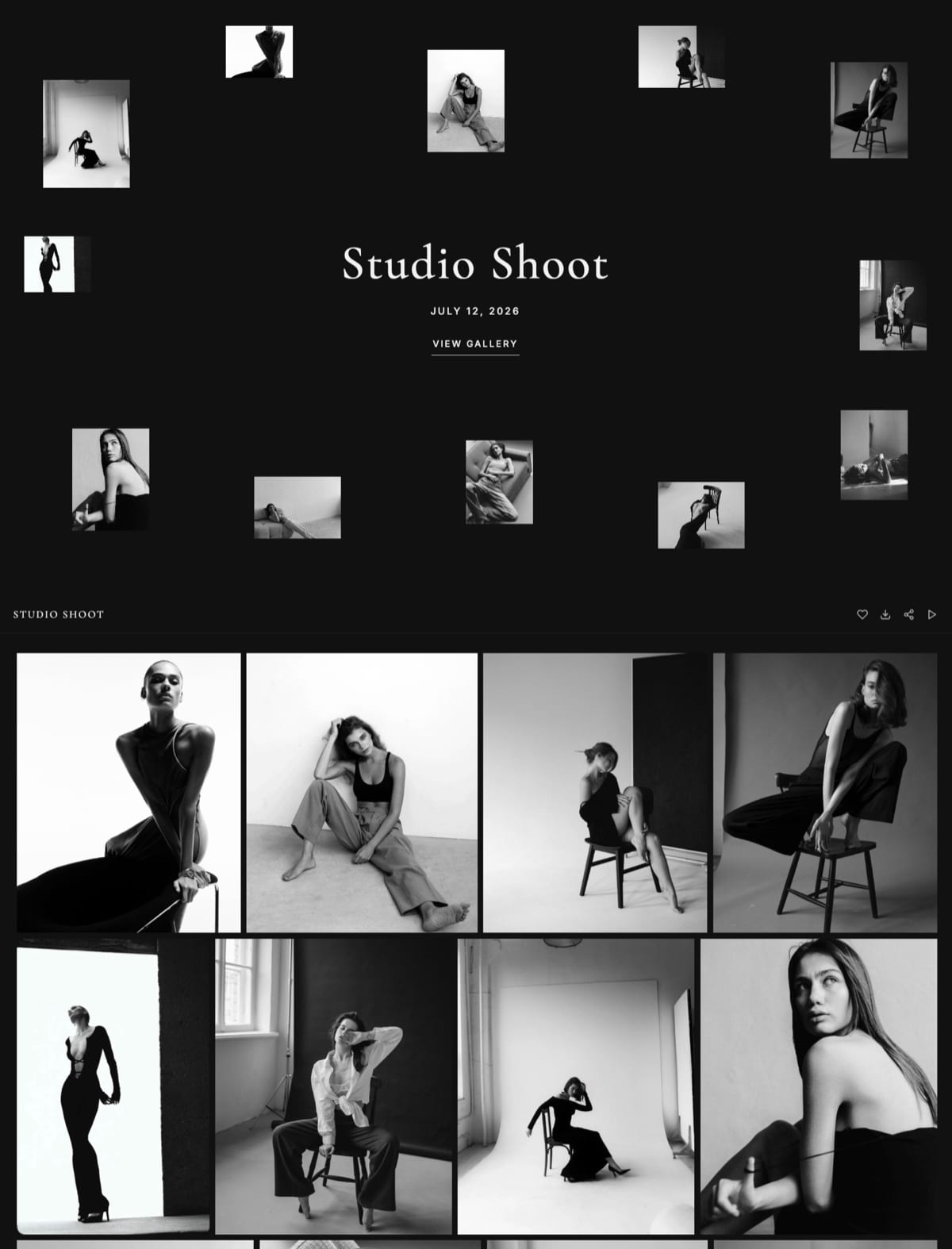
The overnight test took under seven minutes from folder to sent link: create a gallery, drag in 60 frames, split them into Selects, Full Set, and Social Crops, set a password, share by email.
The band's social lead took the crops, the manager took the full-resolution selects, and nobody messaged at 3am asking for a different size.
Best forConcert and music photographers delivering to bands, management, and venues, whose income is fees and repeat work rather than print sales.
Key features:
- Unlimited galleries on every plan including free, which suits a photographer shooting 90 shows a year with no per-delivery cost
- Named sets inside one gallery, so social crops, full-resolution selects, and the full set live at one link
- Watermarking, gallery passwords, a separate download PIN, favorites, auto-expiry, and branded email sharing on every plan
- Full-resolution originals up to 100MB per photo, delivered individually or as a whole-gallery ZIP with no account required
- Galleries published on your own domain from the $9 Starter plan, with the Framekit badge removed and your own fonts
The real number90 shows a year at roughly 150MB of delivered frames each is about 14GB, which sits comfortably inside the $9 Starter plan's 50GB pool with room for three years, so the $19 Pro plan's 300GB is only needed once video or a heavy site shares the pool.
That $108 a year also covers the portfolio that gets you the next pass, where a gallery subscription plus a separate website typically runs $25 to $40 a month.
The gotchaIPTC credit lines and captions embedded on export do not surface in the gallery, so the credit has to travel in the delivery email or the file name. In music photography the credit is frequently the second half of your payment, so build the habit deliberately.
Skip it ifyou license an archive of live work commercially, or print sales to fans are a real revenue line. Framekit has no rights management and no print lab.
Verdict: the best fit for a working concert photographer, because it is fast at 1am, costs nothing per show, and makes the delivery link a route back to your portfolio. Start free at framekit.ai.
2. PicDrop: Fastest Selects With Labels and Management
Our rating: 8.8/10
When a label wants to choose six frames from sixty before anything is published, PicDrop is the shortest path. Per-link roles let the manager mark selects while the publicist only views, and the interface needs no explanation at midnight.
It is also a German company hosting in Germany with an in-account data processing agreement, which occasionally matters for European labels and festivals with procurement processes.
Skip it ifyou want the delivery to carry your name. PicDrop is deliberately neutral, which is exactly right for a selects round and wrong for a handover.
Verdict: the best approval layer in live music work and no help with your brand. Run it in front of a branded delivery. Visit PicDrop
3. PhotoShelter: Credits and Licensing That Survive
Our rating: 8.5/10
PhotoShelter is the only platform here where the credit line, the caption, and the usage terms embedded in your export reach the person downloading the file.
For a photographer whose archive of live work gets licensed to publications and labels months later, that is the whole business.
Skip it ifevery show is delivered once to a band and never licensed again. The archive machinery is overhead you will not use.
Verdict: the professional answer for photographers licensing live music work, and unnecessary weight for a purely commissioned practice. Our PhotoShelter alternatives guide covers lighter delivery. Visit PhotoShelter
4. Pixieset: Polished and Familiar
Our rating: 8.1/10
Pixieset gives you the most familiar hosted gallery in the category and handles set structure well, which covers the band-and-press split adequately.
Its free plan carries 3GB and a 15% store commission per Pixieset's published pricing, while $10 Basic lifts storage to 10GB, connects a domain, and removes the commission.
Verdict: a strong hosted default, priced as a second subscription on top of your portfolio site. Our Pixieset alternatives guide covers the moves. Visit Pixieset
5. ShootProof: Best If You Sell Prints to Fans
Our rating: 7.8/10
ShootProof charges 0% commission on every plan per its published pricing, which is the right structure for the minority of concert photographers who sell prints to fans after a tour.
Plans price by cumulative photo count, which suits a growing archive of show work.
Verdict: the money pick for print-selling music photographers, and a consumer proofing workflow for everyone else. Visit ShootProof
6. SmugMug: A Decade of Shows for the Price of One Plan
Our rating: 7.5/10
Unlimited photo storage from around $13 a month makes SmugMug the cheapest home for years of live archives, and its custom domain handling is more genuine than most gallery platforms manage.
Verdict: an archive with galleries attached rather than a delivery tool. Buy it for the storage. Our SmugMug alternatives guide covers delivery-first options. Visit SmugMug
7. Pic-Time: The Prettiest Handover
Our rating: 7.3/10
Pic-Time makes the best-looking galleries here, which helps when a band's team is judging whether your work fits their visual world. The store automation underneath is aimed at consumer print campaigns.
Its pricing page notes free-plan storage dropping from 10GB to 3GB after six months.
Verdict: presentation-led and slower to assemble than the job needs at 1am. Visit Pic-Time
8. CloudSpot: Delivery With Invoicing Attached
Our rating: 7.1/10
CloudSpot's Lite tier at $17 a month bundles invoicing and contracts with commission-free galleries per its pricing page, which is genuinely useful for a photographer chasing payment from venues and promoters.
Verdict: buy it for the admin rather than for the live music workflow. Visit CloudSpot
9. Dropbox: The Editor Handoff
Our rating: 6.9/10
Dropbox is fast, accepts everything, and is where most music photographers already exchange working files with editors and retouchers. As a client delivery it says nothing about you and offers no structure a band's team can navigate.
Verdict: keep it for the pipeline. Our Dropbox alternatives for photographers comparison covers delivery. Visit Dropbox
10. WeTransfer: The 1am Emergency
Our rating: 6.2/10
There is one legitimate use for a transfer link in music photography: a publication needs a frame in the next twenty minutes and nothing else matters. Beyond that, an expiring link with somebody else's brand is a poor way to end a night's work.
Verdict: keep it for the emergency and nothing else. See client gallery vs WeTransfer. Visit WeTransfer
Credits, Embargoes, and the Four Parties Who Want Your Photos
In one linein live music the credit line is part of your payment and the licence is rarely written down, so the gallery has to carry both to the person actually posting the image, who is almost never the person who booked you.
Put the credit in three places. In the file name, in the IPTC metadata on export, and in the gallery description as plain text: "Please credit: Photo by Your Name." Social teams copy what is in front of them.
Name the licensed party explicitly. A band's gallery is not automatically the label's gallery, the venue's gallery, or the festival's. State who is licensed, for what, and for how long, in the gallery itself. Then invoice the others rather than resenting them.
Deliver social crops. A band's team will crop your 3:2 frame to a square badly and post it. Delivering a 1:1 and a 4:5 set alongside the masters takes five minutes and protects how the work appears.
Respect embargoes with a date, not a request. Tour announcements and album campaigns run on dates. Put the release date in the gallery title and use a download PIN so files are collected deliberately.
Deliver fast, then deliver properly. A set of six edited frames within two hours of the encore, followed by the full gallery the next day, is worth more than a perfect delivery on Thursday. The first set is what gets posted.
Keep the gallery live. Bands come back at album cycles, anniversaries, and press requests, sometimes years later, and a live link is a rebooking. Framekit galleries stay published until you unpublish them.

How to Choose: A Decision Tree
Three questions, answered about how you actually get paid rather than about which platform looks best in a demo. The first branch that matches your revenue is your answer.
Do you license live work from an archive to publications or labels?
- Yes, licensing is real revenue. Choose PhotoShelter for credits, metadata, and rights that survive a download. Stop here.
- No, my income is shoot fees and repeat bookings. Continue.
Does a label or manager approve selects before anything is published?
- Yes, every time. Put PicDrop in front of your delivery for the selects round.
- No, I deliver finished frames directly. Continue.
What matters most about the handover?
- It should build my name and cost nothing per show: Framekit, on your own domain with unlimited galleries.
- The most familiar hosted experience: Pixieset on Basic.
- I sell prints to fans: ShootProof at 0% commission.
- I need a decade of shows online cheaply: SmugMug.
Frequently Asked Questions
What is the best client gallery for concert photographers?
The best client gallery for concert photographers in 2026 is Framekit, because delivery is free on every plan no matter how many shows you shoot, named sets get social crops and full-resolution selects to a band's team from one link, and the gallery publishes from your own domain.
PhotoShelter is the better choice if you license live work commercially, since it surfaces IPTC credit lines and captions that Framekit does not.
How fast should I deliver concert photos?
Deliver a small set of four to eight edited frames within two hours of the show ending and the full gallery within 12 to 24 hours.
Live music photographs lose most of their value within a day because bands, labels, venues, and press all want them for the immediate cycle, so the first fast set is what actually gets posted and credited.
A perfect delivery three days later is worth considerably less.
How do I make sure bands credit my photos?
Put the credit in three places: the file name, the IPTC metadata on export, and a plain line in the gallery description reading "Please credit: Photo by Your Name".
Social teams copy what is directly in front of them, and a credit line that only exists in your contract will not reach the person posting. Repeat it in the delivery email, and follow up politely when it is missed rather than escalating.
Who owns concert photos, the photographer or the band?
Copyright belongs to the photographer at the moment of creation in most jurisdictions unless a written agreement transfers it, so a band that receives files receives a licence rather than ownership.
The complication in live music is accreditation: some venue and festival photo passes contain terms assigning rights or granting broad usage, so read the pass conditions before you shoot rather than the contract afterwards.
Should I deliver social crops to bands?
Yes, and it takes five minutes.
A band's social lead will crop your 3:2 frame to a square regardless, usually badly and usually through the subject's head, so delivering 1:1 and 4:5 sets alongside the masters protects how the work appears in the places most people will see it.
Deliver them as named sets inside the same gallery rather than as a second link.
How much storage does a concert photographer need?
Roughly 10GB to 20GB a year for 90 shows delivering 20 to 40 frames each, since a live music JPEG runs 4MB to 12MB.
That means storage is rarely the deciding factor: the $9 Framekit Starter plan's 50GB covers two to five years and the $19 Pro plan's 300GB covers far more than any live-music archive needs.
Choose on speed and ownership rather than on capacity.
Can I charge the venue and the label separately for the same photos?
Yes, and you should, because each is a separate licensee even though they were all at the same show.
Name the licensed party, territory, and period in the gallery itself so the terms reach whoever downloads, then invoice the others for their own licence when they use the images.
Photographers who treat one booking fee as covering everyone leave most of the revenue on the table.
Do concert photographers need a website as well as a gallery?
Yes, because accreditation, tour bookings, and press commissions all start with someone looking at your live work before they reply.
A gallery platform is not a portfolio, so the practical choice is between paying for both separately, typically $25 to $40 a month combined, or using a builder where galleries are included and the delivery link points at the same site that wins you the pass.
What is the fastest way to deliver photos after a show?
Export a small selects set first, upload it to a gallery you have already configured with a house style, and share by email from a saved template, which should take under seven minutes end to end.
The speed comes from preparation rather than from the platform: a saved cover style, a default password policy, and a written email template turn a 2am delivery into a routine rather than a decision.
Should I watermark concert photos before delivery?
Watermark previews you send to publications or post publicly before a licence is agreed, and deliver clean files to the band or label who paid you.
In live music the watermark's main job is protecting an unlicensed frame in circulation rather than protecting a delivered set.
Framekit includes watermarking on every plan including free, along with a gallery password and a separate download PIN.
Will my IPTC credit line survive a Framekit gallery delivery?
It stays in the file but it does not surface in the gallery, so the credit has to travel in the delivery email or in the file name if you want the band to use it.
In music photography the credit is frequently the second half of the payment, so build that habit deliberately rather than assuming the metadata will do the work.
On cost, 90 shows a year at roughly 150MB of delivered frames is about 14GB, which sits inside Starter's 50GB pool with room for three years at $108 a year, and that covers the portfolio that gets you the next pass as well as the delivery.
Final Verdict: The Best Client Gallery for Concert Photographers in 2026
Ten platforms, one show delivery, and a category with no concept of a deadline measured in hours.
Framekit is the best client gallery for concert photographers in 2026 because it is fast enough to use at 1am, costs nothing per delivery at any volume, splits social crops from masters in one link, and publishes from a domain that sends a tour manager back to your live work.
Where Framekit loses: we do not surface IPTC credit lines or captions, which in a genre where the credit is half the payment is a genuine gap, and we have no rights management and no print lab.
Photographers licensing an archive should be on PhotoShelter, label selects rounds belong on PicDrop, and anyone selling prints to fans should be on ShootProof.
PicDrop is the selects pick, PhotoShelter is the licensing pick, Pixieset is the familiar hosted default, and SmugMug is the cheapest archive. But if the link you send after a show should also be the reason you get the next pass, deliver from a site you own.
Related reading: our full client gallery platform comparison, the picks for event photographers and editorial photographers, and what to include in a client gallery.
Concert photographers building the portfolio side should read our best website builder for concert photographers comparison, and for the delivery email that goes with a 1am handover, how to write a photo delivery email.