Framekit templates
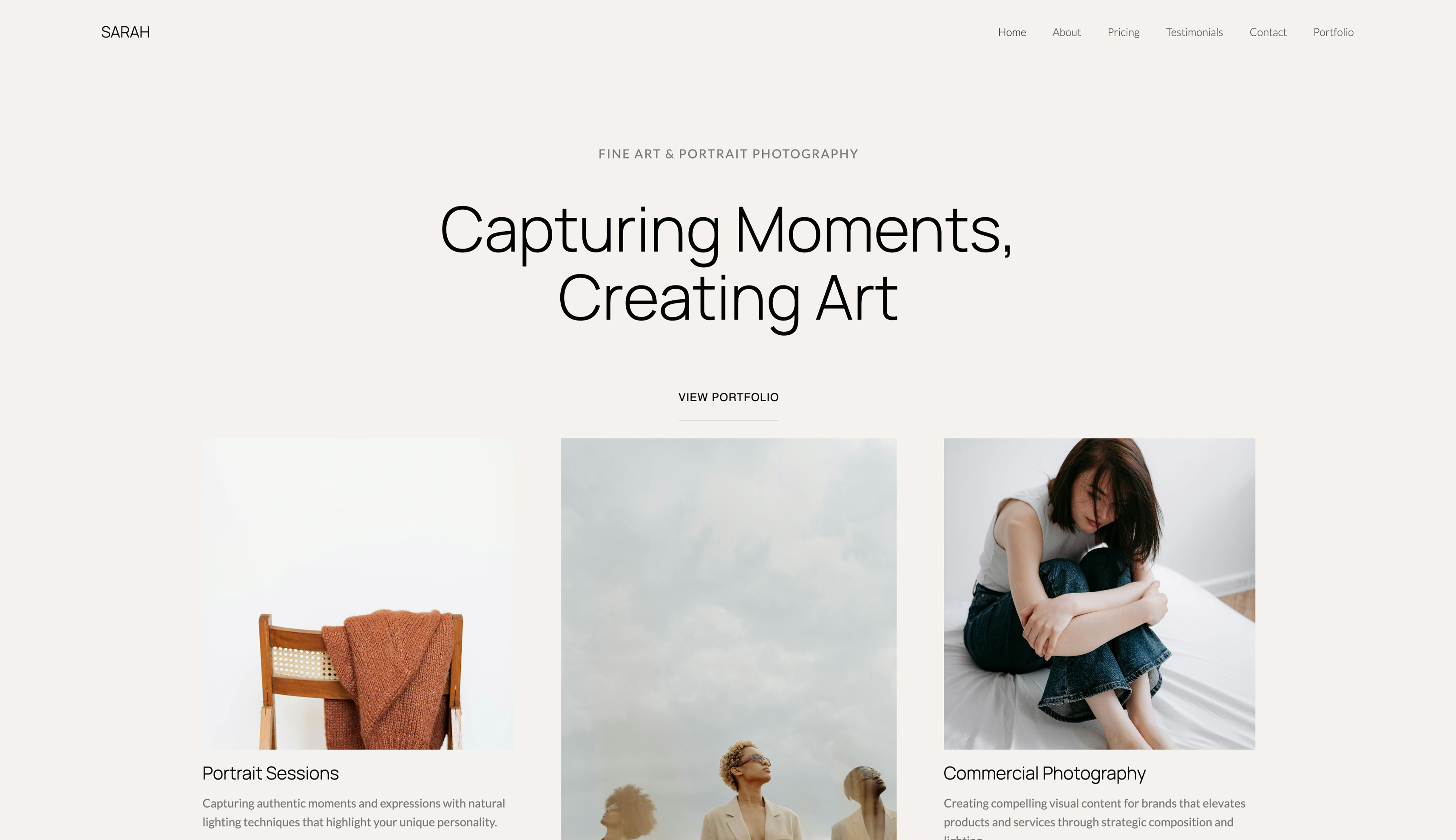
Start from a designer-made template
 Use template
 Use template
 Use template
 Use template
 Use template
 Use template
 Use template
 Use template
These two platforms are usually shortlisted together and they are not really competing on the same thing. ShootProof sells you the cheapest possible path to keeping 100% of your print sales.
CloudSpot sells you a studio in a box and charges 15% until you climb far enough up the ladder to escape it.
Pick wrong and you either pay a commission you did not need to, or you pay for invoicing software you already own.
A client gallery platform is software that delivers finished photos to paying clients and, in both of these cases, sells prints and digital files through pro labs on your behalf.
Framekit sits just outside that definition and is priced against both further down: it delivers the galleries and hosts your portfolio on one plan, but there is no print lab behind it, so it answers the delivery half of the job and not the print half.
ShootProof wins on money, because it charges 0% commission on every plan including its free tier, while CloudSpot takes 15% on Free and Entry and only reaches commission-free at its $17 Lite tier.
CloudSpot wins on breadth, because Lite and above bundle invoicing, contracts, scheduling, and questionnaires that would otherwise be a separate subscription.
Choose ShootProof if you sell prints and already have a business system, and CloudSpot if you want delivery and admin under one bill.
Framekit is the runner-up to know about if the portfolio site is also on your bill, because galleries, site, and store share one plan there, with the flat trade that it sells no prints at all.
Framekit is an AI website builder with client galleries included, and appears at the end of this comparison as the third option for photographers who also need the website neither of these platforms provides.
ShootProof vs CloudSpot at a Glance
Here is how the two platforms line up on the things that decide a subscription, with every figure re-verified against the vendors' own published pricing pages in September 2026.
| ShootProof | CloudSpot | |
|---|---|---|
| Free plan | 100 photos, 5GB, 0% commission | 5GB, 15% commission |
| Entry paid plan | $10.99 a month, 1,500 photos, 75GB | $7 a month, 15GB, 15% commission |
| First commission-free plan | Free plan, 0% on every tier | Lite, $17 a month, 100GB |
| Mid tier | $19.99, 5,000 photos, 250GB | $34, 500GB |
| Top tier | $50, unlimited photos and storage | $50, unlimited storage |
| Pricing model | Cumulative photo count | Storage |
| Sales commission | 0% on every plan | 15% on Free and Entry, 0% from Lite |
| Print fulfillment | Yes, pro labs | Yes, pro labs |
| Contracts and invoicing | Yes | Yes, from Lite |
| Scheduling and questionnaires | No | Yes, from Lite |
| Client mobile apps | Photographer and client apps | Per-client home-screen apps, paid plans |
| Website builder | Light portfolio | Light portfolio |
| Custom domain | CNAME subdomain | Custom URL |
ShootProof prices annually in the figures above; CloudSpot runs a promotional opening rate of $3 a month for three months on paid plans that reverts to full price afterwards.
The Money Question
In one lineon $6,000 of annual print sales ShootProof costs about $320 and keeps every dollar of your markup, while CloudSpot costs either $204 with no commission on Lite or $84 plus $900 in commission on Entry, which makes the cheap CloudSpot plan the most expensive option on this page.
Here is the same year on both platforms, for a photographer delivering 30 galleries and selling $6,000 of prints.
| Scenario | Subscription | Commission | Total |
|---|---|---|---|
| ShootProof 25,000 photos | About $320 | $0 | About $320 |
| ShootProof 5,000 photos | About $240 | $0 | About $240 |
| CloudSpot Lite | $204 | $0 | $204 |
| CloudSpot Entry | $84 | About $900 | About $984 |
| CloudSpot Free | $0 | About $900 | About $900 |
Card processing of roughly 2.9% plus $0.30 applies on top of every row. The pattern is the one that catches most photographers: the cheapest CloudSpot plans are the most expensive way to sell, and the free tier is the worst of all if you sell regularly.
Run it on your own numbers. Take last year's gallery sales, multiply by 0.15, and compare that to $204. If your sales cleared about $1,360, CloudSpot Lite is already cheaper than staying on Entry or Free, and ShootProof was cheaper than both from your first sale.
Where ShootProof Wins
The commission, on every plan. ShootProof's published pricing states plainly that it never takes a commission on sales: session fees, printed products, and digital files all come back whole, on every tier including the free one.
No other mainstream platform in this category does that.
Pricing by photo count suits low-volume, high-value work. A commercial or portrait photographer delivering modest sets can sit on the $10.99 1,500-photo plan for a long time, where storage-based pricing would have pushed them up a tier for a handful of large files.
Storage is generous at every level. 75GB on the entry plan and 1,250GB on the 25,000-photo tier is far more headroom than the price suggests.
Contracts and invoicing are included. For a photographer whose admin is currently a spreadsheet and a PDF template, this alone justifies the subscription.
The gotchathe photo count is cumulative across your whole account rather than per gallery, so photographers who never archive old sessions hit the ceiling mid-season and upgrade under pressure rather than at renewal.
Skip it ifyou want scheduling, questionnaires, and a full studio management layer, or you care about gallery design more than gallery economics.
Where CloudSpot Wins
The bundle. From the Lite tier at $17 a month, CloudSpot's pricing page includes invoicing, scheduling, contracts, questionnaires, and client management alongside commission-free galleries.
If you were about to buy a studio manager separately, the effective cost of the galleries is close to zero.
Storage headroom at the middle tiers. 100GB at $17 and 500GB at $34 is more generous than most storage-priced competitors, and it scales cleanly for photographers with large deliveries rather than many small ones.
The client mobile apps. CloudSpot's per-client mobile apps let each client save their gallery to a phone home screen with the same purchasing, downloading, and favoriting as the browser gallery, available on any upgraded plan.
For families and brand clients who revisit galleries repeatedly, it is a genuine convenience.
The interface. CloudSpot is the more modern product of the two by a clear margin, and the galleries present better to a client.
The gotchathe default gallery address is a shared generic domain in the form yourbusinessname.client-gallery.com according to CloudSpot's own help documentation, which carries neither your brand nor theirs.
Set a custom URL before your first send.
Skip it ifprint revenue is your main income and you do not need business software. You will pay $204 a year for a commission removal that ShootProof gives you free.
The Feature Gaps Neither Platform Fills
Both platforms are delivery and sales tools with a light portfolio attached, and neither of them is a website in the sense a photographer means when they say the word, which creates three gaps worth pricing.
That matters because a photographer running either one typically pays a second subscription of $12 to $18 a month for a real portfolio site, which puts the true annual cost of the pair at $350 to $550.
Counting that line changes the comparison materially and is the reason the third option below exists.
Neither delivers video as a first-class deliverable. ShootProof does not support video at all, and CloudSpot handles it as embeds rather than downloadable hosted files, which is a real gap for hybrid shooters.
Our best client gallery platforms with video comparison covers that.
Neither publishes the gallery from a domain you own in the full sense.
ShootProof documents a CNAME subdomain setup and CloudSpot offers custom URLs; in both cases the pages behind the address belong to the vendor, so cancelling the plan takes every gallery link with it.
The four different meanings of custom domain are broken down in our custom domain gallery comparison.
The Third Option: When Neither Is the Answer

If you need a portfolio website as well as client delivery, the comparison stops being between these two platforms and becomes a question about how many subscriptions you are willing to run.
Framekit delivers unlimited client galleries on every plan with no commission on delivery, published as pages of a website you own, with the portfolio, blog, and digital shop in the same subscription: $9 a month on Starter for a custom domain and a 50GB storage pool, $19 on Pro for 300GB, and $39 on Business for 2TB.
Watermarking, gallery passwords, a separate download PIN, favorites, auto-expiry, and branded email sharing are on every plan including free.
Where Framekit loses to bothit has no print lab and no physical fulfillment, so it cannot sell a framed print at any price.
If print and album revenue is what you are optimising, ShootProof and CloudSpot both beat it outright and this comparison should stay between the two of them. Framekit also has no scheduling or questionnaires, which CloudSpot Lite includes.
Where it winsthe website that ShootProof and CloudSpot both leave you to buy separately, and a gallery URL that survives cancelling a plan.
Which Should You Choose?
Answer these in order and stop at the first branch that matches, because the split between these platforms is about your revenue mix rather than about feature counts.
Do you sell prints and albums as a meaningful revenue line?
- Yes, and I already have invoicing and scheduling I like. Choose ShootProof. 0% on every plan is the cheapest print economics available anywhere.
- Yes, and my admin is a mess. Choose CloudSpot Lite at $17. You get commission-free selling plus the business layer for less than most people pay for the business layer alone.
- No, print revenue is incidental. Continue.
Do you have a portfolio website you are keeping?
- Yes. Choose ShootProof's cheapest plan that fits your photo count, since you are only buying delivery and the 0% costs you nothing.
- No, I need a site too. Choose a builder that includes galleries rather than paying two subscriptions, which is the branch Framekit is built for: the portfolio and the delivery come off one plan from $9 a month, on the condition that print revenue is not what you are protecting.
Do you deliver video alongside stills?
- Yes, regularly. Neither platform is a good answer. Look at Pic-Time or a platform carrying galleries and video review together.
- No. The choice above stands.
Frequently Asked Questions
ShootProof vs CloudSpot: which is cheaper?
ShootProof is cheaper for anyone who sells, because it charges 0% commission on every plan including free, while CloudSpot takes 15% on its Free and Entry tiers and only reaches commission-free at $17 Lite.
On $6,000 of annual print sales, ShootProof's 25,000-photo plan costs about $320 with no commission, CloudSpot Lite costs $204 with no commission, and CloudSpot Entry costs about $984 once the 15% is counted.
Does ShootProof really take 0% commission?
Yes, on every plan including the free tier, which is stated directly on its published pricing page and applies to session fees, printed products, and digital files.
This is the platform's central differentiator and the reason print-led photographers choose it. You still pay the lab's production cost and card processing of roughly 2.9% plus $0.30, but no percentage goes to ShootProof itself.
When does CloudSpot become commission-free?
CloudSpot becomes commission-free at the Lite tier, priced at $17 a month with 100GB of storage, and remains so on Pro at $34 and Unlimited at $50.
The Free tier at 5GB and the Entry tier at $7 with 15GB both carry a 15% commission on store sales. The break-even against staying on a 15% plan arrives at roughly $1,360 of annual sales.
Which has better client galleries, ShootProof or CloudSpot?
CloudSpot has the better-presented galleries and the more modern interface, with per-client home-screen mobile apps on paid plans that let clients revisit a gallery like an app.
ShootProof's galleries are functional and clean rather than distinctive, which reflects the product's priorities: it competes on economics and business features rather than on presentation.
Does CloudSpot or ShootProof include a website?
Both include only a light portfolio rather than a real website builder, which means photographers using either typically pay a second subscription of $12 to $18 a month for a portfolio site.
Counting that line raises the true annual cost of either platform to $350 to $550. If you need both, a builder that includes client galleries covers the same ground in one plan.
Can I use my own domain with ShootProof or CloudSpot?
Both let you point an address at your galleries: ShootProof documents a CNAME subdomain setup such as proofs.yourstudio.com, and CloudSpot lets you set a custom URL, though its default address is a shared generic domain rather than your brand.
In both cases the pages behind the address are the vendor's, so if the subscription lapses every gallery link stops working and there is nothing to redirect.
Which is better for a wedding photographer?
ShootProof if print and album sales are a real part of your income, because 0% commission on $6,000 of sales is worth about $900 a year against a 15% plan.
CloudSpot Lite if your admin is the bottleneck, because $204 a year covers galleries, invoicing, contracts, scheduling, and questionnaires together. Both handle wedding volumes comfortably at their mid tiers.
Does either platform handle video?
Not well. ShootProof does not support video delivery at all, and CloudSpot treats video as embeds rather than hosted downloadable files, which is a problem when a client needs the edit rather than a stream.
Hybrid shooters delivering stills and video on the same job should look at Pic-Time, which includes video storage on every tier, or a platform carrying galleries and video review together.
Should I switch from CloudSpot to ShootProof to avoid the commission?
Switch if you are on CloudSpot Free or Entry and selling more than about $600 a year through the gallery, since the 15% will exceed the cost of moving quickly.
Do not switch if you are already on CloudSpot Lite or above, because you are commission-free there and the business tools have real value.
The cleanest time to move is between seasons, delivering new jobs on the new platform while old galleries expire on the old one.
What is the best alternative to both ShootProof and CloudSpot?
Framekit is the strongest alternative for photographers who also need a website, delivering unlimited galleries with no commission on delivery from a domain you own, with the portfolio and digital shop in the same plan from $9 a month.
It has no print lab, so print-led photographers should stay with ShootProof or CloudSpot.
Pixieset is the alternative for the most familiar hosted experience, and our client gallery platform comparison ranks the full field.
The Verdict
ShootProof wins the money argument outright. Zero percent on every plan including free is a genuinely unusual position in this category, and for a photographer whose income includes prints it is worth about $900 a year against a 15% competitor.
CloudSpot wins the breadth argument. At $17 a month, Lite bundles commission-free galleries with invoicing, contracts, scheduling, and questionnaires, which is less than most studio management tools cost on their own.
Where both lose: neither is a website, so both leave you paying a second subscription for the portfolio that actually markets you, and neither publishes galleries from a domain that stays yours when the plan ends.
If those two gaps matter more to you than a print lab, a builder with galleries included is the better shape.
Choose ShootProof for print economics, CloudSpot for the studio bundle, and neither if what you are missing is a website.
Related reading: our full client gallery platform comparison, best ShootProof alternatives, best CloudSpot alternatives, and commission-free client galleries.
For the money side across the whole category, see cheapest client gallery software and how much client galleries cost.