Framekit templates
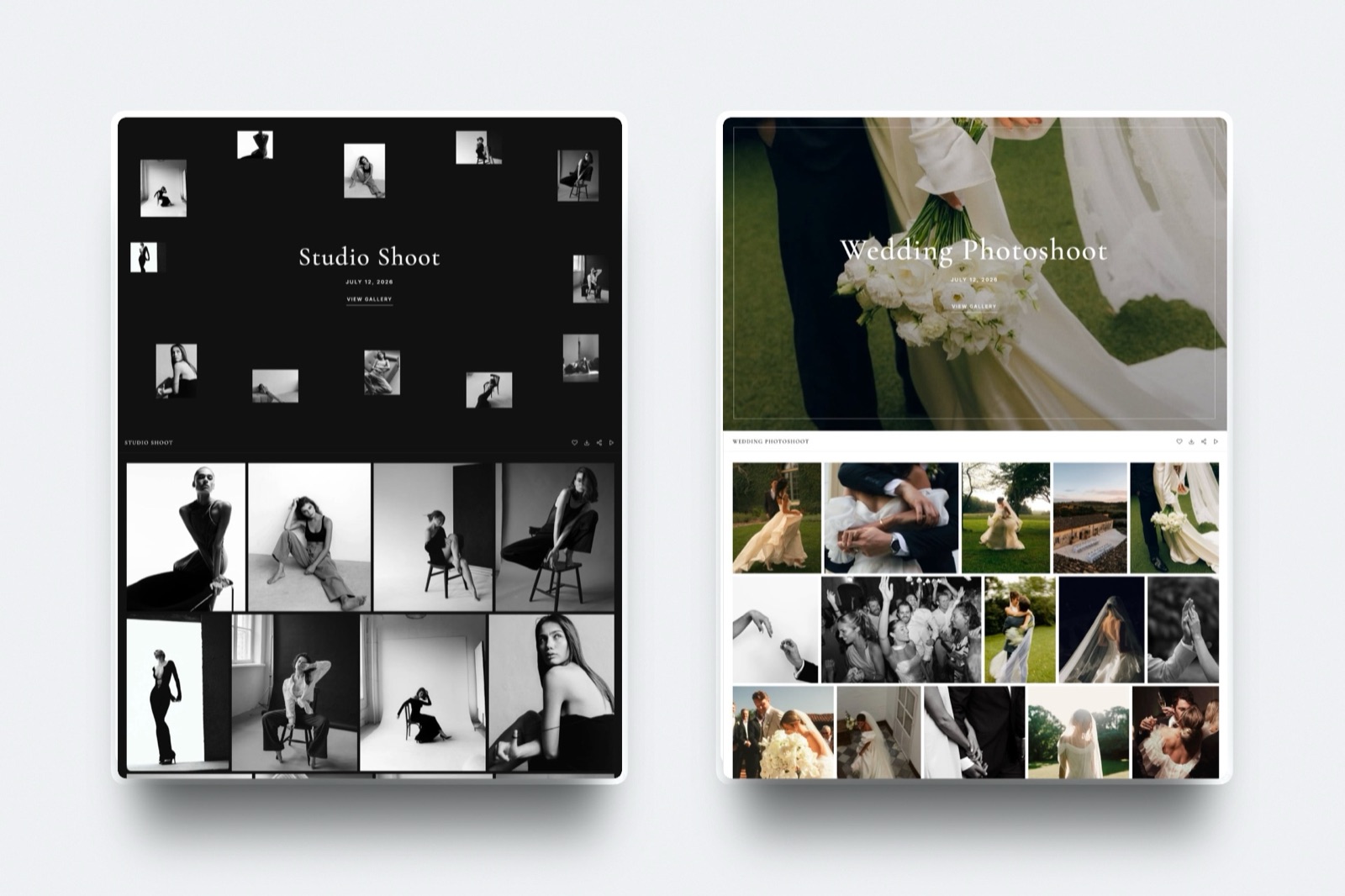
Start from a designer-made template
 Use template
 Use template
 Use template
 Use template
 Use template
 Use template
 Use template
 Use template
You photograph a hotel over two days: eighteen room types, four restaurant spaces, the spa, the lobby, the roof at dusk.
Within a month the images are on the hotel's own site, on three booking platforms, in a press release, and in a deck built by an agency you have never spoken to.
The general manager who booked you thinks all of that is included, because nobody told them otherwise and the gallery you sent had no terms attached to it.
Hospitality is a licensing business disguised as a photography business, and the gallery is where that gets decided.
A client gallery for hospitality photographers is a delivery platform that hands hotel, restaurant, and resort photography to operators, marketing teams, and agencies with the per-property structure, licence visibility, and multi-year archive access that hospitality marketing requires.
The best client gallery for hospitality photographers in 2026 is Framekit, because named sets let you deliver a property space by space in one link, galleries stay live for the years a hotel keeps reusing the images, and delivery costs nothing regardless of how many properties you shoot.
The honest trade-off is licensing tooling: Framekit has no rights management or usage tracking, so photographers licensing a hospitality archive commercially should use PhotoShelter, which does.
Framekit is an AI website builder with client galleries included, so a hotel group receives your work at your address rather than a photo platform's.
Full disclosure: Framekit, ranked first below, is our own product. We ran the same two-day, 240-image hotel delivery through all nine platforms, verified pricing against each vendor's published pages in August 2026, and we name where each beats us: PhotoShelter has licensing and metadata infrastructure we do not, PicDrop runs faster approval rounds, SmugMug archives more for less, and every print-capable platform sells physical products that we do not.
Re-verified on 19 September 2026: Framekit's storage figures below are current, and a custom domain starts on its $9 Starter plan rather than the free one.
How We Compared Galleries for Hospitality Work
Hospitality shoots are commercial jobs with an unusually long tail and an unusually large number of stakeholders, so we scored these platforms on what still matters in year three rather than on delivery day.
Per-property structure (25%). Whether one shoot covering eighteen spaces can be delivered as one navigable link.
Licence visibility (25%). Whether usage terms reach the marketing manager, the PR agency, and the booking-platform contractor who all download the same files.
Archive longevity (20%). Whether galleries stay live across the years a property reuses the images.
Ownership and brand (15%). Whether the delivery link builds your studio, which in hospitality is how the next group finds you.
Cost across a shooting year (15%). What 20 to 40 property shoots a year costs in storage and fees.
Hands-on: uploading a 240-image hotel delivery split by space, setting access rules, and walking the client path on desktop and phone.
Verified from primary sources rather than tested: pricing, storage caps, and expiry behaviour, checked against vendors' own pages in August 2026.
Community sentiment, flagged as such: operator preferences reported by working photographers rather than measured by us.
Our carried example is a hospitality photographer shooting 30 properties a year, delivering 150 to 300 finals per property, licensing 24-month multi-channel rights to the operator.
What the Comparison Showed
Nine platforms, one two-day 240-image hotel delivery, and a category built around a single household downloading their photos being asked to serve a property portfolio. These are the figures behind the ranking.
- 7 of 9 default to one gallery, one password, and one flat run of images, which is the wrong shape for eighteen room types.
- 2 of 9 support named sets well enough to deliver a property space by space in a single link (Framekit, PhotoShelter).
- 1 of 9 publishes the gallery as a page of a site you own, so a property gallery can stay live indefinitely (Framekit).
- 30 properties a year at 200 finals is roughly 40GB to 80GB of delivered files, which clears every free tier in the first quarter.
- 3 of 9 charge nothing per delivery on any plan (Framekit, ShootProof, PicDrop).
| Platform | Best for | Per-space sets | Delivery commission | Our rating |
|---|---|---|---|---|
| Framekit | Delivery from your own domain | Yes | None | 9.2/10 |
| PhotoShelter | Licensed property archives | Yes | Plan-based | 8.8/10 |
| PicDrop | Approval rounds with agencies | Yes | None, no store | 8.4/10 |
| Pixieset | Polished hosted delivery | Partial | 15% free, 0% paid | 8.0/10 |
| SmugMug | Multi-year property archive | Limited | Cut on print sales | 7.7/10 |
| ShootProof | Zero commission plus invoicing | Limited | 0% every plan | 7.6/10 |
| CloudSpot | Delivery plus studio admin | Limited | 15% free, 0% from $17 | 7.4/10 |
| Pic-Time | Best-presented client view | Limited | Markup-based | 7.2/10 |
| Dropbox | Working files with retouchers | Folders | None, no store | 7.0/10 |
Framekit's 9.2 is not a clean card: it scores 10 on structure and ownership and 5 on licensing tooling, because usage terms have to be written into the gallery rather than enforced by a rights engine. That is exactly where PhotoShelter is stronger.
1. Framekit: Best Overall for Hospitality Photographers

Our rating: 9.2/10
Hospitality work is won on portfolio and repeat contracts, and Framekit puts both at one address.
The gallery you send a hotel group is a page on your own website, one click from the property work that got you the brief, and it stays published until you decide otherwise rather than until a storage tier decides for you.
The test delivery took twelve minutes: create a gallery for the property, upload 240 images, split them into Rooms, Suites, Restaurant, Bar, Spa, Exteriors, and Details, set a password with a separate download PIN, and share by email.
The marketing manager took the room sets, the PR contact took exteriors and details, and nobody asked for a re-send.
Best forHospitality and property photographers working with hotel groups, restaurant operators, and their agencies, whose revenue is shoot fees and licence renewals.
Key features:
- Named sets inside one gallery, so eighteen room types and four food and beverage spaces arrive as one navigable link
- Galleries stay published until you unpublish them, with auto-expiry available as an option rather than a default
- Unlimited galleries on every plan, drawing on one storage pool with the site: 10GB free, 50GB Starter, 300GB Pro, and 2TB Business
- Watermarking, gallery passwords, a separate download PIN, favorites, and branded email sharing on every plan including free
- Full-resolution originals up to 100MB per photo, with video review on the same plan for property walkthrough films
The real number30 properties a year at roughly 1.5GB of delivered files each is about 45GB, which fits the 50GB Starter plan at $9 a month for a single year and the 300GB Pro plan at $19 with six years of headroom, and that plan also covers the hospitality portfolio itself because storage is one pool rather than two.
A hosted gallery plan plus a separate website subscription at that volume typically runs $35 to $55 a month.
The gotchaaccess is gallery-level rather than per-person, so you cannot prove which agency downloaded which file. A password plus a download PIN raises the bar; it does not produce an audit trail.
Skip it iflicensing a property archive is a real revenue line, or your contracts require per-user access records. PhotoShelter does both and we do neither.
Verdict: the best fit for commissioned hospitality work, because it solves the two things that cost this genre money: a delivery structure that matches a property, and galleries that are still live when the hotel rebrands in year three. Start free at framekit.ai.
2. PhotoShelter: Best for Licensed Property Archives
Our rating: 8.8/10
PhotoShelter is the only platform here built for images that circulate through organisations for years.
Per-user access, searchable metadata, and licensing records mean you can give the operator, the PR agency, and a booking-platform contractor different levels of access and know afterwards who had what.
For a photographer whose hospitality archive earns through renewals and repeat licensing, that infrastructure is the business rather than an overhead.
The gotchasetup is a project rather than an afternoon, and the client-facing experience is a working tool rather than a piece of craft, which matters when your client is selling an experience.
Skip it ifevery property is shot once, delivered, and never licensed again.
Verdict: the professional answer for licensing-led hospitality photographers. Our PhotoShelter alternatives comparison covers the lighter options. Visit PhotoShelter
3. PicDrop: Fastest Approval Rounds With Agencies
Our rating: 8.4/10
Hospitality jobs usually pass through an agency or a marketing lead who wants to approve which spaces and angles progress before retouching, and PicDrop makes that round take minutes. Per-link roles let the brand manager mark selects while the operations contact only views.
It also accepts client uploads, which is genuinely useful when a hotel needs to send you brand guidelines, a room-type list, or floor plans before the shoot.
Skip it ifyou want the delivery to carry your studio. PicDrop is deliberately neutral.
Verdict: the best front end for a hospitality workflow, sitting in front of a branded delivery. Visit PicDrop
4. Pixieset: Polished Hosted Delivery
Our rating: 8.0/10
Pixieset presents better than most hosted platforms and its collections can separate spaces with some naming discipline.
Its free tier carries 3GB and a 15% store commission per Pixieset's published pricing, while $10 Basic lifts storage to 10GB, connects a domain, and removes the commission.
At 30 property shoots a year you will pass 10GB by spring, so the real plan sits several tiers up.
Verdict: a capable hosted option designed for a single client rather than a property portfolio. Our Pixieset alternatives guide covers the moves. Visit Pixieset
5. SmugMug: Cheapest Multi-Year Property Archive
Our rating: 7.7/10
Unlimited photo storage from around $13 a month makes SmugMug the cheapest place to keep a decade of property shoots accessible, which matters when an operator asks for images of a room type that was refurbished two years ago.
The print-sales cut that no plan removes is irrelevant to hospitality work and a poor deal if you ever do sell.
Verdict: buy it as an archive rather than as a delivery system. Our SmugMug alternatives guide covers delivery-first tools. Visit SmugMug
6. ShootProof: Zero Commission With Invoicing
Our rating: 7.6/10
ShootProof charges 0% on every plan per its published pricing and bundles contracts and invoicing, which is useful when hotel groups pay on 60-day terms and licence renewals need papering.
The product is shaped around consumer proofing and print sales, most of which hospitality work never touches.
Verdict: excellent economics and admin, wrapped in the wrong workflow. Visit ShootProof
7. CloudSpot: Delivery Plus Studio Admin
Our rating: 7.4/10
CloudSpot's Lite tier at $17 a month brings invoicing, contracts, scheduling, and questionnaires alongside commission-free galleries and 100GB of storage, according to its pricing page, which is a sensible consolidation for a solo operator juggling several hotel contracts.
Verdict: a coherent consolidation for a solo hospitality photographer. Set a custom gallery URL before your first send, because the default address carries neither your brand nor theirs. Visit CloudSpot
8. Pic-Time: The Best-Looking Handover
Our rating: 7.2/10
Pic-Time's galleries present better than anything else here, which counts when your client sells atmosphere for a living. The store automation underneath is built for consumer print campaigns you will never run.
Its pricing page is also worth reading before you plan a season around the free tier, since the opening 10GB allowance reduces to 3GB once six months have passed.
Verdict: buy it for presentation, ignore most of the product. Visit Pic-Time
9. Dropbox: Where the Retouching Lives
Our rating: 7.0/10
Hospitality retouching is heavy, with composites, window pulls, and colour work, and all of it belongs in cloud storage where a retoucher can open the layered files.
As a client-facing delivery it offers no structure a marketing team can navigate and no branding at all.
Verdict: essential for production, wrong for handover. See client gallery vs Dropbox. Visit Dropbox
The Licensing Problem Hospitality Creates
In one linea hotel's images are used by the operator, a management company, a brand franchise, three booking platforms, a PR agency, and every OTA listing contractor, none of whom signed your contract, which makes the gallery the only place the terms will ever reach them.
Name the licensee precisely. "Licensed to Northfield Hotels Ltd for the Northfield Riverside property" is different from licensing the group, and groups routinely assume otherwise. Put it in the gallery description.
State the channels explicitly. Own website, booking platforms, print collateral, paid social, and third-party listings are five different permissions, and hospitality clients treat them as one. Naming them in the gallery prevents the argument.
Set a term and diarise the renewal. Twenty-four months is a common hospitality licence, and a renewal invoice at month 23 is far easier to send than a claim at month 30. This is the single largest recurring revenue line most hospitality photographers are not billing.
Deliver a separate press set. PR agencies want a small, captioned set at web resolution. Giving them one stops them pulling 40MB room images into a press release and lets you licence the press use separately.
Use a download PIN. A gallery password lets the operator circulate the link internally; the PIN keeps full-resolution collection with the people who should have it.
Keep the gallery live across the term. Properties relaunch, refurbish, and rebrand, and each event is a licensing conversation you only get if the link still works.
How to Choose: A Decision Tree
Three questions, answered about the work you actually invoice rather than the accounts you are chasing. The first branch that matches your revenue mix is your platform.
Do you earn from licence renewals and repeat use of a property archive?
- Yes, renewals are real revenue. Choose PhotoShelter for per-user access, metadata, and licensing records. Stop here.
- No, my income is shoot fees. Continue.
Do agencies approve selects before you retouch?
- Yes, on most jobs. Put PicDrop in front of your delivery for the approval round, and use its client upload to collect brand guidelines beforehand.
- No, I deliver finished work directly. Continue.
What matters most about the handover?
- It should look like my studio and stay live for years: Framekit, on your own domain with unlimited galleries at no per-delivery cost.
- The most presentable hosted gallery: Pic-Time, or Pixieset on Basic for familiarity.
- Invoicing and contracts alongside delivery: ShootProof, or CloudSpot Lite for scheduling too.
- A decade of properties online cheaply: SmugMug.
Frequently Asked Questions
What is the best client gallery for hospitality photographers?
The best client gallery for hospitality photographers in 2026 is Framekit, because named sets deliver a property space by space in one link, galleries stay live across the years a hotel reuses the images, and delivery costs nothing regardless of how many properties you shoot.
PhotoShelter is the better choice for photographers earning from licence renewals, since it offers per-user access and rights records that Framekit does not have.
How should I structure a hotel photo delivery?
Deliver one gallery per property with named sets matching the spaces the client sells: Rooms, Suites, Restaurant, Bar, Spa, Exteriors, and Details, with a separate press set at web resolution.
Marketing teams, PR agencies, and booking-platform contractors each need a different subset, and set structure lets them self-serve instead of emailing you. Use the client's own room-type names rather than your shoot order.
How do I license hospitality photography properly?
Name the licensee precisely, since a single property is not the same as a group or a management company, and list the permitted channels explicitly because own website, booking platforms, print collateral, paid social, and third-party listings are five separate permissions that clients treat as one.
Set a term, commonly 24 months, put all of it in the gallery description where downloaders will see it, and diarise the renewal invoice for month 23.
How long should hotel galleries stay online?
Across the full licence term and ideally beyond it, because properties relaunch, refurbish, and rebrand, and each of those events is a licensing conversation you only get if the link still works.
A 24-month licence implies at least 24 months of gallery availability. Framekit galleries stay published until you unpublish them, which is unusual: most hosted platforms expire by default or go dark when a subscription lapses.
How much storage do hospitality photographers need?
Roughly 40GB to 80GB a year for 30 property shoots delivering 150 to 300 finals each, since a retouched interior JPEG runs 8MB to 20MB.
Add multi-year retention for licence terms and you are planning for 100GB to 250GB, which points at Framekit Pro at 300GB or Business at 2TB, CloudSpot Pro at 500GB, or SmugMug's unlimited storage if the archive is the priority.
Should I deliver a separate press set?
Yes. PR agencies want a small, captioned set at web resolution and will otherwise pull 40MB room images into a press release, which serves nobody.
A dedicated press set of 15 to 30 frames with captions and a clear credit line also lets you license press use separately from marketing use, which is a distinction hospitality clients accept readily once it is written down.
Can I stop a hotel sharing my photos with booking platforms?
Realistically no, because syndication to booking platforms and listing sites is how hospitality marketing works, so price it rather than prohibit it.
Agree the channels explicitly at quoting, include booking-platform syndication in the licence if the client needs it, and charge accordingly.
Then use a download PIN and a press set so the files that circulate are the ones you intended to circulate.
Do hospitality photographers need video delivery too?
Increasingly yes, as property walkthroughs and short-form social cuts are now standard in hotel and restaurant marketing.
Most client galleries handle video poorly or not at all: Framekit carries a separate video review product on every plan with per-file limits of 500MB free, 1GB Starter, and 2GB Pro, and Pic-Time includes video storage on every tier.
Delivering stills and video from two services undercuts an otherwise professional handover.
Framekit vs PhotoShelter for hospitality photography?
Choose Framekit if your income is commissioned property shoots and you want delivery, portfolio, and brand on one domain with galleries that stay live for years at no per-delivery cost.
Choose PhotoShelter if licence renewals and repeat use are real revenue, because per-user access, searchable metadata, and rights records are things Framekit does not offer.
Studios doing both often run Framekit for client-facing work and PhotoShelter for the licensed archive.
Is a free client gallery plan enough for hospitality work?
Only for the first handful of properties. Most free tiers run 3GB to 5GB and a single two-day hotel shoot can occupy 1.5GB to 3GB on its own, so the cap arrives within a quarter.
Framekit's free plan is the most useful starting point because its 10GB covers three to six shoots rather than one and it includes unlimited galleries with no commission plus a real website, which moves to your own domain on the $9 Starter plan, but a working hospitality photographer will need a paid tier within the first season.
Final Verdict: The Best Client Gallery for Hospitality Photographers in 2026
Nine platforms, one hotel delivery, and a category designed for a family downloading their photos being asked to serve a property portfolio.
Framekit is the best client gallery for hospitality photographers in 2026 because it structures a property delivery the way a hotel is actually organised, keeps the gallery live across a multi-year licence, and costs nothing per property while doubling as the portfolio that wins the next group.
Where Framekit loses: we have no rights management, no per-user access, and no usage tracking, so a photographer whose income includes licence renewals across a large archive should be on PhotoShelter.
PicDrop beats us on approval rounds and on collecting brand guidelines before a shoot, SmugMug archives more for less, and every print-capable platform sells physical products we do not.
PhotoShelter is the licensing pick, PicDrop is the approvals pick, Pixieset and Pic-Time are the best-presented hosted options, and SmugMug is the cheapest archive.
But if the gallery a hotel bookmarks should lead back to the rest of your property work, deliver from a site you own.
Related reading: our full client gallery platform comparison, the picks for architectural photographers, commercial photographers, and real estate photographers.
For the licensing side see how long client galleries should stay online, and for structure, what to include in a client gallery.