Framekit templates
Start from a designer-made template
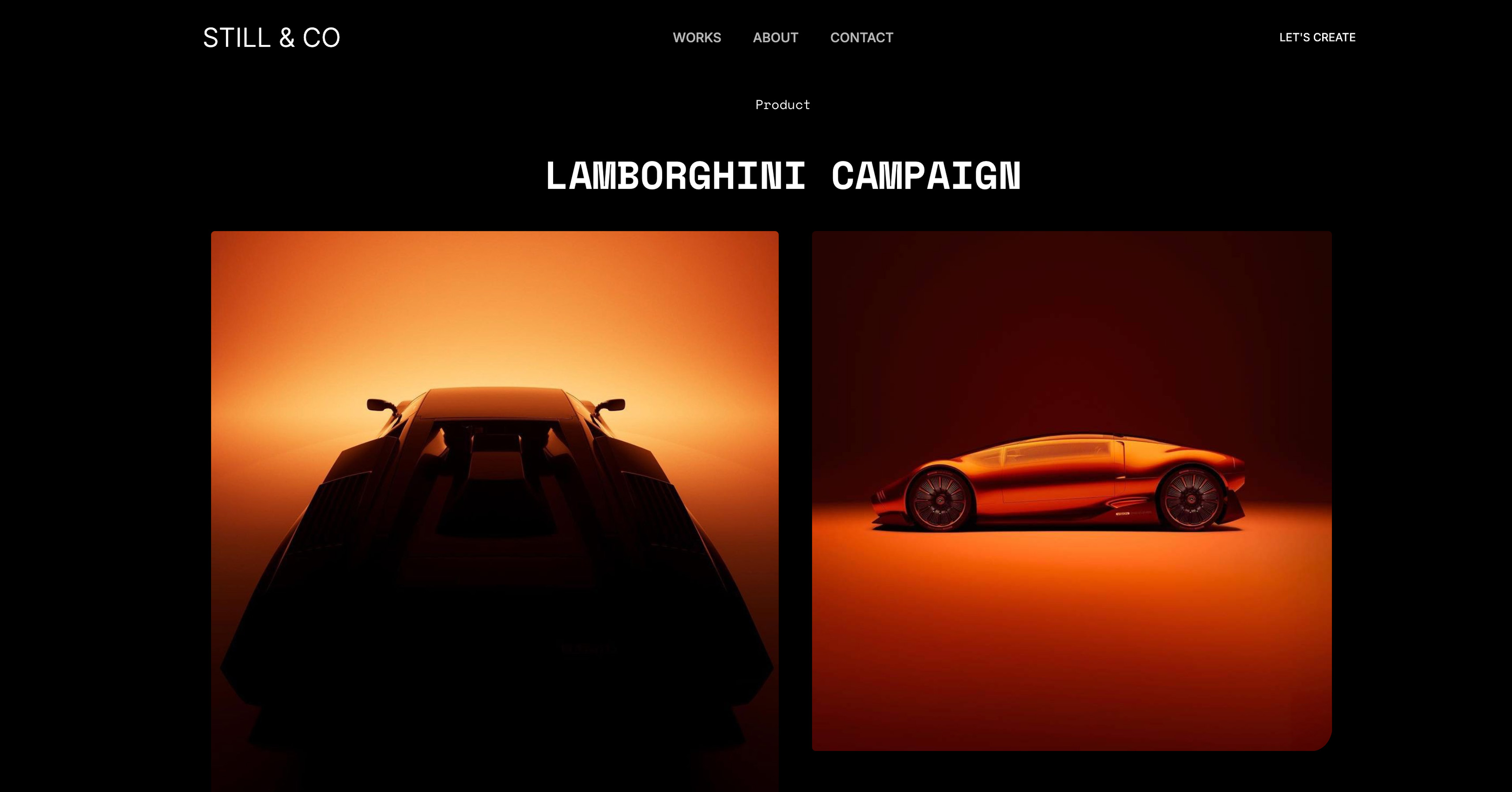 Use template
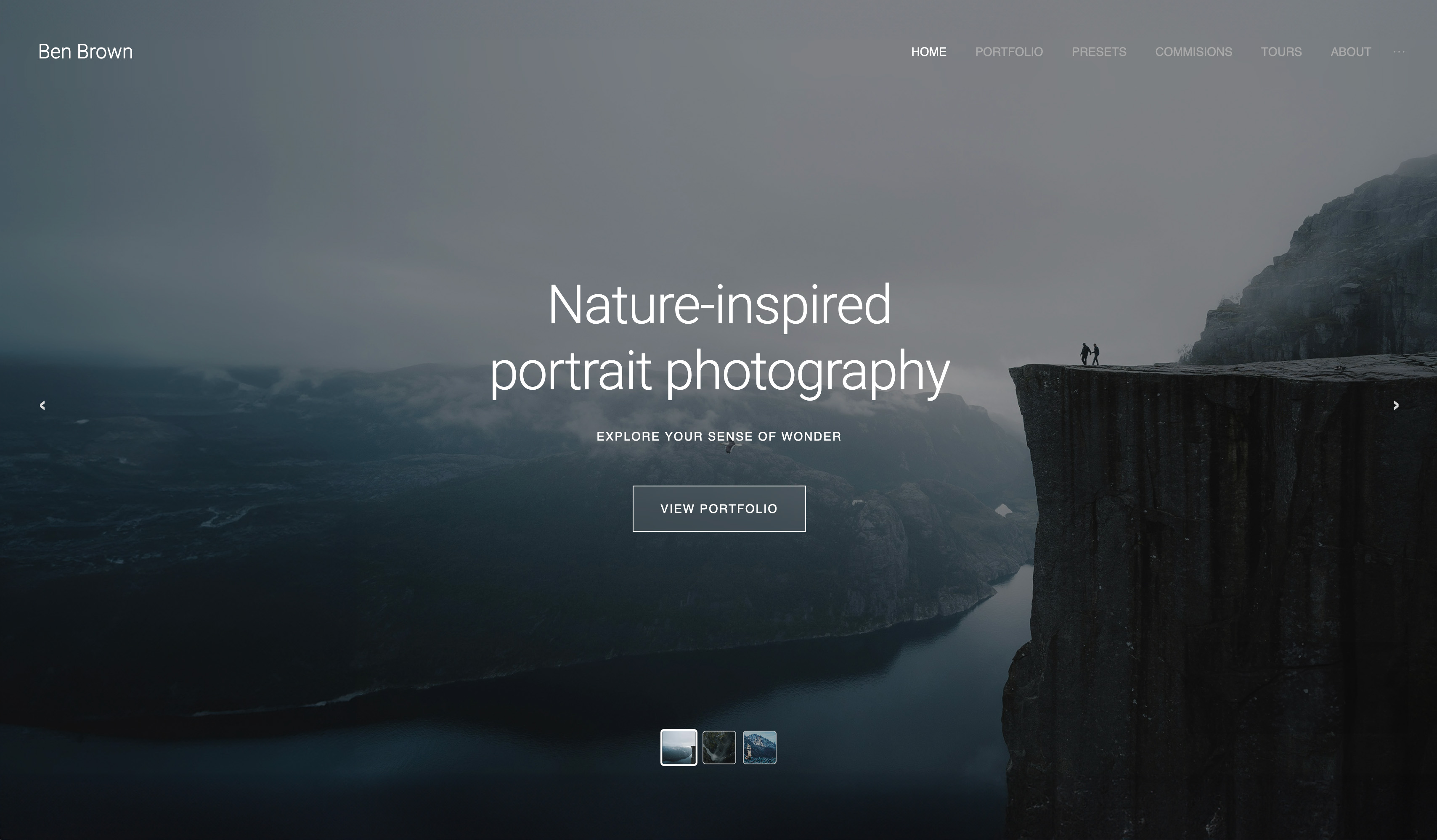 Use template
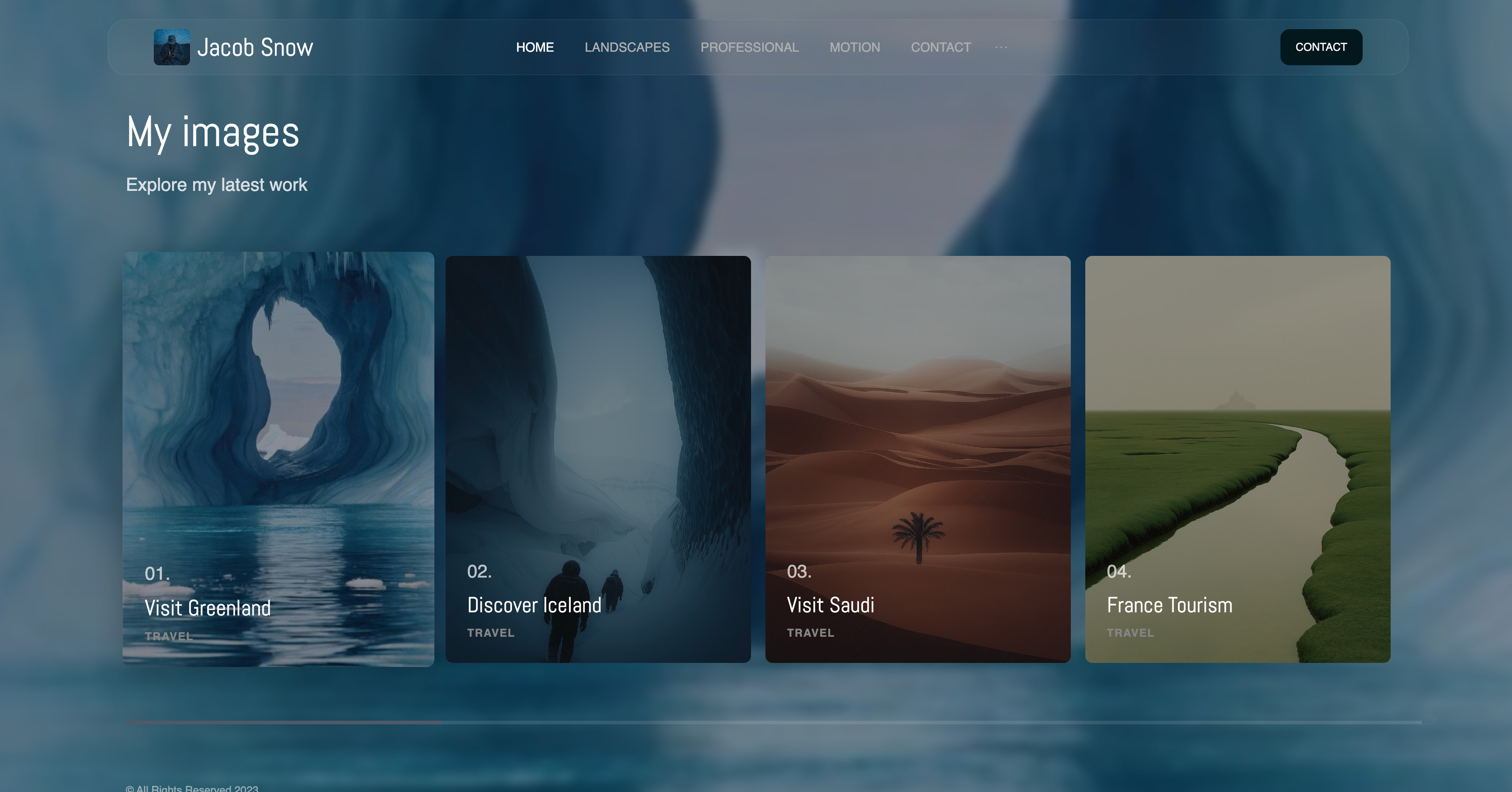 Use template
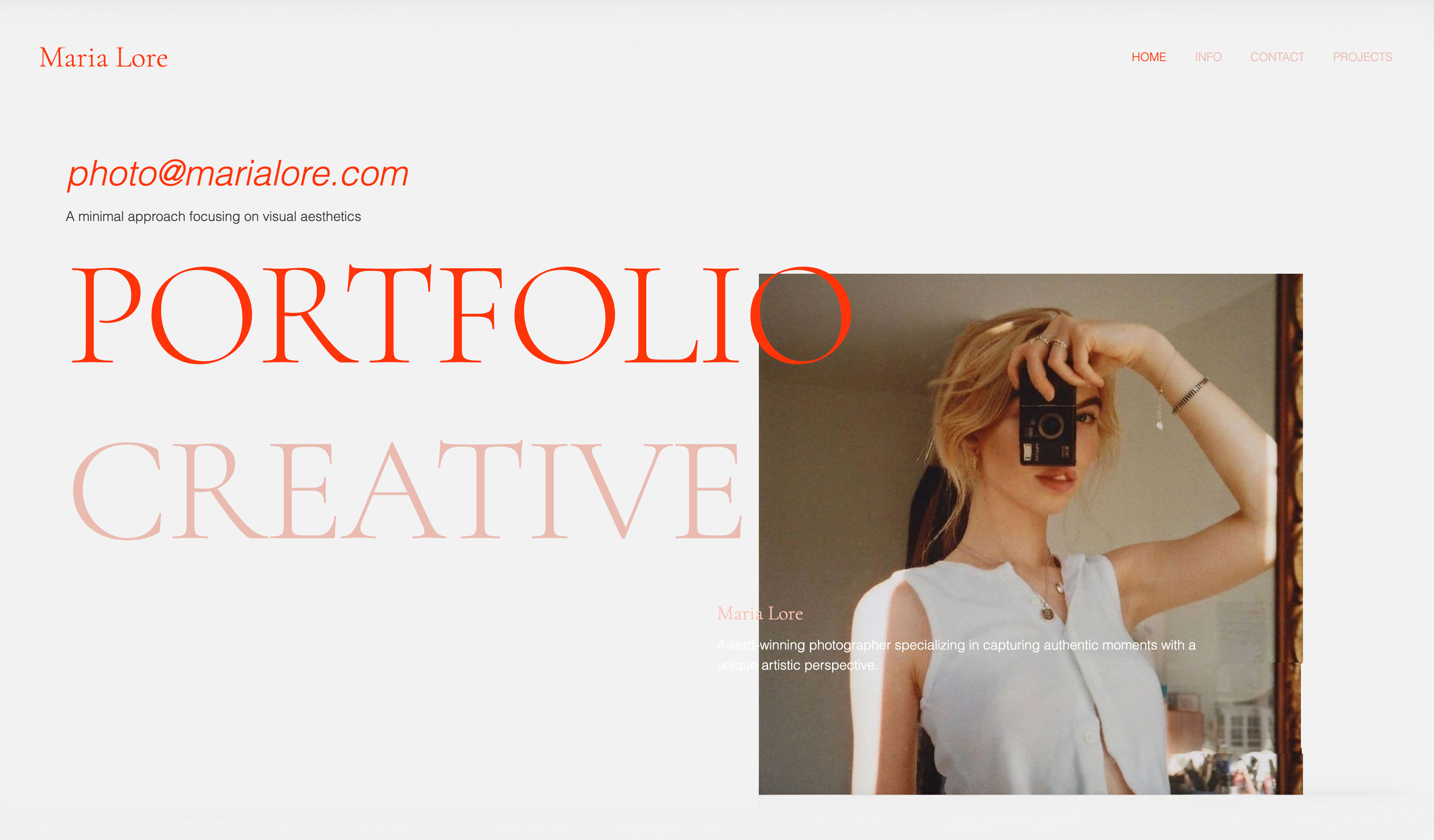 Use template
 Use template
 Use template
 Use template
 Use template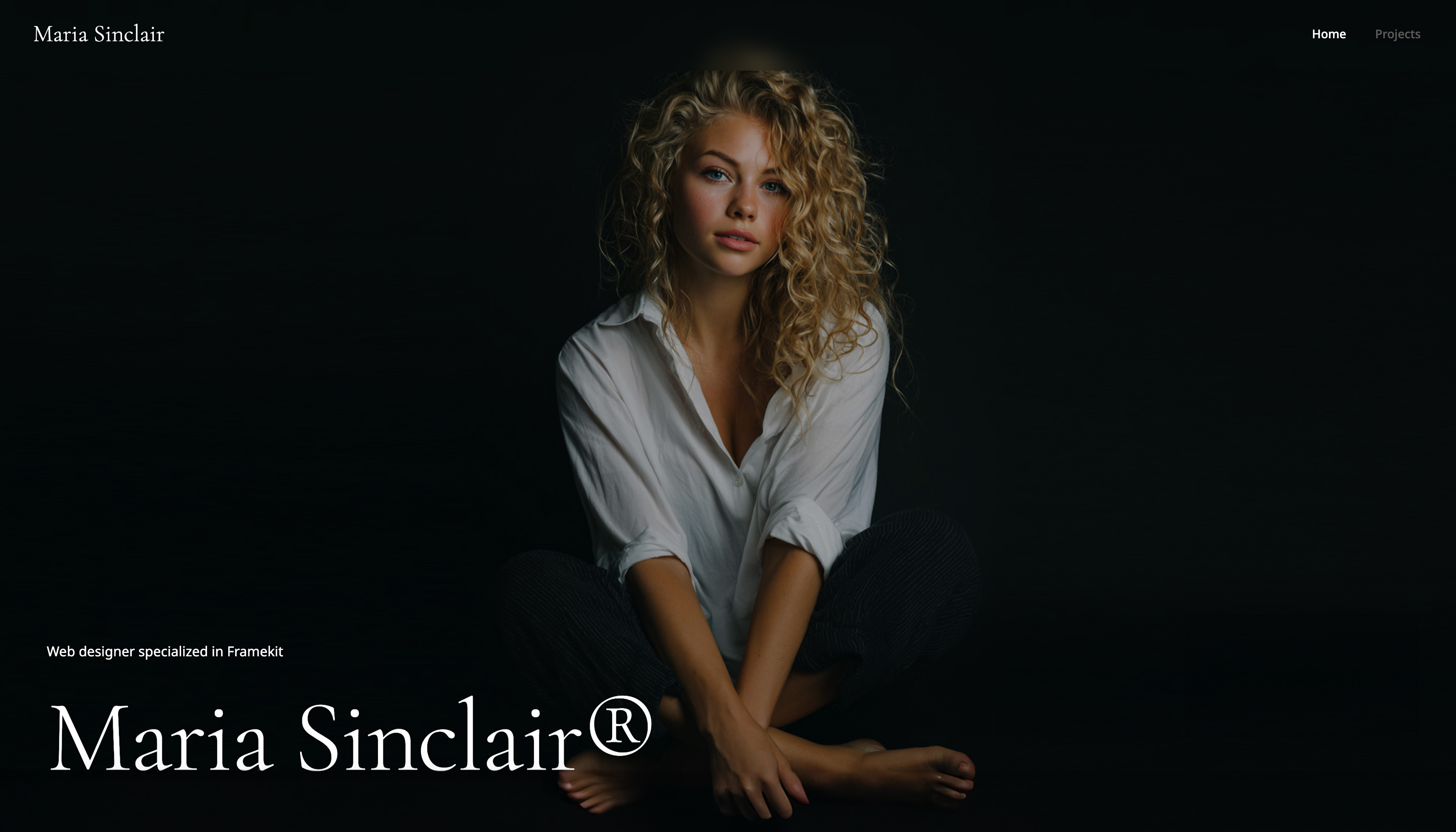
Open your bank statement and search for Adobe. If you are on the Photoshop single-app plan at $22.99 a month, you have handed over $275.88 in the last twelve months, and $1,379.40 if you have held the plan for five years.
Nothing about that number is hypothetical. It is a subscription that renews whether you opened the app twice last month or two hundred times, and it ends the day you stop paying, taking your ability to open your own layered files with it.
That last part is the one people forget until it happens.
A Photoshop alternative is any image editor that gives you layers, masks, selections, retouching and non-destructive adjustments without an Adobe Creative Cloud subscription, either free, open source, or bought once.
In 2026 the category changed shape completely: the strongest paid competitor in the field became free, Apple folded its own pro editor into a new subscription bundle, and two of the most recommended names on old comparison lists have quietly stopped shipping new versions.
The best Photoshop alternative in 2026 is Affinity, because Canva relaunched the whole suite as one free application for Mac and Windows with vector, pixel and layout work in a single document, and it opens PSDs with layers intact.
Photopea is the best free option that needs no install and runs in a browser tab, GIMP 3.2 is the strongest fully open-source desktop editor, and Pixelmator Pro at $49.99 once is the best value on a Mac.
The trade-off with Affinity is that its generative AI tools sit behind a Canva subscription, so a retoucher who lives in Generative Fill will still miss Adobe.
Re-verified in September 2026: Framekit's plans were checked again and so was the section on where retouched work is shown, because Framekit publishes the portfolio and delivers the finished frames to clients from the same account; editor prices are as read in August 2026.
How We Compared 12 Photoshop Alternatives
We took one real job through every editor on this list: a set of twenty portrait frames that needed a skin retouch, a background extension, a colour grade, a logo watermark on a separate layer, and an export to both a print-resolution TIFF and a web JPEG.
Everything was run on the same 16GB M-series Mac and the same Windows 11 laptop between 5 and 8 August 2026, on fresh accounts with no prior settings imported.
Three different kinds of finding appear below, and they are labelled so you can weigh them separately.
Anything about how an editor felt, where a tool hid, how a PSD survived a round trip, or how long an export took is something we did ourselves in the app.
Anything about a price, a licence term or a version number was read off the vendor's own page on the date given, and where a vendor blocks automated access or renders its prices only after a checkout step we say so in that tool's entry rather than repeating a number we could not confirm.
Anything about long-term reliability or support quality is drawn from what users report publicly and is flagged as reported rather than tested.
Four vendors could not be price-checked at the source.
Adobe blocks automated requests to its plan pages, so the Photoshop figures below come from published third-party pricing roundups and should be treated as indicative rather than read off Adobe's own page.
Clip Studio's own store renders every price as a placeholder "0 USD" until you reach checkout, so its perpetual figures come from its authorised reseller. Corel's PaintShop Pro pricing page returns a 404.
Pixlr publishes in euros only from a European address, so its figures below are euros and are labelled as such.
In one linetwelve editors, one twenty-frame retouching job, every price read at the source on 5 to 8 August 2026 or explicitly labelled where the vendor would not show one.
What Testing Twelve Editors Actually Showed
The single most surprising result is that the strongest Photoshop replacement in this comparison now costs nothing, and it was a paid product ten months ago.
Everything else below follows from that, because a free professional editor changes what every paid tool on the list has to justify.
These are the figures the ranking rests on, each one checked against the vendor's own page or labelled where the vendor would not show us one.
- 6 of 12 cost nothing at all, and one of those six was a paid product costing up to $169.99 as recently as October 2025.
- The five-year spread across this list runs from $0 to $1,379.40 for the same core job.
- 9 of 12 open a layered PSD. Only 4 of them gave the file back to Photoshop with adjustment layers and layer effects still editable.
- 2 of the 12 tools most often recommended in older comparison articles have not shipped a new numbered version since 2023.
- 0 of the free editors here charge for AI. Every AI feature on this list that costs money sits inside a subscription that also sells you something else.
- The cheapest one-time purchase that fully replaced Photoshop for our test job was $49.99, and it only runs on a Mac.
If you want the pick matched to your machine and your work rather than the full field, skip to the decision guide.
The Five-Year Cost of Keeping an Image Editor Open
This is the number that matters and almost no comparison publishes it.
Software is not a purchase decision made once, it is a running cost, and the only honest way to compare a subscription with a one-time licence is to pick a horizon and price both against it.
Five years is the horizon we use because it is roughly how long a working creative keeps a machine and a workflow before rebuilding both.
| Editor | How it is sold | Cost per year | Five-year cost |
|---|---|---|---|
| Affinity | Free | $0 | $0 |
| GIMP 3.2 | Free, open source | $0 | $0 |
| Krita 5.3 | Free, open source | $0 | $0 |
| Paint.NET | Free from the developer | $0 | $0 |
| Photopea | Free, ad-supported | $0 | $0 |
| Pixelmator Pro | One-time, Mac | $0 after purchase | $49.99 |
| Clip Studio Paint PRO | Perpetual licence | $0 after purchase | $63.00 |
| Photopea Premium | Subscription | $60.00 | $300.00 |
| Clip Studio Paint EX | Perpetual licence | $0 after purchase | $277.00 |
| Photoroom Pro | Subscription, annual billing | $90.00 | $450.00 |
| Picsart Pro | Subscription, annual billing | $126.00 | $630.00 |
| Apple Creator Studio | Subscription, annual billing | $129.00 | $645.00 |
| Adobe Photography plan, 1TB | Subscription | $239.88 | $1,199.40 |
| Adobe Photoshop single app | Subscription | $275.88 | $1,379.40 |
Two things fall out of that table. The first is that the gap between the top and the bottom is $1,379.40, which is a lens, a body, or three months of rent depending on where you live.
The second is subtler: the middle of the table is almost empty.
There is very little between $63 and $450, because the industry has split into free-and-open on one side and monthly-forever on the other, and the perpetual licence that used to sit in between has nearly died out.
The two products still holding that middle ground, Clip Studio and PaintShop Pro, are both showing strain, and we say exactly how in their entries.
In one linethe same twenty-frame retouching job costs between $0 and $1,379.40 over five years depending only on which icon you click.
The 12 Best Photoshop Alternatives in 2026: Full Comparison
Scores are out of 10 and weight four things: how completely the editor replaces Photoshop for professional work (35%), PSD compatibility in both directions (25%), five-year cost (25%), and how actively it is being developed (15%).
Development activity carries real weight here because two products on this list are functionally frozen, and a frozen editor is a file-format problem waiting to happen when your camera or your operating system moves.
| Editor | Platforms | Price | Opens PSD | Best for | Score |
|---|---|---|---|---|---|
| Affinity | Mac, Windows | Free | Yes, layers intact | Replacing Photoshop outright | 9.4 |
| Photopea | Browser | Free / $5 mo | Yes, best in class | Editing a PSD on any machine | 9.0 |
| GIMP 3.2 | Mac, Windows, Linux | Free | Yes, flattened effects | Open-source desktop work | 8.5 |
| Pixelmator Pro | Mac | $49.99 once | Yes | Mac users who hate subscriptions | 8.4 |
| Krita 5.3 | Mac, Windows, Linux | Free | Partial | Painting and illustration | 8.2 |
| Clip Studio Paint | Mac, Win, iPad, Android | From $63 once | Partial | Comics, manga, line art | 8.0 |
| Photoroom | Browser, iOS, Android | Free / $7.50 mo | No | Product cutouts at volume | 7.6 |
| Pixlr | Browser | Free / from 1.99 euro mo | Partial | Fast browser edits with AI | 7.3 |
| Picsart | Browser, iOS, Android | Free / $10.50 mo | No | Social and mobile-first work | 7.0 |
| Paint.NET | Windows | Free | Via plugin | Light Windows editing | 6.8 |
| PaintShop Pro | Windows | About $99 once | Yes | Windows one-time buyers | 6.2 |
| Canva | Browser, iOS, Android | Free / paid tiers | No | Non-designers making assets | 6.0 |
Affinity does not take a perfect score, and the reason is specific: its generative tools require a Canva account on a paid tier, which means the one part of Photoshop that has changed most since 2023 is the one part Affinity does not hand you for free.
If Generative Fill is load-bearing in your work, read the Affinity entry with that in mind.
1. Affinity: Best Photoshop Alternative Overall
Affinity spent a decade as the credible paid alternative, sold as three separate applications for a one-time fee.
On 30 October 2025 Canva, which had acquired Serif in March 2024, collapsed Designer, Photo and Publisher into a single application and made it free on Mac and Windows.
The suite that cost up to $169.99 now costs nothing, which is the single largest price move this category has ever seen.
What it feels like to usethe biggest adjustment is that there are no longer three apps. One document holds Vector, Pixel and Layout studios, and you switch between them with a click rather than a round trip through another program.
On our twenty-frame retouch this mattered more than expected: the watermark stayed a live vector while the skin work stayed pixel-based, in the same file, with no rasterising and no linked-file management.
Coming from Photoshop the muscle memory that breaks first is the modifier keys during selections, and it takes about two days to stop reaching for the wrong one.
The real numberan Affinity licence used to cost $69.99 per application, or $169.99 for the suite, once.
The new one costs $0, so a three-person studio that would have paid $509.97 to standardise now pays nothing, and the only recurring cost in the workflow is whatever you already pay for storage.
The detail nobody writes aboutAffinity's PSD import keeps adjustment layers and layer effects as live, editable objects rather than baking them in, which is the thing that actually decides whether you can take over someone else's file. It is not perfect.
Smart Objects containing raw files come across as flattened pixels, and any Photoshop-specific filter effect is discarded silently rather than flagged, so a file that opens cleanly can still be missing a step you did not notice.
The gotchathe generative AI tools are not part of the free application. Generative Fill, Expand and background removal live in Canva AI Studio and require a paid Canva account, reported at around $120 a year.
So the free headline is true for everything except the newest category of feature, and if you use Generative Fill to extend backgrounds daily you have swapped a $275.88 Adobe bill for a smaller Canva one rather than eliminating it.
Skip it ifyou work in a team that passes layered files back to Photoshop users every day and cannot afford a single silent conversion loss, or you are on Linux, which Affinity still does not support in any form.
What reviewers say elsewhereTechRadar's 2026 review calls the unified app three tools in one at no cost while questioning whether it fully displaces Adobe, which matches what we found.
Verdict: Affinity is now the default answer to this question and it is not close. A professional-grade editor that costs nothing, opens your existing PSDs with live adjustment layers, and runs on both major platforms did not exist eighteen months ago. Pay the Canva subscription only if generative fill is genuinely part of your billable work, and treat it as an add-on rather than the price of entry.
Already paying for the Creative Cloud photography plan and wondering what else it is buying you? Our guide to the best AI tools for designers covers where Adobe still earns the money.
2. Photopea: Best Free Photoshop Alternative in a Browser
Photopea is a full layered editor that runs inside a browser tab with nothing installed, built and maintained largely by one developer, and it is the tool we reach for when a PSD lands in an inbox on a machine that does not have an editor on it.
What it feels like to usedisorientingly familiar. The panel layout, the shortcuts and the menu structure are close enough to Photoshop that most people stop noticing they are in a browser within ten minutes.
On our test file it handled the twenty frames without complaint, though scrubbing a large history on a 60MB layered file is where you feel the browser rather than a native app.
Files open from your disk and stay on your machine unless you deliberately save to a cloud service, which is worth knowing before you open a client's work in it.
The real numberPhotopea Premium costs $5 a month, which is $300 over five years, or roughly 22% of what the same five years of Photoshop single-app costs.
The detail nobody writes aboutthe developer's own blog states plainly that upgrading to Premium gives you no extra features and that "right now, there is absolutely no difference" beyond removing ads, with beta features and extra themes described as a possible future.
A vendor telling you its paid tier adds nothing is so rare it is worth reading twice. What you are buying is an ad-free workspace and the continued existence of the project, not capability.
The gotchait is a browser tab. Close it at the wrong moment, run out of memory on a big composite, or lose connectivity mid-session and you can lose unsaved work in a way a desktop app with a crash recovery file would not.
Save early and often is not generic advice here, it is the operating requirement.
Skip it ifyou routinely work on multi-gigabyte composites, or you are in a studio with a policy against opening client assets in a browser-based tool, which is a conversation worth having before it becomes an incident.
Verdict: Photopea is the most useful free tool on this list for a specific and common situation, which is needing to open, fix and re-export a layered file right now on whatever computer you happen to be at. It is not the editor you build a retouching business on, and it is the one you will be glad exists roughly once a fortnight.
3. GIMP 3.2: Best Open-Source Desktop Editor
GIMP spent years as the punchline about free software, and the 3.x line has quietly ended that.
The current stable release is GIMP 3.2.4, dated 17 April 2026, and it brought non-destructive editing, better colour management and a single-window interface that no longer feels like an argument.
What it feels like to usecompetent and slightly foreign.
Nothing on our retouch was impossible, but several things took a route we did not expect, and the terminology differs enough that a Photoshop user will search the manual more in week one than with any other tool here.
The healing and clone tools are genuinely good. The text engine is still the weakest part of the application and the place where the free price becomes visible.
The real number$0 forever, on Mac, Windows and Linux, with no account, no telemetry prompt and no upsell screen. Across a five-person studio that is $6,897 not spent over five years against Photoshop single-app pricing.
The detail nobody writes aboutGIMP will open a PSD, but it converts adjustment layers into flattened pixel layers on import without telling you.
The file looks right on screen and is no longer editable in the way the original was, which is a far worse failure mode than refusing to open it, because you only discover it when the client asks for the curve to be pulled back.
The gotchaGIMP is 8-bit by default in more places than you expect, and while 3.x supports higher bit depths, some filters and plugins still quietly work at 8-bit. On heavy grades that shows up as banding in skies.
Skip it ifyou hand files back to Photoshop users, or you need CMYK soft proofing for print work, which GIMP still handles poorly compared with the rest of this list.
Verdict: GIMP is the right answer for anyone on Linux, anyone who wants a desktop editor with no company attached to it, and anyone whose objection to Photoshop is philosophical rather than financial. It is not the shortest path from Photoshop to productive work, and Affinity is.
4. Pixelmator Pro: Best One-Time Purchase on a Mac
Apple acquired Pixelmator and the app is now sold on Apple's own pages, which has produced the strangest pricing situation on this list: the same application is available both as a $49.99 one-time purchase and as part of a new monthly bundle.
What it feels like to usethe most Mac-native editor here by a distance.
It is fast on Apple silicon, the machine-learning tools for upscaling and denoising are one click and genuinely good, and the whole interface assumes you would rather have fewer options presented well.
Our twenty-frame batch went through faster than in any other editor on the list, largely because the ML denoise did in one pass what took three steps elsewhere.
The real numberPixelmator Pro for Mac is $49.99 as a one-time purchase, or included in Apple Creator Studio at $12.99 a month or $129 a year, with student and educator subscriptions at $2.99 a month or $29.99 a year and a 30-day free trial.
Buying it outright once costs less than five months of the bundle.
The detail nobody writes aboutthe iPad version is bundle-only. The one-time $49.99 purchase covers the Mac application, and if you want Pixelmator Pro on an iPad alongside Final Cut Pro and Logic Pro you are into the $129-a-year subscription.
That split is easy to miss and it is the difference between a $49.99 decision and a $645 five-year decision.
The gotchait is Mac only, permanently, and there is no Windows version coming. It also has fewer third-party plugin options than any other paid editor here, so if your workflow depends on a specific retouching panel you will not find it.
Skip it ifyou are on Windows, you share files with Windows collaborators daily, or you need heavy typographic layout, which is not what this app is for.
Verdict: on a Mac, with no interest in a subscription, $49.99 once is the best value in this entire comparison. The student price on the bundle at $29.99 a year is also the cheapest legitimate route to a professional editing suite that exists, if you qualify.
Weighing an Apple bundle against your other subscriptions? We priced the whole stack in what a creative business actually spends on software.
5. Krita: Best Free Editor for Painting and Illustration
Krita is a free, GPL-licensed painting application, currently at version 5.3.3 released on 29 July 2026, and it is the only tool here built by people who clearly draw for a living.
What it feels like to usethe brush engine is the point.
There are more brush parameters here than in Photoshop, stabilisers that actually work for inking, and a pop-up palette on right-click that makes a graphics tablet feel like the primary input rather than a mouse substitute.
On the photo half of our test it was the weakest of the free desktop editors, which is not a criticism so much as a category note.
The real number$0 from krita.org, with paid editions on Steam, the Microsoft Store, Epic and the Mac App Store where the money funds development after the store takes its cut. Paying is a donation with a convenient update mechanism attached, not a feature unlock.
The gotchaPSD support is partial and it is the roughest on this list. Krita will open the layers, but blend modes that do not have an exact Krita equivalent are approximated, and text layers come in as pixels.
A comic page built in Krita and sent to a Photoshop user will mostly survive. A Photoshop composite opened in Krita often will not.
Skip it ifyour work is photographic retouching, colour-critical print, or anything that ends in a CMYK handoff.
Verdict: if you paint, ink or illustrate, Krita is the best free application in the world for it and it beats Photoshop at the specific job of putting marks on a canvas. If you retouch photographs, it is the wrong tool and Affinity is on the same shelf for the same price.
6. Clip Studio Paint: Best for Comics and Line Art
Clip Studio is the industry standard for manga and comics production, and it is one of the last serious editors still selling a perpetual licence.
What it feels like to usethe vector layer implementation is the thing to try first.
A line you draw on a vector layer can be thinned, thickened or re-tapered after the fact, and the eraser can be set to delete to the nearest intersection, which removes the single most tedious step in inking.
Panel and perspective tools are built in rather than bolted on.
The real numberthe perpetual licences run about $63 for PRO and $277 for EX through Clip Studio's authorised reseller, with an optional annual Update Pass at $10.99 and $31.99 respectively. Subscriptions start from $0.99 a month with the first three months free.
The detail nobody writes aboutClip Studio's own store page renders every price as a placeholder "0 USD" rather than a figure, on both browsers we tried.
You cannot read the price of the product from the vendor's own purchase page, which is why the numbers above are sourced from the reseller and labelled accordingly.
The gotchathe perpetual licence is version-locked. It runs your version forever, but new features arrive only if you buy an Update Pass or a new version outright, so the honest five-year figure for EX with updates is $436.95 rather than $277.
Skip it ifyou are a photographer. Almost nothing in this application is aimed at you.
Verdict: for comics, storyboards and line art, Clip Studio EX is worth the money and the perpetual licence is worth choosing over the subscription. For a general Photoshop replacement it is a specialist tool in a generalist's list.
Storyboarding rather than finishing art? We compared the dedicated tools in the best storyboarding software.
7. Photoroom: Best for Product Cutouts at Volume
Photoroom is not a Photoshop replacement and does not pretend to be. It does one job, removing and replacing backgrounds, at a speed and volume no general editor matches.
What it feels like to useyou drag in a folder of product shots and get clean cutouts back. On our test set the edge quality on hair was better than a default Photoshop subject selection and worse than a careful manual mask, which is the correct trade for the work it targets.
The real numberPro is $7.50 a month billed annually, roughly $12.99 to $15 billed monthly, with Max at $20.99 and Ultra from $82.50. The API prices separately from around $0.02 per background removal and $0.10 per edit, which is the number to use if you are automating rather than clicking.
The gotchathe credit and export allowances vary by country, which the vendor states outright in its own FAQ, so the plan you read about in a US comparison may not be the plan you are sold. Check the figure in your own region before you budget against it.
Skip it ifyou need layers, masks or any kind of compositing. This is a background tool, not an editor.
Verdict: if you photograph products and your bottleneck is 200 cutouts a week, Photoroom pays for itself in the first month. If your bottleneck is anything else, it is the wrong purchase.
8. Pixlr: Best Cheap Browser Editor with AI Built In
Pixlr is the browser editor that went all-in on generative features, and it is now priced more like an AI credits service than an image editor.
What it feels like to usetwo editors in one product. Pixlr E is the layered, Photoshop-shaped one and Pixlr X is the simplified one, and moving between them is smoother than it sounds.
Generative fill and expand are right in the toolbar rather than buried, which is genuinely convenient at the cost of constant nudges toward the credit meter.
The real numberread from a European address, Plus is 2.49 euro a month or 1.99 annually, Premium is 9.99 or 7.99 annually with 1,000 monthly AI credits, and Ultra is 24.99 or 19.99 annually with up to 10,000.
Pixlr shows no USD figures to a European visitor, so these are euros and your local price may differ.
The gotchaalmost everything interesting consumes credits, and credits do not roll over. A month where you generate heavily and a month where you barely open the app cost the same.
Skip it ifyou want a stable, predictable editor. The feature set and the credit economics here have moved every few months.
Verdict: Pixlr is the best answer for someone who wants generative fill for under 10 euro a month and does not want to install anything. As a long-term primary editor it is too tied to a credit meter.
9. Picsart: Best Mobile-First Editor
Picsart is a social-first editing suite with a very large template library and an AI model roster that reads more like a video tool than a photo one.
What it feels like to usefast, template-driven and clearly built for a phone first. On desktop it feels like a mobile app that grew a window. For turning a shoot into a week of social posts it is quicker than any desktop editor here.
The real numberPro is $10.50 a month at the current promotional rate against a $15 list price, with 50 daily AI credits and 100GB of storage. Ultra is $37.50 against a $47 list, with roughly five times the usage and 300GB.
The gotchathe daily credit model means unused capacity evaporates every night rather than accumulating, which punishes exactly the burst-heavy pattern most creatives work in.
Skip it ifyou need real layer control, colour management, or print output.
Verdict: Picsart is a social content tool with photo editing attached, and it is good at that. It is not a Photoshop alternative for professional image work, and $630 over five years is a lot for a template library.
10. Paint.NET: Best Lightweight Windows Editor
Paint.NET is the answer to a question the rest of this list ignores: what if you just need to crop, resize, fix a level and paint out a distraction, on Windows, without a 3GB install.
What it feels like to useit opens instantly. That is the feature. Layers, levels, curves and a decent plugin ecosystem are there, and nothing else is, which after a week of heavyweight editors is a relief.
The real numberfree from the developer's own site, with a Microsoft Store edition at $14.99 that adds automatic updates and functions as an optional donation.
The gotchaPSD support is not built in. It comes from a third-party plugin, and that plugin's fidelity on complex files is exactly as reliable as a community plugin sounds.
Skip it ifyou are not on Windows, or you need masks and non-destructive adjustments.
Verdict: the best utility editor on Windows and a poor primary one. Install it alongside something else rather than instead of it.
11. PaintShop Pro: The One-Time Buy That Stopped Updating
PaintShop Pro appears near the top of most Photoshop-alternative lists on the strength of a genuinely good one-time-purchase proposition. That proposition is now showing its age.
What it feels like to usedated but capable. Layers, masks, adjustment layers, raw processing and a script recorder are all present, and it opens PSDs better than most of the free tools here. The interface is a decade behind everything else on this list.
The real numberroughly $79 to $99 as a one-time purchase depending on edition and promotion. We could not confirm this at the source: Corel's own PaintShop Pro pricing page returns a 404, so these figures come from resellers and third-party pricing pages and should be treated as approximate.
The gotcha, and it is the important onethe most recent numbered release is still PaintShop Pro 2023.
A product that has not shipped a new version in three years is a product to buy with a clear head, because raw camera support for bodies released after 2023 is the first thing to go stale, and a broken vendor page is not a reassuring signal.
Skip it ifyou shoot with a recent camera body and need current raw support, or you are on a Mac, which it does not support.
Verdict: a good product in an uncertain position. If Affinity did not exist and cost nothing, this would still be a reasonable Windows recommendation. Affinity does exist and costs nothing.
12. Canva: Best for People Who Are Not Trying to Be Retouchers
Canva is on this list because a large share of people searching for a Photoshop alternative do not need Photoshop. They need to crop an image, put type on it, remove a background and export it at the right size for a platform.
What it feels like to usetemplate-first and forgiving. Background removal is one click and good enough for most social work. The magic is in never having to think about a document setup.
The real numberthe free tier covers a surprising amount, and paid tiers are reported at around $120 a year for an individual.
We could not verify this at the source, because Canva returns a 403 to automated requests on its pricing page, so treat the figure as reported rather than confirmed.
That same subscription is what unlocks generative AI inside Affinity, which makes the two products one buying decision rather than two.
The gotchathere are no real layers, masks or channels. Everything is an object on a page. The moment a job needs a luminosity mask or a frequency separation you are in the wrong application, and no plan upgrade changes that.
Skip it ifyou retouch, composite, or deliver print-ready files.
Verdict: the honest recommendation for a large group of people who have been told they need Photoshop and do not. If your image work is social, presentations and simple product shots, this list stops here and you save $1,379.40.
Which Editors Survive a PSD Round Trip
In one linenine of these twelve open a PSD, but only four hand it back to Photoshop with adjustment layers and layer effects still live, and the five that quietly flatten are the dangerous ones.
Opening a PSD is not the same as preserving it. Every editor here that claims PSD support will render the file correctly on screen. The question that decides whether you can work with other people is what survives when you save it back out.
We took the same layered file, opened it in each editor, made one change, saved it as a PSD, and reopened it in Photoshop to see what was left.
| Editor | Layers | Adjustment layers | Layer effects | Text stays editable | Smart Objects |
|---|---|---|---|---|---|
| Affinity | Yes | Live | Live | Yes | Flattened |
| Photopea | Yes | Live | Live | Yes | Partial |
| Pixelmator Pro | Yes | Rasterised | Rasterised | Yes | Flattened |
| GIMP 3.2 | Yes | Flattened silently | Flattened | Yes | Flattened |
| Krita | Yes | Approximated | Approximated | Rasterised | Flattened |
| Clip Studio | Yes | Partial | Partial | Rasterised | Flattened |
| PaintShop Pro | Yes | Live | Partial | Yes | Flattened |
| Paint.NET | Plugin only | No | No | No | No |
| Photoroom, Picsart, Pixlr, Canva | No PSD workflow |
The failure mode to fear is not refusal, it is silence. GIMP flattening an adjustment layer without a warning dialog produces a file that looks identical and is no longer adjustable, and you find out at the worst possible moment.
If you are the only person who ever opens your files this does not matter at all. If you hand files to a retoucher, an agency or a printer, it decides your shortlist on its own.
The AI Tax: What Generative Fill Costs Outside Adobe
In one lineevery generative feature on this list that costs money is sold inside a subscription to something else, so leaving Adobe does not remove the AI bill, it moves it.
This is the part of the category that changed hardest since the last time most people compared these tools. In 2023 the argument was about brushes and colour management.
In 2026 a meaningful share of retouching hours go into generative fill, expand and removal, and the pricing for those features has settled into a pattern worth naming.
Nobody sells generative editing as a one-time purchase. Affinity's version requires a Canva account on a paid tier. Pixlr sells credits that expire monthly. Picsart sells credits that expire daily.
Photoroom prices per image once you go through the API. The free desktop editors, GIMP and Krita, do not offer generative fill at all, which is a real functional gap rather than a philosophical one.
So the honest framing of the saving is this: dropping the Photoshop single-app plan saves $275.88 a year.
If generative fill is load-bearing in your work, roughly $120 of that comes back as a Canva subscription, and the real saving is about $155 a year, or $775 over five years. Still a large number. Not the $1,379.40 the headline suggests.
The corollary is that the further your work sits from generative editing, the more completely free the free options are. A wedding photographer culling and grading loses nothing. A commercial retoucher extending backgrounds all day loses a workflow.
Raw Files Are the Compatibility Problem Nobody Checks
In one linean editor that stops shipping updates stops supporting new camera bodies, which is how a working editor becomes an unusable one without anything visibly breaking.
Every raw file from every camera needs the software to know that specific sensor. When a manufacturer ships a new body, every editor has to add support, and editors that are no longer being developed simply never do.
This is why development activity carries 15% of the score above rather than being treated as a nice-to-have.
Of the twelve here, GIMP, Krita, Affinity, Pixelmator Pro, Photopea, Photoroom, Picsart, Pixlr and Canva have all shipped releases in 2026. Clip Studio is on version 5.0. PaintShop Pro's most recent numbered release is 2023.
If you buy a perpetual licence, you are buying the raw support that exists on the day you buy it, and the older the last release, the shorter the useful life of that purchase.
The practical test takes two minutes: find your camera model in the editor's supported-cameras list before you pay, not after. If the list has not been updated since before your body shipped, the one-time purchase is not the bargain it appears to be.
Run This Test On Your Own Files
Do not take our word for any of the compatibility claims above.
Take your single most complicated layered file, the one with the masks and the adjustment layers and the type you spent an hour kerning, and do this: open it in whichever free editor you are considering, change one thing, save it back out as a PSD, and open that copy in Photoshop while you still have a subscription.
If everything is still live and editable, you can cancel with confidence. If your curves layer came back as flat pixels, you now know exactly what leaving costs you, in your own files, before it costs you a client relationship.
This takes fifteen minutes and it is worth more than every comparison table on this page including ours.
Where Your Finished Work Actually Lives
Every tool above is a step in the middle of your process. None of them is where the work ends up, and the place it ends up is the part that earns you money. This is the job we do, so treat this section as the disclosure it is rather than a ranking.
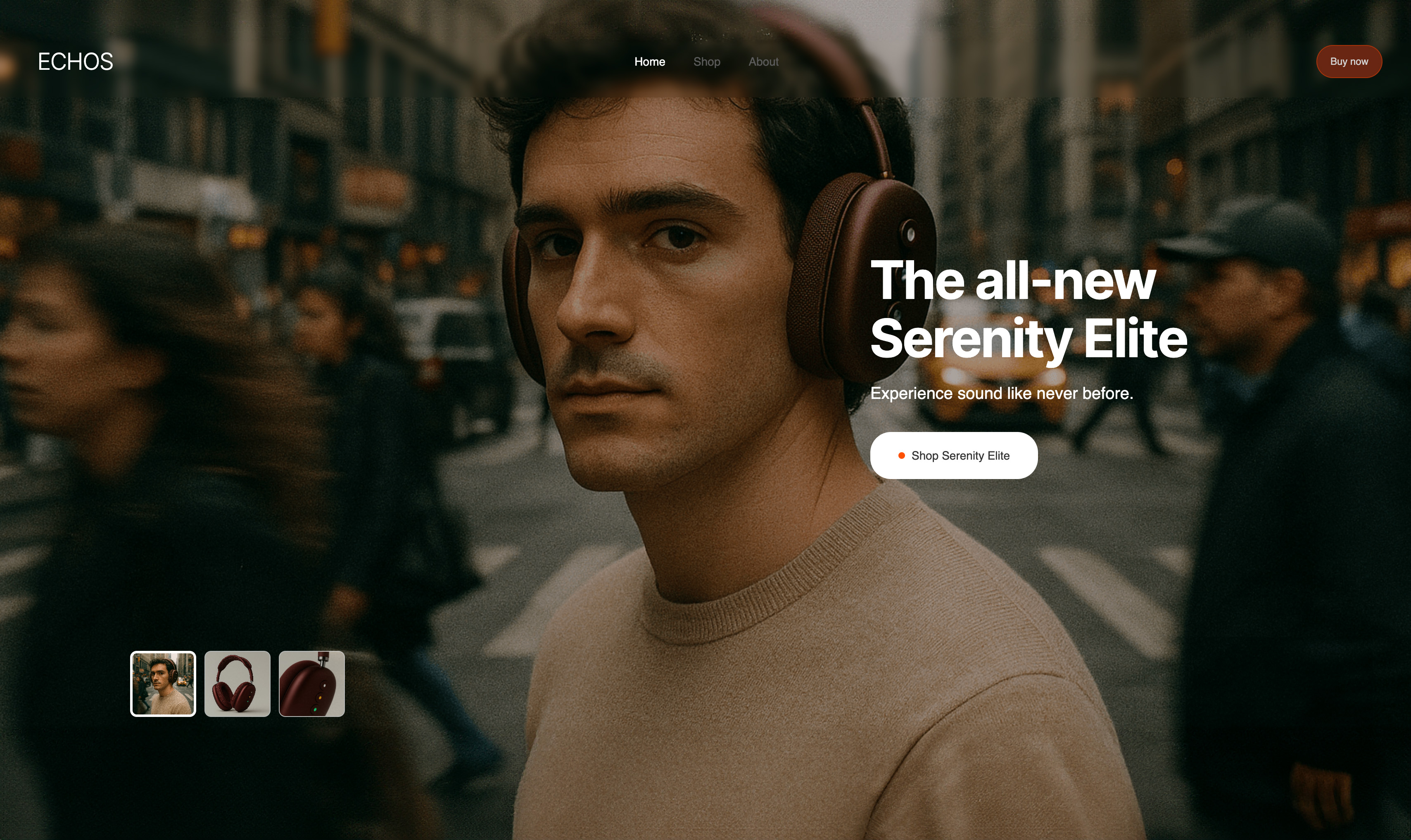
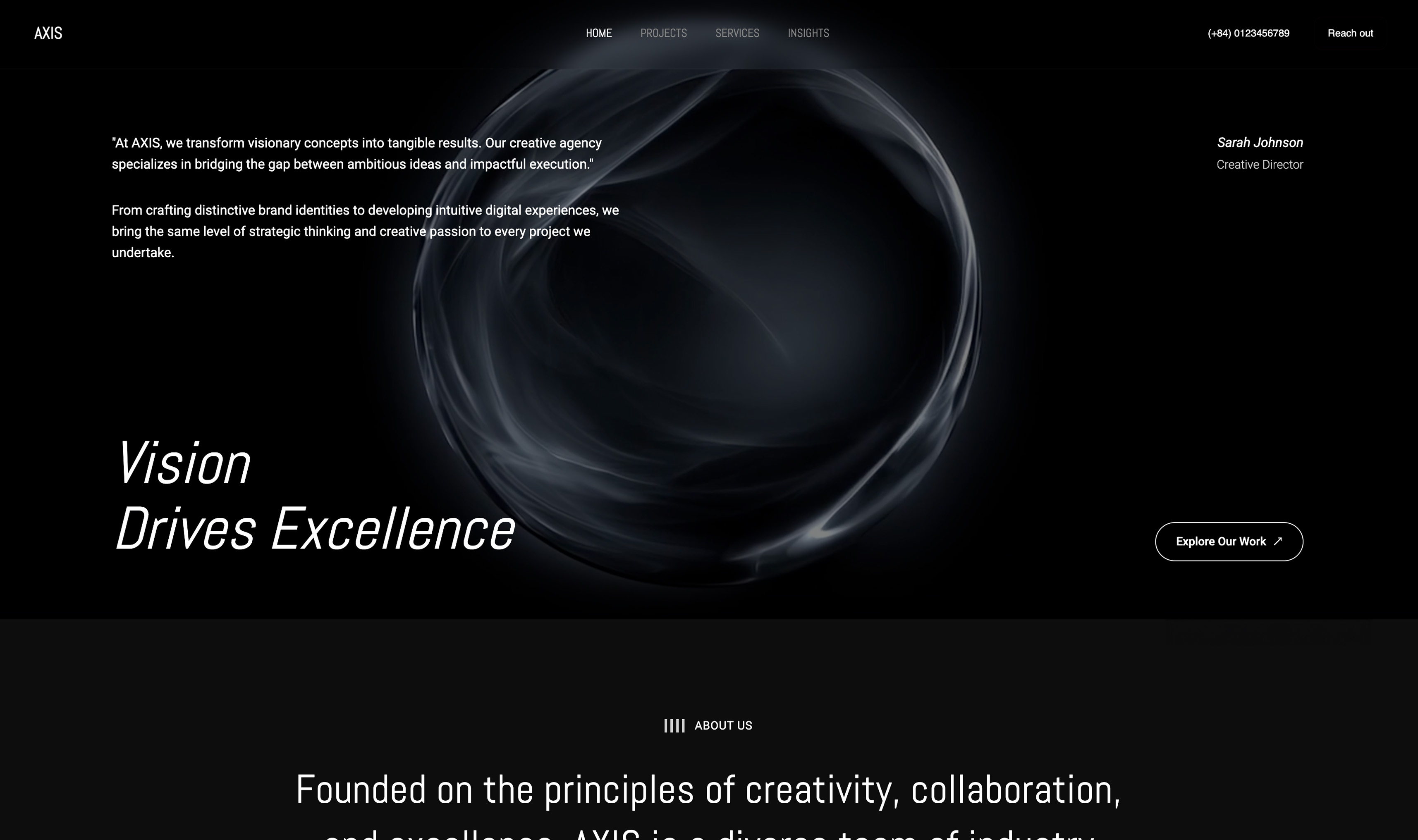
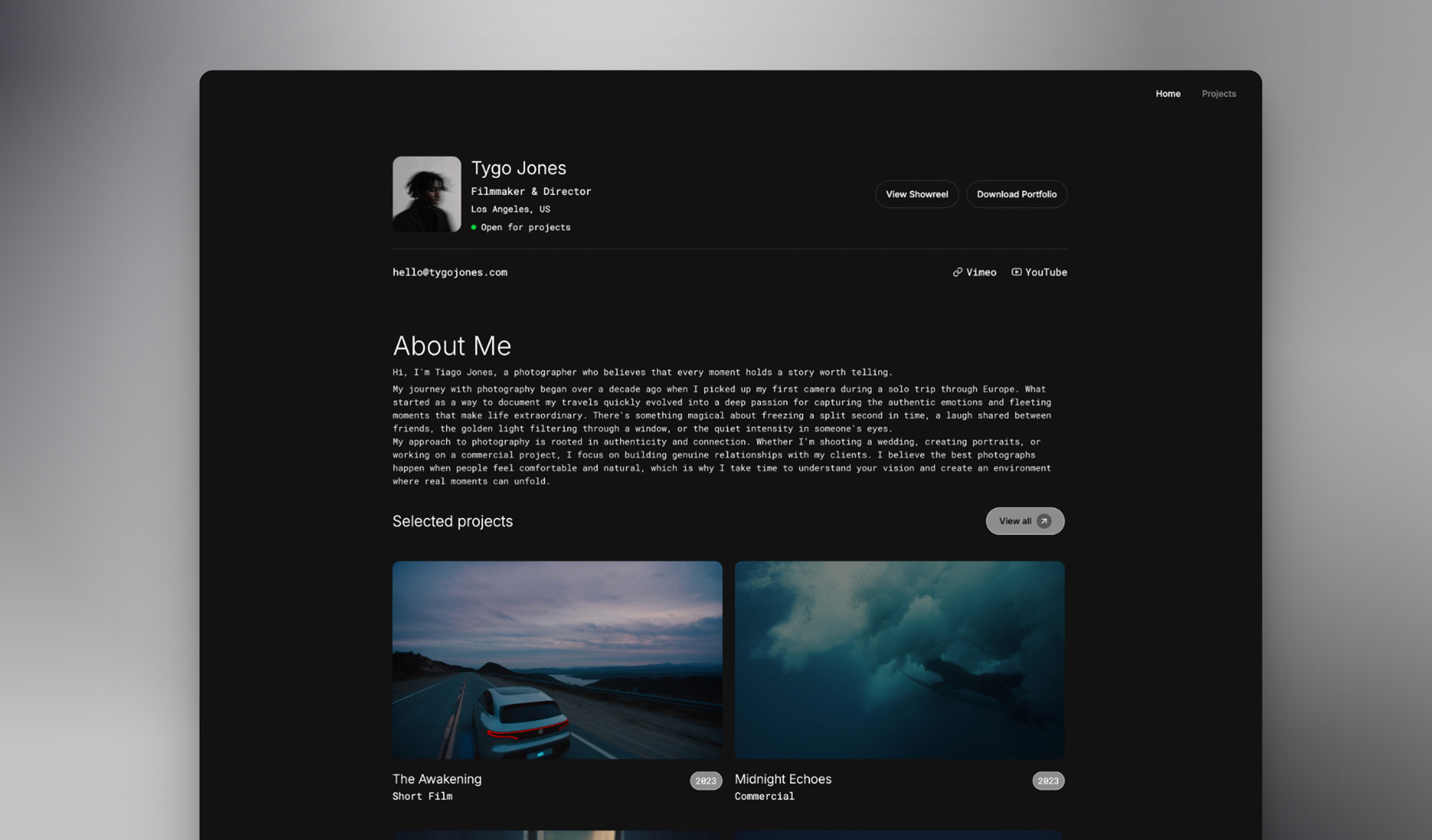
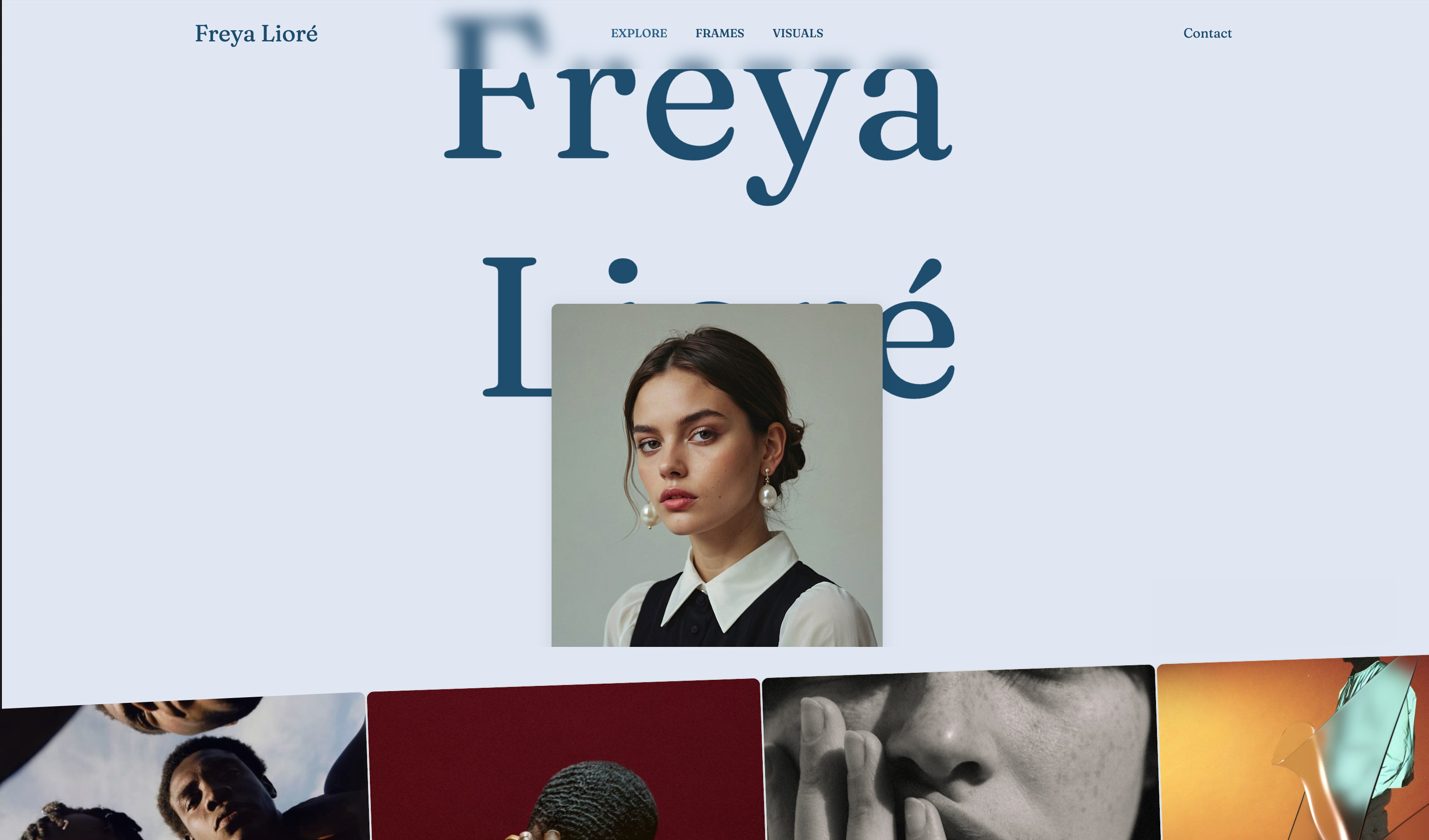
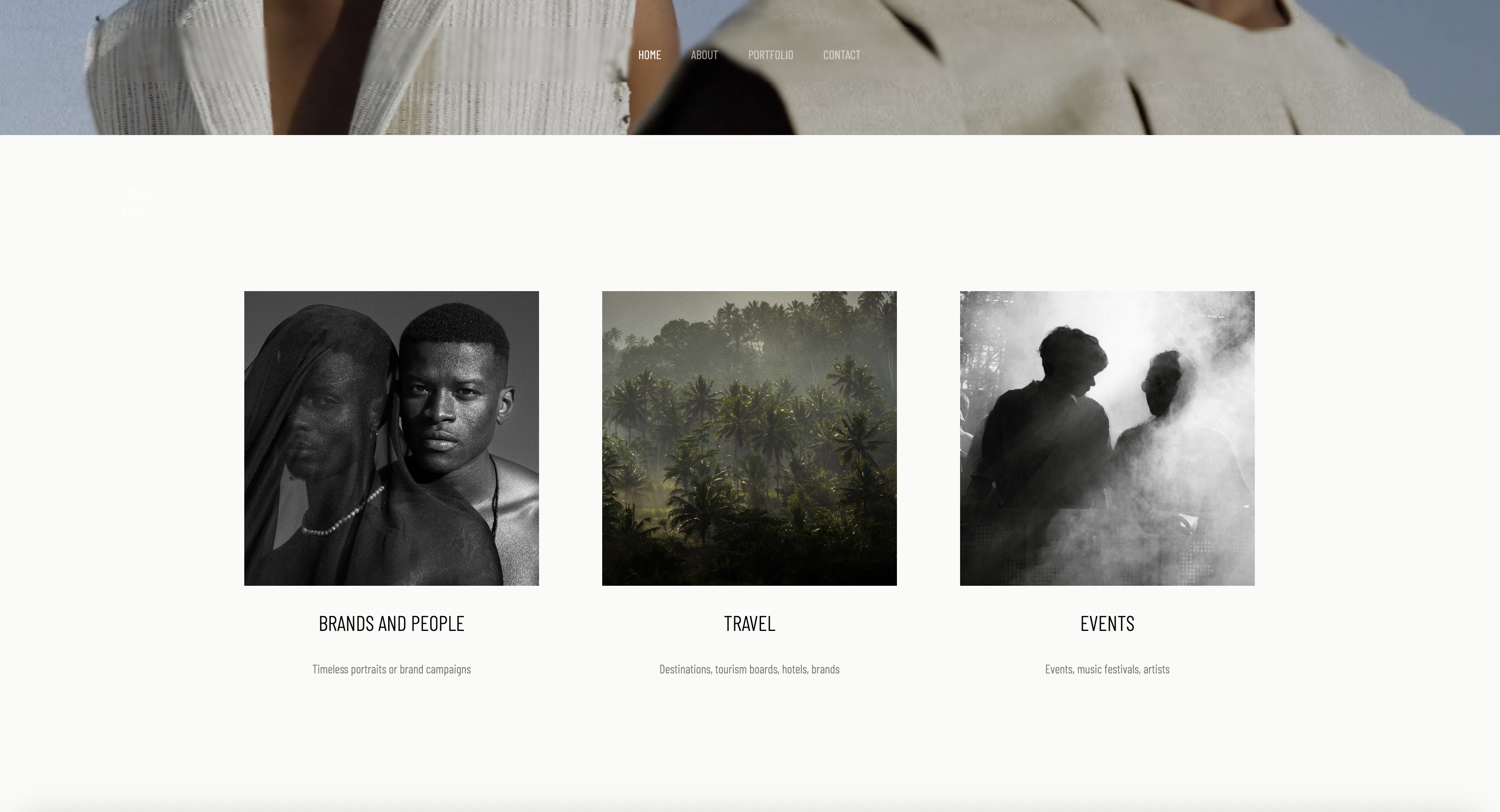
Framekit is an AI website builder for photographers, filmmakers, designers and illustrators, built to turn finished work into a portfolio site, a client gallery and a store without a separate tool for each.
When your retouched frames come out of Affinity or Pixelmator, they need somewhere to be seen: a portfolio that does not compress them into mush, galleries you can send to a client with a password, and if you sell presets, actions, brushes or LUTs, a checkout attached to the same site rather than a marketplace that takes a percentage forever.
Two honest limits. Framekit does not edit images, and nothing on this page competes with it, so if you came here for an editor this section is not your answer.
And selling through Framekit carries a transaction fee that starts at 5% on the free and Starter plans, drops to 3% on Pro at $19 a month, and reaches 0% on Business at $39 a month.
The crossover where a flat plan beats a percentage is around $780 a month in sales. Below that, the free plan and 5% is cheaper than paying for 0%.
The Decision Guide
Most people arrive at this question with a machine, a type of work, and a tolerance for subscriptions already fixed, so the right pick is usually decided before any feature comparison starts.
Work down these questions in order and stop at the first yes, because each one rules out more of the field than the one after it.
Do you need generative fill, expand or AI removal every single working day? If yes, keep Photoshop or accept a Canva subscription alongside free Affinity.
Nothing else on this list gives you that capability for free, and pretending otherwise costs you more in workarounds than the subscription costs in money.
Are you on Linux? If yes, GIMP 3.2 or Krita, depending on whether you edit photographs or paint. Affinity does not run on Linux and there is no sign it will.
Do you paint, ink or illustrate more than you retouch? If yes, Krita if the budget is zero, Clip Studio Paint if comics and line art are the actual job and the perpetual licence appeals.
Is your image work mainly social posts, presentations and simple product shots? If yes, Canva or Picsart, and stop reading comparison articles about professional retouchers. You are not the customer they are written for.
Do you photograph products and need cutouts at volume? If yes, Photoroom, alongside a real editor rather than instead of one.
Are you on a Mac, allergic to subscriptions, and want the fastest native experience? If yes, Pixelmator Pro at $49.99 once. If you also want it on an iPad, price the Apple Creator Studio bundle at $129 a year before you decide.
Do you just need to open a PSD right now on a computer that has nothing installed? If yes, Photopea, free, in a browser tab.
Everyone elseAffinity. Free, on both platforms, opens your existing files with live adjustment layers, and is the closest thing to a straight swap that has ever existed in this category.
What Adobe Still Does That Nothing Here Matches
In one linethree specific things keep Photoshop worth $275.88 a year for a particular kind of professional, and a comparison article that refuses to name them is one you should stop trusting on everything else it tells you.
The first is the plugin and panel ecosystem. Twenty years of retouching panels, frequency-separation actions, beauty-work scripts and studio-specific automations are written for Photoshop and only for Photoshop.
If your speed comes from a purchased panel, none of the twelve editors here runs it, and rebuilding that workflow costs more billable hours than the subscription costs money.
The second is generative editing inside a real layered document.
Several tools here do background removal well and a few do generative fill through a subscription, but doing it on its own layer, with a mask, inside a composite you are still building, is a workflow rather than a feature, and Adobe is ahead on it.
The third is being the format everyone else converts to. PSD is the interchange currency of commercial image work, and every editor on this page is measured by how well it survives contact with it.
If you are the person other people send files to, you are the one who absorbs the conversion losses, and that is a legitimate reason to keep paying.
None of that applies to a wedding photographer, an illustrator, a product seller or a designer doing their own work end to end, which is most people reading this.
It applies precisely to commercial retouchers and studio teams, and if you are one, the honest advice is to keep the subscription and use Affinity as a second seat rather than a replacement.
If your work is drawing rather than retouching, the shortlist is a different one entirely, and we built it in the best Procreate alternatives.
Frequently Asked Questions
What is the best Photoshop alternative in 2026?
The best Photoshop alternative in 2026 is Affinity, which Canva relaunched on 30 October 2025 as a single free application for Mac and Windows combining the former Designer, Photo and Publisher into one document with Vector, Pixel and Layout studios.
It costs nothing, opens PSD files with adjustment layers and layer effects still editable, and is the closest thing to a direct replacement in the category. Its one gap is generative AI, which requires a paid Canva account.
Is Affinity actually free, or is it a trial?
Affinity is free permanently, not a trial. Canva made the unified application free on Mac and Windows, having previously sold the three separate apps for up to $169.99 as a one-time purchase.
There is no time limit and no watermark on exports. The paid element is Canva AI Studio, reported at around $120 a year, which unlocks Generative Fill, Expand and background removal inside Affinity.
Everything that was in the paid Affinity suite before is now free.
Can I open PSD files without Photoshop?
Yes. Nine of the twelve editors in this comparison open PSD files, and Photopea does it in a browser tab with nothing installed.
The difference that matters is fidelity: Affinity, Photopea and PaintShop Pro keep adjustment layers editable, while GIMP silently converts them to flattened pixel layers and Krita approximates blend modes it does not support.
Test your own most complex file before you rely on any of them for client work.
Is GIMP good enough for professional work in 2026?
GIMP 3.2 is good enough for professional work in many workflows, and the 3.x line added non-destructive editing and better colour management that the old 2.10 criticisms no longer apply to.
The two places it still falls short professionally are text handling, which is the weakest on this list, and CMYK soft proofing for print, which it handles poorly.
For a Linux user or anyone who wants software with no company attached, it is the strongest option available.
Affinity vs Photopea: which should I choose?
Choose Affinity if you want a permanent desktop editor and Photopea if you want to open a file right now on any machine.
Affinity is a full native application with better performance on large composites, print output and a vector studio in the same document.
Photopea is a browser tab that requires no install, no account and no admin rights, which makes it the better answer on a locked-down work computer or a borrowed laptop. Many people end up using both.
Is there a free Photoshop alternative with generative fill?
No free editor on this list includes generative fill without a paid account somewhere. Affinity has the feature but routes it through Canva AI Studio, which requires a paid Canva plan.
Pixlr offers generative tools on a credit system starting from about 2 euro a month. GIMP and Krita do not offer generative fill at all.
If AI-based background extension is central to your work, the honest budget is a subscription of some kind, just a cheaper one than Adobe's.
What happens to my PSD files if I cancel Creative Cloud?
Your PSD files remain on your disk and you keep the copyright to your work, but you lose the application that opens them natively. Adobe's subscription ends access to Photoshop itself, not your files.
This is why the practical step before cancelling is to open your most complex layered files in whichever alternative you plan to use, save them back out, and confirm what survived.
Doing that while you still have both applications is the only way to find out for free.
How much does Photoshop cost per year in 2026?
Adobe Photoshop as a single app is widely reported at $22.99 a month, which is $275.88 a year and $1,379.40 over five years, while the Photography plan with 1TB of storage that includes Photoshop and both Lightroom versions is reported at $19.99 a month, or $239.88 a year.
Adobe blocks automated access to its plan pages, so these figures come from third-party pricing sources rather than a direct reading, and the old $9.99 Photography plan with 20GB is reported as withdrawn for new subscribers.
Is Pixelmator Pro worth buying outright when Apple Creator Studio exists?
Buying Pixelmator Pro outright at $49.99 is better value than the bundle unless you specifically need the iPad version or the other applications in it.
Apple Creator Studio costs $12.99 a month or $129 a year and includes Final Cut Pro, Logic Pro and Pixelmator Pro across Mac and iPad, so the one-time purchase pays for itself in under five months against the subscription.
The student and educator rate of $29.99 a year changes that calculation completely and is the cheapest legitimate professional creative suite on this page.
Which Photoshop alternative is best for raw photo editing?
For raw processing specifically, Affinity is the strongest of the free options here, with a dedicated develop workflow and 32-bit support. Pixelmator Pro's machine-learning denoise and upscale handle raw files well on Apple silicon.
The important check is not which editor is best in the abstract but whether your camera body appears in its supported list, because raw support is added per sensor and an editor that has stopped shipping releases will never add yours.
Do any of these support CMYK for print?
Affinity, PaintShop Pro and Clip Studio Paint EX handle CMYK output properly, and Affinity is the only free one of the three. GIMP's CMYK support is limited and its soft proofing is the weakest area of an otherwise capable application.
Photopea can export CMYK but its colour management is not built for a colour-critical print chain. If your work ends at a commercial printer, that requirement alone narrows this list to Affinity or a paid tool.
Is Clip Studio Paint's perpetual licence better value than the subscription?
The Clip Studio perpetual licence is better value if you keep a version for more than about three years, at roughly $63 for PRO and $277 for EX through its authorised reseller.
The catch is that a perpetual licence is version-locked: new features arrive only through an annual Update Pass at $10.99 for PRO and $31.99 for EX, so EX with five years of updates costs $436.95 rather than $277.
Subscriptions from $0.99 a month suit anyone who wants every new version without thinking about it.
Can I use free editors like GIMP and Krita for paid client work?
Yes. GIMP is released under a free software licence and Krita under the GNU GPL v3, and neither restricts commercial use of the images you create. Affinity is free to use commercially with no watermark or output restriction.
The licence question that does bite is asset licensing rather than software licensing: templates, brushes, fonts and stock images inside any of these tools carry their own terms, and those are what to read before delivering client work.
Is PaintShop Pro still being updated?
PaintShop Pro's most recent numbered release is PaintShop Pro 2023, and no 2024, 2025 or 2026 version has shipped. Corel's own pricing page for the product currently returns a 404 error.
The software still works and still opens PSDs well, but a one-time purchase of an editor that has not been updated in three years means buying the raw camera support that existed in 2023, which matters if you shoot with a recently released body.
Which Photoshop alternative works on a Chromebook?
Photopea is the best Photoshop alternative on a Chromebook because it runs entirely in a browser tab with layers, masks, adjustment layers and PSD support, and needs no installation or admin rights.
Pixlr and Canva also run in the browser and work on ChromeOS.
None of the native desktop editors on this list, including Affinity, GIMP, Krita and Pixelmator Pro, runs on ChromeOS without a Linux container, which is more work than most people want.
Final Verdict: The Best Photoshop Alternative in 2026
Affinity is the answer for most people, and the reason is unusual: a professional editor that used to cost $169.99 now costs nothing, runs on both major desktop platforms, and opens your existing PSDs with live adjustment layers.
If you are paying $22.99 a month out of habit rather than need, the test in the section above will tell you in fifteen minutes whether you can stop.
Where the alternatives lose: none of the free options here gives you generative fill without attaching a paid subscription somewhere else, and if extending backgrounds and removing objects with AI is a daily part of how you bill, Adobe is still the tool that does it best inside a proper layered editor.
That is a real reason to stay, and anyone telling you the free options have closed that gap has not used them on a deadline.
Where Framekit loses, and we should say it plainly: Framekit does not edit images and is not a Photoshop alternative.
It is where the finished work goes afterward, and if you came to this page for a retouching tool then the twelve above are your list and we are not on it.
We also do not run a print lab, and our proofing works through client favorites rather than a threaded approval round, so a studio that needs formal sign-off stages will find dedicated tools better.
The rest of the picks in one line each. Photopea for opening a layered file on any machine in the world. GIMP 3.2 for Linux and for anyone who wants no vendor at all.
Pixelmator Pro at $49.99 for the best one-time Mac purchase in this comparison. Krita for painting, Clip Studio for comics, Photoroom for cutouts, Canva for people who never needed Photoshop in the first place.
If cutouts are most of your work, price the field properly first: the best background remover tools covers a thousand-cutout bill that ranges from nothing to $270.
Related readingThe best AI tools for designers, the best photo editing software for photographers, the best Canva alternatives, creative tools you can buy once instead of renting, and the best website builders for photographers.